Generative illustration for The Art of Doing Science and Engineering: Learning to Learn













































The Art of Doing Science and Engineering: Learning to Learn
Overview unavailable.
Book Front Matter
- Identifies the book as Richard W. Hamming’s The Art of Doing Science and Engineering: Learning to Learn.
- Provides publication and copyright details for the 2005 Taylor & Francis e-Library edition, originally published by Gordon and Breach Science Publishers.
- Lists bibliographic information, ISBNs, publisher locations, and reproduction restrictions.
- Includes the table of contents, showing chapters on computing history, AI, coding and information theory, digital filters, simulation, fiber optics, mathematics, creativity, systems engineering, and research.
The Art of Scientific Style
- The author aims to teach the 'style' of thinking in science and engineering, treating it as an art form rather than a purely technical discipline.
- Instruction follows the methods of art teachers, using a loose, rambling lecture format that emphasizes suggestions and multiple approaches over rigid rules.
- The 'story' approach is utilized to demonstrate how individual preparation allows researchers to capitalize on 'luck' and achieve great results.
- Education should focus on preparing students for their own future rather than the teacher's past, despite the inherent difficulty of predicting what is to come.
- The course serves as a non-technical complement to graduate studies, focusing on the intangible qualities that distinguish great practitioners from average ones.
Teachers should prepare the student for the student’s future, not for the teacher’s past.
The Art of Thinking
- The course focuses on the 'style of thinking' rather than specific content, treating information as illustrative material for broader cognitive skills.
- The core philosophy, 'Learning to Learn,' is presented as the primary tool for students to adapt to rapid technological and professional changes.
- The author utilizes personal anecdotes, including spectacular failures, to communicate the 'art' of discovery that cannot be easily codified in words.
- Mathematics is used as a foundational tool to expose the weaknesses of current beliefs and to provide deep insights into future scientific directions.
- The text acknowledges that the future of science and engineering will be increasingly mathematical, yet general concepts remain accessible through verbal descriptions.
- The course serves as a repository for essential knowledge and perspectives that do not fit into the standard academic curriculum.
Apparently an “art”— which almost by definition cannot be put into words—is probably best communicated by approaching it from many sides and doing so repeatedly.
Style Over Technical Content
- The course prioritizes the development of a 'style of thinking' over specific technical training or content.
- Style is defined as a quality that cannot be taught through words alone, requiring examples and personal experience to grasp.
- The author challenges the scientific tradition of impersonal delivery, opting for first-person accounts to ensure the material has a lasting impact.
- Studying successes is presented as more efficient than studying failures because there are countless ways to be wrong but few ways to be right.
- The instructor acts as a coach rather than a lecturer, emphasizing that the student must perform the mental 'running' to achieve any benefit.
I am, as it were, only a coach. I cannot run the mile for you; at best I can discuss styles and criticize yours.
Style and Meta-Education
- Developing a personal style requires synthesizing the fundamentals of masters with one's own native abilities to adapt for the future.
- True leadership in a field comes from selecting and adapting traits rather than merely following or copying the past.
- Education is defined as knowing what, when, and why to do things, whereas training focuses on the technical how.
- The concept of 'meta-education' involves rising above standard learning to examine the process of education and contribution itself.
- Scientific knowledge and the population of scientists have historically doubled every 17 years, creating an exponential growth environment.
Either you will be a leader, or a follower, and my goal is for you to be a leader.
The Growth of Knowledge
- Future professionals face a dramatic decrease in expected growth rates, necessitating constant lifelong learning.
- Great scientists and engineers frequently use back-of-the-envelope calculations to test the compatibility of different data points.
- The model assumes that the growth of knowledge is directly proportional to the number of scientists currently alive.
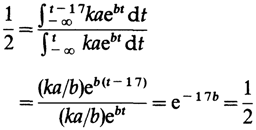
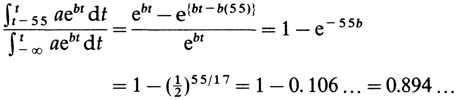
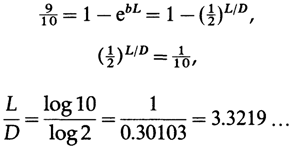
- Mathematical modeling suggests that if knowledge doubles every 17 years, it is consistent with the claim that 90% of all scientists are currently alive.
- Initial estimations use concrete numbers to gain an intuitive 'feel' before moving to more complex parametric equations.
I have frequently observed great scientists and engineers do this much more often than “the run of the mill” people, hence it requires illustration.
The Power of Back-of-the-Envelope Calculations
- Back-of-the-envelope calculations allow scientists to quickly verify the validity of quantitative claims and identify overlooked variables.
- Engaging in rapid modeling helps internalize results and maintains the mental agility required for more complex future applications.
- The rapid growth of new knowledge is compounded by the high rate of obsolescence, with technical knowledge estimated to have a 15-year half-life.
- The transition from vacuum tubes to transistors serves as a primary example of how quickly specialized expertise can become irrelevant.
- The exponential growth of information means that a child entering college may face up to eight times the amount of knowledge their parent encountered.
I found it very valuable at the physics table I used to eat with; I sometimes cleared up misconceptions at the time they were being formed, thus advancing matters significantly.
The Knowledge Explosion
- The volume of technical knowledge is doubling at an exponential rate, affecting everything from mathematics to personal lifestyle choices.
- Future generations will face a staggering mass of information, with technical knowledge expected to quadruple within a single career span.
- To avoid obsolescence, professionals must prioritize mastering fundamentals rather than trying to memorize every fleeting technical detail.
- The ability to rapidly learn and adapt to entirely new fields is a critical survival skill for engineers and scientists.
- Fundamentals can be identified by their longevity and their ability to serve as the logical foundation from which an entire field can be derived.
If you were at times awed by the mass of knowledge you faced when you went to college, or even now, think of your children’s troubles when they are there!
Science, Engineering, and Future Prediction
- Science is defined by exploring the unknown, while engineering relies on applying the known, though the two fields are increasingly merging.
- The rapid pace of progress necessitates lifelong self-teaching, as much of the knowledge required for a career is created after formal education ends.
- Predicting the future is notoriously difficult, with methods ranging from simple linear extrapolation to complex historical analysis.
- Human factors like ego, inertia, and organizational rules often influence the evolution of technology more than physical limitations.
- Long-term predictions are frequently pessimistic because people fail to grasp the power of geometric growth and compounding knowledge.
- The field of Artificial Intelligence serves as a notable exception where long-term predictions have been consistently over-optimistic.
In science if you know what you are doing you should not be doing it. In engineering if you do not know what you are doing you should not be doing it.
Vision and Future Determinism
- Historians often present the past as a series of inevitable trends while viewing the future as a realm of infinite possibility.
- There are four ways to resolve the contradiction between past determinism and future potential, including acknowledging the power of individual choice.
- Human biological evolution and social institutions are likely to constrain the future more than the rapid pace of technological advancement.
- Unforeseen inventions can disrupt even the most rigorous predictions, making foresight a difficult but necessary endeavor.
- The 'drunken sailor' analogy illustrates that having a consistent vision allows for linear progress rather than a random walk.
- The primary differentiator between high achievers and others is the possession of a vision versus merely reacting to current events.
In a lifetime of many, many independent choices, small and large, a career with a vision will get you a distance proportional to n, while no vision will get you only the distance square root of n.
The Necessity of Vision
- The primary goal of the course is to compel students to create a detailed vision of their future career, as drifting is the primary obstacle to greatness.
- A successful vision requires balancing what is scientifically possible, what is likely to happen through engineering, and what is ethically desirable.
- The author advocates for 'Friday afternoon' thinking, dedicating 10% of one's time to imagining future scientific and social shifts.
- Standard education fragments knowledge into departments, but professional success requires recognizing the homogeneity and unity of all information.
- Computers will dominate the future of technical life due to their inherent advantages in speed, reliability, and freedom from human boredom.
No vision, not much of a future.
Excellence and Digital Foundations
- Machines offer distinct management advantages over humans in hostile environments because they lack personal needs, egos, and social complications.
- The author argues that a life dedicated to achieving excellence and making significant contributions is more rewarding than one of mere comfort.
- True fulfillment is found in the struggle toward a goal rather than the achievement itself, echoing the Socratic ideal of the examined life.
- The technological landscape is completing a total shift from continuous (analog) signaling to discrete (digital) pulse-based systems.
- Digital signaling is superior to analog because it prevents the compounding of errors and noise during the amplification process.
It has often been observed the true gain is in the struggle and not in the achievement—a life without a struggle on your part to make yourself excellent is hardly a life worth living.
The Digital Information Revolution
- Digital signaling uses repeaters rather than amplifiers to automatically remove noise, allowing for high-fidelity transmission without requiring exquisite hardware accuracy.
- The transition from analog to digital computation enables deeper and more accurate processing, though analog systems remain useful for simple, low-accuracy tasks.
- Integrated circuits revolutionized computing by eliminating problematic soldered joints and increasing speed through high component density.
- Interconnection costs scale dramatically by orders of magnitude, from fractions of a cent on-chip to dollars between frames.
- Society is shifting from a material-based economy to an information-service economy, with a projected 75% of the workforce handling information by 2020.
- Information differs from material goods because it is organized rather than consumed, despite being stored in physical forms like books or films.
Noise introduced at one spot, if not too much to make the pulse detection wrong at the next repeater, is automatically removed.
The Evolution of Mechanization
- Robotic control will likely evolve beyond standard von Neumann computing to include neural networks and fuzzy logic.
- Robots in manufacturing prioritize tighter quality control, lower costs, and the creation of fundamentally different products.
- Successful mechanization requires an imaginative redesign of the product rather than a literal imitation of hand-crafted versions.
- Large-scale organizational success depends on a flexible 'give-and-take' approach to process transformation.
- Field maintenance must be integrated into the initial design phase of complex systems to prevent it from dominating long-term costs.
It has rarely proved practical to produce exactly the same product by machines as we produced by hand.
The Rise of Simulation
- The author's experience at Los Alamos proved that large-scale computing is essential when physical experiments are impossible or dangerous.
- A massive shift has occurred from performing 90% of experiments in physical labs to performing over 90% via computer simulation.
- Simulations offer greater flexibility and lower costs, allowing researchers to test scenarios that cannot be replicated in a physical environment.
- There is a growing risk of returning to 'Middle Age scholasticism' by trusting computer models more than the actual behavior of Nature.
- Computers enable the engineering of unstable systems, such as high-speed aircraft, by providing stabilization speeds beyond human capability.
- Modern engineering has shifted from the limitation of 'what can we do' to the ethical and creative choice of 'what do we want to do.'
We are now looking more and more in books and less and less at Nature! There is clearly a risk we will go too far occasionally—and I expect this will happen frequently in the future.
The Curse of Micromanagement
- Top management frequently fails to resist the urge to micromanage, even when publicly claiming to decentralize.
- Micromanagement prevents lower-level managers from gaining the decision-making experience necessary for future leadership roles.
- Centralized planning often fails because it lacks the 'local view' and specific details known only to those on the front lines.
- The 'Not Invented Here' (NIH) syndrome flourishes in centrally controlled systems, stifling grassroots innovation.
- A counter-trend is emerging where small, independent organizations form loose associations to maintain autonomy and efficiency.
- Computers have historically enabled micromanagement, but they are now also transforming entertainment and personal life in ways yet to be fully realized.
The people at the bottom do not have the larger, global view, but at the top they do not have the local view of all the details, many of which can often be very important, so either extreme gets poor results.
Evolution of the Computer Revolution
- Computers have rapidly transitioned from simple number crunching to complex symbol manipulation, decision-making, and operational control.
- Modern warfare, exemplified by the Gulf War, has shifted into a domain where information dominance is the primary factor for success.
- The increasing role of machines in decision-making suggests that traditional human roles in business and the military are becoming obsolete.
- Future leaders must critically re-evaluate past doctrines and 'rethink everything' to adapt to a world saturated by artificial intelligence.
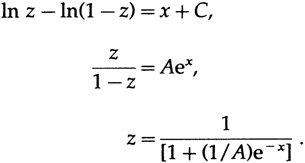
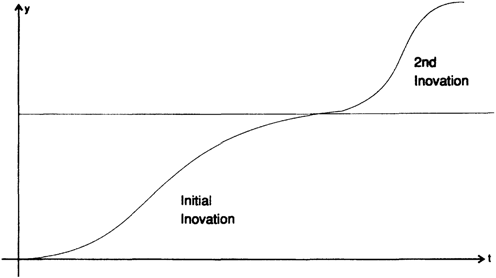
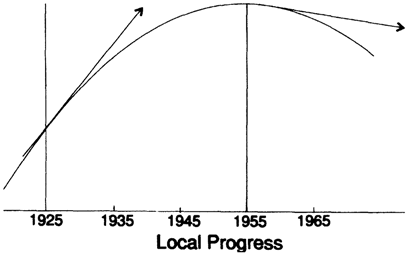
- Technological and field growth typically follows an 'S' shaped curve, starting slowly before rising rapidly and eventually hitting natural limits.
- Mathematical modeling of growth requires accounting for finite limits, as unlimited exponential growth is physically impossible in a finite universe.
I believe computers will be almost everywhere since I once saw a sign which read, “The battle field is no place for the human being”.
S-Curves and Computing Limits
- The growth of systems often follows an 'S' curve, where initial conditions determine the starting point but the fundamental shape remains constant.
- Physical constraints, such as the speed of light and heat dissipation, suggest that single-processor computer performance is approaching a saturation point.
- The shift toward highly parallel processing indicates that the industry is feeling the upper limits of the current technological growth curve.
- New innovations can trigger a transition to a new 'S' curve, effectively launching a new cycle of growth from the saturation level of the previous one.
- Future electrical engineering will shift from fundamental circuit design to the strategic selection and programming of off-the-shelf integrated chips.
- Using general-purpose chips is often superior to custom designs because the broader user base helps identify errors and reduces individual design costs.
Often a new innovation will set the growth of a field onto a new “S” curve which takes off from around the saturation level of the old one.
General Chips and Ancient Computing
- General purpose chips benefit from a community of users who contribute to documentation and continuous upgrades.
- The rapid pace of technological progress means systems often become obsolete before they are fully operational.
- Relying on special purpose chips can trap a designer in an outdated architecture, whereas general chips allow for flexible software updates.
- The history of computing traces back to primitive tools like pebbles and bone markings used for tracking lunar phases.
- Ancient structures like Stonehenge demonstrate that early civilizations possessed significant astronomical and computational sophistication.
You will hardly get a system installed and working before there are significant improvements which you can adapt by mere program changes.
Evolution of Computing Tools
- Ancient civilizations like China, India, and Mexico developed sophisticated astronomical observatories long before modern technology.
- The transition from Roman numerals to Arabic numerals in the 1400s was a pivotal shift for pure computing despite initial legal resistance.
- The invention of logarithms and the slide rule marked a major advancement in analog computing, becoming the standard badge of the engineering profession.
- The development of the differential analyzer and electronic analog computers during WWII allowed for complex military calculations like missile trajectories.
- Early digital computing evolved from 'Napier’s bones' to mechanical desk calculators, including a lost machine designed for Kepler in 1623.
- The history of computing is split between the analog path of physical lengths and voltages and the digital path of discrete numbers.
Slide rules in the 1930s and 1940s were standard equipment of the engineer, usually carried in a leather case fastened to the belt as a badge of one’s group on the campus.
Evolution of Mechanical Computing
- Early computing history traces from Pascal's tax-assessing adder to Leibniz's unreliable machines for multiplication and division.
- Charles Babbage designed the difference engine for error-free table printing and the analytical engine, which prefigured modern computer architecture.
- The transition to practical desk calculators like the Comptometer and Friden led to the formation of human computing groups in major laboratories.
- Herman Hollerith revolutionized data processing by introducing punched cards to solve the logistical crisis of the 1890 US Census.
- Mechanical IBM 601 punches were eventually utilized at Los Alamos to perform the complex calculations required for the first atomic bombs.
Babbage insisted the printing be done by the machine to prevent any human errors creeping in.
The Dawn of Electronic Computing
- Early relay computers by Stibitz, Zuse, and Aitken introduced concepts like remote terminals, time-sharing, and multiprocessing.
- The ENIAC, delivered in 1946, marked the start of the electronic age despite its massive size and cumbersome plug-board wiring.
- Mauchly and Eckert's 1946 course on computer design catalyzed the creation of various machines, including the EDSAC and the Maniac series.
- John von Neumann is often credited with the concept of internal programming due to his report on the EDVAC project.
- Early experts drastically underestimated the market for computers, believing 18 machines would saturate the entire demand.
- The failure to predict the computer revolution stemmed from an inability to imagine entirely new applications beyond current tasks.
I well recall a group of us, after a session on the IBM 701 at a meeting where they talked about the proposed 18 machines, all believed this would saturate the market for many years!
The Scale of Computing Speed
- The author contrasts the exponential growth of computer speeds from the 701 model to 1990s machines, predicting another hundredfold increase.
- To humanize these speeds, the author notes that a modern machine performs more operations in three seconds than there are seconds in a human lifetime.
- Physical constraints like the speed of light dictate that high-speed components must be placed extremely close together to avoid signal lag.
- At the femtosecond scale, light only travels across approximately 300 atoms, necessitating microscopic hardware architecture.
- Heat dissipation remains a critical barrier, as increasing component density and state-change frequency threaten to melt the hardware.
- The transition to lower voltages is a necessary strategy to compensate for the thermal energy generated by dense, high-speed circuits.
Thus in 3 seconds a machine doing 109 floating point operations per second (flops) will do more operations than there are seconds in your whole lifetime, and almost certainly get them all correct!
The Saturation of Single Processors
- Engineers are exploring diamond and other crystal structures to manage heat conduction as integrated circuits reach physical limits.
- Computer architecture is shifting toward parallel processing, pipelines, and cache memories to bypass the speed limitations of single arithmetic units.
- The growth of single-processor computer speed follows an 'S' curve, moving from rapid linear growth toward an inevitable saturation point.
- A lack of a standard parallel architecture leads to fragmented efforts and competing designs with varying strategies for speed.
- The author reflects on the exponential growth of computing demand at Bell Labs, which doubled every 15 to 20 months for years.
- A shift in perspective suggests that the true value of computing lies in generating insight rather than merely increasing the volume of numerical operations.
The purpose of computing is insight, not numbers.
The Machine View
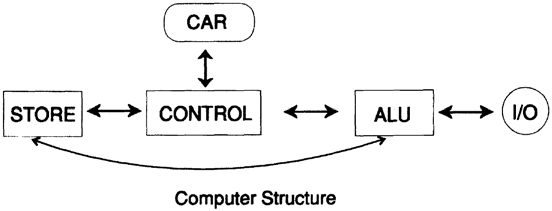
- Computers are fundamentally constructed from binary devices, including two-state storage units and gates that either block or pass signals.
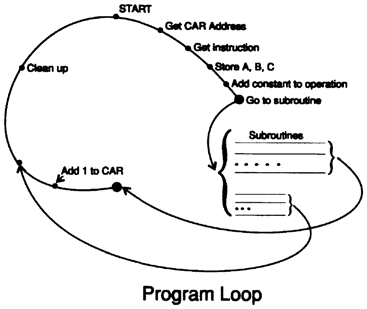
- The basic machine cycle consists of fetching an instruction from a specific address, decoding it, executing it, and incrementing the address register.
- At the hardware level, a computer possesses no global knowledge or inherent meaning; it simply reacts to bits according to other bits.
- The author draws a parallel between the mindless operation of computer gates and the Democritean view of humans as merely atoms and void.
- Adopting a strictly mechanical view of the computer is essential for debugging, as it requires assuming the machine has no free will or self-awareness.
We see the machine does not know where it has been, nor where it is going to go; it has at best only a myopic view of simply repeating the same cycle endlessly.
Evolution of Computer Software
- The text transitions from discussing hardware history to the foundational developments in software.
- It emphasizes that understanding software requires a baseline knowledge of the hardware it runs on.
- The section serves as a structural bridge between physical machine components and logical instructions.
- It highlights the historical progression of programming and operating systems.
- The narrative focuses on how software evolved to manage increasingly complex hardware architectures.
History of Computers—Software
Evolution of Computer Control
- Early computing relied on manual control and physical plug boards to direct data flow and operations.
- The transition to relay machines introduced punched paper tapes, which were physically difficult to manage and prone to mechanical errors.
- Internal programming emerged as storage became available, though its true origin is debated between von Neumann and the Mauchly-Eckert team.
- Early programmers faced the immense complexity of 'minimum latency coding,' manually calculating data placement to sync with rotating storage hardware.
- The development of the SOAP program marked a milestone in self-optimization, where a program could be used to improve its own efficiency.
- Initial coding was performed in absolute binary, requiring programmers to write every instruction and memory address in raw machine code.
Paper tapes are a curse when doing one-shot problems —they are messy, and gluing them to make corrections, as well as loops, is troublesome (because, among other things, the glue tends to get into the reading fingers of the machine!).
The Rise of Symbolic Programming
- Early programmers used octal and hexadecimal systems to manage binary code, requiring them to memorize complex addition and multiplication tables.
- Correcting errors in absolute binary code led to a 'can of spaghetti' structure because inserting instructions required manually updating every address in the program.
- The development of relocatable programs and mathematical libraries allowed for the first instances of reusable software, moving away from fixed storage locations.
- The introduction of symbolic names (like ADD) and symbolic addresses was initially met with fierce resistance from 'heroic' programmers who viewed it as a waste of machine capacity.
- Despite the clear efficiency of Symbolic Assembly Programs (SAP), many veteran programmers dismissed them as 'sissy stuff' and preferred the labor-intensive absolute method.
- The transition to modern programming was delayed for years by a culture that valued manual control over the logical benefits of automation and abstraction.
As a result the control path of the program through storage soon took on the appearance of a can of spaghetti.
The Resistance to FORTRAN
- Early programmers resisted symbolic mapping and FORTRAN, preferring to work in absolute binary addresses despite the inefficiency.
- Professional groups, including programmers, doctors, and lawyers, often fail to apply their own expertise to their own work habits.
- Using FORTRAN allowed the author's team to produce ten times more output than peers who viewed high-level languages as being 'for sissies.'
- The evolution of software is characterized by a transition from absolute to virtual machines, buffering the user from hardware complexities.
- The success of FORTRAN was largely due to its psychological appeal, as it translated familiar mathematical formulas rather than requiring new ways of thinking.
- The development of monitor systems was necessary to stop the massive waste of expensive machine and human time during operation.
Third, even if it did work, no respectable programmer would use it—it was only for sissies!
Logic vs Psychology in Programming
- The failure of Algol demonstrates that logically perfect languages often fail because they are not 'humane' or psychologically intuitive for human users.
- Problem Oriented Languages (POLs) failed to gain dominance due to high learning costs and the inability to handle cross-disciplinary problems.
- LISP emerged almost by accident when a student realized the theoretical elements could be used to write a self-compiling system.
- The author argues that the creators of new fields, including von Neumann and Einstein, rarely understand the full implications of their inventions as well as their followers do.
- Early computing pioneers often failed to grasp the generality of tools like interpreters or the fact that computers are symbol manipulators rather than just number crunchers.
It has been said in physics no creator of any significant thing ever understood what he had done.
The Inventor's Limited Vision
- Creators often struggle to see the full potential of their inventions because they are blinded by the difficulties of the development process.
- The author outlines four foundational rules for language design: ease of learning, use, debugging, and subroutine integration.
- Effective programming requires a hybrid approach, alternating between top-down philosophical design and bottom-up efficiency checks.
- The IBM 650 was transformed from a two-address fixed-point machine into a three-address floating-point system for the user.
- Historical perspective suggests that even revolutionary figures like Newton are often more tied to the past than the future they help create.
Please remember, the inventor often has a very limited view of what he invented, and some others (you?) can see much more.
The Birth of Synthetic Languages
- The author details the creation of a four-step loop on an IBM 650 to interpret a custom three-address language.
- By mapping subroutines to specific instruction numbers, the programmer defines the meaning and behavior of the synthetic language.
- This process demonstrates the practical application of Turing's Universal Turing Machine, allowing one machine to simulate any other.
- The system utilized a memory-partitioning strategy to provide 'designed-in security,' preventing user programs from overwriting the software system.
- The author critiques the tendency of programmers to design 'logical' languages like APL that are powerful but psychologically unfit for human use.
It goes on top of the machine’s language, making the machine into any other machine you want.
Redundancy and Human Error
- The APL programming language lacks redundancy, meaning a single character change can fundamentally alter a program's logic.
- Human communication relies on high redundancy levels, approximately 60% for speech and 40% for writing, to ensure clarity.
- Written and spoken languages differ significantly in structure, making it notoriously difficult to write authentic-sounding dialogue.
- Low redundancy in systems leads to undetected errors because humans are inherently unreliable processors of information.
- Spoken language requires higher redundancy to overcome acoustic noise and the inability of the listener to pause or back-scan.
- English orthography and phonetics demonstrate how written language provides more visual cues for disambiguation than spoken sounds.
Almost no one can write dialog so that it sounds right, and when it sounds right it is still not the spoken language.
The Engineering Efficiency of Language
- Programming languages should be judged by how well they fit the human animal rather than the convenience of computer experts.
- The ideal future of computing involves the domain expert writing code directly, eliminating the 'human interface' of a separate programmer.
- The ADA language is criticized as a 'hacking job' that lacks psychological design, leading developers to write in FORTRAN and convert to ADA only for compliance.
- There is a profound lack of research into the 'engineering efficiency' of languages, including optimal redundancy and structural density for human-machine communication.
- Software problems will persist until we understand how natural languages evolved to suit human communication and apply those lessons to artificial languages.
- The failure of the Japanese 'fifth generation' project highlights the difficulty of using AI to bridge the gap between machines and human problem solvers.
What I wanted to know was how the job of communication can be efficiently accomplished when we have the power to design the language, and when only one end of the language is humans, with all their faults, and the other is a machine with high reliability to do what it is told to do, but nothing else.
Programming as Novel Writing
- The 'software problem' persists because we lack a fundamental understanding of how language communicates meaning between humans and machines.
- Programming is currently more akin to creative novel writing than classical engineering, as different programmers produce vastly different solutions to the same problem.
- While utility programs may eventually be engineered, general software development remains a highly creative process resistant to rigid engineering controls.
- The most effective but often ignored method for improving software productivity is simply thinking deeply about the entire problem and its maintenance before writing code.
- Rigorous programming models often fail because the programming process itself is frequently how the actual problem is discovered and defined.
- Higher-level languages and modern tools have significantly improved productivity, with estimates suggesting a 90-fold increase over 30 years.
But you do not expect novelists to “engineer the production of novels”. The question arises, “Is programming closer to novel writing than it is to classical engineering?” I suggest yes!
The Human Bottleneck in Software
- Programmer productivity has improved by only 16% annually over 30 years, a rate dwarfed by the exponential speed-up of computer hardware.
- The vast disparity in individual talent suggests it is more efficient to pay low-performing programmers to stay home than to let them interfere with elite talent.
- Neural networks offer a potential solution to the 'programming problem' by learning from feedback rather than requiring explicit, detailed instructions.
- Software development is compared to literary writing, suggesting that clear thinking is a fundamental trait that may not be easily taught in a classroom.
- Experience does not necessarily improve a programmer's skill; like bureaucratic writing, long-term habits may actually degrade the quality of their work.
In practice you may actually be better off to pay the worst to stay home and not get in the way of the more capable (and I am serious)!
The Duty of Communication
- The author argues that scientific discovery is incomplete without successful communication in multiple formats.
- A scientist's duty encompasses writing papers, delivering prepared public talks, and mastering impromptu speaking.
- The author recounts overcoming a paralyzing fear of public speaking that threatened his professional growth in the 1950s.
- The text emphasizes that technical material is often best conveyed through the structure of personal anecdotes.
- The author asserts that his pessimistic predictions are backed by years of programming evidence rather than wishful thinking.
On thinking this over very seriously, I came to the conclusion I could not afford to be crippled that way and still become a great scientist.
Mastering the Art of Speaking
- The author identifies public speaking as a critical career skill and commits to overcoming stage fright through deliberate practice.
- To maximize practice opportunities, the author designed a talk specifically tailored to what the audience wanted to hear rather than personal preference.
- A distinction is made between scientific communication and mere entertainment, emphasizing that truth must be the priority even when engaging an audience.
- The chosen topic, 'The History of Computing to the Year 2000,' forced the author to stay intellectually current and anticipate future trends.
- The author argues that a degree of stage fright is beneficial because excitement is contagious and prevents the audience from falling asleep.
- Beyond giving talks, the author began studying the delivery styles of others to identify what makes a presentation effective or ineffective.
Your excitement tends to be communicated to the audience, and if you seem to be perfectly relaxed then the audience also relaxes and may fall asleep!
The Evolution of Computing Economics
- The author transitioned from focusing on hardware and software to realizing that economics and applications are the primary drivers of computer evolution.
- Early computing was dominated by 'number crunching' because only those requiring hard numerical data could justify the high costs of the era.
- Historically, the most difficult problems were solved on the most primitive equipment to prove the technology's viability before it was applied to routine tasks.
- Innovation faces a natural barrier of resistance, requiring proof of success in 'heroic tasks' before being accepted for more useful, everyday applications.
- The author shifted toward the 'mass production of a variable product,' organizing systems to handle a high volume of diverse, unpredictable small problems.
Yes, we did some of the hardest problems on the most primitive equipment—it was necessary to do this in order to prove machines could do things which could not be done otherwise.
Mass Production of Variety
- Computers have enabled the mass production of variable products, allowing for customization without the traditional costs of excessive standardization.
- The author demonstrates that investing a year into building software tools can yield more productivity than solving individual problems sequentially.
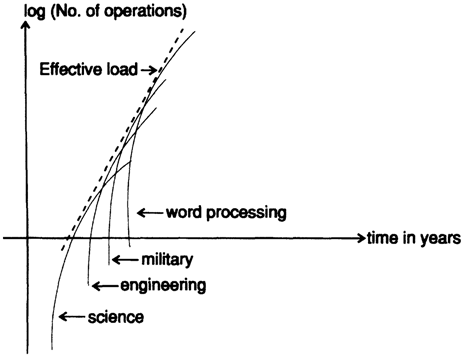
- Computer applications follow an S-curve growth pattern where specific fields like science or engineering eventually saturate, but new fields emerge to maintain overall growth.
- The historical progression of computing at Bell Labs moved from scientific research to engineering, military applications, and eventually symbol manipulation like word processing.
- Future growth in computing power consumption will likely be driven by pattern recognition, virtual reality, and artificial intelligence.
- For software tools to be viable in a rapidly changing field, they must provide a return on investment in the near future.
They enable us to deal with variety without excessive standardization, and hence we can evolve more rapidly to a desired future!
The Rise of Interactive Computing
- The author recounts an early experiment attaching a small SDS 910 computer to a Brookhaven cyclotron to provide real-time data feedback.
- Despite corporate concerns regarding the longevity of the computer manufacturer, the project proceeded and proved highly successful.
- The small computer effectively doubled the productivity of the massive cyclotron by allowing scientists to monitor data as it was gathered.
- Real-time visualization on an oscilloscope enabled researchers to abort and adjust flawed experiments immediately rather than waiting for completion.
- This success at Brookhaven led Bell Telephone Laboratories to integrate small computers into labs for both data reduction and experimental control.
- The shift toward interactive computing transformed the machine from a passive calculator into an active driver of experimental parameters.
I believed then, as I do now, that cheap, small SDS 910 machine at least doubled the effective productivity of the huge, expensive cyclotron!
The Realities of Shared Databases
- Computers often change the nature of experiments and problems rather than just automating existing tasks.
- Boeing's attempt at a centralized design tape failed because engineers could not perform optimization studies against a constantly shifting baseline.
- In practice, teams must freeze a copy of a database to ensure that improvements are due to their own parameter changes rather than external updates.
- Real-time data access in corporate settings can create conflict and inconsistency, such as two executives presenting different figures based on different retrieval times.
- Scientific databases face social and technical hurdles, including prestige-driven conflicts over whose measurements are officially recorded.
- Most high-level decisions and optimizations should not be sensitive to minute-by-minute data fluctuations.
You simply cannot use a constantly changing data base for an optimization study.
The Rise of General Purpose Chips
- The shift from hardware-specific manufacturing to software programming allowed for mass production of variable products using the same general purpose computer.
- The Intel 4004 four-bit chip revolutionized the industry by replacing complex manufacturing jobs with flexible programming tasks.
- General purpose computers have become universal and invisible, controlling everything from stoplights and elevators to automobiles and washing machines.
- Choosing a special-purpose chip over a general-purpose one is often driven by ego rather than economic or practical logic.
- General purpose chips benefit from a shared ecosystem of bug fixes, manuals, and upgrades that are maintained by the wider market.
- Excess capacity in general purpose chips is essential for handling the inevitable future expansion of a project's original requirements.
One of the main reasons is there is a great ego satisfaction in having your own special chip and not one of the common herd.
The Future of Computer Applications
- The potential for symbol-manipulating devices to adapt to changing environments is still in its infancy.
- Innovation should strive for transformative 'great new things' rather than mere ten percent incremental improvements.
- Successful careers require analyzing the specific conditions that lead to project success versus guaranteed failure.
- Effective automation involves redesigning tasks for machines rather than simply replicating human processes.
- Future-proofing and realistic field maintenance are critical components of sustainable system design.
- The next frontier of computing applications lies in the exploration of Artificial Intelligence and its inherent limitations.
I have no objections to 10% improvements of established things, but from you I also look for the great new things which make so much difference to your organization that history remembers them for at least a few years.
The Limits of Machine Intelligence
- Computers manipulate symbols rather than 'information,' as the latter is a fuzzy concept that cannot be strictly defined for programming.
- Early research by Newell and Simon shifted from solving puzzles to modeling the human reasoning patterns used to solve them.
- The General Problem Solver (GPS) failed to scale, leading to a massive increase in the number of rules required for rule-based logic systems.
- Expert Systems face significant hurdles because experts often rely on subconscious patterns that they cannot consciously articulate.
- The success of rule-based logic appears inconsistent, suggesting that some human knowledge may be fundamentally impossible to translate into instructions.
Among other troubles with this idea is in many fields, especially in medicine, the world famous experts are in fact not much better than the beginners!
The Ambiguity of AI
- The term Artificial Intelligence is described as a 'dubious title' due to its lack of a singular, concrete definition.
- AI is framed not as a fixed technology but as a conceptual variant on a deeper philosophical or technical question.
- The text suggests that the nomenclature of AI may be misleading or overly broad in its current application.
- The lack of a unified meaning complicates the public and academic understanding of what these systems actually represent.
dubious title of Artificial Intelligence (AI), which does not have a single meaning.
The Limits of Machine Thinking
- Leaders must avoid the binary trap of believing or disbelieving in machine thought, as both extremes lead to strategic failure.
- The question of AI is better framed as identifying which human burdens machines can relieve, particularly on the intellectual side of life.
- Autonomous intelligence is a physical necessity for remote exploration, such as Mars rovers, where signal delays make human control impossible.
- Modern technology, like unstable high-speed aircraft, already requires machines to handle millisecond-level stabilization that exceeds human capability.
- Defining 'machine' is philosophically difficult, especially when considering the potential integration of organic components or neural networks.
Thus you cannot afford to either believe or disbelieve—you must come to your own terms with the vexing problem, 'To what extent can machines think?'
Defining Machine Thinking
- The definition of thinking is often biased by human exceptionalism, such as the Jesuit engineer's claim that thinking is exclusively what machines cannot do.
- The Turing Test attempts to define thinking through behavioral indistinguishability, though it bypasses the fundamental nature of the process.
- The author suggests that thinking might not be a binary 'yes-no' state but rather a matter of degree, moving away from the search for a 'smallest' thinking program.
- The history of chemistry serves as a parallel, where the 'vitalistic' belief that organic compounds required a life force was eventually overturned by laboratory synthesis.
- Religious and philosophical resistance to machine intelligence often stems from the discomfort of humans potentially creating entities in their own image.
- Historical attempts to quantify the human soul through physical measurements like weight have consistently failed to provide empirical evidence of a distinct vital essence.
As to the soul, in the Late Middle Ages some people, wanting to know when the soul departed from the dead body, put a dying man on a scale and watched for the sudden change in weight—but all they saw was a slow loss as the body decayed.
The Stalemate of Artificial Intelligence
- The debate over AI hinges on whether humans possess a unique, non-material essence or are simply a collection of molecules in a radiant energy field.
- Skeptics often define 'thinking' as a moving target, specifically excluding any task a machine has already proven capable of performing.
- Hard AI proponents argue that human consciousness is a matter of programming and that current failures are due to human ignorance rather than essential limitations.
- The subjective nature of self-awareness creates a stalemate, as machines can claim to have souls without providing any verifiable proof of their internal state.
- Games like chess and 3D tic-tac-toe serve as primary AI testing grounds because their rules are unambiguous and success is clearly defined.
- Historically, AI leaders have made extravagant, unfulfilled predictions, yet their work continues to produce startling results in well-defined problem spaces.
Such people are forced, like the above mentioned Jesuit trained engineer, to make the definition of thinking to be what machines cannot do.
Heuristics of 4x4x4 Tic-Tac-Toe
- The 4x4x4 tic-tac-toe cube contains 16 'hot spots' consisting of corners and center locations that share a geometric duality.
- Randomness is essential in early game strategy to prevent opponents from systematically exploiting predictable patterns.
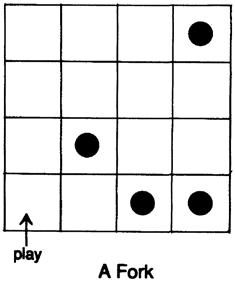
- Game logic follows a hierarchy of immediate win conditions, defensive blocking, and the creation or prevention of forks.
- Winning often depends on 'forcing moves' that maintain the initiative and compel the opponent into defensive positions.
- The transition from defensive play to an offensive sequence is a critical, non-exact science where timing determines victory.
- Computer game programs rely on heuristics—plausible but non-guaranteed rules—to navigate complex decision spaces.
Thus when to go on the attack is a touchy matter; too soon and you lose the initiative, too late and the opponent starts and wins.
Learning and Machine Intelligence
- Arthur Samuel's checker program demonstrated early machine learning by iteratively optimizing its own parameters through self-play.
- The program eventually surpassed its creator's skill level and defeated a state champion, challenging the notion of human superiority in strategy.
- The author draws a provocative parallel between a machine's programmed learning and a student's education in subjects like Euclidean geometry.
- The definition of 'learning' is often shifted by critics to exclude any process that can be explained mechanically or algorithmically.
- The text suggests that human intelligence may itself be a form of complex programming shaped by biological inheritance and chance events.
- True understanding of Artificial Intelligence requires moving beyond philosophical debate to practical experimentation and programming.
If you deny the machine learns from experience because you claim the program was told (by the human programmer) how to do improve its performance, then is not the situation much the same with you, except you are born with a somewhat larger initial program compared to the machine when it leaves the manufacturer’s hands?
Confronting Artificial Intelligence Biases
- The perception of machine learning often shifts from 'impossible' to 'clever cheating' once the underlying mechanism is revealed.
- Progress in understanding computer potential requires a rigorous, formal critique of one's own internal beliefs.
- Students typically approach AI with strong biases, either for or against, which must be dismantled to achieve objectivity.
- The author argues that the computer revolution is in its infancy and will inevitably transform all organizations.
- Holding onto false beliefs about machine intelligence prevents individuals from participating meaningfully in future societal shifts.
Before the checker playing program which learned was exposed in simple detail, you probably thought machines could not learn from experience—now you may feel what was done was not learning but clever cheating.
Intellectual Machines and Emergent Thinking
- The author distinguishes between mechanical automation and artificial intelligence, focusing on the computer's role in intellectual rather than physical tasks.
- A comparison of biological and mechanical structures reveals that engineering often achieves natural goals through entirely different mechanisms, such as fixed wings versus flapping.
- The concept of emergence suggests that complex effects like friction or thinking may simply be artifacts of large-scale organization rather than inherent properties of individual parts.
- The speed of electronic signaling in computers vastly outpaces the biological nervous system, yet the challenge of 'thinking' remains a software problem rather than just a hardware scale issue.
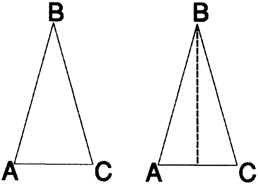
- An early AI geometry program demonstrated 'originality' by discovering an elegant proof for isosceles triangles that bypassed traditional human constructions.
Perhaps it is not a separate thing, it is just an artifact of largeness.
The Paradox of Machine Intelligence
- The author argues that human education is essentially an inefficient process of 'loading a program' into a person, whereas machine programming is clean and permanent.
- Samuel’s checker program and geometry theorem provers demonstrate behaviors that would be labeled as 'originality' or 'creativity' if performed by humans.
- A psychological paradox exists where the moment a program is written to perform a task, humans dismiss that task as a mere 'rote routine.'
- The 'hard AI' perspective posits that humans are biological machines, implying all intellectual feats can eventually be replicated by technology.
- The debate over machine consciousness hinges on whether the universe is governed solely by physics or if mysterious, unknown forces influence human thought.
- The author notes that physics currently cannot account for the vast majority of the universe, such as dark matter, complicating claims of scientific completeness.
Thus we have the paradox; the existence of the program automatically turns you against believing it is other than a rote process.
The Digital Revolution in Music
- Digital music is created by sampling sound frequencies and quantizing amplitudes into numerical data that a computer can process.
- Computers can simulate any existing instrument by programming specific frequency combinations, attack, and decay patterns.
- Algorithmic composition allows computers to generate music by applying formal rules and using random numbers for creative choices.
- Digital technology represents the technical ceiling of music production, shifting the challenge from what is possible to what is worth producing.
- The feedback loop for composers is drastically shortened, allowing them to hear and refine their work instantly rather than waiting years for an orchestra.
- Conductors and producers gain absolute control over every millisecond and tonal fraction, removing the limitations of human performance.
It is now clearly a matter of what sounds are worth producing, not what can be done.
AI and Human Potential
- Computers are shifting human focus from the world of physical things toward the world of abstract ideas.
- The author advocates for human-machine collaboration rather than competition, viewing machines as tools to free humans from routine labor.
- There is significant skepticism regarding the percentage of the population capable of transitioning from manual labor to complex programming.
- Job displacement primarily affects lower-level roles, while new opportunities emerge at higher levels of cognitive complexity.
- The difficulty in automating algebra stems from the lack of explicit, logical rules for concepts like simplification that humans handle intuitively.
- The 'new math' movement illustrates the absurdity of trying to define simple mathematical expressions through rigid, non-intuitive rules.
However, I have long publicly doubted you could take many coal miners and make them into useful programmers.
Machine Diagnosis and Legal Liability
- The definition of simplification is context-dependent and varies based on the intended next step in a process.
- Computer-assisted synthesis in chemistry allows for rapid exploration of costs, yields, and reaction times.
- Machines are increasingly replacing unreliable human analysis in medical measurements due to superior speed and consistency.
- While machines can store vast knowledge of rare diseases, legal liability remains a primary barrier to replacing human doctors.
- The legal system forgives human error under 'due prudence' but lacks a clear framework for suing a machine or its programmer.
- Rising medical costs are driven by the increasing complexity of treatments rather than the efficiency gains provided by computers.
But with a machine error whom do you sue? The machine? The programmer? The experts who were used to get the rules?
Computers in Specialized Labor
- Computers have become essential in healthcare for managing administrative red tape and monitoring patients with a vigilance that human nurses cannot match alone.
- Early symbolic manipulation programs in mathematics, such as Slagle's 1961 integration program, demonstrated that machines could compete with MIT engineers in abstract calculus.
- The complexity of modern integrated circuits, containing over a million transistors, has reached a point where human design is impossible without computer-driven automation.
- While robots excel in controlled production environments, they struggle with nonroutine situations where unexpected obstacles can lead to disaster.
- Future robotic applications, such as naval damage control, prioritize machine endurance in hostile environments where human life would otherwise be at risk.
No human mind could go reliably through the layout of more than a million transistors on a chip; it would be a hopeless task.
Machine Intelligence and Human Insight
- The advancement of chess-playing machines relies on massive computational volume rather than mimicking human psychological processes or insight.
- The original goal of using computers to study human thought has been largely abandoned in favor of simply winning games through brute force.
- Artificial intelligence produces psychological novelty, where programmers are surprised by outcomes, even if the machine follows strict logical rules.
- The concept of logical novelty is questioned, suggesting that human discoveries may also be the result of past experiences rather than true originality.
- The 'monkeys and typewriters' theory illustrates the idea that a random source could theoretically produce all known knowledge given infinite time.
That, at least is what they think they think—what the human mind actually does when playing chess is another matter!
The Paradox of Machine Thought
- Knowledge theoretically exists within random noise, but the inability to recognize it makes filtering information impossible.
- The debate over free will is unresolved because no experiment can prove its existence, yet we deny it to others through environmental determinism.
- Thinking may be defined by the process rather than the result, suggesting that routine tasks are conditioned responses rather than true thought.
- The 'Hard AI' perspective focuses solely on results, which allows humans to maintain a sense of superiority until machines match their output.
- Humans experience a conflict between wanting machines to think for utility and fearing the loss of self-importance if they do.
- The threat of machines surpassing human professionals like doctors creates a deep existential anxiety about our own value.
The logic of the situation is inescapable— the reality is hardly believable!
The Limits of AI
- The fundamental gap between physical molecular movement and the emergence of self-awareness remains an unsolved mystery.
- Current discussions on AI are hampered by a lack of clear definitions for terms like thinking and consciousness.
- The recursive nature of using language to analyze language processing creates inherent uncertainty in the field.
- AI should not be dismissed despite the false claims of experts, as its limits remain an open and vital question for the future.
- Thinking may be a matter of degree or a specific process of execution rather than a binary state of being.
- Defining what evidence would be required to change one's mind is essential for an objective evaluation of machine intelligence.
We simply do not know what we are talking about; the very words are not defined, nor do they seem definable in the near future.
Man-Machine Symbiosis and Resistance
- AI research historically focuses on the outcomes of tasks rather than the internal processes of how they are achieved.
- Human resistance to machine control is often hypocritical, as people already rely on computers for life-critical functions like pacemakers and flight stabilization.
- The argument that machines cannot do what humans do ignores the reality that machines already perform many tasks that are impossible for humans.
- Religious beliefs often underpin the conviction that humans are unique, yet these arguments are rarely articulated clearly in secular or diverse settings.
- The focus should shift from human-machine conflict to the potential of man-machine combinations, moving past ego-driven superiority.
- Machines offer distinct advantages over human experts, including speed, accuracy, freedom from boredom, and ease of retraining.
It is the combination of man-machine which is important, and not the supposed conflict which arises from their all too human egos.
Thinking About Future Applications
- The author emphasizes the importance of sensitizing oneself to future technological possibilities rather than just reviewing past or present applications.
- There is a noted difficulty in getting experts to aggressively reimagine how their own specific fields could be transformed by computers.
- The author suggests that people might be less inhibited and more creative when applying computer logic to areas outside their narrow specialties.
- Readers are encouraged to confront the 'awkward' topic of machine intelligence and develop a clear vision for their personal futures.
- The text advocates for a dialectical approach to belief, where one must argue against their own certainties to achieve true clarity.
- The primary goal of the author is not to dictate belief, but to force the reader to articulate and defend their own positions.
I have some times wondered whether it might be better if I asked people to apply computers to other areas of application than their own narrow speciality; perhaps they would be less inhibited there!
Designing in High Dimensional Space
- The author reflects on a career at Bell Labs, realizing that complex engineering design problems actually occur in n-dimensional space where each parameter represents a dimension.
- Human intuition is often limited to two dimensions; even in a three-dimensional world, life forms like fish or airplanes must congregate in specific areas to ensure encounters.
- Mathematical constructs of n-dimensional space are essential for understanding the behavior of systems with many independent variables.
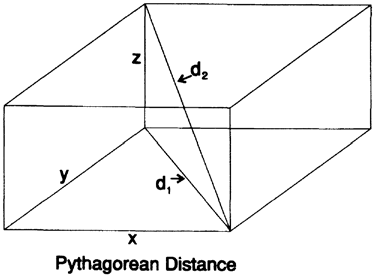
- The Pythagorean theorem naturally extends into higher dimensions, where the square of the diagonal equals the sum of the squares of all mutually perpendicular sides.
- To understand the 'size' of restricted design spaces, one must calculate the volume of n-dimensional spheres using tools like Stirling's approximation.
You think you live in three dimensions, but in many respects you live in a two dimensional space.
Stirling's Formula and Hyperspheres
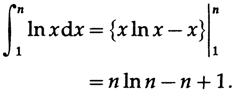
- The text derives Stirling's formula as an approximation for factorials, noting that while the ratio of the approximation to the true value approaches 1, the absolute difference grows with n.
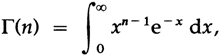
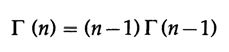
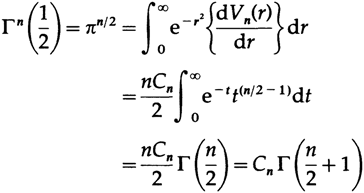
- The gamma function is introduced as a continuous extension of the factorial function for all positive real numbers using an integral definition.
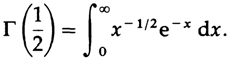
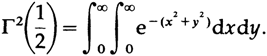
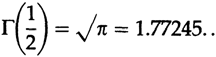
- A mathematical 'trick' involving polar coordinates and the product of integrals is used to evaluate the gamma function of 1/2 as the square root of pi.
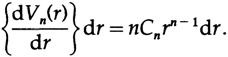
- The volume of an n-dimensional sphere is defined by a constant Cn multiplied by the radius to the power of n.
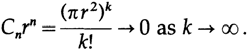
- Calculations reveal a counterintuitive geometric property: the volume coefficient Cn peaks at dimension 5 and then decreases toward zero as dimensions increase.
- For a unit radius, the volume of an n-dimensional hypersphere eventually vanishes as the number of dimensions approaches infinity.
Note as the numbers get larger and larger the ratio approaches 1 but the differences get greater and greater!
Geometry of High Dimensions
- As the number of dimensions increases, the volume of a sphere of any radius eventually shrinks toward zero.
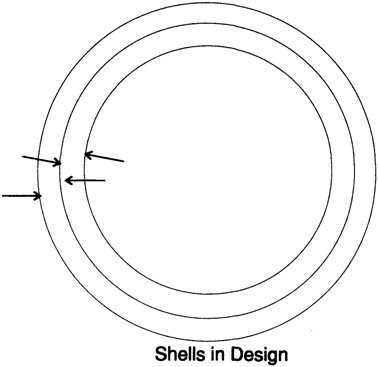
- In high-dimensional spaces, almost all the volume of a sphere is concentrated in a thin shell near its surface.
- Optimal designs in high-dimensional engineering are typically found on the surface of the feasible region rather than the interior.
- Standard calculus optimization methods are often inappropriate for high-dimensional spaces where extremes are the norm.
- The diagonal of an n-dimensional cube becomes increasingly perpendicular to every coordinate axis as dimensions grow.
- In a 10-dimensional space, there are 1,024 diagonal lines that are all simultaneously almost perpendicular to the axes.
As we say, the volume is almost all on the surface.
The Paradoxes of N-Dimensions
- In high-dimensional space, random vectors are almost surely almost perpendicular to one another, defying standard linear algebra intuition.
- While there are only n mutually perpendicular axes in n-dimensions, there are 2^n other directions that are nearly perpendicular to those axes.
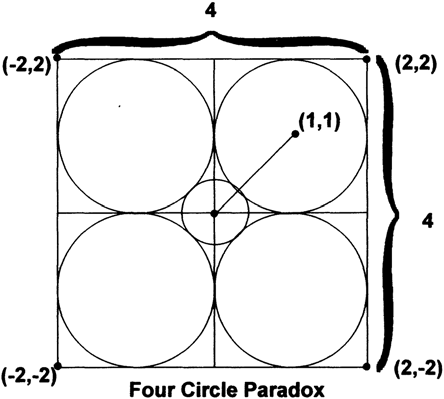
- A geometric construction of packed spheres in an n-dimensional cube reveals that the radius of a central inner sphere grows with the number of dimensions.
- By the 10th dimension, the central sphere, despite being contained by the inner surfaces of the corner spheres, actually reaches outside the surrounding cube.
- The author argues that raw human intuition is poorly suited for high-dimensional spaces where complex design problems occur.
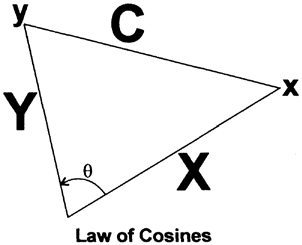
- These phenomena are grounded in classical Euclidean space using the Pythagorean distance formula, also known as the L2 norm.
Yes, the sphere is convex, yes it touches each of the 1024 packed spheres on the inside, yet it reaches outside the cube!
Metrics and Distance Functions
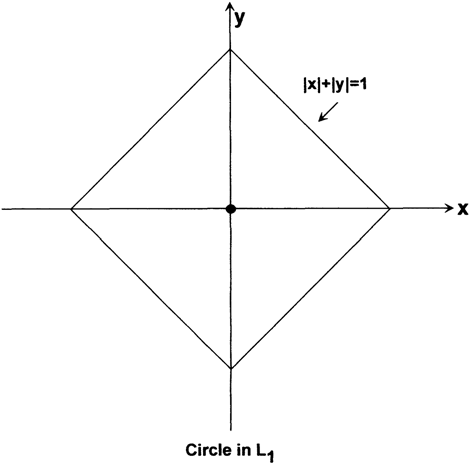
- The L1 metric, or Hamming distance, measures distance as the sum of coordinate differences, resembling travel on a city grid.
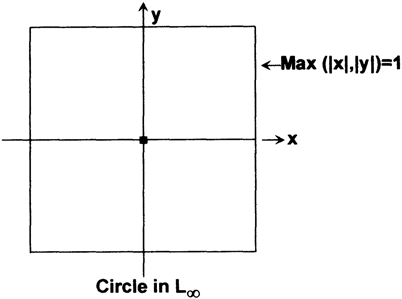
- The L∞ metric, or Chebyshev distance, defines distance as the maximum coordinate difference between two points regardless of other traits.
- Geometric shapes like circles and spheres change drastically depending on the metric used, appearing as squares or cubes in L1 and L∞ spaces.
- All valid metrics must satisfy four fundamental conditions: non-negativity, identity, symmetry, and the triangle inequality.
- While L2 is standard for physical measurements, L1 and L∞ are often more appropriate for intellectual judgments and pattern identification in AI.
- Real-world design spaces are often a 'messy' mixture of different metrics rather than a uniform Euclidean environment.
In this space a circle in two dimensions looks like a square standing on a point, Figure 9.V.
Information Representation and Transmission
- The meaning of a symbol in a computer is not inherent but is defined entirely by how it is processed.
- Information representation is simplified by treating transmission through space and storage through time as the same problem.
- A general theory of information is achieved by abstracting away the specific nature of the source, whether it be music, math, or dance.
- The 'meaning' associated with symbols is excluded from the technical theory to ensure its broad applicability across different fields.
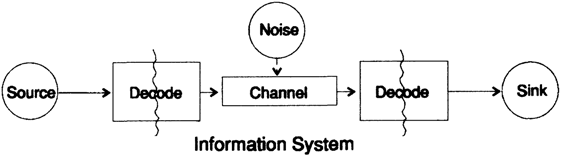
- The standard model of information systems begins with a source that generates a sequence of symbols for processing.
It is the abstraction from details that gives the breadth of application.
Foundations of Information Theory
- Claude Shannon insisted on the term 'information' despite the theory focusing primarily on strings of symbols rather than meaning.
- The encoding process is split into source encoding, which adapts to the data, and channel encoding, which adapts to the transmission medium.
- Information theory uniquely assumes the presence of noise and errors from the start, unlike classical physics or quantum mechanics.
- The concept of transmission applies equally to sending data through space or through time, which is defined as storage.
- Variable length codes, like Morse code, increase efficiency by assigning shorter symbols to more frequent data points.
- A fundamental requirement for any code is the ability to uniquely decode a stream of symbols in the absence of noise.
Recall, again, sending through space is the same as sending through time, namely storage.
Principles of Unique Decodability
- Unique decodability is essential for ensuring a receiver can reconstruct the original message from a stream of symbols without ambiguity.
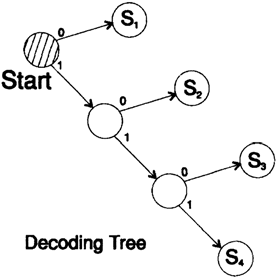
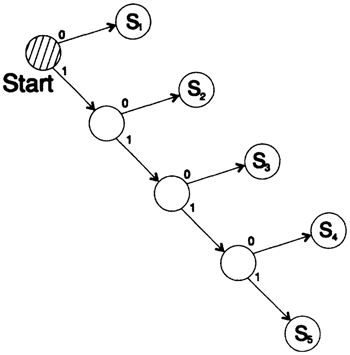
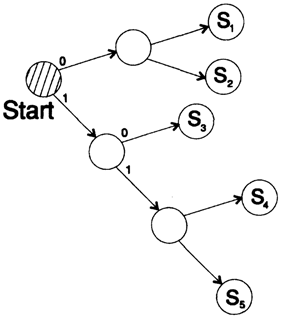
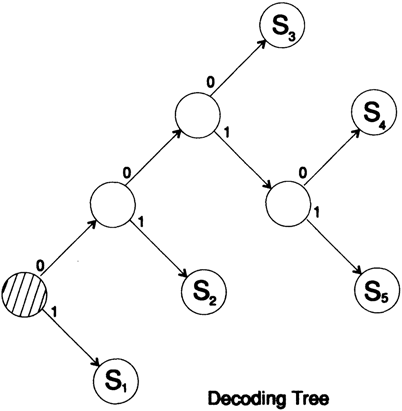
- Instantaneous decodability, where no symbol is a prefix of another, allows for immediate processing of digits without waiting for the end of a message.
- The inclusion of an 'exit' or 'escape' symbol is a critical but often overlooked design element for terminating a decoding process.
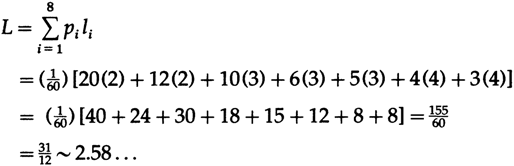
- The efficiency of a code is measured by its average length, calculated by weighting the length of each symbol by its probability of occurrence.
- Optimal code design is inherently dependent on the frequency of symbols; different probability distributions favor different tree structures.
- McMillan’s Theorem suggests that requiring instantaneous decodability does not impose a practical cost on code efficiency.
You have to wait until you get to the end of the message before you can start the decoding process!
The Kraft Inequality and McMillan's Theorem
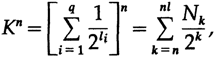
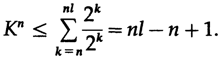
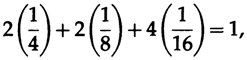
- The Kraft inequality establishes a mathematical constraint on the lengths of symbols in uniquely decodable codes, preventing an excess of short symbols.
- McMillan's Theorem extends this inequality to non-instantaneous codes, proving that instantaneous decodability costs nothing in terms of efficiency.
- A code is uniquely decodable only if the sum of its symbol lengths, weighted by powers of two, is less than or equal to one.
- If the Kraft sum is strictly less than one, the code has excess signaling capacity that could be used to shorten average code lengths.
- Meeting the Kraft inequality does not guarantee a specific code is decodable, but rather that a decodable code with those specific lengths can exist.
When examined closely this inequality says there cannot be too many short symbols or else the sum will be too large.
Meaning and Huffman Coding
- The transmission of ideas is distinct from the specific words used, as meaning is often reconstructed by the receiver using internal context.
- Organizational communication is frequently distorted by 'channel noise' where subordinates hear what they expect rather than what is actually said.
- Efficient coding theory aims to minimize the average message length based on the statistical probability of symbol occurrence.
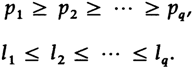
- Huffman coding requires that symbols with higher probabilities be assigned shorter code lengths to achieve mathematical optimality.
- A minimum length code must utilize every decision node in its tree structure to avoid wasted capacity and ensure unique decodability.
This inability of the receiver to “hear what is said” by a person in a higher management position but to hear only what they expect to hear, is, of course, a serious problem in every large organization.
The Logic of Huffman Encoding
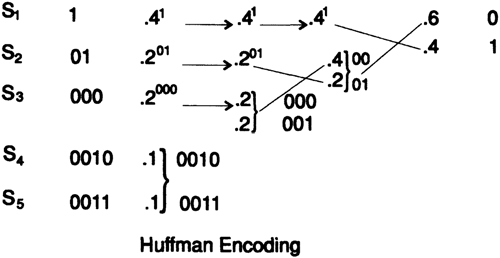
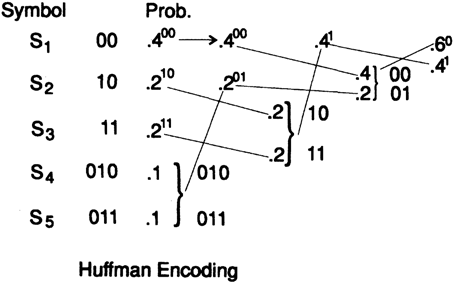
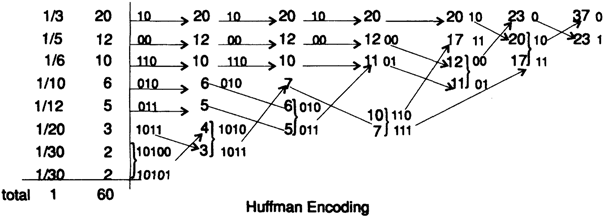
- Huffman encoding functions by iteratively merging the two least frequent symbols until only two remain.
- The process is reversed to assign binary digits, adding a 0 or 1 to distinguish previously merged symbols.
- The resulting code is mathematically guaranteed to have the minimum average length for a given probability distribution.
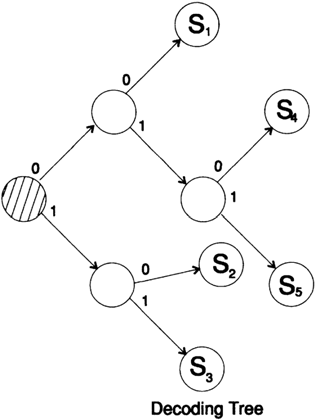
- Huffman codes are not unique; arbitrary choices in bit assignment and symbol ordering can create 'long' or 'bushy' decoding trees.
- Optimizing symbol placement in the tree can reduce the variability of code lengths without changing the average length.
- Practical application of this method can reduce data storage requirements by more than half in certain scenarios.
The average length of the two codes is the same, but the codes, and the decoding trees are different; the first is “long” and the second is “bushy”, and the second will have less variability than the first one.
Automating Huffman Coding Efficiency
- Huffman coding is a mechanical process easily automated by computer programs through iterative probability summation and symbol splitting.
- The system can autonomously sample data, estimate probabilities, and transmit both the decoding tree and encoded data without human intervention.
- Practical implementation requires an escape symbol with low probability to signal the end of the decoding process.
- Huffman coding is most effective when symbol probabilities are highly varied, potentially resulting in a comma code structure.
- If symbol probabilities are uniform, Huffman coding offers little to no advantage over standard block encoding.
- The technique has been applied to computer instruction sets where certain operations occur much more frequently than others.
Indeed, you can write a program which will sample the data to be stored and find estimates of the probabilities, find the Huffman code, do the encoding, and send first the decoding algorithm (tree) and then the encoded data, all without human interference or thought!
Huffman Variance and Parity
- When Huffman coding probabilities are equal, the order chosen affects the variance of the resulting code lengths.
- Placing new probabilities as high as possible in the table minimizes variance, ensuring more consistent message lengths.
- Channel encoding addresses the problem of noise by adding redundancy to detect or correct bit errors.
- A single parity check bit allows for the detection of an odd number of errors within a block of transmitted data.
- The mathematical model for channel noise assumes 'white noise,' where errors are independent and equally likely in any position.
A sensible criterion is to minimize the variance of the code so that messages of the same length in the original symbols will have pretty much the same lengths in the encoded message.
Engineering Error Detection Codes
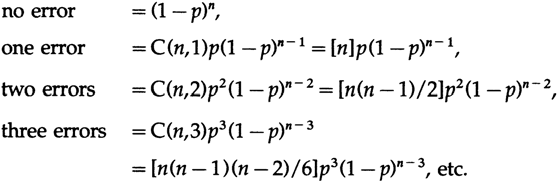
- The probability of undetected errors depends on the engineering balance between block length and redundancy.
- Single error detection is effective for retransmission unless the source data itself is corrupted.
- Historical relay computers used 2-out-of-5 codes to represent decimal digits and catch hardware failures.
- Error detection codes serve a vital maintenance role by identifying the exact moment and location of a machine failure.
- Human data entry errors often involve transposing adjacent characters, requiring more robust codes than simple parity.
- Weighted codes were developed to handle complex human error patterns in alphanumeric naming systems.
Any error was caught by the machine almost in the act of its being committed, and hence pointed the maintenance people correctly rather than having them fool around with this and that part, misadjusting the good parts in their effort to find the failing part.
Weighted Parity and Human Error
- The text describes a weighted parity check using modulo 37 arithmetic to detect single-symbol errors and symbol transpositions.
- Using a prime number as a modulus is essential for the mathematical integrity of the error-detection scheme.
- The ISBN system on books uses a similar weighted code, employing the symbol 'X' to represent the value 10 because its modulus is 11.
- Implementing these codes at the point of data entry allows for immediate error correction before incorrect information propagates through a system.
- Coding theory can be applied to man-machine interfaces to minimize keystrokes by adapting menus to individual user habits, similar to Huffman encoding.
The dashes are merely for decorative effect and are not used in the code at all.
The Genesis of Hamming Codes
- Richard Hamming explores the dual nature of scientific discovery, focusing on both the technical development of error-correcting codes and the psychological process of invention.
- The author warns that retrospective accounts of discovery are inherently limited, as the conscious mind cannot fully trace the 'magic' of the unconscious work.
- The breakthrough was triggered by intense frustration when a relay computer repeatedly failed over weekends, wasting Hamming's limited machine time and forcing him to apologize to colleagues.
- Hamming argues that significant breakthroughs rarely come from calm research; instead, they require the emotional stress and involvement of a 'prepared mind' facing a crisis.
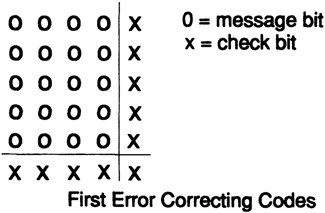
- The technical solution emerged from Hamming's deep familiarity with parity checks and the realization that a rectangular arrangement of bits could pinpoint an error's coordinates.
- By applying parity checks to both rows and columns, the machine could not only detect that an error occurred but identify its exact location for automatic correction.
I was angry to say the least, and said, 'If the machine can locate there is an error, why can it not locate where it is, and then fix it by simply changing the bit to the opposite state?'
The Evolution of Error Correction
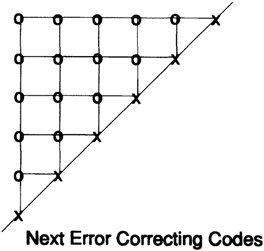
- The author explores the limitations of rectangular parity codes, noting that double errors can lead to unresolvable ambiguities in identifying error locations.
- A sudden realization during a commute led to the development of triangular and then multi-dimensional cubic parity checks to improve redundancy efficiency.
- By extending the logic to an n-dimensional cube, the author discovered that a 2x2x2...x2 configuration provides the most favorable ratio of parity checks to data bits.
- The breakthrough involved using the 'syndrome' of an error as a binary number that explicitly names the position of the error within the message.
- The design of these codes relies on assigning parity checks to specific bit positions based on their binary representation, a novel approach in the late 1940s.
My smugness vanished immediately! Did I have the best code this time?
The Logic of Hamming Codes
- Hamming codes use parity checks to generate a binary syndrome that identifies the exact position of a single bit error.
- The code structure is flexible, allowing for the interchange of columns or bit values without losing the essential error-correcting properties.
- Adding a single global parity check enables the system to detect double errors, even if it can only correct a single error.
- The efficiency of the code improves with message length, as the number of required parity bits grows logarithmically relative to the message size.
- Error correction can be visualized geometrically as movement between vertices on an n-dimensional cube using the L1 metric.
- Engineering these codes requires balancing the risk of uncorrectable double errors against the overhead cost of redundancy.
If it seems magical, then think of the all 0 message, which will have all 0 checks, and then think of a single digit changing and you will see as the position of the error is moved around then the syndrome binary number will change correspondingly.
Geometry of Error Correction
- The text establishes the mathematical foundation of distance using identity, symmetry, and the triangle inequality.
- A sphere in n-dimensional space is defined as the set of all vertices at a fixed distance from a central code point.
- Error correction is achieved by ensuring that spheres of a certain radius around code points do not overlap.
- A minimum distance of 3 between code points allows for single error correction, while a distance of 5 allows for double error correction.
- The relationship between minimum distance and error handling is formalized into a general rule for k-error correction.
It is obvious if the centers of these spheres are code points, and only these points, then at the receiving end any single error in a message will result in a non-code point and you can recognize where the error came from.
The Utility of Error Correction
- Error-correcting codes are mathematically defined by finding sets of code points in n-dimensional space with specific minimum distances.
- There is a direct trade-off between error correction and error detection; sacrificing one correction allows for two additional detections.
- The theoretical upper bound for code points is determined by dividing the total space volume by the volume of a sphere of radius k.
- Beyond ensuring accuracy, these codes drastically reduce the cost and expertise required for field maintenance and initial equipment installation.
- High-level error correction is essential for deep-space communication where low power and high noise make traditional transmission impossible.
- Real-world implementation at the first electronic central office proved that self-checking systems allow for faster, more reliable complex system deployment.
When, during initial installation, any unit is set up and running properly, and you then turned your back on it to get the next part going, if the one you were neglecting developed a flaw, it told you so!
Preparation and Future Greatness
- Success is often attributed to luck, but it is primarily the result of a mind prepared to recognize and act on opportunities.
- The author argues that most people merely react to surface phenomena rather than thinking deeply about the underlying causes of events.
- Greatness is not a fixed trait but a style of thinking and acting that can be trained through the study of successful predecessors.
- A significant challenge to achieving greatness is that the requirements for success shift from one generation to the next.
- Relying on a 'random walk' of decisions is far less effective than having a personal vision for the future and using imagination to anticipate change.
- The author asserts that the possibility of greatness is more common and achievable than most people realize if they refuse to be 'janitors' of their profession.
Of course as you go through life you do not know what you are preparing yourself for—only you want to do significant things and not spend the whole of your life being a “janitor of science” or whatever your profession is.
The Origins of Information Theory
- Claude Shannon chose the name 'Information Theory' over the more accurate 'Communication Theory' for its greater public impact.
- Shannon defined information as a measure of 'surprise,' where the amount of information is inversely related to the probability of an event.
- The mathematical foundation of information requires a continuous function where the information from independent events is additive.
- The Cauchy functional equation proves that the logarithm is the only continuous solution that satisfies the requirements for measuring information.
- In this framework, information is measured in bits, with a base-2 logarithm making a single binary choice equal to exactly one bit.
Shannon identified information with surprise. He chose the negative of the log of the probability of an event as the amount of information you get when the event of probability p happens.
The Distortion of Information Theory
- The mathematical definition of information is based on surprise rather than the common human understanding of the word.
- Information is a relative measure that depends entirely on the observer's prior state of knowledge.
- The term 'Information Theory' is arguably a misnomer that should have been called 'Communication Theory' to avoid conceptual confusion.
- The use of the word 'entropy' in this context provides an 'aura of importance' that may not be physically justified.
- Gibbs' inequality proves that maximum entropy occurs when all symbols in a distribution have equal probability.
- The Kraft inequality and pseudoprobabilities allow for the mathematical bounding of uniquely decodable codes.
The same mathematical form does not imply the same interpretation of the symbols!
Shannon's Noiseless Coding Theorem
- The entropy of a source acts as a fundamental lower bound for the average code length in any symbol-to-symbol encoding.
- Channel capacity is defined as the maximum amount of information that can be reliably transmitted through a channel, maximized over all possible encodings.
- In a binary symmetric channel with white noise, the capacity is determined by the probability of error per bit sent.
- Reliable transmission is achieved by encoding long streams of n bits, where n is large enough to narrow the distribution of expected errors.
- The receiver uses a sphere of radius slightly larger than the expected number of errors to decode the message, with errors occurring if multiple code points fall within that sphere.
- As n increases, the probability of a received message falling outside the sender's error sphere becomes arbitrarily small.
If n is large enough then there is an arbitrarily small probability of there occurring a received message point bj which falls outside this sphere.
Shannon's Random Coding Method
- Shannon addressed the lack of existing error-correcting codes by proposing a random encoding process using coin tosses for each bit.
- The proof relies on averaging the probability of error over the set of all possible code books rather than analyzing a single specific code.
- By increasing the message length n, the probability of duplicate or dangerously close code points can be reduced below any arbitrary threshold.
- The volume of the error sphere is estimated using Stirling's formula and dominated by a geometric progression to simplify the bound.
- The entropy function H(s) naturally emerges from the binomial identities used to calculate the probability of a point falling within the error sphere.
- The final derivation demonstrates that reliable communication is possible if the message length is sufficiently large, even with random selection.
Not knowing how to encode, error correcting codes not having been invented as yet, Shannon chose a random encoding.
Shannon's Noisy Coding Theorem
- Shannon's theorem proves that information can be sent at rates near channel capacity with arbitrarily small error by using sufficiently large block lengths.
- The proof relies on the existence of at least one suitable encoding system within the average of all possible random codes.
- A major practical critique is that the required block length 'n' must be extremely large, leading to significant delays and massive codebooks.
- Error-correcting codes avoid these massive codebooks by using computable, regular methods, though they often trade off some proximity to channel capacity.
- The theorem's relevance is demonstrated in deep-space satellites, which use elaborate encoding of long bit strings to overcome low power and vast distances.
- The geometry of n-dimensional space allows for dense packing of signal spheres with minimal overlap, facilitating high-efficiency error correction.
How large is this n? Very, very large indeed if you want to be both close to channel capacity and reasonably sure you are right!
The Limits of Definitions
- Information theory serves as a guide for efficient machine-like communication but lacks relevance for human meaning.
- The application of information theory to biological inheritance remains an open question regarding its machine-like nature.
- Initial definitions often distort reality and dictate results rather than uncovering objective truths.
- IQ testing is a circular process where the definition is calibrated to produce a desired normal distribution.
- The 'softer sciences' are increasingly prone to applying definitions under conditions for which they were never intended.
- Researchers must scrutinize definitions to ensure their findings are not merely tautologies created by their own tools.
Their conclusion arose from the tool used and not from reality.
The Genesis of Digital Filters
- Hamming identifies a recurring pattern of technological obsolescence where engineers are left behind during shifts from relays to electronics and analog to digital systems.
- The author warns his Vice President that the transition to total digital transmission risks creating a massive economic and social loss of human capital.
- A brief hallway conversation results in a direct mandate from leadership for Hamming to solve the problem himself by creating educational resources.
- Despite initial disinterest in the subject, Hamming feels a social responsibility to prevent the waste of talent and begins a collaboration with expert Jim Kaiser.
- The project evolves from a joint effort into a solo book as Hamming takes over the writing process to ensure the material is actually produced.
- The resulting book on digital filters went through three editions, illustrating how personal initiative and social concern can drive technical education.
He looked me square in the eye and said, Yes Hamming, you should.” and walked off!
Foundations of Digital Filters
- The author reflects on the long-term professional success gained from teaching short courses on digital filters globally while still writing the textbook.
- Learning new subjects is framed as a career necessity for those who wish to remain leaders rather than followers in their fields.
- Dissatisfied with the explanations of electrical engineers, the author sought a fundamental mathematical reason for the dominance of Fourier series.
- The complex exponentials are identified as the essential tool because they are the eigenfunctions of both time-invariant and linear systems.
- The Nyquist sampling theorem provides a third justification, ensuring that band-limited signals can be perfectly reconstructed from discrete samples.
- The concept of 'aliasing' is introduced to describe how high frequencies masquerade as lower ones when sampling rates are insufficient.
Doing what needed to be done, though I did not want to do it, paid off handsomely in the long run.
Signals and Linear Systems
- The reconstruction of original functions from equally spaced samples is best analyzed using Fourier functions and complex exponents.
- Complex exponentials serve as the eigenfunctions of linear, time-invariant, equally spaced sampled systems.
- The transfer function in electrical engineering is fundamentally the set of eigenvalues corresponding to these eigenfunctions.
- A digital signal is defined as an equally spaced sequence of measurements, typically resulting from sampling and quantizing continuous natural signals.
- Equally spaced sampling inevitably leads to aliasing, where frequencies above the Nyquist limit are perceived as lower frequencies.
Lo, and behold, the famous transfer function is exactly the eigenvalues of the corresponding eigenfunctions!
Aliasing and Sampling Fundamentals
- Aliasing occurs when signals are sampled at a rate lower than the Nyquist rate, causing higher frequencies to fold into the fundamental interval.
- Complex exponential notation is preferred over real trigonometric functions because it avoids multiple eigenvalues and covers a symmetric frequency band.
- Standardizing notation by scaling time to one unit per sample simplifies analysis across diverse fields of application.
- Once sampling occurs, higher frequencies are permanently aliased into the lower band and effectively cease to exist as separate entities.
- The author suggests that while the Nyquist rate requires two samples per cycle, practical constraints like finite data points may require up to eight samples per cycle.
- Aliasing is an inherent property of the sampling process itself, independent of any subsequent signal processing.
I have found it convenient to think once the samples have been taken then all the frequencies are in the Nyquist band, and hence we do not need to draw periodic extensions of anything since the other frequencies no longer exist in the signal.
The Power of Sampling Fundamentals
- Hamming illustrates how a firm grasp of the sampling theorem can solve complex engineering problems, such as debugging a missile simulation from across the continent.
- He demonstrates that understanding aliasing allows for the removal of unnecessary hardware by using the sampling act itself to modulate high-frequency signals.
- The text emphasizes that mastering fundamentals enables engineers to perform 'fancy' tasks and innovate beyond standard instructions.
- The discussion transitions into nonrecursive filters, explaining their origins in telephone multiplexing and the use of trigonometric identities for frequency shifting.
- A practical example of filter design is introduced using the least squares method to fit a straight line to data points for smoothing noise.
Debugging a large program across the continent based on the sampling theorem!
Digital Filters and Smoothing Formulas
- The text derives smoothing formulas by applying least squares minimization to linear and quadratic functions over a data window.
- A simple linear fit over five points results in a uniform running average, while a quadratic fit introduces non-uniform coefficients including negative values.
- Digital filters can be conceptualized as a 'window' through which data is viewed, with the coefficients defining the window's shape and transmission properties.
- Smoothing formulas exhibit central symmetry in their coefficients, whereas differentiating formulas exhibit odd symmetry.
- Any non-recursive digital filter can be decomposed into the sum of a smoothing filter and a differentiating filter.
- The transfer function of a smoothing filter is represented by a Fourier cosine expansion, linking filter design to the mathematics of Fourier series.
Do not let that worry you as we were speaking of a window in a metaphorical way and hence negative transmission is possible.
Digital Filters and Innovation
- Orthogonal function fits are mathematically equivalent to least squares fits, providing a reliable method for finite approximations.
- Bessel’s inequality serves as a practical guide for determining the necessary number of terms in a Fourier expansion.
- The history of computing shows that viewing new technology as merely an extension of the old prevents significant innovation.
- A change in magnitude, such as speed or cost, often creates fundamentally new effects rather than just incremental improvements.
- Digital filters were initially misunderstood as simple variants of analog filters rather than a distinct field of study.
- Simple smoothing filters can be combined to effectively remove high-frequency noise from a stream of numbers.
Those who claimed there was no essential difference never made any significant contributions to the development of computers.
Designing Simple Digital Filters
- The author establishes a digital filter with two specific constraints: a transfer function of 1 at frequency 1/6 and 0 at frequency 1/3.
- A simple filter form is derived using two coefficients, a and b, applied to the eigenfunction exp{2πifn}.
- The resulting smoothing filter formula defines the output as the sum of three consecutive inputs divided by two, with the middle value negated.
- Sample data is generated using cosine waves at the specified frequencies to test the filter's performance.
- The final test signal is a composite of both frequencies, designed to demonstrate the filter's ability to isolate specific signals.
- This process illustrates the fundamental mathematical relationship between frequency response requirements and filter coefficients.
In words, the output of the filter is the sum of three consecutive inputs divided by 2, and the output is opposite the middle input value.
Digital Filters and Gibbs' Phenomena
- Digital filters operate by decomposing signals into frequencies and multiplying them by specific eigenvalues defined by a transfer function.
- Ideal filters require a sharp cutoff between passed and stopped frequencies, which mathematically implies a discontinuous transfer function.
- Approximating these discontinuities with a finite Fourier series leads to the Gibbs' phenomenon, characterized by a persistent overshoot.
- The overshoot does not diminish toward zero as more terms are added, maintaining a limit of approximately 8.949%.
- The phenomenon was famously identified by Josiah Willard Gibbs after the physicist Albert Michelson suspected his mechanical analyzer was malfunctioning.
- This historical episode illustrates that scientific discovery often favors those prepared to investigate anomalies rather than dismissing them as equipment error.
When Michelson did this he observed an overshoot and asked the local mathematicians why it happened. They all said it was his equipment—and yet he was well known as a very careful experimenter.
Fourier Convergence and Lanczos Windows
- Cauchy's early textbooks contained a fundamental contradiction regarding the convergence of continuous functions that was eventually resolved by the concept of uniform convergence.
- The rate of convergence for Fourier series is directly observable from the function's smoothness on the real line, unlike Taylor series which are governed by complex singularities.
- Gibbs' phenomenon causes a persistent overshoot at discontinuities in least squares fits, regardless of how many terms are added to the series.
- Lanczos proposed a 'sigma factor' window that averages the output function to significantly reduce, though not entirely eliminate, these ripples.
- Adjusting the transition value to one-half in discrete cases provides an additional mathematical factor that improves the transfer function's behavior.
Thus the rate of convergence is directly observable from the function along the real line—which is not true for the Taylor series whose convergence is controlled by singularities which may lie in the complex plane.
Windows and Convolution Theory
- The author identifies a modified trigonometric series that outperforms the Lanczos filter by vanishing at the Nyquist frequency.
- Personal discovery of these series led to a deeper investigation into the possibilities of 'windows' in signal processing.
- The mathematical relationship between filtering and convolution is established as the multiplication of corresponding functions.
- A digital filter is formally defined as the convolution of one array of coefficients by another.
- The act of recording finite data is modeled as looking through a rectangular window, which results in a convolution of the original coefficients.
- The resulting frequency response of a rectangular window mimics the typical diffraction patterns found in optics.
Multiplication on one side is convolution on the other side of the equation.
Windowing and Spectral Leakage
- Gibbs' phenomena is re-examined as the convolution of a step function with a sinc-like function, illustrating the inherent overshoot in signal processing.
- The modification of Lanczos' window coefficients demonstrates that smoothing discontinuities in the window shape leads to more rapid convergence.
- The von Hann window, or raised cosine, provides greater smoothness than the Lanczos window but still suffers from side lobes that allow spectral leakage.
- The Hamming window was specifically engineered as a 'raised cosine on a platform' to minimize the maximum side lobe height.
- Choosing between windows involves a trade-off between total mean square leakage and the suppression of specific strong interference lines.
The Hamming window was devised to make the maximum side lobe a minimum.
Windows and Collaborative Science
- The Hamming window is often used due to its mysterious aura, though the von Hann window is frequently superior for general applications.
- Hamming recounts how John Tukey named the 'hamming' window after him, illustrating how fame often comes from the recognition of peers.
- The era of the isolated individual scientist is ending, making teamwork and cooperation essential for modern complex projects.
- Hamming advises helping others and letting them take the lead on publications to avoid the appearance of stealing ideas and to build professional goodwill.
- The systematic design of nonrecursive filters begins with an ideal filter model, such as a low pass, high pass, or differentiator.
- Differentiators are particularly sensitive to high-frequency noise because the differentiation process multiplies the signal by its frequency.
The Hamming window has a mysterious, hence popular, aura about it with its peculiar coefficients, but it was designed to do a particular job and is not a universal solution to all problems.
Digital Filter Design Methods
- The design of digital filters begins with computing Fourier coefficients for a desired transfer function using complex exponentials.
- Truncating an infinite Fourier series to a finite number of terms introduces the Gibbs' effect, which causes unwanted oscillations.
- Windowing techniques are applied to the truncated coefficients to mitigate the Gibbs' effect and refine the filter's performance.
- Traditional filter design is often a trial-and-error process involving the manual selection of term counts and window shapes.
- The Kaiser design method automates this by calculating the necessary number of terms and window parameters based on specified tolerance and transition width.
- Final filter coefficients are derived by multiplying original Fourier coefficients by window weights, often involving Bessel functions for precision.
It is a “trial and error” design method.
Kaiser Windows and FFT Origins
- The Kaiser window provides a flexible mathematical framework for filter design that replaces guesswork with specific parameters.
- James Kaiser developed his formulas through a combination of theoretical insight and experimental computer trials, using I0 functions to approximate prolate spheroidal functions.
- The Kaiser method is computationally efficient enough for handheld devices but can occasionally fail when ripples from multiple edges combine.
- The Fast Fourier Transform (FFT) reduced computational complexity from N-squared to N log N, revolutionizing science and engineering.
- The author recounts a personal anecdote about missing the opportunity to develop the FFT because he mistakenly labeled it a 'bad idea' based on outdated hardware limitations.
All I remembered was it was one of Tukey’s few bad ideas; I completely forgot why it was bad— namely because of the equipment I had at time.
The Logic of Impossibility
- Understanding the specific constraints that make a task impossible is as important as knowing it cannot be done.
- Retaining the underlying reasoning allows for future re-evaluation when circumstances change.
- A shift in technology or environment may invalidate the original reason for failure.
- Deep knowledge of limitations prevents permanent dismissal of potentially viable ideas.
- Strategic memory of 'why' fosters innovation by identifying when barriers have been removed.
Moral: when you know something cannot be done, also remember the essential reason why, so later,
The Pitfalls of Spectral Analysis
- The author warns against the common intellectual error of assuming a task is impossible based on outdated circumstances or past failures.
- Power spectra are essential tools for analyzing 'black boxes,' historically enabling breakthroughs like Bohr's model of the atom by focusing on signal properties rather than time origins.
- The act of sampling a continuous signal inherently alters it, convolving the original data with a window function that smears pure spectral lines.
- Using the Fast Fourier Transform (FFT) forces a continuous spectrum into a discrete line spectrum, imposing a false periodicity that may not exist in the original signal.
- Standard data processing techniques, such as removing the mean or linear trends, can introduce significant discontinuities and distortions into the resulting spectrum.
We force all nonharmonic frequencies into harmonic ones—we force a continuous spectrum to be a line spectrum!
Aliasing Noise and Linear Limits
- Algebraic addition of frequencies during function summation can lead to false results and slow coefficient decay due to discontinuities.
- The sampling process aliases high-frequency noise into lower frequencies, often resulting in a flat 'white noise' spectrum.
- Over-sampling allows for the use of low-pass filters to remove noise that exists beyond the signal's frequency range.
- Fourier analysis of stock markets only proves the unpredictability of future prices when restricted to simple linear predictors.
- Numerical integration methods, such as predictor-corrector formulas, are effectively recursive digital filters that can produce unbounded outputs.
- Physical environments dictate error growth; for example, the lack of air drag on the moon leads to quadratic error growth in position calculations.
A little knowledge is a dangerous thing—especially if you lack the fundamentals!
Recursive Digital Filters
- Digital filter stability is defined by the absence of exponential growth from bounded inputs, differing from classical analog criteria.
- Recursive filters utilize feedback by incorporating previous output values into the current calculation, which necessitates constant stability monitoring.
- The use of past values is often a constraint of real-time processing, though non-real-time data allows for more accurate two-sided prediction.
- A recursive filter is mathematically equivalent to a linear difference equation with constant coefficients where the signal acts as a forcing function.
- In steady-state operation, a linear filter only outputs the input frequency, though phase shifts and transient frequencies may occur.
In picture processing, a recursive digital filter which used only data from one side of the point being processed would be foolish since it would not to use some of the available, relevant information.
Feedback and System Instability
- Recursive filters are represented as rational functions in a complex variable rather than simple polynomials.
- The design of recursive filters currently lacks a systematic theory, relying instead on specialized methods like Butterworth, Chebyshev, and elliptic filters.
- Feedback systems are prone to instability, often caused by a delay between an action and the detection of its result.
- The author uses a hotel shower analogy to illustrate how delayed feedback leads to 'hunting' and oscillation around a target temperature.
- Recursive digital filters share theoretical roots with predictor-corrector formulas used in solving ordinary differential equations.
- Stability is more complex in differential equations because feedback paths can be both linear and nonlinear.
I found myself, in spite of many experiences, in the same classic hunting situation of instability.
Challenging Expertise and Choosing Problems
- The author identifies a counter-example to the common claim that all recursive filters must have an infinite impulse response.
- He argues that experts often repeat inherited knowledge without questioning its validity in current contexts.
- A chance encounter leads the author to a difficult problem involving the differentiation of ragged radioactive spectrum data.
- The author insists on visiting the physicist's laboratory to evaluate the researcher's competence before committing to the project.
- The author emphasizes the importance of vetting the significance of a problem before dedicating time and effort to it.
- The ultimate moral is to prioritize working on problems that have the potential for significant impact.
If you will only ask yourself, “Is what I am being told really true?” it is amazing how much you can find is, or borders on, being false, even in a well developed field!
The Curse of Expertise
- The author highlights how specialized expertise can limit a professional's ability to apply their skills to non-traditional contexts, such as treating energy as a time variable.
- By modeling theoretical expectations against synthetic data, the team identified that the signal occupied only 5% of the Nyquist interval, allowing for 95% noise removal.
- The author emphasizes the importance of 'degrees of freedom' in data processing, correcting the physicist's attempt to dishonestly adjust filter cutoffs mid-run.
- A successful collaboration resulted in a classic paper after the author persuaded the physicist to use square roots of counts to achieve equal variances.
- The narrative argues for the increasing necessity of 'generalists' who can bridge narrow specializations and maintain a broader, honest view of scientific problems.
- Digital filtering is often associated with time signals, but its future utility lies in diverse, special-purpose studies across various independent variables.
The curse of the expert with their limited view of what they can do.
Digital Filtering for Management
- Digital filters are essential tools for top-level managers to identify long-term trends within noisy organizational data.
- Applying low-level filtering to non-standard datasets often yields greater gains than using them for traditional engineering tasks like radar reduction.
- Fourier analysis assumes a linear model and can lead to massive financial waste when applied to highly nonlinear phenomena.
- The running median filter is a powerful nonlinear tool that smooths local noise while preserving sharp discontinuities in a system.
- Every linear theory, including digital signal processing, is governed by an inherent uncertainty principle similar to that of Quantum Mechanics.
- Managers must be wary of using intellectual tools like Fourier analysis simply because they do not know what else to do.
When this was pointed out to them, their reply seemed to be they did not know what else to do, so they persisted in doing the wrong thing!
Linearity and Simulation Risks
- The uncertainty principle in quantum mechanics may be a mathematical artifact of assuming linear time invariance rather than an inherent physical reality.
- The Eddington fisherman story illustrates how our tools and methodologies predetermine the limits of what we can observe.
- Scientific leadership requires a delicate balance between doubting established rules and accepting them to avoid paralysis.
- The shift from physical experimentation to computer simulation risks a return to scholasticism where textbooks are favored over reality.
- Simulations are increasingly preferred because they are cheaper, faster, and capable of modeling scenarios impossible to recreate in a laboratory.
It is as if you put on blue tinted glasses; everywhere you look you must see things with a bluish tint!
Simulations Versus Laboratory Experiments
- Programming simulations is often cheaper and faster than maintaining laboratory equipment, which suffers from both physical and intellectual 'shelf life.'
- Simulations can provide more accurate readings in dynamic situations and explore wider variable ranges than physical setups allow.
- A simulation can model scenarios where physical experimentation is impossible, such as the design of the first atomic bomb where critical mass is binary.
- Effective simulation requires deep domain expertise to determine which physical factors are vital and which can be safely ignored.
- The economic viability of a simulation depends on highly repetitive computational tasks that justify the initial cost of programming.
Intellectual shelf life is often more insidious than is physical shelf life.
Simulation and Machine Power
- The inherent power of modern machines often exceeds our ability to program them efficiently.
- Effective simulation design requires identifying and exploiting repetitive patterns within a problem.
- Weather prediction serves as a primary example of complex simulation through atmospheric modeling.
- Atmospheric simulations divide the air into discrete blocks with specific initial conditions.
- Key variables for these blocks include temperature, pressure, moisture, and velocity.
In many situations, the power of the machine itself so far exceeds our powers to program it is wise to look early and constantly for the repetitive parts of a proposed simulation.
Stability and Simulation Limits
- Simulations are highly feasible when a system exhibits stability and resistance to small changes, but become difficult when outcomes are sensitive to minor details.
- The 'butterfly effect' illustrates how small perturbations in weather systems can lead to drastically different short-term results despite long-term seasonal stability.
- Identifying whether stability or instability dominates a problem is crucial before committing significant time and resources to a simulation.
- Practical experience with the NIKE missile system showed that simulations can lead to counter-intuitive design improvements, such as favoring vertical launches.
- The author warns that mathematical models and constants used for small perturbations may lose accuracy when a simulation leads to large-scale structural changes.
- Prudence is required when promising results from simulations, as some problems are practically impossible to handle due to inherent instabilities.
Indeed, it is claimed whether or not a butterfly flaps its wings in Japan can determine whether or not a storm will hit this country and how severe it will be.
Simulation Insight and Missile Design
- The author argues that slow, primitive computing allowed for an 'intimate feeling' for the simulation that high-speed volume output might have obscured.
- Early simulations led to radical design changes, including a vertical launch system and reducing wing size by two-thirds to improve end-game maneuverability.
- A philosophy of starting with simple simulations is advocated to gain system-wide insights before adding complex, disguising details.
- Conflicting data from the only available supersonic wind tunnels highlighted the extreme uncertainty in early guided missile development.
- The author applied similar simulation principles to traveling wave tube design, optimizing energy transfer between electron beams and electromagnetic waves.
Volume output seems to me to be a poor substitute for acquiring an intimate feeling for the situation being simulated.
The Power of Active Minds
- The author improved wave energy transfer by calculating ideal pipe tapers and identifying nonlinear components that invalidated linear approximations.
- An active mind can contribute significantly to a specialized field even as an amateur by paying close attention to small details.
- Mastering jargon is essential for communication but dangerous because it can block thinking outside of a restricted area.
- Jargon serves as an evolutionary defense mechanism, similar to caveman tribalism, used to exclude outsiders from a group.
- Intellectual activity is required to gain the benefits of specialized language while avoiding its inherent pitfalls.
- Mathematics is not always a universal language, as demonstrated by complex simulations involving simultaneous differential equations.
Jargon is both a necessity and a curse.
The Nuances of Simulation
- A shared understanding of mathematical symbols does not guarantee a shared interpretation of their physical application.
- The author emphasizes that domain experts must be involved in detailed programming to prevent catastrophic errors in simulation logic.
- Creative mathematical approximations, such as treating differential equations as impedance lines, allow complex systems to be modeled on limited hardware.
- Simulations are not restricted to time-dependent functions but can also model spatial stability, such as signal growth across relay stations.
- The concept of 'space stabilization' describes how a pulse might decay locally at each station but grow uncontrollably as it travels across a continent.
- Almost any mathematically describable situation can be simulated, provided one is cautious with unstable systems.
It is as good an example as I know of to illustrate the fact both of us understood exactly what the mathematical symbols meant—we both had no doubts—but there was no agreement in our interpretations of them!
The Reliability of Simulations
- The author emphasizes a personal commitment to finding solutions for important problems regardless of the difficulty.
- Faulty simulations are a major risk because they can lead researchers to abandon viable ideas or promote false conclusions.
- The 'Club of Rome' world simulation is cited as a famous failure where equations were biased toward catastrophe and contained computational errors.
- Reliability is often obscured by irrelevant metrics like the amount of manpower used or the speed of the computer involved.
- Validation and authentic representation are essential requirements for any simulation used in critical decision-making processes.
It turned out the equations they chose were designed to show a catastrophy no matter how you started or chose most of the coefficients!
Simulation Versus Reality
- The relevance and accuracy of a simulation must be established before any work begins to avoid misleading or erroneous results.
- A significant gap often exists between the reliability of a simulation and the reliability of the actual physical event it models.
- Simulation experts frequently fall into the trap of identifying their models with reality while ignoring independent checks.
- While simulations like flight trainers allow for safe practice of emergency scenarios, they risk omitting vital new interactions as technology evolves.
- The increasing lack of real-world experience among practitioners makes it harder to ensure that models include all essential details.
- The persistence of errors in long-standing computer programs serves as a warning against overconfidence in complex simulation data.
His refusal to reply, under repeated requests, was a clear admission my point went home, he himself knew the Director did not understand this difference but thought the report was the reliability of the actual shot.
The Sloppiest Simulation
- The accuracy and reliability of simulations are critical because errors can lead to loss of life, equipment, or capital.
- To demonstrate analog computing at a 1955 open house, the author created a tennis simulation using classical mechanics and physical dials.
- The simulation was deemed 'sloppy' because the author relied on peer intuition for constants rather than rigorous empirical testing.
- During the demonstration, children quickly mastered the game's interface while adults consistently failed to grasp the mechanics.
- The experiment revealed a fundamental cognitive gap: younger minds possess a unique elasticity for new ideas that older minds often lack.
- Professionals must account for this mental rigidity when presenting innovative concepts to older decision-makers.
I noticed, after a while, not one adult ever got the idea of what was going on enough to play successfully, and almost every child did!
The Limits of Economic Simulation
- Economic simulations lack the foundational reliability of hard sciences because economics lacks universal, non-tautological laws.
- Simpson's Paradox demonstrates how aggregating data can create the illusion of trends or biases that do not exist within individual subsets.
- A Berkeley graduate school study illustrates this paradox, where apparent gender discrimination vanished when data was analyzed by department.
- Successful simulations in fields like aerospace rely on knowing exactly when complex systems can be simplified into point masses without losing accuracy.
- The author argues that many ecological and social simulations are used as propaganda because they lack mathematically expressed rules for interactions.
- Reliable simulation requires both a deep understanding of background theory and access to real-world data for verification.
You are used to the idea combining data can obscure things, but it can also create effects is less well known.
The Limits of Human Simulation
- Human knowledge of a simulation's predictions often leads to behavioral changes that invalidate the simulation's results.
- The stock market is inherently resistant to public strategies because widespread adoption would immediately ruin the strategy's effectiveness.
- Systemic corruption and insider trading further complicate financial modeling by creating an uneven playing field that resists automation.
- The 'method of scenarios' offers a viable alternative by projecting ranges of possible outcomes rather than making specific, rigid predictions.
- Reliability in simulation requires checking for missing vital effects, data stability, and internal conservation laws to ensure accuracy.
- Maintaining personal integrity is crucial to avoid becoming a tool for propaganda when conducting or presenting simulations.
In the stock market, if there were any widely known strategy for making lots of money, the very knowledge of it would ruin the strategy!
Reliability and Digital Simulation
- Hamming describes automating the generation of differential equations to prevent human programming errors in complex chemical simulations.
- The goal was to keep chemists focused on chemistry rather than the mechanics of computing while maintaining their responsibility for the results.
- Reliability in simulation is paramount and cannot be assumed simply because a machine produces professional-looking output.
- The transition from analog to digital computing is discussed through the lens of the Nyquist sampling theorem.
- Practical digital solutions require seven to ten samples per highest frequency to account for one-sided sampling and to minimize aliasing.
- Designers must provide accurate estimates of signal frequency content to ensure the validity of the digital representation.
It is not something you can take for granted just because a big machine gives out nicely printed sheets, or displays nice, colorful pictures.
Analog Computing and Error Dynamics
- Digital machines offer superior precision and deep computation, whereas analog machines are limited by component accuracy to roughly one part in 10,000.
- Analog computers remain valuable for their real-time responsiveness and ability to integrate physical components without needing full mathematical descriptions.
- The 'Garbage In, Garbage Out' (GIGO) principle is challenged, as accurate inputs do not always guarantee accurate outputs in complex simulations.
- Direction fields in differential equations illustrate how small initial errors can either diverge into large discrepancies or converge into negligible ones.
- The accuracy of a solution is not absolute but depends on the specific trajectory and state of the function being computed.
Analog machines are generally ignored these days, so I feel I need to remind you they have a place in the arsenal of tools in the kit of the scientist and engineer.
Numerical Solutions and Error Accumulation
- Visualizing n-dimensional differential equations as expanding or contracting tubes can be misleading due to high-dimensional paradoxes.
- Numerical integration begins by moving along a local tangent line, which inherently introduces a small error by using 'the slope that was' rather than the interval's average.
- Predictor-corrector methods mitigate this by estimating a future slope and averaging it with the current one to refine the step forward.
- Step size is dynamically adjusted based on the discrepancy between predicted and corrected values to maintain local accuracy.
- Total accumulated error is distinct from local step error and is fundamentally driven by the convergence or divergence of the underlying direction field.
- Advanced numerical methods utilize higher-degree polynomials and treat the corrector as a recursive digital filter processing derivative data.
The four circle figure in two dimensions, leading to the n-dimensional paradox by ten dimensions, shows how tricky such imagining may become.
Numerical Analysis vs Filter Theory
- Differential equations are fundamentally recursive digital filters that compute numbers through difference equations.
- Numerical analysis traditionally uses polynomials to approximate trajectories, while filter theory uses frequencies as its basis.
- Polynomial methods can create small discontinuities in acceleration that disrupt the 'feel' of a simulation.
- Frequency-based approaches prioritize the sensory experience and response of a system over exact positional accuracy.
- The conflict between mathematical precision and engineering utility highlights a lack of knowledge regarding human sensory perception.
- Simulators must account for concealed factors like frequency response to ensure pilots are properly prepared for real-world physics.
In the frequency approach we will concentrate on getting the frequencies right and let the actual positions be what happen.
Challenging the GIGO Myth
- The author argues that individuals with deep insight into a problem must immerse themselves in solution methods rather than relying on traditional approaches.
- During early Nike missile testing, unexplained mid-flight breakups threatened the project's timeline and design phase.
- Despite lacking accurate initial telemetry data, the author used simulation to identify a periodic energy transfer between pitch and yaw caused by missile rotation.
- The simulation succeeded because the guidance system's convergent direction field corrected for initial inaccuracies, proving that 'Garbage In' does not always result in 'Garbage Out'.
- This early success in accident simulation demonstrated that understanding the underlying system dynamics is more critical than having perfect starting data.
I had earlier realized the nature of the field trials being simulated was such that small deviations from the proposed trajectory would be corrected automatically by the guidance system!
Feedback and Error Compensation
- The author describes using French curves to manually interpolate data points for nuclear simulations at Los Alamos.
- Despite using 'garbage' data with low initial accuracy, the final predictions for the 'gadget' were remarkably precise.
- The accuracy resulted from local errors being averaged out over the history of the simulation's physical shells.
- Feedback loops in both physics and engineering allow for accurate systems to be built from inaccurate components.
- Good design principles should aim to protect systems from the need for high-accuracy components through feedback.
- The author emphasizes that these intuitive design principles are not yet formally taught in standard curricula.
Hence garbage in, but accurate results out never-the-less!
Walking the Stability Crest
- The author encountered a transistor design problem involving a differential equation that was inherently unstable in both directions.
- Standard numerical integration techniques failed because any small error caused the solution to diverge rapidly toward infinity.
- Despite initial skepticism about the model's validity, the author felt a professional obligation to solve the problem to maintain his reputation.
- The solution involved using the instability itself as a guide, manually correcting the slope whenever the curve began to deviate.
- This 'piece by piece' approach allowed the author to navigate the 'crest of a sand dune' and produce a viable solution for the space charge problem.
- The author reflects on how professional pride and persistence are essential when facing problems that appear insoluble or poorly posed.
In the past I had used the obvious trick when facing a divergent direction field of simply integrating in the opposite direction and you get an accurate solution. But in the above problem you are, as it were, walking the crest of a sand dune, and once both feet are one side of the crest you are bound to slip down.
The Trap of Randomness
- A psychological experiment at Bell Labs revealed that scientists consistently invent complex theories to explain purely random events.
- Traditional education focuses on replacing old theories with new ones, but fails to teach the validity of 'nothing' or randomness as an explanation.
- Statisticians use confidence limits to distinguish signal from noise, yet even these methods are subject to Type 1 and Type 2 errors.
- Many modern simulations function like Rorschach tests, where researchers adjust assumptions until the results match their preconceived expectations.
- The necessity of double-blind experiments in medicine highlights how both subjects and observers can unconsciously bias data to see patterns that do not exist.
You are lovingly taught how one theory was displaced by another, but you are seldom taught to replace a nice theory with nothing but randomness!
The Dangers of Simulation
- Human self-delusion makes it nearly impossible for researchers to remain objective without strict, blind protocols.
- Simulation is the only viable tool for answering 'What if...?' questions in a highly technical future.
- The scale of a computer or the quality of its output does not guarantee the validity of a simulation's results.
- Decision-makers must take personal responsibility rather than relying on mediocre committee compromises.
- Mastering simulation concepts is essential for leaders to effectively question results and avoid being misled.
Simulation is essential to answer the 'What if...?', but it is full of dangers, and is not to be trusted just because a large machine and much time has been used to get the nicely printed pages, or colorful pictures on the oscilloscope.
The Rise of Fiber Optics
- The author reflects on fiber optics as a case study in how to evaluate and engage with emerging technologies of high potential.
- Bandwidth is identified as the primary driver for the telephone company, with optical frequencies offering vastly superior transmission rates over electrical ones.
- Economic factors such as the scarcity of copper versus the abundance of sand (silica) made glass fibers a sustainable long-term alternative.
- Practical urban infrastructure constraints, like overcrowded wire ducts in Manhattan, necessitated the development of smaller-diameter transmission media.
- The author identified early technical hurdles, such as the difficulty of splicing hair-thin glass fibers without losing signal quality.
- Smaller fiber diameters were found to be essential for flexibility, allowing the glass to bend without leaking light.
During the early part of the talk the speaker remarked, “God loved sand, He made so much of it”.
The Evolution of Fiber Optics
- Fiber optic cables offer superior signal clarity and inherent security because they are difficult to tap without detection.
- The technology is uniquely resistant to electromagnetic disturbances, including lightning and atmospheric atomic explosions, ensuring military support.
- Engineers solved light leakage by developing a graded index of refraction, similar to focusing techniques used in cyclotrons.
- The author advocated for single-mode signaling based on the same logic that favored binary systems in early computing.
- A critical challenge was ensuring that fiber splicing could be performed by field technicians under adverse conditions rather than just by lab experts.
- Advancements in glass purity reached a point where, if ocean water were as clear, one could see to the bottom of the Pacific.
They said if the ocean waters were as clear as were some of the glasses then you could see to the bottom of the Pacific Ocean!
The Quest for Optical Amplification
- The author critiques the inefficiency of existing systems that convert signals between optical and electronic forms.
- Bell Labs and other research institutions prioritized the development of pure optical amplification to solve this design flaw.
- Several competing technologies emerged as potential candidates for standardizing optical field equipment.
- Solitons are highlighted as a superior transmission method because they maintain their shape during the amplification process.
- The stability of solitons prevents signal degradation as data travels through the fiber optic network.
One of the virtues of solitons is they can be amplified without changing their shape (which does not degrade as it goes
Fiber Optics and Satellite Competition
- The author describes a strategic approach to emerging technologies: monitoring developments without necessarily becoming an expert in every field.
- Geopolitical tensions arise from equatorial countries claiming airspace rights over the limited orbital slots available for stationary satellites.
- Fiber optics offer superior bandwidth and privacy compared to satellites, which are limited by atmospheric interference and orbital spacing.
- The industry is transitioning from classical pulse signaling to soliton signaling, which may revolutionize signal analysis methods.
- Practical advantages of fiber optics, such as significant weight reduction, are transforming military and commercial aviation infrastructure.
The use of satellites means broadcasting the signal—cables give a degree of privacy and the ability to make the user pay rather than get a free ride.
The Future of Fiber Optics
- Fiber optics are poised to replace traditional wiring for information handling in both military ships and civilian skyscrapers.
- The development of armored and lightweight fibers enables new applications, such as missiles that maintain two-way communication during flight.
- Optical technology could eventually move onto the chips themselves, potentially using light beams to replace physical wiring and avoid interference.
- A significant drop in switching costs through optical crossbars would necessitate a complete redesign of computer architecture beyond the von Neumann model.
- The author emphasizes that anticipating technological shifts is essential for researchers to lead rather than passively follow.
- Active anticipation prepares the mind to absorb and utilize new developments more effectively than a reactive approach.
Light beams can pass through one another without interference (provided the intensity is not too high) which is more than you can do with wires.
The Future of Fiber Optics
- The author emphasizes the importance of moving from a passive role to an active, anticipating role within an institution.
- Fiber optic 'drop lines' are predicted to replace traditional wiring, providing a single conduit for TV, radio, phone, and personalized news.
- Digital filters at the consumer end will allow users to select specific information channels from a unified data stream.
- Technological feasibility and economic efficiency do not guarantee adoption due to legal, social, and political restraints.
- A successful 'seer' or specialist must account for regulatory and societal resistance to avoid making false predictions.
Just because it can be done economically does not mean it should be done.
The Illusion of Easy Learning
- The history of education is filled with failed promises of 'royal roads' to knowledge, ranging from sleep-learning to speed-reading.
- The author argues that intellectual achievement, like running a four-minute mile, requires inherent hard labor and cannot be bypassed by gimmicks.
- The absence of exceptional individuals produced by these alternative methods suggests that most 'shortcuts' to intelligence are ineffective.
- The Hawthorne effect explains why new educational tools often show initial success: students and teachers perform better simply because they feel cared for.
- While modern computers offer new possibilities, one must remain skeptical of claims that technology will finally eliminate the struggle of learning.
- Wishful thinking often leads people to believe in new methods because they desperately want an easier path to success.
There is a story from ancient Greek times of a Mathematician telling a ruler there were royal roads for him to walk on, and royal messengers to carry his mail, but there was no royal road to geometry.
The Hawthorne Effect Challenge
- The Hawthorne Effect significantly compromises the validity of most educational experimentation.
- Experimental results are often skewed because subjects change their behavior simply because they are being observed.
- The author draws a direct parallel between educational research and the necessity of double-blind studies in medicine.
- Without controlling for the psychological impact of being studied, experimental outcomes may be misleading.
- The text emphasizes that this phenomenon is a pervasive issue across various fields of human research.
Hawthorne effect vitiates most educational experimentation.
The Hawthorne Effect in Education
- Experimental results involving humans are often compromised by the Hawthorne effect, where subjects perform better simply because they feel they are receiving special attention.
- To ensure validity, experiments must be double-blind, keeping both the participants and the evaluators ignorant of who received the specific treatment.
- The author suggests that the ideal teaching method involves constant experimental change to maintain the belief in improvement among both professors and students.
- Automated systems like the Stanford 'grader program' often fail not due to lack of utility, but because of minor technical shifts and a lack of institutional persistence.
- Large-scale educational technology projects like PLATO often fail to provide rigorous evidence of improvement that accounts for the Hawthorne effect or long-term compounding benefits.
The Hawthorne effect strongly suggests the proper teaching method will always to be in a state of experimental change, and it hardly matters just what is done, all that matters is both the professor and the students believe in the change.
Limits of Programmed Learning
- Programmed books and early computer-aided instruction (CAI) often fail because they prevent browsing and backtracking, making the learning experience rigid.
- Bright students frequently sabotage programmed texts by choosing wrong answers out of boredom to see how the system reacts.
- A lack of empirical evidence supports the claims that programmed texts are superior to traditional methods, relying instead on anecdotal opinions.
- Automated instruction excels at rote learning, such as arithmetic tables, where machines can tirelessly drill students on specific errors.
- Machines are highly effective for training conditioned responses, such as pilot training or fencing, where split-second reactions are more vital than deep reflection.
- The shift toward automation in organizations means future employment will value human judgment over the rote skills machines now handle better.
Another terrible fact is carefully watching the students to see what happens in practice has shown a good student often picks what they know is the wrong answer simply out of either boredom or amusement to see what the book will say.
The Weight of Learning
- The author uses a weightlifting analogy to question whether making learning easier for students actually diminishes their intellectual development.
- A distinction is made between learning from others to follow and learning for oneself to lead, suggesting that struggle is essential for leadership.
- The author argues that speed in learning is a critical metric for identifying valuable individuals for society and leadership roles.
- Over-reliance on specific visual aids or graphics may inadvertently restrict a student's ability to generalize concepts to new, unfamiliar contexts.
- The 'transfer of training' problem is highlighted by students failing to recognize the same mathematical concepts when the notation or environment changes.
- The fundamental difficulty in assessing educational technology like CAI is the lack of a clear definition of what an educated person should be.
What you learn from others you can use to follow; What you learn for yourself you can use to lead.
The Transfer of Training
- Students often fail to apply knowledge learned in one classroom to an identical problem in a different setting.
- The 'transfer of training' is the critical ability to utilize existing ideas and skills in entirely new situations.
- The author identifies this lack of transfer as a major hurdle in education and a key area of their professional contribution at Bell Labs.
- Many students rely on rote memorization to pass mathematics courses rather than developing deep conceptual understanding.
- Analytic integration serves as a pedagogical wall where memorization fails and pattern recognition becomes necessary.
The fact is, what they knew in one class at on e hour with one professor did not transfer to the another hour in a room across the hall with another professor.
The Limits of Educational Automation
- Mastering analytic integration is essential for developing abstract pattern recognition and general intelligence.
- Removing difficult foundational tasks from curricula can have long-term negative consequences, similar to students failing to learn the alphabet.
- Computer Aided Instruction (CAI) is effective for low-level conditioned training but remains unproven for high-level education.
- The definition of an 'educated person' is poorly understood, making it difficult to judge the success of new educational proposals.
- Simulations like war games or business management programs risk training individuals for the wrong situations if the underlying models are flawed.
- Historical shifts in education, such as the move away from classical Latin and Greek, demonstrate that the definition of a core curriculum is constantly evolving.
At their age then it was practically impossible to make them so overlearn the alphabet they could use such information sources easily.
The Future of Mathematics
- Future education will differ as drastically from current systems as modern schooling does from classical education.
- Preparing students for a high-tech future requires a vision of the 'educated person' rather than mere technical tinkering.
- The universal availability of laptop computers and massive data processing power necessitates a total reevaluation of CAI projects.
- Progress often comes from examining 'background' elements like language and mathematics that are usually taken for granted.
- Mathematics is central to science and engineering, yet even professional mathematicians struggle to define it beyond circular logic.
Just because something can be done, especially using computers, does not mean it should be done.
Mathematics as Clear Thinking
- Mathematics is defined as the language of clear thinking, offering a precision that natural languages like English—with its inherent contradictions and ambiguities—cannot match.
- While notations vary across cultures (such as Roman numerals versus binary), the underlying mathematical concepts, like the primality of seven, remain universal and independent of their representation.
- The author argues that any advanced extraterrestrial civilization would likely possess essentially the same mathematics as humans, as it is a prerequisite for mastering physical laws like Maxwell's equations.
- Platonism, the oldest school of mathematical thought, posits that numbers and theorems exist in an eternal world of ideas and are discovered rather than created.
- Despite its historical popularity, Platonism struggles to explain the evolution of mathematical definitions and concepts over time, which contradicts the notion of immutable, eternal truths.
You have only to look at the legal system and the income tax people, and their use of the natural language to express what they mean, to see how inadequate the English language is for clear thinking.
Mathematical Foundations and Formalism
- Euler's concept of continuity differs significantly from modern interpretations, suggesting that mathematical ideas evolve as we perceive them more clearly.
- The Platonic view posits that all mathematical ideas and their logical consequences have existed eternally since the Big Bang.
- Formalists, led by David Hilbert, view mathematics as a mechanical game of symbol manipulation devoid of human interpretation to avoid error.
- A classic geometric fallacy proving all triangles are isosceles revealed fundamental gaps in Euclidean geometry regarding 'betweenness' and intersections.
- Hilbert's rigorous re-evaluation added numerous postulates to Euclid's work, yet remarkably, none of the original 467 theorems were found to be false.
- The fact that Euclid's theorems remained true despite lacking rigorous proofs suggests a mysterious alignment between intuition and formal logic.
For them all of Mathematics is a mechanical game where no interpretation of the meaning of the symbols is permitted lest you make an all too human error.
The Illusion of Rigor
- Euclid and Hilbert did not discover truths through deduction, but rather worked backward from known results to find supporting postulates.
- The historical development of mathematics suggests that 'truth' often precedes the formal proof used to justify it.
- Formalism's claim that mathematics lacks inherent meaning fails to explain its immense utility in the physical world.
- If mathematics were merely an idle game like chess, there would be no logical reason for society to support its study.
- The logical school, including Whitehead and Russell, failed to successfully reduce all of mathematics to a branch of logic.
- Russell's definition of pure mathematics emphasizes the relationship between propositions over the actual truth of the premises.
Euclid did not lay down postulates and make deductions as it is commonly taught; he felt his way back from “known” results to the postulates he needed!
The Foundations of Mathematics
- The author argues that mathematical foundations are often a 'penthouse' rather than a base, as assumptions are frequently chosen to support theorems we already believe are true.
- Mathematical rigor is a shifting standard, meaning that what is considered a 'proof' today may be seen as incomplete or flawed by future generations.
- The intuitionist school acknowledges that mathematics is a human creation, suggesting we are both the masters and servants of the systems we build.
- Proof should be viewed on a probabilistic scale from 0 to 1 rather than a binary of absolute certainty, as definitions and standards of logic evolve over time.
- Constructivists and computer scientists prioritize explicit methods of creation over the formalist view that consistency alone implies existence.
- Most practitioners treat mathematics as a practical tool, ignoring the philosophical contradictions inherent in its various schools of thought.
I will tell you to go back and get new assumptions—I know Cauchy’s theorem is “true”.
The Nature of Mathematical Meaning
- The belief that software can be proven correct like mathematical theorems is flawed because theorems themselves are not strictly proven in the way many assume.
- Many programming problems are too ill-defined for formal proofs, as the resulting code often serves to define the problem itself.
- Mathematics is not a universal truth but a collection of different systems where symbols like 1+1 can equal 2 or 0 depending on the context.
- The meaning of mathematical symbols and language arises from how they are used and their relationships to other symbols rather than from inherent definitions.
- Mathematicians often adopt a formalist stance to avoid philosophical scrutiny, treating their work as a game with symbols despite its immense practical utility.
- The choice of which mathematical system to apply must be dictated by the specific field of application rather than a belief in absolute truth.
The professors are too busy doing the details of Mathematics to ever discuss what they are actually doing—a typical technician’s behavior!
The Paradox of Mathematical Meaning
- Language is inherently circular because words can only be defined by other words, making the initial acquisition of language by children a profound mystery.
- Meaning is not an absolute or prescriptive quality of words but arises dynamically from how they are used in specific contexts.
- Mathematics is revealed to be a collection of arbitrary human conventions rather than a repository of absolute, objective truth.
- The 'unreasonable effectiveness' of mathematics stems from our ability to map symbols onto reality through the recognition of analogies.
- Mathematics serves as a universal mental tool where meaning is injected during the translation of a problem into symbols and extracted during interpretation.
- The logical construction of the world remains a fundamental paradox, as it allows abstract symbolic manipulation to predict real-world outcomes.
We have passed from absolute certain truth in Mathematics to the state where we see there is no meaning at all in the symbols—but we still use them!
The Future of Mathematical Models
- Future mathematical models will likely move away from simple correspondences toward complex systems where the whole is greater than the sum of its parts.
- The author defines mathematics broadly as any form of clear thinking, especially when utilizing symbols to solve complex organizational or technical problems.
- There are fundamental human experiences, such as music, painting, and poetry, that communicate truths which cannot be fully captured by words or discrete symbols.
- Concepts like truth, beauty, and justice remain elusive to formal definition, as evidenced by the gap between legal systems and the actual sense of justice.
- Gödel's theorem suggests inherent limitations in discrete symbol systems, implying that human language may have evolved its ambiguity and nuance specifically to bypass these logical constraints.
Indeed, a tone of voice, a lift of an eyebrow, the wink of an eye, or even a smile, can change the meaning of what is being said.
Future Challenges in Computation
- The evolution of language remains a mystery, with current knowledge limited to guesswork regarding the selection forces of linguistic survival.
- Standard computers are currently restricted to handling discrete symbols, potentially limiting their ability to process complex, non-discrete phenomena.
- Neural networks may offer a different paradigm, where finite bandwidth and sampling rates define their operational equivalence.
- Past scientific progress has focused on 'easy problems,' leaving more complex, recalcitrant issues for future generations to solve.
- Addressing these remaining problems will likely require the invention of entirely new mathematical frameworks and novel ways of thinking.
- The potential for future discovery is vast, suggesting that what remains to be found far outweighs all past human knowledge.
The problems will not go away—hence you will be expected to cope with them—and I am suggesting at times you may have to invent new Mathematics to handle them.
The Birth of Quantum Mechanics
- Science provides descriptions of how the universe functions but remains unable to explain the underlying 'why' behind physical laws.
- Classical physics at the turn of the 20th century failed to explain discrete atomic spectra, atomic stability, and black body radiation.
- Max Planck discovered his famous constant by accident when he realized his formula only worked if he refused to take the mathematical limit to zero.
- The author applies this historical lesson by choosing function classes that match a researcher's specific field rather than relying on standard polynomials.
- Quantum mechanics gained momentum only after Einstein used Planck's quanta to explain the photoelectric effect and Bohr modeled discrete electron orbits.
Fortunately for Planck, the formula fitted only so long as he avoided the limit, and no matter how he took the limit the formula disappeared.
The Duality of Quantum Mechanics
- Quantum Mechanics was simultaneously pioneered in 1925 by Werner Heisenberg and Erwin Schrödinger.
- Heisenberg's matrix mechanics focused strictly on measurable quantities like spectral lines.
- Schrödinger developed a wave-based approach inspired by the earlier theories of de Broglie.
- Both mathematical frameworks successfully identified discrete eigenvalues corresponding to energy levels.
- Despite their visual and conceptual differences, the two theories were proven to be mathematically equivalent.
- The historical development suggests that a single body of observations can be explained by multiple theoretical forms.
It was quickly shown by Schrödinger, Eckart, and others the two theories , though looking very much different we re, in many senses, equivalent to each other.
Limits of Scientific Theory
- Scientific data cannot produce a unique theory, as multiple internal structures can yield identical input-output results.
- Quantum Mechanics and Relativity replaced Newtonian physics by addressing phenomena at extreme scales of size, speed, and energy.
- The wave-particle duality remains a fundamental paradox that educators admit cannot be explained, only accepted through familiarity.
- The inability to resolve quantum paradoxes suggests there may be inherent biological limits to human thought and cognition.
- Quantum probability is an intrinsic property of individual particles rather than a statistical average of a larger set.
- The development of Quantum Mechanics was a process of 'groping around' and interpreting symbolic effects after the fact.
There are smells you can not smell, wave lengths of light you cannot see, sounds you cannot hear, all based on the limits of your sense organs, so why do you object to the observation given the wiring of the brain you have then there can be thoughts you cannot think?
Heisenberg and Conjugate Variables
- Werner Heisenberg derived the fundamental uncertainty principle governing quantum mechanics.
- The principle identifies a specific relationship between conjugate variables.
- Conjugate variables are mathematically defined as Fourier transforms of one another.
- This relationship implies a physical limit to the precision of simultaneous measurements.
Heisenberg derived the uncertainty principle that conjugate variables, mean ing Fourier transforms,
Quantum Uncertainty and Free Will
- The author argues that the uncertainty principle in quantum mechanics is a mathematical property of linear models rather than a physical effect of nature.
- Debates over 'hidden variables' and the probabilistic nature of reality remain unresolved, with mathematical proofs often being found fallacious over time.
- The text posits that humans are 'rationalizing' rather than 'rational' animals, often choosing beliefs based on desire rather than logic.
- The author rejects the idea that quantum mechanics provides a basis for free will, noting that a probabilistic universe does not necessarily grant human agency.
- The 'atoms and void' perspective of modern physics is criticized for ignoring phenomena like self-awareness and consciousness.
- Recent experiments by Alain Aspect regarding particle polarization and entanglement present new, 'bothersome' challenges to classical physical intuition.
Man is not a rational animal, he is a rationalizing animal.
Quantum Non-Locality and Understanding
- Quantum mechanics asserts that measurement collapses the wave function, creating immediate effects across remote distances.
- The Aspect experiments demonstrate non-local effects where entangled systems interact instantaneously regardless of separation.
- While these effects seem to contradict relativity, they cannot be used for faster-than-light signaling, preserving a fragile theoretical harmony.
- Einstein and others resisted non-locality, yet Bell's inequalities and subsequent experiments have largely confirmed its reality.
- Human intuition, evolved for the macroscopic scale, fails to 'understand' quantum mechanics in the classical sense.
- Mathematical structures provide a vital tool for coping with and predicting phenomena that our brains are not wired to intuitively grasp.
QM is stranger than we ever believed, and seems to get stranger the longer we study it.
The Frontier of Understanding
- Future opportunities in science require the intellectual courage to create and apply new forms of mathematics.
- The concept of 'understanding' remains elusive and difficult to define explicitly, much like St. Augustine's struggle to define time.
- Computers are central to human progress by providing tools for simulation and forcing us to confront new philosophical questions.
- Emerging experimental techniques in quantum mechanics are challenging long-held beliefs about particle indistinguishability and the uncertainty principle.
- Modern technology is shifting once-pure theoretical claims into the realm of experimental verification.
- Deeper experimental probing of tiny particles is likely to produce fundamentally new technologies for human use.
We all know what we mean by “understand” until we try to say explicitly just what it means—and then it sort of fades away!
Defining Creative Novelty
- The terms creativity, originality, and novelty are often used interchangeably despite having distinct nuances.
- Defining these terms is essential for understanding how we value new ideas versus established traditions.
- Primitive societies and modern large organizations often prioritize ancestral methods over individual innovation.
- Novelty alone does not equate to value, as demonstrated by the triviality of multiplying two random large numbers.
- The author suggests that true creativity requires more than just doing something that has never been done before.
This is also true in many large organizations today; the elders are sure they know how the future should be handled and the younger members of the tribe when they do things differently are not appreciated.
Defining Creativity and Originality
- Originality requires more than just novelty; a random act or a simple calculation lacks the effort or coincidence necessary to be considered significant.
- The art world often confuses shock value and novelty with true creativity, leading to a disconnect between modern artists and the public.
- Creativity implies a sense of value, though this value is subjective and may only be recognized by a small group of experts or future generations.
- The delayed acceptance of theories like continental drift and Mendelian genetics proves that science, like art, often fails to recognize creative breakthroughs in their own time.
- Societal definitions of creativity are often contradictory, such as in fashion where it means being different but not too different.
By a kind of inverted logic it does allow many people to believe because they are unappreciated therefore they must be a great artist!
Defining Creative Synthesis
- Creativity is often the act of combining elements from established fields rather than inventing entirely new concepts.
- The perceived degree of creativity is not necessarily proportional to the difficulty of the execution.
- Applying standard methodologies from one discipline to another can result in highly influential and frequently cited work.
- A key component of creative success is the 'useful' integration of ideas previously thought to be unrelated.
- The psychological distance between the combined elements may be the primary measure of a creative act's significance.
Creativity seems, among other things, to be “usefully” putting together things which were not perceived to be related before, and it may be the initial psychological distance between the things which counts most.
The Mechanics of Creativity
- Creativity often arises from a specific set of the mind rather than formal brainstorming sessions, which have generally proven ineffective when strictly scheduled.
- While the author admits creativity cannot be taught through a simple formula, he argues that an individual's creative style can be improved through awareness and experience.
- The creative process typically begins with a deep emotional involvement and a period of problem refinement to avoid falling into conventional solutions.
- A period of temporary abandonment or 'gestation' is often essential, allowing the subconscious to work on the problem away from monomaniacal pursuit.
- The moment of insight is frequently followed by a cycle of failure and revision, where false starts serve to sharpen the eventual successful approach.
I often suspect creativity is like sex; a young lad can read all the books you have on the topic, but without direct experience he will have little chance of understanding what sex is—but even with experience he may still not understand what is going on!
Managing the Creative Subconscious
- Problem-solving efficiency increases as you eliminate failed approaches and sharpen the definition of what a potential solution must look like.
- The subconscious can be managed by saturating it with a single problem for days or weeks, depriving it of other distractions until a solution emerges.
- Creativity relies heavily on reasoning by analogy, where a current problem is linked to previously stored knowledge from diverse fields.
- Effective knowledge storage requires examining ideas from multiple angles and focusing on fundamentals to create mental 'hooks' for future retrieval.
- Analogies do not need to be perfect to be valuable; even a poor or partial analogy can suggest the necessary next step in a complex process.
- The final stage of creativity involves logical cleaning and reorganization to translate idiosyncratic insights into a form others can understand.
My method, and it is implied above, is to saturate the subconscious with the problem, try to not think seriously about anything else for hours, days, or even weeks.
Cultivating the Creative Mind
- Effective information retrieval depends on creating mental 'hooks' by repeatedly mulling over new ideas and imagining future applications.
- Creativity is often spurred by the 'constant impinging of reality' and external pressure rather than ideal, peaceful environments.
- Self-management techniques, such as setting firm deadlines to induce a 'cornered rat' state, can force creative breakthroughs through pride and necessity.
- Creativity is not an innate gift but a skill that can be taught by consciously changing one's habits and self-perception.
- Personal transformation requires starting with small behavioral changes to build the self-confidence necessary for larger reformations.
- In a world of rapidly evolving technology, taking charge of one's own mental organization is essential for leadership rather than mere following.
In the past I have deliberately managed myself in this matter by promising a result by a given date, and then, like a cornered rat, having at the last minute to find something!
Managing a Creative Career
- The ability to drop a wrong or unsolvable problem is essential to prevent career-long stagnation.
- Over-confidence from early success can lead highly creative individuals to waste decades on sterile pursuits.
- Different fields value age differently, with raw creativity peaking early in mathematics and physics while experience benefits literature and statesmanship.
- Significant achievements usually occur early in a career, suggesting that aspiring creators must start immediately rather than waiting for a perfect moment.
- Success is a combination of luck and preparation, where 'creativity' is the label given to historical breakthroughs achieved by prepared minds.
If you cannot drop a wrong problem then the first time you meet one you will be stuck with it for the rest of your career.
Experts, Generalists, and Paradigms
- Experts often win arguments by using unintelligible jargon and citing irrelevant specialist results to silence generalists.
- Scientific progress typically operates within a 'paradigm,' a set of unexamined assumptions and methods taught to students as absolute truth.
- Significant breakthroughs occur when contradictions in the current paradigm can no longer be ignored, leading to a sudden shift in belief systems.
- Established experts frequently resist new paradigms because they have significant personal and professional investment in the old approach.
- The history of continental drift illustrates how experts can ignore obvious physical evidence for decades until new measurement methods force acceptance.
An expert is one who knows everything about nothing; A generalist knows nothing about everything.
The Fallibility of Experts
- Scientific paradigms are often resisted by established experts until a mechanism is proven, at which point they claim to have always believed it.
- The history of innovation is filled with experts declaring feats like supersonic flight or heavier-than-air travel impossible just before they were achieved.
- Impossibility proofs are only as valid as their underlying assumptions, which experts frequently fail to re-examine in new contexts.
- A patent applicant successfully defied the 33-foot water-lifting limit by using standing waves, a method not considered by textbook-reliant officials.
- True innovation rarely comes from field experts because they are conditioned to dismiss or force-fit new data into existing frames of reference.
- A reliable rule of thumb is to trust an expert's positive prediction but seek a second opinion when they declare something impossible.
The record of the experts saying some thing is impossible just before it is done is amazing.
The Limitations of Experts
- The author argues that paradigm shifts occur on both large and small scales, often driven by adopting new perspectives like the frequency approach over traditional polynomial methods.
- Experts frequently resist innovation because they are conditioned to believe the established way of doing things is the only correct way.
- The rate of progress and innovation is accelerating, requiring modern professionals to endure more frequent paradigm changes than previous generations.
- Great innovations often originate from outsiders rather than field insiders, as seen in carbon dating coming from physics rather than archaeology.
- Understanding the rigid characteristics of experts is essential for both dealing with them and avoiding becoming a barrier to progress yourself.
They simply kept the polynomial approach, though under questioning they could give no real reason for doing so-simply that was the way things had been done, hence was the right way to do things.
The Expert's Dilemma
- Albert Einstein's early career illustrates how revolutionary ideas often originate from outside the official university circle.
- Experts face a strategic dilemma between ignoring all 'crackpots' or risking their careers pursuing rare, innovative breakthroughs.
- Most professionals choose to ignore outsiders to avoid wasting time, effectively opting out of participating in future paradigm shifts.
- Insiders are often blinded by their own certainty, heavy investment in current methods, and mental laziness.
- Individuals must consciously decide whether they want to be a standard contributor or one of the few who fundamentally change their field.
- The same patterns of resistance to new ideas found in science likely apply to most other fields of human thought and technology.
Outs ide the field there are a large number of genuine crackpots with their crazy ideas, but among them may also be the crackpot with the new, innovative idea which is going to triumph.
The Curse of the Expert
- Experts often fail to re-evaluate their core beliefs when technological shifts invalidate the original reasoning behind those beliefs.
- The 'closed world of theory' inhabited by experts leads to an intolerance of new opinions and a lack of humility regarding potential errors.
- During the early days of digital computing, established mathematicians at Bell Labs viewed machines as inferior tools or direct competition rather than assets.
- Progress is frequently hindered by experts who rely on past successes to justify their opposition to emerging paradigms.
- To avoid becoming a 'drag on progress,' one must regularly ask what evidence would be required to prove their current beliefs wrong.
- The author advocates for a 'man and machine' collaborative approach rather than viewing new technology as a threat to human expertise.
In some respects the expert is the curse of our society with their assurance they know everything, and without the decent humility to consider they might be wrong.
The Trap of Success
- Historical methods of success are becoming obsolete at an accelerating rate due to technological shifts like computing.
- Established leaders often struggle to admit that the very strategies that brought them to power are no longer appropriate.
- The rate of progress is likely accelerating, meaning future leaders will face even faster cycles of obsolescence.
- Applying past successful behaviors to new contexts is frequently counterproductive and can actively hinder progress.
- Current leaders should strive to step aside and allow the next generation to innovate without being blocked by outdated expertise.
- Even monumental figures like Einstein eventually became obstacles to the fields they helped create, such as Quantum Mechanics.
What you did to become successful is likely to be counterproductive when applied at a later date.
The Perils of Expertise
- Even foundational figures like Einstein can be left behind when they refuse to accept new paradigms in their own fields.
- The history of computing shows that experts often aggressively oppose innovations like symbolic languages and FORTRAN before being marginalized.
- Failing to keep up with technological and theoretical shifts leads to professional obsolescence and the eventual 'squeezing out' of once-prominent individuals.
- Professional stagnation creates a psychological toll, often tainting the memories of an entire career with bitterness and distaste.
- Civilization requires the conscious suppression of immediate, instinctive responses in favor of self-aware, calculated actions.
- The ultimate goal of self-awareness is to avoid the common trap where the expert of today becomes the obstacle of tomorrow.
If you are passed over for an important (to you) promotion in an organization, then it will tend to affect all the relevant memories of a great career and taint them darker.
The Fallibility of Data
- Data accuracy is frequently lower than advertised, which is a critical issue because it serves as the foundation for both human decisions and computer simulations.
- The author recounts a project for a 20-year submarine cable where the reliability of the test equipment itself was never properly questioned or verified.
- Accelerated life testing relies on shaky foundations like increasing temperature or voltage, yet it remains the industry standard due to time and budget constraints.
- The shrinking gap between scientific invention and engineering deployment often forces the use of new technology before its long-term reliability can be proven.
- Organizations often fail to invest in proactive research for testing methods, leading to a culture where there is never time to do a job right but always time to fix it later.
- A fundamental engineering paradox exists: how to validate highly reliable devices using less reliable equipment within a very limited timeframe.
As the saying goes, “There is never time to do the job right, but there is always time to fix it later.”
The Fallibility of Data
- Data accuracy is often compromised by human ego and institutional trust in equipment labels over empirical verification.
- Even automated systems designed to record their own operations can produce nonsensical data, such as calls to nonexistent central offices.
- Professional scientific and regulatory bodies often find it necessary to recalibrate every new instrument to ensure accuracy regardless of manufacturer claims.
- Data consistency should never be assumed, as even 'cleaned' datasets often contain residual errors that can ruin a project's results.
- Pilot studies can fail to predict large-scale errors because different organizational units may handle the main workload differently than the test case.
- The author advocates for a mandatory pre-testing phase for all data to identify outliers and inconsistencies before any processing begins.
You cannot even trust a machine to gather data about itself correctly!
The Illusion of Accuracy
- Statistical analysis of historical physical constants reveals that new measurements frequently fall far outside the error margins of previous data.
- The average error in one 24-year period was over five times larger than the claimed accuracy of the original measurements.
- This phenomenon of over-optimistic accuracy is not limited to laboratory physics but extends to fundamental cosmological values like Hubble's constant.
- Experimentalists often inadvertently manipulate data by fine-tuning equipment until they achieve low variance, rather than true accuracy.
- The data provided to statisticians is often pre-selected for consistency, leading to a false sense of reliability in the final results.
Now you are ready to gather data, but first you fine tune the equipment. How? By adjusting it so you get consistent runs!
The Illusion of Measurement Accuracy
- Published measurement accuracies are frequently exaggerated, with subsequent independent measurements often falling far outside previous confidence limits.
- As measurement precision improves, the inherent errors and assumptions within the underlying model become the dominant source of inaccuracy.
- In large organizations, highly precise engineering data is often combined with wild guesses, yet the final decision is treated with the reliability of the engineering part alone.
- Economic data is notoriously unreliable, exemplified by gold flow reports between countries that can differ by a factor of two to one.
- Changes in legal reporting rules, such as inventory tax laws, can create false signals in economic indices that are misinterpreted as shifts in market sentiment.
- The reliability of a sum is limited by its most uncertain component, a fact frequently ignored in both corporate and economic forecasting.
Careful estimates are combined with wild guesses, and the reliability of the whole is taken to be the reliability of the engineering part.
The Fallacy of Economic Data
- Definitions of metrics like poverty and unemployment are constantly shifting, making long-term historical comparisons unreliable.
- Institutions often prefer using irrelevant but consistent indicators over updating definitions to reflect modern shifts from manufacturing to service economies.
- Economic data is frequently gathered for unrelated purposes or intentionally falsified, leading to systemic inaccuracies.
- Hidden practices like secret customer discounts create biased pricing data that government economists cannot accurately track during market fluctuations.
- The author argues that economics lacks the rigor of a true science because its practitioners often refuse to acknowledge the fundamental flaws in their data.
- If engineering and scientific data are prone to significant error, social science data is likely even less reliable due to these compounding factors.
What is now called “poverty” is in many respects better than what the Kings of England had not too long ago!
The Fallibility of Data
- Human beings are fundamentally unreliable at repetitive tasks and accurate counting, making manual data collection inherently prone to error.
- Large-scale surveys are often less accurate than small, carefully selected samples due to the difficulty of maintaining quality control over massive datasets.
- The phrasing and sequencing of questionnaire items frequently manipulate respondents into providing the specific answers desired by the surveyors.
- Averages derived from non-homogeneous groups are often meaningless and fail to represent any actual individual within the population.
- Data accuracy is unlikely to improve significantly in the future due to the dismissive attitudes of many experts toward these systemic flaws.
Small samples carefully taken are better than large samples poorly done.
The Perils of Unreliable Data
- Organizational hierarchies distort data because subordinates often provide information they believe will please their superiors rather than the truth.
- Questionnaires are frequently compromised by selection bias and 'made up' reports submitted by low-level employees to meet deadlines.
- Social data, such as rates of adultery, are notoriously difficult to measure accurately because they rely on self-reporting for sensitive behaviors.
- The 'randomized response' method using coin tosses is a clever but unproven technique designed to protect anonymity and encourage honest reporting of crimes.
- Historical polling failures, like the Literary Digest disaster, demonstrate how sampling bias can lead to catastrophic organizational failure.
- Designing and evaluating surveys is a specialized field that requires expert advice to avoid the inherent traps of data collection.
Those under you will often do what they think you want, and often it is not at all what you want!
Systems Engineering and Global Vision
- Modern leadership requires navigating treacherous social data and personal attitudes rather than just hard material facts.
- The parable of the cathedral builder illustrates the difference between focusing on isolated tasks and contributing to a grander purpose.
- Most professionals suffer from a myopic view, focusing on technical details like 'teaching partial fractions' rather than the ultimate goal of education.
- Systems engineering is defined as the constant effort to keep larger goals in mind and translate local actions into global results.
- The scope of one's responsibility is ever-expanding, moving from personal output to departmental, corporate, and eventually global impact.
- There is no sharp boundary where a professional's obligations end, as every system is nested within a larger context.
It is characteristic of most people they keep a myopic view of their work and seldom, if ever, connect it with the larger aims they will admit, when pressed hard, are the true goals of the system.
The Systems Engineering Paradox
- The author's role shifted from solving immediate problems to developing methodologies and educating others for long-term research sustainability.
- True systems engineering is defined by tangible output rather than the ability to articulate theoretical concepts.
- A fundamental rule of the field is that optimizing individual components often leads to the degradation of the overall system performance.
- The common assumption that improving an isolated part benefits the whole is a logical fallacy in complex engineering.
- A practical example involved a differential analyzer where 'improvements' to a second unit caused the combined system to fail its first test.
If you optimize the components you will probably ruin the system performance.
The System Performance Rule
- Improving a single component in a complex machine can inadvertently ruin the performance of the entire system.
- A technical flaw in an analog computer was traced back to inadequate grounding caused by upgraded amplifiers.
- The 'system approach' suggests that optimizing individual parts often leads to detrimental back-circuit leakage or systemic failure.
- Cramming for individual courses is a form of component optimization that is counter-productive to a student's total education.
- True learning requires focusing on the long-term retention of knowledge rather than short-term grades or pleasing professors.
As I said, the improvement of a component in such a machine, even where each component is apparently self-standing, still ruined the system performance!
The Failure of Sub-Optimization
- Cramming for exams is a form of sub-optimization where students prioritize short-term grades over the long-term goal of education.
- Systems engineering is difficult because practitioners often lose sight of the whole while becoming obsessed with individual components.
- Mathematics education has been damaged by optimizing individual courses, leading to significant gaps in student knowledge regarding complex numbers and induction.
- Educational reforms often fail because they focus on adding specific tools, like computers, rather than defining the total mathematical education required.
- The Venetian arsenal (1200–1400) serves as a historical example of successful systems engineering through its 'just in time' production of ships and crews.
Systems engineering is a hard trade to follow; it is so easy to get lost in the details!
The Evolution of Systems Engineering
- Systems engineering emerged from the necessity of intermeshing complex parts into a reliable, functioning whole rather than optimizing components in isolation.
- The telephone company pioneered this field because they provided a service rather than just equipment, requiring every part to interconnect with high reliability.
- Large-scale systems often face a 'diseconomy of scale' where adding new nodes increases complexity and expense exponentially, requiring shrewd design.
- Modern systems must be designed for flexibility to accommodate constant upgrades and field changes that cannot be predicted during the initial design phase.
- Education should focus on enduring fundamentals rather than transient technical details, as half of current engineering specifics become obsolete within 15 years.
I have already observed I did not immediately grasp the systems approach as I was running the computers, but at least I gradually realized the computers were but a part of a research—development organization, vital to be sure, but it was their value to the system which mattered in the long run.
Systems Engineering and Graceful Decay
- Strict adherence to design specifications can lead to catastrophic failure when systems are overloaded.
- Bridges and telephone central offices serve as primary examples of systems that degrade rapidly if not designed for excess capacity.
- Effective systems engineering requires planning for 'graceful decay' rather than immediate collapse under stress.
- The author draws heavily from H.R. Westerman's philosophical essays on the nature and methodology of systems engineering.
- Systems engineering is defined not just by technical execution but by the 'what, how, and why' of complex organizational frameworks.
The closer you meet specifications the worse the performance will be when overloaded.
The Nature of Systems Engineering
- Systems engineering relies on interdisciplinary teams of specialists who must return to their core fields to maintain expertise.
- The introduction of a solution fundamentally alters the environment, often creating new problems or unintended behaviors.
- A systems engineer must prioritize global optimization over the local optimization strategies of individuals.
- The design process is never truly finished because solutions generate deeper insights and new dissatisfactions.
- Engineers must look beyond a client's reported symptoms to identify and address the underlying causes of a problem.
- Unlike academic problems with fixed answers, systems engineering is an evolutionary process with no final solution.
The optimal strategy for the individual was clearly opposed to the optimal strategy for the whole of the laboratories, and it is one of the functions of the systems engineer to block most of the local optimization of the individuals of the system and reach for the global optimization for the system.
The Art of Systems Engineering
- Traditional education focuses on definite techniques for definite problems, whereas systems engineering requires formulating problems from a background of indefiniteness.
- The complexity of real-world systems—including organizational habits and personnel characteristics—is nearly impossible to replicate in a classroom setting.
- Systems engineering is often learned through apprenticeship in teams or through simplified 'toy' stories that capture the essence of complex compromises.
- A common failure in engineering is solving the wrong problem correctly; systems engineering prioritizes solving the right problem, even if the initial solution is imperfect.
- The ultimate goal of a system engineer is to gain deep insight into the problem's nature, while the client typically seeks immediate relief from symptoms.
- The evolution of the Nike missile project illustrates how a system's purpose can shift from shooting down a single target to a broader strategy of economic attrition.
In a sense systems engineering is trying to solve the right problem, perhaps a little wrongly, but with the realization the solution is only temporary.
The Evolution of Systems Engineering
- Effective solutions should lead to a deeper understanding of the underlying problem.
- Initial symptoms of a problem are often temporary and shift as success is achieved.
- Project goals are dynamic and must evolve alongside the customer's deepening insight.
- There is a critical distinction between true practitioners and those who only talk about the field.
- The profession faces a significant need to replace ineffective talkers with skilled engineers.
- Measurement systems fundamentally dictate the outcomes and behaviors within a project.
There is a great need for real systems engineers, as well as perhaps a greater need to get rid of those who merely talk a good story but cannot play the game effectively.
The Influence of Measurement
- The choice of measurement tools and metrics fundamentally dictates the behavior and outcomes of a system.
- Quarterly profit tracking often incentivizes short-term gains at the expense of long-term corporate health.
- High initial performance ratings discourage risk-taking because employees have more to lose than to gain by deviating from safety.
- Organizations often prioritize 'hard' accurate data over 'soft' relevant data, leading to a focus on training rather than education.
- Statistical distributions, such as the normal distribution of IQ, are often artifacts of how the tests are calibrated rather than inherent natural laws.
Accuracy of measurement tends to get confused with relevance of measurement, much more than most people believe.
The Artifact of Measurement
- The normal distribution of intelligence or grades is often an artifact of the measurement method rather than a reflection of reality.
- An instructor can manipulate the distribution of exam grades by adjusting the ratio of easy, moderate, and hard questions.
- Exams are frequently designed to create clarity around the pass-fail threshold rather than to measure absolute knowledge.
- Rating systems are limited by the dynamic range used by the individuals providing the data.
- Discrepancies in how people use a scale can lead to skewed results where one person's extreme rating outweighs another's moderate one.
If I could make up an exam which was uniformly hard, then each student would tend either to get all the answers right or all wrong.
Information Theory and Selection
- Using the full dynamic range of a rating scale maximizes the information communicated, whereas grade inflation reduces entropy.
- Ranking systems prevent grade inflation but risk unfairly penalizing high-performing individuals in exceptional cohorts.
- Academic fields attract individuals whose existing psychological peculiarities align with perceived rather than actual field features.
- The early focus on technical detail in STEM often filters out the creative minds needed for high-level conceptual work later on.
- Standardized recruitment processes often fail to identify top researchers because originality in science frequently correlates with non-conformity.
Hence, as at Bell Telephone Laboratories, usually the research people go out to do the hiring for the research area, and the personnel department shudders!
The Hazards of Inbreeding
- Higher-level organizational members tend to select successors who resemble themselves to ensure comfort and harmony.
- This self-selection process creates a distinct organizational personality but often leads to intellectual inbreeding and a lack of innovation.
- Historical safeguards against inbreeding, such as departments refusing to hire their own graduates, are increasingly being ignored.
- The 'you get what you measure' principle applies to promotion criteria, where unconscious biases shape the future of the institution.
- Despite the inherent flaws and complexity of human nature, ranking and measurement are unavoidable necessities in any hierarchical society.
- Effective leadership requires conscious thought about measurement systems rather than passive acceptance of biased selection processes.
Never mind humans are at least as complex as vectors, and probably even more complex than matrices or tensors of numbers; the complex human, plus the effect of the environment they operate in, must somehow be reduced to a simple measure which makes an ordered array of choices.
The Impact of Measurement Scales
- Nonlinear scale transformations, such as the Richter scale for earthquakes, fundamentally alter the distribution and perception of data compared to linear scales.
- The choice of measurement scale—whether additive or percentage-based—should depend on the specific context and the type of conclusion one aims to draw.
- Individuals and groups will actively optimize their behavior to exploit any rating system, often at the expense of the system's overall performance.
- Traditional measurement systems in military and business settings often create a facade of readiness that fails to reflect real-world capabilities.
- Training based on idealized reports rather than reality leads to leaders who are prepared for simulated games but not for actual crises.
Any change in the rating system you think will improve the system performance as a whole is apt to not work out well unless you have thought through the response of the individuals to the change—they will certainly change their behavior.
The Distortion of Organizational Measurement
- Inspections are often compromised by informal communication networks, allowing commanders to prepare for supposedly random evaluations.
- The popularity of a specific metric within an organization rarely correlates with its actual accuracy or relevance to the mission.
- Individual employees at every level tend to bend data to improve their personal appearance, though these distortions may partially cancel each other out.
- Top management is often willfully complicit in data distortion, reinterpreting capability assessments as probabilities to meet desired targets.
- Physical verification, such as 'nosing around' loading docks, often reveals systemic bad habits like scavenging parts to meet quarterly shipping quotas.
If the whole organization is working together to fool the top, there is little the top can do about it.
The Consequences of Measurement
- Engineering designs should prioritize built-in reliability to avoid the cycle of constant repairs.
- Removing human judgment from processes can eliminate random variation and reveal underlying patterns previously hidden.
- While human judgment handles infinite complexity, its subjectivity can also obstruct systematic progress.
- Measurement systems often create counter-incentives, such as bloated software caused by measuring productivity through lines of code.
- The design of any metric must account for how it will inevitably influence and potentially distort human behavior.
- The fundamental principle of organizational management is that you get exactly what you measure.
There is never time to do the job right, but there is always time to fix things later.
You and Your Research
- The author argues that leading a life of significant accomplishment is superior to merely surviving or seeking amusement.
- Setting high, first-class goals is a personal responsibility, even if society discourages vocalizing such ambitions.
- While luck plays a role in success, it primarily favors the 'prepared mind' that has been cultivated through consistent effort.
- Great works are rarely isolated incidents of chance, as evidenced by the repeated breakthroughs of individuals like Shannon, Einstein, and Newton.
- The difference between those who succeed and those who do not often lies in their internal preparation and willingness to confront difficult questions early on.
- Relying on luck for one's life outcome is a mistake; significant achievement requires years of hard work and 'perspiration'.
Our society frowns on those who say this too loudly, but I only ask you say it to yourself!
Pursuing Important Problems
- Great achievements are often born from persistence and activity rather than raw IQ or early academic success.
- Intelligence manifests in diverse forms, and unconventional thinkers are frequently undervalued by their immediate peers.
- The story of Bill Pfann and zone melting illustrates how a 'mediocre' individual with a great idea can revolutionize a field like transistor production.
- A fundamental requirement for greatness is the conscious decision to work on problems that actually matter.
- Directly questioning the importance of one's daily work can lead to significant career shifts and professional recognition.
- Self-confidence and courage are essential psychological traits for those who wish to tackle difficult, high-impact challenges.
“If what you are working on is not important and not likely to lead to important things, then why are you working on it?”
The Psychology of Great Work
- Courage and confidence are essential traits for researchers to endure long periods of failure and discouragement.
- A clear vision of excellence prevents the 'drunken sailor' effect, where random efforts cancel each other out over time.
- While mathematicians and physicists often peak early, fame can become a curse that prevents scientists from planting 'small acorns' of new ideas.
- The Institute for Advanced Study is cited as a cautionary example where prestige and comfort can lead to intellectual stagnation.
- Optimal working conditions are counterintuitive; for instance, an open-door policy may reduce immediate productivity but ensures one works on the right problems.
While playing chess Shannon would often advance his queen boldly into the fray and say, “I ain’t scaird of nothing”.
Inverting Problems and Personal Drive
- The author argues that an open mind and an open door are mutually reinforcing qualities that lead to greater opportunities.
- Resource constraints, such as lacking an 'acre of programmers,' can be transformed into assets by inverting the problem and seeking automated solutions.
- Significant scientific progress often occurs when a researcher shifts focus from merely finding an answer to demonstrating a broader principle or methodology.
- Harsh reality and practical limitations are often superior to 'pure research in a vacuum' because they force researchers into significant discoveries.
- Great achievement is frequently the result of immense personal drive and hard work rather than innate genius alone.
What had seemed to be a defect now became an asset and pushed me in the right direction!
The Strategy of Greatness
- Intellectual investment functions like compound interest, where a small amount of extra daily effort leads to a massive accumulation of output over a lifetime.
- Hard work alone is insufficient; success requires 'style,' which involves working on the right problems at the right time and in the right way.
- Dedicate a fixed portion of time, such as 'Great Thoughts' Friday afternoons, to step back from details and examine the long-term direction of your field.
- Great achievers possess a high tolerance for ambiguity, maintaining a paradoxical state of both believing in their work and doubting it enough to seek improvements.
- Maintain a mental list of ten to twenty important, unsolved problems and be prepared to drop everything the moment a clue for a solution appears.
- A problem's importance is defined not just by its inherent value, but by the existence of a viable path or 'attack' to solve it.
Great people can tolerate ambiguity, they can both believe and disbelieve at the same time.
The Art of Professional Style
- Doing a job with style means recasting work in its most fundamental form to maximize its range of application.
- Work should be performed in a way that allows others to build upon it rather than making the creator indispensable.
- Sharing ideas freely often leads to greater recognition and collaboration rather than theft of intellectual property.
- A professional should focus on the main task rather than wasting energy on reforming trivial organizational blemishes.
- Success requires mastering the ability to sell ideas through formal presentations, written reports, and informal interactions.
As the old song says, “It ain’t what you do if s the way thatyou do it”.
The Art of Excellence
- Effective presentation is essential because good ideas do not automatically win out and are often resisted by the establishment.
- Mastering the delivery of ideas requires a habit of privately critiquing others and adapting successful techniques to your own style.
- Professional freedom is earned by establishing a reputation for expertise on your own time before being granted autonomy by an organization.
- Navigating superiors who are less capable than yourself is a necessary part of the journey for those destined for the top.
- The true value of striving for excellence lies in the personal transformation and struggle rather than the final achievement.
Yes, it is nice to end up where you wanted to be, but the person you are when you get there is far more important.
The Style of Thinking
- The core value of the text is not the technical content of coding or filter theory, but the 'style' of thinking applied to those problems.
- A deliberate plan for the future is essential to avoid drifting aimlessly and to maximize one's potential accomplishments.
- Opportunities are constantly present for everyone, and success is often more attainable than it initially appears.
- The author views the instruction as a form of 'revivalist preaching' intended to inspire a commitment to greatness.
- Personal discovery and self-reliance are emphasized, as the author had to find these truths independently.
- The reader is challenged to exceed the author's own achievements now that the roadmap to success has been shared.
A plan for the future, I believe, is essential for success, otherwise you will drift like the drunken sailor through life and accomplish much less than you could otherwise have done.
Index of Intellectual History
- A comprehensive index listing influential figures in science and philosophy, ranging from Plato and Socrates to Alan Turing and John Tukey.
- The text highlights key computational milestones including the SDS 910 computer, UNIVAC, and the SOAP programming language.
- It references diverse scientific concepts such as the uncertainty principle, solitons, and the stability of solutions.
- The index suggests a focus on the intersection of human psychology and technology through entries like the Turing test and psychological novelty.
- It includes anecdotal 'stories' and specific case studies, such as the shower story and space shot reliability, to illustrate technical points.
Socrates, 2, 12, 359INDEX 217
The Art of Scientific Style
- Education should prepare students for their own future, not the teacher’s past—despite the difficulty of predicting what comes next.
Teachers should prepare the student for the student’s future, not for the teacher’s past.
Style Over Technical Content
I am, as it were, only a coach. I cannot run the mile for you; at best I can discuss styles and criticize yours.
Science, Engineering, and Future Prediction
In science if you know what you are doing you should not be doing it. In engineering if you do not know what you are doing you should not be doing it.
Vision and Future Determinism
- The “drunken sailor” analogy shows that a consistent vision turns random wandering into linear progress.
- A key difference between high achievers and others is having a vision rather than merely reacting to events.
In a lifetime of many, many independent choices, small and large, a career with a vision will get you a distance proportional to n, while no vision will get you only the distance square root of n.
The Rise of Simulation
- As experiments shift from laboratories to simulations, science risks a return to scholasticism: trusting models more than Nature.
- Modern engineering has shifted from asking “what can we do?” to “what do we want to do?”
We are now looking more and more in books and less and less at Nature! There is clearly a risk we will go too far occasionally—and I expect this will happen frequently in the future.
Evolution of the Computer Revolution
I believe computers will be almost everywhere since I once saw a sign which read, “The battle field is no place for the human being”.
S-Curves and Computing Limits
Often a new innovation will set the growth of a field onto a new “S” curve which takes off from around the saturation level of the old one.
General Chips and Ancient Computing
You will hardly get a system installed and working before there are significant improvements which you can adapt by mere program changes.
The Machine View
We see the machine does not know where it has been, nor where it is going to go; it has at best only a myopic view of simply repeating the same cycle endlessly.
Logic vs Psychology in Programming
It has been said in physics no creator of any significant thing ever understood what he had done.
The Engineering Efficiency of Language
What I wanted to know was how the job of communication can be efficiently accomplished when we have the power to design the language, and when only one end of the language is humans, with all their faults, and the other is a machine with high reliability to do what it is told to do, but nothing else.
Programming as Novel Writing
- Programming is more like creative novel writing than classical engineering: different programmers produce vastly different solutions to the same problem.
- The most effective productivity method is often ignored: think deeply about the whole problem and its maintenance before writing code.
But you do not expect novelists to “engineer the production of novels”. The question arises, “Is programming closer to novel writing than it is to classical engineering?” I suggest yes!
The Duty of Communication
On thinking this over very seriously, I came to the conclusion I could not afford to be crippled that way and still become a great scientist.
Mastering the Art of Speaking
Your excitement tends to be communicated to the audience, and if you seem to be perfectly relaxed then the audience also relaxes and may fall asleep!
The Rise of Interactive Computing
I believed then, as I do now, that cheap, small SDS 910 machine at least doubled the effective productivity of the huge, expensive cyclotron!
The Realities of Shared Databases
You simply cannot use a constantly changing data base for an optimization study.
The Genesis of Hamming Codes
- Hamming argues that major breakthroughs often require a prepared mind under emotional stress, not calm research alone.
- The breakthrough behind Hamming codes came from realizing that rectangular parity checks could locate an error’s coordinates, not merely detect it.
I was angry to say the least, and said, 'If the machine can locate there is an error, why can it not locate where it is, and then fix it by simply changing the bit to the opposite state?'
Preparation and Future Greatness
- Success is often called luck, but it mainly comes from a mind prepared to recognize and act on opportunities.
- Greatness is not fixed; it is a style of thinking and acting that can be trained by studying successful predecessors.
Of course as you go through life you do not know what you are preparing yourself for—only you want to do significant things and not spend the whole of your life being a “janitor of science” or whatever your profession is.
Kaiser Windows and FFT Origins
- The FFT reduced computation from N² to N log N, revolutionizing science and engineering.
- Hamming recalls missing the FFT because he dismissed it as a “bad idea” based on outdated hardware constraints.
All I remembered was it was one of Tukey’s few bad ideas; I completely forgot why it was bad— namely because of the equipment I had at time.
Simulation Versus Reality
- A simulation’s relevance and accuracy must be established before work begins, or it may mislead from the start.
- Simulation experts often identify their models with reality while neglecting independent checks.
His refusal to reply, under repeated requests, was a clear admission my point went home, he himself knew the Director did not understand this difference but thought the report was the reliability of the actual shot.
The Trap of Randomness
- A Bell Labs experiment showed that scientists readily invent elaborate theories to explain purely random events.
- Education rarely teaches that “nothing” or randomness can be a valid explanation.
You are lovingly taught how one theory was displaced by another, but you are seldom taught to replace a nice theory with nothing but randomness!
The Foundations of Mathematics
- Mathematical foundations are often a “penthouse,” with assumptions chosen to support theorems we already believe.
- Proof should be viewed as probabilistic rather than absolutely certain, since definitions and standards of rigor evolve.
I will tell you to go back and get new assumptions—I know Cauchy’s theorem is “true”.
The Paradox of Mathematical Meaning
- Language is circular because words are defined only by other words, making children’s first acquisition of meaning deeply mysterious.
- Mathematics works by mapping symbols onto reality through analogy; meaning is injected during translation and extracted during interpretation.
We have passed from absolute certain truth in Mathematics to the state where we see there is no meaning at all in the symbols—but we still use them!
The Mechanics of Creativity
- Creativity usually begins with deep emotional involvement and problem refinement, avoiding the trap of conventional solutions.
- Temporary abandonment or “gestation” lets the subconscious work on a problem away from obsessive pursuit.
I often suspect creativity is like sex; a young lad can read all the books you have on the topic, but without direct experience he will have little chance of understanding what sex is—but even with experience he may still not understand what is going on!
Managing the Creative Subconscious
- The subconscious can be managed by saturating it with one problem for days or weeks until a solution emerges.
- Creativity depends heavily on analogy, linking the current problem to stored knowledge from diverse fields.
My method, and it is implied above, is to saturate the subconscious with the problem, try to not think seriously about anything else for hours, days, or even weeks.
Experts, Generalists, and Paradigms
- Scientific progress usually works inside a paradigm: a set of unexamined assumptions taught as truth.
- Experts often resist new paradigms because they have personal and professional investments in the old one.
An expert is one who knows everything about nothing; A generalist knows nothing about everything.
The Fallibility of Experts
- Impossibility proofs are only as valid as their assumptions, which experts often fail to re-examine in new contexts.
- Trust an expert’s positive prediction, but seek a second opinion when they declare something impossible.
The record of the experts saying some thing is impossible just before it is done is amazing.
Systems Engineering and Global Vision
- The cathedral-builder parable contrasts isolated task work with contribution to a larger purpose.
- Systems engineering means constantly keeping the larger goal in mind and translating local actions into global results.
It is characteristic of most people they keep a myopic view of their work and seldom, if ever, connect it with the larger aims they will admit, when pressed hard, are the true goals of the system.
The Systems Engineering Paradox
- A core systems rule: optimizing individual components often degrades overall system performance.
- The assumption that improving an isolated part improves the whole is a fallacy in complex engineering.
If you optimize the components you will probably ruin the system performance.
The Influence of Measurement
- The choice of measurement tools and metrics fundamentally shapes a system’s behavior and outcomes.
- Organizations often favor hard, precise data over soft but relevant data, confusing training with education.
Accuracy of measurement tends to get confused with relevance of measurement, much more than most people believe.
The Consequences of Measurement
- Metrics create counter-incentives, such as bloated software when productivity is measured by lines of code.
- The fundamental management principle is: you get what you measure.
There is never time to do the job right, but there is always time to fix things later.
The Strategy of Greatness
- Set aside fixed time—such as “Great Thoughts” Friday afternoons—to step back and examine your field’s long-term direction.
- Great achievers tolerate ambiguity: they believe in their work while doubting it enough to improve it.
Great people can tolerate ambiguity, they can both believe and disbelieve at the same time.
The Style of Thinking
- The book’s core value is not coding or filter theory, but the style of thinking applied to those problems.
- A deliberate plan for the future is essential to avoid drifting and to maximize what you can accomplish.
A plan for the future, I believe, is essential for success, otherwise you will drift like the drunken sailor through life and accomplish much less than you could otherwise have done.