Generative illustration for Relativity






Relativity
Overview unavailable.
Einstein's Relativity Book Overview
- Contains publication history, translation details, and legal licensing information for Einstein's 1916 work.
- Outlines the foundational concepts of the Special Theory of Relativity, including time, distance, and coordinate systems.
- Explores the General Theory of Relativity, focusing on gravitation, non-Euclidean geometry, and the space-time continuum.
- Includes cosmological discussions on the universe's structure along with technical appendices and mathematical derivations.
Logic and Geometric Truth
- Einstein aims to explain Relativity to educated laypeople by focusing on physical ideas rather than complex mathematical formalism.
- The author deliberately avoids stylistic elegance in favor of clarity and the natural sequence of how the theory's ideas originated.
- The text posits that geometry is a logical system where propositions are deemed true if they follow correctly from established axioms.
- Einstein explains that pure geometry does not concern itself with the relationship between its concepts and real-world objects.
- The concept of truth in geometry is described as internal logical consistency rather than empirical verification through experience.
I adhered scrupulously to the precept of that brilliant theoretical physicist L. Boltzmann, according to whom matters of elegance ought to be left to the tailor and to the cobbler.
Geometry and Physical Reality
- Pure geometry focuses on the logical connection between ideas rather than their correspondence with real-world objects.
- By linking geometrical concepts like distance to practically rigid bodies, geometry transforms into a branch of physics where propositions can be tested.
- Einstein notes that the perceived truth of Euclidean geometry is based on incomplete experience and will be shown to have limitations in general relativity.
- The measurement of length is fundamentally established by the repeated application of a standard unit rod between two fixed points.
- Every description of a position in space is relative to a specific point on a rigid body of reference.
The concept "true" does not tally with the assertions of pure geometry, because by the word "true" we are eventually in the habit of designating always the correspondence with a "real" object.
Defining Position in Space
- Length measurement is fundamentally based on the repeated application of a standard distance between two points on a rigid body.
- Every description of an event's location requires a reference point on a rigid body, such as identifying a specific place on Earth.
- Position specification is refined by using numerical measurements, allowing for the location of objects like clouds that do not touch the reference surface.
- The Cartesian coordinate system provides a universal method for describing positions using three perpendicular planes and numerical lengths.
- While often determined indirectly, the physical meaning of coordinates is rooted in rigid measuring rods and the rules of Euclidean geometry.
If, for instance, a cloud is hovering over Times Square, then we can determine its position relative to the surface of the earth by erecting a pole perpendicularly on the Square, so that it reaches the cloud.
Relative Motion and Reference
- Every description of spatial events necessitates a rigid body of reference to serve as a coordinate system.
- Einstein argues that the common concept of 'space' is too vague and should be replaced by motion relative to a rigid body.
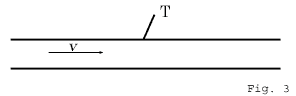
- The trajectory of a falling object, such as a stone dropped from a moving train, appears differently depending on whether the observer is on the train or the ground.
- A single event can be described as a straight line in one coordinate system and a parabola in another, proving that path-curves do not exist independently.
- This relativity of motion underscores that there is no such thing as an 'absolute' trajectory outside of a specific frame of reference.
I should load my conscience with grave sins against the sacred spirit of lucidity were I to formulate the aims of mechanics in this way, without serious reflection and detailed explanations.
Relativity of Reference Systems
- Einstein demonstrates that the trajectory of a moving object, such as a falling stone, depends entirely on the observer's frame of reference.
- The text asserts that there is no such thing as an absolute trajectory, only a path relative to a specific body of reference.
- A complete description of motion requires the integration of time measurements, which must be observable and measurable magnitudes.
- A Galileian system of coordinates is defined as a reference frame where the law of inertia holds true, unlike systems that rotate relative to the stars.
- The Principle of Relativity suggests that objects in uniform motion in one system will maintain uniform motion when viewed from another non-accelerating system.
With the aid of this example it is clearly seen that there is no such thing as an independently existing trajectory (lit. "path-curve" 1)), but only a trajectory relative to a particular body of reference.
The Principle of Relativity
- Objects moving uniformly in a straight line relative to one coordinate system maintain that motion when viewed from another system in uniform translatory motion.
- The restricted principle of relativity states that natural phenomena follow the same general laws in all coordinate systems moving uniformly without rotation.
- Although classical mechanics brilliantly describes the motion of heavenly bodies, newer fields like electrodynamics began to challenge its foundational assumptions.
- Einstein argues it is logically improbable for a fundamental principle to hold with perfect exactness in the domain of mechanics but fail in another domain.
- Without this principle, physics would be forced to identify one specific frame of reference as being 'absolutely at rest' while all others are 'in motion.'
Let us imagine a raven flying through the air in such a manner that its motion, as observed from the embankment, is uniform and in a straight line.
Relativity and Velocity Paradoxes
- Einstein posits that without relativity, laws of nature would vary depending on an object's velocity and direction relative to an absolute rest system.
- Earth's orbital motion provides a test case, yet experiments show no directional variation in physical laws, validating the principle of relativity.
- Classical mechanics uses a simple additive theorem for velocities, exemplified by a man moving through a railway carriage.
- The text introduces a fundamental tension by asserting that this common-sense addition of velocities is physically incorrect.
- The propagation of light at a constant speed in a vacuum is identified as a simple yet potentially incompatible law with classical mechanics.
We shall see later that this result, which expresses the theorem of the addition of velocities employed in classical mechanics, cannot be maintained ; in other words, the law that we have just written down does not hold in reality.
Light and Relativity Conflict
- The law of light propagation states that light travels in a vacuum at a constant velocity c, independent of the source's motion.
- Classical calculations suggest that light's velocity relative to a moving railway carriage should be different from its velocity relative to the embankment.
- This mathematical result directly contradicts the Principle of Relativity, which asserts that natural laws must be identical in all reference systems.
- Physicists face a theoretical crisis: they must either discard the Principle of Relativity or modify the law of light propagation.
- The dilemma is particularly challenging because both principles are deeply rooted in physical observation and logical simplicity.
Who would imagine that this simple law has plunged the conscientiously thoughtful physicist into the greatest intellectual difficulties?
Relativity and Physical Simultaneity
- Early theoretical conflicts arose between the principle of relativity and the observed constancy of the speed of light in a vacuum.
- Despite a lack of contradictory empirical data, some prominent physicists were initially prepared to reject the principle of relativity to preserve electromagnetic laws.
- The Special Theory of Relativity resolved this impasse by systematically re-evaluating the fundamental physical conceptions of time and space.
- Einstein uses the example of lightning strikes at two distant points to illustrate that the concept of simultaneity is not as intuitive as it first appears.
- He asserts that a physical concept remains meaningless until a method is established to experimentally verify its existence in reality.
The concept does not exist for the physicist until he has the possibility of discovering whether or not it is fulfilled in an actual case.
The Definition of Simultaneity
- Einstein argues that the concept of simultaneity has no meaning unless it is defined through a specific experimental method.
- A midpoint observer can test simultaneity by determining if light from two distinct events reaches them at the exact same moment.
- The assumption that light travels at the same speed from both directions is presented as a necessary stipulation rather than a provable hypothesis.
- This definition of simultaneity allows for the synchronization of multiple identical clocks across a coordinate system.
- Physical 'time' is defined as the reading of a clock in the immediate spatial vicinity of a specific event.
It would thus appear as though we were moving here in a logical circle.
The Relativity of Simultaneity
- Einstein establishes the physical hypothesis that identical clocks at rest within the same reference frame maintain a constant and synchronized rate of time.
- The definition of simultaneity relies on the assumption that the velocity of light in a vacuum is constant regardless of the observer's position.
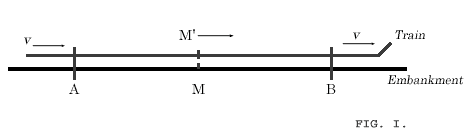
- A thought experiment involving a moving train and a stationary embankment illustrates how motion affects the perception of event timing.
- An observer on a moving train will perceive a flash from the front of the train earlier than one from the rear because they are moving toward the oncoming light beam.
- The core conclusion is that two events which are simultaneous relative to one reference body are not simultaneous when viewed from a different moving reference body.
Now in reality (considered with reference to the railway embankment) he is hastening towards the beam of light coming from B , whilst he is riding on ahead of the beam of light coming from A.
Relativity of Simultaneity
- Observers in different states of motion will perceive the timing of the same events differently, meaning simultaneity is relative to the frame of reference.
- Every coordinate system has its own specific time, and a statement regarding the time of an event only has meaning if the reference body is specified.
- The abandonment of the traditional assumption of absolute time resolves the conflict between the constant speed of light and the principle of relativity.
- Measuring the distance between points on a moving object requires determining their positions at a specific time, making distance measurements relative to the observer's frame.
Every reference-body (co-ordinate system) has its own particular time; unless we are told the reference-body to which the statement of time refers, there is no meaning in a statement of the time of an event.
Relativity of Space and Time
- Measuring the length of a moving train from a stationary embankment may yield a different result than measuring it from within the train itself.
- Einstein identifies two 'unjustifiable hypotheses' of classical mechanics: that time intervals and distances are independent of an observer's motion.
- Rejecting these classical assumptions resolves the apparent contradiction between the constant speed of light and the principle of relativity.
- The text proposes the need for a specific transformation law to reconcile space-time measurements across different reference bodies.
- Einstein suggests conceptualizing reference frames as three-dimensional frameworks of rods to localize any event in space.
Thus the length of the train as measured from the embankment may be different from that obtained by measuring in the train itself.
Mathematical Framework of Transformation
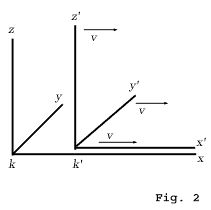
- Einstein extends the thought experiment into three-dimensional space using two coordinate systems, K for the embankment and K1 for the train.
- Every physical event is defined by its spatial coordinates and its specific time value within its respective reference framework.
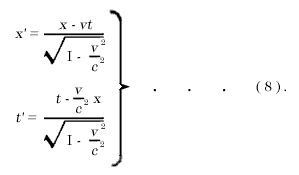
- The Lorentz transformation equations are introduced to define the relationship between the two systems while maintaining the constant speed of light.
- The older Galilei transformation is contrasted as a system that incorrectly assumes time and length are absolute across all frames of reference.
- By applying the Lorentz equations, Einstein mathematically proves that light travels at velocity c for observers in both the stationary and moving frames.
Without committing any fundamental error, we can disregard the fact that in reality these frameworks would continually interfere with each other, owing to the impenetrability of solid bodies.
Moving Rods and Clocks
- The Lorentz transformation equations confirm that the velocity of light remains constant across different reference frames, regardless of their relative motion.
- A moving rigid rod undergoes length contraction, meaning it appears shorter to a stationary observer as its velocity increases.
- Time dilation occurs in moving reference frames, where clocks appear to run more slowly than they would if they were at rest.
- The speed of light serves as a fundamental limiting velocity that can neither be reached nor exceeded by any physical object.
- These physical phenomena demonstrate that measurements of length and time are not absolute but are relative to the state of motion of the observer.
The rigid rod is thus shorter when in motion than when at rest, and the more quickly it is moving, the shorter is the rod.
Velocity Addition and Light
- Time dilation implies that a moving clock runs slower than one at rest, reinforcing light speed as a universal limit.
- Classical mechanics dictates a simple additive law for velocities, which Einstein contrasts with the relativistic addition formula.
- The author acknowledges that while these relativistic effects are subtle at human speeds, they produce singular results that require experimental proof.
- Fizeau’s experiment with light in moving liquids is introduced as the historical and scientific benchmark for testing these competing theories.
As a consequence of its motion the clock goes more slowly than when at rest. Here also the velocity c plays the part of an unattainable limiting velocity.
Heuristic Value of Relativity
- Experiments by Fizeau and Zeeman on the propagation of light in moving liquids provide empirical support for the Lorentz transformation over the Galilean model.
- Einstein acknowledges H.A. Lorentz's earlier work but emphasizes that relativity simplifies and generalizes these previously independent electrodynamic hypotheses.
- The theory originates from the unification of the principle of relativity and the constant speed of light in a vacuum.
- A rigorous mathematical requirement of the theory is that all general laws of nature must be covariant with respect to Lorentz transformations.
- This principle of covariance serves as a critical heuristic guide for researchers attempting to uncover new fundamental laws of physics.
Rather has the latter been developed trom electrodynamics as an astoundingly simple combination and generalisation of the hypotheses, formerly independent of each other, on which electrodynamics was built.
General Results of Special Relativity
- The theory acts as a heuristic aid by demanding that all general laws of nature remain co-variant with respect to Lorentz transformations.
- Special relativity simplifies the theoretical structure of electrodynamics, reducing the number of independent hypotheses required to support the Maxwell-Lorentz theory.
- Classical mechanics is modified for high-velocity motions, showing that kinetic energy approaches infinity as a particle nears the speed of light.
- The velocity of any material point is physically constrained to remain below the speed of light, regardless of the energy used for acceleration.
- The most significant general result is the unification of the previously independent conservation laws of mass and energy into a single principle.
The special theory of relativity has rendered the Maxwell-Lorentz theory so plausible, that the latter would have been generally accepted by physicists even if experiment had decided less unequivocally in its favour.
Mass-Energy Equivalence
- The special theory of relativity unifies the separate laws of conservation of mass and energy into a single principle.
- Einstein demonstrates that a body's inertial mass is not a fixed constant but changes whenever the body's energy levels change.
- The energy of a system can be measured by its inertial mass, making mass a concentrated form of energy represented by the term mc².
- Classical mechanics viewed mass conservation as independent only because energy-induced mass changes are typically too small to perceive.
- Relativity replaces the Newtonian concept of instantaneous action at a distance with transmission that occurs at the finite velocity of light.
The inertial mass of a body is not a constant but varies according to the change in the energy of the body.
Experience and Special Relativity
- The special theory of relativity draws significant support from the established Maxwell-Lorentz theory of electromagnetic phenomena.
- Empirical evidence for the theory includes the observed aberration of fixed stars and the Doppler shift in the spectral lines of light from those stars.
- The Maxwell-Lorentz framework is so well-supported that no competing theory has successfully held its own against experimental testing.
- Scientists faced a fundamental challenge in explaining why electrons do not scatter under the mutual repulsion of their own negative electrical charges.
- To reconcile theory with the motion of electrons, H. A. Lorentz introduced the hypothesis that electrons undergo physical contraction in their direction of travel.
For since electrical masses of one sign repel each other, the negative electrical masses constituting the electron would necessarily be scattered under the influence of their mutual repulsions, unless there are forces of another kind operating between them, the nature of which has hitherto remained obscure to us.
Relativity and the Ether Problem
- Lorentz hypothesized that the form of the electron contracts in the direction of motion to align mathematical theory with experimental observations.
- The theory of relativity arrives at the same law of motion for the electron without needing any specific hypotheses about its physical structure or behavior.
- Early 20th-century physicists believed that one unique coordinate system was at rest relative to a hypothetical 'æther' that permeated space.
- Attempts to detect the Earth's motion against this æther through terrestrial experiments consistently failed to produce any measurable result.
- The Michelson-Morley experiment, designed to detect æther-drift using light interference, produced a negative result that deeply perplexed the scientific community.
But the experiment gave a negative result — a fact very perplexing to physicists.
The Four-Dimensional World
- The Michelson-Morley experiment's failure to detect movement through the æther puzzled physicists until the concept of length contraction was introduced.
- Relativity explains contraction as a relational effect between coordinate systems rather than a physical hypothesis designed to rescue the æther.
- By removing the need for a 'specially favoured' coordinate system, the theory of relativity renders the concept of æther-drift meaningless.
- Minkowski redefined the physical 'world' as a four-dimensional space-time continuum, integrating time as a coordinate equivalent to space.
The non-mathematician is seized by a mysterious shuddering when he hears of "four-dimensional" things, by a feeling not unlike that awakened by thoughts of the occult.
The Four-Dimensional Continuum
- Classical mechanics historically treated time as an absolute, independent entity that remained constant regardless of a system's motion.
- Under the theory of relativity, time loses its independence and becomes inextricably linked with space through the equations of the Lorentz transformation.
- Hermann Minkowski's breakthrough was recognizing that the four-dimensional space-time continuum shares a profound formal relationship with Euclidean geometry.
- By treating time as a fourth coordinate, physical laws gain a mathematical symmetry that was essential for the birth of the general theory of relativity.
Without it the general theory of relativity, of which the fundamental ideas are developed in the following pages, would perhaps have got no farther than its long clothes.
Defining General Relativity
- Einstein distinguishes between the simple observation of relative motion and the profound assertion that physical laws maintain the same form across reference bodies.
- The Special Theory of Relativity is constrained to Galileian reference-bodies, which are systems in uniform, rectilinear, and non-rotary motion.
- The author emphasizes that the equivalence of these reference bodies is an empirical finding rather than a self-evident truth derived from the concept of motion.
- The transition to the General Theory of Relativity involves the radical claim that all bodies of reference are equivalent, regardless of their specific state of motion.
For the physical description of natural processes, neither of the reference bodies K, K1 is unique (lit. " specially marked out ") as compared with the other.
Expanding Relativity and Gravitational Fields
- Einstein proposes the general principle of relativity, asserting that all reference frames should be equivalent for formulating the laws of nature regardless of their state of motion.
- The experience of non-uniform motion, such as the sudden jerk felt in a braking railway carriage, initially suggests that acceleration possesses an absolute physical reality that defies relativity.
- Transitioning from the special theory to the general theory requires a more abstract formulation to reconcile the mechanical differences observed in accelerated systems.
- Einstein rejects the idea of 'action at a distance,' arguing that physical phenomena like gravity must involve an intermediary medium rather than direct attraction through empty space.
- The concept of a 'field' is introduced as a physically real entity in space that mediates forces, modeled after Faraday’s interpretation of magnetic fields.
If the motion of the carriage is now changed into a non-uniform motion, as for instance by a powerful application of the brakes, then the occupant of the carriage experiences a correspondingly powerful jerk forwards.
Equality of Mass and Inertia
- The concept of a field allows for a more satisfactory theoretical representation of how forces like magnetism and gravity transmit across space.
- A fundamental property of gravity is that it accelerates all bodies at the same rate, regardless of their material composition or physical state.
- Newtonian mechanics reveals that the ratio of gravitational mass to inertial mass must be constant for all bodies to explain uniform acceleration.
- Einstein argues that weight and inertia are simply two different manifestations of the same inherent quality of a body.
The same quality of a body manifests itself according to circumstances as 'inertia' or as 'weight' (lit. 'heaviness').
Equivalence of Gravity and Acceleration
- Einstein presents a thought experiment featuring an observer inside a large chest in a gravity-free region of space.
- When a constant force pulls the chest upward, the observer feels a pressure from the floor identical to the sensation of gravity.
- Dropped objects within the accelerated chest move toward the floor at the same rate, mirroring behavior in a gravitational field.
- Einstein argues that the observer’s conclusion—that they are in a stationary gravitational field—is as valid as the view that they are accelerating.
- This principle of equivalence relies on the fundamental equality of inertial and gravitational mass, supporting a generalized theory of relativity.
He must fasten himself with strings to the floor, otherwise the slightest impact against the floor will cause him to rise slowly towards the ceiling of the room.
Relativity of Accelerated Frames
- Einstein argues that the principle of relativity can include accelerated reference bodies, leading to a generalized postulate of relativity.
- This interpretation is only possible because of the fundamental equality between inertial and gravitational mass.
- Through the accelerated chest experiment, Einstein illustrates how internal tension can be interpreted as either acceleration or a gravitational pull.
- The author clarifies that while local acceleration can simulate gravity, complex fields like the Earth's cannot be entirely eliminated by coordinate shifts.
- The sensation of a jerk in a braking carriage can be interpreted as the sudden appearance of a forward-directed, time-varying gravitational field.
My body of reference (the carriage) remains permanently at rest. With reference to it, however, there exists (during the period of application of the brakes) a gravitational field which is directed forwards and which is variable with respect to time.
The Problem of Privileged Motion
- Einstein suggests that the experience of a braking carriage can be interpreted as the influence of a temporary gravitational field rather than absolute deceleration.
- Classical mechanics is criticized for giving preference to specific reference frames without providing a physical justification for doing so.
- An analogy involving two identical pans on a stove illustrates the logical need for observable causes to explain different physical behaviors.
- The text notes that while Newton failed to address this logical gap, Ernst Mach recognized the need for a new foundation for mechanics.
- The general principle of relativity is presented as necessary because it applies the laws of nature to all bodies of reference regardless of motion.
But if I now notice a luminous something of bluish colour under the first pan but not under the other, I cease to be astonished, even if I have never before seen a gas flame.
Light and Gravitational Fields
- The general principle of relativity allows for the derivation of gravitational properties by observing how natural processes appear from accelerated reference frames.
- A body in uniform rectilinear motion relative to a Galileian frame appears to follow an accelerated, curvilinear path when viewed from an accelerated reference body.
- Einstein concludes that light rays do not travel in straight lines but are propagated curvilinearly when passing through gravitational fields.
- This theory predicts that stars near the sun will appear displaced by 1.7 seconds of arc during a total solar eclipse, a claim requiring astronomical verification.
- The curvature of light implies that the law of the constancy of the velocity of light in a vacuum, a pillar of special relativity, is not universally valid.
From this we conclude, that, in general, rays of light are propagated curvilinearly in gravitational fields.
The Scope of General Relativity
- Einstein explains that the constancy of the velocity of light is not universally valid because light rays curve when passing through gravitational fields.
- He clarifies that general relativity does not overthrow the special theory but instead defines its limited domain of validity where gravity can be disregarded.
- The relationship between the theories is compared to electrostatics and electrodynamics, where the former remains a valid limiting case of the latter.
- The text identifies the investigation of the laws governing gravitational fields themselves as the primary objective of the general theory.
- Einstein suggests that while some gravitational fields can be derived from motion, a deeper difficulty exists in formulating a truly universal law of gravitation.
No fairer destiny could be allotted to any physical theory, than that it should of itself point out the way to the introduction of a more comprehensive theory, in which it lives on as a limiting case.
Gravity in Rotating Frames
- Einstein suggests general laws of gravitation can be derived from specific cases, provided we extend the concept of the space-time continuum.
- Using a rotating disc as a reference body, the author demonstrates how centrifugal force can be interpreted as a gravitational field by an observer on that disc.
- This interpretation allows an observer on a rotating body to consider themselves 'at rest,' even if the resulting gravitational field contradicts Newtonian physics.
- The investigation moves toward a practical level, questioning how physical tools like clocks and measuring rods behave within these non-inertial frames.
But between the clear vision of this goal and its actual realisation it was necessary to surmount a serious difficulty, and as this lies deep at the root of things, I dare not withhold it from the reader.
Rotating Discs and Relativity
- Clocks at the edge of a rotating disc run slower than those at the center because of their relative velocity in a non-rotating frame.
- These discrepancies make it impossible to establish a uniform definition of time or simultaneity across a body in rotation or a gravitational field.
- Measuring rods suffer length contraction when placed tangentially to the motion of the disc but remain unchanged when placed radially.
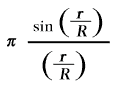
- Because of these physical distortions, the ratio of circumference to diameter on the disc no longer equals the mathematical constant pi.
- The failure of Euclidean geometry on the rotating disc necessitates a subtle detour to define coordinates and apply the laws of general relativity.
Hence the idea of a straight line also loses its meaning.
The Euclidean Continuum
- Einstein notes that a subtle detour is necessary to precisely apply the postulate of general relativity to the natural laws.
- A continuum is defined as a surface where one can move between any two points through a continuous sequence of neighboring points without executing jumps.
- A Euclidean continuum is demonstrated through a thought experiment involving tiling a surface with equal-length rods to form perfect squares.
- Cartesian coordinates are established by counting the number of rods required to reach a point from a fixed origin along the grid.
- The author highlights that the successful construction of such a grid is an especial property of Euclidean geometry and may not be possible on all surfaces.
It is a veritable wonder that we can carry out this business without getting into the greatest difficulties.
Geometry and Physical Distortion
- Cartesian coordinates are established through a grid of rigid rods that serve as unit lengths across a surface.
- Uneven heating causes localized expansion of these rods, breaking the symmetry required to maintain a Euclidean continuum.
- If all materials are affected equally by such conditions, the standard definition of distance becomes fundamentally arbitrary.
- This dilemma requires discarding Cartesian coordinates in favor of a method that does not assume Euclidean validity for rigid bodies.
- Einstein notes that mathematicians like Gauss and Riemann provided the formal framework for these non-Euclidean continua.
But our construction of squares must necessarily come into disorder during the heating, because the little rods on the central region of the table expand, whereas those on the outer part do not.
Mapping the Non-Euclidean Continuum
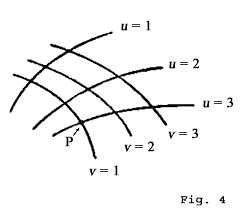
- Einstein introduces Gaussian coordinates as the primary method for handling geometric relationships in non-Euclidean continua where Cartesian coordinates fail.
- In this system, arbitrary curves cover a surface to assign unique numerical values to every point, creating an infinitely dense grid.
- The distance between adjacent points is determined by coefficients that describe how measuring rods behave relative to the chosen coordinate curves.
- This analytical method successfully scales to multiple dimensions, allowing for the mathematical description of a four-dimensional space-time continuum.
The surface is not a Euclidean continuum with respect to the rods, and we cannot define Cartesian co-ordinates in the surface.
Gaussian Coordinates and Space-Time
- Gaussian coordinates provide a way to define points in any number of dimensions by assigning sets of numbers to them where neighboring points have adjacent values.
- The distance between points in a non-Euclidean continuum is defined by a formula with variable magnitudes that change according to their position in space.
- A general continuum can only be mathematically modeled if its smallest regions can be regarded as Euclidean systems.
- Minkowski's four-dimensional space-time continuum utilizes specific coordinate systems governed by the Lorentz transformation to ensure the universal validity of the law of light transmission.
Hence the imperfections of the construction of squares in the previous section do not show themselves clearly until this construction is extended over a considerable portion of the surface of the table.
The Non-Euclidean Continuum
- Minkowski identified that the Lorentz transformation maintains an invariant interval, known as distance, between two events in four-dimensional space-time.
- By employing an imaginary time variable, the space-time of the special theory of relativity can be interpreted as a flat, Euclidean four-dimensional continuum.
- The general theory of relativity asserts that the velocity of light is not constant but depends on the coordinates whenever a gravitational field is present.
- The presence of gravity renders it impossible to establish a global system of rigid rods and clocks that provide direct, uniform physical measurements.
- Einstein concludes that the space-time continuum in general relativity is non-Euclidean, behaving like a physical surface with local variations that distort geometry.
In view of the resuIts of these considerations we are led to the conviction that, according to the general principle of relativity, the space-time continuum cannot be regarded as a Euclidean one, but that here we have the general case, corresponding to the marble slab with local variations of temperature, and with which we made acquaintance as an example of a two-dimensional continuum.
Gaussian Spacetime Coordinates
- Traditional rigid reference bodies fail in a non-Euclidean continuum, requiring a new method of measurement.
- Einstein introduces Gaussian coordinates, four arbitrary numbers assigned to events that lack direct physical meaning individually.
- Material points are represented as continuous lines in a four-dimensional continuum, reflecting their persistent existence through time.
- The fundamental evidence of physical reality consists of encounters, where two world-lines share a common set of coordinate values.
- Gaussian coordinates allow for a universal physical description that is not restricted to the constraints of Euclidean geometry.
The only statements having regard to these points which can claim a physical existence are in reality the statements about their encounters.
The General Relativity Principle
- Gaussian coordinates replace rigid reference bodies because they do not require space-time to have a Euclidean character.
- The General Principle of Relativity asserts that all Gaussian coordinate systems are equivalent for formulating the laws of nature.
- Gravitational fields prevent the existence of rigid bodies and alter the behavior of clocks, making standard physical definitions of time difficult.
- General Relativity requires equations to remain valid under arbitrary substitutions of variables, going beyond the limited Lorentz transformation.
- To describe space-time in gravitational fields, science must utilize non-rigid reference bodies that can move and deform arbitrarily.
For this reason non-rigid reference-bodies are used, which are as a whole not only moving in any way whatsoever, but which also suffer alterations in form ad lib. during their motion.
The Reference-Mollusc Concept
- Gravitational fields influence the motion of clocks, rendering traditional rigid definitions of time insufficient for the general theory of relativity.
- Einstein introduces the concept of the 'reference-mollusc,' a non-rigid reference body that can undergo arbitrary alterations in form during motion.
- The general principle of relativity requires that all laws of nature remain valid and independent of the specific 'mollusc' chosen as a coordinate system.
- The behavior of matter in gravitational fields is derived by mathematically transforming simple Galileian domains into complex Gaussian coordinate systems.
This non-rigid reference-body, which might appropriately be termed a "reference-mollusc", is in the main equivalent to a Gaussian four-dimensional co-ordinate system chosen arbitrarily.
Foundations of General Relativity
- Einstein outlines the essential demands for a general law of the gravitational field, focusing on the postulate of relativity and energy conservation.
- The theory extends special relativity to determine how gravity affects physical processes involving clocks, measuring rods, and material points.
- Newtonian physics is revealed to be a first approximation of General Relativity, valid only under conditions of weak gravity and slow velocities.
- General Relativity corrects defects in classical mechanics and successfully interprets the empirical equality of inertial and gravitational mass.
- Einstein highlights how his theory explains the anomalous orbit of Mercury, a specific astronomical observation that classical mechanics could not account for.
The theory of gravitation derived in this way from the general postulate of relativity excels not only in its beauty ; nor in removing the defect attaching to classical mechanics which was brought to light in Section 21; nor in interpreting the empirical law of the equality of inertial and gravitational mass ; but it has also already explained a result of observation in astronomy, against which classical mechanics is powerless.
Relativity and Island Universes
- General Relativity successfully accounts for the 43-arcsecond orbital rotation of Mercury, a phenomenon classical mechanics could only explain through improbable hypotheses.
- The theory is empirically supported by the observed curvature of light rays near the sun and the displacement of spectral lines from distant stars.
- Einstein identifies a fundamental flaw in Newtonian mechanics when applied to the universe as a whole, specifically regarding the distribution of matter.
- Newtonian theory requires the universe to exist as a finite island of stars surrounded by an infinite void, a concept Einstein describes as unsatisfactory.
The stellar universe ought to be a finite island in the infinite ocean of space.
Limits of the Newtonian Universe
- Newtonian physics suggests the stellar universe is a finite island situated within an infinite, empty ocean of space.
- A major flaw in this model is that light and matter would perpetually escape the system, leading to a systematic impoverishment of the universe.
- Proposed modifications to Newton's law to allow for infinite constant density are criticized for being arbitrary and lacking theoretical foundations.
- Non-Euclidean geometry offers a conceptual alternative where space can be considered finite without having physical boundaries or a center.
Such a finite material universe would be destined to become gradually but systematically impoverished.
Finite Yet Boundless Universes
- Einstein uses the analogy of two-dimensional beings to compare a flat, infinite universe with a curved, spherical one.
- On a spherical surface, a straight line is actually a great circle of finite length, meaning the universe has a finite area but no boundaries or edges.
- Geometric measurements, such as the ratio of a circle's circumference to its diameter, allow beings to detect the curvature and size of their universe.
- A spherical universe appears indistinguishable from a flat Euclidean plane if the observer only has access to a very small portion of it.
- This conceptual framework demonstrates how a universe can be finite in volume while remaining unbounded for its inhabitants.
The great charm resulting from this consideration lies in the recognition of the fact that the universe of these beings is finite and yet has no limits.
Spherical and Elliptical Space
- Beings living on a small portion of a spherical surface may perceive their world as flat, making it difficult to determine if their universe is finite or infinite.
- In a spherical universe, the area of a sphere increases with its radius only up to a maximum 'world-radius' before gradually decreasing back to zero.
- Einstein describes Riemann's three-dimensional spherical space as being finite in volume yet possessing no physical boundaries or limits.
- Lines radiating from a single point in curved space eventually converge at a 'counter-point' once they have traversed the entire spherical universe.
- Elliptical space is presented as a symmetrical alternative where the two opposite counter-points are identical and indistinguishable from one another.
At first, the straight lines which radiate from the starting point diverge farther and farther from one another, but later they approach each other, and finally they run together again at a "counter-point" to the starting point.
Matter and Spatial Curvature
- Einstein introduces elliptical space as a curved, symmetric model where all points are equivalent and the universe is closed without limits.
- The general theory of relativity establishes that the geometrical properties of space are not independent but are fundamentally determined by the distribution of matter.
- Calculations reveal that a quasi-Euclidean, infinite universe would necessitate an average matter density of zero, a result that contradicts physical observation.
- If the average density of matter is non-zero, the universe must be spherical or elliptical, implying it is necessarily finite rather than infinite.
- The actual universe is described as 'quasi-spherical,' possessing local irregularities due to non-uniform matter distribution while maintaining a finite overall structure.
We might imagine that, as regards geometry, our universe behaves analogously to a surface which is irregularly curved in its individual parts, but which nowhere departs appreciably from a plane: something like the rippled surface of a lake.
Deriving the Lorentz Transformation
- Einstein asserts that the universe is necessarily finite and quasi-spherical, with its size determined by the average density of matter.
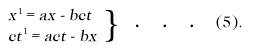
- The derivation of the Lorentz transformation begins by examining light signals as they appear to observers in two different coordinate systems.
- Mathematical relations are established to ensure that light propagates at a constant velocity across both frames of reference.
- The relative velocity between coordinate systems is defined by the movement of one system's origin relative to the other.
- The principle of relativity dictates that unit measuring rods must maintain the same length when compared between systems at rest and in motion.
In order to see how the points of the x-axis appear as viewed from K, we only require to take a "snapshot" of K1 from K; this means that we have to insert a particular value of t (time of K), e.g. t = 0.
Deriving the Lorentz Transformation
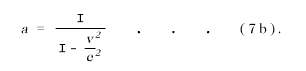
- Einstein demonstrates that the principle of relativity requires length measurements to be reciprocal between two systems moving at a constant velocity.
- The derivation utilizes mathematical "snapshots" taken at specific times to determine the constants for the transformation between coordinate systems.
- The Lorentz transformation is shown to satisfy the postulate that light propagates at the same velocity in all directions for any observer.
- The mathematical invariance of the light-propagation equation across frames confirms that the speed of light is a constant of nature.
- Einstein explains that these transformations can be generalized to include arbitrary directions of motion and spatial orientations of the axes.
In order to see how the points of the x-axis appear as viewed from K, we only require to take a " snapshot " of K1 from K; this means that we have to insert a particular value of t (time of K), e.g. t = 0.
Minkowski's Four-Dimensional World
- Lorentz transformations can be generalized to include both spatial rotations and translations in any direction beyond the x-axis.
- By treating time as an imaginary fourth coordinate, the mathematical condition for the transformation becomes identical to that of spatial coordinates.
- Hermann Minkowski's 'world' concept reimagines physics as a four-dimensional continuum where point-events are fixed within a mathematical 'existence'.
- The Lorentz transformation is formally equivalent to a rotation of the coordinate system within this four-dimensional Euclidean space.
- Einstein argues that the evolution of science requires intuition and deductive thought rather than being a purely empirical cataloging of observations.
From a 'happening' in three-dimensional space, physics becomes, as it were, an 'existence' in the four-dimensional 'world.'
The Evolution of Scientific Theory
- Science transcends simple empirical cataloging by utilizing intuition and deductive logic to build theoretical systems from fundamental axioms.
- A theory's validity and 'truth' are ultimately determined by its ability to unify and correlate a vast array of individual observations.
- Multiple theories with fundamentally different assumptions can lead to nearly identical predictions, making them difficult to distinguish experimentally.
- Newtonian mechanics and General Relativity show such extensive agreement that only a few specific deductions allow for investigation into their differences.
- The motion of Mercury's perihelion serves as a key test case where the predictions of Newtonian gravity and General Relativity diverge.
But this point of view by no means embraces the whole of the actual process ; for it slurs over the important part played by intuition and deductive thought in the development of anexact science.
Empirical Proofs of Relativity
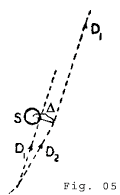
- General relativity predicts that planetary orbits are not perfectly closed ellipses but rotate over time, filling an annular region of the orbital plane.
- The theory explains a previously mysterious 43-second-per-century shift in Mercury's perihelion that Newtonian mechanics could not account for.
- Einstein asserts that gravitational fields curve the path of light rays, similar to how they influence the movement of physical bodies.
- The predicted light deflection is caused in equal parts by the sun's Newtonian attraction and the geometric curvature of space itself.
- Validation of the theory's light-deflection prediction requires photographing stars near the sun's edge during a total solar eclipse.
The line of the orbit would not then be a closed one but in the course of time it would fill up an annular part of the orbital plane, viz. between the circle of least and the circle of greatest distance of the planet from the sun.
Confirming General Relativity
- Astronomers used the unique conditions of a total solar eclipse to observe stars near the sun that are normally invisible due to atmospheric illumination.
- Einstein predicted that the sun's mass would deflect light from distant stars, causing them to appear slightly displaced from their true positions.
- In 1919, British expeditions to Brazil and West Africa successfully captured photographs to test this theory despite the material and psychological difficulties caused by World War I.
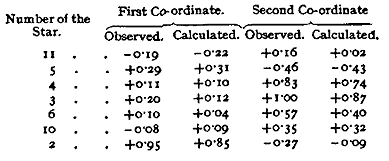
- The measured stellar displacements confirmed the general theory of relativity, requiring extreme precision to detect shifts of only a few hundredths of a millimeter.
- The text also introduces how gravitational potential and rotation affect the rate of clocks, explaining the displacement of spectral lines towards the red.
Undaunted by the [first world] war and by difficulties of both a material and a psychological nature aroused by the war, these societies equipped two expeditions — to Sobral (Brazil), and to the island of Principe (West Africa).
Gravitational Redshift and Relativity
- Einstein establishes that clocks at different gravitational potentials operate at different rates, using a rotating disc as an illustrative model.
- He identifies atoms as natural clocks, concluding that the frequency of light they emit depends on the strength of the gravitational field in which they are situated.
- The theory predicts a specific displacement towards the red for spectral lines on the surface of massive stars compared to those on Earth.
- Although early 20th-century measurements were contradictory and difficult to verify, researchers were actively working to confirm these minute changes.
- Einstein explicitly states that the entire framework of general relativity depends on the empirical discovery of this gravitational redshift.
If the displacement of spectral lines towards the red by the gravitational potential does not exist, then the general theory of relativity will be untenable.
Expanding Space and General Relativity
- Einstein's initial cosmological model required a 'cosmological term' to maintain the assumption of a static universe with a fixed radius.
- The mathematician Friedman demonstrated that dropping the static universe hypothesis allows for a model where the 'world radius' depends on time.
- Edwin Hubble's observations of redshift in distant nebulae provided empirical evidence that the system of stars is in a state of large-scale expansion.
- The displacement of spectral lines toward the red was definitely established in 1924, confirming a key prediction of the general theory of relativity.
- A paradox remains where the calculated age of the universe's expansion appears significantly shorter than the estimated age of stars.
If the displacement of spectral lines towards the red by the gravitational potential does not exist, then the general theory of relativity will be untenable.
The Limits of Expansion Theory
- Hubble's discovery of galactic line-shifts provides a significant empirical confirmation of the expanding universe theory.
- A chronological conflict arises because the expansion appears to have started more recently than the formation of the stars themselves.
- The discrepancy between the age of the expansion and the development of individual stars remains an unsolved mystery in physical astronomy.
- The theory of expanding space leaves the question of whether the universe is finite or infinite fundamentally undecided.
It is in no way known how this incongruity is to be overcome.
Logic and Geometric Truth
I adhered scrupulously to the precept of that brilliant theoretical physicist L. Boltzmann, according to whom matters of elegance ought to be left to the tailor and to the cobbler.
Light and Relativity Conflict
- Light in vacuum travels at constant speed c, independent of the source’s motion.
- This directly conflicts with classical velocity addition and the Principle of Relativity, creating a theoretical crisis.
Who would imagine that this simple law has plunged the conscientiously thoughtful physicist into the greatest intellectual difficulties?
The Relativity of Simultaneity
- A moving-train thought experiment shows that observers in different states of motion judge event timing differently.
- Events simultaneous relative to one reference body are not necessarily simultaneous in another moving reference body.
Now in reality (considered with reference to the railway embankment) he is hastening towards the beam of light coming from B , whilst he is riding on ahead of the beam of light coming from A.
Mass-Energy Equivalence
- Relativity unifies conservation of mass and conservation of energy into a single principle.
- A body’s inertial mass changes with its energy; mass is concentrated energy, expressed by mc².
The inertial mass of a body is not a constant but varies according to the change in the energy of the body.
Equivalence of Gravity and Acceleration
- An observer in an upward-accelerated chest feels effects indistinguishable from gravity.
- The observer’s claim to be in a stationary gravitational field is as valid as the claim that the chest is accelerating.
He must fasten himself with strings to the floor, otherwise the slightest impact against the floor will cause him to rise slowly towards the ceiling of the room.
Rotating Discs and Relativity
- On a rotating disc, edge clocks run slower than center clocks, making uniform time and simultaneity impossible.
- Measuring rods contract tangentially but not radially, so the circumference-to-diameter ratio no longer equals pi.
Hence the idea of a straight line also loses its meaning.
Expanding Space and General Relativity
- Friedman showed that abandoning a static universe permits a world radius that changes with time.
- Hubble’s redshifts in distant nebulae gave empirical evidence that the stellar system is expanding.
If the displacement of spectral lines towards the red by the gravitational potential does not exist, then the general theory of relativity will be untenable.