Generative illustration for Read Write Own







Read Write Own
Overview unavailable.
Building the Next Internet Era
- Chris Dixon's book 'Read Write Own' outlines a vision for the internet's next phase, centered on digital ownership and blockchain technology.
- The work traces the evolution of digital infrastructure from open protocol networks to the current dominance of centralized corporate networks.
- A central theme is the 'Attract-Extract Cycle,' which describes how corporate platforms eventually exploit the users and creators they initially courted.
- The author explores how tokens and blockchains can facilitate community-governed software, treating code like 'Lego bricks' through composability.
- The text argues that the most significant technological breakthroughs often start by appearing confusing, incomplete, or like mere toys to observers.
For any speculation which does not at first glance look crazy, there is no hope.
The Internet's Centralization Crisis
- The early internet was an open, permissionless platform where creators owned their work and operated under democratic governance.
- Starting in the mid-2000s, a small group of megacorporations gained control, with the top 1 percent of sites now dominating the vast majority of web traffic.
- The internet has transitioned from a decentralized network of equals to a permissioned system controlled by a handful of tech giants.
- Centralization has created negative externalities, including widespread user surveillance and an adversarial relationship between platforms and their users.
- Creators and startups now face significant risks because they depend on centralized platforms that can unilaterally change rules and seize audiences.
The network went from permissionless to permissioned.
The Tyranny of Gatekeepers
- Big Tech companies utilize widespread user surveillance and opaque privacy policies to exploit personal data for profit.
- Centralized platforms control public discourse and business success through non-transparent practices like deplatforming and shadowbanning.
- The current internet landscape forces startups and creators into a system of permission-seeking that incumbents use to thwart competition.
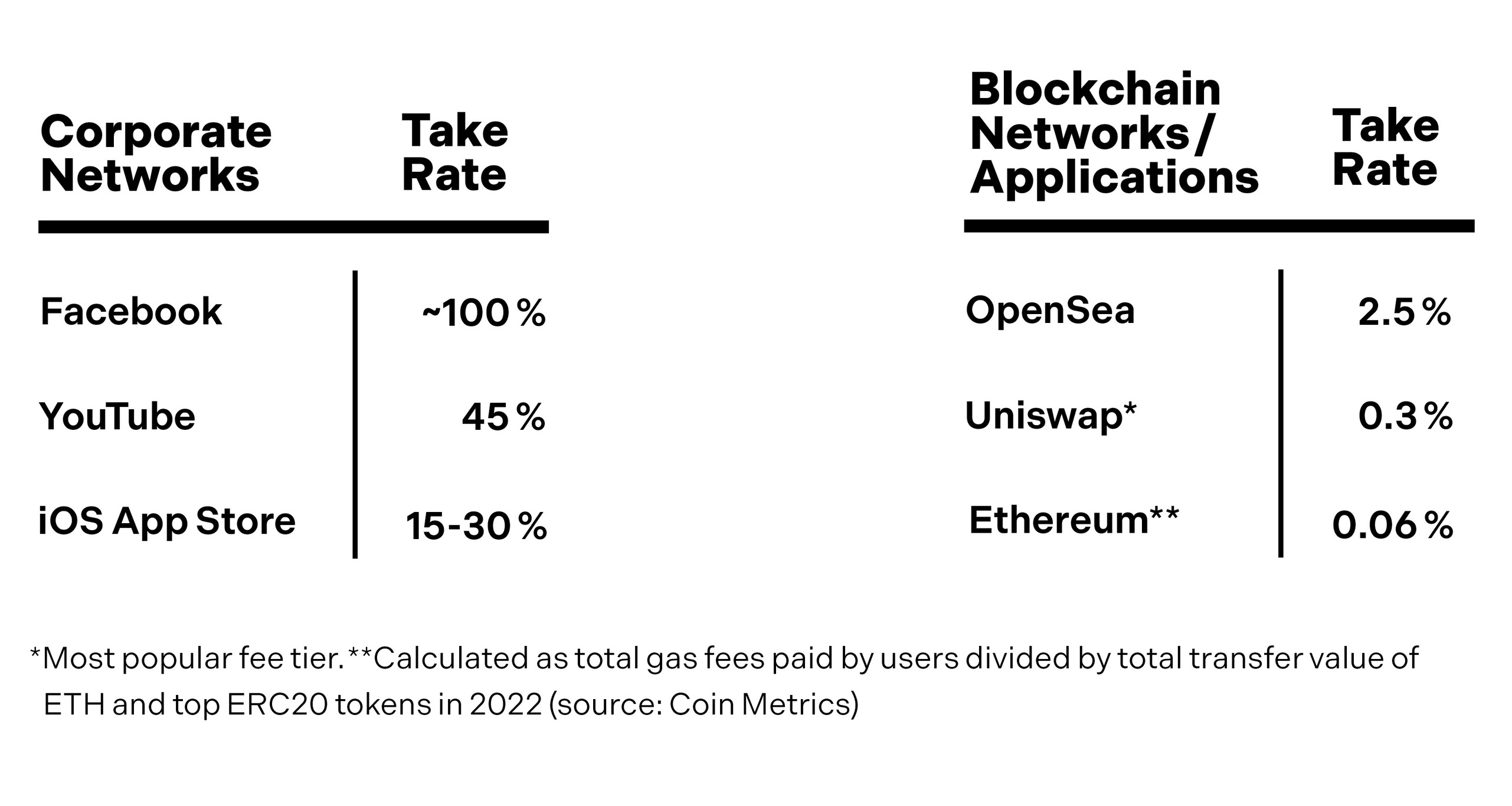
- Major social networks maintain nearly 100 percent take rates, extracting almost all revenue generated by the users and creators who provide the actual value.
- While networks are the primary engine of the internet, their private ownership concentrates power and wealth in the hands of a few corporate entities.
In business, permission becomes a pretense for tyranny.
The Big Tech Tax
- Big Tech corporations extract immense wealth by maintaining high take rates, often capturing nearly all the value created by independent users and creators.
- The mobile landscape is dominated by an Apple and Google duopoly that charges payment fees ten times higher than the industry standard.
- Social networks have historically crushed third-party developers by cutting off platform access, creating a quicksand environment that stifles startup innovation.
- Companies like Amazon and Google leverage their roles as essential infrastructure to unfairly promote their own products and undercut smaller competitors.
- This consolidation of power allows platforms to act as capricious gatekeepers, using restrictive policies to maintain dominance and eliminate consumer choice.
Developers know better than to lay foundations on quicksand.
Reclaiming the Centralized Internet
- Major tech platforms like Amazon and Apple utilize their market dominance to stifle competitors through high fees and exclusionary practices.
- The centralization of power is fundamentally transforming the internet from a decentralized network into a closed system that discourages innovation.
- Traditional government regulation may inadvertently strengthen incumbents by creating barriers to entry that smaller startups cannot afford to navigate.
- The software-based nature of the internet allows for it to be reshaped through new code, which acts as an encoding of human thought capable of rapid change.
Big Tech platforms have more than just a home field advantage. They get to rewrite the rules of the entire game for their sole benefit.
Evolution of Digital Networks
- Software is a uniquely expressive medium for human thought, functioning more like an art form than traditional engineering.
- The distribution of power and money on the internet is fundamentally determined by the architecture and design of its networks.
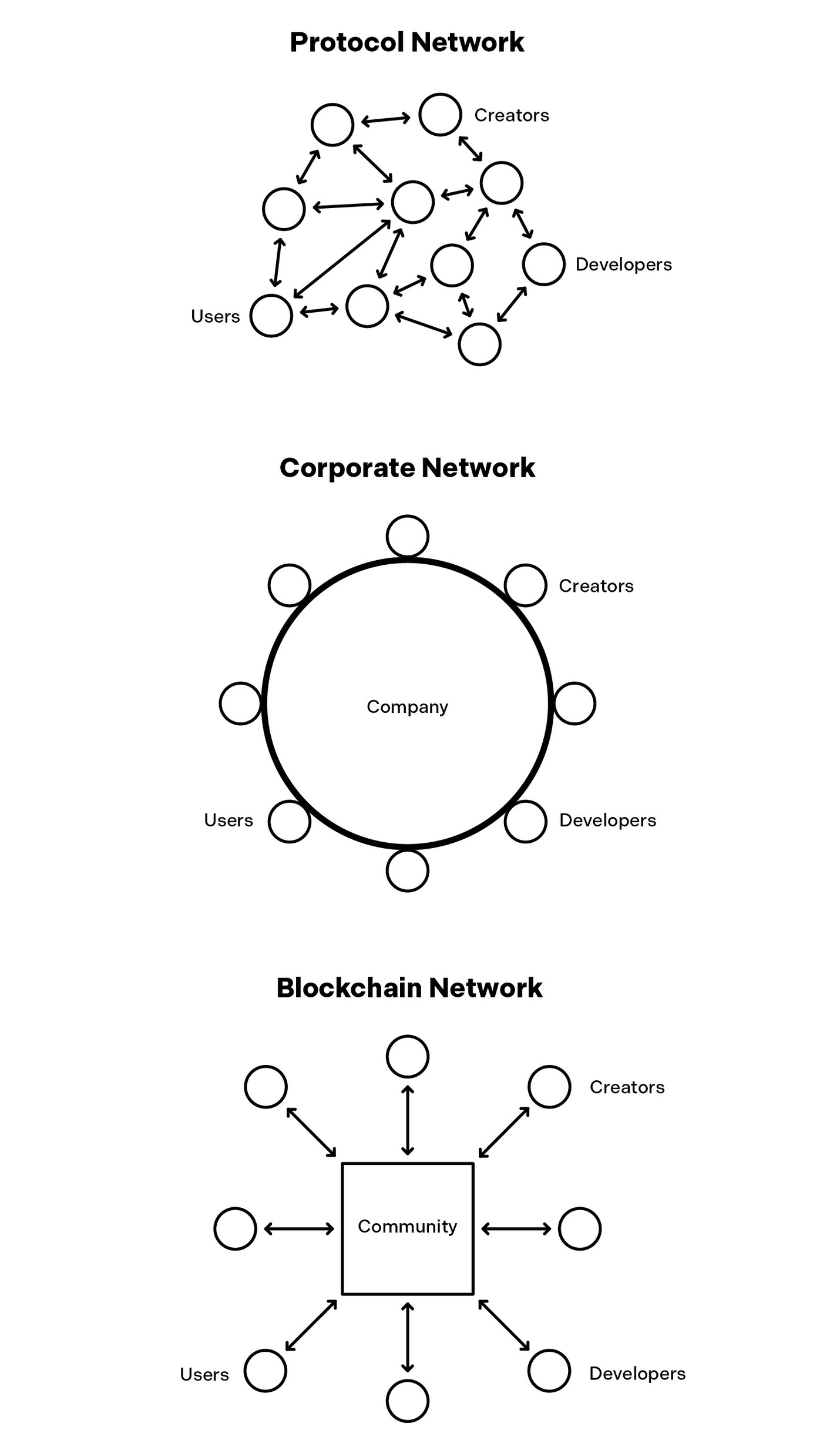
- Protocol networks represent open, democratic systems where control remains at the edges with the users and developers.
- Corporate networks operate as centralized 'walled gardens' where profits and power flow inward to the companies that own them.
- The history of the internet is divided into distinct eras: the 'read era' of open information and the 'read-write era' of corporate-led publishing.
Software is the encoding of human thought, just like writing or painting or cave drawings.
The Era of Digital Ownership
- The internet has evolved through three distinct architectures: the information-focused 'read' era, the publishing-driven 'read-write' era, and the emerging 'read-write-own' era.
- The current shift toward web3 and blockchains aims to democratize ownership, allowing users to become stakeholders with economic and governance power.
- Unlike traditional computers where hardware owners control the software, blockchains allow software to govern a network of hardware devices through inviolable rules.
- This inversion of power enables networks to make strong, software-enforced commitments to their users, counteracting the consolidation of Big Tech.
- Blockchain networks facilitate marketplaces and social connections with lower costs and increased user empowerment compared to corporate-controlled platforms.
Blockchains invert the hardware-software power relationship, like the internet before them.
The Casino and the Computer
- Blockchains enable strong behavioral commitments, creating networks that prioritize user empowerment over corporate interests and reduce transaction fees.
- The author likens blockchains to steel, arguing they provide a superior structural material for building more resilient and ambitious digital public works.
- A cultural divide exists between the 'casino,' focused on speculation and scandals, and the 'computer,' focused on building long-term internet infrastructure.
- While speculators dominate media headlines, the 'computer' group uses blockchain's financial mechanisms as a means to align incentives for genuine innovation.
- Meaningful technological progress in the blockchain space requires patience, often necessitating a decade-long horizon for development and value creation.
Asking “What problems do blockchains solve?” is like asking “What problems does steel solve over, say, wood?”
Computers Versus Casinos
- The author distinguishes between 'computer culture,' which focuses on long-term innovation and decade-long development cycles, and 'casino culture,' which prioritizes short-term speculation.
- True innovation in the software movement requires time to generate financial returns, often necessitating the long hold periods found in venture capital funds.
- Technology is fundamentally neutral; much like a hammer or nitrogen-based fertilizer, blockchains can be used to either build productive systems or fuel destructive speculation.
- The author aims to show how blockchain networks can empower users and revive the potential of open-source protocols that previously lost out to corporate-owned rivals.
- The book provides a roadmap for the internet's future by analyzing its history and the technical mechanisms that allow blockchains to solve urgent digital problems.
So, it’s the computer versus the casino battling it out to define the narrative for this software movement.
Network Design Is Destiny
- Blockchain networks serve as a critical tool for counterbalancing the consolidation of power by major internet corporations.
- The shift in global software development and the rise of AI threaten to accelerate the dominance of well-capitalized tech giants.
- The architecture of a network fundamentally dictates how wealth and power accumulate, effectively acting as an organizing framework for society.
- The distinction between digital 'bits' and physical 'atoms' is increasingly irrelevant because digital networks now shape every aspect of physical reality.
- The current transition in internet technology offers a rare opportunity for developers and users to reimagine and rebuild digital history.
This is a chance to create the internet you want, not the internet you inherited.
Fusion of Worlds
- Digital networks are often dismissed as frivolous, yet they profoundly influence physical realities including global politics, pandemics, and the worldview of individuals.
- Automation typically manifests as the transmutation of physical objects into digital networks, such as travel websites absorbing the tasks of human agents.
- The linguistic use of prefixes like 'e-' diminishes the perceived value of digital activities that have effectively become the new standard for commerce and communication.
- Unlike the industrial economy's focus on production costs, the internet economy derives power from network effects where value increases with every new connection.
- Future technologies like AI and the Internet of Things will further fuse the physical and digital by embedding sensors and actuators into everyday environments.
We wanted flying cars, instead we got Zoom.
The Logic of Networks
- Unlike industrial-age widgets, digital power is built through network effects where value increases with every new connection point.
- Mathematical models like Reed’s law suggest that social network value can scale exponentially, creating values far beyond traditional economic logic.
- Large tech companies guard their network advantages by making it costly for users to leave, which centralizes power and stifles innovation.
- Solving the problem of digital monopolies requires moving beyond mere regulation toward building new networks that are structurally resistant to centralization.
Network effects take small advantages and snowball them into avalanches.
The Evolution of Protocol Networks
- The author advocates for building decentralized networks that prevent power concentration by design rather than relying on corporate-led startups.
- The early internet, specifically ARPANET, was shaped by an academic culture that valued open access, meritocracy, and user-led governance.
- Permissionless protocols are compared to natural languages because they require broad consensus to function and allow diverse participants to communicate.
- Early digital pioneers envisioned cyberspace as a radically open environment that could transcend physical-world prejudices like race and economic status.
- Unlike centralized platforms, original web protocols like HTTP and HTML created a decentralized 'space' for information without a singular controlling organization.
We are creating a world that all may enter without privilege or prejudice accorded by race, economic power, military force, or station of birth.
The Internet Protocol Stack
- The internet functions through a layered stack of protocols that require consensus to operate, much like the evolution of human languages.
- The networking layer, defined by Internet Protocol (IP) in 1983, enables hardware devices to communicate by formatting and routing data packets.
- The application layer allows user interaction through protocols like SMTP for email and HTTP for the web, which succeeded due to their open and simple designs.
- Users access these protocol networks through clients or portals, such as web browsers, which act as the interface for participating in the underlying network.
- The internet's core architecture was designed to be decentralized and resilient, allowing the system to function even if nodes are destroyed during a catastrophe.
Just as the LP was invented for connoisseurs and audiophiles but spawned an entire industry , electronic mail grew first among the elite community of computer scientists on the ARPANET , then later bloomed like plankton across the Internet.
The History of Internet Naming
- While the internet's architecture is decentralized for resilience, its naming system functions as a centralized 'source of truth' to map human-friendly labels to IP addresses.
- Before DNS, the entire network relied on a single file called HOSTS.TXT, which had to be manually updated and redistributed every time a new node joined the network.
- Paul Mockapetris created the Domain Name System in 1983 to solve the scaling issues of manual recordkeeping by creating a hierarchical, distributed naming system.
- Early DNS governance was overseen by Jon Postel, who was famously described as the 'god' of the internet before control transitioned to the nonprofit ICANN.
- Modern DNS lookups involve a complex chain of resolvers and root servers that translate domain names into numerical addresses in a fraction of a second.
If the Net does have a god, he is probably Jon Postel.
The Power of Digital Names
- The Domain Name System (DNS) allows users to own their identities and control the mapping to IP addresses, creating a system of digital property rights.
- This architecture provides mobility, enabling users to switch service providers without losing their network connections or breaking inbound web links.
- Centralized networks like Twitter and Facebook maintain control by owning user handles, which allows them to gatekeep relationships and manipulate visibility.
- The design of DNS forces businesses to remain competitive and honest, as they cannot rely on network effects to lock in their customers.
- Corporate 'data download' features are often hollow because they return raw data but strip away the social connections that give that data value.
Your only choice is to stay, or leave and start from scratch somewhere else.
Digital Ownership and Networks
- Centralized social networks trap users by controlling identity mappings, making data download features mere gestures rather than true portability.
- Unlike open web protocols, corporate platforms operate as separate networks that discard the principles of democratic governance and permissionless innovation.
- The Domain Name System (DNS) grants users digital property rights, creating an ownership model that has fostered decades of infrastructure investment.
- To remain universal, core network protocols stay unopinionated about content, leaving moderation to be handled by services at the network edges.
- While digital ownership can trigger speculative markets, its primary value lies in giving users control over their names and connections.
These “data download” features are feints. They gesture toward openness and freedom, but they do nothing to increase user choices.
The Power of Protocols
- Protocol networks grant users ownership of their identities and connections, fostering a user-centric digital environment.
- Network effects in protocols benefit the collective community rather than being captured by a single corporate entity.
- The absence of "take rates" and central intermediaries provides strong assurances for developers to invest time and capital.
- Open protocol systems function like highway infrastructure, where predictable accessibility stimulates private investment and growth.
- Corporate platforms currently capture trillions in value that would be distributed to creators if the systems were built on protocols.
The difference between a protocol network like email and a corporate network like Twitter is that email’ s network effect accrues to a community instead of a company .
The Power of Protocols
- Corporate networks centralize trillions in market value that would be distributed to creators and developers if these platforms were open protocols.
- The resurgence of email newsletters demonstrates the value of protocol-based networks where creators own their audience relationships and can switch services without losing subscribers.
- Centralized platforms like Facebook have historically stifled competition by revoking API access, as evidenced by Mark Zuckerberg's personal decision to cripple the video app Vine.
- Open protocols incentivize external innovation and venture capital to solve systemic issues like spam and search, whereas corporate networks must rely solely on internal resources.
- Permissionless innovation allows entrepreneurs to build essential tools and security software without seeking approval from a central gatekeeper or platform owner.
“Yup, go for it,” he told another exec. The move crippled Vine’s growth, and Twitter discontinued the service in 2017 after years of neglect.
Protocols vs. Corporate Platforms
- Protocol networks allow developers to build and capture value without seeking permission from a central authority.
- Corporate networks are historically shunned by founders and venture capitalists because they are susceptible to sudden rule changes and rent extraction.
- Early protocols like email and the web succeeded by growing in a collaborative environment before the rise of massive centralized competitors.
- RSS, once a strong decentralized competitor to social media, was eventually overtaken by Twitter’s centralized but feature-rich model.
- A system is only genuinely open if users can participate without involving a specific, central governing institution.
No higher power could take away what we made.
The Decline of Open Protocols
- Twitter transitioned from an open network participant to the internet's first core service controlled by a single for-profit gatekeeper.
- The decline of the RSS protocol was marked by corporate moves like the shutdown of Google Reader and Twitter's removal of RSS support.
- RSS failed to compete because it lacked a centralized database to facilitate user-friendly features like content discovery and analytics.
- The technical complexity of managing domains and servers created a high barrier to entry for RSS compared to streamlined corporate services.
- Early decentralized social networks failed because they lacked a mechanism to link users and define relationships without a central authority.
At some point Twitter will need to make lots of money to justify their valuation.
Protocol Funding vs. Corporate Capital
- Early open-source social networks failed to scale because they lacked a decentralized database capable of mapping complex human relationships.
- Corporate platforms dominated the market by leveraging massive venture capital to hire developers and subsidize hosting while open protocols relied on donations.
- Non-profit efforts to create neutral social graphs struggled with coordination challenges that for-profit companies could simply bypass.
- The Heartbleed vulnerability exposed the dangers of the internet's reliance on critical open-source software maintained by a handful of underfunded volunteers.
- Technology monopolies selectively fund open-source projects like Linux that serve their interests but avoid supporting protocols that encourage competition.
RSS was just a loosely connected group of developers with no access to capital beyond voluntary donations. It was never a fair fight.
Skeuomorphic and Native Technologies
- Corporations avoid funding new protocol networks because their primary business strategy is to capture and monopolize user bases.
- Early protocol networks like email and the web succeeded because they were established before corporate alternatives became dominant.
- Skeuomorphism involves designing digital tools to mimic familiar physical objects, helping people transition more easily to new technologies.
- The most significant impacts of a new medium are realized when it moves beyond imitation to enable entirely new forms of human interaction.
When Johannes Gutenberg, inventor of the movable-type printing press, published his namesake Bible in the fifteenth century, he made it look like a handmade manuscript copy.
The Internet's Native Renaissance
- Early digital design relied on skeuomorphism, using familiar physical metaphors like trash cans and bookshelves to help users adapt to new computer interfaces.
- The 1990s internet, known as the 'read era,' functioned primarily as a one-way publishing system consisting of digital brochures and catalogs.
- Following the dot-com bubble burst in 2000, mainstream consensus was skeptical of the internet's future, with many users questioning the need for high-speed broadband.
- A shift toward 'internet-native' design in the mid-2000s introduced dynamic, interoperable services like blogging and social networking.
- The transition to a two-way system empowered ordinary people to write to and publish on the web as easily as they could read it.
Most people logged on via dial-up modems—slow landline connections that plunked and plodded along at speeds people today would regard as excruciating.
The Read-Write Era
- Web 2.0 transformed the internet from a passive, read-only medium into a two-way system where ordinary users could publish content as easily as they consumed it.
- The era marked a shift toward corporate network models, where a central authority maintains complete control over services, access, and financial flows.
- Unlike open protocols, centralized corporate networks allowed developers to iterate quickly and secure venture capital by promising the ownership of a network.
- Early successes like eBay demonstrated that network-effect businesses were often more profitable and scalable than inventory-based models like Amazon's initial structure.
- The rise of YouTube illustrated the victory of social video networks over open protocols, enabling anyone with an internet connection to broadcast to the world.
Users, software developers, and other participants are pushed to the network’s edges, where they are subject to the central corporation’s whims.
The Hook and the Network
- Early video startups evolved from supporting existing media providers to building centralized social video platforms like YouTube.
- The 'come for the tool, stay for the network' strategy attracts users with a free utility before transitioning them into a platform-specific network.
- YouTube and Instagram both used free, high-quality tools to solve expensive problems for creators, eventually making cross-platform sharing obsolete.
- Corporate networks have a significant advantage over open protocols because they can subsidize massive infrastructure costs in exchange for eventual network ownership.
- Google's acquisition of YouTube provided the necessary financial war chest and legal protection to transform a costly tool into a massive economic asset.
The treasuries of donation-based projects pale in comparison to the war chests of Big Tech giants.
The Corporate Frenemy Cycle
- Protocol networks struggle to compete with corporate giants because they lack the massive financial subsidies and war chests required to host and scale global services.
- While traditional competitors offer substitute products, corporate platforms and their content creators act as complements that reinforce each other's value.
- Complements exist in a state of constant tension, often engaging in zero-sum battles to capture the largest portion of a customer's total spending.
- Network effects create a paradox where platforms need third-party developers to grow but eventually feel compelled to stifle them to reclaim revenue.
- The history of Big Tech, such as Microsoft in the 1990s, illustrates how platforms strategically move against their own most successful partners.
Indeed, some of the most ferocious competition in business occurs between bedfellows.
Corporate Platform Extraction
- Platform owners prioritize a fragmented ecosystem of complements to maximize their own value and minimize the bargaining power of third parties.
- Microsoft established a precedent for this by bundling free native apps to undermine successful third-party developers on the Windows operating system.
- Social networks frequently use a 'bait and switch' strategy by decreasing organic reach once creators have become economically dependent on the platform.
- This tactic forces creators and advertisers to purchase sponsored content to reach the audiences they previously built for free.
- The trend of squeezing complements is a logical outcome of profit optimization that ensures the survival of the platform owner.
The tension between these goals almost always causes the relationship between corporate networks and their complements to snap.
The Death of Open Networks
- Social networks prioritize profit optimization, leading them to extract value from the creators and advertisers who were initially encouraged to join.
- Platforms frequently use a bait and switch tactic, inviting third-party developers to build apps and then later cutting them off or acquiring them to eliminate competition.
- The transition from open to closed ecosystems began in earnest around 2010 as major players like Facebook and Google engaged in what was termed data protectionism.
- The author shares a personal lesson from his startup, Hunch, which had to be sold partly because the open data it relied on from Twitter was becoming unavailable.
- The predatory behavior of platforms is compared to the Greek Titan Cronos, who consumed his own children to prevent them from eventually challenging his power.
Twitter was acting, Stone added, like “the mythological Greek Titan Cronos, [who] began eating each of his children as they were born.”
The Trap of Platform Risk
- Corporate networks transitioned from open interoperability to 'data protectionism,' trapping user data to prevent competition and protect their social graphs.
- The concept of 'platform risk' emerged as a deterrent for developers and investors, as platforms began to limit or cannibalize the third-party apps built on their foundations.
- Closed networks struggle to solve systemic issues like spam because they lack the external 'cavalry' of innovators who historically supported open protocols like email.
- The life cycle of a corporate network follows an S-curve, moving from a friendly recruitment phase to a hostile, zero-sum relationship with its own developers as growth slows.
- Using Metcalfe's Law, the text illustrates why dominant networks eventually refuse to interoperate, as the relative value gain decreases as they grow larger.
Building on a corporate network was like building on a broken foundation.
The Attract-Extract Cycle
- Metcalfe's Law illustrates that smaller networks gain significantly more value from interoperating than larger ones, creating a natural disincentive for dominant platforms to cooperate.
- The 'attract-extract cycle' describes a pattern where platforms initially foster cooperation to grow, only to pivot toward competition once they achieve maximum leverage.
- Facebook's severed partnership with Zynga serves as a primary example of a platform dismantling a successful partner to protect its own revenue and prevent potential competition.
- Entrepreneurs and developers are increasingly wary of building on corporate networks because the inherent logic of the model leads to a 'bait-and-switch' strategy.
- In contrast to closed corporate platforms, open protocols like email and the web continue to drive massive innovation because they remain community-owned and predictable.
- The systemic misalignment between a corporate network's interests and its participants ultimately stifles global innovation and results in a poorer user experience.
The moment a platform has maximum leverage is the same moment it makes sense to do an about-face.
The Corporate Network Dilemma
- Corporate networks face a fundamental misalignment where company profit motives eventually degrade the user experience.
- Decisions regarding algorithmic rankings and deplatforming are often managed in black boxes, causing significant user frustration.
- Protocol networks like email offer transparent, democratic governance that puts power and stakeholdership into the hands of the community.
- While corporate platforms provided the features and funding to scale the web to billions, they often trap users in an attract-extract cycle.
- Newer protocol-based architectures struggle to survive because the corporate model has become too effective at colonizing new competition.
Corporate networks colonize and overtake new protocol networks like kudzu.
The Platform-App Loop
- Corporate networks eventually succumb to an attract-extract cycle that prioritizes profit-driven logic over the needs of creators and builders.
- Blockchains represent a new network architecture that automates the center of a business model rather than the workers at the periphery.
- The rapid advancement of computing is fueled by Moore's Law, which allows for exponential increases in hardware power and transistor density.
- Economic growth in technology is driven by a feedback loop where applications make platforms more valuable, leading to further reinvestment in the platform.
- This compounding cycle of improvement applies to both corporate-owned platforms like Windows and community-owned protocols like the web.
Instead of putting the taxi driver out of a job, blockchain puts Uber out of a job and lets the taxi drivers work with the customer directly.
Computing Cycles and Innovation Paths
- The platform-app feedback loop creates growth cycles by alternating investment between infrastructure and applications across both corporate and community platforms.
- Historical data suggests computing cycles occur every ten to fifteen years, driven by Moore's law and the time required for research to mature.
- AI and new hardware devices are current consensus bets for the next cycle, whereas blockchains remain a non-consensus bet dismissed by much of the establishment.
- New technologies emerge either 'inside out' from established institutions with high capital or 'outside in' from independent developer communities.
Together these trends combined to bring us the magical handheld supercomputers that are ubiquitous today yet which most science fiction failed to imagine.
Innovation from the Fringes
- Inside-out technologies are predictable products of institutions that require high capital and formal training.
- Outside-in technologies are hatched on the fringes by hobbyists and are often dismissed as toylike or unserious.
- Because software is an art form, groundbreaking innovations often emerge from unconventional spaces like garages and dorm rooms.
- Hobbies act as a leading indicator of future industries because they represent what smart people choose to build when unconstrained by financial goals.
- Success in outside-in tech frequently involves exponential growth that starts from humble, half-baked beginnings like the early web.
I like to say that what the smartest people do on the weekends is what everyone else will do during the week in ten years.
Blockchains as New Computers
- The interests of hobbyists and engineers often predict future mainstream trends because they work on interesting problems without the constraint of near-term financial goals.
- Technology development oscillates between inside-out movements led by incumbents and outside-in movements driven by hackers and independent developers.
- Blockchains represent a classic outside-in technology, currently ignored or dismissed by major tech companies but championed by the open-source community.
- Satoshi Nakamoto's 2008 paper introduced the blockchain as a way to enable secure transactions through cryptographic proof rather than reliance on a trusted third party.
- Conceptually, a computer is a state machine—an abstraction defined by its ability to store information and its means to modify that information via programs.
I like to say that what the smartest people do on the weekends is what everyone else will do during the week in ten years.
Blockchains as Virtual Computers
- Blockchains are software-based virtual computers that function as state machines layered over a network of physical devices.
- These systems utilize an analogy where nouns represent state or memory and verbs represent the code that manipulates that data.
- Trust is established through mathematical guarantees involving cryptography and game theory rather than a central authority.
- Validators achieve consensus by verifying transaction signatures and randomly selecting a bundle to define the computer's next state.
- The decentralized structure is inherently resilient to manipulation because participants can detect and outvote anyone attempting to cheat.
As you’ll hear me repeat, anything you can dream up, you can code, which is why I compare coding to creative activities like fiction writing.
Blockchains as Global Computers
- Blockchains maintain a single version of history through a consensus process where validators vote on the validity of state transitions.
- While Bitcoin's internal programming is intentionally limited, general-purpose blockchains like Ethereum allow developers to build complex, expressive applications.
- The evolution of blockchain technology is compared to the introduction of the app store, transforming a simple ledger into a permissionless global computer.
- Native digital currencies serve as a critical incentive mechanism, rewarding honest validators for providing the computing power necessary to secure the network.
- The core philosophy of blockchain is to create a permissionless system that bypasses elitist intermediaries and provides equal access to all users.
Blockchains are not databases; they’re full-fledged computers.
Decentralized Trust and Transparency
- Satoshi Nakamoto designed Bitcoin to be permissionless to bypass the elitist gatekeeping inherent in traditional banking systems.
- Proof of work and proof of stake are mechanisms designed to secure open networks against bad actors by imposing either energy costs or financial risk.
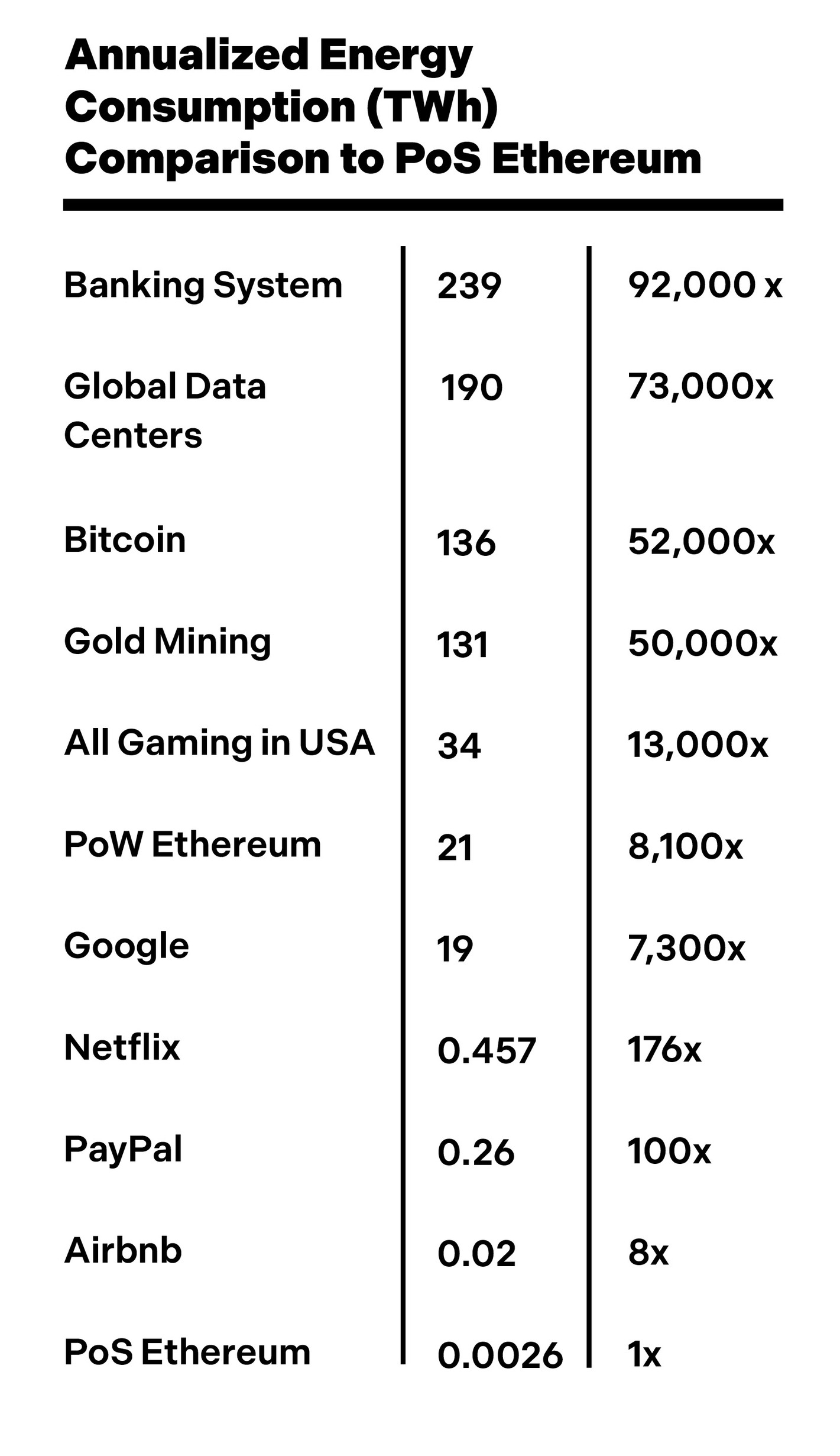
- Proof of stake is a more sustainable and efficient evolution of blockchain technology that addresses the environmental concerns associated with high energy consumption.
- The popular perception of blockchain as a tool for anonymity is a misconception; most major networks are entirely public and easily traceable by authorities.
- The extreme transparency of blockchain ledgers could actually prevent mainstream adoption if users feel uncomfortable exposing sensitive personal and financial information.
This inaccuracy is common, for example, in TV and movies that depict criminals using cryptocurrency to secretly transfer money . It’s also dead wrong.
The Mechanics of Blockchain Security
- While often perceived as anonymous, blockchains are innately transparent and can expose sensitive data like salaries and medical bills, which may hinder broader adoption.
- The term 'crypto' refers to the use of public key cryptography for authentication and signing rather than the encryption of data for privacy.
- Public and private key pairs form the security foundation, allowing users to mathematically sign transactions that are nearly impossible to forge.
- A 'trustless' network functions without a central authority by using consensus processes and financial incentives to ensure validators remain honest.
- Blockchain security is bolstered by the high cost of attacks and the ability for participants to 'hard fork' the network to undo malicious actions.
The signature is analogous to signing a check or legal document in the offline world, but it uses math to prevent forgery instead of handwriting.
Blockchain's Inherent Security Model
- Blockchains utilize calibrated economic rewards to create a self-policing system where participants trust decentralized logic over individual honesty.
- Traditional perimeter security models are inherently flawed because they focus on protecting a single "wall" around data, which attackers can easily bypass through a single gap.
- Unlike corporate databases that store vulnerable login credentials, blockchains require signed transactions and have no central point of failure to break into.
- The blockchain approach unbundles security from general business functions, allowing specialized custodians to manage data protection rather than non-expert institutions like hospitals or car dealers.
- True blockchain hacks are exceedingly rare; most reported thefts are actually attacks on third-party institutions or individuals through methods like phishing.
The model is like putting a wall around a fort that’s stocked with gold and then trying to protect only the wall. It doesn’ t work.
The Virtues of Blockchains
- Most alleged blockchain hacks target external institutions or individuals through phishing rather than the underlying network protocols themselves.
- Major networks like Bitcoin and Ethereum act as the world's largest bug bounty programs, having withstood countless attacks due to the prohibitive cost of a 51 percent breach.
- Blockchains provide a democratic and transparent framework that ensures equal access and public auditability for all participants.
- The technology's most critical feature is its ability to make strong commitments, ensuring code executes exactly as designed without human intervention.
- By putting code in charge, blockchains provide a more reliable alternative to traditional corporate computers governed by one-sided Terms of Service agreements.
These blockchains are, in effect, the world’s biggest bug bounty programs.
Blockchains and Hard Commitments
- Unlike traditional systems where companies control the software, blockchains allow the software to be in charge, resisting external manipulation.
- Applications built on top of blockchains inherit security guarantees that allow them to make binding commitments about their future behavior.
- Critics often misinterpret the intentional constraints of blockchain technology as technical weaknesses rather than structural strengths.
- Corporate promises are inherently unreliable because companies can unilaterally change terms of service or shut down products to suit their interests.
- The value of digital currencies like Bitcoin relies on immutable rules that prevent double-spending and ensure scarcity, which no corporation can credibly provide.
It’s hard for people accustomed to free rein to appreciate that computers could improve on a dimension that is designed, in part, to undermine their authority .
Multiplayer Social Technologies
- Corporate commitments are inherently unreliable because businesses prioritize fiduciary duty over service agreements or user promises.
- Blockchains enable social technologies that facilitate coordination and commitments between parties without pre-existing trust relationships.
- The failure of internal corporate blockchains suggests the technology's primary value lies in public, large-scale networks rather than isolated enterprise use.
- New blockchain-based networks promise fairer governance and shared financial upside for sectors like social media, gaming, and creative arts.
- Managing the complexity of internet-scale software requires encapsulation to ensure that logical interdependencies remain manageable for billions of users.
Fiduciary duty trumps other concerns.
Encapsulation and Digital Tokens
- Software complexity is managed through encapsulation, a technique that hides intricate logical dependencies behind user-friendly interfaces like an electrical outlet.
- Encapsulated code functions like Lego bricks, enabling developers to reuse and combine basic components into larger structures without needing to understand every line of code.
- Blockchain tokens are technical abstractions that simplify complex code into units of ownership, making them easy to manipulate and program.
- Tokens allow for the ownership of anything representable in code, ranging from virtual game items and music to physical assets like real estate.
- Unlike traditional digital environments where items are effectively rented, blockchain-based tokens provide genuine control by utilizing permanent technical commitments.
Outlets unlock the electrical grid and give humans superpowers without anyone having to understand what’s happening on either side of the socket.
The Illusion of Digital Ownership
- In traditional games and social networks, digital goods are merely rented because platforms can unilaterally change terms or revoke access.
- Blockchains shift power from corporate entities to immutable code, enabling true ownership through the mechanism of tokens.
- The current 'read-write-own' era of the internet is defined by tokens, building on previous eras centered around websites and posts.
- Tokens function as expansive building blocks, categorized into fungible units for currency and non-fungible units for unique assets.
- A revolutionary aspect of blockchains is their ability to let software directly hold and control money, rather than just referencing external bank ledgers.
Almost invariably, games eventually fade away or shut down, and along with them their virtual goods blink out of existence.
The Nature of Tokens
- Tokens allow software to directly hold and control value, a fundamental shift from traditional financial systems that only manage references to money held in banks.
- While frequently associated with libertarian politics, blockchain technologies are politically neutral software primitives with a wide variety of potential uses.
- Dollar-pegged stablecoins likely reinforce the global supremacy of the U.S. dollar by meeting the strong market demand for internet-native versions of the currency.
- There are multiple models for stablecoins, ranging from fiat-backed tokens like USDC to algorithmic systems like Maker, which vary in their stability and collateral management.
- The industry often prefers the term 'tokens' because it describes the technology's abstract and generalizable nature more accurately than 'coins' or 'cryptocurrency'.
Money that is held and controlled by software is a new idea that didn’ t exist before blockchains.
The Utility of Tokens
- Fungible tokens serve as 'fuel' for blockchain networks, reviving the pay-as-you-go model of mainframe computing from previous decades.
- Non-fungible tokens (NFTs) act as digital deeds for physical assets like real estate or digital assets like music, art, and code.
- The value of an NFT is often derived from a complex mix of scarcity and social signals rather than direct utility or copyright ownership.
- Beyond simple ownership, NFTs provide digital utility through creator royalties, gaming abilities, and token-gated access to exclusive communities.
- Major brands like Nike and Tiffany use NFTs as 'digital twins' that allow physical products to be represented and used within digital environments.
For users, the NFTs act as a digital twin of the physical object, breaking down the barrie r between the on- and offline worlds.
The Shift to Digital Ownership
- NFTs act as digital twins and identifiers, allowing users to carry their assets and social connections across different platforms and applications.
- Digital wallets serve as persistent inventories and primary interfaces for the blockchain, functioning similarly to how web browsers operate for the internet.
- Treasuries and DAOs enable groups to coordinate and programmatically manage assets, acting as 'multiplayer reserves' governed by software rules.
- Blockchain technology flips the script on digital ownership by transferring control from centralized services like Amazon or Apple to individual users.
- Unlike current models where companies can revoke access to digital purchases at will, tokens provide users with true ownership, portability, and resale capabilities.
If token s are like cells, then treasuries are like full-blown organisms.
The Crisis of Digital Ownership
- Most digital purchases, such as e-books and movies, are actually licensed content that companies can revoke at any time, preventing resale or transfer.
- Corporate networks are compared to theme parks where a single owner dictates all policies, contrasting with the agency found in the physical world.
- Ownership is a key driver of innovation, providing the freedom to remix and repurpose assets into new business models without seeking corporate permission.
- Digital ownership fosters persistent identity and asset portability, similar to how individuals carry their clothes and names across different physical locations.
- While digital tokens currently seem like a niche interest for early adopters, they represent a fundamental shift toward widespread digital ownership.
Imagine if the clothes you bought could be worn only in the venue you bought them in.
The Toy Theory of Disruption
- Disruptive technologies often start by serving a small niche of enthusiasts and are dismissed as toys due to their initial limited functionality.
- Incumbents frequently miss major trends because they are incentivized to focus on high-margin customers and legacy products rather than low-end alternatives.
- Clayton Christensen’s theory suggests that technologies become disruptive when they improve exponentially faster than actual user needs, eventually displacing established leaders.
- To distinguish true disruptors from passing fads, one must look for exponential forces like network effects and software composability that create compounding growth.
Time and again, a sling and rock beat a lumbering swordsman.
The Nature of Disruption
- Exponential growth in software stems from compounding forces like network effects and code composability, which allow developers to build on existing work.
- Disruptive technologies are defined by their misalignment with incumbent business models, making them difficult for established leaders to adopt or even recognize.
- Current advancements like AI and VR are classified as sustaining technologies because they reinforce the data and computing advantages of Big Tech giants.
- The historical dismissal of blockchain and tokens by major corporations suggests that these technologies possess the classic hallmarks of a disruptive force.
Incumbents missing disruptive innovation is what makes it disruptive.
The Evolution of Blockchain Networks
- Tokens function as a new computing primitive, offering programmability and composability that enable diverse applications from social networks to virtual economies.
- Skeptics often overlook the power of network effects, much like those who previously dismissed websites and social media posts as insignificant.
- Using urban planning as an analogy, the text argues that healthy digital networks require a balance between public shared spaces and private commercial incentives.
- Blockchain networks serve as a necessary alternative to corporate-owned platforms, aiming to restore community control and the 'read-write-own' era of the internet.
A city owned by a private company would, in contrast, be a soulless simulacrum.
The Promise of Blockchain Networks
- Corporate networks prioritize owner interests over users, often leading to the crowding out of alternatives and restricted opportunities.
- Blockchain networks provide a new alternative by placing immutable software at the core of the network rather than relying on hardware owners.
- Historically, network designs were limited by the fear that nodes could 'turn evil,' necessitating either weak protocols or centralized corporate control.
- The inversion of the hardware-software relationship allows for rich, expressive network designs with built-in consensus and economic incentives.
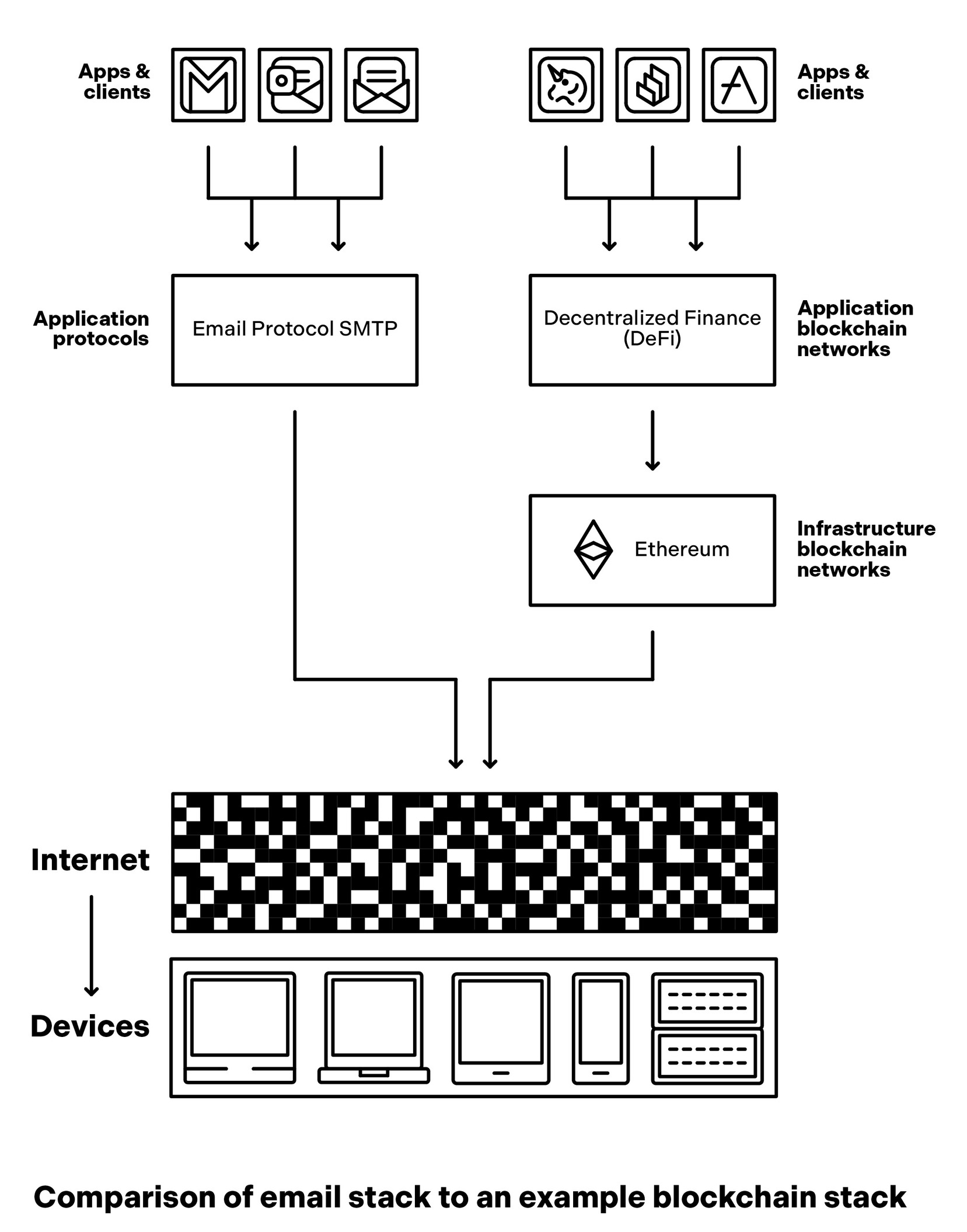
- These networks span a layered architecture, encompassing both base infrastructure like Ethereum and specific applications like decentralized finance.
Recall that blockchains put software in charge, inverting the traditional relationship between hardware and software.
Scaling the Blockchain Stack
- Blockchain networks are organized into layers, ranging from general-purpose infrastructure like Ethereum to specialized application networks like DeFi protocols.
- Recent improvements in scaling technology have significantly lowered transaction fees and increased throughput, moving blockchains toward internet-scale capabilities.
- Performance metrics have jumped from the 7-15 transactions per second seen in early networks to hundreds of thousands in newer systems like Aptos and Sui.
- Layer two 'rollups' increase processing power by shifting heavy computation off-chain while using advanced cryptography to verify results on the main network.
- A platform-app feedback loop drives investment, where new infrastructure enables new applications that in turn necessitate further infrastructure improvements.
Imagine paying a few dollars every time you want to upload a post or click “like”—it would be impractical.
The Blockchain Goldilocks Zone
- Maturing infrastructure like rollups is abstracting away complexity, allowing developers to focus on user experience rather than esoteric scaling issues.
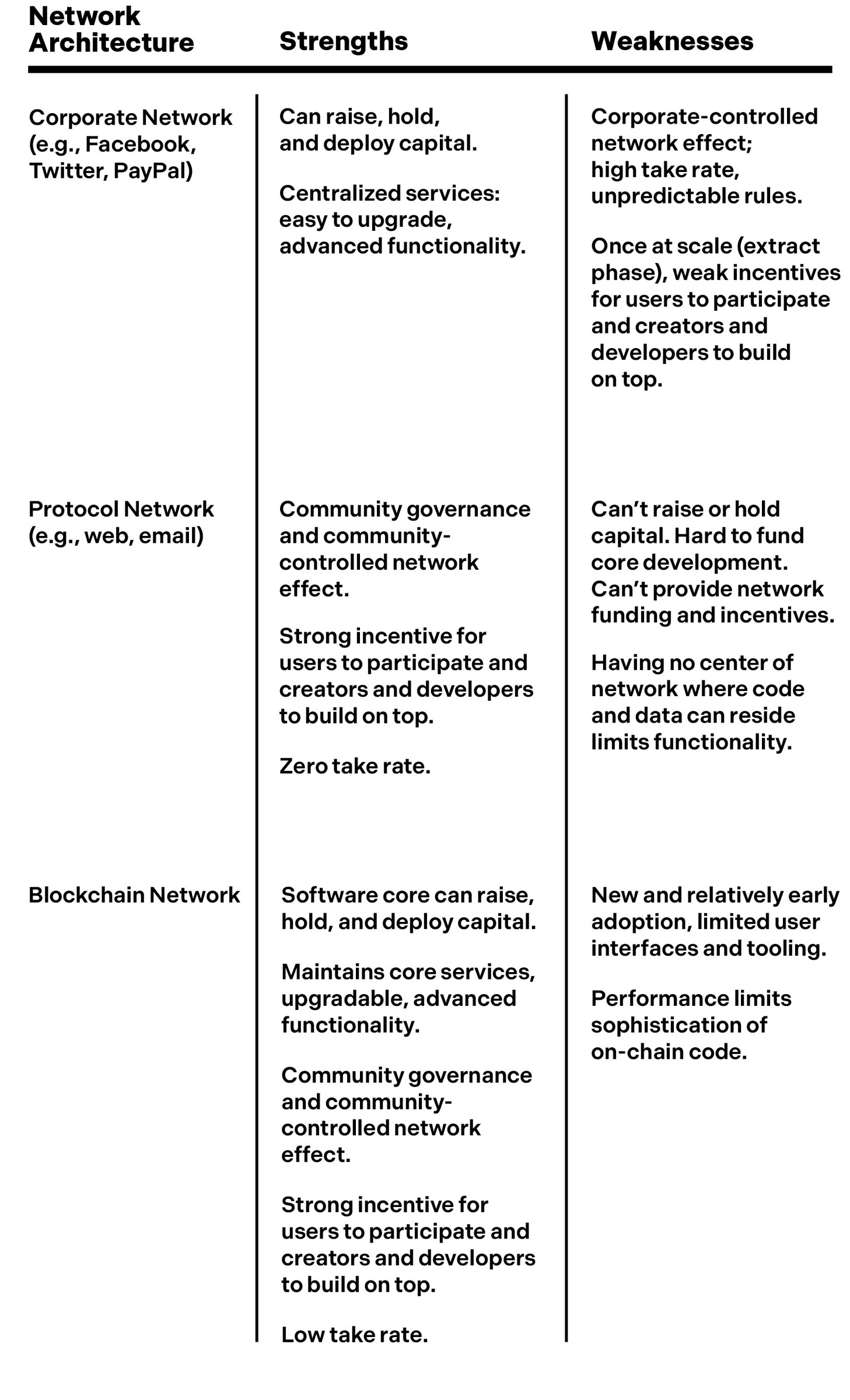
- Blockchain networks combine the core service capabilities of corporate models with the community governance and predictability of protocol networks.
- Unlike corporate entities, blockchain networks have hard-capped pricing power, which prevents them from arbitrarily raising take rates and encourages ecosystem growth.
- These networks inhabit a 'Goldilocks zone' where the core system is large enough to support basic services but not so big as to monopolize the network.
- Blockchain architecture achieves a unique balance by being logically centralized through code while remaining organizationally decentralized through its participants.
Blockchain networks inhabit the “Goldilocks zone.” They consist of small core systems surrounded by rich ecosystems of creators, software developers, users, and other participant s.
Principles of Blockchain Networks
- Blockchains establish a canonical state through software rules that cannot be overridden by hardware owners or individuals.
- Unlike corporate networks that often trap users in an 'attract-extract' pattern, blockchain networks distribute control among stakeholders like users and creators.
- Most blockchain projects begin with a centralized founding team and transition to community governance through a process called progressive decentralization.
- Effective network design involves keeping the core software minimal while shifting the bulk of development and decision-making to the community.
- DAOs serve as the financial and governing core of these networks, operating through self-executing code and token-based consensus.
Blockchains allow rules to be encoded in software that can be overridden by neither the hardware nor the people who own the hardware.
Blockchain as Digital Cities
- DAOs use on-chain code to self-execute governance decisions and hold funds without relying on external institutions.
- The development of a blockchain is compared to urban planning, where tokens represent land grants that incentivize early residents and developers.
- Property rights and predictable governance are essential for encouraging entrepreneurs to invest their time and money into a digital ecosystem.
- Blockchain networks shift software development from a top-down corporate model to a bottom-up, crowdsourced model similar to Wikipedia.
- This collaborative structure ensures that the interests of the city and its residents are mutually dependent and aligned for growth.
Think Zen. The project belongs to no one and to everyone.
Software's Economic Evolution
- Blockchain networks align incentives to foster inclusive communities where stakeholders collectively guide and share in network value.
- Bill Gates shifted the tech industry's focus from hardware to software by exploiting network effects and platform-application feedback loops.
- The open-source movement challenged corporate dominance by establishing a worldwide community that shares source code in cyberspace.
- The commoditization of software led the tech industry to move up the stack, transitioning into the modern software as a service (SaaS) model.
- The early read-write era of the internet saw a surge in APIs and mash-ups, creating temporary hope for universal interoperability.
Think Zen. The project belongs to no one and to everyone.
The Fall of the Open Web
- During the early Web 2.0 era, the internet was characterized by a spirit of interoperability where developers freely remixed services using APIs.
- The rise of smartphones and the iPhone catalyzed a platform shift that favored corporate networks over open protocol networks.
- Following the attract-extract cycle, dominant platforms eventually prioritized corporate extraction over participant benefits, leading to the closure of open APIs.
- The open web's decline resulted in a concentrated internet where user time is largely spent within a few massive corporate silos like Facebook.
- Interoperability survives primarily in the PC gaming sector, where modding culture allows users to remix games and has even birthed hits like League of Legends.
APIs withered, interoperability fizzled, and the open internet got packed away into silos.
The Art of Software Composition
- Modding has evolved from a niche hobby into a mainstream driver of gaming culture, spawning massive hits like League of Legends and Counter-Strike.
- Open-source software transitioned from a radical 1980s ideology into the foundational technology powering most modern phones and data centers.
- The concept of composability allows software to be built like Lego bricks, enabling developers to assemble complex systems from smaller pieces.
- Platforms like GitHub host a global branching tree of billions of interconnected ideas, facilitating collaboration between millions of strangers.
The collective set of code repositories make up a branching tree of billions of interconnected ideas created by millions of people, most of whom have never met, yet who work collaboratively to advance the global store of knowledge.
Software's Compounding Power
- Platforms like GitHub enable a global collaboration where developers build upon a branching tree of billions of interconnected ideas.
- Composability acts as software's version of compounding interest, where code created once can be reused infinitely to drive exponential productivity.
- This model leverages encapsulation and the wisdom of crowds, allowing developers to integrate complex expertise without needing to understand every underlying detail.
- The advancement of composable services is currently stalled by the lack of sustainable business models and the closed-off nature of corporate networks.
The collective set of code repositories make up a branching tree of billions of interconnected ideas created by millions of people, most of whom have never met, yet who work colla boratively to advance the global store of knowledge.
Reclaiming Software Composability
- Open-source services often struggle to scale because they lack a sustainable business model to fund infrastructure costs like bandwidth and hosting.
- Corporate networks have stifled software innovation by transitioning from open interoperability to restrictive models that prioritize data extraction over developer support.
- While business-to-business APIs like Stripe provide utility, they remain permissioned and closed-source, meaning providers can change rules and fees at will.
- Blockchain networks offer a solution by providing software-encoded assurances that services will remain open, remixable, and autonomous in perpetuity.
- By using tokens to fund global hosting costs, blockchains create a self-sustaining financial model that removes reliance on corporate gatekeepers.
Blockchain networks turn “Don ’t be evil” into “Can’ t be evil.”
Cathedrals, Bazaars, and Margins
- Blockchain architecture shifts the ethical paradigm from "don't be evil" to "can't be evil" by providing immutable guarantees of openness.
- The text contrasts centralized "cathedral" software development with the "bazaar" model, which relies on a self-correcting spontaneous order from a diverse community.
- Blockchain networks allow for massive software reuse and remixes, enabling them to rival the scale and efficiency of large corporate networks.
- Jeff Bezos’s strategy of minimizing margins to seize market share highlights a deflationary business model that blockchains are poised to inherit and evolve.
- By slashing overhead costs like their internet predecessors, blockchains act as a disruptive force against established incumbents with high take rates.
In the first model, popularized by closed-source companies like Microsoft, software is "built like cathedrals, carefully crafted by individual wizards or small bands of mages working in splendid isolation."
The Trap of Take Rates
- Internet disruptors historically succeeded by slashing costs, a strategy blockchains now extend by targeting the high take rates of corporate networks.
- Dominant social networks leverage lock-in from network effects to extract maximum value, often keeping up to 99 percent of advertising revenue.
- Unlike YouTube's revenue-share model, many platforms use fixed 'creator funds' that create a zero-sum environment where platform success reduces individual creator earnings.
- Beyond monetary fees, these networks extract personal data from users and exercise strict control over third-party ecosystems, such as Apple's 30 percent App Store cut.
The web and email are the last free havens on mobile phones.
Dynamics of Network Take Rates
- Apple maintains a high 30 percent take rate by leveraging its captive network, forcing developers to use web-based payment workarounds or pursue legal action.
- Payment networks like Visa and PayPal keep fees low through competition and interchangeable services, often returning value to consumers via incentives.
- Marketplaces for physical goods like eBay and Etsy have moderate take rates because sellers own their inventory, which lowers switching costs compared to digital platforms.
- Protocol networks like email and the web lack a central intermediary, keeping effective take rates low by forcing providers to charge based on infrastructure costs.
- Corporate networks often hide their true take rates by manipulating algorithms to reduce organic reach, effectively forcing participants to purchase advertising to maintain their audience.
The web and email are the last free havens on mobile phones.
Corporate Extraction vs. Blockchain Efficiency
- Corporate networks artificially inflate their take rates by throttling organic reach, forcing creators and sellers to pay for advertisements to reach their own audiences.
- During the 'extract phase,' dominant platforms like Google and Amazon prioritize sponsored content and their own products over the organic links that built their initial utility.
- High gross margins in Big Tech companies often result in bloated bureaucracies and wasteful spending rather than being reinvested into the network participants.
- Blockchain networks disrupt rent-seeking intermediaries by maintaining significantly lower take rates, often ranging from less than 1 percent to 2.5 percent.
- The low fees of blockchain networks are secured by code-enforced commitments and community control, preventing the arbitrary rule changes common in corporate networks.
Where bean counters see fat margins, entrepreneurs should see blood.
Blockchain Networks and Decentralization
- Blockchain networks maintain low take rates through code-enforced commitments and the community's power to vote on changes.
- The open-source nature of blockchain allows for 'forking,' providing a constant competitive pressure that keeps costs close to maintenance levels.
- A significant risk of recentralization exists if users gravitate toward high-convenience, corporate-owned front-ends that re-introduce pricing power.
- Successful decentralized networks must fund high-quality user experiences to prevent the fate of protocols like RSS, which lacked sustainable funding.
- By ensuring users own their digital identities and goods, blockchains enable a credible threat of switching that prevents application-level lock-in.
Applications are unable to acquire pricing leverage if users can easily switch from one application to another.
Blockchain Ownership and Profit Shifts
- Blockchain-based ownership of digital identity and goods reduces platform lock-in by making it easy for users to switch services at any time.
- The competition between NFT marketplaces like OpenSea and Blur demonstrates that blockchain interoperability compels lower take rates, a trend rarely seen in corporate networks.
- Low take rates and fixed protocol rules provide a stable environment for developers, who often fear being undermined by centralized corporate intermediaries.
- According to the law of conservation of attractive profits, commoditizing one layer of a tech stack shifts the profit potential to other layers, much like squeezing a balloon.
The theory is that commoditizing a layer in a tech stack is like squeezing a balloon.
Conserving Attractive Profits
- The 'law of conservation of attractive profits' suggests that when one layer of a tech stack is commoditized, profits shift to other layers rather than disappearing.
- Companies use a 'commoditize your complement' strategy to ensure their primary revenue sources remain unblocked by gatekeepers in other layers.
- Google created products like Android and Chrome as a calculated move to reduce platform risk and prevent competitors from capturing search revenue.
- Apple's ability to charge Google billions to be the default search engine on Safari illustrates the zero-sum nature of profit capture within a stack.
- Intel's support for open-source Linux follows the same logic, reducing Microsoft's influence to ensure hardware sales remain profitable.
The overall profits are conserved but shift from layer to layer .
Thick vs. Thin Networks
- Corporate networks function as thick layers that centralize profits, squeezing value away from the creators and developers who build on top of them.
- Blockchain and protocol networks are designed as thin layers, allowing value to flow outward to the edges where users and developers reside.
- The author argues that social networks should function like roads—basic, reliable utilities that facilitate a thick layer of innovation around them.
- The current corporate model forces startups to build entirely new proprietary infrastructures rather than innovating on top of open, interoperable protocols.
- The historical success of the internet is credited to the thin nature of HTTP, which allowed for decades of explosive innovation at the application level.
Network effects that result in lock-in force creators to work for free and developers to behave as they are told.
Tokens vs Corporate Take Rates
- Centralized social and financial networks act as thick layers that capture excessive value and stifle innovation by forcing startups to build proprietary infrastructure.
- Blockchain technology reshapes this economic model by creating thin layers, which reduces costs in sectors like payments and lending while empowering creators.
- Historical protocols like email flourished because they were ignored by corporations, but modern decentralized projects face intense competition for developer talent.
- Unlike traditional protocols that rely on volunteers, blockchain networks use token incentives as a sustainable mechanism to fund software development and attract top-tier talent.
- Token incentives serve as a 'carrot' to balance the 'stick' of high take rates, making decentralized networks competitive with corporate compensation models.
The Net grew like a weed between the cracks in the monolithic steel-and-glass empire of traditional commerce.
Token-Driven Network Development
- Blockchain networks utilize native tokens as a built-in mechanism to compensate developers, distinguishing them from protocol networks that rely on volunteers.
- By offering tokens that represent ownership and governance rights, these networks transform external contributors into invested stakeholders.
- The transition from corporate models to blockchain models shifts internal software development to an open, market-based system of external tasks.
- Token incentives foster global competition, allowing users to choose from a variety of software options rather than being limited to a single corporate provider.
- As networks mature and launch, original developers relinquish control to ensure the platform remains permissionless and treats all participants equally.
Jobs held captive in corporate networks become external, market-based tasks in blockchain networks.
Incentivizing Network Growth
- Blockchain networks utilize decentralized token grants to fund development, ensuring that no single app developer holds privilege over others.
- Corporate networks typically centralize wealth among a few founders and investors, often leaving the early contributors who built the platform's value behind.
- By granting tokens to early users, blockchain networks provide a level playing field to compete with the massive capital of corporate software development.
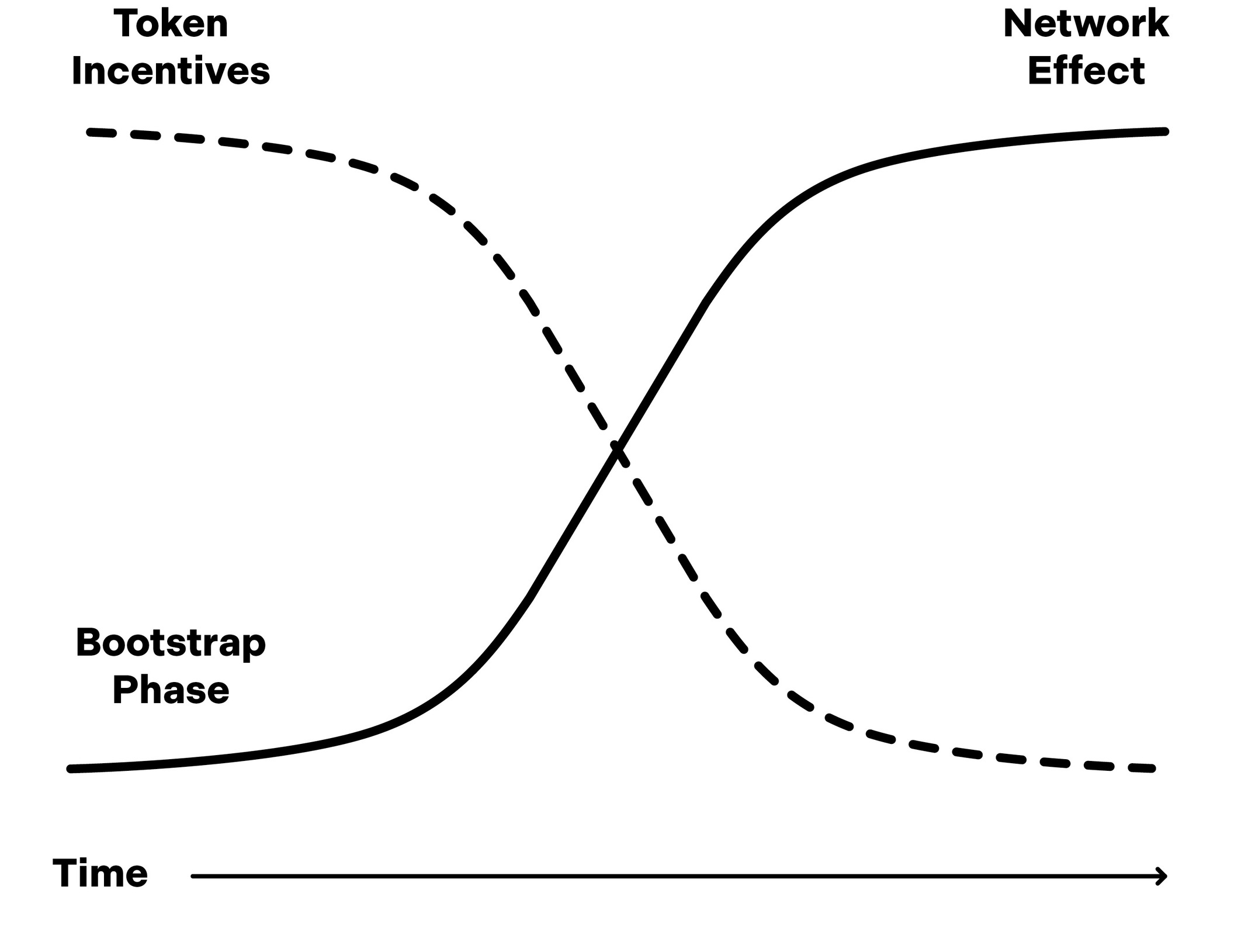
- This inclusive model solves the 'cold start' problem by rewarding early risk-takers who contribute to the network before its intrinsic value is established.
- As a network achieves scale and its effects become self-sustaining, token incentives naturally decrease in necessity.
Just look at the video creators who built YouTube, the social groups who built Facebook, the influencers who built Instagram, the homeowners who built Airbnb, the drivers who built Uber—the list goes on.
Solving the Bootstrap Problem
- Building networks is difficult due to the 'bootstrap' problem, where a lack of early participants makes the service initially useless.
- While corporations once used financial subsidies to grow, token incentives now offer a decentralized way to attract early adopters.
- The Helium project demonstrated that tokens can build complex physical infrastructure, like a nationwide telecom network, through grassroots participation.
- By rewarding early contributors with tokens, new projects can overcome the 'rich-get-richer' dynamic of centralized corporate platforms.
- This token-led growth model is being applied to diverse fields including artificial intelligence, computer storage, and green energy infrastructure.
Network effects cut both ways: they can accelerate growth, but they can also handicap it.
Tokens as Self-Marketing
- The mobile app landscape is currently dominated by decade-old incumbents, making it increasingly difficult for new startups to break into established user routines.
- Startups are often forced to pay Big Tech gatekeepers for advertising, leading to high acquisition costs that frequently result in negative profit margins.
- Tokens offer an alternative growth strategy by transforming users into stakeholders who are financially and emotionally motivated to evangelize the network.
- This ownership model facilitates authentic peer-to-peer marketing through community activities like blogging, coding, and organizing meetups.
- Major blockchain networks such as Bitcoin and Ethereum have achieved massive scale without traditional marketing budgets by relying on these organic viral loops.
They sing praises and shout from the desktops.
Tokens and Community Ownership
- Blockchain networks leverage tokens to drive grassroots evangelism, often achieving massive scale without traditional advertising budgets.
- The text compares token holders to homeowners who are incentivized to build and promote their cities because they have a financial stake and a say in governance.
- Dogecoin serves as a primary case study, demonstrating how a parody project can maintain a multi-billion dollar valuation through community passion alone.
- Unlike corporate networks that capture all value, token-based systems allow users to share in the upside and control of the platforms they help build.
- While memecoins can be speculative or risky, their longevity highlights the powerful psychological and economic effect of making users owners.
To its users, Dogecoin may be a silly network, but at least it’s their silly network.
The Rise of User-Ownership
- Memecoins like Dogecoin demonstrate that ownership creates powerful, lasting community engagement that traditional corporate networks often lack.
- Decentralized exchanges like Uniswap have pioneered large-scale token distributions, granting early users significant financial upside and governance rights.
- While corporate giants like Facebook and YouTube profit from user-generated content, they typically exclude those users from participating in the network's financial success.
- Blockchain networks fundamentally shift the ownership paradigm by distributing the majority of tokens to the community based on their contributions.
- Despite minor efforts by companies like Airbnb and Uber to offer equity, their programs represent only a fraction of the ownership scale seen in blockchain models.
And yet in most corporate networks, users are treated as second-class citizens at best, or as a product to be served up to real customers, like advertisers, at worst.
Tokenomics and Community Ownership
- Ownership in blockchain networks is broadly distributed to contributors via incentives, whereas corporate networks remain centralized.
- Tokens act as a mechanism to fulfill the original internet's decentralized vision, offering users commitments and open APIs that corporations lack.
- Tokenomics integrates traditional economic concepts with internet protocols to design sustainable incentive systems for blockchain participants.
- The development of blockchain economies is heavily influenced by video games like Eve Online, which features complex monetary policies and professional oversight.
- Sustainable network growth is achieved by carefully balancing the supply and demand of native tokens to maintain value and attract users.
While memecoin mutations, like Dogecoin, may seem like a joke, they show how users are embracing all sorts of tokens—some silly, some serious—in search of community, to fill the void left by corporate networks.
Balancing Blockchain Economies
- Blockchain networks utilize tokenomic designs inspired by video game economies to balance supply and demand.
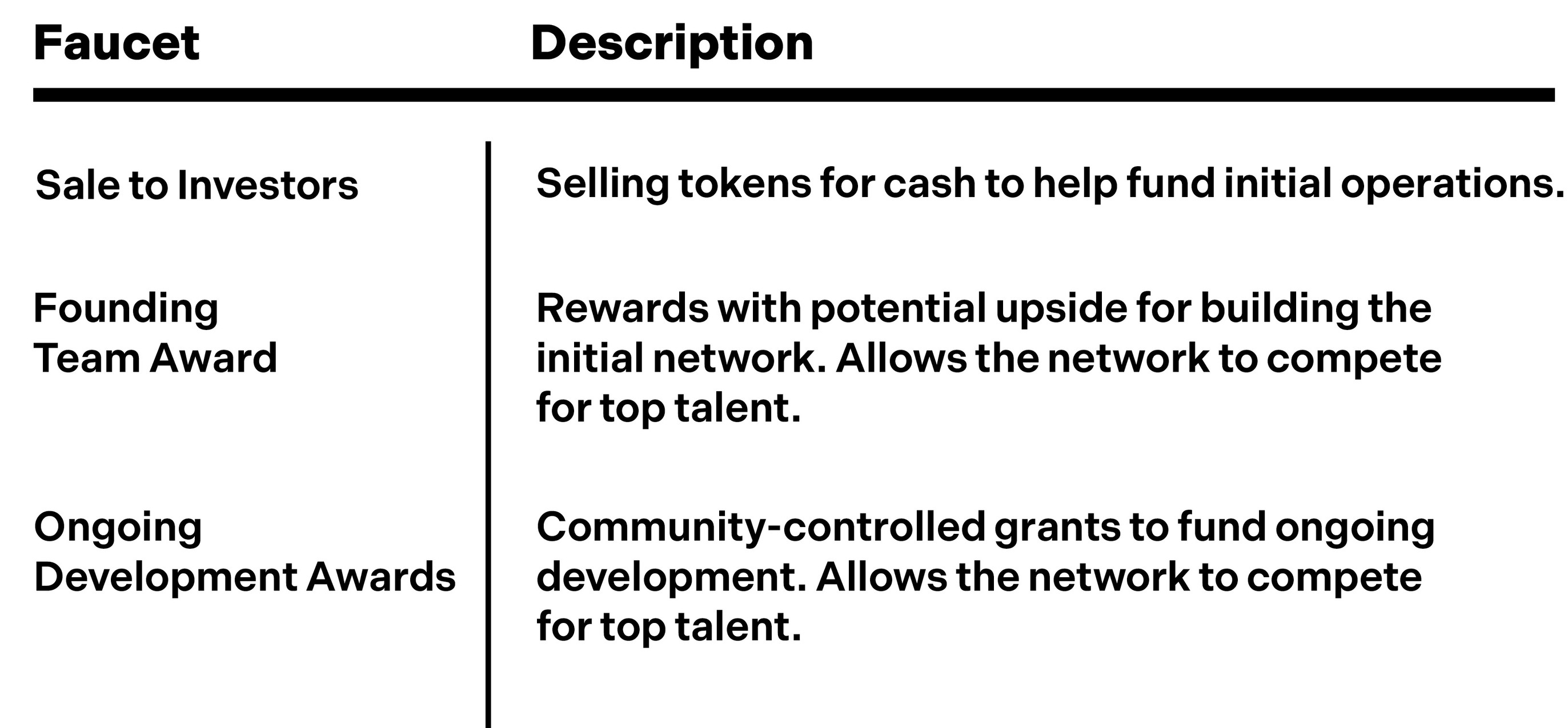
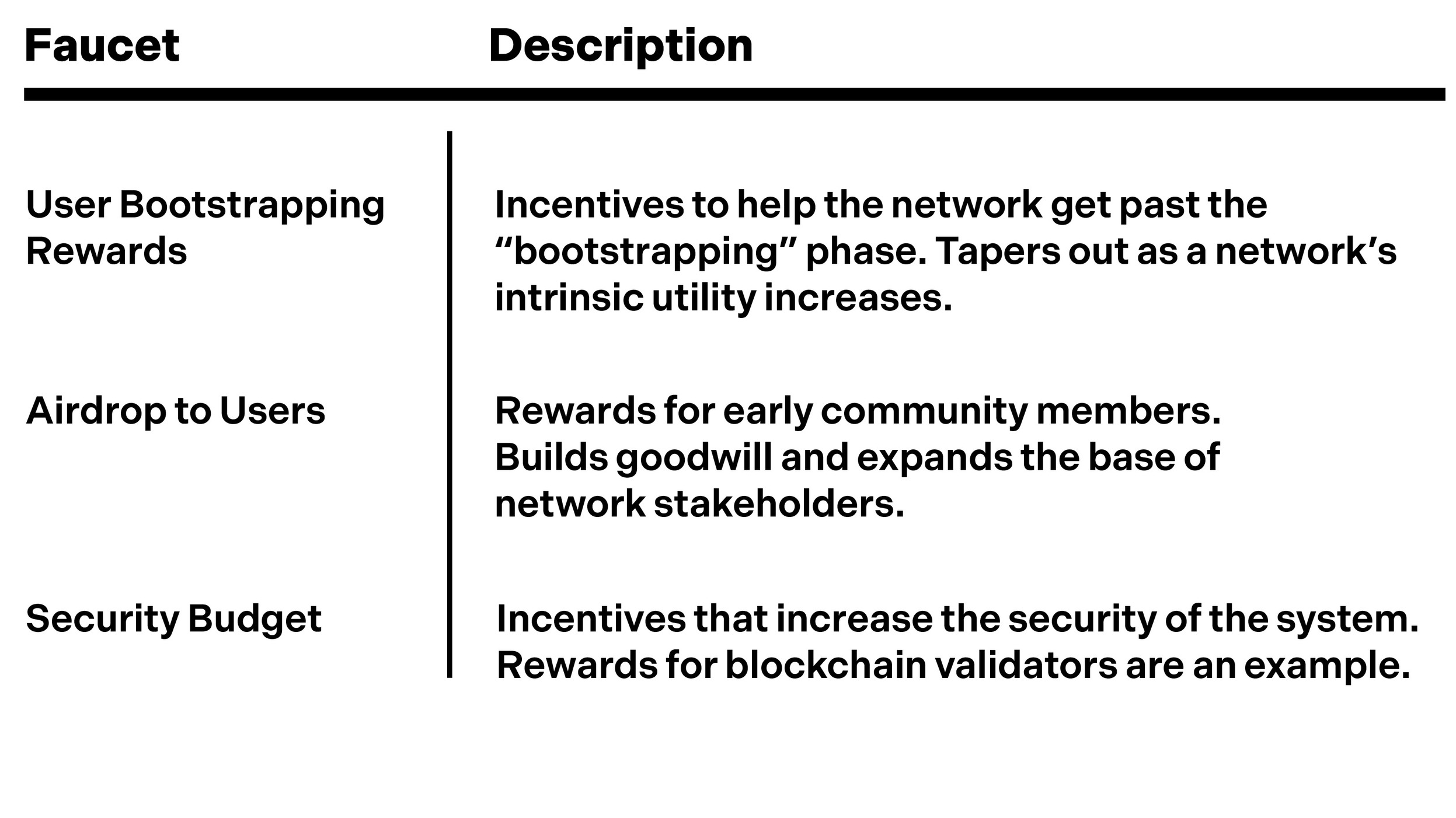
- The metaphor of 'faucets' and 'sinks' helps designers visualize how tokens flow into and out of the network's ecosystem.
- Faucets serve as powerful incentives, similar to land grants, to attract developers and overcome the initial bootstrap problem.
- Sinks, such as access fees or token burning, align a token's price with the actual usage and popularity of the network.
- Ethereum uses 'gas' fees to manage compute demand, burning a portion of these tokens to reduce supply and potentially increase value.
A common metaphor for thinking about the design of token economies is to imagine tokens as water that flows through the plumbing of a house.
Token Economics and Sinks
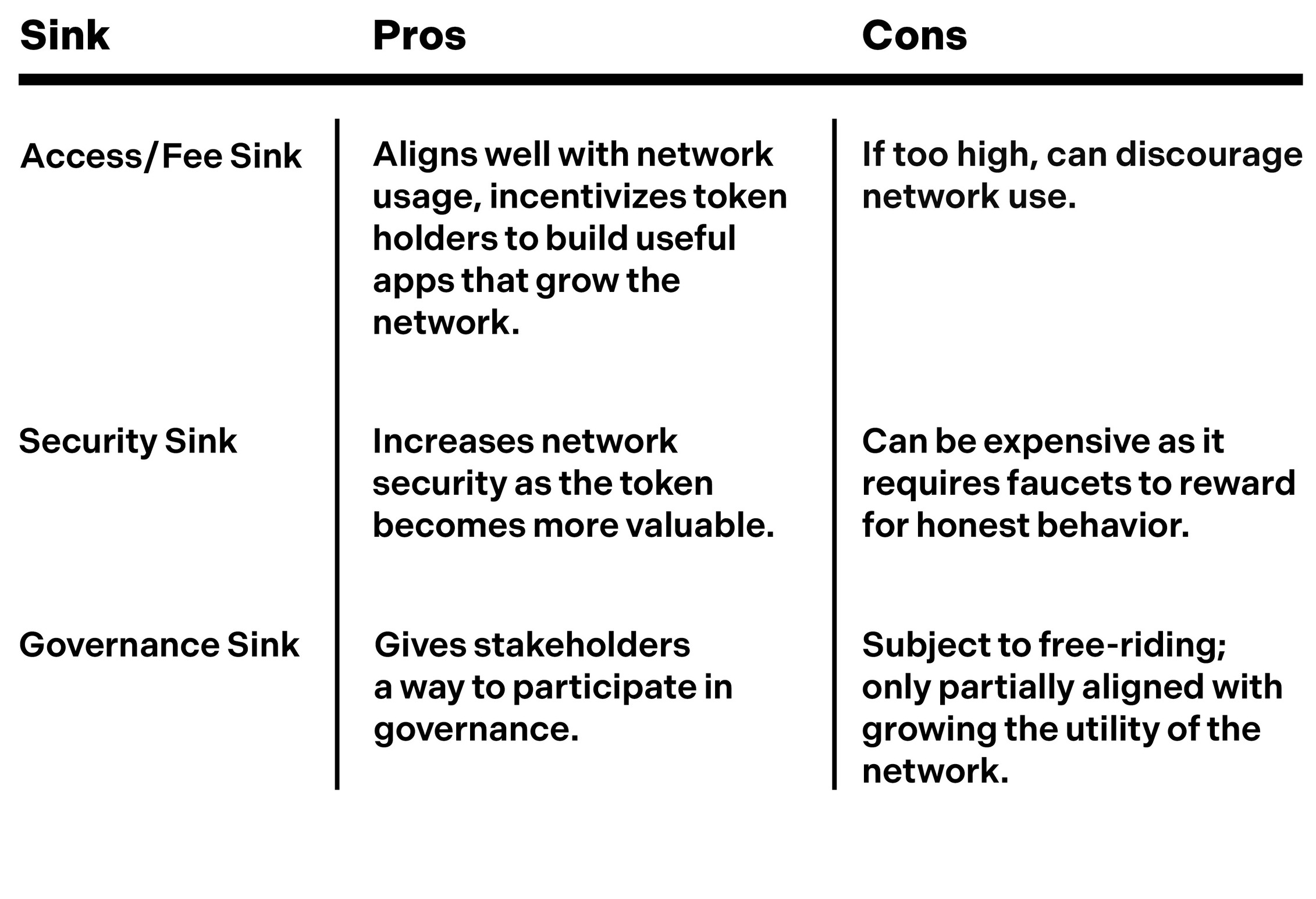
- Access sinks, such as Ethereum's 'gas' fees, reduce token supply by burning a portion of transaction costs, which can theoretically increase the price of the native token.
- Security sinks reward users for 'staking' or locking up tokens to validate the network, creating a balance between network security and potential inflation from reward faucets.
- Governance sinks attempt to drive token demand by granting users voting power over network changes, though they often struggle with the free-rider problem of voter apathy.
- Effective economic designs link sinks to network usage, creating a virtuous cycle where increased activity drains the token supply and funds further development.
- The health of a blockchain community is often reflected in its discussions, where an obsession with token price indicates a 'casino culture' rather than a focus on technology.
Paying excessive attention to prices is a bad sign—a hallmark of casino culture.
Valuing Token Economies
- Token design determines whether a community becomes a speculative 'casino' or a constructive hub for technological improvement.
- Critics often dismiss blockchain by focusing on the worst actors, ignoring historical precedents like the skepticism faced by early railroads and the internet.
- The inherent flexibility of software allows for any imaginable economic model to be encoded, enabling sustainable supply and demand structures.
- Ethereum demonstrates healthy tokenomics by using transaction fees to burn tokens, creating a system analogous to corporate cash flow.
- By analyzing transparent 'faucets' and 'sinks,' investors can value blockchain networks using traditional metrics such as price-to-earnings ratios.
The railroad wasn’t worthless just because many unviable railroad companies fed early stock market mania.
Valuing Tokens and Market Cycles
- Blockchain tokens can be evaluated using standard financial metrics, such as price-to-earnings ratios and cash flow analysis.
- The value of a network token relies on its economic design and whether its 'faucets and sinks' successfully convert popularity into sustained demand.
- Comparing blockchain networks to real estate illustrates how access fees generate a fundamental value similar to rental property income.
- Technological revolutions typically follow a predictable cycle involving an initial speculative frenzy, a market crash, and a subsequent deployment phase.
- While skeptics may doubt specific platforms, tokens are best understood as functional assets for virtual economies rather than speculative 'magic beans'.
Tokens are not magic beans. They are assets used to power virtual economies, and they can be valued using traditional financial methods.
The Price-Innovation Cycle
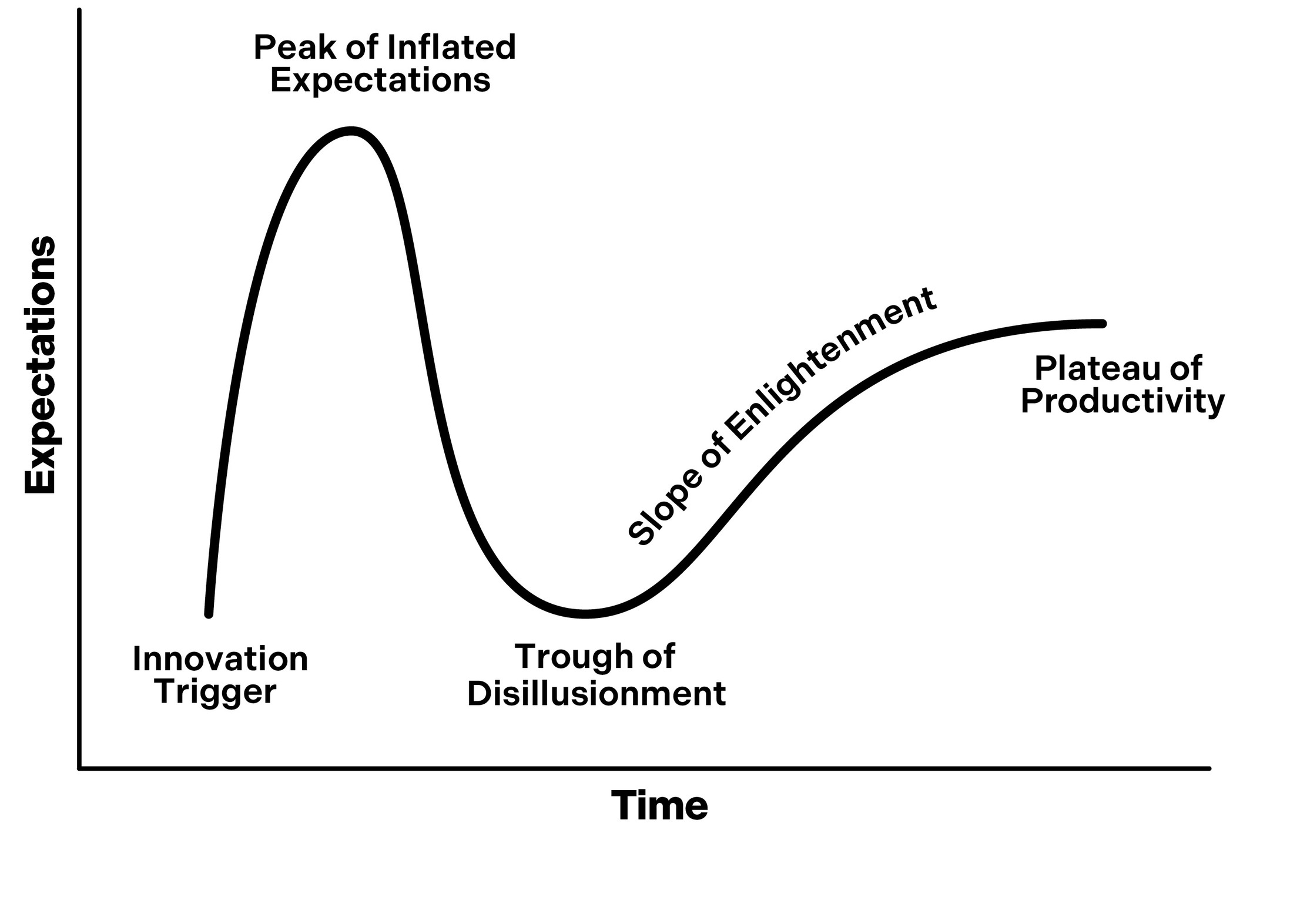
- The hype cycle framework illustrates how new technologies transition from financial bubbles and disillusionment into periods of sustainable productive growth.
- Blockchain networks experience intense speculative cycles because their core innovation—digital ownership—inherently enables trading and market activity.
- The 'price-innovation cycle' suggests that market peaks attract builders who remain in the industry after a crash, incubating the next wave of advancement.
- Historical precedents like the dot-com boom demonstrate that speculative manias provide the capital necessary to build the infrastructure for future technological phases.
- Speculation tends to subside as investors learn to value new technologies based on fundamental principles rather than pure excitement.
Any skeptic who dismissed dot-coms as magic beans would have missed out on the successes of Google, Amazon, and others.
Investment and Digital Governance
- Major technological shifts, from railroads to blockchains, require massive capital inflows to build the infrastructure necessary for widespread adoption.
- Blockchain markets are expected to move from speculative popularity to long-term stability driven by fundamental supply and demand.
- Internet protocols operate as a bottom-up democracy where developers and users effectively "vote" on standards through their participation.
- Global internet governance is managed by a patchwork of nonprofit organizations that rely on consensus and recommendations rather than government-led edicts.
To quote an old Wall Street adage attributed to Benjamin Graham, the father of value investing: markets are a voting machine in the short term and a weighing machine in the long term.
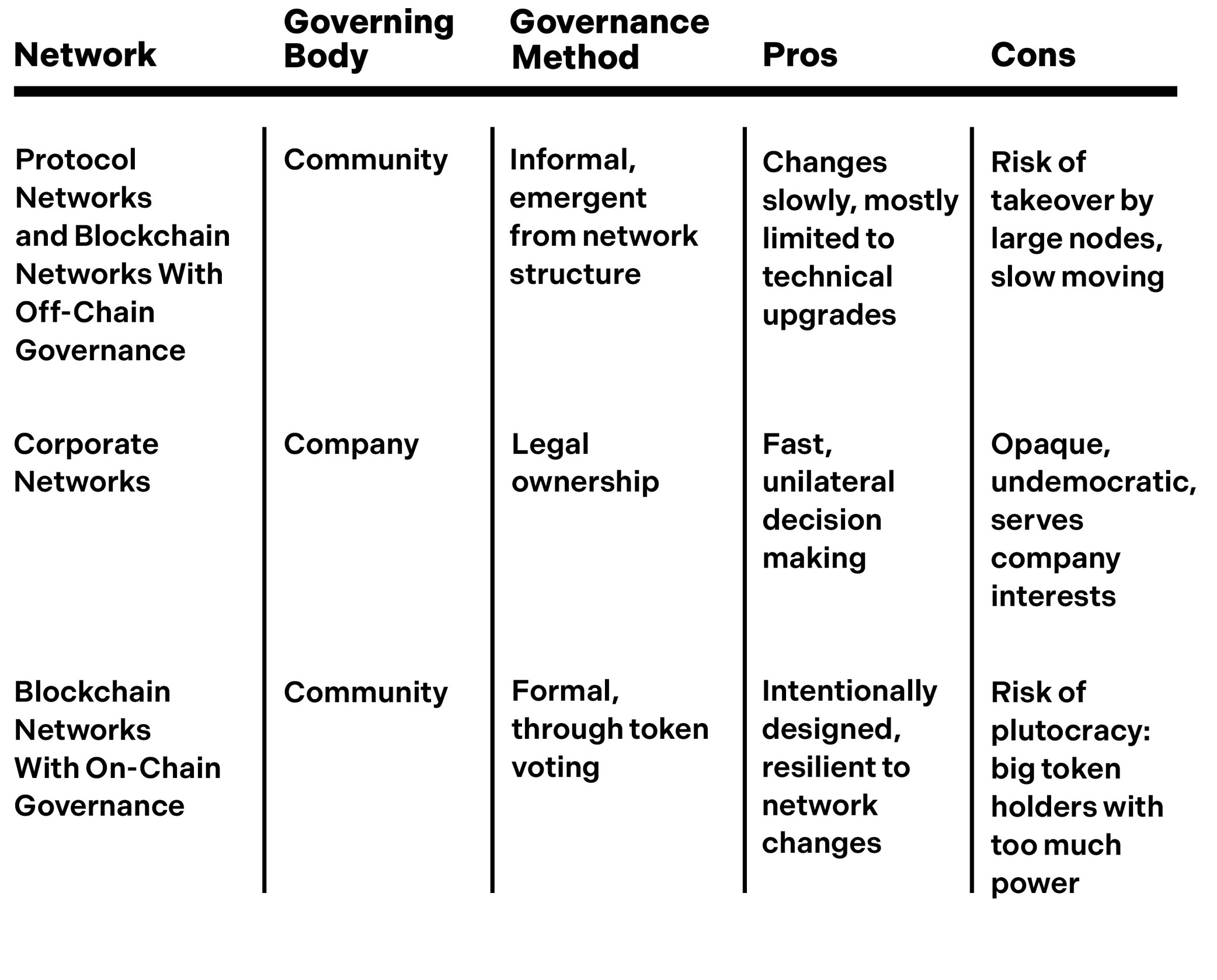
Protocol Governance vs. Corporate Control
- Internet governance bodies prioritize consensus and recommendations over formal edicts, fostering a collaborative dialogue between diverse stakeholders.
- Regulation focuses on the behavior of people and applications rather than the underlying protocols, ensuring the core technology remains neutral and flexible.
- Corporate networks are described as dictatorships where management holds absolute power to make unilateral, often opaque decisions at the expense of users.
- Recent shifts in platform ownership highlight the risks of centralized control, where the livelihoods of creators depend on the changing views of whoever owns the company.
We reject: kings, presidents, and voting. We believe in: rough consensus and running code.
Governing Digital Networks
- There is a growing consensus that critical internet networks should not be controlled by the changing whims of individual owners or corporate leadership.
- The nonprofit model, exemplified by Wikipedia, offers a potential solution but remains an outlier due to its unique low-maintenance nature and static product needs.
- Prominent tech organizations like Mozilla and OpenAI eventually pivoted to for-profit subsidiaries to compete with the massive capital of Big Tech.
- Competing in the modern internet landscape requires significant revenue and capital access, which places pure nonprofits at a severe structural disadvantage.
- Alternative governance models include returning to open, verifiable protocols that no single institution or individual can own or manipulate.
It’s hard to be a nonprofit in a for-profit world.
The Rise of Federated Networks
- Jack Dorsey and other tech leaders advocate for a return to open protocol networks to solve the governance issues inherent in centralized social media.
- Numerous decentralized alternatives, including Mastodon and Bluesky, utilize the Fediverse model where users run and maintain independent servers.
- Federated networks use cross-server communication protocols like ActivityPub to simulate centralized features without a single corporate owner.
- The author compares corporate networks to one large dictatorship, while federated networks represent a collection of many smaller, competing dictatorships.
- These decentralized systems face significant technical hurdles, specifically regarding user friction and the lack of a central repository for searching content.
These countries are still dictatorships, but there are now many dictatorships to choose from.
The Friction of Federation
- Federated networks experience significant friction because data is fragmented across independent servers, complicating basic functions like global search and thread tracking.
- Blockchains offer a unique architectural middle ground by centralizing data for accessibility while keeping its governance and control decentralized.
- Adoption of blockchain solutions is often hindered by the "casino culture" stigma, even though newer systems offer the performance necessary for social networks.
- The lack of formal guardrails in federated networks creates a risk of "protocol coups," where popular server owners become de facto dictators of user data.
Without building consent and resistance into the protocol and infrastructure, we’re just forcing most users to pick a new dictator for their data without any real basis for that choice.
The Fragility of Federated Networks
- Federated networks lack inherent guardrails, often resulting in a fragmented system where users simply trade one data dictator for another.
- Economic incentives and the high cost of scaling large servers inevitably drive federated nodes toward corporate logic and the removal of interoperability.
- The 'attract and extract' cycle illustrates how platforms use open standards to grow before pivoting to closed, proprietary models to maximize revenue.
- Dominant nodes in classic protocols, such as Gmail in the email ecosystem, exert outsized influence that can marginalize smaller participants and undermine core standards.
- Blockchains present a new governance model by encoding immutable rules into software, acting as a 'network constitution' to resist corporate takeovers.
In the absence of rules explicitly enshrined in code, only custom—nothing more—keeps tyrants at bay.
Blockchains as Network Constitutions
- Blockchains shift network governance from corporate management to written code, effectively acting as constitutions for digital networks.
- These programmable systems can emulate any governance model, from centralized corporate structures to constitutional democracies and light-touch republics.
- Off-chain governance relies on community coalitions but risks being taken over if specific nodes gain disproportionate power within the network structure.
- On-chain governance empowers token holders to vote on protocol changes directly, which automate based on the outcome of the ballot.
- The primary risk of on-chain systems is plutocracy, which networks attempt to mitigate through broad token distribution and bicameral voting structures.
In the absence of rules explicitly enshrined in code, only custom—nothing more—keeps tyrants at bay.
Blockchain Network Governance
- Plutocracy in blockchain networks can be mitigated through broad token distribution and bicameral voting structures that separate community members from token holders.
- Governance models range from networks that automatically implement code updates based on votes to immutable systems where token holders only control treasury distributions.
- The author cites 'the tyranny of structurelessness' to explain how informal governance leads to hidden, unaccountable hierarchies rather than true equality.
- Blockchain-based governance allows for the creation of formal 'constitutions' enshrined in code, ensuring that power dynamics are intentional rather than accidental.
- Unlike corporate networks with clear CEOs, protocol networks rely on well-considered processes to keep opaque interpersonal power dynamics in check.
The problem with informal governance is that rules and leaders inevitably emerge, but they are usually a product of inscrutable social dynamics rather than thoughtful design.
The Computer versus the Casino
- Blockchain governance enables the creation of community-owned networks, described as "digital cities" built for and by their participants.
- The industry is divided between "the computer" culture of innovation and "the casino" culture of speculative gambling.
- Media coverage tends to focus on short-term price volatility because technical infrastructure stories are more nuanced and slower to develop.
- Current regulatory trends often target transparent domestic companies while offshore scammers continue to operate with relative impunity.
- Constructive regulation is essential to protect users and foster an environment where responsible entrepreneurs can safely innovate.
Tales of fortunes won and lost are dramatic, easy to explain, and attention grabbing.
Regulating Digital Tokens
- Financial regulations can protect consumers and promote national interests while enabling responsible innovation.
- Securities laws address risks stemming from investor dependency on management teams and information asymmetries.
- Unlike securities, commodities like gold operate in decentralized ecosystems where information is uniformly accessible.
- Applying outdated 1930s securities laws directly to tokens risks a recentralization that could destroy the fundamental value of decentralized technology.
The ecosystem around gold and other commodities is decentralized enough that anybody can, in principle, conduct research and compete on a level playing field with other market participants.
The Decentralization Dilemma
- Regulating tokens as securities would mandate intermediation by brokers, effectively destroying the core value of decentralization.
- To compete with corporate giants, blockchain networks must provide seamless user experiences; excessive regulatory friction would be fatal.
- Both regulators and blockchain developers share the philosophical goal of eliminating the need for trust, albeit through different mechanisms like disclosure and code.
- While Bitcoin is clearly a commodity, the Howey test creates a middle-stage ambiguity for newer projects transitioning toward decentralization.
Although the motives and tools are different, disclosure regimes and network decentralization have the same philosophical goal: eliminating the need for trust.
Regulating Digital Asset Networks
- The Howey test is the primary legal standard used to determine if a digital asset constitutes a security, requiring an investment of money in a common enterprise with an expectation of profit from the efforts of others.
- Current regulatory ambiguity creates a 'gray area' that disadvantages good-faith actors who spend heavily on legal compliance while favoring bad actors who bypass rules to launch tokens quickly.
- Conflicting classifications between the SEC and CFTC regarding assets like Ethereum highlight the lack of a unified regulatory framework for blockchain technology.
- The author argues for a 'path to decentralization,' noting that Bitcoin itself began as a centralized project and might have been blocked by modern regulatory interpretations.
- Tokens are described as essential infrastructure for community-owned networks rather than mere speculative instruments that can be easily removed.
Tokens are not a sideshow of blockchain networks, a nuisance that can be stripped out and discarded.
The Necessity of Tokens
- Tokens serve as the fundamental mechanism for community ownership in decentralized networks rather than being mere speculative assets.
- The ability to buy and sell tokens is a core requirement of ownership, as preventing trading effectively removes the rights associated with ownable property.
- Network validators rely on token incentives to cover operational costs, making liquid token markets a technical necessity for blockchain functionality.
- Implementing time-based or milestone-based restrictions on token trading can shift focus from short-term speculation toward long-term network productivity.
- Targeted regulation is required to punish bad actors while protecting the unique potential of blockchains to restore a democratic internet.
No trading means no ownership; you can’t have one without the other .
Regulating the Network Era
- Smart regulation has historically accelerated innovation, as seen when the transition from partnerships to limited liability corporations enabled the industrial revolution.
- The limited liability structure expanded economic participation from small family circles to millions of public shareholders by managing financial risk.
- A mismatch between industrial-era legal structures and modern network architectures often forces digital platforms to shift from user attraction to predatory value extraction.
- Blockchain networks provide a digitally native framework that can use tokens to expand ownership from millions of shareholders to billions of global participants.
- Effective policy should prioritize decentralization to foster a productive 'computer culture' while curbing the speculative excesses of 'casino culture.'
There are many things that can be done to rein in casino culture while allowing computer culture to develop.
From Incubation to Growth
- Computing platforms typically undergo long incubation periods before a breakthrough product triggers a phase of exponential growth.
- The transition from hobbyist 'toys' to essential tools often depends on the development of killer applications like spreadsheets or web browsers.
- Artificial intelligence represents the longest gestation period of any computing movement, taking eighty years to move from concept to mainstream scaling via GPU advances.
- Successful mobile applications emerged by blending 'skeuomorphic' adaptations of existing activities with 'native' features unique to the hardware, such as GPS and cameras.
- Smart regulation should distinguish between speculative 'casino culture' and productive 'computer culture' to allow founders to build decentralized futures.
The casino should not hold the computer down.
Blockchain’s Native Future
- Success in mobile apps came from leveraging unique device traits like GPS, suggesting that blockchain success will come from its own native capabilities.
- The blockchain industry is transitioning from an incubation phase to a growth phase as infrastructure finally matures for internet-scale use.
- Skeuomorphic applications will reinvent social and financial networks by removing high take rates and reducing transaction friction.
- Native blockchain applications will enable entirely new functions in media, AI, and virtual worlds that could not exist on centralized platforms.
- While Kevin Kelly predicted the internet would allow creators to thrive with just 1,000 true fans, the reality of current platforms still requires millions.
Entrepreneurs and developers who build the future are always going to outsmart armchair predictions.
The Creator Network Economy
- Corporate networks have dominated the internet by positioning themselves as intermediaries that siphon significant value away from creators.
- The top five social networks generate $150 billion in annual revenue but distribute only a small fraction to the creators who fuel their growth.
- Protocol-based and decentralized networks offer a viable alternative by maintaining low take rates and ensuring users own their digital connections.
- Lowering take rates to 10 percent could redirect $115 billion back to creators, potentially supporting nearly two million full-time creative jobs.
- This economic shift would create a virtuous cycle, improving content quality and fostering greater social mobility within the digital economy.
Powerful network effects locked users into Big Tech’s clutches, and that lock-in led to high take rates.
Decentralized Creative Economies
- Empowering creators economically fosters a virtuous cycle where sustainable 'media enterprises of one' produce higher-quality content for the entire internet.
- Social networks can act as an essential counterweight to AI automation by providing people with new, fulfilling career opportunities in creative fields.
- Decentralized networks solve the platform risk of corporate giants by allowing users to switch software without losing their social connections.
- While previous protocol networks like RSS failed due to lack of funding, blockchains provide the infrastructure and token treasuries needed to rival corporate features.
- Long-term success for new platforms depends on parity with existing user experiences and focusing on positive community building rather than just reactionary flight.
Durable social networks are built out of friendships and shared interests, not anger.
Building the Open Metaverse
- Blockchains provide a centralized global state that avoids the fragmented user experiences of previous decentralized protocol networks.
- New networks can overcome early adoption hurdles by offering creators lower take rates and a direct share in the platform's economic upside.
- Successful platforms like YouTube demonstrate that growth often comes from native stars in niche communities rather than established figures from legacy media.
- The current corporate-controlled internet model extracts billions of dollars that could otherwise support a more diverse and creative ecosystem.
- The development of the metaverse raises critical questions about whether virtual worlds will be under the control of single entities or open networks.
The real issue is not who wins—it’s that one person can control that virtual world at all.
Building the Open Metaverse
- Current video games like Fortnite and Roblox represent the early stages of expansive virtual worlds that will eventually feature lifelike graphics and massive scale.
- The boundaries between digital and physical realities are disappearing as people increasingly find employment, relationships, and social meaning within online environments.
- A critical divide exists between the prevailing corporate network model and a proposed open model built on decentralized protocols and blockchain technology.
- An open metaverse would require standardized 3D formats and interoperable blockchain networks to allow for the free movement of virtual currencies and digital goods.
- Future digital economies will likely utilize both tradable NFTs and soulbound non-transferable tokens to represent personal achievements and identity.
Things that look like toys sometimes remain toys, but sometimes they become much more than that.
Blockchain's Open Metaverse Vision
- Blockchain technology facilitates a rich design space where tokens represent everything from transferable skins to permanent soulbound achievements.
- Interoperability allows players to retain value across different platforms, ensuring that years of effort in one game are not lost when migrating to another.
- Unlike corporate networks that see cross-platform compatibility as a liability, blockchain systems use interoperability as a primary tool for network growth.
- In a digital era defined by the infinite and frictionless copying of information, NFTs reintroduce necessary scarcity to protect the interests of creators.
If open systems like protocol or blockchain networks don’t step in to fill the void, corporate networks will, and then the world will end up with the dystopia of Ready Player One.
The Attention-Monetization Dilemma
- Digital media faces a fundamental conflict between maximizing reach through free distribution and maximizing profit through restricted access.
- Paywalls and copyrights create friction that prevents content from surviving the intense competition for attention in an abundant digital landscape.
- The video game industry pioneered the free-to-play model, giving away core products while charging for non-essential cosmetic upgrades.
- Removing financial barriers allows content to spread virally, turning games into top-trending categories across all social media platforms.
- The gaming industry's embrace of openness has led to global revenues of $180 billion, dwarfing traditional media like the movie box office.
Taking their sole source of revenue and giving it away free of charge was a daring move, but it worked.
The Evolution of Digital Value
- The video game industry has grown into a $180 billion behemoth by prioritizing attention over strict copyright enforcement, specifically regarding live streaming.
- By shifting from paid software to a mix of free play and paid virtual goods, game studios successfully expanded their total revenue while shrinking traditional costs.
- In contrast, the music industry stunted its own growth through persistent litigation against technological innovators and a general reluctance to explore new business models.
- The litigious nature of the record labels has created a chilling effect that discourages entrepreneurs and investors from launching new music-oriented startups.
- The author suggests that NFTs can replicate the success of gaming's virtual goods by establishing digital ownership and emotional connections in other media.
The problem isn’t supply and demand; it’ s the broken business models in between.
The Value of Digital Ownership
- NFTs establish digital ownership based on emotional connections to creators and brands, functioning similarly to signed physical collectibles.
- As versatile containers, NFTs can provide utility such as private group memberships, voting rights in narratives, and exclusive behind-the-scenes access.
- The 'Mona Lisa effect' suggests that wide sharing and remixing of digital art actually increases the value of the original NFT rather than diminishing it.
- Blockchain technology enables programmable copyrights that can automatically distribute revenue between original creators and multiple layers of remixers.
- By eliminating high-fee intermediaries, NFTs allow musicians to support themselves with significantly smaller fan bases compared to traditional streaming platforms.
A remix of a remix might keep a third of the revenue for itself, pass a third back to the remix, and a third back to the original.
NFTs: Cities vs Theme Parks
- The NFT model represents a transition from centralized corporate control toward a modular 'city' structure where third parties build applications around core digital assets.
- Unlike corporate networks where owners can arbitrarily change rules, NFTs offer 'credible neutrality' that protects the rights of creators and independent developers.
- The rise of generative AI is expected to flood the market with content, making traditional media scarcity and copyright-based business models difficult to sustain.
- As digital media becomes abundant, economic value shifts from the content itself to the curation, community, and verifiable scarcity provided by blockchain technology.
The corporate model is like a highly managed theme park that builds the whole experience end to end.
The Rise of Collaborative Storytelling
- AI shifts the value of art from production to curation, community, and the culture surrounding the media.
- NFTs introduce digital scarcity to abundant media, offering new business models for creators while allowing the internet to remix freely.
- Fans are often emotionally invested in narrative universes but currently lack formal influence or financial stakes in the franchises they support.
- Collaborative storytelling via blockchain allows fans to transition from passive observers to active owners and creators of original IP.
- Wikipedia’s triumph over expert-led encyclopedias proves that diverse groups can work together to produce high-quality, trusted systems.
They wore black in mourning and wrote a torrent of letters pleading for the detective’ s resurrection.
Blockchain and Collaborative Storytelling
- Collaborative storytelling utilizes blockchain networks to reward contributors with tokens, granting them ownership and a voice in the development of shared intellectual property.
- The model allows users to 'fork' narratives and characters to create expansive multiverses where creative elements function like composable Lego bricks.
- By removing traditional gatekeepers, these networks broaden the talent funnel and return a significantly higher percentage of revenue directly to creators.
- Fans are transformed from passive consumers into active evangelists and participants who have a literal financial stake in the stories they help build.
- The historical difficulty of establishing secure online payments led the early internet toward advertising-based models, resulting in today's landscape of tracking and cluttered experiences.
Characters and stories become composable Lego bricks for people to mix and match, mod and remix.
Evolution of Digital Payments
- Early internet services adopted advertising models because frictionless electronic payments were initially difficult to implement.
- The 2010s saw the rise of payment-based models, including e-commerce, freemium services, and virtual goods in gaming.
- Despite modern advancements, payment systems remain inefficient due to high fees and a complex web of intermediaries.
- Solving the money-movement problem requires navigating a collective action challenge among banks, merchants, and processors.
- Corporate networks present a platform risk, as they often use established network effects to extract higher fees and limit competition.
The ad gusher hasn’t stopped flowing since—with all the cluttered experiences and user tracking that entails.
Blockchain's Payment Evolution
- Corporate networks often start by attracting partners but eventually use their market power to extract fees and limit competition.
- Traditional protocol networks struggle with developer recruitment and technical limitations, such as the inability to maintain shared databases.
- Blockchains combine the benefits of corporate and protocol networks by offering shared ledgers, funding mechanisms, and neutral, predictable rules.
- Treating the payment layer as a public good, similar to a highway system, allows private companies to innovate on a neutral foundation.
- Scaling solutions like Bitcoin's Lightning Network and Ethereum's rollups are actively working to overcome barriers like high transaction costs and volatility.
Blockchain networks can make payments a public good, analogous to a public highway system that spurs commerce and development in the physical world.
The Future of Global Money
- Legacy payment systems impose unnecessary friction and high fees, particularly affecting international remittances and lower-income families.
- Just as internet protocols replaced expensive traditional phone networks, new blockchain networks can modernize the movement of value.
- Micropayments, which have long been hindered by transaction costs, could enable new economies for digital media and automated machine interactions.
- The concept of financial composability would allow money to function like an open-source digital file, integrated seamlessly into diverse applications.
- Decentralized Finance (DeFi) offers a transparent, neutral alternative to banks, proving its reliability during times of extreme market stress.
A block chain-based system would make money remixable and composable, as digital photos are today .
DeFi and the Digital Covenant
- DeFi networks provide a resilient and transparent alternative to centralized finance, remaining functional even during periods of extreme market volatility.
- The potential of blockchain technology lies in its ability to transform financial infrastructure into a public good, shifting the internet from data to value.
- The internet operates on an implicit economic covenant where content creators provide supply and distributors provide demand through audience attention.
- Search engines and social platforms have gained lopsided power by controlling distribution, making it nearly impossible for individual creators to opt out.
- Content providers are currently too fragmented to negotiate effectively, a situation that might have been avoided through early collective coordination.
Creators bring supply; distributors bring demand. That’ s the deal.
The One-Boxed Internet
- The historical dominance of search engines made it impossible for content providers to opt out without losing essential traffic and revenue.
- Google's practice of 'one-boxing' directly extracts site content for search result summaries, effectively killing the traffic startups depend on to survive.
- Generative AI tools like ChatGPT represent the logical conclusion of one-boxing by providing self-contained answers that bypass the need for clicks.
- Current AI systems generally do not credit or compensate the millions of human creators whose data is used to train their neural networks.
- The rapid advancement of AI necessitates new economic models to replace the crumbling covenant between search platforms and content providers.
If this becomes the new way to search, AI could one-box the entire internet, thereby breaking the multi-decade covenant between search engines and the content they index.
AI's Economic Covenant
- Current AI systems leverage vast amounts of internet data without compensating creators, framing the process as analogous to human inspiration.
- Without a formal economic agreement, creators may pull content from the web or be forced into 'content farms' to supplement AI training data.
- Individual opt-out strategies are ineffective because isolated creators lose visibility and bargaining power against massive AI entities.
- Blockchain networks could act as collective bargaining machines to enforce attribution and automate revenue sharing for content used in AI training.
- A new network-based covenant is necessary to ensure AI progress supports deep, authentic human creativity rather than exploiting it.
Machines direct progress, and humans toil like cogs.
AI and Creator Rights
- A decentralized governance system managed by creators and AI providers could use blockchain to enforce copyright and distribute revenue fairly.
- Collective bargaining through software-enforced rules offers creators strength in numbers against large AI companies, avoiding the attract-extract cycle of corporate platforms.
- Because AI places human creators at the beginning of the creative pipeline, the economic structure should be reshaped to ensure they are paid for their foundational contributions.
- The proliferation of deepfakes has undermined the reliability of video as ground truth, challenging society to find solutions beyond simple government regulation.
No one can put the generative genie back in the bottle.
The Case for Cryptographic Attestation
- Proposed regulations like government certification or research pauses are unlikely to succeed because AI's mathematical foundations cannot be unlearned.
- Burdensome rules risk entrenching Big Tech's dominance and exacerbating internet consolidation by excluding smaller competitors.
- The root problem is the internet's lack of an effective reputation system, which can be addressed by building systems for verifying media authenticity.
- Cryptographic attestations stored on a blockchain provide a transparent, immutable, and neutral way for creators to vouch for their content.
- This decentralized infrastructure can identify legitimate actors and help users distinguish between authentic human interaction and AI-generated bots.
Neural networks, the core technology behind modern AI, are an application of mathematical ideas that cannot be unlearned; linear algebra is here to stay, whether government officials like it or not.
Building a Trusted Internet
- Blockchain provides an objective, auditable framework for verifying identity and authenticity across social networks.
- By transforming reputation systems into public goods, blockchain enables website rankings and data to be owned by the community rather than corporations.
- The author warns that current corporate-dominated networks risk turning users into digital serfs who toil for the profit of overlords.
- While traditional internet protocols have failed to compete with corporate power, blockchain offers a viable architecture that preserves democratic values.
- The transition to blockchain-based networks moves the internet from a trust-based model to a 'Can’t be evil' model rooted in immutable code.
Users become no better than serfs, toiling in the fields for the benefit of a corporate overlord.
The Blockchain Network Revolution
- Blockchain technology transitions the internet from a trust-based model of 'Don’t be evil' to a code-based architecture of 'Can’t be evil.'
- These networks combine the community-driven benefits of open protocols with the capital and user experience advantages of corporate structures.
- Growth is accelerated by three feedback loops: platform-app cycles, inherent network effects, and the 'Lego-like' composability of open-source code.
- A generational shift is occurring as top talent chooses to build on the blockchain frontier rather than optimize advertising for tech incumbents.
- While modern AI tends to favor data-rich monopolies, blockchain offers a path to restore internet stewardship to communities rather than corporations.
When we ask why, they tell us they don’t want to spend their careers helping Google or Meta sell more ads.
The Blockchain Frontier
- Blockchains represent a unique bottom-up counterweight to the centralizing forces of artificial intelligence and corporate protocol networks.
- Blockchain networks function like digital cities where builders, creators, and users share meaningful rights, agency, and financial rewards.
- The emerging read-write-own era aims to balance private and community ownership to sustain a healthy civic life in the digital world.
- Outside-in technologies often arrive disguised and messy, making their long-term potential harder to grasp than pre-packaged corporate solutions.
- The current state of blockchain development mirrors the early, experimental days of the personal computer and the internet.
Inside-out technologies arrive nicely packaged, ready for the market. Outside-in technologies arrive messy, mysterious, disguised as something else.
Acknowledgments and Research Notes
- The author highlights the critical role of editor Robert Hackett in shaping the book’s ideas and improving the overall quality of the writing.
- Extensive gratitude is expressed toward industry leaders and peers who provided technical feedback and data analysis during the project.
- The text includes a heartfelt dedication to the author’s wife, recognizing her unwavering support during a demanding schedule of weekends and holidays.
- Preliminary notes cite significant market data regarding the dominance of the top 1 percent of social networks and search engines.
- The research section notes that approximately 40 percent of internet users have adopted ad blockers to mitigate invasive tracking and digital annoyance.
You’re my partner in everything, and this book is as much yours as it is mine.
Big Tech Marketplace Dominance
- Internet users increasingly turn to ad blockers for privacy while companies like Apple simultaneously pivot toward expanding their own massive advertising networks.
- Average digital consumption has climbed to seven hours per day with mobile apps accounting for roughly half of all time spent on connected devices.
- Platforms utilize controversial tactics such as shadowbanning and deplatforming to manage content, sometimes silencing users without their direct knowledge.
- E-commerce and search giants face scrutiny for anti-competitive behavior including rigging search results to favor their own brands over third-party sellers.
- Major technology firms maintain market dominance through high transaction fees and advertising revenues that total hundreds of billions of dollars annually.
People may get silenced and not even know it.
Network Laws and Antitrust Battles
- Tech giants like Apple and Meta face mounting legal pressure and antitrust allegations regarding high fees and unfair competition rules.
- Historical analysis of the tech industry reveals that many failed ideas from the 1990s dot-com bust were actually revolutionary concepts ahead of their time.
- Critics and investors debate whether modern Silicon Valley is producing meaningful innovation or merely iterating on minor digital conveniences.
- Mathematical principles like Metcalfe’s Law and Reed’s Law define how the economic value of networks grows exponentially as the number of nodes increases.
- The immense scale of modern social networks is highlighted by Meta reaching nearly 3 billion monthly users, solidifying its dominance in the advertising market.
Tile Will Accuse Apple of Worsening Tactics It Alleges Are Bullying, a Day After iPhone Giant Unveiled a Competing Product.
Network Power and Protocol History
- David Reed’s network theory suggests that the ability for individuals to form subgroups creates more value than simple broadcast or peer-to-peer connections.
- The Federal Trade Commission is leveraging antitrust regulation to prevent tech giants from dominating new markets like virtual reality and gaming.
- Permissionless protocols provided the architectural foundation for the early internet, ensuring it remained decentralized and open to innovation.
- Regulatory shifts now focus on technical interoperability as a means to dismantle the closed ecosystems of modern digital platforms.
- The evolution of the web involved a layered stack of technologies, ranging from physical networking to high-level application protocols like email.
Poet-activist and sometime lyricist for the Grateful Dead
Internet Infrastructure and Power
- The text documents the early history of the internet, highlighting the Mosaic browser as a catalyst for mainstream adoption.
- Infrastructure development is traced through the creation of the Domain Name System (DNS) by pioneers like Paul Mockapetris and Jon Postel.
- The shift in internet governance is marked by ICANN's independence, ending symbolic U.S. control over network identification.
- The narrative explores the power dynamics of platforms, specifically how corporate giants like Facebook historically stifled competitors by revoking API access.
- The resurgence of email newsletters is contrasted with the volatility of social media networks and the resulting alienation of content creators.
Remembering Jon Postel—and the Day He Hijacked the Internet
Walled Gardens and Web Competition
- Facebook leveraged its social graph to systematically cut off access for potential competitors like MessageMe and Voxer.
- Lawsuits allege that Facebook leadership engaged in predatory tactics, such as cloning successful apps like Phhhoto before suppressing them.
- The shift from open protocols like RSS to proprietary 'walled gardens' has centralized power within a small group of tech giants.
- Efforts to build decentralized or open-source alternatives like Diaspora and OpenSocial faced significant barriers to entry against established networks.
- Security failures like the Heartbleed bug and the vulnerabilities of legacy browsers underscore the risks of a consolidated internet infrastructure.
From Inside Walled Gardens, Social Networks Are Suffocating the Internet As We Know It
Origins of the Corporate Web
- The references document the historical transition from open social graphs to the walled gardens of corporate social networks.
- Significant focus is placed on the vulnerability of the internet's foundational protocols, illustrated by the Heartbleed security bug.
- The text highlights the shift in digital philosophy, including the rise of the 'Read/Write Web' and the mainstreaming of broadband internet.
- Comparative financial histories of early tech giants like eBay and Amazon provide context for the era's economic valuation of users.
How Much Are Your Eyeballs Worth? Placing a Value on a Website’ s Customers May Be the Best Way to Judge a Net Stock.
Evolution of Tech Ecosystems
- Digital platforms like eBay and Amazon were initially assessed by the valuation of their customers and relative profitability during the early broadband era.
- YouTube illustrates the unpredictable nature of tech pivots, having transitioned from a niche video-dating site to a massive driver of Google's market capitalization.
- Successful social networks often utilize a 'come for the tool, stay for the network' strategy to gain initial traction before building out complex social graphs.
- The history of tech giants like Microsoft and Twitter reveals a recurring pattern of encouraging third-party developers before eventually restricting or acquiring them.
- The 1998 antitrust case against Microsoft served as a foundational legal moment that continues to influence how the Department of Justice views modern tech monopolies.
It’s Not Perfect, but on the Net, What Is?
The Platform Ecosystem Wars
- Twitter's acquisition of Tweetie and subsequent restriction of third-party apps signaled a shift toward a closed 'walled garden' strategy.
- The evolution of platform APIs led to a sense of betrayal among independent developers whose apps were eventually deprecated or outright killed.
- The symbiotic yet volatile relationship between Facebook and Zynga demonstrates the risks of third-party companies depending on a single platform's revenue stream.
- Major tech companies like Google and Facebook engaged in aggressive competitive tactics to protect their dominance over the social and mobile landscape.
- The shift in policies by major social networks effectively turned once-thriving partner startups into competitors or 'roadkill'.
Twitter’s New Rules of the Road Mean Some Apps Are Roadkill
The Roots of Innovation
- Facebook strategically shifted away from its dependence on Zynga, which was eventually acquired by Take-Two for $12.7 billion.
- Major tech giants like Apple and Alphabet are investing heavily in artificial intelligence and autonomous driving to maintain market dominance.
- Vitalik Buterin notes that blockchain technology offers a distinct approach to automation compared to previous technological cycles.
- The origins of massive platforms like Linux and Google can be traced back to humble beginnings in student projects and enthusiast clubs.
- Industry experts define the adoption of new technologies through two primary paths known as 'inside-out' and 'outside-in'.
Facebook Kicked Zynga to the Curb, Publishers Are Next
Foundations of Digital Infrastructure
- The references trace the historical origins of transformative technologies like Linux, Google, and Amazon Web Services.
- Documentation of the first blockchain via Satoshi Nakamoto’s Bitcoin whitepaper establishes the roots of decentralized finance.
- The records include the shift toward environmental sustainability in crypto, specifically focusing on the Ethereum Merge and its energy reduction.
- Energy consumption reports compare the environmental footprint of major tech platforms like Netflix and Google against blockchain networks.
- Foundational concepts in computing are anchored to Alan Turing's 1936 mathematical theories and early IBM hardware milestones.
Aug. 25, 1991: Kid from Helsinki Foments Linux Revolution
Crypto Security and Sustainability
- Tech giants and financial institutions are now standardizing ESG reports to disclose the carbon footprints and energy requirements of digital platforms.
- The dismantling of the web’s largest illicit sites has proven that blockchain transactions are often more traceable than users anticipate.
- Advanced cryptographic tools like zero-knowledge proofs are being proposed to satisfy both the demand for user privacy and the requirements of law.
- Decentralized networks continue to face existential threats from 51 percent attacks, which have repeatedly targeted various cryptocurrencies.
- Gaming ecosystems have pioneered a multi-billion dollar economy for virtual goods, highlighting the commercial potential of tokenized assets.
Inside the Bitcoin Bust That Took Down the Web’s Biggest Child Abuse Site
Ownership in the Digital Economy
- The digital economy generates billions in revenue through virtual goods, creating a massive marketplace for both game developers and independent creators.
- Corporate platforms exercise absolute control over digital identities, often seizing long-held usernames or deactivating accounts with little recourse for users.
- The rise of programmable money includes stablecoins, central bank digital currencies like China's digital renminbi, and fiat-backed assets like USDC.
- Market volatility is underscored by high-profile collapses such as the Terra crash, which devastated parts of the crypto ecosystem in 2022.
- Luxury brands and renowned artists are increasingly using NFTs to define ownership for digital artworks and high-end collectibles like jewelry and sneakers.
Twitter Commandeers @X Username from Man Who Had It Since 2007
Innovation and Ownership Evolution
- The text lists various sources examining how NFTs are redefining concepts of digital ownership in sectors like jewelry, sneakers, and fine art.
- A distinction is drawn between the perceived ownership of digital content on platforms like iTunes and the actual investment behaviors of physical homeowners.
- The theory of disruptive innovation is cited to explain why dominant market incumbents frequently fail to recognize the potential of new technologies.
- Historical examples such as Western Union and Digital Equipment Corporation illustrate a pattern of industry leaders missing transformative shifts like the telephone and mobile computing.
- The contemporary landscape of disruption is highlighted through massive investments in AI and critical assessments of how experts occasionally misjudge major products like the iPhone.
“The Next Big Thing Will Start out Looking Like a Toy,”
Evolution of Digital Ecosystems
- The text references significant financial maneuvers in AI, specifically Microsoft's thirteen-billion-dollar investment in OpenAI and the associated market uncertainty.
- It tracks the transition of software from proprietary licensing models to community-driven initiatives like Linux and the accidental revolution of open-source development.
- Gaming history is highlighted through the success of user-generated content, where mods for games like Doom and the Steam Workshop led to standalone titles like League of Legends.
- The documentation contrasts the pragmatic 'Open Source' label with the more radical, fringe political origins of the 'Free Software' movement championed by Richard Stallman.
- The citations illustrate how the internet shifted from a spirit of interoperability toward a mobile-centric landscape dominated by closed apps and social media platforms.
Open source began as a radical idea.
Disruption and Platform Economics
- Open source software has evolved from a fringe movement into a mainstream industry standard, evidenced by the corporate success of platforms like GitHub.
- The strategy of disrupting high-margin businesses allowed companies like Amazon and Craigslist to overtake traditional newspapers and retailers.
- Major tech platforms including Google and Facebook have consolidated the global advertising market, capturing significant revenue from traditional media.
- Emerging creator economies on TikTok and Twitter face challenges regarding revenue sharing and the competition for limited platform resources.
- Apple exerts significant influence over the digital marketplace through its extraordinary pricing power and institutional control.
It forces people to fight over limited resources
Platform Power and Profit Extraction
- Large technology platforms exert significant pricing power and impose restrictive rules that limit how developers and users interact with digital ecosystems.
- Major lawsuits, such as those involving Epic Games and UK app developers, challenge the high commission fees and monopolistic practices of major app stores.
- E-commerce platforms like Amazon increasingly rely on sponsored search results and additional advertising fees, fundamentally changing the economics for independent sellers.
- Tech giants like Meta maintain massive gross margins, often exceeding 70 percent, by dominating digital advertising and social media markets.
- The move toward blockchain and decentralized networks seeks to lower the 'take rates' of intermediaries, though critics question their true independence and structural efficiency.
It forces people to fight over limited resources
Strategic Tech and Tokenized Incentives
- The text references foundational business strategies like Clayton Christensen's law of conservation of attractive profits and the tactic of commoditizing complements.
- Citations document the high-stakes cooperation between Apple and Google, including legal allegations that search engine dominance is maintained through massive payoffs.
- The success of newer NFT platforms like Blur is attributed to the exploitation of low switching costs within the Web3 ecosystem.
- Token incentives are highlighted as a critical mechanism for building networks, drawing on examples from decentralized finance pioneers like Compound.
- The references explore the history of decentralized infrastructure, ranging from early community wireless experiments like MIT Roofnet to blockchain projects like Helium.
Show me the incentives and I will show you the outcomes.
Community Growth and Digital Incentives
- The development of community-led internet infrastructure, such as NYC Mesh and Helium, highlights a shift toward decentralized and 'guerrilla' connectivity solutions.
- Historical marketing tactics, like Hotmail's iconic email footer, demonstrate how organic viral loops can scale a platform without traditional advertising spend.
- Many contemporary startups face a dangerous reliance on paid marketing, which can lead to negative gross margins and eventual business failure.
- The Dogecoin phenomenon represents the purest form of self-marketing, where community enthusiasm and social media influence transform a joke into a global financial movement.
- Emerging blockchain projects are increasingly using utility tokens to incentivize everything from EV charging station management to data contribution in federated learning.
“ ‘Welcome to the Mesh, Brother ’: Guerrilla Wi-Fi Comes to New York,”
Tokenomics and Community Ownership
- The social impact of cryptocurrency extends beyond finance, influencing everything from deep-rooted internet communities to modern romantic relationships and marriages.
- Decentralized protocols like Uniswap have achieved massive financial scale, surpassing one trillion dollars in lifetime volume while rewarding early adopters with lucrative airdrops.
- New economic models are prioritizing community ownership, with projects often distributing over half of their total token supply to their active user base.
- The study of tokenomics applies incentive structures seen in virtual worlds and classic arcades to create complex, functioning digital economies.
- High-profile financial skeptics like Warren Buffett and Michael Burry provide a sharp contrast to this growth, labeling digital assets as 'rat poison' and 'magic beans'.
Warren Buffett branded them 'rat poison'
Innovation Cycles and Governance
- Prominent financial skeptics like Warren Buffett and Michael Burry have compared crypto-assets to 'rat poison squared' and 'magic beans' to warn against speculative bubbles.
- Technological revolutions are analyzed through frameworks like the Gartner Hype Cycle and Carlota Perez’s theories on the dynamics of financial capital.
- Market behavior is described using Benjamin Graham’s classic analogy: a 'voting machine' in the short run and a 'weighing machine' in the long term.
- The development of the internet relies on unique protocol governance systems that prioritize 'rough consensus and running code' over formal hierarchy.
- Entities such as Wikipedia and Mozilla demonstrate the sustainability of non-traditional models through community engagement and strategic corporate partnerships.
Billionaire Warren Buffett Calls Bitcoin ‘Rat Poison Squared,’
Capitalism and Decentralized Alternatives
- Mozilla maintains its open-source operations through high-value corporate partnerships and strategic acquisitions.
- OpenAI’s restructuring into a ‘capped-profit’ entity illustrates the financial pressures facing large-scale research organizations.
- Tech leaders like Jack Dorsey have publicly lamented the centralization of social media platforms as corporate entities.
- Emerging protocols such as Scuttlebutt and Solid represent a shift toward user-owned data and decentralized networking.
- The integration of major platforms with the Fediverse through ActivityPub presents both opportunities and significant systemic risks.
Federation Is the Worst of All Worlds
Decentralization and Digital Governance
- Decentralized networks like Mastodon encounter significant usability challenges that prevent them from easily replacing centralized social media.
- Major tech corporations use their dominance to manipulate web standards and abandon open protocols such as RSS in favor of proprietary systems.
- The failure of the Bahamas-based FTX exchange has triggered a global wave of regulatory scrutiny and legislative proposals aimed at the crypto industry.
- US regulators are increasingly targeting large-scale crypto operations through enforcement actions against platforms like Binance and Coinbase.
- Ethical entrepreneurs in the technology sector report growing fear of building new products due to the current aggressive regulatory environment.
Technology happens. It’s not good, it’s not bad.
US Crypto Regulatory Conflict
- The SEC is actively suing major exchanges like Binance and Coinbase, asserting that many cryptocurrencies are unregistered securities.
- Regulatory uncertainty is cited as a primary driver for moving tech jobs and development outside of the United States.
- The legal classification of digital assets relies on the Howey test and the concept of 'sufficient decentralization' for blockchain networks.
- Industry leaders emphasize the need for clear guidance to prevent regulatory chaos and ensure the long-term viability of onshore crypto projects.
America’ s Slow-Moving, Confused Crypto Regulation Is Driving Industry out of US
Crypto Regulation and Corporate Evolution
- U.S. regulators are deeply divided over whether digital assets like Ethereum should be classified as securities under the SEC or commodities under the CFTC.
- The SEC has labeled over 60 cryptocurrencies as securities, leading to significant enforcement actions and legal battles within the digital asset industry.
- Proposed legislation, such as the Security Clarity Act and the Token Taxonomy Act, aims to provide much-needed regulatory clarity for the crypto market.
- Historical shifts in corporate structures, moving from partnerships to limited liability corporations, demonstrate how technological innovation drives legal and pragmatic changes.
- The text highlights a transition from incubation to growth in technology, drawing parallels between early personal computers like the Altair and modern digital shifts.
The future is not to be forecast, but created.
Creating the Digital Future
- The evolution of personal computing transitioned from niche hobbyist kits like the Altair to the widespread adoption of the IBM PC and productivity software.
- Critical networking milestones such as NSFNET and the Mosaic browser transformed the internet from an academic tool into a visual and accessible medium.
- Artificial intelligence foundations were established mid-century through logical calculus and the Turing test, later powered by advancements in graphics processing units.
- The 'metaverse' concept has evolved from Neal Stephenson’s science fiction into a commercial reality where virtual goods generate billions in revenue.
- Modern digital economics emphasize the power of niche audiences, as seen in Kevin Kelly's theory that creators only need 1,000 true fans to thrive.
The future is not to be forecast, but created
Video Game and Music Economics
- The video game industry has shifted toward monetization models like charging for virtual goods, with Fortnite generating over $9 billion in its first two years.
- Gaming revenue has grown to exceed the combined earnings of the global movie industry and North American sports, a trend accelerated by the pandemic.
- Historically, the music industry has prioritized litigation against innovators and startups to protect its existing business models rather than investing in new tech.
- Recent developments in Web3 and NFTs are being explored as potential tools to transform the economic landscape for individual music creators.
Valve Is Letting Money Spoil the Fun of Dota 2
The Economics of Digital Creators
- NFTs and Web3 tools are emerging as transformative economic models for musicians seeking to bypass traditional industry structures.
- Significant disparities exist in streaming royalties, prompting calls for federal intervention to ensure fairer artist compensation.
- The market for virtual goods in video games has reached a staggering $36 billion, dwarfing traditional physical music merchandise sales.
- While creators have earned billions through new NFT standards, legacy platforms like YouTube continue to pay out massive sums in advertising revenue.
- The transition from proprietary software like Encarta to the community-led Wikipedia illustrates the power of decentralized information.
People hated the irritating alien Jar Jar Binks so much
Evolution of Digital Power
- The decline of Microsoft's Encarta in the face of Wikipedia's rise marks a historic shift from paid, centralized knowledge to open-source collaboration.
- New decentralized models like 'Fantasy Hollywood' suggest a future where fans and communities can share ownership of fictional characters and intellectual property.
- Cryptocurrencies, specifically stablecoins and DeFi protocols, are proving resilient and useful in providing financial services to volatile global markets.
- Google’s overwhelming dominance in search has created a fragile 'covenant' with content creators, leading to recurring antitrust challenges and legal disputes.
The Former Mouthpiece of Apartheid Is Now One of the World’ s Most Successful Tech Investors
The Battle for AI Control
- Tech giants and media companies are increasingly litigating how AI models ingest and profit from proprietary data without compensation.
- Artists and creators are launching legal challenges to determine if AI training constitutes copyright infringement or human-like learning.
- Major internet platforms like Reddit are restricting API access to force AI developers to pay for the vast amounts of data they harvest.
- Regulatory discussions are intensifying globally, with proposals ranging from a total six-month research pause to the creation of new government oversight agencies.
- The text highlights a growing movement toward 'data dividends,' where users and creators would be paid for the personal and professional information AI requires.
‘Not for Machines to Harvest’: Data Revolts Break Out Against A.I.
The Architecture of Decentralization
- The document traces the technological evolution from early internet foundations like ARPANET to modern blockchain-based systems.
- It introduces the 'attract-extract cycle' to describe how centralized platforms eventually prioritize profit over user interests.
- Blockchain networks are positioned as a 'Goldilocks zone' that achieves decentralization without sacrificing necessary scale.
- The intersection of Artificial Intelligence and blockchain is explored through themes of regulation, monetization, and content ownership.
- Concepts like 'composability' and 'tokenomics' are presented as the building blocks for the next generation of social networks and digital spaces.
If you want to build a ship: Paraphrase of a quote widely attributed to Antoine de Saint-Exupéry ,
Decentralized Network Architecture
- Blockchains are characterized as a new software abstraction layer that manages power relationships between software and hardware.
- The distinction between 'casino culture' and 'computer culture' underscores the divide between speculative financial activity and meaningful software creation.
- Composability is highlighted as a critical software property that allows for the creation of interoperable systems like the metaverse.
- Ownership through tokens and NFTs is presented as a solution to the 'bootstrap problem' for emerging decentralized networks.
- The text explores the risk of recentralization and how blockchain 'network constitutions' aim to prevent anti-competitive behaviors.
RSS as symbol of defiance against
Corporate Control and Decentralized Alternatives
- Corporate networks often follow an 'attract-extract' cycle, leveraging initial growth to later impose high take rates on creators.
- Blockchain technologies like Ethereum and Bitcoin offer alternative models of governance and security through decentralized architectures.
- The rise of DeFi networks introduces sophisticated mechanisms for managing token supply and demand via fees and programmed rules.
- Historical protocol networks like email represent a more transparent, federated model that centralized corporate platforms eventually eclipsed.
bait-and-switch strategy , 43
Digital Networks and Governance
- The text catalogs the evolution of the internet from the early 'read era' to the current focus on ownership and blockchain-based networks.
- It contrasts the 'take rates' of centralized corporate giants like Facebook and Google with the decentralized models found in Ethereum and protocol networks.
- Governance is identified as a critical factor, comparing formal blockchain 'constitutions' against the informal or corporate structures of the past.
- The index highlights the shift in internet payment systems, moving from corporate-controlled models toward micropayments and blockchain stacks.
- Network design is presented as the primary determinant of power, influencing how supply and demand for digital tokens are managed.
Federation Is the Worst of All Worlds
Evolution of Digital Networks
- The index outlines the core technical architecture of the internet, including the 'stack' and protocols like TCP/IP and DNS.
- It tracks the movement from early decentralized protocols toward consolidated corporate networks like Apple's iPhone and Meta.
- Blockchain networks are presented as a means to reinvent the internet's future through decentralized naming and micropayment models.
- Key industry concepts such as Metcalfe's Law, Moore's Law, and the 'Lindy effect' are listed as factors in network growth.
- The text focuses on the tension between corporate take rates and the potential for interoperability in the emerging metaverse.
law of conservation of attractive profits
The Evolution of Network Ownership
- The internet has transitioned through historical stages categorized as the 'read,' 'read-write,' and current 'read-write-own' eras.
- Protocol networks offer a decentralized alternative to corporate networks, aiming to solve issues of internet centralization and platform risk.
- Non-fungible tokens (NFTs) act as digital containers for ownership, creating new monetization and control opportunities for art, music, and gaming creators.
- Open-source software principles and composability are vital to blockchain networks, allowing developers to build on and 'mod' existing codebases.
- The value and growth of digital networks are governed by principles like Metcalfe’s Law and the 'snowball effect' of user adoption.
democratization of ownership, in “read-write-own era,” xxii
Evolution of the Digital Stack
- The text tracks the shift from the static 'read era' to the 'read-write-own' era, emphasizing user ownership in modern networks.
- It highlights the tension between open protocols like RSS and the centralized control exerted by dominant corporate social platforms.
- Software construction is discussed through the lens of 'composability,' where reusability enables complex, bottom-up collaborative development.
- The role of regulation is analyzed, focusing on how the SEC classifies tokens and the potential impact of AI attestations.
- Platform economics are explored via 'take rates,' which measure the portion of value captured by a network from its participants.
as symbol of defiance against centralized web
The Economics of Software Networks
- Software is presented as both art and a regulatory foundation, developed through diverse methods ranging from corporate 'cathedrals' to collaborative 'bazaars.'
- 'Take rates' are used to measure and compare the economic extraction of corporate platforms versus the more equitable decentralized protocol networks.
- Tokenomics involves the design of incentives and supply controls to facilitate network security and positive user behavior.
- Disruptive technology and blockchain ownership allow startups to challenge the gatekeeping dominance of established Big Tech companies.
- The growth of new technologies often follows an 'S-curve' involving cycles of speculation and financial capital revolutions.
casino culture and, xxv
Tokenomics and Digital Ownership
- Tokenomics involves designing incentive structures and managing supply-demand dynamics to promote positive network behaviors and growth.
- The text draws a sharp contrast between corporate networks, which rely on user surveillance and 'Terms of Service' control, and decentralized protocol networks.
- Tokens are presented as disruptive tools that solve the 'bootstrap problem' by providing funding for software development and representing digital ownership.
- Historical shifts in platforms like Twitter highlight the move from open ecosystems for developers to centralized environments with restricted third-party access.
- Blockchain governance relies on validators and mechanisms like 'staking' to create trustless systems that do not require centralized intermediaries.
the tyranny of structurelessness
Index and Author Profile
- The index entries highlight the book's focus on the evolution of digital platforms, spanning from early web protocols to modern web3 and zero-knowledge proofs.
- Author Chris Dixon is a prominent general partner at Andreessen Horowitz and a leading voice in the venture capital world.
- Dixon founded a16z crypto, a division that grew from $300 million in 2018 to over $7 billion in committed capital for blockchain technologies.
- The author has a history of high-profile early investments in influential companies such as Coinbase, Oculus, Pinterest, and Stripe.
- A legal disclaimer clarifies that the author and his firm maintain financial interests in many of the companies and tokens discussed in the text.
Dixon founded and leads a16z crypto, a division of the firm that he has grown from $300 million in 2018 to more than $7 billion of committed capital dedicated to investing in crypto and blockchain technologies.
The Internet's Centralization Crisis
- By the mid-2000s, a small group of megacorporations gained control, with the top 1 percent of sites dominating most web traffic.
- Creators and startups now depend on centralized platforms that can unilaterally change rules and seize audiences.
The network went from permissionless to permissioned.
The Tyranny of Gatekeepers
In business, permission becomes a pretense for tyranny.
Evolution of Digital Networks
Software is the encoding of human thought, just like writing or painting or cave drawings.
The Era of Digital Ownership
- The internet has evolved through three architectures: the information-focused “read” era, the publishing-driven “read-write” era, and the emerging “read-write-own” era.
- Blockchains invert the usual hardware-software hierarchy: software governs a network of hardware devices through inviolable rules.
Blockchains invert the hardware-software power relationship, like the internet before them.
The Power of Digital Names
- DNS lets users own identities and control mappings to IP addresses, creating digital property rights and portability.
- Corporate “data download” features are often hollow because they return raw data without the social connections that give it value.
Your only choice is to stay, or leave and start from scratch somewhere else.
The Attract-Extract Cycle
- The “attract-extract cycle” describes platforms that cooperate to grow, then pivot toward competition once they have maximum leverage.
- Open protocols like email and the web keep driving innovation because they remain community-owned and predictable.
The moment a platform has maximum leverage is the same moment it makes sense to do an about-face.
Blockchains as Virtual Computers
- Blockchains are software-based virtual computers: state machines layered over networks of physical devices.
- Trust comes from cryptography and game theory rather than a central authority.
As you’ll hear me repeat, anything you can dream up, you can code, which is why I compare coding to creative activities like fiction writing.
The Virtues of Blockchains
- Major networks like Bitcoin and Ethereum function as enormous bug bounty programs, with attacks deterred by the high cost of a 51 percent breach.
- Blockchain’s key feature is making strong commitments: code executes as designed without human intervention.
These blockchains are, in effect, the world’s biggest bug bounty programs.
The Illusion of Digital Ownership
- In traditional games and social networks, digital goods are effectively rented because platforms can change terms or revoke access.
- Blockchains shift power from companies to immutable code, enabling true ownership through tokens.
Almost invariably, games eventually fade away or shut down, and along with them their virtual goods blink out of existence.
The Blockchain Goldilocks Zone
- Blockchain networks combine corporate-style core services with protocol-style community governance and predictability.
- They occupy a “Goldilocks zone”: the core is large enough to support basic services, but not so large that it monopolizes the network.
Blockchain networks inhabit the “Goldilocks zone.” They consist of small core systems surrounded by rich ecosystems of creators, software developers, users, and other participant s.
Reclaiming Software Composability
- Blockchain networks provide software-encoded assurances that services will remain open, remixable, and autonomous.
- Tokens can fund global hosting costs, creating a self-sustaining model that avoids reliance on corporate gatekeepers.
Blockchain networks turn “Don ’t be evil” into “Can’ t be evil.”
Corporate Extraction vs. Blockchain Efficiency
- In the extract phase, dominant platforms like Google and Amazon prioritize sponsored content and their own products over the organic links that built their utility.
- Blockchain networks disrupt rent-seeking intermediaries by keeping take rates far lower, often below 1 percent to 2.5 percent.
Where bean counters see fat margins, entrepreneurs should see blood.
Incentivizing Network Growth
- Token grants give early users and contributors ownership, helping new networks compete with corporate software’s massive capital base.
- This model helps solve the “cold start” problem by rewarding early risk-takers before a network has intrinsic value.
Just look at the video creators who built YouTube, the social groups who built Facebook, the influencers who built Instagram, the homeowners who built Airbnb, the drivers who built Uber—the list goes on.
The Friction of Federation
- Federated networks face friction because fragmented servers make global search, thread tracking, and discovery harder.
- Blockchains offer a middle ground: centralized data accessibility with decentralized governance and control.
Without building consent and resistance into the protocol and infrastructure, we’re just forcing most users to pick a new dictator for their data without any real basis for that choice.
Blockchains as Network Constitutions
- Blockchains shift network governance from corporate management to written code, acting as constitutions for digital networks.
- Programmable systems can emulate many governance models, from corporations to constitutional democracies and light-touch republics.
In the absence of rules explicitly enshrined in code, only custom—nothing more—keeps tyrants at bay.
The Creator Network Economy
- The top five social networks generate $150 billion annually but distribute only a small fraction to the creators who fuel them.
- Lowering take rates to 10 percent could redirect $115 billion to creators, potentially supporting nearly two million full-time creative jobs.
Powerful network effects locked users into Big Tech’s clutches, and that lock-in led to high take rates.
AI's Economic Covenant
- Current AI systems use vast internet data without compensating creators, treating the process as analogous to human inspiration.
- Blockchain networks could act as collective bargaining machines, enforcing attribution and automating revenue sharing for AI training data.
Machines direct progress, and humans toil like cogs.
The Case for Cryptographic Attestation
- The internet lacks an effective reputation system; media authenticity needs verifiable infrastructure.
- Cryptographic attestations stored on a blockchain offer a transparent, immutable, neutral way for creators to vouch for content.
Neural networks, the core technology behind modern AI, are an application of mathematical ideas that cannot be unlearned; linear algebra is here to stay, whether government officials like it or not.