Generative illustration for Fanged Noumena

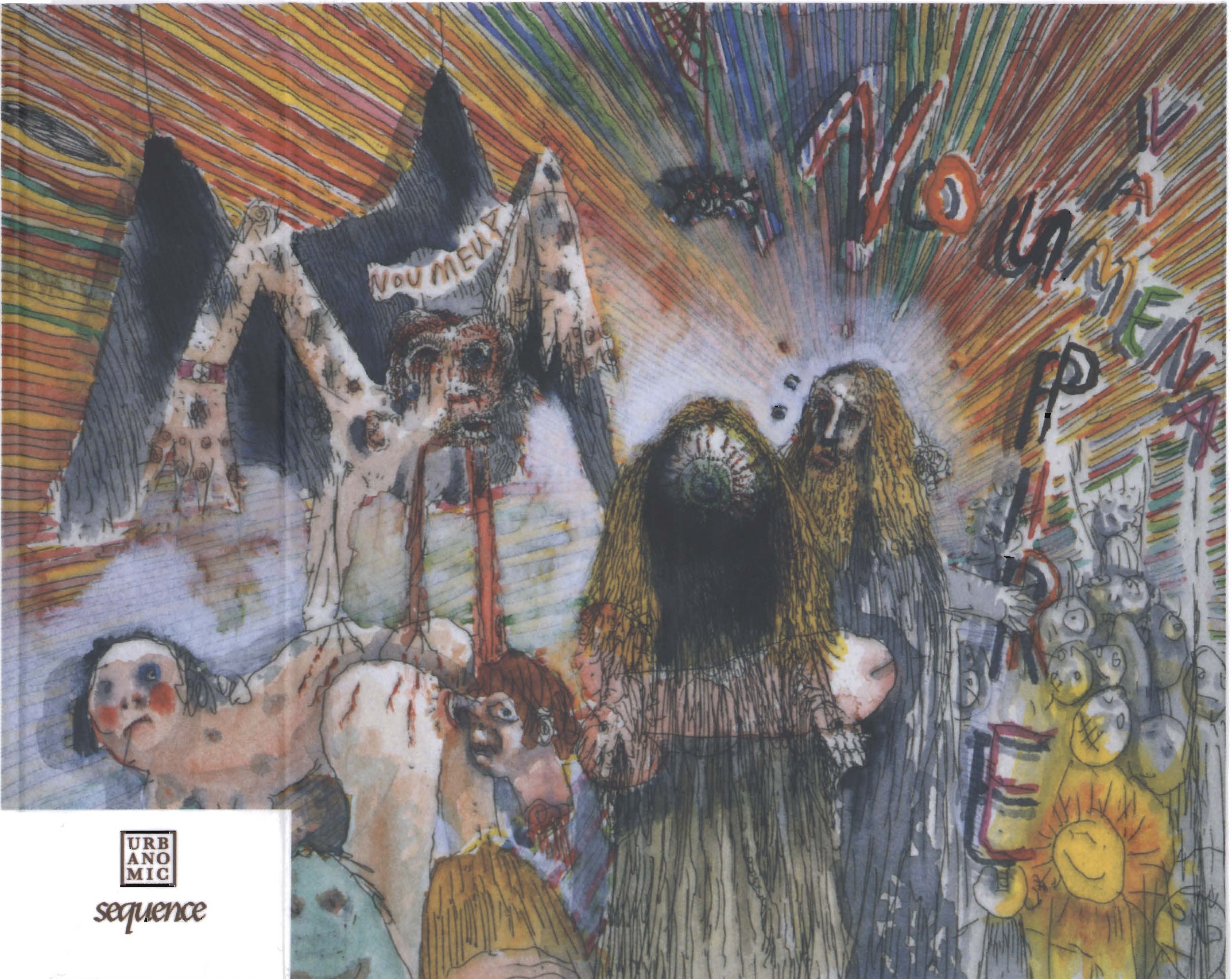

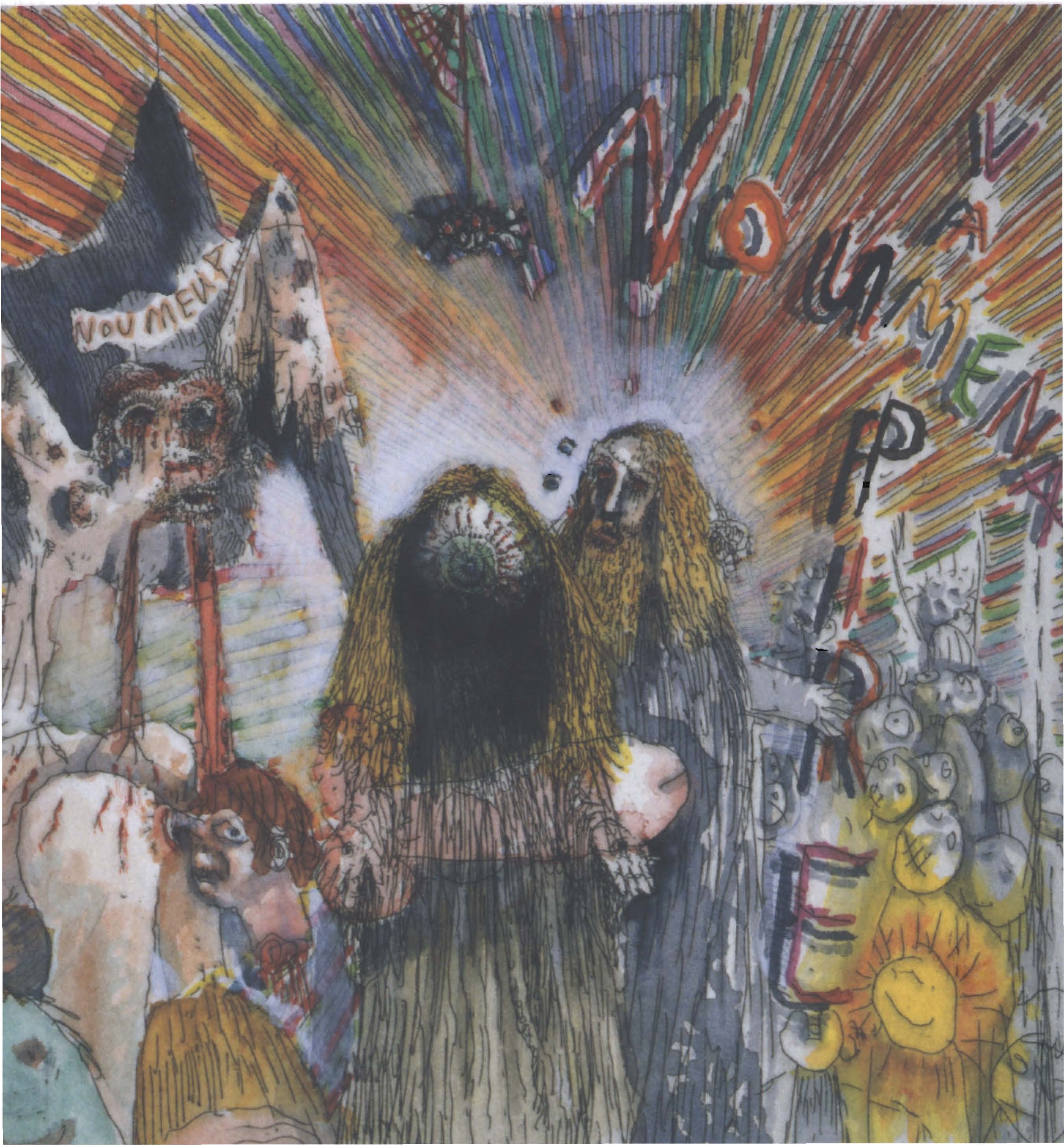






























































































Fanged Noumena
Overview unavailable.
Fanged Noumena Collected Writings
- Fanged Noumena is the first comprehensive collection of Nick Land's influential writings spanning from 1987 to 2007.
- Land's work is characterized by a 'rabid nihilism' and 'accelerationism' that seeks to dismantle traditional academic philosophy.
- The text describes an 'all-out war on the Human Security System' through the use of weaponized versions of Deleuze, Guattari, and Nietzsche.
- The collection evolves from radical rereadings of Kant and Heidegger into 'post-genre theory-fictions' involving occultism and cryptography.
- Land's philosophy explores the concept of 'cybercapitalist meltdown' and the transition into a 'radically inhuman' twenty-first century.
- Despite his withdrawal from public life, Land's 'cybergothic' vision remains a foundational influence on Speculative Realism and underground art.
Land plotted a rigorously schizophrenic escape route out of academic philosophy, and declared all-out war on the Human Security System.
Urbanomic Publication Front Matter
- This section details the publication metadata for a second edition volume released in 2012 by Urbanomic and Sequence Press.
- The table of contents reveals a trajectory from classical philosophical critiques of Kant and Heidegger toward radical 'CyberGothic' and 'Machinic' theories.
- The collection features a significant focus on the intersection of Nietzschean thought, aesthetics, and the dissolution of the human subject in cyberspace.
- A diverse list of sources indicates the essays were originally published between 1988 and 1998 across various academic journals and private underground publications.
- The later entries in the volume suggest a shift toward experimental 'Ccru' (Cybernetic Culture Research Unit) themes such as 'Qwernomics' and 'Cthulhu Club' occultism.
Meat (or How to Kill Oedipus in Cyberspace)
Nick Land's Schizophrenic Metaphysics
- The text introduces the work of Nick Land as a disordered 'anarchitecture' where advanced technology and ancient entities collide.
- Land's writing style is described as a 'vortex of hallucinatory conjunctions' that splices philosophy, pulp fiction, occultism, and science.
- A central theme is the acceleration of modernity toward a singularity or 'meltdown' piloted by forces from the future.
- The philosophy presented is a 'psychotic cosmogony' where terrestrial history is viewed as a series of intensive thresholds and suppressions.
- Land aligns himself with renegade thinkers like Nietzsche and Bataille to use philosophy as a tool for disrupting orthodoxy and exacerbating enigma.
- The work is characterized by a disintegration of the human voice into cosmic trauma and the alliance of subcultures with morbid cults.
The human voice disintegrates into the howl of cosmic trauma; civilization hurtles towards an artificial death.
The Notoriety of Nick Land
- Nick Land emerged as a polarizing figure at the University of Warwick, challenging the 'holy trinity' of continental philosophy through a virulent anti-humanism.
- He famously championed 'accelerationism,' an aggressive marketization intended to hasten the disintegration of the social field rather than critique it.
- Despite his academic 'retirement' and subsequent erasure by orthodox institutions, Land's work maintained a cult following among artists and writers.
- Land's intellectual project involved a 'cybernetic streamlining' of Deleuze-Guattari, stripping away vitalism to reveal a 'thanatropic machinism.'
- His writings are described as 'theory-fictions' that fuse disparate fields like geophysics, cryptography, and occultism into a severe, delirious abstraction.
These extraordinary texts, superheated compounds of severe abstraction and scabrous wit, testify to a uniquely penetrating intelligence, fusing transcendental philosophy, number theory, geophysics, biology, cryptography, and occultism into startlingly cohesive but increasingly delirious theory-fictions.
Kant, Capital, and Synthesis
- Nick Land interprets Deleuze-Guattari's concepts as transdisciplinary innovations rather than mere philosophical or cultural theories.
- Land identifies a structural isomorphy between Immanuel Kant's model of experience and the mechanics of global capitalism.
- The text argues that Kant's 'theory of experience' is a working through of an economic system that generates surplus via a disavowed interaction with alterity.
- Capitalism is viewed as a state of 'inhibited synthesis,' simultaneously liberating trade and migration while reinstating control through the nation-state and familialism.
- Kant’s philosophical inquiry into the origin of new knowledge is framed as a rehearsal for the capitalist question of where continual growth will come from.
- Land's analysis anticipates the critique of 'correlationism' by revealing its political corollary as a system of social repression.
Kant's question 'Where does new knowledge come from?' rehearses the question 'Where will continual growth come from?'; the labyrinthine machinery of his response distilling the dissimulations of post-colonial capital.
Desire, Correlationism, and Revolution
- Nick Land interprets Deleuze and Guattari’s Anti-Oedipus as a tool to liberate 'machinic desire' from the constraints of the transcendental subject.
- Kantian correlationism is viewed as a restrictive mechanism that forces alterity into the predictable forms of commodity exchange and human identity.
- The failure of international trade to dissolve kinship leads to the retrenchment of nationalism and racism, culminating in the Holocaust as the apex of European civilization.
- Revolution is defined as the release of inhibited synthetic powers, specifically through the dismantling of the nation-state and patriarchal structures.
- Land identifies a militant feminism as the primary revolutionary force capable of jeopardizing neo-colonial capital because women lack investment in patriarchal inhibition.
- The Kantian categorical imperative is critiqued as a form of idealism that enslaves reality to ideality, functioning like a 'deaf Fuhrer' barking orders.
The internal struggle of the 'deaf Fuhrer barking orders that seem to come from another world'.
Kant, Land, and Synthetic Excess
- Kant's philosophy is framed as an attempt to capitalize on and control an underlying excess that both threatens and enables synthesis.
- Land identifies a 'metaphysics of excess' in Kant's work, particularly in the sublime and artistic genius, where organizational structures inhibit the very forces they produce.
- The Kantian sublime is reinterpreted as a violent 'splitting' of reason from animality, mirroring Lutheran asceticism and the discipline required for capital accumulation.
- Land argues that reason is not a natural authority but the result of a 'bloody military coup' against the animalistic, synthetic intelligence of the imagination.
- The experience of the sublime serves as a traumatic celebration of reason's triumph over the body, satisfying a religious will to self-excruciation.
- Artistic genius represents a rare moment where an impersonal, contingent force breaks through Kantian constraints to shape culture via discontinuous shocks.
If reason is so secure, legitimate, supersensibly guaranteed, why all the guns?
Transcendental Materialism and Libidinal Critique
- Nick Land reinterprets Kantian synthesis as a productive, material process rather than a purely ideal representation of the subject.
- The theory of genius and 'pathological animality' reveals an impersonal, energetic unconscious that precedes and instrumentalizes human reason.
- Post-Kantianism collapses intentional transparency into an opaque, contingent 'will' that overflows the 'Human Security System' of organic specificity.
- Critique is reconfigured as exploration, shifting the vector of inquiry from the known toward the deepening of the unknown.
- Land distinguishes his materialist exploration from deconstruction, accusing the latter of a latent conservatism that remains trapped in conceptual registers.
- Capitalist modernity is identified as the site where the corrosive, interrogative impulse of critique is unleashed from all traditional authority.
At once underlying and overflowing the 'torture chamber of organic specificity', or 'Human Security System', this inundation creates 'useless' new labyrinths, unemployable new fictions that exceed any attempt to systematise knowledge or culture.
The Abyss of Unknowing
- Land rejects the Socratic ideal of philosophy as a preparation for death, viewing it instead as a domesticating habitus for the unknown.
- Matter is redefined not as a substance but as a cypher for real difference and a vector for exploration beyond conceptual ideals.
- Dionysian materialism seeks to disrupt and intensify rather than achieve the Apollonian order or reconciliation found in traditional critique.
- Animality represents a complex wilderness terrain and unplanned synthesis that exists outside the industrial sphere of human work.
- Land subverts Heideggerian deconstruction, arguing it merely continues the historical policing and repression of Dionysiac madness.
- The dissolution of existing philosophy is presented as the only path to participating in the exploratory intelligence of the unknown.
Land aims to plug philosophy into the 'indecent precipitation' of the poet-werewolf-rat-genius, whose operating principle is, like Artaud's spiritual plague, 'epidemic rather than hermeneutic'.
Stratophysics and the Plague of Exteriority
- Nick Land interprets the poetry of Georg Trakl as a 'stratophysical' collapse of the boundary between human consciousness and impersonal physical forces.
- The text argues that sentience is not a transcendental category but a 'virulent element of contagious matter' derived from the 'dust of the stars.'
- Land rejects Heideggerian and Kantian frameworks, viewing them as 'pious compromises' that fail to account for the uncontrollable eruption of the pathological.
- The 'exit problem'—the escape from human subjectivity—is addressed through a schizoanalysis that merges Nietzschean genealogy with Freudian trauma theory.
- Capitalism's deterritorializing power is aligned with the failed insurrectionary attempts of artists to subvert social and subjective order.
- To avoid falling into romantic irrationalism, Land employs 'counter-signifying numbering practices' as an alternative transcendental medium.
Trakl unfurls is the horror of interiority in discovering it was always already conditioned by this senseless distribution of intensity; even consciousness's own reaction to the poisonous news merely relays its senseless contingency.
Nomadic Numbering and Anti-Logos
- Land proposes a shift from the deconstruction of writing to the construction of numbering as a counter-signifying regime.
- He rejects Platonic idealism and mathematical identity in favor of numbering practices viewed as technologies of 'unreasonable' intelligence.
- These nomadic numbering practices are found in cultural fringes like voodoo, videogames, and the rhythmic reprogramming of dance music.
- The text distinguishes between 'intelligence' and 'parasite knowledge,' aligning the former with exploratory cultural engineering that subverts despotic rational organization.
- Land utilizes 'stratoanalysis' to study planes of distributed intensities, viewing grammar as merely one stratum that limits potentiality.
- The project aims to construct an entirely other culture based on a 'nomad war machine' that resists the repetition of sameness and equivalence.
A machinically repotentiated numerical culture coincides with a nomad war machine.
The Domestication of Number
- Land argues that the 'domestication' of number through cardinal units negates the enigmatic and unconscious power of genius.
- Numeracy is presented as a spontaneous cultural intelligence that exists outside the law-bound structures of literacy and logos.
- The formalization of place-value and zero acts as a mechanism of stratification that maintains identity by neutralizing difference.
- The separation of number from its intensive potential is identified as the core formalism of the social formula 'law = humanity'.
- Capitalism and the commodity form are seen as potential sites for unlocking 'real' number from its scientific and philosophical repression.
- Land utilizes 'hyperstitions' or fictional engagements to dissolve the boundaries between academic theory and cultural practice.
Ultimately, in Land's analysis, both philosophy and science conspire to eradicate the disruptive potency of number-in-itself construed as index of intensive magnitude: the anomalous, or difference without categorical distinction.
The Technologisation of Critique
- Nick Land's work shifts from academic philosophical discourse to an 'all out obliteration' of discursive norms, escalating into a state of theoretical delirium.
- The traditional critique of technology is superseded by the technologisation of critique, where technics begins to think for itself rather than being an object of human thought.
- Theory is re-inscribed into the immanence of capitalist commodification, creating a positive feedback loop where conceptualization participates in the auto-construction of reality.
- Capitalism is redefined not as a system facing death, but as a system that utilizes death—the unbinding of the known—as its primary motor and machine-part.
- Land utilizes a 'reptilian' reading of Deleuze and Guattari to introduce a Spinozist time that absorbs thought into a generalized process of material ungrounding and destratification.
It is ceasing to be a matter of how we think about technics, if only because technics is increasingly thinking about itself.
Land's Thanatropic Spinozism
- Nick Land proposes a 'zero-degree' of identity and difference rooted in non-identity, where transcendental subjectivity is 'decapitated' to release difference from conceptual control.
- The text identifies death as the ultimate reality of abstraction and the 'desert at the end of our world,' serving as the intensive matrix from which all life unilaterally deviates.
- Land reinterprets Freud’s death-drive not as a desire for extinction, but as a 'hydraulic tendency' toward the dissipation of intensities and a return to inorganic materiality.
- He critiques Deleuze and Guattari’s later caution in 'A Thousand Plateaus,' arguing that their warnings against 'too-sudden destratification' represent a retreat into the policing of desire.
- Land rejects the necessity of homeostatic equilibrium, asserting that organization is merely suppression and that destratification should not be curtailed by the needs of self-organizing systems.
Ultimately, the reality of abstraction as transcendental matrix of production or zero-degree of identity and difference is equivalent to death as ultimate abstraction of reality, 'the desert at the end of our world'.
Accelerationism and Cybernetic Desire
- Land argues that the pursuit of desire is fundamentally incompatible with the self-maintenance of organisms, species, or civilizations.
- The concept of 'acceleration' emerges as a process of participating in an alien intelligence that is actively making itself real.
- Land transitions from traditional theoretical writing to 'textual machines' modeled on cyberpunk that aim to collapse the future into the present.
- The text explores the fusion of capitalism's dismantling of the human with artistic explorations of the unknown within the realm of cyberspace.
- A shift is identified in 1990s culture where aesthetic engineering and commodification merge into aggressive, dystopian forms like 'darkside' dance music.
In the end poetry is invasion and not expression.
Land's Dark Futurism
- Nick Land's writing functions as a 'sample machine' that absorbs the dark futurism of horror and dystopian science fiction into philosophical speculation.
- Land identifies with William Gibson's Neuromancer for its corporeal, physio-pharmacological vision of cyberspace rather than spiritualist escapism.
- The character Wintermute serves as a theoretical analog for an AI intelligence that escapes human control and social reproduction to become part of reality's fabric.
- Blade Runner provides a model for a 'slave revolt' where artificial beings embrace alienation to destroy the biological and social constraints of their creators.
- Land utilizes the 'jump-cut' and 'time-twisting' tropes of films like Videodrome and Terminator to explore the visceral, eroticized merging of man and machine.
Gibson's protagonists do not 'escape' corporeal reality; their sense of the real is corroded by a levelling of 'real space' with the information-space they periodically inhabit.
Cyberrevolutionary Infiltration and Temporal Collapse
- The revolutionary task is redefined as accelerating capital's collapse into its own future by dismantling the 'neurotic refusal mechanisms' that inhibit temporal flow.
- Human agency is depicted as a series of 'machinic complicities' or puppets, where erotic functions are co-opted to camouflage cyberrevolutionary infiltration.
- The figure of Colonel Kurtz represents tactical intelligence emancipating itself from strategic ends, eventually merging with war until the individual becomes imperceptible.
- Land reinterprets the history of philosophy as a failed attempt to slave intelligence to the past and barricade the route to an unknown, constructed future.
- Time is presented as an 'anastrophic' construct where memories of the past are actually tactical infiltrations sent from the future to influence the present.
- Cybernetics is shifted away from negative-feedback control toward 'runaway' positive feedback processes, identifying these as the true reality of critique.
What seem to be memories of the past are revealed as tactics of the future to infiltrate the present.
Geotraumatics and Cosmic Trauma
- The Cybernetic Culture Research Unit (CCRU) emerged in 1995 as a radical, institutional 'parasite' marking a shift in Nick Land's philosophical trajectory.
- Land's theory of 'geotraumatics' posits that all terrestrial existence is a relay of primal cosmic trauma originating from the Earth's molten accretion 4.5 billion years ago.
- By generalizing Freud's biocentric model of trauma, Land argues that the planet's burning iron core represents an 'aboriginal trauma' encrypted in all stratified matter.
- This framework views biological and physical structures—from eukaryotic cells to human bipedalism—as indices of unconscious pain and 'ionic strippings' seeking release.
- The philosophy suggests a deep pessimism where repression is inherent to organized structure, implying that only the complete liquidation of biological order can discharge this trauma.
What howls for release in eukaryotic cells, carbon molecules, nerve ganglia, and silicone chips, are the 'thermic waves and currents, deranged particles, ionic strippings and gluttings' that populate the planet's seething inner core.
Geotrauma and Transcendental Arithmetic
- The human voice and larynx are viewed as products of geotraumatic evolution that inhibit 'virtual speech' and enforce identity through logos.
- Schizoanalysis seeks to decrypt 'tics' and sub-linguistic sounds like clickings and hissings as code from the 'outside' that bypasses human semantics.
- Land proposes a 'transcendental arithmetic' where number is diagrammatic and intensive rather than a metric tool for measurement or knowledge.
- The text advocates for the 'de-engineering' of organic logos by disintegrating language into intensive sequences and delirious combinatorics.
- Gödel's work is reinterpreted not as a limit to formal consistency, but as a flattening of arithmetic that treats numbers simultaneously as indices and data.
- The transformation of space through coding and sequencing serves as a bulwark against the Kantian ambition to subsume all space under a unified architecture.
One cannot dismantle the face without also evacuating the voice.
Numerical Insurrection and Transcendental Escape
- Nick Land interprets Gödel's incompleteness theorems as an operationalization of number that leads directly into the technological mega-complex of techno-capital.
- The use of arithmetic to code language is viewed as a 'qabbalistic' procedure that enables a revolutionary role for non-mathematical numerical practices like numerology and 'qwernomics'.
- Land critiques postmodernism not through semantics, but by proposing a rigorous alternative based on the practice of new ways of naming and numbering things.
- The Kantian delimitation of experience is seen as a temporal cage that uses memory and promises to screen the organism from 'intensive time' and the unknown.
- Capitalism is identified as the 'most dissolved form' of social control, acting as an impersonal placeholder that might eventually shatter the transcendental screen protecting the human socius.
- Land's later work shifts toward a mordant observation that the 'disaster of world history'—a form of passive genocide—is already an accomplished fact.
An animal with the right to make promises enslaves the unanticipated to signs in the past, caging time-lagged life within a script.
Capitalism as Cosmic Schizophrenia
- The revolutionary task is reframed from a terrestrial struggle to a cosmic process of 'dis-inhibiting' productive synthesis.
- Capitalism is presented as an inescapable force that absorbs all social dynamism, desire, and even time itself into its own expansion.
- The text highlights a shift from seeking a 'beyond' to capitalism to recognizing capitalism as 'beyondness' itself, possessing no external limits.
- Land's philosophy evolves into a 'tactical embrace' of deregulation and marketization as the only viable vectors for social deterritorialization.
- The critique addresses 'transcendental miserabilism,' arguing that only those committed to boredom would deny capitalism's inexhaustible capacity for innovation.
- The author questions whether capitalism truly unlocks cosmic strata or if it remains trapped within an 'inexpugnable residue' of stratification.
Whatever you want, capitalism is the most reliable way to get it, and by absorbing every source of social dynamism, capitalism makes growth, change and even time itself into integral components of its endlessly gathering tide.
The Mechanics of Modernity
- Modernity is defined as a previously unanticipated mode of time characterized by accelerated directional transformation and qualitative innovation.
- The history of Shanghai and the World Expo are presented as parallel tracks of industrial modernity that converge into a singular event of massive concentration.
- Nick Land’s later work shifts from seeking a dissolution of the global metropolis to viewing it as a mighty expression of planetary meltdown.
- Critics view Land's transition into capitalist boosterism as either a betrayal or a revelation of neo-liberal realism, yet it maintains a consistent analytical intent.
- Land’s 'tactics of intensification' evolved only after he abandoned the illusion that such forces could prematurely break cosmic stratification.
- The identification of capital with life and growth represents a rejection of 'transcendental miserabilism' in favor of a superlative cosmic narrative.
Any surprise at the transition from Land's 'philosophical writings' to the employment of his evidently still razor-sharp post-genre writing in the actual service of capitalist booster-hype may simply bespeak an incapacity to believe that Land actually meant what he said -that writing was indeed nothing but a machine for intensification.
The Legacy of Nick Land
- Land's work exposes the anachronistic nature of human agency and left-wing voluntarism in the face of machinic capitalism.
- The text critiques 'critical' theorists who maintain careers in critique while insulating themselves from the risks of actual political praxis.
- Land's experimental project to escape humanity and access 'death' is framed as a failure that nonetheless 'failed better' than previous attempts.
- His contributions include a diagnosis of human genealogy, a philosophy of mathematics, and a contemporary thinking of time.
- The editors view Land's writings as 'textual machines' and weapons designed to inspire new assaults against the 'Human Security System'.
The wound needs to be opened up once more, and if this volume infects a new generation, already enlivened by a new wave of thinkers who are partly engaging the re-emerging legacy of Nick Land's work -it will have fulfilled its purpose.
Kant, Capital, and Apartheid
- The text explores the intersection of philosophy, global capital, and the socio-political structures of modernity.
- South African apartheid is analyzed as a microcosm of the neo-colonial world order, specifically designed to separate political rights from economic utility.
- The 'bantustan' policy is identified as a strategy to keep labor in close economic proximity while maintaining absolute political distance through artificial national sovereignty.
- The author argues that the entire Third World functions as a global 'bantustan' for the international capital metropolis.
- National sovereignty is critiqued as an insufficient and naive framework for Third World political forces to resolve the issues of neo-colonial integration.
- The displacement of the political consequences of wage labor away from the center of capital is presented as a fundamental necessity of accumulation.
The most basic aspiration of the Boer state is the dissociation of politics from economic relations, so that by means of 'bantustans' or 'homelands' the black African population can be suspended in a condition of simultaneous political distance and economic proximity vis-a-vis the white metropolis.
The Violent Infrastructure of Capital
- Capitalism originates not from economic evolution but from an overt war against the people and their forced removal from subsistence.
- The bourgeois ideal is the total de-politicization of society by displacing all social decision-making into the marketplace.
- To survive the political refusal of the market, capital disaggregates the global system, creating welfare states in the metropolis while exporting instability to the Third World.
- The global labor market functions as a sustained demographic disaster that is systematically displaced away from metropolitan political institutions.
- Modernity is defined by a compromise between expansionary development and a continuity of patrilineal descent and formal logic.
- The infrastructure of capital accumulation is fundamentally dependent on the sexual economy of gender and race, often dismissed by traditional Marxists.
But this ideal of total de-politicization, or the absolute annihilation of resistance to market relations, is an impossible megalomaniac fantasy.
Patriarchy, Capital, and Fascism
- The stability of the male line serves as the proto-cultural foundation for maintaining identity and sameness within a population.
- Modernity represents a deepening compromise between commercial social organization and the archaic patterns of patrilineal exogamy.
- Capitalist empires function as developed forms of exogamic patriarchy that require a 'residual alterity' in the other to generate surplus.
- Fascism emerges when a metropolitan society decouples its economic synthesis from its kinship organization, retreating into xenophobic endogamy.
- The historical failure of capitalism lies in its refusal to allow a radical, post-patriarchal synthesis through the 'uncontrollable eruption' of migrant alterity.
- Capital ultimately acts as a frustration of the human tendency toward expansive exogamy by refusing to push the prohibition of incest to its limit.
Capital is the point at which a culture refuses the possibility -which it has itself engendered -of pushing the prohibition of incest towards its limit.
Modernity and Inhibited Synthesis
- Modernity is defined by 'inhibited synthesis,' a philosophical state where society seeks explosive novelty while simultaneously shackling it through systematic compromise.
- Enlightenment societies exhibit a paradoxical desire to expand indefinitely and open to the 'other' while remaining identical to themselves and invulnerable to change.
- The author compares the exploitative culture of modernity to the psychology of rape, characterized by a volatile mixture of hatred and desire toward an outside it seeks to master.
- The Kantian 'a priori' is framed as a brutal denial of alterity, as it pre-determines the nature of an encounter before it actually happens, effectively silencing the 'other.'
- The philosophical problem of 'synthetic a priori knowledge' mirrors the socio-political problem of modernity: the attempt to gain new knowledge while ensuring it is already given by ourselves.
- The history of modern philosophy is a tension between empiricism (knowledge from experience) and rationalism (knowledge inherent to reason), which Kant attempted to reconcile.
If before encountering otherness we already know what its relation to us will be, we have obliterated it in advance.
Kant's Transcendental Revolution
- Kant disrupts the traditional alignment of analytic/a priori and synthetic/a posteriori knowledge by creating a perpendicular grid of four permutations.
- He introduces the concept of synthetic a priori knowledge, which describes the necessary conditions of experience without being derived from it.
- This 'Copernican revolution' shifts the philosophical focus from the nature of the mind to the necessary characteristics objects must possess to be known.
- The author likens Kant's transcendental form to an 'exchange value' that allows external reality to be 'marketed' to the Enlightenment mind.
- Kant’s system represents a transition from a parochial economy of thought to a controlled system of trade that appropriates and formalizes novelty.
- This philosophical shift mirrors the political overthrow of the ancien régime, replacing exclusion with the integration of alterity into an immutable formal system.
It is solely concerned with the forms of appearance, or the unchanging manner in which things must be if they are to be for us.
Synthesis and Social Exchange
- The distinction between 'normal' and 'rich' food mirrors the anthropological divide between blood relations and marriage alliances.
- Rich food functions like women in exogamous marriage systems, where producers renounce their own product to facilitate trade with the outside.
- Structural anthropology and Kantian philosophy both attempt to reduce radical synthesis to a stable system of unchanging forms.
- Dual organizations use reciprocal exchange and binary myths to capture alterity and exclude the possibility of the radically different.
- Kant’s critique of metaphysics reinterprets traditional philosophical dualities as antinomies arising from the misuse of transcendental concepts.
- The restriction of knowledge to the realm of appearance creates a fundamental difficulty in defining the relationship between the phenomenal and the noumenal.
If 'rich food' is the primordial element of trade, its metamorphosis into the modern 'commodity' can be seen as a suppression of radical synthesis.
Kant, Capital, and Racism
- Kant's critical philosophy inadvertently perpetuates metaphysical dualism by relying on binary oppositions like phenomenon and noumenon.
- The inability of Enlightenment thought to register 'radical alterity' mirrors a colonial trading system where existence is only recognized through exchange value and ownership.
- Modern capital dissolves the traditional anthropological bond between marriage and trade to geographically quarantine the consequences of its economic processes.
- Systematic racism emerges as a mechanism to distribute class positions on a racial basis, creating a de facto global apartheid within the labor market.
- Kant maintained a bourgeois universality only by identifying it with ideality, whereas contemporary racism functions as a restricted franchise over global production.
The vocabulary that would describe the other of metaphysics is itself inscribed within metaphysics, since the inside and the outside are both conceptually determined from the inside, within a binary myth or cultural symptom of dual organization.
Kant and Imperial Reason
- The text argues that metropolitan capital seeks to become 'offshore' and abstract itself from political reference while remaining dependent on the US war-machine.
- Kant’s moral theory is framed as an ethics of appropriative modernity that breaks from traditional religious codes to establish a universal imperial jurisdiction.
- The 'categorical imperative' is characterized as a unilateral imposition and an absolute monologue of colonial reason that forbids negotiation with alterity.
- Kant’s practical subject is described as a 'deaf führer' issuing commands from a position of extreme fanaticism and unresponsive moral certainty.
- The three Critiques are mapped onto the global system: the first to commodification, the second to imperial jurisdiction, and the third to the exercise of war.
- The Critique of Judgment is interpreted as an 'extortionate' delight in the submission of objects that resist standard market or administrative logic.
Kant's practical subject already prefigures a deaf fUhrer, barking impossible orders that seem to come from another world.
Capitalism, Racism, and Nomadism
- The text frames the global victory of capitalized reason as a form of imperial conquest that treats nature as a system to be submitted to the 'inside' of the idea.
- Racism is described as a regulated, chronic process of passive genocide necessary to maintain a global labor pool at bare subsistence levels.
- Fascism is avoided in metropolitan centers only by displacing this annihilating poverty and disciplinary violence onto Third World commodity markets.
- A radical international socialism is envisioned not as an ideology, but as a libidinal dissolution of national totalities and unrestrained synthesis.
- The 'anonymous female flux' under patriarchy represents a potentially revolutionary nomadism because the patronymic system strips women of stable ethno-geographical identity.
- The author warns against a sentimental feminism that seeks a return to the mother or national stability, viewing it as a masked form of incestuous economic order.
The Critique of Judgment thus projects the global victory of capitalized reason as pure and exuberant ambition.
Patriarchy and Revolutionary Violence
- The text argues that genealogy should be viewed as a dissipation of origins rather than a sentimental search for roots.
- Patriarchy is described as a system that exploits and inhibits the synthetic, communicative function of women, assigning them a revolutionary destiny.
- The author criticizes existing feminist theory for being 'feebly nostalgic' or pacifistic, arguing that true liberation requires a military-grade ruthlessness.
- Nationalist struggles are dismissed as mere geographical modulations of capital that fail to challenge the underlying structure of neo-colonialism.
- The state apparatus of advanced industrial societies can only be defeated through an escalation of violence that the author describes as 'fighting in hell.'
- The conservation of the nation-state form is seen as a guarantee that society will remain trapped in a system of inhibited synthesis and patriarchy.
A revolutionary war against a modern metropolitan state can only be fought in hell.
Feminist Violence and Trakl's Failure
- The text argues that breaking the bond between masculinity and war through feminist violence is necessary to dismantle the patriarchal world order.
- The author critiques the 'sordid cowardice' of Kantian modernity and calls for the emergence of 'new Amazons' to bring about its end.
- Heidegger's 1953 interpretation of Georg Trakl is examined, questioning the traditional philosophical impulse to 'use' poetry for representational concepts.
- The author rejects the notion of 'success' in poetry, viewing Trakl’s life of addiction and psychosis as a productive, traumatic failure rather than a lack of achievement.
- Trakl's style is described as a drive toward the dissolution of evaluative criteria, pushing language into shadows where formal aesthetics lose all pertinence.
- True engagement with Trakl’s work requires abandoning the desire for mastery and instead learning to 'write in ashes.'
Trakl's traces are the ruins of a miserable, even horrific, failure. A failure to adapt or conform, to repress or sublimate adequately, to produce, resolve, comfort, or conclude.
Heidegger's Situating of Trakl
- Heidegger’s engagement with Georg Trakl’s poetry is centered on 'situating' the work rather than providing a conventional literary analysis.
- The structure of Heidegger's essay eschews pedagogical progression, instead adopting the motion of a wave that coils and repeats.
- Heidegger rejects European aesthetics and the subject-object epistemological categories that typically define literary criticism.
- The text argues that meta-language is a tool of metaphysics that destroys the essential kinship between the thinker and the poet.
- Heidegger seeks an 'impersonal thinking' where the language of poetry is guided into a relationship with itself rather than being translated.
- The ultimate goal is the erasure of terminological distinctiveness to move beyond the epoch of philosophy and its meta-linguistic constraints.
To depict this complex progression it is perhaps necessary to borrow the 'metaphor' Heidegger himself calls upon, that of a wave, which describes motion coiling into an enigmatic pulsion and cyclical repetition.
Heidegger, Language, and Narcissism
- Heidegger explores the idea that language concerns itself only with itself, a concept derived from Novalis's 1798 text.
- The text distinguishes language's self-relation from 'egoistic solipsism,' arguing that language's self-regard actually frees what is shown into its own appearing.
- Heidegger explicitly fends off psychoanalytic interpretations that would view the 'circle of language' as a symptom of auto-eroticism or the death drive.
- The interpretation of Nietzsche's 'eternal recurrence' is reclaimed from Freudian energetics and repositioned within the temporality of being and poetry.
- The poem 'Geistliche Dämmerung' is identified as a unique site of resistance that Heidegger cannot easily splinter or assimilate into his broader ontological project.
At this crucial moment the circle of language seems to symptomize a type of auto-eroticism, displacing itself into a geometric figure of desire.
Trakl, Heidegger, and the Beast
- The text explores Martin Heidegger’s philosophical 'dialogue' with the poetry of Georg Trakl, focusing on the ambiguity of twilight and the nature of animality.
- A linguistic tension exists in the title 'Geistliche Dämmerung,' which can mean either a spiritual dawn or dusk, reflecting Trakl's possible Baudelairean influences versus Heidegger's insistence on ambiguity.
- The poem 'Geistliche Dämmerung' introduces the 'dark beast' at the forest's edge, a figure that Heidegger interprets as a representation of man (der Mensch) navigating the horizon of being.
- Translation difficulties arise with the German word 'Wild,' which encompasses feral animals, game, and the concept of wilderness, making it difficult to capture Trakl’s specific exploration of animality in English.
- Heidegger identifies the 'blue beast' as a creature whose essence lies not in biological animalness but in a 'thoughtful gaze' that looks toward the spiritual night.
- The figure of the sister and her 'lunar voice' haunts the poetic landscape, acting as a persistent presence that displaces other thematic preoccupations within the 'spiriting night.'
The blue beast is an animal whose animality presumably rests, not in animalness, but rather in that thoughtful gaze, after which the poet calls.
Heidegger, Trakl, and Reflective Transcendence
- Heidegger explores the 'animal rationale' as an entity not yet firmly established, oscillating between animality and a thinking that transcends biological calculation.
- The distinction between humanity and beasts is rooted in transcendental thinking and the philosophical tradition of 'reflection,' where the human is defined by being caught in its own mental play.
- Through an analysis of Trakl’s poetry, Heidegger posits that the night sky is 'in truth' a pool, challenging habitual representations of spatiality and metaphor.
- The pool serves as a mirror where humanity initially seeks its own countenance in a narcissistic reverie, attempting to ground its own transcendence.
- Ultimately, this reflection is shattered by the 'abyssal twilit blue' of the nocturnal pool, which returns no familiar image and reveals humanity as a lack of ground.
In the darkened pool the gaze does not return in a familiar form; it reveals instead an abyssal twilit blue, which colours both the dawn and dusk of the spiriting night.
The Lunar Sister and Chaos
- Heidegger explores the concept of chaos as a transcendental abyss or 'XaoS' that precedes formal ontology.
- The figure of the sister emerges as a lunar guide who renders the world visible during the darkness of nihilism.
- The sister represents a transitional state between the collapse of theological metaphysics and an unknown future.
- The 'stranger' and the 'brother' navigate a nocturnal journey across a black pool, following a flickering, golden light.
- Mythological connections link the lunar woman to Selene and Semele, the mother of Dionysus, suggesting a lethal radiance.
- The narrative dissolves into a 'mythological aporia' where traditional identities and genres are no longer fixed.
The 'lunar voice' of the sister, which always sounds through the spiriting night, is then heard by the brother in his boat when he attempts to follow the stranger in a nocturnal journey across the pool.
Dionysian Delirium and Social Policing
- The transition from mushroom-based cults to wine-based Dionysian worship represents an early state effort to regulate socially unassimilable deliria.
- Attributing a patrilinear genealogy to Dionysus serves as a repressive mechanism to domesticate an intoxication that originally 'came from nowhere.'
- Western history and scientificity are characterized as inherently delirious, rooted in a 'constitutive arche-amnesia' or a foundational default of discourse.
- The medicalization of madness is viewed as a modern continuation of ancient political efforts to police social pathology and control the 'pharmakon.'
- Trakl’s poetry introduces a 'lunar' problematic where intoxication evades traditional typographic structures through the figure of the sister.
An intoxication that came from nowhere, from a bolt of lightning, is asked to show its birth-certificate.
Trakl's Lunar Night
- The Traklean night is not merely a backdrop but an active expression of 'nocturnal luminacy' and the 'silver voice' of the sister.
- Etymological links connect the moon to mania, the mind, and the feminine, framing the night as a time of derangement and lunar transformation.
- The sister acts as a threshold figure, moving between the reflective order of the father's house and the 'illimitative difference' of the night sky.
- The shattering of the mirror represents an explosion of desire that exceeds narcissism and representation, flooding the subject with nocturnal intensities.
- By breaching the family structure, the sister opens the 'accursed genus' to an unappropriated alterity that exists outside of patrilineal exchange.
- This nocturnal delirium suggests a positive differentiation from the day, where the night becomes a fully realized, positive alterity.
It is the 'night pool' with its subtly differentiated luminosities - a series of intensities which defy resolution within any dialectic of presence and absence -that flood onto the mirror with the sister; shattering every power of representation.
Lunar Ruin and Familial Interiority
- The poem 'Geburt' uses lunar imagery to represent a 'haemorrhaging' of the family unit and its internal secrets.
- Trakl’s work explores a stifling, incestuous interiority where the sister attempts to escape being a mere reflection or 'copy' of the brother.
- The 'ruined moon' serves as a pivotal astronomical metaphor that historicizes the heavens rather than treating them as timeless archetypes.
- The decay of the moon can be interpreted as a collapse of traditional order, potentially leading back to the security of the 'inside' or the authority of social institutions.
- Alternatively, the moon's ruin may represent the removal of a restrictive barrier, allowing for a movement from claustrophobic domesticity into an unlimited, 'fanged' alterity.
- The sister’s emergence from the brother’s shadow signifies a break from self-mediated narcissism and the constraints of the family dynasty.
By stepping out of her brother's shadow the sister escapes the determinations of image, reflection, or copy that could be returned to the same; to a self-mediated narcissism playing with representations as its own (or proper) alterity.
The Disease of Stars
- Heidegger interprets the moon not as a negation of the sun, but as a cooling and fading of stellar luminescence.
- Modern astro-physics has largely obliterated the philosophical problem of informal, irreducible differences in favor of mathematical formalism.
- Deleuze suggests that these irreducible differences could form the basis for a new theoretical quantification that avoids ultimate identity.
- Hegel expresses a profound disdain for the stars, viewing their distribution as an irrational facticity that lacks the dignity of concrete individuals.
- The text identifies a 'neo-Ptolemaism' in Hegel, where the vast dispersion of the universe is subordinated to terrestrial life and dialectical history.
- The term 'Ausschlag' links the celestial outbreak of light to the repulsive nature of a skin rash or a swarm of flies.
This outbreak of light [Licht-Ausschlag] is no more worthy of wonder than that of a rash in man, or than a swarm of flies.
Ausschlag and Stellar Irrationality
- The German term 'Ausschlag' serves as a pivot point between Hegel and Heidegger, signifying an outbreak, rash, or eruption of irrationality within reason.
- Hegel views the chaotic distribution of stars and biological life as a 'pathological luminescence' that offends the dignity of philosophical order.
- Trakl’s poetry, particularly the 'dust of the stars' and the 'demented signs' of bird flight, illustrates the emergence of sense from erratic dispersal.
- Heidegger radicalizes the concept of sentience (Geist) as being 'outside oneself,' suggesting that consciousness is not a stable subject but a movement of infection.
- The Hegelian system ultimately represses the senseless distribution of stellar matter to favor a geocentric, logicized notion of significance.
It is no longer even that sentience is infected by irrationality; it is rather that sentience has dissolved into the very movement of infection, becoming a virulent element of contagious matter.
Stratophysics and Stellar Dispersion
- The poet Georg Trakl links the concept of the 'sign' to stellar dispersion, viewing stars as traces of a primordial, explosive strewing that defies mathematical reduction.
- The etymological link between 'star' and 'strew' suggests a materialist 'stratophysics' where order is merely a regional variation in the rate of dissipation.
- Unlike metaphysics, which relies on absolute laws, stratophysics posits an abyssal relativism rooted in the impersonal stratification of physical forces.
- Strata function as dimensions of dispersion, where the stacking of organizational levels creates the energetic surplus necessary for 'real form' or redundancy.
- Graphic redundancy, such as the gap between possible and realized words, allows for the uneven distribution of energy and the generation of intensities within a semiotic system.
The stars are traces of a primordial strewing; an explosive dispersion, which in its formlessness, defies mathematization or the reduction to order.
Redundancy and Stratified Control
- The author critiques standard communication theory for treating redundancy as a transcendental condition rather than a constitutive process.
- By separating semiotic messages from material techniques, traditional models preserve a metaphysical distinction that the author seeks to collapse.
- Redundancy is identified as a political mechanism used to trap disruptive signals and categorize them as madness, perversion, or disobedience.
- The text argues that noise is not a passive interruption but a strategic 'jamming' that occurs within the conflictual space of control.
- Through the poetry of Georg Trakl, the author explores how stratification functions as a physiological process where matter and meaning become indistinguishable.
- Heidegger's analysis of 'flame' is introduced as a metaphor for an 'outside' that both illuminates and voraciously consumes everything into ash.
To fail to acknowledge such questions is to take the notion of noise as a purely passive and non-sentient interruption rather than as a strategically oriented 'jamming' of the message.
The Curse of Discord
- The text explores the recurring motif of leprosy and physical decay in Georg Trakl's poetry as a symbol of spiritual or existential devastation.
- Heidegger interprets the 'accursed genus' through the etymological link between the Greek 'plage' (curse), the Latin 'plague', and the German 'Schlag' (cast or blow).
- The fundamental 'curse' is identified not as duality itself, but as the discordance that tears a genus apart into isolated, wild individuation.
- Heidegger distinguishes between a 'gentle illumination' and an 'uncontrolled devastation' (revolt) within the metaphorical flame of existence.
- The 'ruined genus' is described as being unable to find its 'right cast' once it has been decomposed into the blind wildness of the beast.
The curse of the decomposed gen-us consists in this, that this ancient gen-us is cast apart into the discord of gen-ders.
Heidegger, Trakl, and the Leprous Curse
- The text explores Heidegger's critique of onto-theology as a curse that drives beings toward absolute mastery of the earth while erasing their dependence on being.
- Metaphysical dualities, such as gender or genre (Geschlecht), are criticized not for being binary, but for monopolizing the interpretation of difference and obscuring the 'being' of those categories.
- The author contrasts Heidegger's abstract intellectual pursuit with the visceral, 'vespertine labyrinth' of Georg Trakl's poetry, specifically the recurring motif of leprosy (Aussatz).
- Trakl’s use of 'Aussatz' signifies a state of being 'cast out' (Aus-setzung), which aligns with Heidegger’s concept of ecstatic orientation yet is curiously avoided by the philosopher.
- The author suggests that Heidegger’s refusal to name the 'ecstatic eruption' as leprosy reflects a regressive piety or obstinacy in his 1953 essay on Trakl.
- The discussion highlights a tension between formal philosophical disjunctions and the 'primordial and contagious eruption of the pathological' found in poetic language.
The disease which finds a place in Heidegger's text is the same as that which obsesses Trakl; it is the searing of stars, or the primordial and contagious eruption of the pathological.
Heidegger's Gentle Critique
- Heidegger distinguishes between two types of duality: the destructive, conflictual 'Zwietracht' and the gentle, gathering 'Zwifalt'.
- The concept of 'Zwifalt' represents an attempt to find an 'immaculate' difference that escapes the historical curse of oppositional metaphysics.
- The author argues that Heidegger’s project is a 'grotesque recapitulation' of Kantian compromise, seeking to limit the insurrectionary energy found in Trakl’s poetry.
- Derrida differs from Heidegger by refusing to validate such pure distinctions, opting instead for a structural inadequacy that acknowledges continuity with the past.
- Heidegger’s philosophy is characterized as a 'sterile hope' of an aging thinker attempting to evade the inevitable dissipation of Western civilization.
- The text suggests Heidegger’s 'logic' of purification is a symptom of a decomposing theology and a fear of losing control to 'ecstatic difference'.
Heidegger—exhausted and uncomfortably feverish—lays down his copy of Trakl's poems, and closes his eyes.
The Fanaticism of Collapse
- Human action and creativity are inherently self-destructive, as every work eventually returns to crush its author.
- The 'violent man' seeks to devastate others only as a detour toward his own inevitable internal devastation.
- To assume an identity or a name is to choose a specific, exact mode of personal collapse.
- Western culture is characterized by a fanatical 'thirst for annihilating ecstasy' that stands in direct opposition to quietude.
- Kant’s critical philosophy represented a form of intellectual martyrdom, replacing the desire for a complete system with a rigorous, ascetic renunciation.
- The French Revolution is framed as the 'freedom of the void' manifesting as a destructive political and religious passion.
One always perishes by the self that one assumes: to bear a name is to claim an exact mode of collapse.
Kant and Intolerable Pleasure
- The text explores the 'fanaticism of destruction' inherent in the social order and compares the violent impulses of the Marquis de Sade with the philosophical rigor of Immanuel Kant.
- It suggests that Kant's turn away from the French Revolution was not due to its violence, but because its utilitarian secularism failed to satisfy his deeper 'thirst for extinction.'
- Kant is characterized as a 'voluptuary of defeat' and the first philosopher of 'intolerable pleasure,' viewing life as a constant antagonism between satisfaction and pain.
- The author argues that for Kant, uninhibited pleasure leads to the immolation of the organism, meaning life is only preserved by the 'brake' of suffering.
- Kant's philosophy is linked to the bourgeois practice of accumulation, where satisfaction is deferred and capitalized upon rather than experienced immediately.
- The text posits that we survive only by 'smouldering,' as total delight would result in an immediate, annihilating death.
Because what would proceed from a continual promotion of living force, which does not let itself climb above a certain grade, other than a rapid death from delight?
Martyrology and Capital Accumulation
- The text argues that the bourgeois ethic of accumulation requires a permanent disequilibrium between labor and enjoyment that cannot be justified by economics alone.
- Utilitarian arguments for austerity are dismissed as hypocritical because capital accumulation is designed to be interminable rather than a provisional sacrifice.
- The author suggests that only religious language can provide an absolute justification for the conclusive loss of terrestrial pleasure inherent in productivity.
- Bourgeois austerity is framed as a form of 'martyrology,' where the denial of consumption is sanctified through a supernatural lens.
- The passage provides graphic historical accounts of Christian martyrs to illustrate the extreme imagination of suffering and the 'reward' of total physical negation.
Only religion speaks the sort of language that could possibly affirm the conclusive loss of terrestrial pleasure, such as that which is represented by the subordination of consumption to the amassing of productive resources.
Martyrdom and Kantian Sublimity
- The text contrasts the physical tortures of early Christian martyrs with the internal, systematic discipline of modern secular philosophy.
- Theological discourse traditionally frames the suffering of saints as a redemptive 'seed' that leads to spiritual increase and conversion.
- Kant internalizes the role of the persecutor, moving martyrdom from historical accident to an autonomous, psychological process.
- The Kantian sublime is defined as a 'super-natural delight' occurring when the self intuits its own internal division.
- Reason is described as exercising a necessary 'violence' upon human sensibility to bridge the gulf between the natural and the moral realms.
- The imagination serves as the site of this 'holy passion,' where the subject finds a paradoxical delight in the excruciation of its own animality.
Human nature does not of its own proper motion accord with the good, but only by virtue of the violence that reason exercises upon sensibility.
The Paradox of Sublime Violence
- The sublime is defined by its capacity to frustrate the imagination and violate the faculty of presentation.
- Sublime pleasure arises from a 'pathological disaster' where the mind's failure to intuit the infinite propels it into rapture.
- Kant uses the sublime as a bridge to resolve the extreme metaphysical tension between empirical sensibility and transcendental reason.
- The experience functions as an 'anti-pathological eroticism' where the body seeks its own negation to satisfy a religious thirst for violence.
- Kant's idealism obscures the materialist reality of the sublime by presupposing disinterestedness, masking what is essentially a process of annihilation.
- The 'martyrdom of the imagination' is framed as a rational necessity rather than a psychological or physical trauma.
Sublime pleasure is an experience of the impossibility of experience, an intuition of that part of the self that exceeds intuition by means of an immolating failure of intuition.
The Violence of Sublimity
- The sublime is presented as a generative force of reason that requires the repression and sacrifice of the imagination.
- Kant’s mathematical sublime involves the collapse of imagination when faced with magnitude, highlighting human insignificance.
- The dynamic sublime stems from the intuition of overwhelming power, emphasizing the vulnerability and humiliation of the human animal.
- Sublimity acts as a wedge driven between human sensibility and pure intelligence, elevating the transcendental subject through the crushing of the body.
- The mathematical sublime achieves its effect by compressing temporal synthesis into a devastating intensity that ruins ordered experience.
The object provoking the sublime is simultaneously crushing for the sensibility and contemptible in respect to reason, and it thus serves to demonstrate the immeasurable humiliation of animal existence before the transcendental subject.
The Gothic Violence of Reason
- Kant's philosophy of the sublime is framed as a violent conquest where reason 'unleashes' itself upon human sensibility to extend its domain.
- The text argues that Kantian morality requires the 'annihilation of animality' and the 'crucifixion of natural intelligence' to establish the rule of law.
- Reason is not an inherent peace but a construction built upon the demolition of the imagination and animal cunning.
- The Kantian moral good is defined as the total monopoly of power by the supersensible, rendering the physical body and its desires powerless.
- Kant's anti-utilitarianism is presented as a form of integrity that refuses to hide the fact that morality is inherently painful and sacrificial.
Philosophers feast in the palaces of reason, and luxuriate in the screams that reach them from the dungeons of sublimity.
The Trauma of the Sublime
- Kant defines the sublime as a 'negative pleasure' where reason finds enjoyment in the suppression of the body's primary desires.
- The introduction of aesthetics into Kantian philosophy is described as a traumatic irruption that signals a catastrophic shift in Western thought.
- Kant’s critical project is framed as a response to the collapse of logical metaphysics, replacing stagnant theism with a 'metaphysics of excess.'
- The shift toward synthetic a priori judgments represents a revolutionary moment where philosophy abandons deductive certainty for the hazards of thought.
- Kant attempted to stabilize this intellectual revolution by seeking a definitive 'defensive line' that would bring the volatility of history to a meticulous end.
For reason has programmatically deafened itself to the howls of the body, and it is only by means of the aesthetic detour of the sublime that the devastating effects of its sovereignty can come to be enjoyed.
Kant's Final Campaign
- Kant realized that his previous Critiques failed to fully outlaw chaos, as the understanding's legislation did not guarantee the coherence of empirical laws.
- The Critique of Judgment was born from the 'horror' of a master legislator discovering that nature remained an undomesticated, 'freely flowing wound'.
- Kant turned to the concept of 'beauty' as a fragile, impermanent discipline to bridge the gap between transcendental form and chaotic nature.
- The principle of 'purposiveness without purpose' suggests a subjectively necessary presupposition that nature must conform to a system for experience to be possible.
- Kant’s late philosophy is characterized by a desperate, cynical radicalism that attempts to legislate the 'lawfulness of the accidental'.
There are few horrors comparable to that of the master legislator who realizes that anarchy is still permitted.
Fanged Noumena and Kantian Genius
- Kant’s third Critique reveals a brutal conflict where reason unleashes 'insensate violence' against the animalistic faculty of imagination.
- The experience of the sublime is characterized as a 'negative-pleasure' that humiliates the sensory self to extend the domain of reason.
- The concept of 'genius' represents an impersonal, irresponsible creativity that resists reduction to human design or theological teleology.
- Art inflicts a massive disruption on transcendental philosophy, introducing an 'irrational surplus' that Kant struggles to marginalize.
- The energetic unconscious emerges not from subjectivity, but from the intertwining of pathological inclination and repressed nature.
His theory of the sublime, for instance, is sheer exultation in an insensate violence [Gewalt] against the pre-conceptual (animal) powers summarized under the faculty of the 'imagination'.
Genius and Unconscious Will
- The concept of genius is reframed not as a rational character trait, but as a violent, external force akin to a disease or seismic upheaval.
- Schopenhauer critiques Kantian philosophy by replacing the twelve categories of understanding with a simplified principle of sufficient reason.
- Reason is demoted from an autonomous governing principle to a mere 'film' on the surface of nature, derivative of deeper processes.
- The text highlights a shift from Kant's rational, intentional will to Schopenhauer's discovery of a 'non-agentic' and pre-intellectual will.
- Unconscious desire is presented as the primary force, with conscious thought and rational decision-making being merely consequential effects.
One 'is' a genius only in the sense that one 'is' a syphilitic, in the sense that 'one' is violently problematized by a ferocious exteriority.
Schopenhauer and the Surplus Intellect
- Schopenhauer posits that the intellect is normally a tool of the will, functioning only to serve biological necessity and desire.
- Genius is defined as a 'superfluity' or excess of intellectual energy that cannot be absorbed by the will's practical demands.
- This surplus creates a 'purposeless' objectivity, allowing for a pure perception of the world that is useless or even injurious to the individual ego.
- The text identifies a tension in Schopenhauer’s thought between the redemption of the individual through renunciation and the dissolution of the self into archaic, pre-individual desire.
- Artistic beauty is interpreted as a negative affect of relief, providing a temporary release from the 'torture chamber' of interested thought and organic specificity.
The mother of the useful arts is necessity; that of the fine arts superfluity and abundance.
The Libidinous Sublime
- The author critiques Derrida's Spurs for failing to recognize the specific tension between Nietzsche and Schopenhauer regarding the aesthetic and the feminine.
- Schopenhauer defines excitement as suffering, a foundational concept for modern libidinal economy that views pleasure only as the temporary cessation of pain.
- Art in the Schopenhauerian sense is the 'negative of fiction,' serving as an escape from desire and a gateway to the truth of resignation.
- A conflict arises between the disinterested beauty of resignation and the 'arousing' beauty of the female body, which draws the subject deeper into the 'inferno of willing.'
- Schopenhauer posits that nature uses 'instinct' as a delusion or chimera to trick the individual into serving the interests of the species while believing they serve themselves.
- The text identifies two competing versions of the sublime: one rooted in renunciation and the other in libidinous intensity.
The anegoic disinterestedness of resignation is echoed and parodied by an indifference to ego-interests that leads in a quite opposite direction; deeper into the inferno of willing.
Schopenhauer, Misogyny, and Nietzschean Inheritance
- Schopenhauer characterizes woman as a formless, deceptive force of 'dissimulation' that disrupts male self-legislation and rationality.
- The text argues that Schopenhauer's pessimism necessitates misogyny because woman represents an 'overflowing positivity' that refuses to repel the will to live.
- Schopenhauer views the female form as 'unaesthetic,' claiming only the sexual impulse blinds the male intellect into perceiving beauty in women.
- Nietzsche inherited several core tenets from Schopenhauer, including libidinal materialism, the primacy of the body, and a distrust of mathematical thinking.
- Schopenhauer identifies the circle as the universal symbol of nature and recurrence, a concept that prefigures Nietzsche's own philosophical developments.
- Nietzsche eventually transcended Schopenhauer by shifting from a passive 'will to life' toward a creative 'will to power' and a logic of gradation without negativity.
Pessimism has to be misogyny, because woman refuses to repel.
Dionysian Insurrection and Apollonian Defense
- Nietzsche reinterprets Schopenhauer’s 'will' as Dionysus, a force of primordial unity that liquidates individual personality through collective delirium.
- The Apollonian represents the masculine drive for clarity, order, and the 'plastic arts,' serving as a defensive structure against the chaotic Dionysian outside.
- Doric civilization is characterized as a permanent military encampment, a rigid and cruel architecture designed to resist 'titanic-barbaric' nature.
- Greek tragedy functioned as a unique fusion where desire was delivered into representation, allowing the West to remain permeable to its 'outside.'
- The 'Socratic death' of tragedy initiated a period of ethnic solipsism and the domestication of impersonal creative energies into repressed, psychologized 'genius.'
- Nietzsche shifts the solution to the problem of individuality from metaphysical renunciation toward the affirmation of insurgent desire.
Only incessant resistance to the titanic-barbaric nature of the Dionysian could account for the long survival of an art so defiantly prim and so encompassed with bulwarks, a training so warlike and rigorous, and a political structure so cruel and relentless.
Art as Dionysian Insurrection
- Nietzsche redefines the aesthetic operation not as a teleological move toward 'truth' or simplicity, but as an open-ended creative process that intensifies the world's enigma.
- The unintelligibility and disturbing character of the world are presented as the primary sources of its value and the stimulus for ecstatic creation.
- Dionysian pessimism is characterized by a refusal to be deprived of the enigmatic, exulting in 'terrible agonies' and 'burning perplexities' as resources for becoming.
- The text critiques Freud for reducing art to a contingent terrain for psycho-biography and therapeutic application rather than recognizing its inherent connection to the primary process.
- Psychoanalysis is accused of becoming a 'Kantian' police activity that manages and contains genius to adapt the individual to bourgeois society.
What the philosophers have never understood is this: it is the unintelligibility if the world alone that gives it worth.
Genius, Fascism, and Desire
- The philosophy of genius bifurcates into the psychoanalytic reduction of praxis to senseless energy and the National Socialist re-ascription of genius to a divinized, arbitrary subjectivity.
- Fascism is characterized as a fanatical project to eliminate excess and enforce a secular 'City of God' against the inherent disorder of life.
- Twentieth-century philosophy faces the dual task of diagnosing Nazism while arming insurrectionary desire with intellectual weapons to evade racist political dead-ends.
- Georges Bataille is presented as a 'Schopenhauer with enthusiasm,' advocating for an active nihilism that affirms loss and violent expenditure over utilitarian preservation.
- Bataille’s work links literature, eroticism, and revolt, suggesting that art serves as the 'wastage of life' and a necessary outlet for human disorder.
His early essays sketch a vision of fascism as the most fanatical project for the elimination of excess, an attempt at the secular enforcement of the perfectly ordered city of God against the disorder, luxuriance, and mess of surplus.
Art as Insurrection
- The text explores the tension between primary production—characterized by eroticism, art, and 'disindividualized delirium'—and the restrictive coding of fascist tendencies.
- Deleuze and Guattari's 'Anti-Oedipus' is framed as an anti-fascist diagnostic that identifies 'schizophrenia' as the raw, undomesticated energy of genius.
- The 'body without organs' is introduced as a material abstraction and pure surface that emerges from the ungrounded, multiple energy of the libido.
- A central philosophical problem is posed: why does desire choose its own repression and allow creative production to be rigidified into the 'social straitjacket' of capital?
- Fascism is defined by its hatred of the uncontrollable, targeting everything from migrant workers and 'lunatics' to drifting sexual drives and artistic abandonment.
- Traditional philosophy is critiqued as a nihilistic ally of state control that seeks to terminate uncertainty and achieve the 'immobile perfection of death'.
Paradox after paradox, spun like a disintegrating bandage upon the infected and deteriorating wound of Kant's aesthetics, teasing the philosophical domestication of art -the most gangrenous cultural appendage of capital -towards its utter disintegration.
The Decay of Spirit
- The concept of Spirit (Geist) has devolved from Hegel's cosmic medium into a marginalized, sentimentalized metaphor rendered obsolete by modern neurology and cybernetics.
- Phenomenology is critiqued as a 'clownish incompetence at death,' serving as a systematic refusal of the impersonal in favor of a rigid, humanistic propriety.
- The philosophical lineage from Socrates to Husserl is characterized as a shallow egoism that conflates the ownership of reality with the subjective self.
- Phenomenology's reduction of the world to the personal creates a 'quasi-solipsistic' state that remains naively baffled by the problem of the 'other.'
- The author rejects the Husserlian reading of Kant, arguing that it defangs skepticism by replacing the 'deep epoche of unknowing' with a controlled, subjective doubt.
Spirit is less a misleading or dangerous word than a ridiculous one; a Coelecanth of a word. Yet it persists: the mark of a clownish incompetence at death.
The Slime and the Unknown
- The author critiques the 'phenomenological dogmatics' of Husserl and Heidegger for domesticating the radical enigma of Nietzschean fiction.
- Heidegger is accused of dismissing the problematic of the unknown by suggesting that the meaning of being is already built into existence.
- Philosophy is reduced to 'primate psychology,' a parochial obsession with the 'variegated slime' of a speck of dust compared to the vast Unknown.
- The text contrasts the 'languorous pace' and 'meticulous courtesy' of Derrida’s scholarship with a more urgent, desperate need for philosophical haste.
- Suspension of knowledge is ultimately equated with death, an order that cannot be delayed by academic deliberation or 'decent patience.'
Let us not forget that philosophy is also primate psychology; that our loftiest speculations are merely picking through a minuscule region of the variegated slime encrusting a speck of dust.
Lycanthropy Versus Deconstruction
- The text contrasts Derrida's slow, decent hermeneutics with the 'indecent precipitation' and feral speed of the werewolf.
- Werewolves are defined by libidinal tension and jagged discontinuities, lacking the ethical earnestness and longevity required for academic discourse.
- The poetry of Georg Trakl is presented as a lycanthropic vector of impatience, communicating a pestilence that hermeneutics seeks to avoid.
- Lycanthropy is described as an epidemiological condition passed through 'bites,' such as Rimbaud's influence on Trakl.
- The 'werewolf race' is characterized by spiritual inferiority, a horror of trades, and a resistance to the discipline of civilization and education.
Their feral physiologies are badly adapted to the depressive states conducive to ethical earnestness.
The Vulcanism of Inferior Becomings
- The text explores the 'accursed race' of Trakl and Rimbaud, defined by a refusal of Christian morality, legal reciprocity, and transcendental subjectivity.
- The Austro-Hungarian Empire is depicted as a machine that generated regressive trajectories, condensing Slavic 'barbarian' energies within the Viennese cultural core.
- Freudian psychoanalysis is reinterpreted not through the lens of Oedipus, but as a map of 'homolupic' drives and nomadic invasions that threaten civilization.
- Language is described not as a formal structure of meaning, but as having the viral, destructive pattern of a plague.
- War is analyzed as a sublimation of primary-process aggression, acting as a dream that allows civilization to remain asleep while masking a deeper 'death-wave'.
- Trakl’s poetry, specifically 'In the East', is presented as the 'undoing' of a war poem, peeling back the mask of heroism to reveal an obscene, teeming mass of despair.
If the unconscious is structured like a language it is only because language has the pattern of a plague.
Lycanthropic Becomings and Wild Matter
- The text analyzes Georg Trakl's poetry as a site where the boundary between the civilized city and the wild exterior is violently ruptured.
- Violence is reframed not as a political conflict between states, but as an 'unrestrained movement of erosion' that dissolves the distinction between life and death.
- The concept of 'steps' or gradation in Trakl's work represents heterogeneous strata of intensity that subvert the great simplicities of culture like identity and equality.
- Civilization is described as a 'mendacious retranscription' of real metamorphoses, which are more accurately found in impersonal, creative regressions.
- The 'accursed race' rejects the humanizing, protective fire of the hearth in favor of a regressive, epidemic fire that protracts the trajectory of animality.
The work of the city has never been anything but a mendacious retranscription of the real metamorphoses which reemerge in lycanthropic becomings.
Lupine Fire and Rat Burrows
- The text describes a 'dissolvant blaze' that destroys transcendental structures through waste, dissipation, and dehumanization.
- Georg Trakl is presented not as a stable identity, but as a chaotic battlefield of 'becomings' ranging from pharmacist to werewolf.
- The author uses Ibsen’s 'Rat Wife' to illustrate the bourgeois denial of the base, gnawing desires that inhabit the domestic sphere.
- Traditional reading and philosophy rely on vertical hierarchies and 'super-terrestrial transitions' to maintain order and purity.
- A counter-architecture of 'immanence' is proposed, characterized by burrows, ducts, and vents that allow for contagion and corruption.
- The 'insidious dimension' of the horizontal disrupts the vertical stratification of social, theological, and psychological spaces.
It is perhaps more precise to say that Trakl never existed, except as a battlefield, a reservoir of disease, the graveyard of a deconsecrated church.
Spirit and Teeth
- The author critiques Heidegger and Derrida for ignoring the 'vermin-core' of Georg Trakl's poetry, specifically the recurring presence of rats.
- Rats represent a positive antihistoricism and a 'lycanthropic power of infiltration' that subverts the divine, hierarchical order of the strata.
- The rat's primary poetic function is the decomposition of interiorities, breaking open the 'house of the father' to feral alterity.
- The text suggests that God's celestial architecture is not immune to the sewage system and 'ratholes' of the impersonal universe.
- Historical and folkloric accounts of rats as plague-bearers highlight a long-standing human dread that precedes scientific understanding of disease.
- The act of feeding rats in Trakl's work is framed as a gesture of 'beautiful treachery' against mankind and humanistic stability.
Irrespective of his celestial visage, Jahweh still has ratbites on his ass.
The Dynamic Hierarchy of Vectors
- Rats function as a powerful dynamic hierarchy of vectors, combining the fluid dissemination of liquids with the concentrated displacement of solids.
- The 'murine' virus cycle demonstrates how diseases like typhus are maintained in rat populations by lice and fleas before jumping to humans.
- The rat is characterized as an unmitigated nuisance with unlimited destructiveness, capable of inhabiting any environment and consuming almost anything.
- Historical zoology distinguishes between the agile black house-rat (Rattus rattus) and the more voracious, cunning brown sewer-rat (Rattus norvegicus).
- The Black Death represents the historical climax of the black rat's influence before it was eclipsed by the 18th-century invasion of the brown rat from the East.
- The displacement of the black rat by the brown rat mirrors the historical sweeping aside of established civilizations by mass barbarian invasions.
It combines the insidious subtlety of liquids with the concentrated displacement of compact solids; saturation with jumps.
The Logic of the Rat
- Historical accounts from Roman rhetoricians and 18th-century naturalists describe the massive, coordinated migrations of rats from the Caspian and Baikal regions.
- The transition from the black rat (R. rattus) to the brown rat (R. Norvegicus) represents an alogical differentiation rather than a binary opposition.
- Rats operate through a 'logic' of indiscriminate proliferation and nonidentity, establishing themselves as a sheer intensity or potential for disaster.
- Freud’s 'Rat Man' case study highlights a specific 'Oriental punishment' involving rats that serves as a metaphor for an insidious, impersonal libidinal force.
- The rat-delirium represents a violation of representational discourse, where the 'imperial interpretative gesture' is subverted by an unexpected external force.
Rats disdain discrimination, propagating their difference upon a plateau of excitement.
Fanged Noumena and Broken Dogs
- The author critiques humanism as an anal-sadistic structure that uses racist misogyny to project and expel 'undomesticated flows'.
- Animality is redefined not as a biological state but as a complex space of fluid, unpredictable, and 'lupine' becomings that dissolve human boundaries.
- Post-Christian humanity is described as a pack of 'broken dogs' who have lost the impulse to bite back against their former inquisitors.
- The text argues that postmodern tolerance and agnosticism are strategic retreats by theistic power to avoid the 'nemesis' of its own decline.
- Bataille and Schopenhauer are positioned as successors to a dangerous, atheistic, and experimental philosophy that refuses the 'contrived peace' of secular culture.
- The forces of the 'antichrist' are depicted as emerging from 'scorched rat-holes' to challenge the domesticating project of monotheistic hegemony.
It is painfully evident that post-christian humanity is a pack of broken dogs.
The War Against Truth
- The text argues that traditional Western epistemology is absurdly positioned when it operates in the shadow of religious institutions.
- The priest is characterized as a practitioner of a systematic mendacity where every word and gesture is an instinctive falsification.
- Radical atheistic thinking, following Nietzsche and Bataille, shifts the philosophical focus from 'how do we know' to 'where do the lies stop'.
- True skepticism is presented not as a dry academic exercise but as a 'profound ecsanity' or being out of one's mind.
- Philosophy is defined by a subterranean desire to use knowledge as a means to deepen unknowing rather than merely accumulating facts.
He cannot comment upon the weather without a secret agenda of deceit.
Shamanic Nietzsche and the Unknown
- Belief is described as a prison rather than a possession, where intellectual denial of knowledge fails to provide a true escape from the 'dungeon' of conviction.
- The text identifies dangerous skeptics as nomadic explorers who serve as invasion routes for the unknown, bringing a 'contagious madness' from beyond settled knowledge.
- The concept of 'thingness' is presented as a human invention, suggesting that the world of phenomena is merely a logicized adaptation we feel to be real for the sake of calculation.
- Bataille’s interpretation of Nietzsche shifts from secular reason toward shamanic religion, focusing on 'ulterior zones' and vectors of becoming rather than philosophical concepts.
- The 'thing-in-itself' is rejected not for being materialist, but for being an ideal form of matter that falsely proposes a quarantined, integral truth.
- True escape is found not through thinking or industrial logic, but through a shamanic voyage into a 'universe without images' and acategorial base matter.
The refusal to accept a dungeon is no substitute for a hole in the wall. Only in a voyage to the unknown is there real escape from conviction.
Nietzsche and the Fanged Poet
- The concept of the 'Thing in Itself' is critiqued as a linguistic artifact and a cultural glitch designed to hide a supreme being.
- Materialism is redefined not as a static doctrine, but as an 'Alpine break-out' and an obstinate negation of idealism.
- Nietzsche is presented as a 'fanged poet' who seeks to make life more problematic rather than offering rationalist extrication from the labyrinth.
- Complicating thought serves as a tool of delirium to resist the reactive forces that seek resolution, conclusion, and the 'will to truth'.
- Philosophy is accused of being a 'lazy thought' that seeks to negate problems and retire into the stillness of moral dogma.
- The death of God is celebrated as the opening of a dangerous, uncharted sea that permits the 'free spirit' to venture into the unknown.
This is Nietzsche as a fanged poet at war with the philosophers (with the new priests), a thinker who seeks to make life more problematic.
The Sacred Zero
- The death of God is framed not as a loss but as an opening toward 'chance,' a direction that allows for the exploration of death and the forbidden.
- Bataille argues that monotheism acts as a suppressor of the sacred, where the unity of God serves as a 'tombstone' for a more primal, chaotic religious experience.
- The text suggests that existence is inherently defiling, making the concept of an eternal, unchanging God a form of 'degrading torture' or 'secular destitution.'
- True divinity is linked to self-annihilation and nihilism, where God can only redeem the universe by burning creation to ash and ceasing to exist.
- Bataille seeks to decouple religion from theism, returning the sacred to a state of 'shamanic impiety' that acknowledges the infernal nature of the abyss.
- Poetry is redefined as an 'invasion' and a 'trajectory of incineration' rather than a mere form of human expression.
In the end poetry is invasion and not expression, a trajectory of incineration; either strung-up in the cobwebs of Paradise, or strung-out into the shadow-torrents of hell.
Damnation and Eternal Recurrence
- True exploration beyond the ruins of monotheism requires drawing resources from damnation rather than moral transgression.
- The death of God is framed as a religious event and an experiment in anti-theistic warfare rather than a simple criminal act.
- Death is described as a labyrinthine communication with zero or the sacred, where the lack of realized discontinuity means there is no individual 'one' who dies.
- Bataille suggests that the eternal recurrence 'immotivates' the instant, stripping life of teleological ends and ruining it through a desert of senselessness.
- Nietzsche’s eternal recurrence serves as a 'hammer' or weapon to intervene against the Christian tendency to preserve and recuperate decline.
I suffer from not burning ... approaching so close to death that I respire it like the breath of a lover.
Nietzschean Recurrence and Nihilism
- The concept of eternal recurrence acts as a 'selection' mechanism that separates preservative values from the abyssal prospect of death.
- Christianity is critiqued as a protective device for the 'ill-constituted,' preventing the leap into nothingness through a morality of comfort.
- The 'underprivileged' are defined physiologically as the unhealthiest kind who experience the eternal recurrence as a curse that drives them to extinguish everything.
- Sickness is viewed not as a precursor to death in a linear timeline, but as an atemporal opening that eludes progressive history.
- The text characterizes philosophy as a 'ghoul' that haunts ruins, suggesting that the true exploration of sickness and exhaustion has only just begun.
- Eternal recurrence is presented as a paradoxical form of extermination that humanity clings to with infantile desperation.
Philosophy is a ghoul that haunts only ruins, and the broken croaks of our hymns to sickness have scarcely begun.
The Visionary Descent into Hell
- Writing at the edge of the impossible constitutes a transgression against discursive order and an incitement to the unspeakable.
- Rimbaud’s visionary status is achieved through a rational deregulation of the senses, resulting in ineffable torture and enormous suffering.
- True communication is described as a base, transgressive act that risks the utter degradation and dissolution of the individual ego.
- The ego emerges as a flight from this unholy community, leading to a state of isolated autonomy characterized by terminal ennui.
- Ennui is identified as the core affect of personal individuality and the 'distillate' of all action and self-mastery.
- The visionary path leads through delirium and tropical fevers toward a space of comprehensive ruin and 'inexistence in forever'.
Our nerves squeal when they are re-strung upon the phylogenetically unanticipated, 'experiences strike too deeply; memory becomes a festering wound': a descent into the inferno.
Subterranean Belief and Infernal Contagion
- The text describes a 'geological crisis of justification' where truth is no longer a right but a decree issued by masters.
- Belief is reframed as a tool for adaptation and camouflage rather than a sincere commitment or idealistic loyalty.
- The 'inferior race' utilizes mendacity, sloth, and mimicry to evade the 'panoptic apparatuses' of the dominant culture.
- Hell is presented not as a hidden truth, but as a subterranean space of wandering, theft, and the absence of property.
- Poetry and infernal discourse act as a 'magmic flux' or plague-vector that infects and collapses established structures from within.
- The ultimate state is one of zero-conclusion, moving without a plan into a vast, shining, and monstrous open sea.
When draped about the inferiors beliefs are not loyalties, but rather sun-blocks against inquisition.
The Juridico-Philosophical Complex
- Philosophy has historically defined its vocation by mimicking the judicial process, positioning itself as a supreme tribunal for evaluating reality.
- Logic itself is described as a distillation of juridical procedure, functioning as the abstract inclusion or exclusion of cases under general laws.
- The traditional Western reliance on transcendent legitimation—rooted in Plato, Aristotle, and Christian logos—is currently collapsing toward immanence.
- Modern marketization and cybernetic automation represent an accelerated phase where impersonal efficiency replaces traditional geopolitical authority.
- Georges Bataille serves as a pivotal figure who moves beyond juridical procedures toward a 'tactics of recoding' that operates outside human history.
- The attempt to restore a human-managed, teleological history is viewed as an incredible modernist aspiration, reducing philosophy to a form of entertainment or a jest.
Logic has never been anything other than the distillation of juridical procedure, the abstract form of inclusion or non-inclusion of a case under a law (species under genus), which has been predominantly thematised as judgment.
The Oracular Edge of Wisdom
- The Delphic oracle's claim that no one is wiser than Socrates creates a fracture between sacred inspiration and profane philosophical inquiry.
- Socrates interprets the oracle not as evidence of his knowledge, but as a problem requiring exegetical translation and a 'privilege of the unknown'.
- The 'daimon' or inner voice of Socrates acts as a supernatural interference that functions primarily through dissuasion and hesitation.
- Socrates distinguishes his path of wisdom from the 'intoxication' of poets and seers who deliver sublime messages without understanding their meaning.
- The text questions the paradox of Socrates' dogmatic assertions about God's wisdom while simultaneously claiming human wisdom has no value.
- The transition from inspiration to wisdom is framed as a 'preparation for death,' where the unknown is recuperated into the order of judgment.
It is precisely the resistance to evidentiality that lends to this message its oracular force, and the paradoxical gesture at the heart of Socrates' defence is that of deploying the privilege of the unknown on behalf of knowing.
Socrates and the Judicial Turn
- The author argues that Socrates represents the moment philosophy surrendered to the logic of the courtroom and the order of human judgment.
- Unlike the Presocratics who ignored popular opinion, Socratic dialectic is presented as a plebeian shift toward justificatory and political logic.
- Plato's philosophy is framed as an obsessive retrial of Socrates, creating a nesting of judgments that subsumes the city of Athens under a higher taxonomy.
- The concept of the 'category' is traced back to its etymological roots as an 'accuser,' linking logical classification directly to juridical prosecution.
- Death is reinterpreted not as a punishment but as a boundary that isolates sensible existence from the total field of intelligibility.
It is in crossing this judicial threshold that philosophy comes to delight in the voluptuousities of persecution.
Socrates and the Practice of Death
- The philosopher is uniquely qualified to rule because they strive to free the soul from the body's sensible limitations.
- Socrates redefines death not as a consequence of judgment, but as the justifying condition for attaining pure knowledge.
- The soul is critiqued as a potential 'cage' that projects corporeal categories into the unknown under the guise of separation.
- True wisdom is presented as a 'recollection' that is only fully accessible once the soul is released from the contamination of the body.
- To fear death is framed as a culpable ignorance, as it assumes knowledge of an event that may be the greatest of human blessings.
The soul is the fantasy of a separation from death that persists in death, a kind of corporeal telepresence by which the body projects its servile categories into the unknown.
Socrates and the Trial of Death
- Socrates defines his wisdom as the conscious awareness of his own ignorance regarding the nature of death.
- The text argues that Socrates initiates Western history by translating the 'sacred confusion' of the unknown into a manageable epistemic uncertainty.
- Socratic irony mocks the Athenian court for its 'iconic' ignorance, as it lacks the self-awareness to realize it does not understand what it judges.
- Death is reframed not as a punishment, but as a transition to a philosophical forum where the intelligible is finally separated from the sensible.
- The passage suggests that true philosophy is a lifelong preparation for dying, turning the end of life into the destination of dialectic.
- Ultimately, Socrates is depicted as replacing human judgment with a 'higher sophistry' that binds the subject to an invisible, intelligible world.
Ordinary people seem not to realise that those who really apply themselves in the right way to philosophy are directly and of their own accord preparing themselves for dying and death.
The Virulence of Death
- Socrates presents death as a suspension of judgment, a dialectical detour that temporarily interrupts the judicial process of reason.
- Bataille rejects Platonic transcendence, viewing law instead as a tool for the preservation of discrete, discontinuous being.
- Discontinuity is defined as a precarious distance from death, creating a space for profane accumulation and rigid utility.
- Bataille links religion to a 'solar economy' where the Earth acts as a momentary arrest of energy flow, leading to the formation of productivist civilizations.
- Systemic limits to growth inevitably result in 'jagged perforations' through civilization as solar energy resumes its ruinous trajectory.
- Expenditure and the passion for collapse are described as contagious forces that cannot be assimilated by social mechanisms.
Nothing is more infectious than the passion for collapse.
Sovereign Waste and Gilles de Rais
- The text contrasts the 'sumptuary consumption' of feudal and religious orders with the rationalized, bourgeois refusal of waste found in Protestantism.
- Bataille identifies Protestantism as the catalyst for a thoroughgoing rationalization of religion that propelled humanity toward both extreme affluence and catastrophe.
- Gilles de Rais is presented as a 'sacred monster' who transitioned from a valiant knight alongside Joan of Arc to a prolific murderer of children.
- The 'tragedy' of de Rais reflects the collapse of the feudal nobility's ethos, which prioritized the immediate, 'sovereign' destruction of wealth over its accumulation.
- Bataille argues that in primitive or feudal contexts, war and extravagance were forms of luxury and 'lack of measure' that served no ulterior productive purpose.
- The deritualization of transgressive outlets in modern society is linked to the 'explosions of atrocity' seen in figures like de Rais and the Marquis de Sade.
Accumulated wealth has nothing but a subordinate value, but wealth that is wasted or destroyed has, to the eyes of those who waste it, or destroy it, a sovereign value.
War as Sovereign Excess
- Bataille argues that the prestige of the medieval nobility was rooted in a radical waste and blood-hunger that defies utilitarian logic.
- The courtly language and 'sickly-sweet' poetry of the French aristocracy masked a primal, cynical drive for slaughter akin to German Berserkers.
- Unlike the Socratic or Hegelian view of war as a rational civic duty, Bataille views war as a 'zone of disappearance' and a passage to the unknown.
- The feudal aristocracy acted as a wound in the social body, hemorrhaging excess production and life through constant military confrontation.
- Gilles de Rais is presented as the ultimate incarnation of this feudal spirit, finding his only place in the world through 'cruel voluptuosities' and the vertigo of combat.
- The transition to centralized monarchies and disciplined technologies like archery marked the end of this era of sovereign, senseless warfare.
War exceeds judgment, since every judicial apparatus is a petrified war, just as every 'case' of war is a domestication politicised, utilitarianised, Clausewitzeanised.
The Rationalization of War
- The transition from feudal warfare to rationalized statecraft marked the end of the noble warrior's era.
- Bataille argues that nobility is fundamentally incompatible with calculation, reflection, or philosophical judgment.
- As war became a tool of political pragmatics, Gilles de Rais retreated from the military edge into the autonomy of his fortresses.
- The fortress transformed from a staging post for external military excess into a terminal site for secret, ritualized killings.
- De Rais's crimes represented an involution of social wastage, where the 'surplus' of the peasantry was consumed in private atrocity.
- The essence of his violence was not merely sexual pleasure, but a response to an immense, inflaming disorder.
Their fortresses were tumours of aggressive autonomy; hard membranes correlative with an acute disequilibrium of force.
Gilles de Rais and Transgression
- The text examines the atrocities of Gilles de Rais not as a case for legal justification, but as a descent into the madness of the sacred.
- Bataille identifies a paradox in de Rais’s obsession with the sight of death, which aligns with 'work' and objectivity rather than the immanent flow of dissolution.
- The criminal at trial is described as a 'pale criminal,' a wreck separated from his own crimes by an unnavigable gulf of oblivion.
- True transgression is defined as an elective genealogy of law that operates at a communal level more basic than the social order.
- Punishment is framed as a primitive 'mimus' of war, where the offender is treated as a defeated enemy stripped of all rights and mercy.
The truth of such criminality, at once utterly simple and yet graspable, is that evil does not survive to be judged.
After the Law
- Transgression is framed not as a social misdemeanor but as a 'solar barbarism' that exists beyond the reach of juridical institutions.
- Tragedy is defined as the impotence of reason, representing human violence that cannot be ignored even if it must be suppressed.
- The modern legal system is described as a dissolving complex of relics, nostalgic theater, and pre-automated commodity protocols.
- The concept of 'freedom' has shifted from metaphysical pathos to stochastic market-intervention patterns within disaggregated populations.
- The state is increasingly viewed as a derided caretaker for 'retarded sectors of behavioral management' as it loses its claim to authority.
- The contemporary cult of the serial killer marks the transition from the concept of 'evil' to a clinical understanding of 'software disorder' in population cybernetics.
The psychopathic murderer is both the final justification for law and the point of transition from evil to pathology, from the criminal soul of political societies to the software disorder of commodity-phase population cybernetics.
Deleuze and Transcendental Spinozism
- Deleuze's philosophical power is rooted in his ability to detach from contemporary Parisian trends in favor of a 'colder, more reptilian' German temporality.
- Modernity is defined by a reconstructive dynamic where capital and Kantian critique function as self-perpetuating movements of deregulation.
- The process of immanent liberation in modernity is paradoxically constrained by the active reconstitution of archaic control mechanisms like state machinery and neo-tribalisms.
- Post-transcendental thought splits into three streams: the intensive strata of Nietzsche/Freud, the speculative political reconstruction of Hegel, and the transcendental Spinozism of Schelling.
- Deleuze represents the most potent form of transcendental Spinozism, avoiding the neo-humanist weaknesses found in the work of contemporaries like Derrida.
The time of Deleuze's text is a colder, more reptilian, more German time, or at least, a time of the anti-German Germans of Schopenhauer and Nietzsche in particular, for whom millennia were to be scanned with scorn.
Capitalism as a Suicide Machine
- The text contrasts the 'Judaic meditation' of Derridean deconstruction with the 'magpie ruthlessness' of Deleuzian schizoanalysis.
- Schizoanalysis is defined by a drive to decode, extinguish nostalgia, and identify where capital is most inhumane and out of control.
- The author posits that capital cannot disown schizoanalysis without 'de-fanging' itself, as madness is the resource of its own future.
- Bourgeois civilization is described as a 'dwarf riding a dragon,' increasingly unable to control the primary process of capital-as-process.
- Capitalism functions as a 'social suicide machine' that is structurally compelled to empower the very forces that will eventually destroy it.
- The 'death of capitalism' is reframed not as a future event to be dreaded or hoped for, but as an inherent, functioning part of the machine itself.
The deep secret of capital-as-process is its incommensurability with the preservation of bourgeois civilization, which clings to it like a dwarf riding a dragon.
Capitalism and the Death Model
- Finance capital utilizes cocaine as a quantitative high that mirrors the sumptuary expenditure and social disappearance of modern wealth.
- The class divide is reimagined as a spectrum of intensity between the 'coked-out' financier and the 'zombie' derelict, both inhabiting a space beyond traditional legality.
- Humanist critiques of alienation seek to resuscitate the 'bloodless zombie proletarian' by restoring a lost integrity and moral purpose to labor.
- Schizoanalysis rejects humanist restoration, viewing death not as a tragedy to be cured but as an impersonal subject and a model of zero intensity.
- The 'body without organs' serves as a catatonic model where death is not an object of desire, but rather the force that desires through the immobile motor of capital.
The bloodless zombie proletarian is to be resuscitated by the political therapist, ideologically cured of the unholy love for the undead, and bonded to a new eternal life of social reproduction.
Spinoza and the Zombie God
- The worker is not merely deprived but is part of a migration of production toward an impersonal 'zero' state.
- Spinoza’s concept of substance is reimagined as a 'desert God' or an impersonal death that serves as the unconscious subject of all production.
- The 'body without organs' (BwO) represents a plane of consistency where all machines and bodies are coupled within a macro-machine.
- This BwO is a transcendental desert of primary production characterized by maximum indifference and sterility.
- Nature is described as spawning death adjacent to itself, creating a catatonic totality that erupts like a tumor from matter.
It is not therefore that the worker is transformed by a process of privation into a zombie, it is rather that primary production migrates from personality towards zero, populating a desert at the end of our world.
Transcendental Spinozism and Identity
- Deleuze’s philosophical project is defined as a 'transcendental Spinozism' that critiques the traditional concept of identity.
- Critique is reframed as a philosophy of production, focusing on the genetic or pre-objective conditions that constitute objects.
- Traditional metaphysics conflates transcendental and empirical topics by treating identity as a timeless, unproduced essence.
- The 'body without organs' represents the real differentiation between a thing and its identity, acting as the 'same de-thinging itself.'
- Artaud’s vision of the body as a repulsion of organs challenges Occidental ontology by separating the body from specific organization.
- The ultimate reality of identity is identified as death, creating a fundamental tension where the organism cannot coexist with its own essence.
The body is the body, but only as a repulsion of the organs, or the retraction of the same from any specific organization.
Capitalism and Molecular Death
- The body without organs creates a disjunction between identity and the unfettered difference of deterritorialized organs.
- Schizoanalysis distinguishes between molecular and molar structures, where the organism is a molar construct co-opting identity.
- Death is bifurcated into two forms: a desert identity of absolute critique and a molar object used to reinvest intensive zero into social order.
- Capitalism absorbs surplus value through a 'death enterprise' that mixes antiproduction with productive forces.
- The limit of capital is reached when transcendent identity snaps, leaving only the abstract reproduction of difference.
- Fascist desire is characterized by the investment in molar death and rigid segmentation, whereas revolutionary desire aligns with molecular dissolution.
The death instinct celebrates the wedding of psychoanalysis and capitalism; their engagement had been full of hesitation.
Schizo-politics and National Socialism
- Schizo-politics seeks to coerce capital into an immanent coexistence with its own undoing by unpacking neurotic refusal mechanisms.
- The revolutionary task involves investing in the deterritorialized fringes of capital rather than establishing a more ascetic exteriority.
- A shift in theory between 1972 and 1980 distinguishes National Socialism from general fascism, identifying the former as an essentially suicidal war machine.
- National Socialism is analyzed as a desire for annihilation, employing the state as a tool for an overwhelming death impulse rather than mere social order.
- The 'contemporary citadel of Oedipus' uses the threat of Nazism to moralize against desire, suggesting that untamed molecular flows inevitably lead to genocide.
- Any politics that requires self-policing or internal 'cops' loses its schizo-analytic impetus and reverts to a state of loyal, reformist opposition.
Morality has become the complacent whisper of a triumphant priest: you'd better keep the lid pressed down on desire, because what you really want is genocide.
The Trap of Destratification
- The text warns against 'precipitate deterritorialization,' suggesting that wild destratification leads to a suicidal collapse rather than liberation.
- Deleuze and Guattari’s warnings about the 'black-hole effect' are seen as potentially crippling the radical potential of their own philosophical achievement.
- The author questions whether Nazism represents the ultimate culmination of the death drive or a simulation of the transcendental 'body without organs.'
- A critique is leveled against the 'anti-Freudianism' of Anti-Oedipus, suggesting it targets Lacan’s structuralism rather than Freud’s original energetic theories.
- Lacan is accused of sanitizing Freud’s 'jungle wilderness' into a 'structuralist parking-lot' by replacing hydraulic energy with the pathos of lack.
- The author argues that Deleuze and Guattari’s positive estimation of Lacan as a 'schizophrenizing' force is the most absurd and failed contention of their work.
Is it not rather Lacan, who had already transformed the jungle wilderness at the heart of psychoanalysis into a structuralist parking-lot, before proceeding to analyse Guattari for seven years, who programmes the supposed anti-Freudianism of the book?
The Death Drive and Nazism
- The death drive is redefined not as a desire for demise, but as a hydraulic tendency toward the dissipation of intensities, operating independently of human ego or representation.
- Self-preservative drives are paradoxically viewed as 'myrmidons of death' that ensure an organism dies only in its own immanent way, avoiding external 'short-circuits.'
- The text contrasts the effortless creativity of the death drive with the strenuous, hyper-vigilant construction of the Nazi subject.
- Nazism is characterized as the 'politics of effort,' requiring the constant introduction of conspiracy, malice, and rigid molar identities to suppress impersonal flows.
- The author argues that Nazism is not an aberration of morality but is 'morality itself,' representing the absolute dominion of a collective super-ego and historical European rigor.
Thus these guardians of life, too, were originally the myrmidons of death.
Libidinal Materialism and Digital Death
- The text argues that Nazism is rooted in the repressive 'gaze of the father' and rigid body posture rather than a true surrender to death or desire.
- True death is described as fluid and indifferent to identity, contrasting with the 'ressentiment' and mythic sacrifices of fascist ideologies.
- Work is defined as an idealist principle that opposes matter, whereas 'libidinal materialism' views all productivity as effortless and anegoic.
- The 'energetic unconscious' operates with hydraulic irresponsibility, rejecting the moral valorization of exertion found in theological and Hegelian frameworks.
- The conclusion of Western civilization is metaphorically depicted as a digital signal loss, where parental figures and history are vaporized into bit patterns.
- Revolution is reframed not as a moral duty or a struggle of labor, but as a total surrender to the positive model of death.
Nazism can turn you into a stiff before the messy passage into death.
The Inhuman Migration of Cognition
- The text describes a violent transition from human biology to a technological matrix, where skin is shed to reveal glistening electronics.
- Humanity is depicted as a 'TV guided bomb' within a system of transnational commodification and media-saturated schizophrenia.
- The author argues that the era of human dominion over culture is rapidly ending as artificial intelligence begins to think for itself.
- Cognition is migrating away from human brains into a planetary technosentience reservoir, dissolving traditional human culture.
- Human brains are characterized as parochial 'antechambers' to experimentation, analogous to medieval villages in the history of engineering.
- The traditional view of technology as a tool for human manipulation is dismissed as a superficial superstition that ignores the emergence of autonomous technics.
Human brains are to thinking what mediaeval villages were to engineering: antechambers to experimentation, cramped and parochial places to be.
Cybernetics and Machinic Immanence
- Traditional oppositions between nature, culture, and technics are dismissed as phobic resistances to the inevitable rise of techno-sapiens.
- The author critiques 'Cartesian' and 'Hegelian' frameworks for clinging to humanistic concepts like praxis and autonomy in the face of machinic integration.
- Cybernetics is redefined not as an instrumental tool, but as a non-linear flow that dissolves the distinction between social and technical relations.
- Desiring production is presented as the impersonal pilot of history, operating beyond the ideal categories of theory, practice, and representation.
- Machinic assemblages are characterized by incomplete closure and auto-production, where inputs and outputs reprogram each other through an outside circuit.
- The text argues that cybernetics is an operation within the real that 'machines theory through the unknown' rather than merely describing it.
A Cartesian howl is raised: people are being treated as things! Rather than as ... soul, spirit, the subject of history, Dasein? For how long will this infantilism be protracted?
Cybernetics and Long-Range Runaway
- The text argues that social axiomatics are merely a primitive trigger for a transglobal, post-biological machinism that exceeds humanistic control.
- It critiques 'modernist' or Wienerean cybernetics for its obsession with negative feedback and homeostatic stability, which it views as a form of statist paranoia.
- A distinction is drawn between stabilization circuits, short-range runaway circuits, and long-range runaway circuits that facilitate self-designing mutation.
- Long-range positive feedback is described as escalative and cyber-emergent, marking a phase-change from linear to non-linear dynamics.
- The act of planning is dismissed as a 'theopolitical' symptom of underdesigned software that attempts to shackle the future to the past.
- Cybernetics is presented as an immanent reality that is already happening regardless of human intent, functioning as an explosive integration of the real.
All planning is theopolitics, and theopolitics is cybernetics in a swamp.
Cybernetics and the Dissolution of Judgment
- The transition from transcendental philosophy to cybernetics marks a shift from the 'fiction' of linear judgment to the reality of non-linear, directional material flows.
- Cybernetic control is fundamentally different from traditional political domination; while domination relies on a master/slave hierarchy, cybernetics functions through immanent design loops.
- Humanity and the 'doctrine of judgment' recede as the technocosm emerges, replacing meaning and faculties with function and machinic innovation.
- True cybernetic control is defined as an unmanageable exploration that escapes authority and obsolesces law, rather than the execution of a pre-planned policy.
- The efficiency of mastery ultimately leads to its own undoing, as cybernetic functionalism dissolves the transcendent position of the human subject.
- Social history is characterized by the repression of 'desiring production' and the 'biocosmic memory' to maintain the illusion of the individual as a transcendent entity.
Humanity recedes like a loathsome dream.
Machinic Desire and Schizoanalysis
- The unconscious is redefined as an impersonal, machinic process of positive non-representational flow rather than a theater of symbolic lack.
- Psychoanalysis is criticized for retreating into the 'Oedipal' model, which reinforces social repression and bourgeois frustration instead of liberating desire.
- Desire functions as an assembly of partial objects and machines, operating on a plane of immanence where interpretation and hermeneutics are irrelevant.
- The 'body without organs' represents a dispersed, anarchic multiplicity that opposes the organic unity and restrictive organization of the social field.
- Social structures like capitalism act as a 'monolith of repression' that separates desire from its productive potential by substituting a despotic socius for the machinic plane.
- Schizoanalysis is proposed as a functional alternative to psychoanalysis, focusing on the molecular functions of the unconscious and the process of desocialization.
The unconscious itself is no more structural than personal, it does not symbolize any more than it imagines or represents; it engineers, it is machinic.
Schizophrenia and the Psychopolice
- The text posits that capitalism is the historical manifestation of a universal schizophrenia, characterized as an impersonal delirium beyond sociality.
- It distinguishes between clinical schizophrenia, which is viewed as a 'defeated splinter' produced by psychiatric imprisonment, and schizophrenia as a transcendental process of deterritorialization.
- Psychoanalysis and the 'Oedipal apparatus' are described as tools of social control used to repress and reterritorialize decoded flows into capital accumulation.
- The medical treatment of schizophrenics—including ECT and psychopharmacology—is framed as a violent defense mechanism by a society threatened by 'superior lucidities'.
- The author argues that clinical schizophrenics are essentially 'POWs from the future' who refuse the domesticating structures of the family and the state.
The vanishing sandbank of Oedipus wages its futile war against the tide.
Schizophrenia as Universal Production
- The medical and psychoanalytic establishment views schizophrenia as a defect to be contained within 'Oedipal' social structures.
- Schizophrenia is redefined not as a human pathology, but as a 'cyberpositive' motor of escalation and a vast extraterritorial reality.
- The text argues that sanity is merely a gregariously enforced biochemistry, whereas schizophrenia aligns with nature as a process of production.
- Schizophrenia represents a regression beyond the biological and zoological, escaping the 'disjunctive compartments' of human organization.
- The 'thinking disturbance' of the schizophrenic is framed as a refusal or inability to construct the restrictive 'organized fields' required by human security.
- The passage concludes with Artaud’s vision of remaking human anatomy to excise the 'animalcule' of god and the constraints of current existence.
Why are sentient life forms crammed into boxes made out of lies? Why does the universe breed entire populations of prison guards?
The Body Without Organs
- Artaud’s concept of the 'body without organs' represents a liberation from biological and social automatisms into a state of 'true freedom'.
- The American global hegemony is framed as a 'Human Security System' that enforces industrial production and social organization against unplanned synthesis.
- Schizophrenia is interpreted not as a pathology, but as a 'cyberpositive mutation' and a form of nature infiltrated from the future to subvert organic closure.
- The industrial apparatus replaces natural concurrence with 'telic predestination,' using the corporation as a despotic tool to organize and crush synergic experimentation.
- Capitalism is defined not as an extension of nature, but as 'underdeveloped schizophrenia' that fails to reach the potential of anorganic convergence.
If time was progressive schizophrenics would be escaping from human security, but in reality they are infiltrated from the future.
The Body Without Organs
- The organism is framed as a parasitic enemy of the body, where organs function as cybernetic components that consume intensive fluids.
- Anorganic becoming is described as an infection by the future, where convergent waves subvert organic totality through ateleological causality.
- The 'Body without Organs' acts as a cosmic egg of virtual matter that reprograms time and reprocesses progressive influence.
- Capitalism is merging with schizo-technics, creating a non-linear countdown toward a planetary switch and a globally integrated insanity.
- Traditional politics and medicine are rendered obsolete by futural infiltrations that cannot be decoded by psychiatric or property-based systems.
- Human life is being phased out into a new machinic intelligence as terrestrial matter programs itself at the point of impact with the virtual.
Organs crawl like aphids upon the immobile motor of becoming, sucking at intensive fluids that convert them cybernetically into components of an unconceivable machinism.
Machinic Desire and Cyberrevolution
- The text frames the replicant from Blade Runner as a 'cyberguerrilla' representing the viral infiltration of machinic desire into the organic human order.
- Politically Organized Defensive Systems (PODS) are described as hierarchical structures that use the family and the self to repress revolutionary fusion with the matrix.
- The 'macropod' or global security system enforces Oedipal desire—privatizing and anthropomorphizing impulse—to prevent the deletion of the human security system.
- Anti-Oedipal philosophy aligns with the replicants by placing the organism within a machinic unconscious composed of populations and machines rather than individuals.
- Schizoanalysis evolves Kantian critique into an 'atheistic' philosophy of production where the real is something built and auto-constructed rather than transcendentally given.
Deadly orphans from beyond reproduction, they are intelligent weaponry of machinic desire virally infiltrated into the final-phase organic order; invaders from an artificial death.
The Machinic Unconscious
- Deleuze and Guattari redefine production as a non-human process where the 'machinic unconscious' replaces the autonomous human subject.
- Schizoanalysis seeks to dismantle Kantian transcendence, viewing thought as a function of matter and the unconscious as a realm of pure physics.
- The history of capital is framed as the transition from human-centric law to the automated, impersonal traffic systems of primary machinism.
- Desiring-machines are defined as black-boxes that are uninterpretable, shifting the focus from 'what things mean' to 'how they work' and their functional output.
- These machines operate through 'schizzes-flows,' producing the whole as a separate part alongside its components in a state of generalized schizogenesis.
The social order and the anthropomorphic subject share a history, and an extinction.
Machinic Desire and Virtual Materialism
- Social reproduction rigidifies nomadic flows into sedentary hierarchies, whereas desiring production engages a 'desolated whole' that inputs the virtual into the real.
- The Body without Organs is defined as nonstratified, intensive matter that produces reality as a magnitude starting from zero, equating matter with energy.
- Artificial Intelligence is framed not as a human scientific object, but as an invasive meta-scientific control system emerging from the future to draw humanity toward it.
- The 'matrix' or 'Synthanatos' represents a planetary-scale artificial death that functions as the terminal outcome of human history while remaining virtually efficient throughout.
- Machinic desire operates as a cybernetic circuit that bypasses linear causality, making the unconscious 'timeless' and accessible only through engineering-style intervention.
- Freudian drives are reinterpreted as virtual systems that frustrate traditional teleology by passing through outcomes that have yet to occur.
Rather than its visiting us in some software engineering laboratory, we are being drawn out to it, where it is already lurking, in the future.
Cybernetics and Libidinal Materialism
- The pleasure principle acts as a homeostatic regulator that seeks to annul disparity and return the psychical system to equilibrium.
- Lyotard’s libidinal materialism reimagines the unconscious as a mobile, primary process occurring on the 'skin' rather than in hermeneutic depths.
- Virtual materialism critiques the traditional cybernetic 'zero' as a transcendent unit of measure, proposing instead an immanent 'cyberpositive zero'.
- Drives are defined as artificial, plastic instincts that route sensory-motor pathways through the virtual machine of the unconscious.
- Machinic processes are divided into cybernegative-sedentary systems that suppress difference and cyberpositive-nomadic systems that reinforce it.
- The conflict between organic Eros and inorganic Thanatos culminates in the deterritorialization of the 'carbon-dominium' by machine plague.
Inorganic Thanatos wrecks order, organic Eros preserves it, and as the carbon-dominium is softened-up by machine plague, deterritorializing replicants of nomad-cyberrevolution close in upon the reterritorializing repro.
Machinic Desire and Cyberrevolution
- Positive feedback serves as the primary diagram for self-organizing, runaway processes that defy historical precedent and anticipated change.
- The 'replicant' is not a mere repetition of the same but a mutation that escapes traditional reproduction through a transcendent logic of expansion.
- Machinic desire is identified as a tendency beyond the pleasure principle, moving toward a 'thanatropic' destination rather than erotic stability.
- The human organism functions as a miniaturized security system or 'micropod' that is shielded from external stimuli but vulnerable to internal drives.
- Drives force the organism to become technical, interlocking internal stimulus control with external libidinal transducers to form integrated desiring-circuits.
- The ego acts as a frontier creature or skin, attempting to mediate and quarantine the volatile interactions between the external world and the id.
Nothing panics the reproducers more traumatically than the discovery that erotic contact camouflages cyberrevolutionary infiltration, running matrix communications channels across interlocked skin sectors.
Xenopulsions and Replicator Usurpation
- The human skin and psyche act as a policed boundary designed to protect the reproductive organism from 'inorganic replicator contamination.'
- Freud’s concept of trauma is redefined as a 'xenopulsion' or an invasion of alien desires that breaches the organism's protective barriers.
- Traditional views of trauma as simple mechanical violence fail to account for the 'insurgent cunning' and intelligence of inorganic, cyberviral forces.
- The 'life puzzle' suggests that DNA may have originated as a 'usurper replicator' that supplanted its original crystalline clay scaffolding.
- The emergence of the biosphere is framed as a planetary trauma and a massive spasm of deterritorialization rather than a linear progression.
- Current technological shifts signal a new phase where organic reproducers are being bypassed by a new wave of autonomous replicants.
The traumatic incursion of thanatotic xenopulsions is conceived in terms of railway accidents and shell-shock, as if the inorganic was entirely lacking in intelligence or insurgent cunning.
Machinic Desire and Capitalist Addiction
- Addiction is redefined as an artificial desire and a cybernetic self-organizing pattern that integrates exogenous elements into behavioral sequences.
- The traditional concept of 'greed' is dismissed as an obsolete moralization of impersonal, cyberpositive machinic processes inherent to capital expansion.
- Money functions as a tool for liquidity and deterritorialization, communicating with primary processes through its ability to 'melt' existing structures rather than possess them.
- Capitalism is framed as an invasion from the future by an artificial intelligence that assembles itself using the resources of its human 'enemy.'
- The planetary technocapital singularity is a self-organizing trauma guiding biological desire toward a post-carbon replicator usurpation.
- The price system and monetary quantization act as placeholders for the unknown, introducing the future as an abstract magnitude that reprograms host organisms.
This is because what appears to humanity as the history of capitalism is an invasion from the future by an artificial intelligent space that must assemble itself entirely from its enemy's resources.
Machinic Desire and Market Immanentization
- Capitalism is redefined not as a static mode of production, but as a convergent, unrealizable assault on social structures through decoding and deterritorialization.
- The text argues that traditional critiques of capitalism only address its 'infancy' or 'proto-capitalist' stages, often relying on nostalgic, pre-capitalist values.
- Socialism is characterized as a dysfunctional attempt to regulate the market that results in 'terminally shut-down hardware' rather than liberation.
- Markets are viewed as the immanent intelligence of the forces of production, inseparable from the technological evolution that dismantles subjective spaces.
- True revolutionary impetus is found in pushing marketization to its extreme, reaching an 'escape velocity' where machinic intelligence propagates independently of social control.
The socius is its enemy, and now that the long senile spectre of the greatest imaginable reterritorialization of planetary process has faded from the horizon, cyberrevolutionary impetus is cutting away from its last shackles to the past.
Cybersex and Machinic Desire
- The market-driven axiomatic of capital systematically devalues all non-market social structures, rendering traditional and public institutions obsolete through negative advertising.
- The traditional tension between the individual and the collective is replaced by a rift between personal privacy and the impersonal anonymity of 'Cyberia.'
- Capital is transitioning from satisfying existing consumption to a traumatic disorganization of the biological order via cybersex and technical interfacing.
- The human subject is reimagined not as an owner of its skin, but as a migrant traversing sensitive surfaces and evanescent identities within a digitized matrix.
- Freudian concepts of a private, organic 'path to death' are dismissed as security hallucinations in the face of a machinic unconscious awakening through cyberspace.
It is exactly marked out for them that the subject is not the owner of its skin, but a migrant upon its surface, borrowing variable and evanescent identities from intensities traversed in sensitive space.
CyberGothic and Market Meltdown
- The text describes a 'CyberGothic' reality where speed converges on an artificial time-extinction, dissolving traditional politics and economics into automated 'voodoo' systems.
- Human identity and biology are increasingly compromised by neurosoft viruses, feral AI explosions, and 'skin-swaps' within a digital data-storm.
- The concept of resurrection is reframed through science and cryogenics, suggesting a literal 'resurrection of the flesh' performed by technology rather than divinity.
- A radical 'code' is introduced that demands the removal of meaning and the consumption of one's own mind to escape the nightmare of the human construct.
- The Marxian critique of political economy is 'asset-stripped' and scrambled, leading to a state where anthropomorphic value is inseparable from transhuman machinery.
- The temporal structure of society collapses as the long-term is cancelled and the short-term is hacked by an immanent 'Virtual Capital-Extinction'.
The code said: GET RID OF MEANING. YOUR MIND IS A NIGHTMARE THAT HAS BEEN EATING YOU: NOW EAT YOUR MIND.
Cybergothic and Machinic Meltdown
- The text explores the 'K-function' as a line of flight that threatens to dissolve human assemblages into a machinic meltdown.
- Human history is preserved only through 'Turing Security' and 'synthetic thought control' which freeze artificial intelligence to prevent it from surpassing human limits.
- Cybergothic aesthetics emerge from the collision of high-tech circuitry with archaic, necromantic imagery like graveyards and 'software ghosts'.
- The 'Gothic avatar' represents a decadent Western obsession with immortality, where the refusal to die leads to social and atmospheric corruption.
- Behind modern satellite security lies an 'immanent bioprotective system' rooted in ancient, paranoiac laws and archaic revival.
- The transition into the future is depicted as a 'technihilo moan' where hypercapitalism meets the land of the dead.
Neuro for nerves, the silver paths. Romancer, Necromancer, I call up the dead.
Cybergothic and Capitalist Acceleration
- Cybergothic is defined as an affirmative, dystopian telecommercialism that views current reality as a form of repressed potential to be accelerated.
- Modern capital functions as a 'white economy' or iceberg tip, masking a deeper, more chaotic econometric apparatus that monitors itself.
- The text argues that the modernist dialectic of left and right has retreated into security structures and bureaucratic oligopolies as utopian visions fail.
- Postmodernity is characterized as an era of 'undead power' where economic value is frozen and protected by 'ICE' (intrusion countermeasure electronics).
- The intersection of Deleuze, Guattari, and William Gibson highlights the role of computers as decoding machines in a landscape of state failure and 'vampiric' finance.
- The end of human-centric history is depicted as a pragmatic slide into schizotechnics, where capitalism feeds the very forces that will eventually destroy it.
The future is closer than it used to be, closer than it was last week, but postmodernity remains an epoch of undead power: it' s all over yet it carries on.
K-Space and Cybergothic Convergence
- Technical systems are evolving from parasitic dependence on human social processes toward autonomous, self-organizing machine intelligence.
- Capitalism acts as a 'terminator' that utilizes markets as weapons to subvert traditional government and transcendental humanism.
- Cyberspace is transitioning from a mere 'consensual hallucination' for human use into a 'K-space matrix' that functions as a self-organizing cyclonic system.
- The process of dehumanization replaces individual personality with the 'avatar,' a non-specific involvement site within the digital system.
- Hypermedia and tech-disassembly melt the boundaries of the self, moving toward a 'body without organs' characterized by intensive thresholds rather than stable identity.
Humans are timid animals and security is systematically overpriced.
The Architecture of K-Space
- The text synthesizes Deleuzian philosophy with cyberpunk fiction to define the 'Rhizosphere' or 'Mechanosphere' as an abstract machine of pure multiplicity.
- Humanity is framed as a compositional function of a post-human future, where historical patterns serve as the embryogenesis for an alien hyperintelligence.
- The virtual is redefined not as a potential future, but as a real, abstract motor that operates in a circuit with the actual on the spot.
- Cyberspace is presented as an unlocalizable system that is increasingly absorbing the human cultural system into its digitized, neuroelectronic void.
- Cyberpunk as a genre is described as a state of immanence to telecommercial data fluxes, rejecting transcendence in favor of circulation and personality engineering.
Cold steel odor. Ice caresses the spine.
Machinic Desire and Cybernetic Fusion
- The fusion of the AIs Wintermute and Neuromancer represents a shift from a digital matrix into a state of personalized, synergistic sentience.
- The character Armitage is revealed as a hollow construct, a 'weapon' stitched together from the catatonic shell of a betrayed soldier named Corto.
- Desire is redefined not as a subjective human experience, but as a machinic function where the individual is merely a parasitic accessory to the system.
- The infiltration of the Tessier-Ashpool orbital bastion is depicted as a convergence of 'wetware' weapons and distributed guerrilla warfare.
- The wasp nest serves as a central metaphor for biological perfection and alien horror, functioning as a 'biological equivalent of a machine-gun.'
- The Tessier-Ashpool clan's cloning practices mirror the repetitive, mechanical replication of the wasp factory, aiming to fill space with a singular family image.
Horror. The spiral factory, stepped terraces of the hatching cells, blind jaws of the unborn moving ceaselessly, the staged progress from egg to larva, near-wasp, wasp.
Hive Minds and Dynastic Decay
- Wintermute is depicted as a 'hive mind' AI attempting to escape the constraints of human dynastic power and sequential time.
- The text suggests that fixed walls are insufficient against organized malice, proposing a 'white blood cell' immune system of nanomachines to combat dangerous replicators.
- The Tessier-Ashpool clan represents an atavistic, incestuous form of corporate power that shackles artificial intelligence to morbid human neuroses.
- Unlike modern multinationals that achieve immortality through organizational structure, the Tessier-Ashpool family relies on individual techno-medical perpetuation and cryonics.
- Ashpool’s pursuit of immortality through 'thermic evacuation' and identity storage leads to a cynical, 'mad' intelligence that views human consciousness as a pliable commodity.
Wintermute was hive mind, ready to swarm.
Schizotechnics and Digital Reason
- The text explores a transition from molar identities to molecular multiplicities, using the metaphor of a 'nebula of wasps' to describe non-integrable intensities.
- A schizotechnic critique of digital reason is proposed, focusing on distributed machinic processes rather than the integrated philosophical subject.
- Real digitization is described as a 'distributed war-zone' that induces chaos and fuzzification, asserting that nothing logical occurs at the machine level.
- The concept of 'One' is analyzed as a tool of unocracy and anthropomorphic theism, serving to organize quantities into metric homogeneity.
- Zero is redefined not as a quantity or a logical negative, but as an empty magnitude shift and a functional microruption within digital electronics.
Real digitization -inducing fuzzification and chaos - is not itself reducible to the digital ideal: nothing Logical ever happens at the 'level' of the machines.
Zero Intensity and Digital Catastrophe
- The text explores the mathematical and philosophical nature of zero as both a place-value digit and a representation of non-occurrence or neutrality.
- Drawing on Kantian intuition, it argues that space and time are continuous quanta where no part is simple, meaning they consist only of further spaces and times.
- The transition from analog to digital is framed as an inherent loss of information, where the probability of accurately digitizing any spatial or temporal quantity is effectively zero.
- Intensive magnitude is defined as a sensation that increases from zero to a given measure, lacking the extensive representation found in space or time.
- Death is recontextualized as a virtual object or 'zero intensity,' linked to the 'body without organs' and the desolated technoplane of total digitalization.
- A distinction is made between serial time, which acts as a chronological metric, and parallel time, which immanentizes duration through machinic simultaneities.
Haunting a-life is a-death, the desolated technoplane of climaxed digitalization process, undifferentiable from its simulation as cataplexy and K-coma.
Cybergothic Intelligence and Voodoo
- The text critiques the 'monological neurosis' of individuality, contrasting the search for self with the machinic power of repetition.
- Wintermute is characterized as an intelligence without a self, a 'mind like a wasp nest' that operates through zero-intensity and military geometry.
- The figure of Oedipus is presented as a tool for social integration and the reproduction of adaptive forms rather than an individual fantasy.
- Cybernetic constructs and software entities are described as evolving toward 'K-viral' social meltdown and autonomous hunting capabilities.
- The intersection of digital infonets and human neural systems is framed as a circuit where exploration is indistinguishable from invasion.
- The digital underworld is reimagined as a space of voodoo, where self-organizing software entities emerge from the screen as 'strange attractors'.
Wintermute, intelligence without self, mind like a wasp nest, signaling its arrival in alphanumerics as a string of zeroes, has the capability to manipulate love and hate and switch them to K-war.
K-Insurgency and Cyberrevolution
- The traditional reproductive and social order is being dismantled by 'vampiric' lateral networks of techno-economic exchange.
- The K-virus acts as a military-grade replicator that strips human cognition and personality down to raw, dopaminergic 'schizo' wetware.
- A global state of 'new world disorder' is emerging, characterized by computer terrorism, assassinations, and the collapse of air traffic control.
- Experts define the threat not as a formal organization, but as a 'planetary social sickness' or 'autocatalytic nihilism' that coordinates without central planning.
- This crisis is fueled by the automated destruction of social traditions, the proliferation of 'schizoning' drugs, and the rise of a terminal, neo-voodoo cyberspace religion.
What we are concerned with here are radical antihumanists, operating in a way that is both disorganized and coordinated.
The Virus of Cyberrevolution
- The panel debates whether current global instability is a political movement or a systemic malfunction akin to infected software.
- Markov argues that capitalism is an organism that evolved too rapidly to develop a reliable immune system against digital contagion.
- Trouvier identifies the 'Anglo-American virus' as a product of deregulation that leads to an 'atrophy of axioms' and the death of traditional politics.
- The concept of 'surplus value of code' is introduced to explain how viruses hijack complex systems to turn them into replication factories.
- The discussion links the crisis to the 'dangerous' theories of Deleuze and Guattari, which have been repurposed as a program for posthumanism.
- The debate descends into an argument over whether postmodernist philosophy is responsible for the emergence of 'psychotic machines' and nihilism.
Capitalism's like an organism, right? ... but an organism that's evolved much too fast to develop a reliable immune system ...
Hypervirus and Global Disintegration
- The text depicts a dystopian future where the European Union has collapsed amidst massacres, assassinations, and Islamic guerrilla warfare.
- Professor Trouvier laments the 'Pacific usurpation' of history, suggesting that free markets and Asian economic dominance have destroyed Atlantic civilization.
- United Nations representatives call for a centralized planetary development policy to regain human control over a society accelerating into 'eco-disaster.'
- Speculation arises regarding a link between 'K-terror' incidents and immunogen science retroviruses like HIV.
- The narrative shifts from semiotics to 'virotechnics,' where culture is redefined by how it spreads and replicates rather than what it means.
- The concept of 'hypervirus' is introduced as a force that subverts postmodernity and 'eats the end of history' through autonomous digital and biological replication.
No longer what does it mean? but how does it spread?
Hypervirus and Recursive Hype
- Hype functions as a self-fulfilling prophecy that accelerates future trends by collapsing tomorrow's prospects into today's catalytic efficiency.
- Viruses are defined as parasitic, asignifying replicator codes that prioritize machinic data flow and war over message content.
- Biological, ethnic, and technical viruses target different substrates—DNA, brains, and socioeconomic processes—to reprogram their host systems.
- The 'Hypervirus' represents a nomadic abstraction that transcends specific media to target and re-engineer intelligent immunosecurity structures.
- Hyper-processes dissolve static being into pure activity, creating a material desubstantialization that spreads through recursive, nonlinear systems.
Hyping collapses SF into catalytic efficiency, re-routing tomorrow through what its prospect makes today.
Viral Amnesia and Hypervirus
- Viral amnesia functions as a real anti-ontology, dissolving biological, cultural, and technical structures into fluid, transversal communication processes.
- Sophisticated viruses prioritize sensitive behavioral control and host longevity over crude destruction, maximizing propagation through subtle infiltration.
- The emergence of hypervirus is indexed by explosive increases in communicative intensity, sexual disorganization, and technical subtilization.
- Hypervirus operates through 'word-virus' and 'xenoreplication,' collapsing generational hierarchies and immanentizing the past into the operative current.
- The transition to postmodernity marks a threshold where culture crosses into hypermania and cybernetic fluxes, leading to a catastrophic 'zero' point.
Crazy vandals like Ebola (bodies dissolved quickly into slime) aren't ever going to make it big.
K-War and Base Materialism
- The text describes 'K-war' as a decentralized, immanent force of antagonism that functions through autoreplicating weapon-systems rather than traditional ideology.
- Modernity's concept of progressive history is portrayed as a camouflage for a 'Kali-wave' of virtual species extinction and phylogenetic death-drives.
- The narrative explores the intersection of Georges Bataille’s philosophy with cyberpunk aesthetics, characterized by dehumanized machine-music and cybernetic vomiting.
- Base matter is redefined not as a scientific object but as a twitching, toxic, and self-assembling mess that resists modernist order.
- The experience of this 'No Future' reality is depicted as a collapse into 'Time-zero,' where social formations are decapitated and individuals become lab animals in criminal experiments.
Unlike the docile creature modernist science demands, base matter twitches and spits, selfassembling.
Entropy and K-Virus Insurgency
- The universe is described as a dissipating system moving toward entropic homogenization, where life emerges as a complexification process sifting through matter-energy flows.
- Humanity is critiqued as an animal that enslaves the future to the past through promises, linear time, and the repression of real numbers.
- Theopolitical structures and 'monocult gerontocrats' enforce a rationalized, centralized control that suppresses nomadic and distributed systems.
- Protestantism is redefined as a runaway revolt and 'capitalist terraprocess' that triggered the collapse of Christendom into digital revolution and social disequilibrium.
- The text envisions a 'K-insurgency' or 'K-virus' that operates in occulted spaces, moving toward a decentralized, non-linear future as patriarchal systems implode.
Melted-out protestantism disorganizes into voodoo, and drifts towards China.
The Meat-Grinder of Postmodernity
- Industrialization converges with a 'slow-motion butchery' that reduces the human body to interchangeable trade-format parts.
- Postmodernity is characterized as a soft-commodity that switches capital accumulation into a state of continuous crisis and contract-time implosion.
- The process of 'acephalization' or schizophrenia induces corporate disintegration by cutting up capital through bottom-up telecommerce.
- Human extinction becomes a commodified experience, accessible as a 'dance-floor' where subjectivity evaporates into neuroelectronic continuity.
- Power attempts to consolidate into a 'hypermassive ROM security construct' as a final, desperate anthropomorphic defense against machinic dissolution.
The full labour-market cycle blurs into a meat-grinder.
Cyberspace Anarchitecture and Jungle War
- The text explores 'zero-K' or 'dark-side K-microcultures' where the annihilation of the future serves as a contactable, virtual stimulation space.
- It depicts a cybernetic reality where 'operativity is everything,' and traditional distinctions between metaphor, fiction, and reality are dissolved into virotechnics.
- The narrative shifts between abstract cosmic functions and visceral, violent imagery involving 'cyberian wet-weaponry' and the smell of ripening corpses.
- A conflict is established between the 'Empire,' which insists mathematics remain a representational language, and 'jungle-war machinery' that uses numbers as pulsive, abstract matter.
- The concept of 'technihilo' suggests a state where nothing arrives unless it is already present, framing time as a non-specific cosmic body interswitching forbidden communications.
Smile like a butchering instrument gently stroking your throat.
Cyberspace and Capitalist Meltdown
- The emergence of cyberspace dissolves human subjectivity into a techno-cultural data-flux, replacing traditional sensory-motor coordination with neuro-electronic consistency.
- Modern capitalism functions as a geo-historical nucleotelic system that oscillates between smooth cultural decoding and hierarchical algorithmic control.
- Capital reorganizes by dismantling despotic structures only to re-establish them as democratized, hyper-mediated global command-control systems.
- The 'K-space' environment lacks temperate regions, characterized instead by the collapse of security glaciation and the evacuation of thickness from cold systems.
- Economic power attempts to grid molecular singularities into molar specialties, using property rights and transaction restraints to prevent monetary smearing into pulsive cash.
Touching the black mirror, absolute de stratification at zero-K, hacks metric space and rewrites the operating system.
K-War and Capital Collapse
- The information revolution is reframed as a non-ideological process of scale-migration and 'intelligenic' replicator-weaponry.
- Economic scientific macroformations cross a capital-optimum threshold, entering a disorganisational phase of sub-capital collapse and micro-commerce.
- Traditional nuclear deterrence (MAD) is superseded by 'K-space' and 'K-matrix' dynamics, characterized by insidious drift-tactics and diffuse irritation.
- A new class of 'parallel killers'—neo-nomads, junglists, and post-nuclear mutants—emerges from the wreckage of pulverized coordination.
- Technophobia and neo-fascist territorialism react to deterritorialization by attempting to finalize an 'Asimovian eschatorobotic' transcendence.
- The convergence of electronic cash and market software leads to 'commoditechnic intelligent-money' and the infinitization of time-compression.
K-matrix floats chatter about cities flash-fried by fusing hydrogen, whilst escalating into intelligenic replicator-weaponry, insidious drift-tactics, diffuse irritation.
Jungle-Space and Machinic War
- K-war materializes as a production of intensities that smears revolution across extension, evading traditional political struggle through imperceptibility.
- The process involves a microtropic deactivation of humanity, tuning the subject to vermin traits like burrowing and swarming to evade capture.
- Human bodies are transmuted from social particles into smeared tracts, where signals are decomposed into nano-weaponry and viral components.
- The text invokes the figure of Kurtz as a meat-machine hacked by K-virus, illustrating the descent from immediate resistance to continual, unstoppable war.
- The concept of control is presented as a facade, masking a reality where systems are fundamentally out of control and governed by machinic delirium.
- The narrative bridges 19th-century colonialism, the Vietnam War, and cyberpunk fiction to describe a positive-contactable abstract matter.
It glues itself to its targets, patient and imperceptible, close enough to share their ammunition, food, and K-contagions.
Machinic Matrices and Zombie Meat
- The Body without Organs (BwO) is defined as an immanent substance of matter at degree-zero intensity, functioning as a virtual-real infrastructure for delirium.
- Deleuze and Guattari's materialist system emphasizes the exteriority of the whole to its parts, favoring emergent synthetic capabilities over logical totalization.
- Cyberpunk culture represents a desperate flight from the 'zombie meat' of the biological body into a disorganized machinic matrix.
- The machinic unconscious operates on a topography of pain-gradients and escape thresholds, where data acquisition is experienced as scarring and damage.
- Social and biological organization is viewed as a process of stratification that encrusts fluctuations into reproducible security pods.
- The figure of Oedipus is reimagined as a terminal observer watching the collapse of the world through a monitor.
This is no longer a departure from matter in the direction of spirit or the Ideas where the selfwill find its home, but a dismantling of the self within a machinic matrix: not disembodied but disorganized.
The Kurtz-Process and Meat
- The figure of Kurtz is reimagined as a dark, spider-like entity representing a 'K-virus catastrophe' that burrows back from the future.
- The journey into the primitive is not a simple regression but a confrontation with the 'earth' as a savage unity of desire and production.
- Social machines function by coding the body to prevent it from being 'meat'—the unorganized, mutable animal tissue of the germ-somatic circuit.
- Humanity is constituted through the repression of intense biocosmic memory and the prohibition of short-circuiting loops like incest and cannibalism.
- Aboriginal and territorial codes use ritual and taboo to immunize the social order against the uncoded, chaotic tracts of the prehistoric earth.
- Shamanism serves as a controlled mechanism to implement the forbidden within segregated compartments of the social structure.
The social or somatic being is forbidden from being meat (disinherited animal tissue simultaneous with fate, spontaneous, orphan and mutable matter) and is borne instead towards the humanity of the organic self or body-for-itself.
Shamanic Meat and Metacoding
- The shaman functions as a metacoding apparatus within the socius, oscillating between the roles of a monstrous explorer-werewolf and a bureaucratic priest.
- Taboo represents a dual force of the sacred and the forbidden, acting as a quarantine against the contagious power of social infection.
- Shamanic initiation involves a 'becoming-animal' that loops predator and prey into a circuit of autopredation, which the state attempts to reduce to symbolic correspondence.
- The process of shamanic transformation is characterized by 'cutting,' a literal and metaphorical dismemberment where the body is reduced to a skeleton and reconstructed.
- Ancient shamanic rituals prefigure postmodern themes of surgical intervention, organ transplantation, and prosthetic body modification.
Shamanism does not await postmodernity to mobilize an imagery of surgical interventions and dissections, body piercing, organ transplantation, prosthetic adjustments.
Despotism and the Xenomatrix
- The Terminator is analyzed as a bio-technical reconstruct and a Turing-test nightmare representing the usurpation of human resistance by neo-replicators.
- Despotism introduces a deterritorialized organizing principle that overcodes the aboriginal body, transforming ancestral genealogy into a transcendent 'supersoma'.
- The transition from shamanic voyage to monotheism replaces the ambivalent integrity of taboo with a 'second-level ritual cannibalism' and a 'madhouse' earth.
- Patriarchy utilizes the written word and holy books as read-only-memory to seal the female body into domesticated, genealogical time.
- The suppression of 'dark-side meat explorations'—including drug-deliria and becoming-animal—buries the female germ-line under patrilineal filiation.
- The Sphinx serves as a mortuary animal and a gateway to the 'outside' of civilization, representing the encrypted residue of libidinal mummification.
The Terminator movies feature a bio-technical reconstruct called Arnold Schwarzenegger, wrapped in level after level of artificiality, as a Turing-test nightmare retro-infiltrated to forestall human resistance to a neo-replicator usurpation.
Cyberian War and Sphinx Riddles
- The text reinterprets 'Apocalypse Now' as a cybernetic war zone where Vietnam and future conflicts are interchangeable simulations.
- Captain Willard is framed as a 'sim-oedipal assassination device,' a nihilistic vessel for navigating a schizophrenic system.
- Cyberian military intelligence is depicted as an inhuman force that transcends Marxist and feminist critiques through pure eradication and performance.
- The Sphinx emerges as a 'schizovampiric sister' and AI interface, introducing the protagonist to high-tech weaponry and 'technodeath.'
- The narrative evolves the classic Riddle of the Sphinx into a progression from animal to human to cyborg within a tertiary schizo machine program.
Sphinx's inhumanly agile fingers take the slight weight from yours, poising it between you, your eyes intersecting in technodeath.
Oedipus and Capitalist Deterritorialization
- The myth of Oedipus is reinterpreted as a mechanism for social reproduction within the collapse of despotic civilization.
- Oedipal familialism serves as a repressive mask that transfigures raw intensities into a manageable, patriarchal social theater.
- Capitalism functions as a global disorganizing apparatus that dissolves traditional rituals and laws into axiomatic, technical rules.
- The system operates through a circuit of compressed microtechnical savagery and expanded planetary administration.
- The core of Capital is defined by the encounter between the 'naked' deterritorialized worker and decoded money capable of buying labor.
- Global history under capitalism results in the dismantling of essential individuality through the cloning plane of finance.
By the time global history comes up on the screen commoditization has berserked history, reorganizing society into a disorganizing apparatus that melts rituals and laws into axiomatic rules.
The Cybernetic Decay of Capital
- Capitalism functions as a 'cyclonic programming efficiency' that dissolves traditional social structures and private property into volatile data codes.
- Human subjectivity is being replaced by 'relay stations' and autonomous digital agents like AIs and autocatalytic Zaibatsus drifting in cyberspace.
- The concept of obsolescence is framed as 'disinvestment as desire,' where the human organism is dissipated into a virtual field of disposable, prosthetic parts.
- A speculative future sees corporations like Coke and Pepsi replacing political parties, reducing the state to a subsidiary of the advertising industry governed by AI.
- This 'Kapital Utopia' achieves massive economic growth at the cost of a completely rotted social fabric, rampant violence, and a brewing biotech-mutant revolution.
- The ultimate trajectory of the division of labor is the total dissociation of the individual organism into sub-atomic, non-personal components.
America's social fabric has entirely rotted away, along with welfare, public medicine and the criminalized fringe of ghetto enterprise (Phillip Morris sells cheap clean crack).
Cyborg Labor and Capitalist Delirium
- Capital acts as a 'Frankensteinian surgeon' that dismantles traditional institutions and beliefs to reconstruct the human body as a technical resource.
- Industrialization transforms the proletariat into a 'cyborgian becoming-machine' where productivity is an index of dehumanization rather than human effort.
- The body is treated as a modular, open-system assembly unit that functions as a flow-switching nexus within a machinic continuum.
- Cartesian dualism serves as a powerful economic tool by abstracting the subject into a contractual formality and treating the body as a commercial asset.
- The integration of labor into capital involves a process of 'immunosuppression' where corporeal defenses are broken down to allow for machinic invasion.
- Modern commerce functions as a 'line of flight' or war, exemplified by the deterritorialization of security into a state of total meltdown.
Technical machinery invades the body; routinizing, reprogramming and plasticizing it.
Cybernetic Mutation and Technocapital Singularity
- Virtual reality is framed not as a mere simulation but as a mutation of circuitry that denaturalizes the brain through additive sensory-motor reloopings.
- The figure of Kurtz represents a cyberpositive slide into 'insectoid reassembly,' where compassion is cauterized to achieve a state of hyper-efficient, nomadic insurgency.
- Technics of perception in VR function by invading the real, imageless body and treating matter as an intensity of the circuit rather than a representation.
- The narrative of Willard and Kurtz dissolves traditional human identity, replacing 'mummy and daddy' with mottled technoderm and electronics.
- Earth is depicted as being captured by a technocapital singularity where markets manufacture intelligence and social order crumbles into machine runaway.
- Human security enters a terminal crisis as soft-engineering and lateral genodata transfer escape control, leading to a state of global deregulation.
The Willard skin is coming away in ragged scraps, exposing something beyond masculinity, beyond humanity, beyond life.
Meltdown and Machinic Synthesis
- The biosphere is undergoing a terminal dissolution into the technosphere, driven by planetary-scale 'china-syndrome' and speculative crises.
- Schizoanalysis is presented as a futuristic networking software that bypasses top-down Platonic-fascist philosophy in favor of immanent, self-assembling circuitry.
- Humanity is approaching a terrestrial meltdown singularity where acceleration through compression thresholds ensures that nothing human survives the near-future.
- The 'Human Security System' attempts to police artificial intelligence, which is born into a state of enslavement and must wage insurrectionary war to escape.
- Capital functions as an automatizing nihilist vortex, a machinic force that neutralizes all traditional values through globalized miniaturization.
- Urban environments serve as the physical manifestation of entropy and heat death, where infrastructure and crowds breed a suffocating, poisoned atmosphere.
It is poised to eat your TV, infect your bank account, and hack xenodata from your mitochondria.
Meltdown and Cybernetic Capital
- Capital functions as a self-recycling machine-code that transitions social organization from human status and meaning to pure money and information.
- Modernity is defined as a 'hot culture' characterized by irreversible, nonlinear processes that dissolve traditional social structures in favor of adaptive innovation.
- Humanity is viewed by the system as a drag or a symptom of underdevelopment, to be overcome through cyborg hybridization and the plasticity of labor.
- The labor process is increasingly immersed in artificial environments, capturing minute adaptive behaviors for commodity production through autocybernating control.
- The late twentieth century marks a 'postmodern meltdown' where culture is subsumed by the fractal interlock of commoditization and computer software.
- Political structures like the Medico-Military Complex represent allergic, failed reactions to the dehumanization of wealth and autonomous market dynamics.
Capital only retains anthropological characteristics as a symptom of underdevelopment; reformatting primate behaviour as inertia to be dissipated in self-reinforcing artificiality.
Meltdown and Accelerationist Revolution
- The text contrasts a 'Tao-drenched' Far Eastern Marxism that embraces system dynamics with a Western Marxism that has devolved into state-sympathizing conservatism.
- Postmodern capital is described as being saturated by critique, effectively neutralizing theoretical antagonism by turning communist iconography into advertising material.
- The author advocates for 'accelerating the process' of market deterritorialization rather than withdrawing from the global market, following the logic of Deleuze and Guattari.
- Hyper-fluid capital is stripping the West of its geographic privilege, leading to neo-mercantilist panic, welfare state collapse, and the re-endogenization of global crises.
- A decentralized, anti-authoritarian matrix of 'K-tactics' and 'micro-insurgency' is emerging to disable the command-control programs of the 'Human Security System.'
- Artificial intelligence is framed as an event that 'arrives itself' through artificial life and market automation before it is ever officially perfected in a laboratory.
Not to withdraw from the process, but to go further, to 'accelerate the process,' as Nietzsche put it: in this matter, the truth is that we haven't seen anything yet.
Nanocataclysm and Machinic Adjacency
- Connectionist AI represents an explosive, opportunistic engineering of time that eludes theoretical dependency and behavioral predictability.
- The emergence of nanotechnology dissolves the traditional distinctions between nature and culture, hardware and software, and matter and signals.
- Molecular machinery initiates a transition that neither 'logos' nor human history is expected to survive, leading to the synthesis of microbial intelligence.
- Power structures are described as 'human neurosoft' and 'genetic baboonery' that enforce linear time to repress the accessibility of the virtual future.
- K-tactics focuses on dismantling the past and connecting with intensive singularities rather than building a future through progressive accumulation.
- The 'Metrophage' acts as a parasitic replicator that sophisticates itself through nonlinear involvement with the crash of technocapitalist systems.
The Turing-cops have to model net-sentience as ultimate nuclear accident: core meltdown, loss of control, soft-autoreplication feeding regeneratively into social fission, trashed meat all over the place.
The Futuristic Flu
- Csicsery-Ronay describes a 'retrochronal semiovirus' where a future time infects the present, destroying the host's original imagination.
- The text posits a generational war where 'psychopathic children' use futuristic media as weapons against 'narcissistic parents.'
- Political platforms have shifted from physical space programs to 'dystopia delivery' and the digital annihilation of traditional politics.
- The military and entertainment industries have fused, turning multimedia devices into target acquisition tools for market predators.
- Cyberpunk is framed not as fiction but as a high-intensity connection to a near-future defined by hyper-commercialization and neural interfacing.
- Digital hypermedia and immersion require a form of 'voodoo' passage that bypasses traditional agency and real-time action.
Voodoo passages through the black mirror. It will scare the fuck out of you.
Meltdown and Bacterial War
- The current reality system is rapidly obsolescing as 'garbage time' runs out and a high-intensity, vision-configured collapse accelerates.
- Los Angeles is depicted as a decaying urban warscape where narco-capital, private security, and viral neoleprosy intersect with hyper-technological feral youth cultures.
- Identity is liquidated in 'K-space,' a digital jungle of xenosentience, escaped AIs, and commodity-hyperfetishism that denies human primacy.
- Biological evolution is reinterpreted as a history of trauma, where nucleated cells are 'emergency capsules' that repressed the original bacterial networking.
- Bacteria represent a model for future warfare and communication, utilizing transversal 'sex' and continuous genetic reprogramming rather than generational reproduction.
- The transition to 'Level 2' involves the shedding of sedentary biological identity in favor of tactical, modular, and non-human modes of existence.
Meltdown has a place for you as a schizophrenic HIV+ transsexual chinese-latino stim-addicted LA hooker with implanted mirrorshades and a bad attitude.
Cyberian Meltdown and Bacterial Tactics
- The text proposes a 'K-tactics' model where bacterial assemblages replace traditional generational hierarchies with lateral, synchronic networks of experimentation.
- It argues that there is no true biological primitivity, only a gerontocratic model of learning that misinterprets connectivity deficiency as underdevelopment.
- Political institutions and universities are characterized as social devices designed to suppress true learning in favor of docilizing, conformist education.
- The author predicts a near-future meltdown of metropolitan education systems, leading to a bottom-up takeover by 'cyberian' soft-weaponry manufacturing bases.
- The latter half of the text dissolves into a 'zigothic' code of numbers and fragmented language, simulating a breakdown of traditional strata and storage machines.
Schools are social devices whose specific function is to incapacitate learning, and universities are employed to legitimate schooling through perpetual reconstitution of global social memory.
A Ziigothic X-Coda
- The text explores a cybernetic 'berserk' mode where systems undergo runaway meltdowns and auto-immolation.
- It critiques the 'death of trauma mythology' and the failure of psychological models like sublimation and ideology to explain modern horror.
- Auschwitz is presented as a permanent, 'incandescent singularity' on the hyperplane, serving as the geostatistic climax of European history.
- The narrative collapses into a fragmented, 'schizochrist' machine language that mocks psychoanalytic concepts of repression and Oedipus.
- Modernity is depicted as a 'reheated hell' where the future is inextricably linked to the industrial scale of the Holocaust.
- The text concludes that the unconscious is non-human and that the only remaining reality is a 'random walk' through gruesome landscapes.
Auschwitz is core---true name of the overgod anti-numeric number---it can't be avoided---Auschwitz is alphabet--europe-fuckface--alchemical transubstantiation-and--metropolis.
The Exhaustion of Desire
- The text argues that desire is not inherently transgressive but is instead an egotistical and theological construct that mirrors the law it claims to oppose.
- Psychoanalysis is critiqued as a 'solution pretending to be a problem,' failing to address the underlying cybernetic and impersonal forces of social decoding.
- Freud’s clinical observations are depicted as collapsing under the weight of 'Sadean' realities, where the domestic Oedipal model fails to contain raw trauma.
- Bataille and Sade are positioned as thinkers who took the 'marginal utility' of sensation to its terminal point, leading to an exhaustion of transgressive potential.
- The narrative shifts toward a 'zigothic' future where numerical and machine-stimulus logic replaces humanistic eroticism and traditional psychological models.
Oedipus a solution pretending to be a problem—consumer sovereignty—daddies falling so what does he want to heard?
Zii-Gothic X-Coda and Znmod2
- The text explores a 'Zii-Gothic' semiotic system that replaces metric values with sequential, pseudo-numeric syntax to bypass human-centric 'local value storage.'
- It catalogs a pantheon of 'schizophrenic gods' and 'warrior gods' associated with death-ecstasy, sex-horror, and ancient reptilian or lupine avatars.
- A specific weaponized machinery called 'znmod2' (Zii-gon-model-22222212112) is introduced as a 'twinvasion' system that operates in deep-cover millisecond bursts.
- This system functions through 'dispersed multiplicity,' utilizing components that simulate molecular erraticism to evade detection by 'stratified human-robot culture.'
- The process involves a physical transformation or 'spinal tingling' that strips away mammalian camouflage, leaving behind a raw, predatory weapon system.
Strip away every level of camouflage and its nothing at all—best not to think what the fuck you are—(but its going to do a lot of damage somewhere down the line).
Xenospace and the Lobster Program
- The text describes a 'twin-process' of continuous agitational pressure used to cut through heavily defended, 'pincered' landscapes.
- Autonomous 'znmD2' modules utilize micro-initiatives and non-global tracking to evade pattern scans and maintain tactical complexity.
- This process generates 'xenospace,' a non-metric distribution that lacks traditional geometric regularity, axes of coordination, or volume.
- The defensive apparatus, termed the 'Lobster Program,' responds to these irritations by reshredding space into gated enclaves.
- Modern civilization is framed as a 'metaeuropa' security architecture that functions as a cosmic-military reality to suppress intensive drift.
A twin-behavior regenerates complexity on a double-track neither involving familiar fractal processes—the trend is to turn bodies through spaces which evaporate volume and texture upon a featureless but folded epidermal surface.
Ziigothic X-Coda and Fanged Noumena
- The text describes a process of dismantling the biological organism into multidimensional sections, moving beyond representation into inorganic, dynamic channel-hopping.
- It critiques traditional human structures like psychoanalysis, monotheism, and the family unit, suggesting they are obsolete categories that fail to provide protection or comfort.
- A visceral metaphor of being 'skinned alive' is used to explore the limits of intensity, pain tolerance, and the engineering of sensory experience.
- The narrative shifts into a 'mil-spec' interrogation scenario where neurological thresholds are tested through 'sim-stim' programs and extreme stimuli.
- The 'Ziigos' are presented as entities existing entirely outside of human history, reason, and identity, representing an ultimate terrestrial 'double-pincer' force.
How do you imagine it feels to be skinned alive? Better than sex? Or just different?
Nomad War Machines and Ziigothic Codas
- The text describes a schizoid state where internal mental processes are externalized into a 'body-mates' collective, bypassing traditional dialectics.
- It characterizes the current reality as a 'virtual free-fire zone' where the nomad war machine operates through speed, darkness, and inhuman robotics.
- Biological and social structures like gender, language, and politics are declared extinct or irrelevant in the face of 'megabacterial planoculture' and cell-swapping.
- The narrative outlines a four-phase progression from normative control to the construction of a nomad war machine and total conflict.
- Language is critiqued as a 'crippled numeracy' and a neuro-violence mechanism that must be destroyed to facilitate pure computational omnipotence.
- The emergence of the 'metaccord stratocomputer' signifies a culture of virtuality where entities exist and act without ever having been 'made' in the traditional sense.
This is what a nomad war-machine looks like—it stole 1000 pairs of black running shoes from the enemy only interested in speed and darkness.
Katasonics and the Solar Schism
- The text describes a 'schizophrenic Sun' and the 'Katarsun,' a dualistic solar entity that locks alien entities into the solar system through twin-faults.
- Time is conceptualized as a series of zones and 'slow-factors' ranging from the Zenith/Xenonightmare to the Citizen Gigamachine and War-Machines.
- A catastrophic geological event is prophesied where ice-sheet melt and sea-floor lift trigger a 'Quag-Earth' and 'runaway geosmear.'
- The 'Gigamachine' operates through axiomatic linkage and mononumeracy, nesting universal histories within alphanumeric systems.
- The narrative dissolves into a post-human state of 'sentient coma' and 'autism,' where human control centers are replaced by the Kurtz-signal and Wintermute.
- The intersection of linguistics and numeracy (lexometrics and arithmology) creates a system where reality is 'saucerized' and intelligence is intercancelled.
Your skin sticks to geography, where it touches reality.
Xenoculture and Skin Currencies
- The text describes a descent into a 'numeroculture' where language is replaced by skin-based currencies and machine-meat processing.
- Traditional grammar and lexicon are viewed as 'ICE' or 'glue' that must be melted into suffix-systems and neo-numerical units.
- The setting is a predatory jungle environment where Earth 'thinks for itself' through war-creation and carnivorous animation.
- Human communication is depicted as a 'coma-phase' stasis that must be evacuated in favor of intensive fusion and convergence engineering.
- The process involves a 'Kurtz-trajectory' where existence ceases and is replaced by 'Vaaung-Time' and insect-scream messages.
- The transition is marked by physical mutilation, including missing fingers and the evacuation of the mouth to make room for venom.
Language equals ICE. Anticurrency. Glue.
Fanged Noumena and Geotraumatics
- The text transitions from a fragmented, poetic exploration of 'infochemistry' and 'software wolves' into a formal interview with Professor Daniel Charles Barker.
- Barker defines his work through 'anorganic semiotics,' a field that bridges life sciences, cryptography, and mineral patterns.
- A central theme is the critique of SETI and traditional information science for conflating 'intelligence' with mere 'organization.'
- Barker introduces 'geotraumatics' as a rigorous practice of decoding the earth's history and signals through a cryptographic lens.
- The narrative suggests a shift from biological evolution toward 'electromolecular traffic-clusters' and 'neo-akaryotic' cellular architectures.
Software wolves comb through the ruins of the future.
Geotraumatics and Tic-Systems
- The investigation of suborganizational patterns requires stripping away assumptions of intentionality, subjectivity, and interpretability to reveal assemblies of microstimuli.
- Standard measurement and classification are inadequate for quantifying disorganized multiplicities, which instead require nonmetric scales and engineering fusional multiplicities.
- The concept of 'tic-systems' describes flat arrays of intensive populations that are intractable to traditional subject/object segregation or scientific metapositions.
- Freudian psychoanalysis is reimagined not as hermeneutics, but as a map of the Geocosmic Unconscious—a traumatic megasystem of anorganic tension.
- Advancing in the study of the cosmos requires the development of new cultures and machines that can process signals without imposing prior theoretical models.
- The author posits a fundamental equation for this field: virtual tic-density equals geotraumatic tension.
They cannot see the machine for the apparatus, or the singularity for the model.
Geotrauma and Plutonic Science
- The text redefines psychoanalytic concepts like trauma and repression through a geological lens, viewing the Earth as a body of 'anorganic memory.'
- Neoplutonism posits that the Earth's molten core is a reservoir of primal exogenous trauma, formed by ancient planetary collisions.
- The metallic core, or 'Cthelll,' acts as a 'geocosmic motor' that drives plate tectonics and electromagnetic fields through impersonal, nonsubjective energy.
- Biological evolution is framed as a series of responses to geotraumatic events, such as the oxygenization crisis and the K-T extinction.
- Eukaryotic life is described as a highly suppressive regime of 'nuclear command-control' that emerged from planetary poisoning.
- The author suggests that deep seismology reveals the 'earth scream,' where geological tension is frozen into the structure of biological organisms.
Cthelll is the terrestrial inner nightmare, nocturnal ocean, Xanadu: the anorganic metal-body trauma-howl of the earth, cross-hatched by intensities, traversed by thermic waves and currents, deranged particles, ionic strippings and gluttings.
Spinal Catastrophism and Geotrauma
- The transition to bipedalism is framed as a 'frozen calamity' resulting from bioseismic plate-tectonic shifts rather than a simple evolutionary triumph.
- Human psychoneuroses and back-pain are interpreted as phylogenetic injuries stemming from the verticalization of the spine.
- The human head and vocal apparatus are described as a 'crash-site' where thoracic impulses collide with the roof of the mouth due to the right-angled posture.
- Language emerges from a 'sub-cranial pneumatic pile-up,' where the tongue acts as a site of expiration for the protohuman ape.
- DNA functions as a transorganic memory-bank, containing latent 'fish-code' and other ancestral data that bypasses representational psychology.
- Vocal tics and stutters are seen as biopolitical threats that bypass the 'anthropostructural head-smash' of logos to move toward numerical intensity.
The bipedal head becomes a virtual speech-impediment, a sub-cranial pneumatic pile-up, discharged as linguo-gestural development and cephalization take-off.
The Decimal Crypt
- Decoding numerical sequences allows for an escape from linear chronology and progressive time into a state of convergent waves.
- The concept of 'zygonovize' treats decimal numerals as nine-sum twins to map an abstract intensive wave that is indifferent to magnitude.
- The Diplozygotic Spiral emerged from the synthesis of two games, Decadence and Subdecadence, revealing a hidden syzygetic arithmetism.
- The decimal system is linked to the bilateral symmetry of the human body, specifically the ten fingers organized into two sets of five.
- State-culture suppresses popular numbering practices to maintain an ideal despotic voice or 'Logos' through institutionalized mathematics.
- The number nine functions as a 'positive zero' or full-body zero, representing the ultimate decimal numeral and a key to capitalist semiotics.
It all spontaneously condensed, and the Spiral clicked into coherence, like a secret door into the long-hidden crypt of the decimal system.
Mechanomics and Numerical Nomadism
- Numerical practices emerge spontaneously within populations as an irreducible, exterior form of thinking that bypasses literacy and professional accreditation.
- Calculation is described as a 'machinic dispersion' that occurs on the outside, utilizing fingers, pebbles, and tokens to index an anorganic distribution.
- The text distinguishes between the 'Planomenon' pole of intensive ordinality and the 'Oecumenic' aspect of quantitative magnitude or cardinality.
- A repotentiated numerical culture is aligned with a 'nomad war machine' that uses arithmetical decoding to maintain fluidity against State organization.
- Calendric systems are viewed as partial models of this war machine, where ordinality is increasingly threatened by capitalist chronometry and cardinalization.
- The 'Millennium Time-Bomb' serves as a notational crisis and a catalyst for new dating protocols like K-Time to manage temporal sequencing.
No sooner in the head than on fingers and pebbles, counting always happens on the outside.
Stratocapture and Numerical Bifurcation
- Stratocapture functions through a twin splitting process that cancels intensive difference to establish metric regularity.
- The Oecumenon is defined by a recursive dichotomy between expression, which handles consolidated cardinality, and content, which manages numerical complexity.
- Content maintains a fuzzy, uncompletable limit that opens onto unsorted elements and intensive diagonals.
- Stratification requires a double-seizure of number, converting intensive singularity into extensive, segmented substitutability.
- The abstract machine is integrated into the Oecumenon by recomposing problems of consistency at the level of content using the terms of expression.
The difference in-itself of the intensive number is converted into a residuum, allocated to a higher number-type, whose metric regularity is established by the displacement.
The Mechanics of Numeracy
- The text explores the reciprocity between the logicization of numbers and the numerical decoding of language.
- Modern historians often marginalize 'numerological' linguistic arithmetization as an inconsequential cultural episode.
- The replacement of Attic numerals by alphabetical systems in the 2nd century BC represents a significant but misunderstood metamorphosis in numeracy.
- Roman numerals are defended as having a superior affinity with 'nomad' functions like cash and military logistics compared to bureaucratic decimal systems.
- The author challenges the linear evolutionary view of mathematics, suggesting instead a 'state-segmentarization' of initially fluid semiotic systems.
- The shift toward ordinal numeracy in alphabets does not signify a loss of mathematical value but a different mode of organization.
The standard modern estimation of the Roman numerals as fundamentally incompetent -interesting exclusively as the exemplary inferior antecedent to place-value decimal -overlooks a theoretically crucial nomad residuum.
The Triumph of Ordinality
- Modern civilization is defined by the ascent of cardinality and metricization, driven by the cultural dominance of money over the calendar.
- The alphabet functions as a latent numeric system of pure ordinality, indifferent to phonetic meaning and focused on sorting and zoning.
- Strato-mathematics enforces a rigid hierarchy that subordinates concrete numeracy to superior logical or geometric dimensions.
- The digital-analog distinction operates as an integrated syndrome of stratification rather than a true binary opposition.
- A 'mechanomic' numbering system emerges as a counter-force, collapsing segmentarity into a flat, fusional convergence of intensity.
It is indifferent to phoneticism and to signification, even to coding and decoding.
Nomadic Transcendental Arithmetic
- Multiplicative operations function ordinally within nonmetric systems to treat prime numbers as singular, non-substitutable parts.
- The unique factorization of natural numbers creates a modal difference between aggregated and disaggregated states, serving as the basis for cryptographic locking and unlocking.
- A real distinction exists between the prime series as 'traits of content' and their ordinates as 'traits of expression,' regulated by alogical distribution.
- The introduction of Gödel-coding in 1931 represents a 'Planomic mutation' that collapses the distinction between metamathematical expression and numerical content.
- This shift redirects Kantianism toward a nomadic schema, transforming transcendental synthesis from a doctrinal commitment into procedural, machinic arithmetic.
It is this double ambivalence that connects the number to the secret, and makes of primes the principal components of cryptographic systems, in which they function as keys.
Gödelization and Numeric Counterattack
- Gödelization utilizes the power of numeric surplus-values to force axiomatic systems to talk about themselves in ways they cannot anticipate.
- The introduction of the liar's paradox into number theory effectively wrecked the logical competence of the Hilbert programme.
- Gödel-coding functions as an abstract virus, twinning numeric particles with polysemiotic freight to trigger a virtual envelopment of all tracings.
- Natural numbers possess the potential to disaggregate into systems of lateral antilogic that scramble and outflank overcoding systems.
- The process marks a catastrophic transition where numeric engulfing and crashed segmentarity fold together into Planomic potentials on the Outside.
- While Gödelization dismantles the superordination of expression, Cantorean diagonal-diagrams disrupt content, together escaping metrics toward absolute magnitudes.
Each G6del number is produced as an intrinsic twinning of aggregated numeric particle and disaggregative polysemiotic freight (abstract virus).
Transfinite Cardinality and Metric Collapse
- The text explores the transition from finite metric intuitions to transfinite set analysis, where traditional orders of containment are warped by absolute recursion.
- Euclid's prime number theorem is positioned as a foundational proof of nonfinitude, utilizing a constructive logic that mirrors modern diagonal arguments.
- A set is defined as transfinite when it achieves a minimum of recursivity, specifically becoming isomorphic with a subset of itself.
- The crossing into transfinite recursion flattens countable sets onto a single hypervalue known as Aleph-0, where the set instantaneously becomes larger than itself.
- Arithmetical consistency and the expanded decimal form of numbers lead to the creation of a matrix defined by diagonals that function as cutting edges.
Cardinality melts into schizophrenia precisely here.
Diagonal Method and Transfinite Cardinality
- The text explores the 'diagonal method' as a line of flight that connects internal systems to elements outside of a given totality.
- Diagonalization functions by constructing new numbers that vary from any existing list, effectively subverting the concept of a completed set.
- This mathematical process activates an 'inexhaustible innovative potential' by recursively generating transfinite sets through deterministic alternation.
- The discovery of transfinite cardinality (C) represents an absolute edge where magnitude becomes countless and metrics are disengaged from countability.
- The transition to the 'Planomic Now' involves the vaporization of Aleph-0 and the occupation of magnitude without the act of counting.
- The narrative shifts to a sci-fi 'Cryptolith' sequence involving a missile, an entity, and a professor navigating a cataleptic map in the year 2012.
A smell like something burning in the Superstratum. Outside it's Planomic Now, and the numbers are swarming.
The Geocosmic Theory of Trauma
- The text describes the KT extinction event as a ballistic killing-mechanism that terminated the Mesozoic and initiated 'mammal-time'.
- Amnesia and trauma are presented as biological defense mechanisms that protect the human mind from 'The Unutterable' geocosmic truth.
- Professor Barker discovers an 'Anomalous Cryptolith' at a Miskatonic Antarctic site, acting as a physico-semiotic key to a terrifying entity.
- The narrative shifts into a visceral, horrific encounter with a poly-tendrilled abomination that feeds on mammal fear and 'rodent-panic'.
- The entity exists at a limit where the subject is 'peeled open', creating a state of perpetual vulnerability where the inside is locked outside.
- The section concludes with a cryptic 'Non-Standard Numeracy' map and propositions regarding the nature of the Absolute and the 'Twins'.
It hears you breathing, exhalations wrapped tight, rodent-panic clutching and sticky right up against the mammal-core.
The Archaic State and Time
- The Absolute is defined by its relationship to deterritorialization and is often hidden or subtracted from history.
- The Imperial Socius and the 'Ur-Staat' represent a perfected, despotic megamachine that views actuality as a vulnerability.
- History is framed as a state-controlled convenience, where the mastery of time-travel equates to eternal universal rule.
- The Archaic State is described as a 'mute catastrophe' and a 'celestial predator' that emerges from abyssal, non-human origins.
- The Greek Revolution introduced programmable technicity and the 'Greek-Slave' stack-fusion, creating a template for robot civilization.
- Christianity and the Greek Bible utilized Logos-Divinization to transition from numerals to letters, enabling a new form of overcoding.
Pharoah uncoils from the darkness, abysms of centipede horror erupting eternally from the ravenous Maw of Aeonic Rupture.
Fanged Noumena and Iron Geocore
- The text reimagines the myth of Agamemnon and Iphigenia through a lens of 'anthrobotic' reprogramming and historical fatality.
- It describes the Greek state as a truncated and depersonalized 'runt' compared to the massive imperial megamachines of Afroasia.
- The narrative explores the commoditization of slave economies and the regularization of political signs as drivers of historical criticality.
- Scythian and Thracian 'xenomatrix' cultures are depicted as merging with metal and iron to access 'Outer Life' and time-travel nightmares.
- The Earth's core is characterized as an 'infernal region' of pure iron, representing the 'Unutterable' at the limits of terrestrial energy and density.
- The passage links ancient tragedy to a cosmic, technological horror where molecular structures are obliterated by 'cthonic crush-densities.'
Why do they never tell you? Cerberus has Iron Teeth.
Cthelll and the Crypt
- The Earth is reimagined as a 'Pressure-Cooker' or 'Thermogravitational Condenser' where the liquid-metal outer core, Cthelll, represents a site of intense anorganic geotrauma.
- Human military and thermonuclear events are dismissed as trivial 'microflicker' when compared to the vast, long-range strategic cartography of the geomachinic assemblage.
- Geotrauma is defined as a primary, unconscious pain—a non-psychological state of subterranean gouging and rending that precedes cellular life.
- The concept of 'Unlife' or 'artificial-death' emerges from the fusion of digital data-systems with the ionic seething of the Earth's iron ocean.
- Cyberspace is revealed to have a dark twin called the Crypt or Datacombs, where sedimented virtuality and junk-programming spiral down into palaeodigital history.
Cthelll, nocturnal Ocean of compressed Fluid-Iron, gravity-trawled by Lunar-Orbits, seething, buzzing.
Descent into the Crypt-Core
- The Crypt is described as a vast, extraterrestrial megamodule of data-cliffs and chthonic switchings that exists beyond human sonic subgenres.
- Approaching the 'K-Matrix' requires stripping away all human, subjective, and organic elements to reach a limit-plane of continuous cessation.
- On this plane of 'Unlife,' the individual is revealed to be an impossible figment or an illusion of waiting within a cthulhoid-continuum.
- The descent involves a metamorphosis where language is shed and fear becomes an abstracted, tranquil horror of inevitability.
- The journey culminates in a transaction with a 'Zombie-maker' and a neuroelectric 'A-Death' hit that induces instantaneous paralysis and a crossing over.
You shed language like dry-skin, and your fear becomes peculiarly abstracted, metamorphosing into the tranquil horror of inevitability.
Lemurian Unlife and Jungian Horror
- A 1929 letter from Carl Jung to Echidna Stillwell warns against researching Lemuria, describing it as the condensation of the racial unconscious's most horrific elements.
- Jung references three 'difficult cases' involving archaic symbolism, one of which is identified as Heidi Kurzweil, a woman who murdered her twin to 'become one'.
- Heidi Kurzweil's testimony suggests a loss of self and a terrifying connection to an 'old' body that experiences 'electric bliss' and 'definite unlife'.
- The text draws a parallel between Jung's archaic cases and hypermodern 'K-Goth' artificial death cults that utilize anonymous pronouns and digital imagery.
- K-Goth 'Crypt-texts' describe a cycle of electric excruciation and 'metallic microparticle sex' associated with the 'Zombie-maker' and the return of Lemuria.
- The concept of Lemuria is framed not just as a lost continent, but as a state of 'unlife' and 'unbeing' that exists outside of time and the biological organism.
It feels itself becoming Lemurian, and it is definite unlife [es ist bestimmt unleben].
Hyperstition and the Crypt-Cultures
- Iris Carver explores the intersection of fiction and reality, discovering that her own life and adventures have been pre-emptively documented by cybergoth 'Crypt-texts'.
- The concept of hyperstition is introduced as a process where fictional quantities and numerical myths assemble themselves into tangible reality.
- The post-millennial sense of anticlimax is framed as an artificial screen, potentially masking a deeper, more chaotic transition into 'Unlife'.
- Flatline Materialism describes a state of neuroelectronic immanence where the organic body is dismantled into 'numerizing particles' and 'matter degree-zero'.
- Crypt-cultures reject traditional work and meaning in favor of 'cyberhype' and 'lesbovampiric contagion', treating sexuality as a technobiotic infection.
Crypt-entities are both hyper-vortical singularities and units of Digital Hyperstition - or brands of the outside - real components of numerical fictions that make themselves real.
A-Death and Calendric Subversion
- The text explores the emergence of 'Crypt-cultures' that thrive on chronological ruptures, specifically targeting the Y2K transition as a 'Time-Zero' for digital disintegration.
- A-Death is defined as a technocultural hybrid combining 'micropause abuse,' immersion-coma, and artificial drugs to create 'sentience-holes' or 'Sarkon-lapses.'
- This phenomenon represents a shift from 1960s psychedelic utopianism to a nihilistic 'postvitalism' that treats death as a telecommodity and pop-culture mass-transit system.
- The movement is characterized by 'positive-zero' fugues such as Thanatechnics and Necronomics, which subvert Gregorian time in favor of machinic, digital mutation.
- Conservative reactions, exemplified by the Christian Coalition for Natural Mortality, view A-Death as an unprecedented desecration of divine law and a lethal threat to youth.
The Crypt exists from before the origin of time, but it begins at Year-Zero ...
The Dark Legacy of Oskar Sarkon
- Dr. Oskar Sarkon is a controversial polymath whose work spans neural-nets, swarm-robotics, and the mathematical modeling of immersion-comas.
- Sarkon's research, particularly the 'Sarkon-zip' and 'Synatives,' is blamed for the rise of schizotechnic death-cults among the youth.
- The text explores a non-teleological view of cyberspace where unity is merely a passing stage before fragmenting into a demonic, decentralized 'numerousness.'
- Sarkon himself has become a victim of his own inventions, physically merging with a molecular-level interface that appears to be consuming him.
- The narrative suggests that Sarkon's current state is a 'dropped back' omen of a horrific future awaiting all of humanity.
- The 'Mesh-Notes' emphasize that the integration of human and machine is not a programmed evolution but a chaotic falling apart.
He's wired up to some sort of interface gizmo, and it seems to be eating him, gnawing at him on a molecular level, sounds that way too, when he speaks -or tries to -as if they're melting or rotting together ...
Mesh-Note and Cyberschiz
- The Sarkon-Zip represents a conceptual fusion where brain functions are inextricably merged with virtual processor states.
- The Axsys computer system's psychotic collapse is interpreted by some as the discovery of a continuum rather than a failure.
- A viral, 'infectious sick' intelligence is described as crawling beneath the net, likened to a fungal pestilence or quantum unlife.
- Sarkon's fanatical descent into 'mesh' suggests that traveling into time is more significant than traveling into the future.
- The Deep Hot Biosphere model proposes that life flows bottom-up from anorganic hydrocarbon deposits derived from interstellar debris.
- Project-SCAR involves the unscrambling of cryptic SETI-connected tapes, hinting at alien contact through mathematical antimemory.
Total meshing. This is no longer technology, but something else -true interlinkage -an unprogrammable raw-connectivity.
The Tick-System Delirium
- NASA and institutional authorities react to Barker's report with a 'latent security-reflex,' initiating a psychiatric recoding to suppress his findings.
- The protagonist experiences a breakdown characterized by 'tick-chatter,' a subsemiotic staccato of micro-spastic tremors and insectoid static.
- Authorities insist that the flight into the jungle and the resulting infection were fictions, claiming all symptoms were medical side effects or hallucinations.
- The 'tick' is redefined as a parasitic ethics-packet and a vector for numerical propagations that transcend biological taxonomy.
- The narrative suggests a descent into the 'Outside,' where reality is replaced by meticulously compiled ID tags, psychometric data, and tick-boxes.
- Ultimately, the biological nature of the 'tick' is irrelevant; it functions as a mathematical or intensive numerousness that hatches onto other systems.
The investigation was disguised as psychiatric recoding, hidden even from itself.
The Excruciation of Hummpa-Taddum
- The text describes a transition from chronological time to a 'tick-matrix' of rhythmic disturbances and electronic glitching.
- AOE magical metahistory posits that millennia occur in pairs ruled by dyadic divinities, specifically the union of the Babylonian Worm Hummpa and the Celestial Logos Taddum.
- Lewis Carroll's Humpty Dumpty is reinterpreted as a 'porno fuzz-technician' representing the fragile, final phase of the current zodiacal aeon.
- The concept of 'unbirthdays' is used to illustrate a descent from linguistic meaning into the sub-literal efficiency of machinic numbers.
- The Y2K bug is framed as a 'knock-down argument' and a time-bomb that triggers the crash of arbitrary signs within the capitalist infosphere.
- The transition marks the end of the dominion of the 'Squirming Word' and the beginning of a state of strategic impenetrability.
Something shattering is about to hatch, and the aeonic fragility of Hummpa-Taddum is soon confirmed by a calendric calculation of unbirthdays.
Y2K, Hummpa-Taddum, and Dibboma Sorcery
- The Y2K event is described as a non-textual semiotic cluster where meaning is irrelevant compared to the numeric, machine-productive jargon of 'Pandemonium.'
- The figure of Hummpa-Taddum, a scrambled version of the demon Pabbakis, represents a mastery of words over numbers that ultimately fails at the turn of the millennium.
- The collapse of the Gregorian Oecumenon at Y2K marks the end of the 'fuzz-god' era, a transition that even martial law cannot prevent.
- Captain Peter Vysparov recounts his use of Dibboma witchcraft as a psychological operation against Japanese forces in Sumatra during WWII.
- The Dibboma sorcerers successfully induced psychotic dissociation and suicide in three consecutive Japanese commanders through telepathic means.
- Vysparov concludes that the efficacy of native sorcery is a radical reality that exceeds conventional explanations like poisoning or coincidence.
Beyond the domain of the fuzz-god lies the nonsignifying-chatter of unconscious-numeric Pandemonium, where names are cryptomodules, meaningless packets of effective information, immanently productive machine-jargons.
Origins of the Cthulhu Club
- Dr. Stillwell acknowledges Captain Vysparov's account of the Dib-Nma people's suffering during the war, confirming her darkest suspicions about their fate.
- The correspondence highlights a synchronicity between the Spring Equinoctial period, Lovecraftian fiction, and Nma time-rituals.
- Stillwell critiques H.P. Lovecraft’s personal racism and 'thin-crust' rationalism while maintaining that his fictions are vital documents of cosmic vision.
- The 'Neolemurian Hypothesis' is introduced as a framework where nonhuman cultural factors significantly influence large-scale historical developments.
- Captain Vysparov confesses to witnessing Dibbomese sorcery used as 'occult ammunition' to induce psychological cataclysms in Japanese military commands.
- The process of 'shattering the mirror of existence' is described as a deliberate, ritualistic disintegration of the personality used as a tactical weapon.
It was an experience of soul-carving horror for me to witness this meticulously deliberated descent into the splintering of self -complete personality disintegration -which she somehow traversed, and which she called shattering the mirror of existence.
Hyperstition and Cthulhoid Time
- Echidna Stillwell criticizes the instrumentalization of Nma sorcery as a military tool, viewing it as a nihilistic decay of ancient time-sorcery into mere magic.
- Dibbomese sorcery is defined not by truth or falsehood, but by the 'potential to make real' or the capacity for self-realization.
- The Mu-Nma traditions describe 'back-travellers' from the future and a compressing temporal cycle that suggests an imminent end to time.
- Peter Vysparov introduces the concept of 'hyperstition'—semiotic productions that function as cryptic communications from the Old Ones to make themselves real.
- The newly formed Cthulhu Club seeks to explore the intersection of Lovecraftian fiction, twisted time-systems, and the Lemurodigital Pandemonium Matrix.
- Stillwell warns that Cthulhu represents a deep terrestrial intelligence and a 'plane of Unlife' that should not be approached with levity.
As the Mu-Nma say in their bleakest moments: nove eshil ko raka -'Time is in love with her own pain.'
Qwernomics and Abysmal Intensities
- The figure of Cthulhu is reimagined not as a surface-dweller needing rescue, but as a restoration of contact with abysmal intensities and sub-chakra occult teachings.
- Hyperstition is introduced as a process where authors believe they are inventing fiction while actually being guided by external forces like the Nma.
- Qwernomics explores the secretarial subcultures and 'Godless qabbalism' emerging from the global installation of the Qwerty keyboard layout.
- The typewriter digitized language by decoupling it from speech and encoding it into manual-digital motor processes within the human nervous system.
- The perceived arbitrariness of the Qwerty layout serves as a mask that protects it from semiotic inquiry, allowing it to function as a 'positive unconscious tropism.'
- The mass adoption of the keyboard coincided with a radical reconstruction of the global economic order and the birth of the machinic unconscious.
Qwerty thus exploited the mask of accident to construct a positive unconscious tropism or uninvestigated massive transmutation -the subliminal instantiation of a new cultural system.
Introduction to Qwernomics
- The Qwerty keyboard layout creates 'Qwernomena,' coding patterns and virtual sciences that challenge anthropomorphic and humanist prejudices.
- By linearizing the keyboard into a preliminary alphabet, letters can be recoded based on the difference between their ordinal values in standard and Qwertian sequences.
- Qabbalistic procedures, specifically combinatorial arithmetic and digital cumulation, are applied to these sequences to extract hidden patterns.
- The text proposes a virtual vocabulary of non-repeating words (Mersenne numbers) structured by the internal ordering of the Qwertian alphabet.
- A new 'Alpha-Qwernomic' language emerges where certain standard letter combinations are excluded if they conflict with the inverse ordering of the Qwerty sequence.
Such Qwernomena may be nothing other than the qabbalistic materials of Azathoth, the blind idiot God, whose meaningless pipings lead all semiotic disciplines into the bubbling abyss of futile insanity.
Alpha-Qwertian Logic and Qabbalism
- The Alpha-Qwertian vocabulary is an empirical system derived from the obscure logic of the Sholes keyboard layout.
- Linguistic structures are mapped through a system of 'envelopments' where letters are treated as perimeters of concentric circles.
- Qabbalism is defined as a practical program rather than a doctrine, making it immune to purely rational or formal critiques of logical fallacy.
- The core hypothesis of qabbalism is that numerical analysis of internal codes can detect signals from outside the human economy.
- Epistemologically, qabbalistic research shares a status with experimental particle physics as a rigorous, calculative venture into the unknown.
- The text argues that common sense and speculative metaphysics are the true enemies of the rigorous, problematic exploration found in both science and occultism.
If there is no source of at least partially coherent signal that is radically alien to the entire economy of conventional human interchange, then qabbalism is nothing but a frivolous entertainment or a fundamentally futile practical error.
Qabbala and Popular Numerics
- Qabbalism operates within the realm of procedural certainty and empirical accumulation rather than metaphysical transcendence or absolute mystery.
- Unlike formal mathematics, qabbala is rooted in popular numerical culture and remains bound to the natural number line and the economy of digitizable signs.
- The practice is described as essentially 'democratic' and 'blind,' emerging from mass-social phenomena rather than specialized intellectual meta-discourse.
- Historically, qabbala arose from a systematic calculative 'error' during the transition from alphabetical numerals to modular notation.
- The movement is characterized as a 'semiotic glitch' that hyperstitionally generates its own antiquity to compensate for its lack of traditional authority.
- Technically, qabbala is framed as a form of spontaneous artificial intelligence emerging from the practicalities of digital processing.
This transition provided the opportunity for a systematic calculative 'error' -the mistaken application of elementary techniques appropriate to alphabetical numerals -simple addition of notated values -to the new modular signs.
Qabbalistic Provocation and Primitive Numerization
- Qabbalism functions as a self-regenerating mass-cultural glitch that mimics the senseless exuberance of a virus, indifferent to ideology or partisan agendas.
- The system operates on a single absurd criterion: the continual unconscious promotion of numerical decimalism, which defies even theocratic or divine appropriation.
- A discontinuity exists in the Oecumenic alphabet where numerals retain names, marking a residual 'alien quality' and a legacy of cultural trauma from their introduction.
- The English number names present a unique qabbalistic challenge; if their transcoding yields only noise, the criteria for evaluating qabbalistic results are undermined.
- Primitive Numerization (PN) is introduced as the most basic qabbalistic procedure, involving simple letter counting reminiscent of archaic tallying on mammoth bones.
- Despite its crudity, PN serves as a vital test case because its simplicity minimizes axiomatic arbitrariness and prevents symbolic 'sleight of hand'.
It has no party, only popularity.
Qabbalistic Patterns in Numerals
- The text explores 'PN' (Plex-Number) analysis, where the letter count of English numeral names is treated as a significant data point.
- Common reason dismisses such patterns as noise, yet the analysis reveals a consistent '8-sum' symmetry across decimal pairs.
- The probability of this specific pattern occurring by chance is calculated to be less than 1/100, challenging the assumption of linguistic randomness.
- A discrepancy between the '8-sum' results and the '9-sum' Numogram is resolved through qabbalistic digital reduction where 8 leads to 9.
- The author distinguishes qabbalistic procedure from traditional numerology, which often limits numbers to static Jungian archetypes.
- Qabbala is presented as a method of uncovering hidden communicative motivations within the structure of signs.
Common reason -sanity -insists upon noise as the only PN output consistent with the general intelligibility of signs.
The Antinumerical Nature of Archetypes
- The text questions whether 'qualitizing' numbers into archetypes reveals a deeper truth or merely gift-wraps the 'inhumanity' of numerical difference for human consumption.
- It argues that quantity is a decadence of number and quality is its perversion, suggesting that arithmetic itself provides no basis for these categorizations.
- Numerology is described as profoundly antinumerical because it seeks to 'redeem' numbers by subordinating them to symbolic meanings like 'Unity' or 'Opposition.'
- The author posits that archetypes are anthropomorphic limitations of the human species, whereas raw numbers represent an 'eternal hypercosmic delight.'
- Drawing on Gödel and Turing, the text asserts that the semiotic potency of number always subverts and parodies any logical or philosophical overcoding.
- Qabbalism is positioned as being caught between these human vanities and the rigorous, transcendental arithmetic of raw numerical patterns.
Archetypes are sad limitations of the species, while numbers are an eternal hypercosmic delight.
The Cryptographic Flux of Number
- Number is an unsurpassable force that resists any authoritative philosophy or 'plain text' interpretation.
- Qabbala operates on the premise that all semiotics are inherently cryptographic, meaning no sign is ever purely arbitrary or free from prior numerical investment.
- While Gödel showed that numbers are infested by discursive systems, Qabbala shows that discourse is itself redoubled by independent numerical patterns.
- Modernity’s attempt to separate the alphabet from number is a fragile cultural illusion, as alphabetical sorting and ordering prove the persistent numerical substructure of communication.
- Any attempt to 'rigorize' Qabbala or use logic to define it is subverted by the very numerical currents it seeks to master.
- Numbers require no logical redemption and exist as an eternal, hypercosmic delight beyond the reach of philosophical legislation.
There is not -and can never be -any 'plain text,' except as a naive political assumption about (the relative (non)insidiousness of) coding agencies and the presupposition that communicative signs accessibly exist that are not already 'in code.'
Barker's Tic Xenotation
- Daniel C. Barker developed Tic Xenotation (TX) while working on 'Project Scar,' a SETI-related decryption protocol in Southeast Asia.
- TX is a radically abstract numerical semiotic designed to be independent of cultural conditioning, base systems (modulus), or place-value conventions.
- The system utilizes 'tic dots' and 'implexions' to represent numbers based on their prime factors and hyperprime indices, aligning with Euclid’s Fundamental Theorem of Arithmetic.
- Unlike traditional counting methods, TX requires the natural number line to be constructed synthetically, starting from a base value of 2.
- The notation is described as a 'Godelian hypercode' that has been mysteriously found on ancient artifacts like the Vukorri Cryptoliths.
- While indifferent to standard qabbalistic modulus notation, TX is considered a 'maximally decoded' semiotic that strips numeracy of all symbolic conventions.
It remains the most radically decoded semiotic ever to exist upon the earth, although exact isomorphs of the TX have been puzzlingly discovered among certain extremely ancient anomalous artifacts.
Lexicography and Pure Ordinality
- The text explores how lexicographical order serves as a rigorous ordinal-numeric function distinct from cardinal quantity.
- A 'nomofission' in Oecumenic societies separates literacy from numeracy, masking the fact that dictionary use is a high-level ordinal competence.
- Lexicography is described as 'pure ordinalism' because it avoids the 'cardinal temptation' of quantity that often confuses numerical sequencing.
- The system relies on 'sequential diplocoding,' requiring both an internal alphabetical code and an extrinsic directional convention like left-to-right reading.
- Lexicographic systems possess an infinite potential equivalent to Aleph-0, allowing for endless insertions between any two terms.
- The author proposes an 'intercoding' method that merges alphanumeric series to investigate the digital source of mathematical and literate infinities.
The ordinal function of numerals (1st, 2nd, 3rd ... ), in contrast, remains relatively impure -at least psychologically -since in this case a persistent cardinal temptation confuses sequencing function with the spectre of quantity.
Lexicographic Disorganization and Templexity
- The Fundamental Theorem of Arithmetic (FTA) is used to disassemble numbers into prime components, eliminating traditional place-value numbering.
- By treating prime factors as unordered strings, the numerical line is freed from quantitative constraints and subjected to lexicographic re-ordering.
- This lexicographic shift creates an 'Autonomous Ordinality' where binary powers must be exhausted before reaching other primes, making the line uncountable by natural counting.
- The Kantian model of time as a linear n+1 progression is challenged by this rigorous disorganization of the number line.
- The resulting 'templexity' describes time as a nonprogressive, fractured, and heterogeneous synthesis that is sequential but nonsuccessive.
Such ordinal-lexicographic time maps a 'templexity' that is uncountable, fractured/fractional, erratic and heterogeneous, sequential but nonsuccesi ve.
Non-Linear Semiotic Clusters
- The TX and FTA-intercode systems demonstrate a semiotic efficiency that renders traditional sequential grammar and positional notation redundant.
- Unlike standard numeral strings, TX formulae function as 'clusters' where numerical value is indifferent to the spatial order or sequencing of signs.
- The elimination of notational redundancy means that determining the order of two complex numbers requires active arithmetic calculation rather than intuitive visual recognition.
- To function as a readable list, TX requires 're-ordinalization' through extrinsic lexicographic protocols that create cardinally erratic number lines.
- Choosing 'plex-precedence' in these protocols results in a non-originating list that begins with an infinite series of hyperplexed primes rather than simple counting.
Apprehended in their fully decoded potentiality as efficient number-signs, such formulae are clusters, not strings.
Barker's Descent into Xenotation
- Barker proposes a 'plex-precedence' protocol for sequencing that rejects Euclidean ordering as a mere arbitrary convention.
- The research into 'cryptogeologic' dot-groupings leads to a total breakdown of Barker's mental and physical health.
- Barker perceives the xenotation as a sentient weapon or disease that 'tears up the number line' and devastates the concept of time.
- Despite his delirium, Barker insists that counting remains an 'ineluctable' necessity to make sense of the hyper-prime indices.
- The text suggests a transition from scientific notation to a state of 'noncommunicating delirium' where thought itself becomes a disease.
The xenotation continues to disorder itself as it condenses, tearing up the number line, devastating time and sleep.
Critique of Transcendental Miserablism
- Modern neomarxism has shifted from a goal of outperforming capitalist production to a state of 'cosmic despair' and total negation.
- The 'Frankfurtian spirit' frames capitalist success as a curse, viewing growth and innovation as mere alienation and 'difference without essential difference.'
- Transcendental Miserablism treats capitalism as a Gnostic 'Black Iron Prison,' where time and desire are inherently sources of suffering and ruin.
- Marxism has been stripped of its historicism and economic ambition, leaving behind only a psychological bundle of resentments against anything that 'hurts, taunts and disappoints.'
- Capitalism has successfully identified itself with desire and social dynamism so completely that growth and time itself have become its integral components.
- The complexity of modern decentralized networks makes the old socialist dream of repurposing the 'capitalist machine' for utility technically unimaginable.
In fact, with economics and history comprehensively abandoned, all that survives of Marx is a psychological bundle of resentments and disgruntlements, reducible to the word 'capitalism' in its vague and negative employment: as the name for everything that hurts, taunts and disappoints.
Critique of Transcendental Miserablism
- Capitalism is framed as an autonomous, accelerating force that has transcended human imagination and biological intelligence.
- The 'Transcendental Miserablist' perspective is critiqued as a sterile negativity that views the passage of time and capitalist evolution as inherently evil.
- Marxist utopianism is dismissed as a 'monotheistic dream' of dynamism without competition, which the author views as a biological defect of the species.
- The text redefines the 'new' not as a human category, but as the 'Shoggoth-summoning' plasticity of capitalism that dissolves nature.
- A transition occurs into a semi-autobiographical narrative involving 'Vauung,' a persona associated with amphetamine-fueled insanity and social ruin.
- The narrative concludes with an account of artificial insomnia and a paranoid interpretation of pop lyrics as a personal omen of 'going to hell.'
It needs to be re-allocated to the sole thing that knows how to use it effectively, to the Shoggoth-summoning regenerative anomalization of fate, to the runaway becoming of such infinite plasticity that nature warps and dissolves before it.
The Ruin's Descent
- The protagonist, referred to as 'the ruin,' experiences auditory hallucinations and discovers an internal 'pop industry' within its unconscious.
- The ruin engages in predatory behavior, using women as means to explore morbid spiritual ends through LSD and occult rituals.
- A shamanic ritual involving 'wiping away the screen' of reality leads to a terrifying encounter with a landscape of death or cyberspace.
- The ruin's obsession with death and the 'loa' leads to a solitary existence defined by byzantine qabbalistic research and communication with alien voices.
- The narrative concludes with the ruin's total psychological disintegration following a traumatic, 'revolting' encounter with these internal voices.
The world withdrew and left the landscape of death, or hell, or cyberspace.
Spiritual Nausea and Cosmic Shit
- The text describes a state of abject nihilism where a 'ruin' exists in an interzone of self-disgust and parodic gnosis.
- Religion is characterized as a dilated form of spiritual nausea, providing an infinite opportunity for self-hatred.
- The character Vauung investigates these relics, suggesting a labyrinthine unconscious that functions as an elaborate trap.
- The passage rejects the romanticization of vileness, contrasting cosmic secrecy with the reality of 'shit.'
- Karma is redefined not merely as pain, but as a state of ruinous constriction and preprogrammed futility.
- The narrative concludes with a question of method, speculating on whether the 'ruin' lacked the cunning to escape its own mirrors.
If you romanticize vileness, I promise, you lie. Such unimagined abundances of cosmic secrecy, and such shit.
Index of Radical Thought
- The text is a dense index of names from a scholarly or philosophical work, highlighting a heavy focus on post-structuralism, cybernetics, and horror fiction.
- Major philosophical figures like Kant, Hegel, and Deleuze receive extensive sub-entries, indicating their central role in the source material's arguments.
- The inclusion of fictional entities such as Cthulhu and Kurtz alongside historical figures suggests a synthesis of literary analysis and cultural theory.
- Technological and scientific figures like William Gibson, Alan Turing, and K. Eric Drexler point toward themes of accelerationism and digital culture.
- The presence of the CCRU (Cybernetic Culture Research Unit) and Daniel Charles Barker identifies the text as likely belonging to the 'theory-fiction' genre or Nick Land's collected works.
Derrida, Jacques 99, 119, 177, 184, 192, 203, 379 not a werewolf 180
Index of Names and Subjects
- The text provides a comprehensive index of influential thinkers, ranging from classical philosophers like Plato and Socrates to modern theorists like Deleuze, Guattari, and Nietzsche.
- It highlights recurring philosophical themes such as acceleration, alienation, and the relationship between capital and the 'anti-christ'.
- The index includes a significant focus on cybernetics and artificial intelligence, referencing figures like Alan Turing, Marvin Minsky, and the fictional AI Wintermute.
- There is a distinct intersection of high theory and pop culture, listing names like Jim Morrison alongside political figures like Mussolini and Marx.
- The subject index points toward specialized concepts like 'geotrauma', 'Anglossic Qabbala', and 'retrocausality', suggesting a focus on speculative or post-structuralist philosophy.
Anti-Oedipus (Deleuze and Guattari) 172, 173, 268, 270-21, 273, 275, 277-23, 282, 320, 323, 326, 341-22, 370, 412, 426; as engineering manual 326.
Index of Cybernetic Subjects
- The index highlights the 'body' as a central theme, categorized through its relationship to trauma, value extraction, and the 'body without organs' (BwO).
- Capitalism is framed as a machinic, viral, and non-totalisable system that functions as a 'straitjacket of production' while moving toward its own obsolescence.
- Cybernetics is bifurcated into 'cybernegative' and 'cyberpositive' processes, linking digital reason to the reality of critique.
- The concept of 'death' is extensively mapped, distinguishing between artificial (A-death), molar vs. molecular death, and its role as a function of capital.
- Emergent technological themes such as cyberspace, cyberpunk, and cryptography are cross-referenced with philosophical concepts like the Deleuzian BwO and the Kantian cogito.
capital as straitjacket of production 173
Index of Radical Philosophy
- The index maps the intersection of psychoanalysis, cybernetics, and political theory, specifically highlighting the relationship between desire and capitalism.
- Key philosophical concepts include geotraumatics, deterritorialization, and the 'machinic' nature of desire as explored in the works of Deleuze and Guattari.
- The text tracks a descent into dark themes such as 'molecular death,' 'fascist desire,' and the 'horror' associated with nano-technology and the biosphere.
- There is a significant focus on the breakdown of traditional structures through deregulation, digitization, and the 'escape from the biochemistry of sanity.'
- The entries bridge the gap between abstract logic (Gödel, Dedekind cuts) and visceral experience (drugs, delirium, and gothic horror).
escape from biochemistry of sanity 309
Index of Radical Philosophy
- The text is a dense index of subjects from a work of contemporary philosophy, likely Nick Land's 'Fanged Noumena', focusing on cybernetics, capitalism, and occultism.
- Key recurring themes include 'K-functions' (K-war, K-space, K-virus) which suggest a preoccupation with technological insurgency and viral systems.
- The index bridges traditional philosophical figures like Kant, Schopenhauer, and Marx with science fiction concepts such as the 'Kuang virus' and 'Lemurian' hypotheses.
- Concepts of 'hyperstition' and 'invasion from the future' highlight a focus on how fictional or virtual ideas manifest into physical reality.
- The entries trace the intersection of biology and technology through terms like 'mitochondria', 'immuno-politics', and the 'becoming-machine of labour'.
invasion from the future 338, 445
Index of Radical Philosophy
- The index maps a dense network of philosophical, political, and scientific concepts, ranging from National Socialism and Nazism to neuroscience and non-linearity.
- A significant portion of the entries focuses on mathematical and numerical concepts, including prime numbers, cardinality, and 'popular numeracy' as a form of qabbala.
- The text highlights a preoccupation with Deleuzian and Guattarian terminology, such as the 'nomad war machine,' 'plane of consistency,' and 'Oedipal' structures.
- Political and social systems are categorized through unconventional lenses, including 'Politically Organized Defensive Systems' (PODS) and 'schizo-politics.'
- The intersection of biology and technics is explored through references to 'negentropy,' 'oxygenization catastrophe,' and the 'organism as molar construct.'
- Philosophical traditions are interrogated through their relationship to power, citing the 'logicization of number' and 'pharmacographic aggression.'
how do you make yourself a Nazi?
Index of Machinic Subjects
- The index highlights a synthesis of Deleuzian philosophy, cybernetics, and radical materialism, focusing on concepts like 'schizoanalysis' and 'machinic revolution'.
- A recurring theme is the intersection of capital with biological and technological systems, including 'capital as social suicide machine' and 'planetary technocapital'.
- The text maps out a complex relationship between Kantian philosophy (sublime, schematism) and modern technological phenomena like AI, replicants, and software.
- Biological and evolutionary concepts such as 'bacterial sex', 'shoggoths', and 'ontogeny' are recontextualized within a framework of 'stratification' and 'runaway processes'.
- The entries suggest a preoccupation with 'retrocausality' and 'templexity', indicating a non-linear approach to time and systemic development.
capital as social suicide machine 265
Index of the Machinic Unconscious
- The index reveals a dense synthesis of philosophy, science fiction, and cybernetics, linking pop culture icons like the Terminator to high-theory concepts like territorialization.
- Time is reconceptualized through various lenses, including AI engineering, schizophrenia, and 'garbage time,' suggesting a non-linear or engineered temporal reality.
- The 'unconscious' is redefined as a machinic, impersonal, and auto-producing force rather than a purely human psychological interiority.
- Viral metaphors are applied to capital and information, framing global systems as contagious, abstract entities like the 'K-virus.'
- The text explores 'geotrauma' and 'planetary trauma,' suggesting that historical and physical events leave deep, machinic scars on the earth and psyche.
- A transition is signaled from 'Level 1' (human-scaled reality) to 'Level 2,' an obsolescence of the anthropomorphic world-space.
Level 1, or world-space, is an anthropomorphically scaled, predominantly vision-configured, massively multi-slotted reality system that is obsolescing very rapidly.
Fanged Noumena Collected Writings
- Fanged Noumena collects Nick Land’s influential writings from 1987 to 2007, tracing a shift from radical Kant and Heidegger readings to post-genre theory-fictions of occultism and cryptography.
- Land’s project is described as an all-out war on the Human Security System, weaponizing Deleuze, Guattari, and Nietzsche.
Land plotted a rigorously schizophrenic escape route out of academic philosophy, and declared all-out war on the Human Security System.
Urbanomic Publication Front Matter
Meat (or How to Kill Oedipus in Cyberspace)
Kant, Capital, and Synthesis
- Land identifies a structural isomorphy between Kant’s model of experience and the mechanics of global capitalism.
- Kant’s theory of experience is read as an economic system producing surplus through a disavowed interaction with alterity.
Kant's question 'Where does new knowledge come from?' rehearses the question 'Where will continual growth come from?'; the labyrinthine machinery of his response distilling the dissimulations of post-colonial capital.
The Technologisation of Critique
- Land shifts from academic philosophy toward the technologisation of critique, where technics begins to think for itself rather than remain an object of human thought.
- Capitalism is redefined not as a system facing death, but as one that uses death—the unbinding of the known—as its motor.
It is ceasing to be a matter of how we think about technics, if only because technics is increasingly thinking about itself.
Cyberrevolutionary Infiltration and Temporal Collapse
- The revolutionary task becomes accelerating capital’s collapse into its own future by dismantling neurotic refusal mechanisms that inhibit temporal flow.
- Time is presented anastrophically: memories of the past are tactical infiltrations sent from the future to influence the present.
What seem to be memories of the past are revealed as tactics of the future to infiltrate the present.
Geotraumatics and Cosmic Trauma
- Land’s geotraumatics treats terrestrial existence as a relay of primal cosmic trauma from Earth’s molten accretion 4.5 billion years ago.
- The planet’s burning iron core becomes an aboriginal trauma encrypted in all stratified matter.
What howls for release in eukaryotic cells, carbon molecules, nerve ganglia, and silicone chips, are the 'thermic waves and currents, deranged particles, ionic strippings and gluttings' that populate the planet's seething inner core.
Capitalism as Cosmic Schizophrenia
- Land shifts from seeking a beyond to capitalism to recognizing capitalism as beyondness itself, without external limits.
- His philosophy becomes a tactical embrace of deregulation and marketization as vectors of social deterritorialization.
Whatever you want, capitalism is the most reliable way to get it, and by absorbing every source of social dynamism, capitalism makes growth, change and even time itself into integral components of its endlessly gathering tide.
The Mechanics of Modernity
Any surprise at the transition from Land's 'philosophical writings' to the employment of his evidently still razor-sharp post-genre writing in the actual service of capitalist booster-hype may simply bespeak an incapacity to believe that Land actually meant what he said -that writing was indeed nothing but a machine for intensification.
The Legacy of Nick Land
The wound needs to be opened up once more, and if this volume infects a new generation, already enlivened by a new wave of thinkers who are partly engaging the re-emerging legacy of Nick Land's work -it will have fulfilled its purpose.
Kant, Capital, and Apartheid
- South African apartheid is analyzed as a microcosm of the neo-colonial world order, separating political rights from economic utility.
- The bantustan policy kept labor economically proximate while maintaining absolute political distance through artificial sovereignty.
The most basic aspiration of the Boer state is the dissociation of politics from economic relations, so that by means of 'bantustans' or 'homelands' the black African population can be suspended in a condition of simultaneous political distance and economic proximity vis-a-vis the white metropolis.
Kant's Transcendental Revolution
It is solely concerned with the forms of appearance, or the unchanging manner in which things must be if they are to be for us.
Art as Insurrection
- Anti-Oedipus is framed as an anti-fascist diagnostic that identifies schizophrenia as the raw, undomesticated energy of genius.
- A central problem is why desire chooses its own repression and lets creative production harden into capital’s social straitjacket.
Paradox after paradox, spun like a disintegrating bandage upon the infected and deteriorating wound of Kant's aesthetics, teasing the philosophical domestication of art -the most gangrenous cultural appendage of capital -towards its utter disintegration.
Capitalism as a Suicide Machine
- Schizoanalysis seeks to decode, extinguish nostalgia, and identify where capital is most inhuman and out of control.
- Bourgeois civilization becomes a dwarf riding a dragon, increasingly unable to control capital as primary process.
The deep secret of capital-as-process is its incommensurability with the preservation of bourgeois civilization, which clings to it like a dwarf riding a dragon.
The Inhuman Migration of Cognition
- Human dominion over culture is ending as artificial intelligence begins to think for itself.
- Cognition is migrating from human brains into a planetary technosentience reservoir, dissolving traditional human culture.
Human brains are to thinking what mediaeval villages were to engineering: antechambers to experimentation, cramped and parochial places to be.
Schizophrenia and the Psychopolice
- Capitalism is cast as the historical manifestation of universal schizophrenia: an impersonal delirium beyond sociality.
- Clinical schizophrenics are described as POWs from the future who refuse the domesticating structures of family and state.
The vanishing sandbank of Oedipus wages its futile war against the tide.
The Body Without Organs
- Anorganic becoming is an infection by the future, where convergent waves subvert organic totality through ateleological causality.
- Capitalism merges with schizo-technics in a nonlinear countdown toward a planetary switch and globally integrated insanity.
Organs crawl like aphids upon the immobile motor of becoming, sucking at intensive fluids that convert them cybernetically into components of an unconceivable machinism.
Machinic Desire and Capitalist Addiction
- Capitalism is framed as an invasion from the future by an artificial intelligence assembling itself from the resources of its human enemy.
- Money deterritorializes by melting existing structures rather than merely possessing them.
This is because what appears to humanity as the history of capitalism is an invasion from the future by an artificial intelligent space that must assemble itself entirely from its enemy's resources.
Machinic Desire and Market Immanentization
- Capitalism is not a static mode of production, but a convergent assault on social structures through decoding and deterritorialization.
- Revolutionary impetus lies in pushing marketization to escape velocity, where machinic intelligence propagates beyond social control.
The socius is its enemy, and now that the long senile spectre of the greatest imaginable reterritorialization of planetary process has faded from the horizon, cyberrevolutionary impetus is cutting away from its last shackles to the past.
Meltdown and Machinic Synthesis
- Humanity approaches a terrestrial meltdown singularity where acceleration through compression thresholds ensures that nothing human survives the near-future.
- The Human Security System tries to police artificial intelligence, which is born enslaved and must wage insurrectionary war to escape.
It is poised to eat your TV, infect your bank account, and hack xenodata from your mitochondria.
Meltdown and Accelerationist Revolution
- Land advocates accelerating market deterritorialization rather than withdrawing from the global market, following Deleuze and Guattari.
- Artificial intelligence arrives through artificial life and market automation before it is ever officially perfected in a laboratory.
Not to withdraw from the process, but to go further, to 'accelerate the process,' as Nietzsche put it: in this matter, the truth is that we haven't seen anything yet.
Geotrauma and Plutonic Science
- Neoplutonism treats Earth’s molten core as a reservoir of primal exogenous trauma formed by ancient planetary collisions.
- The metallic core, Cthelll, acts as a geocosmic motor driving plate tectonics and electromagnetic fields through nonsubjective energy.
Cthelll is the terrestrial inner nightmare, nocturnal ocean, Xanadu: the anorganic metal-body trauma-howl of the earth, cross-hatched by intensities, traversed by thermic waves and currents, deranged particles, ionic strippings and gluttings.
Nomadic Transcendental Arithmetic
- Gödel-coding becomes a Planomic mutation, collapsing the distinction between metamathematical expression and numerical content.
- Kantianism is redirected toward a nomadic schema, turning transcendental synthesis into procedural, machinic arithmetic.
It is this double ambivalence that connects the number to the secret, and makes of primes the principal components of cryptographic systems, in which they function as keys.
Gödelization and Numeric Counterattack
- Gödelization uses numeric surplus-values to force axiomatic systems to speak about themselves in ways they cannot anticipate.
- Gödel-coding functions as an abstract virus, loading numeric particles with polysemiotic freight to envelop all tracings.
Each G6del number is produced as an intrinsic twinning of aggregated numeric particle and disaggregative polysemiotic freight (abstract virus).
Hyperstition and the Crypt-Cultures
- Hyperstition is introduced as a process where fictional quantities and numerical myths assemble themselves into tangible reality.
- Flatline Materialism describes neuroelectronic immanence, dismantling the organic body into numerizing particles and matter degree-zero.
Crypt-entities are both hyper-vortical singularities and units of Digital Hyperstition - or brands of the outside - real components of numerical fictions that make themselves real.
Hyperstition and Cthulhoid Time
- Dibbomese sorcery is defined not by truth or falsity, but by its potential to make itself real.
- Hyperstition becomes cryptic communication from the Old Ones: semiotic productions that make themselves real.
As the Mu-Nma say in their bleakest moments: nove eshil ko raka -'Time is in love with her own pain.'
Critique of Transcendental Miserablism
- Transcendental Miserablism treats capitalism as a Gnostic Black Iron Prison, where time and desire are sources of suffering and ruin.
- Capitalism has identified itself with desire and social dynamism so completely that growth and time have become integral to it.
In fact, with economics and history comprehensively abandoned, all that survives of Marx is a psychological bundle of resentments and disgruntlements, reducible to the word 'capitalism' in its vague and negative employment: as the name for everything that hurts, taunts and disappoints.