Generative illustration for Astrophysics



Astrophysics
Overview unavailable.
Astrophysics Overview
- Table of contents for Stan Owocki’s Fundamentals of Astrophysics.
- Organized into five major parts: stellar properties, stellar structure and evolution, interstellar matter and planet formation, galaxies, and cosmology.
- Covers methods for inferring stellar distances, luminosities, temperatures, radii, masses, rotation, ages, and velocities.
- Introduces broader astrophysical topics including the Sun, star formation, exoplanets, the Milky Way, external galaxies, dark matter, and active galactic nuclei.
- Concludes with cosmology topics such as universal expansion, dark energy, the Big Bang, cosmic microwave background, nucleosynthesis, and inflation, plus appendices on atomic physics and radiative transfer.
Fundamental Properties of Stars
- Stars appear as points of light due to their immense distance, which prevents telescopes from resolving their physical surfaces like we do with the Sun.
- The Sun serves as a critical local benchmark, allowing astronomers to scale physical properties like mass and temperature to more distant stellar objects.
- Stellar positions are measured using celestial coordinates, with modern space telescopes achieving milli-arcsec precision by avoiding atmospheric distortion.
- Trigonometric parallax uses the Earth's orbital motion to calculate the distance to nearby stars based on shifts in their apparent position.
- Apparent brightness is quantified as energy flux, though the historical magnitude system remains in use due to the human eye's logarithmic response to light.
Of course, when we actually do so, the values we obtain dwarf anything we have direct experience with, thus stretching our imagination, and challenging the physical intuition and insights we instinctively draw upon to function in our own everyday world.
Observational Properties of Stars
- The historical magnitude system for star brightness is logarithmic, where a five-magnitude difference corresponds to a factor of 100 in physical energy flux.
- Modern telescopes can detect stars as dim as magnitude +21, which is a million times fainter than what the naked eye can perceive.
- Astronomers use filters and diffraction gratings to analyze a star's spectrum, providing high-resolution data on how flux varies across narrow wavelength bins.
- High spectral resolution allows for the detection of spectral lines, which reveal the chemical composition and physical conditions of a star.
- The three primary observational inputs—position, brightness, and spectrum—are the foundation for inferring complex physical properties like mass, age, and luminosity.
And since the Greeks decided to give dimmer stars a higher magnitude, we find that magnitude scales with the log of the inverse flux.
Scales and Orders of Magnitude
- The text outlines a pedagogical approach to understanding stellar properties through physical theories, observational data, and computational methods.
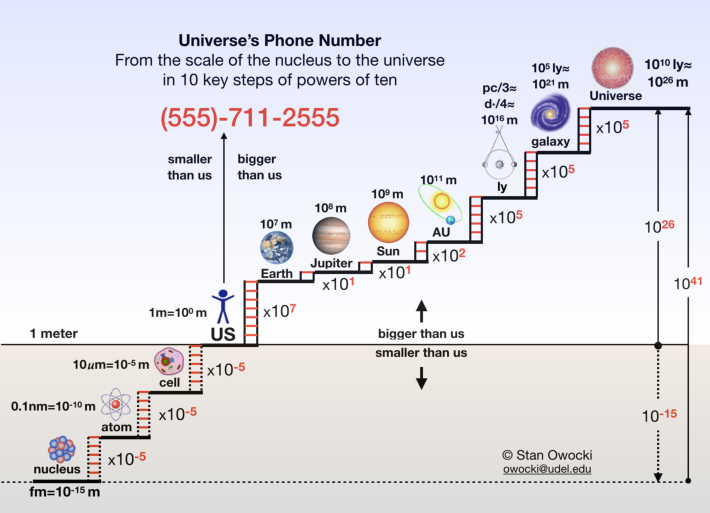
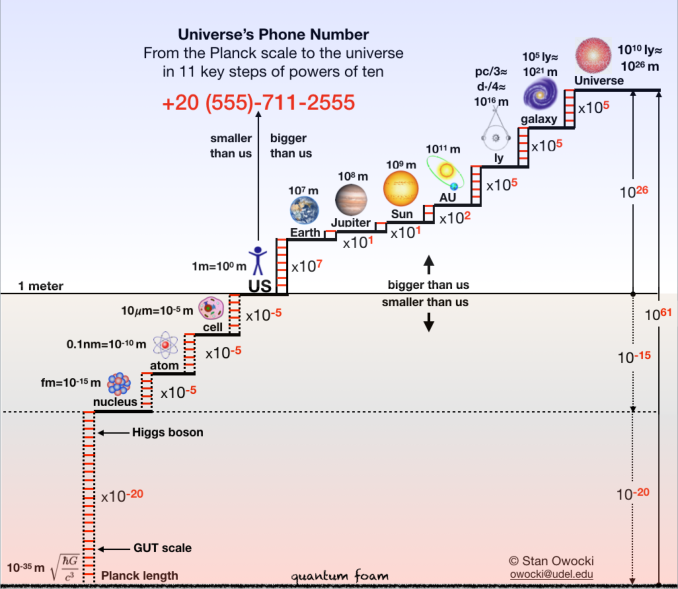
- A geometric progression using powers of ten is employed to bridge the gap between human scales and the vastness of the universe.
- The scale of the Earth is seven orders of magnitude larger than a human, while the Sun is approximately one hundred times the diameter of Earth.
- Distances in the solar system are often measured in light-travel time, with the Sun being eight light minutes away from Earth.
- Interstellar distances represent a massive jump in scale, with the nearest star being five orders of magnitude further than the Earth-Sun distance.
- The Milky Way galaxy, containing 100 billion stars, extends the cosmic scale another five orders of magnitude beyond the distance between individual stars.
As a mneumonic, this is cast as a 10-digit "telephone number", with the 3-digit "area code" representing the 3 steps of 10-5 from us down to the nucleus, and 7-digit main-number representing 7 key steps to the scale of the universe.
Scales of the Universe
- The distance between stars is roughly 10 to the 16th power meters, which is five orders of magnitude greater than the Earth-Sun distance.
- The Milky Way galaxy is a disk 100,000 light-years across, representing another five-order jump in scale to 10 to the 21st power meters.
- The observable universe spans 26 orders of magnitude from the human scale, reaching approximately 10 to the 26th power meters.
- A '10-digit phone number' mnemonic (555-711-2555) maps the powers of ten from atomic nuclei up to the entire universe.
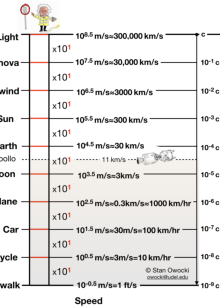
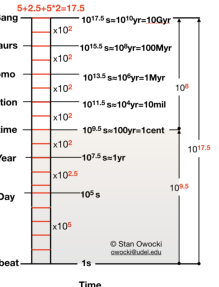
- Time and speed scales are equally vast, ranging from a single human heartbeat to the 14-billion-year age of the universe and the speed of light.
The full sequence of steps over this span thus looks something like a 10-digit phone number with area code: 555-711-2555.
Inferring Distances and Angular Size
- The text introduces fundamental astronomical calculations involving the speeds of Earth's rotation, its orbit around the Sun, and the Sun's orbit within the Milky Way.
- It provides exercises for calculating distances and travel times using light-seconds, solar radii, and astronomical units (AU).
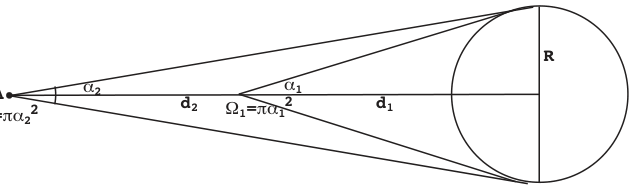
- The concept of angular size is introduced as a primary method for intuitively and mathematically estimating the distance of an object.
- The small-angle approximation is explained, showing how the tangent and sine functions simplify to a linear relationship for distant objects.
- Geometric formulas are established to relate an object's physical size and its distance to the angle it subtends in a viewer's field of vision.
The apparent angular size that object subtends in our overall field of view is then used intuitively by our brains to infer the object's distance, based on our extensive experience that a greater distance makes the object subtend a smaller angle.
Measuring the Cosmos
- The distance to a celestial object can be calculated by comparing its known physical size to its observed angular size.
- Small-angle approximations simplify complex trigonometric relations into linear equations for distant astronomical bodies.
- Atmospheric seeing blurs images to about 1 arcsecond, preventing ground-based telescopes from resolving the tiny angular diameters of most stars.
- Trigonometric parallax mimics human stereoscopic vision by using two different viewpoints to perceive depth and distance.
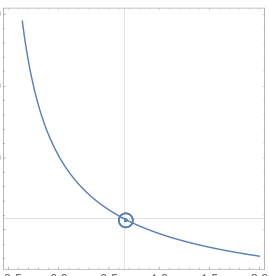
- The parallax effect is inversely proportional to distance, meaning closer objects exhibit a larger shift in apparent position.
Neurosensors in the eye muscles that effect this inward pointing relay this inward angle to our brain, where it is processed to provide our sense of 'depth' perception.
Trigonometric Parallax and Stellar Distance
- Trigonometric parallax uses a change in perspective to calculate the distance of an object based on an angular shift.
- While human binocular vision is limited to about 10 meters, larger baselines allow for the measurement of astronomical distances.
- Early 19th-century astronomers used the Earth's diameter as a baseline to calculate the distance to Mars during opposition.
- Stellar parallax utilizes the Earth's orbital radius (1 AU) as a baseline, observing stars at six-month intervals to maximize the shift.
- The 'parsec' is defined as the distance at which a star exhibits a parallax angle of one arcsecond, equivalent to roughly 3.26 light-years.
- Atmospheric blurring and the tiny scale of parallax angles (all less than one arcsecond) make these measurements extremely challenging.
The key point here is that the parallax angle shift of your finger, which results from switching perspective from one eye to the other, exactly fits the apparent angular separation between your own mirror-image eyes.
Measuring Cosmic Distances
- The parsec and light-year are the primary units for astronomical distance, with one parsec equaling approximately 3.26 light-years.
- Ground-based parallax measurements are limited to about 100 parsecs due to atmospheric blurring, though averaging techniques can improve accuracy.
- Space-based missions like Hipparchus and Gaia significantly extend our reach by measuring parallax angles down to a milliarcsecond.
- The Astronomical Unit (au) serves as the fundamental baseline for all stellar distance calculations.
- Modern radar ranging of planets like Venus allows for the precise trigonometric derivation of the au's physical length.
- Solid angle, measured in steradians, provides a two-dimensional generalization for describing the size of extended objects in the sky.
The parallax for even the nearest star is less than an arcsec, implying stars are all at distances more (generally much more) than a parsec.
Solid Angles and Celestial Geometry
- The distance to Venus at maximum elongation can be used with simple trigonometry to calculate the physical value of an astronomical unit (au).
- Solid angle is introduced as the two-dimensional generalization of an angle, measured in steradians or square radians.
- The solid angle of an object is mathematically defined as the ratio of its projected area to the square of its distance.
- A full sphere contains 4π steradians, which is equivalent to approximately 41,253 square degrees.
- The Sun and Moon each cover a solid angle of about 0.2 square degrees, representing only 1/200,000th of the total sky.
- Calculations of solid angles help explain physical phenomena, such as why the full moon is significantly dimmer than the sun.
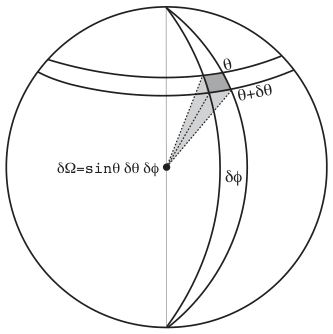
Integration over a full sphere shows that there are 4π steradians in the full sky.
Luminosity and Distance Measurement
- The text provides practical exercises for calculating astronomical distances using angular separation, radar timing, and parallax errors.
- Apparent brightness is defined as the flux of light, which is the energy per unit time per unit area captured by a detector.
- The inverse-square law dictates that light intensity decreases in proportion to the square of the distance as energy spreads over a spherical area.
- The 'Standard Candle' method allows astronomers to calculate distance by comparing an object's known intrinsic luminosity to its observed flux.
- When distance is known via trigonometric parallax, the same physical relationship is used to calculate a star's total power output or luminosity.
This is a profoundly important equation in astronomy, and so you should not just memorize it, but embed it completely and deeply into your psyche.
Stellar Luminosity and Surface Brightness
- Luminosity can be determined through spectroscopic parallax by measuring a star's spectrum and apparent brightness.
- The Sun's luminosity is approximately 4 x 10^26 Watts, a scale equivalent to four million billion billion 100-watt light bulbs.
- Solar luminosity serves as a benchmark for other stars, which range from 1/1000th to one million times the Sun's power.
- Surface brightness, or specific intensity, is a unique quantity that remains constant regardless of the observer's distance from the object.
- While the flux of light decreases with distance, the solid angle it occupies shrinks proportionally, keeping the ratio of flux per solid angle stable.
- The surface brightness of the Sun viewed from Earth is identical to the brightness one would experience standing on the Sun's surface.
Thus we see that the Sun emits the power of about 4 x 10^24 100-watt light bulbs! In common language this corresponds to four million billion billion, a number so huge that it loses any meaning.
Stellar Magnitudes and Distance Modulus
- Astronomers distinguish between absolute, apparent, and surface brightness, which relate to luminosity, flux, and specific intensity respectively.
- The magnitude system is a logarithmic scale where a difference of 5 magnitudes corresponds to a factor of 100 in relative brightness.
- Apparent magnitude (m) measures how bright a star looks from Earth, while absolute magnitude (M) measures its brightness at a standard distance of 10 parsecs.
- The distance modulus (m - M) is a mathematical relationship used to determine the distance to a star based on its apparent and absolute magnitudes.
- The Sun has an absolute magnitude of approximately +4.8, serving as a baseline for calculating the absolute magnitudes of other stars.
The huge flux from this large, bright solid angle would cause a lot more than a mere sunburn!
Stellar Luminosity and Thermal Radiation
- Mathematical exercises explore the relationships between apparent magnitude, absolute magnitude, and distance modulus for stars and supernovae.
- Stellar brightness is a direct consequence of high surface temperatures, which cause atoms and electrons to collide violently and emit thermal radiation.
- Temperature in astronomy is measured in Kelvins, where absolute zero represents the theoretical limit where all thermal motion ceases.
- Light is defined as electromagnetic radiation consisting of oscillating electric and magnetic fields as described by Maxwell's equations.
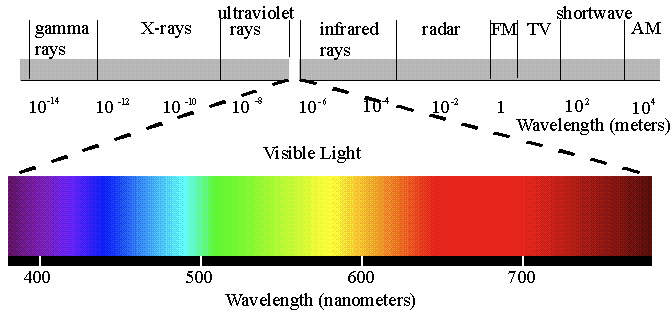
- The electromagnetic spectrum spans from short-wavelength gamma rays to long-wavelength radio waves, with visible light occupying a narrow band between 400 and 750 nm.
- All electromagnetic waves travel at the constant speed of light (c) in a vacuum, maintaining a strict inverse relationship between wavelength and frequency.
The light they emit is called "thermal radiation", and arises from the jostling of the atoms (and particularly the electrons in and around those atoms) by the violent collisions associated with the star's high temperature.
Light Quanta and Black-Body Radiation
- Light exhibits a dual nature, behaving as both a wave with a specific frequency and wavelength and as discrete bundles of energy called photons.
- The energy of a photon is directly proportional to its frequency, a discovery by Planck and Einstein that established the quantization of energy.
- A Black Body is an idealized material in thermodynamic equilibrium that emits a Spectral Energy Distribution (SED) dependent solely on its temperature.
- The Planck function describes how the intensity or surface brightness of this radiation is distributed across different wavelengths or frequencies.
- Wien's Displacement Law shows that the peak wavelength of emission shifts to shorter, bluer wavelengths as the temperature of the object increases.
- By measuring the peak wavelength of a star's light, astronomers can calculate its surface temperature, such as the Sun's 5800K temperature based on its 500 nm peak.
Each photon carries a discrete, indivisible 'quantum' of energy that depends on the wave frequency.
Measuring Stellar Temperatures
- Wien's displacement law provides a direct mathematical relationship between a star's peak wavelength and its surface temperature.
- The Sun's peak wavelength of 500 nm corresponds to a surface temperature of approximately 5800 K, placing its brightest emission in the visible spectrum.
- Human vision likely evolved to be most sensitive to the specific wavelengths where solar illumination is at its peak intensity.
- In practice, astronomers use photometric color systems like the Johnson UBV filters because measuring a full spectral energy distribution is difficult and time-consuming.
- The 'color index' (such as B-V) serves as a distance-independent diagnostic for temperature, where negative values indicate hotter, bluer stars.
This is not entirely coincidental, since our eyes evolved to use the wavelengths of light for which the solar illumination is brightest.
Stellar Radius and Stefan-Boltzmann Law
- The Stefan-Boltzmann law establishes that the total energy emitted by a blackbody increases sharply with the fourth power of its temperature.
- Stellar luminosity is determined by the combination of a star's surface temperature and its total surface area.
- By measuring a star's flux and temperature, astronomers can mathematically derive its physical radius.
- The relationship between luminosity, temperature, and radius is often simplified by scaling values against those of the Sun.
- While blackbody radiation provides a foundational model, real stellar spectra are complicated by discrete absorption lines.
The Stefan-Boltzmann law is one of the linchpins of stellar astronomy.
Stellar Absorption Line Spectra
- Stars are not perfect blackbodies because their spectra contain detailed signatures of elemental composition rather than just temperature.
- The interior heat of a star diffuses outward through a temperature gradient, interacting with atoms and ions in the cooler surface layers.
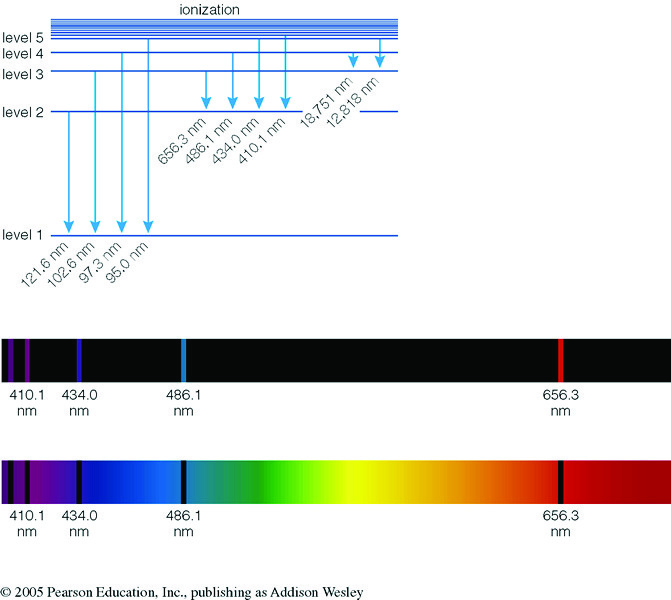
- Atomic energy levels are quantized like steps in a staircase, meaning atoms only efficiently absorb photons that match specific energy differences.
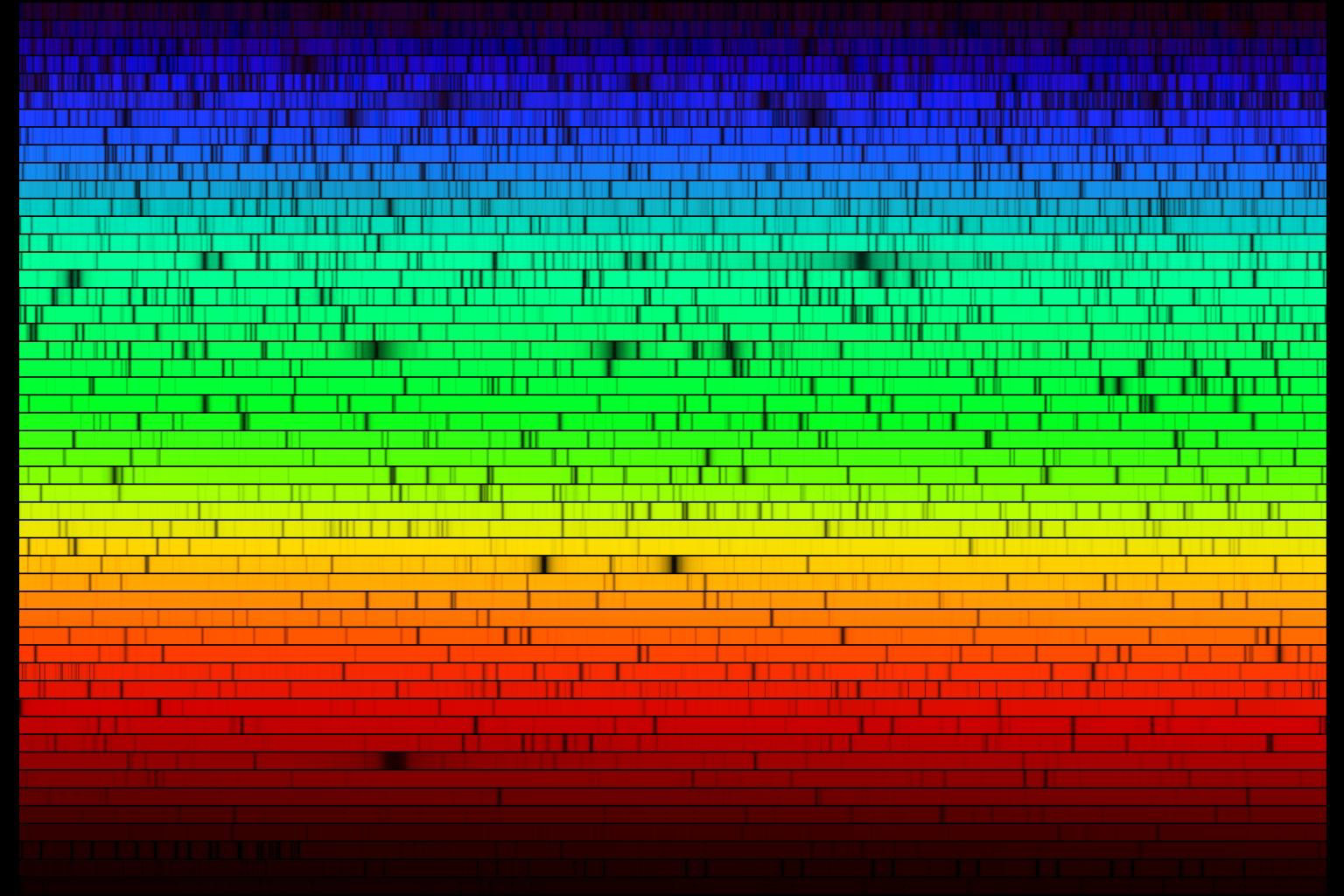
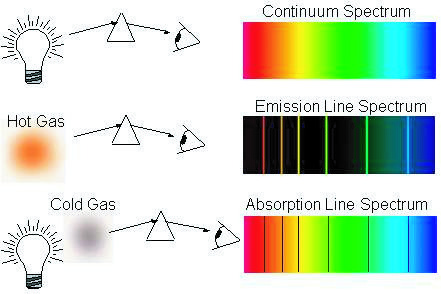
- The resulting missing light appears as a complex series of dark absorption lines when a star's spectrum is spread out by a prism.
- These absorption lines act as a unique fingerprint or barcode that identifies the specific elements and ionization stages present in a star's atmosphere.
- Laboratory measurements of known elements allow scientists to decode these stellar fingerprints to determine chemical composition.
As such the associated wavelengths of the absorption lines in a star's spectrum provide a direct 'fingerprint' — perhaps even more akin to a supermarket bar code — for the presence of that element in the star's atmosphere.
Stellar Fingerprints and Composition
- Absorption lines in a star's spectrum act as a unique 'barcode' or fingerprint for identifying specific chemical elements.
- The Sun and most stars are composed almost entirely of hydrogen (90.9%) and helium (8.9%), with all other elements making up only 0.2% of the total atoms.
- In astronomy, all elements heavier than hydrogen and helium are collectively referred to as 'metals,' accounting for a mass fraction of about 2%.
- Earth's composition mirrors the Sun's heavier elements, but our planet lost its lighter gases like hydrogen and helium due to its weaker gravity.
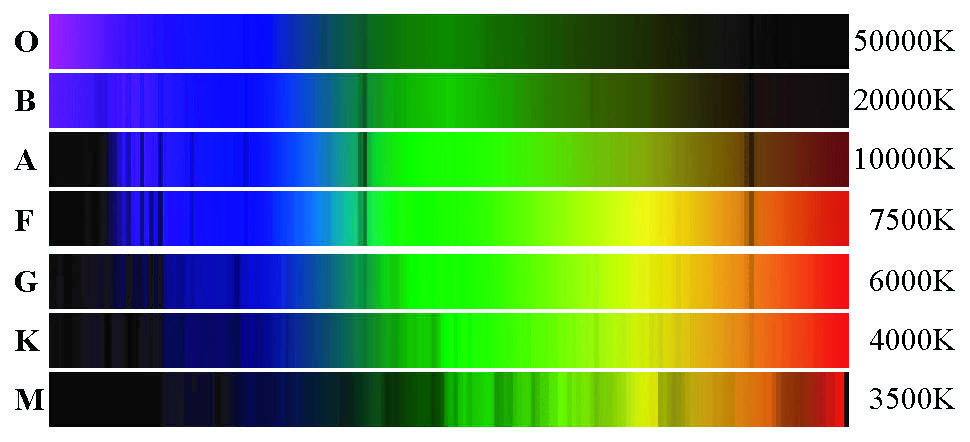
- Stellar spectral types (OBAFGKM) are determined by surface temperature, which dictates the ionization stages of the elements present.
The associated wavelengths of the absorption lines in a star's spectrum provide a direct 'fingerprint'—perhaps even more akin to a supermarket bar code—for the presence of that element in the star's atmosphere.
Spectral Classification and H-R Diagrams
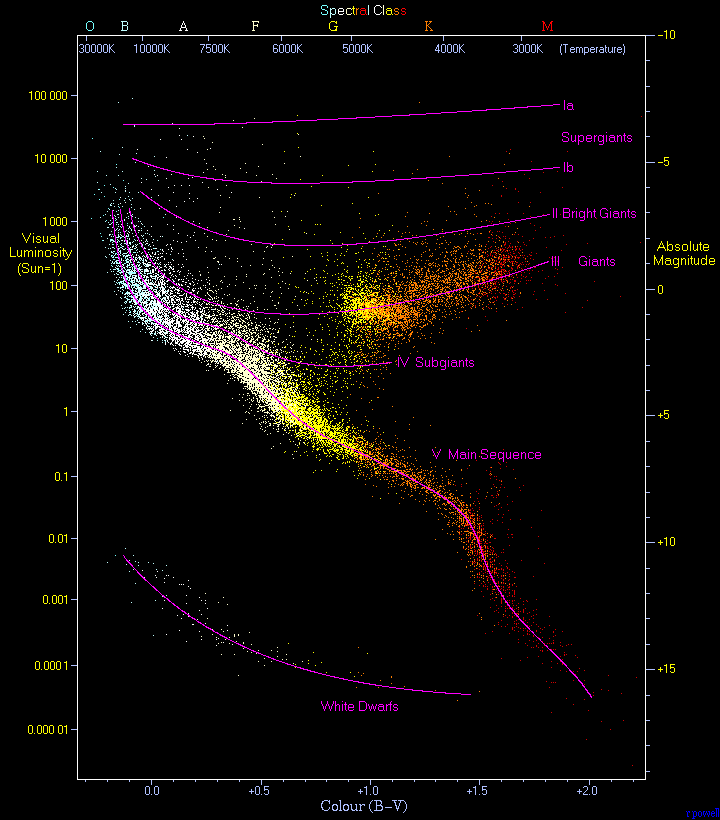
- Stars are categorized into spectral types (OBAFGKM) based on surface temperature, ranging from 50,000 K to 3,500 K.
- Luminosity classes, denoted by Roman numerals I through V, distinguish between massive supergiants and smaller dwarf stars.
- The Sun is classified as a G2V star, representing an average temperature and a dwarf-scale luminosity.
- Absorption lines in stellar spectra serve as markers for measuring the Doppler effect and identifying chemical composition.
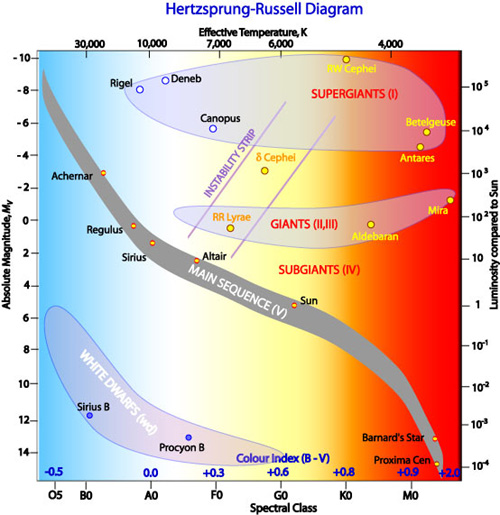
- The Hertzsprung-Russell (H-R) diagram is a fundamental tool that relates a star's luminosity to its surface temperature.
- Brown dwarfs (classes LTY) represent a bridge between the coolest stars and gas giant planets like Jupiter.
In summary, the appearance of absorption lines in stellar spectra provides a real treasure trove of clues to the physical properties of stars.
The Hertzsprung-Russell Diagram
- The H-R diagram relates a star's absolute magnitude or luminosity to its color, spectral type, or temperature.
- The main sequence represents the longest phase of a star's life, characterized by stable hydrogen burning in the core.
- Giant and supergiant stars represent later evolutionary stages where stars burn heavier elements or hydrogen in shells.
- White dwarfs are the final, cooling remnants of low-mass stars like the Sun, positioned below the main sequence.
- The H-R diagram serves as a vital link between observable surface light and the physical evolution of a star's interior.
- Mass and age are identified as the two primary parameters that differentiate stars across the diagram's various regions.
The reason there are so many stars in this main-sequence band is that it represents the long-lived phase when stars are stably burning Hydrogen into Helium in their cores.
Stellar Mass and Surface Gravity
- The text transitions from measuring stellar distance and luminosity to the fundamental physical parameter of stellar mass.
- Newton's law of gravitation provides the mathematical framework for calculating surface gravity based on a star's mass and radius.
- The Sun's surface gravity is approximately 27 times that of Earth, significantly increasing the theoretical weight of any object on its surface.
- Red Giant stars possess extremely low surface gravity due to their massive expansion, often leading to the loss of their outer envelopes into space.
- Compact remnants like white dwarfs and neutron stars exhibit surface gravities thousands to millions of times stronger than the Sun due to their extreme density.
- Surface gravity serves as a precursor to understanding more complex concepts like escape velocity and orbital speeds in binary systems.
Imagine what you'd weigh then on the surface of a neutron star!
Gravity and Orbital Mechanics
- Stellar remnants like white dwarfs and neutron stars exhibit extreme surface gravities, with neutron stars reaching ten billion times the gravity of Earth.
- The log g scale provides a standardized way to compare gravitational strength across diverse celestial bodies, from Red Giants to dense stellar cores.
- Escape speed represents the velocity required for an object to overcome a body's gravitational pull and reach an infinite distance.
- Circular orbital speed is mathematically related to escape speed, specifically being the escape speed divided by the square root of two.
- The Virial Theorem establishes a fundamental relationship in bound orbits where kinetic energy is equal to half of the absolute gravitational binding energy.
Imagine what you'd weigh then on the surface of a neutron star!
Gravitational Energy and the Virial Theorem
- The text defines gravitational binding energy as the negative of the energy required for an object to escape a star's pull.
- For a stable orbit, kinetic energy is shown to be exactly half of the absolute value of the gravitational binding energy.
- The Virial Theorem states that total energy in a stably bound system equals half of the gravitational binding energy, a principle applicable to both orbits and internal stellar structures.
- The theorem extends to stars by treating internal thermal energy as a form of kinetic energy that balances self-gravity.
- Mathematical exercises are provided to calculate surface gravity, escape speeds, and orbital velocities for various stellar masses and radii.
- The text transitions into the historical search for stellar energy sources, questioning if chemical burning could sustain a star's lifespan.
This fact that the total energy E just equals half the gravitational binding energy U is an example of what is known as the Virial Theorem.
Stellar Energy and Timescales
- Nineteenth-century scientists initially explored chemical reactions as a solar energy source but found they could only power the Sun for about 15,000 years.
- The Kelvin-Helmholtz timescale suggests that gravitational contraction could power the Sun for 30 million years by converting potential energy into radiation.
- Geological evidence of the Earth's age eventually proved that both chemical and gravitational energy sources are insufficient to explain solar longevity.
- Nuclear fusion provides the actual energy source, operating with a mass-energy efficiency roughly seven million times greater than chemical reactions.
- By fusing hydrogen into helium in its core, a star like the Sun can maintain its luminosity for approximately 10 billion years.
Even in the 19th century, it was clear, e.g. from geological processes like erosion, that the Earth — and so presumably also the Sun — had to be much older than this.
Stellar Lifetimes and Cluster Ages
- The Sun's lifetime is determined by nuclear fusion efficiency, where 0.7% of mass is converted to energy, giving it a total lifespan of approximately 10 billion years.
- Currently 4.6 billion years old, the Sun is roughly halfway through its hydrogen-burning phase before it will exhaust its core fuel.
- Stellar luminosity scales steeply with mass (L ~ M³), meaning high-mass stars consume their fuel much faster and have significantly shorter lifespans than low-mass stars.
- The most massive stars may live for only 1 million years, a stark contrast to the multi-billion-year timescales of solar-mass stars.
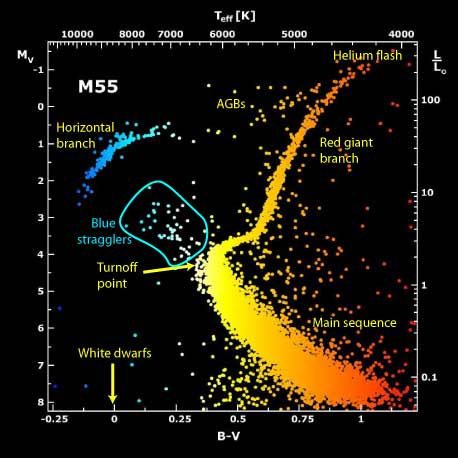
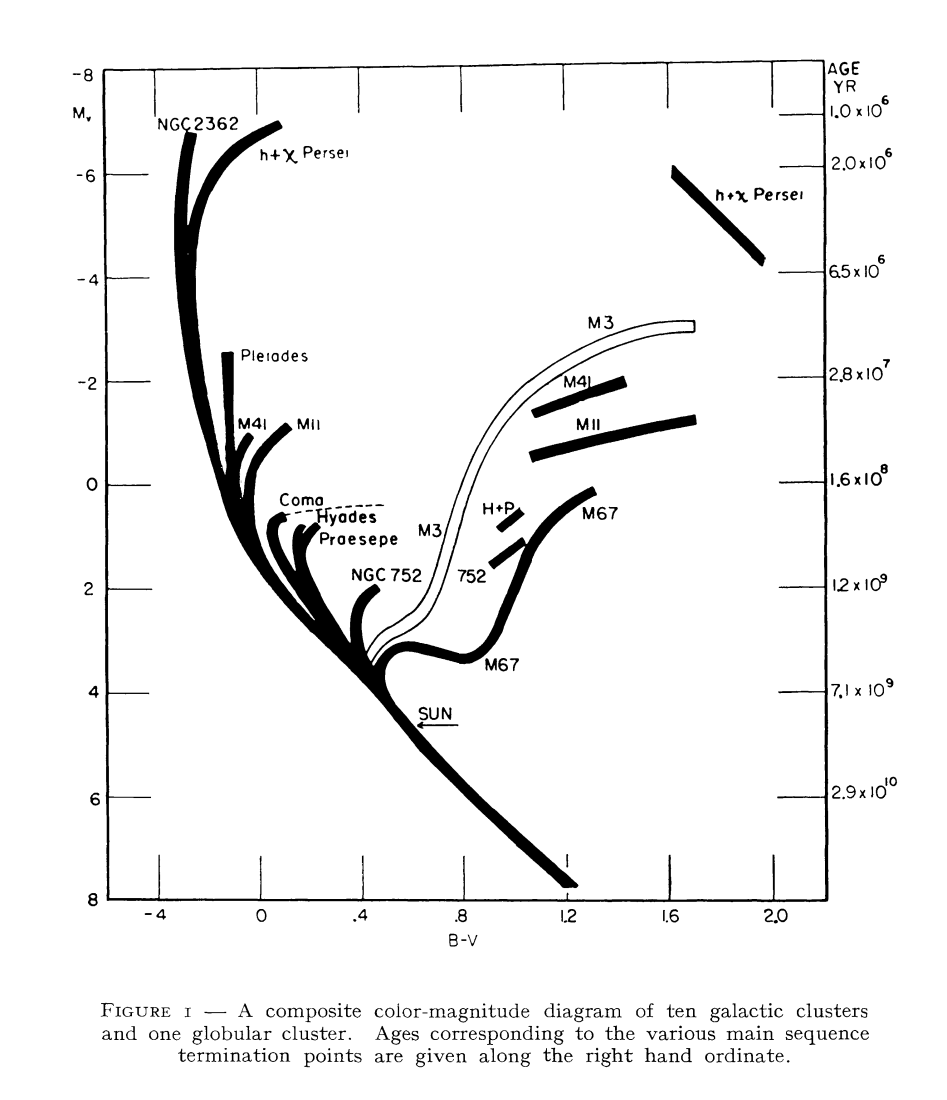
- The age of a stellar cluster can be determined by identifying the 'turn-off point' on an H-R diagram, where stars begin to exhaust their hydrogen and exit the main sequence.
The most massive stars, of order 100 M, and thus with luminosities of order 106L, have main-sequence lifetimes of only about about 1 Myr, much shorter the multi-Gyr timescale for solar-mass stars.
Stellar Lifetimes and Space Velocities
- The main-sequence turn-off point in H-R diagrams serves as a critical diagnostic for determining the age of stellar clusters.
- Luminous stars exhaust their hydrogen fuel significantly faster than dimmer stars due to inverse luminosity scaling.
- Blue stragglers are stars rejuvenated by mass transfer from a binary companion, making them appear younger and hotter than their peers.
- Stellar motion is measured through proper motion (transverse drift) and spectrometric techniques for radial velocity.
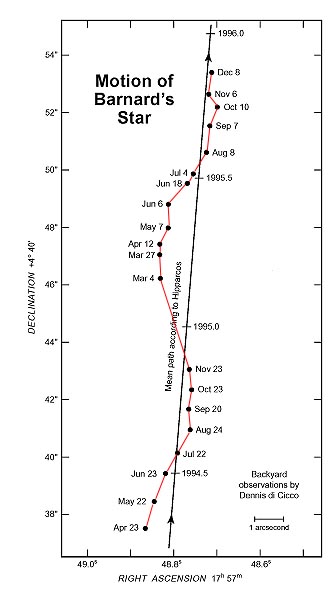
- Barnard's star exhibits the highest proper motion of any star, showing a detectable drift even with modest equipment.
This rejuvenated the mass gainer, making it again a hot, luminous blue star.
Measuring Stellar Space Velocities
- The apparent wobble in a star's path, such as Barnard's star, is caused by Earth's orbital motion and provides a direct measure of stellar parallax.
- Stellar distance can be calculated from parallax, which then allows astronomers to convert observed proper motion into a physical transverse velocity.
- Barnard's star exhibits one of the fastest transverse speeds among nearby stars, moving at approximately 90 km/s.
- Radial velocity, the component of motion along the line of sight, is measured using the Doppler effect rather than direct positional shifts.
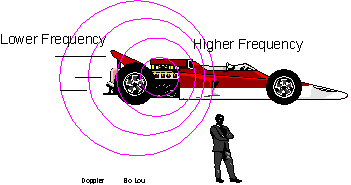
- The Doppler effect causes a shift in observed wavelength proportional to the object's speed relative to the speed of the signal, such as light or sound.
- In extreme cases where an object moves faster than the signal speed, such as supersonic travel, shock waves like sonic booms are created.
Consider the noise from a car on a highway, for which the 'vvvvrrrrrooomm' sound stems from just this shift in pitch from the car engine noise.
Doppler Shifts and Binary Systems
- The Doppler effect explains how sound waves compress into shock waves, creating sonic booms from supersonic jets.
- In astronomy, the Doppler shift of light allows scientists to measure a star's radial velocity by observing changes in spectral line wavelengths.
- Combining radial velocity with tangential velocity allows for the calculation of a star's total space velocity relative to the Sun.
- Barnard's star serves as a primary example of high space velocity, moving at 143 km/s toward our solar system.
- Binary star systems are so prevalent in the galaxy that astronomers jokingly claim 'three out of every two stars' are part of a binary.
- Binary systems are categorized as visual binaries, which are resolved through position monitoring, or spectroscopic binaries, which are identified via light spectra.
It turns out, in fact, that stellar binary (and even triple and quadruple) systems are quite common, so much so that astronomers sometimes joke that 'three out of every two stars is (in) a binary'.
Measuring Mass in Visual Binaries
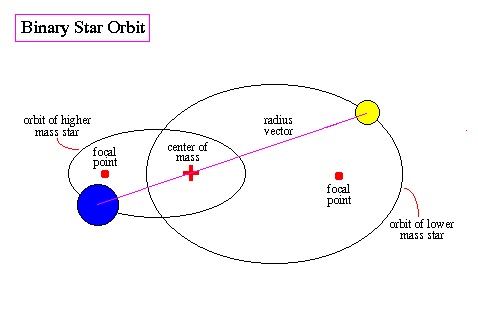
- Visual or astrometric binaries are detected by monitoring the precise movements of two stars as they orbit a common center of mass over years or decades.
- By combining the observed angular separation with the system's distance via parallax, astronomers can determine the physical distance between the stars.
- Unlike planetary systems where the central mass is dominant, binary stars often have comparable masses, requiring both to be treated as moving around a shared center of mass.
- Newton's generalization of Kepler's Third Law allows for the calculation of the total system mass based on the orbital period and the physical separation.
- If the individual orbital distances of both stars can be measured, the specific mass ratio and individual masses of each star can be calculated in solar units.
In visual binaries, monitoring of the stellar positions over years and even decades reveals that the two stars are actually moving around each other, much as the Earth moves around the Sun.
Spectroscopic Binaries and Orbital Mechanics
- Kepler's third law applies to both circular and elliptical orbits by substituting the radius with the semi-major axis.
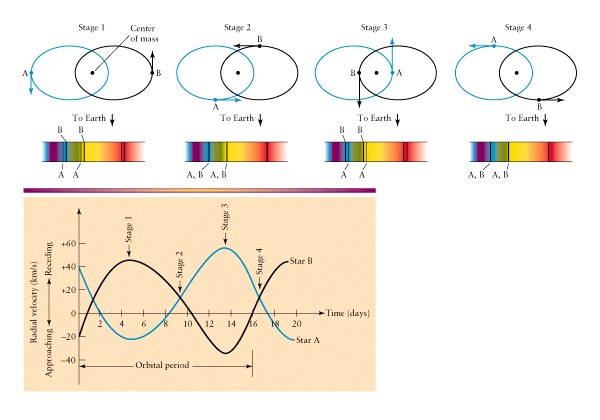
- Spectroscopic binaries are systems where stars are too close to resolve visually but can be identified via periodic Doppler shifts in their spectral lines.
- The inclination of an orbital plane can be disentangled from its ellipticity by observing the rate of movement along the projected orbit.
- In double-line spectroscopic binaries, the ratio of the stars' velocity amplitudes directly reveals their mass ratio.
- Newton's generalization of Kepler's third law allows for the calculation of individual stellar masses using orbital periods and radial velocities.
However, if the orbital plane is not perpendicular to the line of sight, then the orbital velocities of the stars will give a variable Doppler shift to each star's spectral lines.
Eclipsing and Spectroscopic Binaries
- Spectroscopic binaries allow astronomers to infer the presence of a secondary star through the periodic Doppler shifting of the primary star's spectral lines.
- The inclination of the orbital plane affects mass calculations, requiring a correction factor of sin³i unless the system is viewed edge-on.
- Eclipsing binaries are rare systems where stars pass in front of each other, providing a direct measure of orbital speeds without projection effects.
- The timing of 'contacts' during an eclipse—when stellar rims first touch or fully overlap—allows for the precise calculation of individual stellar radii.
- Complexities such as elliptical orbits, off-center chords, and tidal distortions require sophisticated theoretical modeling to accurately fit observed light curves.
- Combining Doppler shift data with eclipse intervals provides a comprehensive method for determining both the masses and radii of distant stars.
In eclipse jargon, the times when the stellar rims just touch are called 'contacts', labeled 1-4 for first, second, etc.
Mass-Luminosity Scaling in Binaries
- Determining precise stellar masses requires accounting for orbital inclination, which often creates ambiguity in spectroscopic measurements.
- Combining spectroscopic data with astrometric or eclipsing observations allows astronomers to resolve inclination and calculate unambiguous masses and distances.
- Empirical data from binary systems reveals a clear power-law relationship where stellar luminosity scales approximately with the cube of the mass.
- The observed mass-luminosity relation (L ∝ M^3.1) is a fundamental characteristic of main-sequence stars explained by hydrostatic equilibrium and radiative diffusion.
- Advanced modeling of eclipsing binaries must account for non-spherical shapes caused by mutual tidal distortion and non-uniform surface brightness.
Indeed, to get good results, one often has to relax even the assumption that the stars are spheres with uniform brightness, taking into account the mutual tidal distortion of the stars.
Inferring Stellar Rotation
- Stellar rotation speeds vary significantly by mass, with low-mass stars like the Sun rotating slowly while massive stars can reach critical speeds.
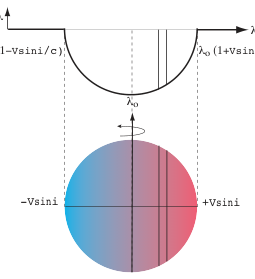
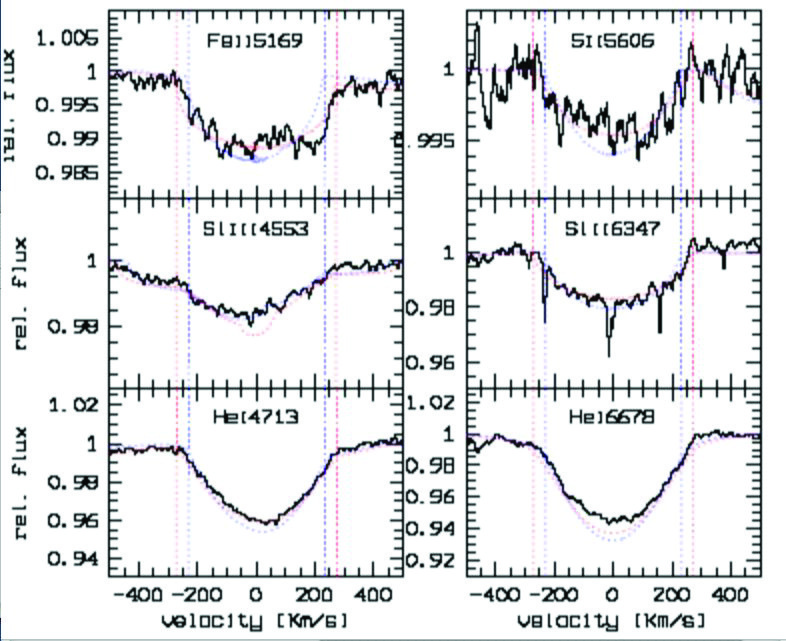
- Rotational broadening occurs because different parts of a rotating star's surface move toward or away from the observer, creating differential Doppler shifts.
- The observed broadening of spectral lines is dependent on the inclination angle of the star's rotation axis relative to the line of sight.
- A rigidly rotating star produces a characteristic hemispherical absorption profile where the width is proportional to the projected equatorial velocity.
- While rotation is a major area of research, it is generally considered secondary to stellar mass in determining a star's overall evolution.
In hotter, more-massive stars, the rotation can be more rapid, typically 100 km/s or more, with some cases (e.g., the Be stars) near the "critical" rotation speed at which material near the equatorial surface would be in a Keplerian orbit!
Measuring Stellar Rotation
- Rotational broadening of spectral lines is a primary tool for determining a star's projected equatorial rotation speed (Vsini).
- Rapid rotation dilutes the central depth of absorption lines because the total flux reduction is spread over a wider wavelength range.
- The 'equivalent width' provides a standardized measure of total line absorption, represented as a saturated rectangle of equal area.
- Starspot modulation offers an alternative method to determine rotation periods by tracking periodic brightness variations as spots cross the stellar disk.
- Combining rotation periods with projected velocity allows astronomers to calculate a minimum constraint for the stellar radius.
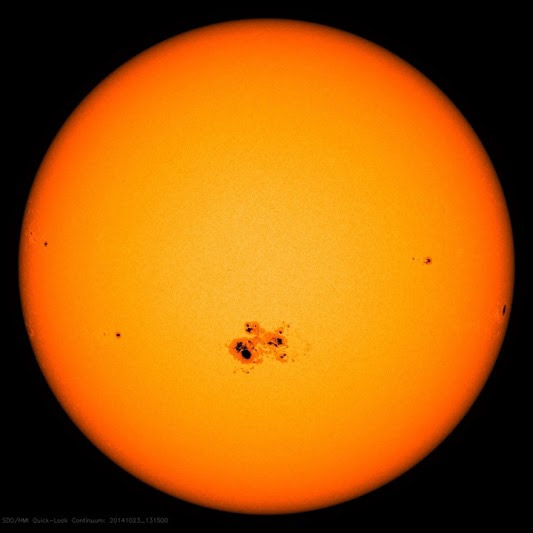
When Galileo first used a telescope to magnify the apparent disk of the Sun, he found it was not the 'perfect orb' idealized from antiquity, but instead had groups of relatively dark 'sunspots' spread around the disk.
Light Intensity and Flux
- Specific intensity is a fundamental quantity defined as radiative energy per unit area and time within a specific solid angle.
- Unlike flux, which decreases with distance according to the inverse-square law, intensity remains invariant as distance increases.
- The text distinguishes intensity as a scalar with directional dependence, while flux is a vector representing the rate of energy through a surface.
- In stellar interiors, intensity characterizes the radiation field as energy is transported from the core to the surface.
- The total radial flux of a star is calculated by integrating the intensity contributions over all solid angles.
As the solid angle of the projected emitting area declines with the inverse square of the distance, the fixed solid angle receiving the intensity grows in area in proportion to the distance-squared.
Flux, Intensity, and Optical Depth
- The total radial flux is calculated by integrating specific intensity over a solid angle, typically resulting in a factor of 2π for azimuthal symmetry.
- The inverse-square law for flux arises from the shrinking angular size of a source as distance increases, even if the surface brightness remains constant.
- The Stefan-Boltzmann law for surface flux is derived by integrating blackbody intensity over a hemispherical outward direction.
- Absorption is characterized by the mean-free-path, which is inversely proportional to the number density and cross-sectional area of particles.
- Opacity is defined as the cross section per unit mass, providing a standardized measure of a medium's ability to absorb light.
- Optical depth represents the integrated number of mean-free-paths along a distance, determining the exponential attenuation of light intensity.
It is clear from the initial definition that one can think of optical depth as simply the number of mean-free-paths between two locations.
Interstellar Extinction and Reddening
- The intensity of light decreases exponentially as it passes through a medium, a process governed by the integrated optical depth.
- Optical depth can be conceptualized as the total number of mean-free-paths between two specific locations.
- The Inter-Stellar Medium (ISM), though extremely low in density, causes significant extinction of starlight over vast astronomical distances.
- Failure to account for interstellar extinction leads to an overestimation of a star's distance when using standard candles.
- Interstellar dust grains are often smaller than the wavelength of light, causing shorter blue wavelengths to be absorbed more effectively than longer red wavelengths.
- This wavelength-dependent absorption results in 'reddening,' which is quantified by the color excess between different photometric filters.
Because this redder, longer wavelength light is less strongly absorbed than the bluer, shorter wavelengths, the remaining light tends to appear " reddened ", much in the same way as the Sun's light at sunset.
Stellar Reddening and Telescopic Aperture
- Interstellar dust causes 'reddening' because longer wavelengths of light are absorbed less strongly than shorter, bluer wavelengths.
- The color excess (EB-V) allows astronomers to calculate visual extinction and correct errors in stellar distance measurements.
- Dust opacity is often modeled as an inverse power law, with the interstellar medium typically following a weaker scaling than atmospheric Rayleigh scattering.
- Telescopes function as 'light buckets' where the light-gathering power scales with the square of the aperture diameter.
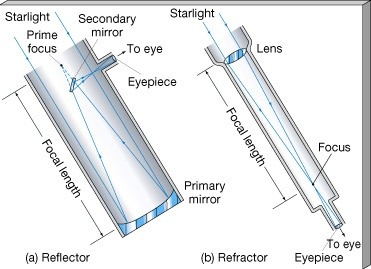
- While refractor telescopes are limited by lens size and focal length, reflector telescopes use segmented mirrors to reach diameters of 10 meters or more.
The scattering of blue light out of the direction from the Sun makes the sunset red, while all that scattered blue light makes the sky blue.
Telescope Aperture and Resolution
- Reflector telescopes surpass refractors in size because large mirrors are easier to support than massive lenses, with current mirrors reaching 10 meters in diameter.
- A telescope's light-gathering power scales with the square of its aperture, allowing modern instruments to collect millions of times more light than the human eye.
- Limiting magnitude is further enhanced by digital detectors and long exposure times, though it is ultimately constrained by local sky background and light pollution.
- Angular resolution is fundamentally limited by diffraction, but ground-based telescopes face additional blurring from atmospheric turbulence known as 'astronomical seeing'.
- Adaptive optics and space-based positioning, like that of the Hubble Space Telescope, are used to bypass atmospheric distortions and achieve sharper focus.
But this can be reduced to resolutions approaching 0.1 arcsec through a technique called adaptive optics, wherein reflection from a laser beam shot up into the sky is used to estimate these seeing distortions, and then dynamically deform secondary mirrors to correct for them.
Radio Astronomy and Space Observatories
- Radio telescopes utilize large dishes and interferometry to bypass atmospheric interference and achieve extreme angular resolution.
- The Very Long Baseline Interferometry (VLBI) technique can effectively simulate a telescope the size of the entire Earth by combining global signals.
- Millimeter-wave arrays like ALMA are strategically placed in high, dry deserts to minimize water vapor absorption and study star-forming regions.
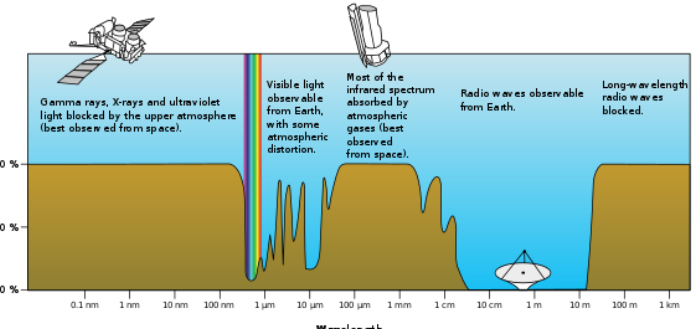
- Space-based missions are essential for observing UV, X-ray, and gamma-ray wavelengths that are otherwise blocked by Earth's atmosphere.
- High-energy observations in the X-ray and gamma-ray spectrum allow astronomers to probe extreme phenomena like black hole accretion and neutron star mergers.
An extension of this technique, called Very Long Baseline Interferometry (VLBI) can even combine signals from telescopes spread all around the globe; their diffraction limit can thus in principle approach that of a telescope the size of the entire Earth!
Space Telescopes and Solar Imaging
- Space-based telescopes allow for infrared observations that bypass atmospheric blockage to study star formation in dense interstellar regions.
- The Hubble Deep Fields utilized weeklong exposures to reveal faint galaxies located up to 10 billion light-years away.
- While other stars appear only as points of light, the Sun's proximity allows for the resolution of surface intensity across its 0.5-degree angular diameter.
- Galileo's discovery of sunspots challenged the classical ideal of the Sun as a perfect, unchanging heavenly sphere.
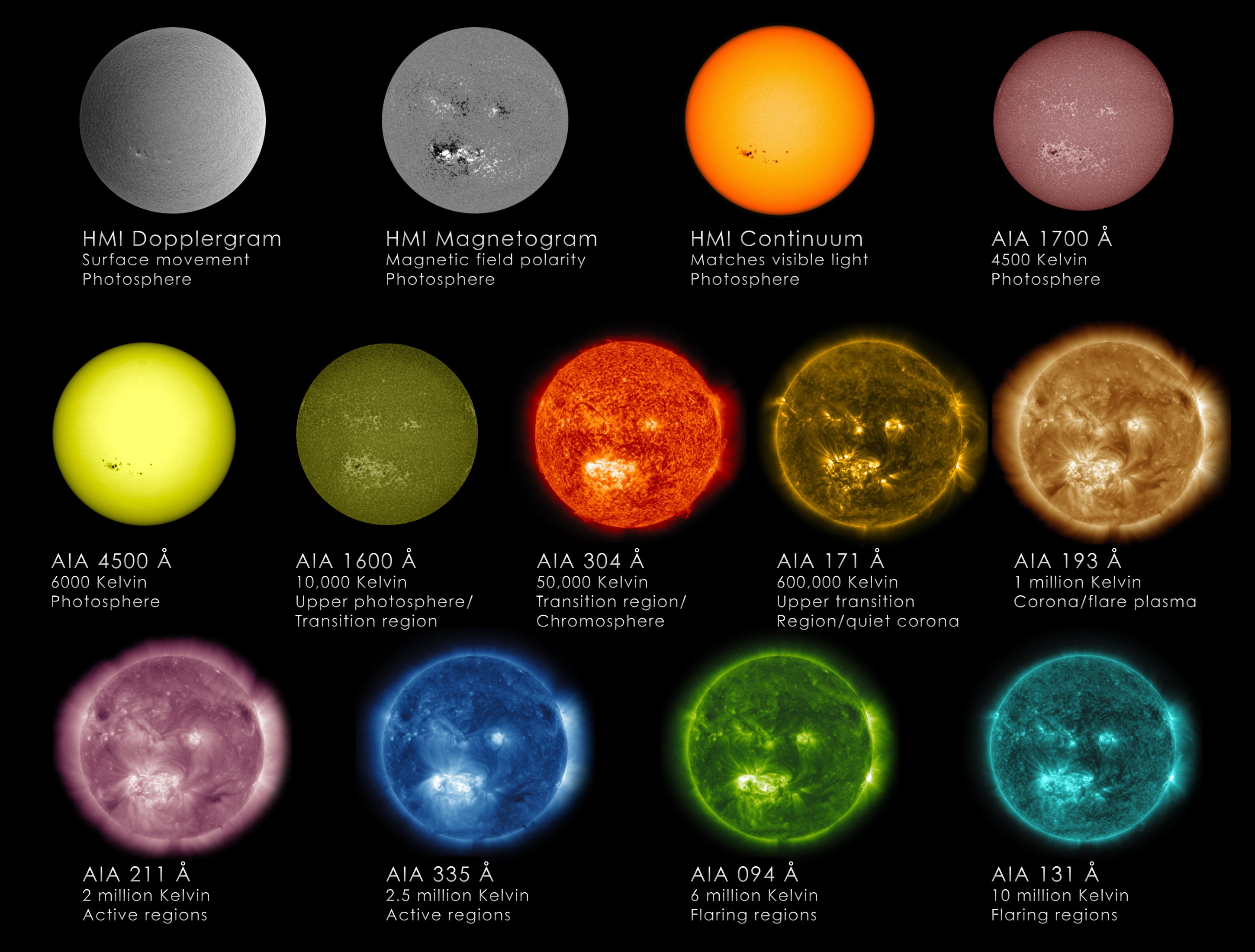
- Modern multi-wavelength imaging from the Solar Dynamics Observatory reveals the Sun as a highly structured and variable environment rather than a simple ball of gas.
- Limb darkening and magnetograms provide evidence of the Sun's vertical temperature gradients and intense magnetic activity.
These vividly demonstrate that the Sun is in fact highly structured and variable over a wide range of spatial and temporal scales, and so provide a sobering reality check on our own simple idealizations of stars as being constant, featureless, spherically symmetric balls of gas.
Solar Atmosphere and Magnetic Dynamics
- Strong magnetic fields inhibit convective energy transport, causing sunspots to appear darker and cooler than the surrounding photosphere.
- Magnetic waves and turbulence provide mechanical heating that causes temperatures to rise dramatically in the upper solar layers.
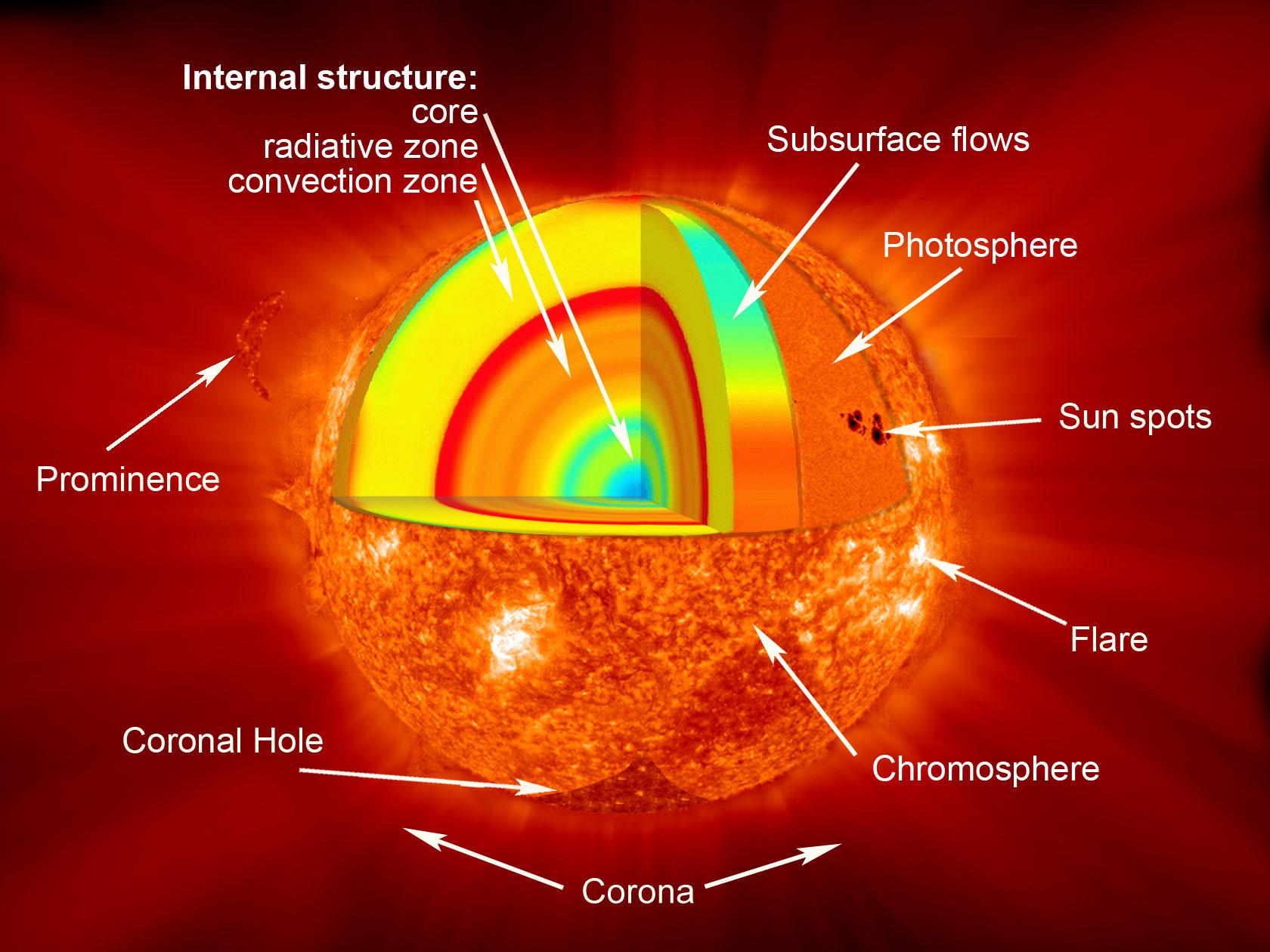
- The solar atmosphere transitions from the 5,800 K photosphere to a chromosphere of up to 50,000 K, and finally to a million-degree corona.
- Active regions above sunspots appear bright in ultraviolet and X-ray wavelengths due to the extreme heat trapped by magnetic conduits.
- Coronal holes represent regions of low emission and contrast sharply with the high-temperature active regions in the far-UV spectrum.
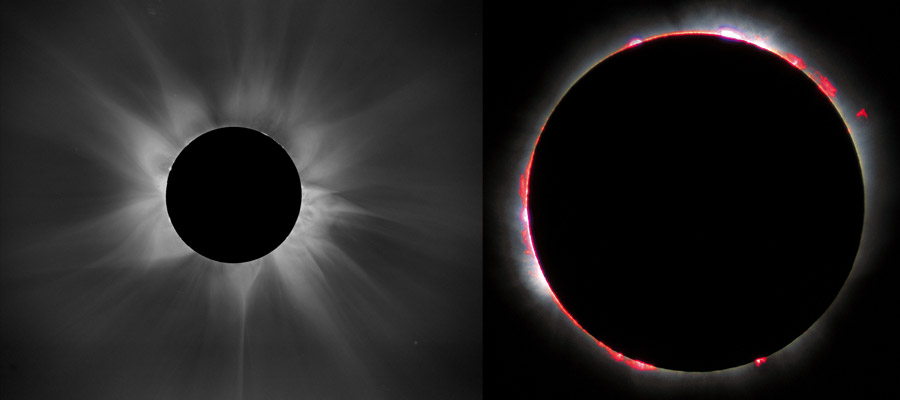
- The solar corona is typically invisible due to its low density but can be observed during a total solar eclipse when the moon blocks the solar disk.
This is followed by an abrupt jump across a narrow transition region to temperatures of millions of Kelvin (!) in the solar corona.
Solar Corona and Magnetic Dynamics
- The solar corona's structure is primarily defined by magnetic fields, where closed loops trap hot gas and open regions create coronal holes.
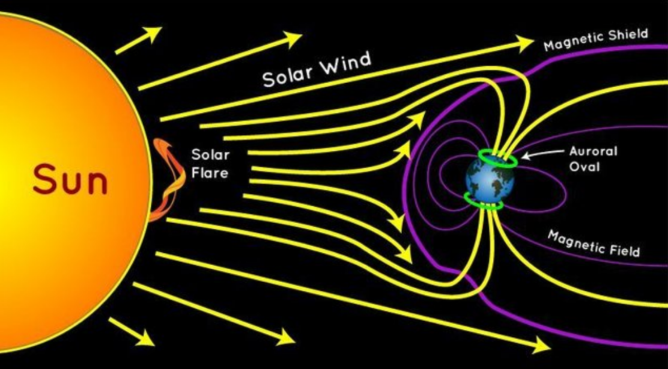
- Solar wind is a pressure-driven expansion of gas that occurs because the Sun's gravity cannot contain the extremely high temperatures of the corona.
- The heliosphere is the vast region extending over 100 au where the solar wind dominates before meeting the interstellar medium.
- Planetary magnetic fields, like Earth's magnetosphere, act as shields against solar wind erosion, a protection notably absent on Mars.
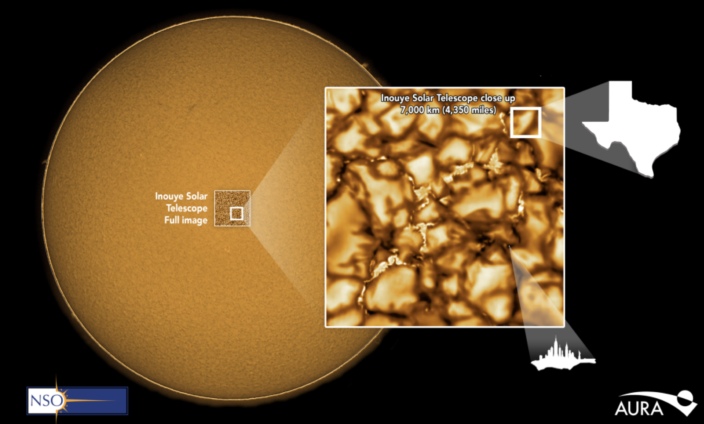
- Advanced telescopes like DKIST can resolve solar surface features down to 70 km, revealing convection cells known as granulation.
The lack of a strong field on Mars has allowed the solar wind to gradually erode its now much thinner atmosphere.
Solar Convection and Magnetic Dynamos
- The Daniel K. Inouye Solar Telescope (DKIST) achieves high-resolution imaging of the Sun down to 70 km by using adaptive optics and a high-altitude site.
- Solar granulation patterns are the visible result of convection, where hot gas wells up in bright centers and cooler gas sinks into dark lanes.
- The Sun's gas behaves as an ionized plasma with high electrical conductivity, causing magnetic fields to become 'frozen-in' and move with the plasma.
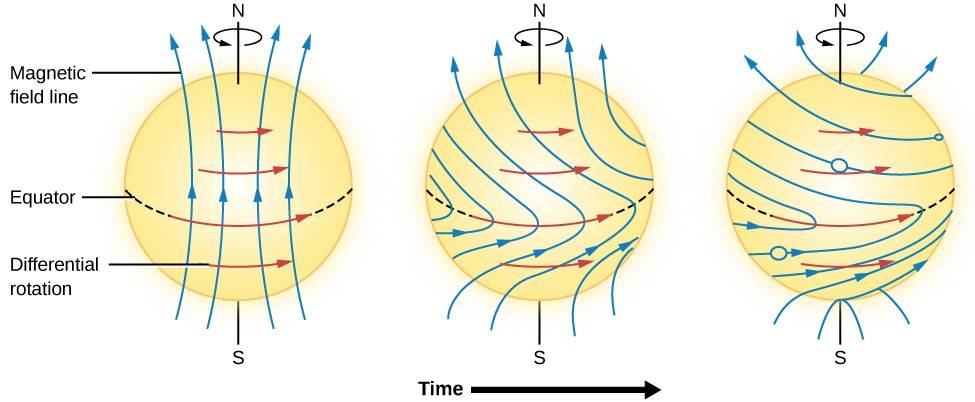
- Convection and differential rotation—where the equator rotates faster than the poles—work together to amplify magnetic fields through a dynamo effect.
- Magnetic field lines stretched by solar rotation eventually kink and emerge through the photosphere, creating sunspot pairs and driving coronal structures.
Such a conducting plasma makes any magnetic field 'frozen-in', or effectively stuck to the local plasma.
Solar Activity and Hydrostatic Balance
- Differential rotation in the Sun stretches magnetic field lines, creating sunspots and localized flares through magnetic reconnection.
- The 11-year solar cycle is driven by the periodic winding and dissipation of these complex magnetic fields.
- Observations of coronal X-ray emissions confirm that other solar-type stars experience similar activity cycles of varying lengths.
- Stars maintain structural integrity through hydrostatic equilibrium, where internal gas pressure counteracts the inward pull of gravity.
- Internal stellar temperatures are significantly higher than surface temperatures due to both energy trapping and dynamical pressure requirements.
- The Virial theorem provides a mathematical framework for relating a star's internal temperature to its mass and radius.
The latter refers to the fact that the Sun does not rotate as a solid body, like the Earth or any planet, but instead actually has a faster angular rotation at its equator than at higher latitudes towards its poles.
Mechanics of Hydrostatic Equilibrium
- Stars maintain static equilibrium through a balance between inward gravitational pull and outward internal gas pressure.
- The condition of hydrostatic equilibrium is defined by the pressure gradient being equal to the product of local density and gravitational acceleration.
- Mean molecular weight in a star depends on the ionization state and chemical composition, typically averaging around 0.6 times the proton mass for solar-like stars.
- The pressure scale height represents the vertical distance over which gas pressure changes significantly, determined by the ratio of sound speed to gravity.
- In stellar atmospheres, the scale height is remarkably small—often less than one-thousandth of the total stellar radius—indicating a very thin surface layer.
For the solar atmosphere, the sound speed is cs ≈ 9 km/s, about 1/60th of the surface escape speed Vesc = 620 km/s.
Hydrostatic Balance and Interior Temperatures
- Stellar atmospheres exhibit exponential stratification where pressure and density drop rapidly with height due to a small scale height relative to the radius.
- The sharp visual edge of stars and gaseous planets is caused by the narrow transition from opaque interior regions to transparent upper layers.
- Planar atmospheric models can often ignore the stellar radius, relying instead on surface temperature and gravity to describe emergent radiation.
- In stellar interiors, hydrostatic equilibrium requires a balance between the pressure gradient and the local gravitational acceleration of the enclosed mass.
- A scaling relation reveals that characteristic interior temperatures are approximately 10 million Kelvin, far exceeding surface temperatures.
- The high interior temperature is a direct consequence of the thermal energy required to balance the star's gravitational binding energy.
Thus, while surface temperatures of stars are typically a few thousand Kelvin, we see that their interior temperatures are typically of order 10 million Kelvin!
Stellar Interiors and Photon Diffusion
- Interior stellar temperatures reach approximately 10 million Kelvin, providing the necessary energy for nuclear fusion of Hydrogen into Helium.
- The Virial Theorem explains the link between a star's internal thermal energy and its gravitational binding energy, treating temperature as a measure of average kinetic energy.
- Photons generated in a star's core do not escape directly but undergo a 'random walk' due to constant absorption and re-emission by dense stellar material.
- The central optical depth of a star like the Sun is enormous, calculated at approximately 10 to the 11th power, meaning the mean-free-path of a photon is incredibly short.
- In the solar core, the density is so high that the mean-free-path for a photon is only about 0.07 millimeters, despite the sun's radius being 700,000 kilometers.
The Sun wouldn't quite float in your bathtub.
The Photon Random Walk
- The mean-free-path of a photon in the solar core is so small that the optical depth to the surface is approximately 10 to the 11th power.
- Using a 3D random walk model, photons created in the Sun's core must undergo roughly 10 to the 22nd power scatterings to escape.
- Despite the Sun's radius being only 700,000 km, it takes approximately 7,000 years for radiation to diffuse from the center to the surface.
- The stellar surface represents a sharp transition where radiation shifts from being nearly isotropic to distinctly anisotropic.
- In the deep interior, the diffusion approximation allows the net upward flux to be calculated based on the gradient of the Planck function.
Photons created in the core of the Sun need to scatter a total of N ≈ 2 1022 times to reach the surface!
Radiative Diffusion and Stellar Structure
- The net upward radiative flux in a star is determined by the local temperature gradient and the radiative conductivity, which increases with the cube of the temperature.
- In the surface layers of a star, the temperature varies with optical depth according to a specific power law where the local temperature equals the effective temperature at an optical depth of 2/3.
- The fundamental structure of a stellar interior is governed by the interplay between hydrostatic equilibrium and the equations of radiative diffusion.
- By evaluating the pressure and temperature gradients at a single point, one can derive the physical basis for the observed mass-luminosity relation.
- The theoretical derivation confirms the empirical observation that for main-sequence stars, luminosity scales approximately with the cube of the mass (L ~ M³).
The terms in square bracket can be thought of as a radiative conductivity, which we note increases with the cube of the temperature T³, but depends inversely on opacity and density.
Stellar Scaling and Pre-Main-Sequence Evolution
- Hydrostatic equilibrium and radiative diffusion equations combine to derive a fundamental scaling law where luminosity is proportional to the cube of stellar mass.
- Remarkably, this mass-luminosity scaling is independent of the stellar radius and the specific nuclear processes occurring in the core.
- The scaling law was historically understood by Eddington and Schwarzschild well before hydrogen fusion was confirmed as the primary energy source for stars.
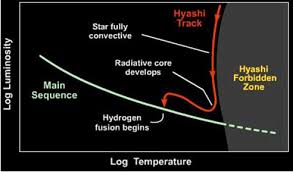
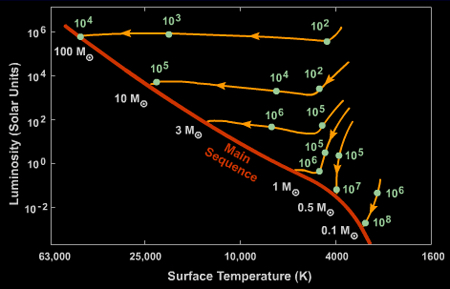
- Pre-main-sequence stars of solar mass or higher transition from convective Hayashi tracks to horizontal radiative tracks on the H-R diagram.
- During horizontal-track contraction, a star's luminosity remains nearly constant while its surface temperature increases until core hydrogen fusion ignites.
- Convective instability occurs when temperature gradients become too steep, providing an alternative energy transport mechanism to radiative diffusion.
Two remarkable aspects of this derivation are that: (1) the role of the stellar radius cancels; and (2) the resulting M-L scaling does not depend on the details of the nuclear generation of the luminosity in the stellar core!
Convective Instability in Stars
- Energy transport in stars shifts from radiative diffusion to convection when temperature gradients become excessively steep.
- Massive stars often develop convective cores due to the CNO cycle's high sensitivity to temperature.
- In lower-mass stars, the recombination of hydrogen and helium increases opacity, forcing a steeper temperature gradient in outer layers.
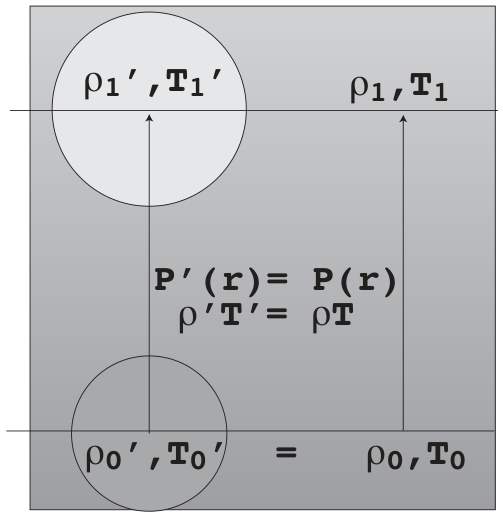
- Convective instability occurs when a displaced gas element becomes less dense than its surroundings, creating upward buoyancy.
- The physical condition for convection is met whenever the magnitude of the radiative temperature gradient exceeds the adiabatic gradient.
Convection refers to the overturning motions of the gas, much like the bubbling of boiling water on a stove.
Convective Instability and Hayashi Tracks
- Convective instability occurs when the magnitude of the radiative temperature gradient exceeds the adiabatic temperature gradient.
- In dense stellar interiors, convection is so efficient that it maintains the local temperature gradient at nearly the adiabatic value.
- Hot stars with temperatures above 10,000 K typically maintain radiative envelopes because hydrogen remains fully ionized, preventing high-opacity recombination zones.
- Cooler stars with surface temperatures between 3,500 and 4,000 K can become fully convective from the core to the surface due to deep hydrogen recombination.
- Fully convective stars bypass standard mass-luminosity scaling laws, allowing for the high luminosities seen in red giants and contracting proto-stars.
- The Hayashi track describes the early evolution of a proto-star as it contracts at a nearly constant temperature, moving vertically downward on the H-R diagram.
In the dense and hot stellar interior, once convection sets in, it is so efficient at transporting energy that it keeps the local temperature gradient very close to the adiabatic value above which it is triggered.
Stellar Evolution and Fusion
- Proto-stars initially evolve along the Hayashi track, characterized by a vertical descent in the H-R diagram as they contract at a constant temperature.
- The transition to the Henyey track occurs when the stellar interior switches from convective to radiative transport, moving horizontally toward the main sequence.
- Hydrogen fusion begins when core temperatures reach a critical threshold, halting gravitational contraction and stabilizing the star's luminosity.
- Post-main-sequence evolution often retraces these pre-main-sequence paths, leading stars toward the red giant phase.
- Hydrogen fusion occurs via two primary channels: the proton-proton (PP) chain in low-mass stars and the CNO cycle in high-mass stars.
- The CNO cycle is highly temperature-sensitive due to the electrical repulsion of heavier nuclei, making it dominant only in the hotter cores of massive stars.
The higher charge of CNO nuclei requires higher proton energy to overcome the higher electrical repulsion.
Quantum Tunneling and Solar Fusion
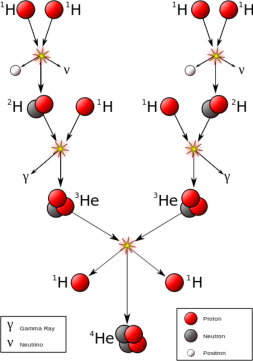
- The Sun and low-mass stars primarily generate energy through the Proton-Proton (PP) chain, converting four hydrogen nuclei into one helium nucleus.
- Classical physics suggests that solar core temperatures are a thousand times too low to overcome the electrostatic repulsion between protons.
- Nuclear fusion is only possible at these 'modest' temperatures because of the uncertainty principle and the De Broglie wavelength of protons.
- Quantum tunneling allows protons to bypass the electrostatic barrier and come close enough for the strong nuclear force to take over.
- The thermal speed required for fusion depends entirely on fundamental physical constants like Planck’s constant and the charge of an electron.
- The Sun has naturally adjusted its radius so that its gravitational binding energy produces an interior temperature perfectly suited for hydrogen fusion.
Within quantum mechanics, it thus has an associated 'fuzziness' in position, characterized by its De Broglie wavelength λ = h/p, where h is Planck's constant.
Stellar Scalings and Fusion Limits
- The core temperature required for hydrogen fusion is approximately 17 million Kelvin, which aligns closely with the virial temperature of the Sun.
- While a naive linear mass-radius scaling is often assumed, main-sequence stars actually follow a sub-linear relation where radius scales to mass to the power of 0.7.
- The higher core temperatures in massive stars are necessary to drive more vigorous nuclear burning, often utilizing the CNO cycle as a catalyst.
- Combining mass-luminosity and Stefan-Boltzmann relations suggests that luminosity is a steep function of surface temperature, scaling as temperature to the eighth power.
- There is a lower mass limit for stars, roughly 0.08 solar masses, below which electron degeneracy pressure prevents the core from reaching the temperatures required for fusion.
- Objects below this mass limit are classified as Brown Dwarfs, representing a failure to achieve sustained hydrogen burning due to quantum mechanical effects.
Stars with a mass below this minimum should not be able to ignite H-fusion, because electron degeneracy prevents their cores from contracting to a small enough size to reach the 17 MK temperature required for fusion.
Stellar Mass Limits and Eddington
- Brown dwarfs represent the lower mass limit for stars because electron degeneracy prevents their cores from reaching the 17 million Kelvin required for hydrogen fusion.
- The minimum mass for hydrogen fusion is approximately 0.08 solar masses, a value where the role of Planck's constant in quantum tunneling cancels its role in degeneracy.
- The upper mass limit of stars is defined by the Eddington Limit, where outward radiation pressure equals the inward pull of gravity.
- Radiation acts as a form of 'anti-gravity' because its acceleration follows the same inverse-square law as gravitational acceleration.
- Stars exceeding approximately 195 solar masses risk becoming gravitationally unbound as their luminosity surpasses the Eddington threshold.
- Massive stars near the Eddington limit are often unstable and prone to 'photon bubble' instabilities, leading to significant mass ejection episodes.
This gives the radiative acceleration the same inverse-square radial decline as the stellar gravity, g=GM=r2, meaning that it acts as a kind of \anti-gravity".
Post-Main-Sequence Stellar Evolution
- Very massive stars near the Eddington limit experience photon bubble instabilities and mass ejection episodes that keep them near a maximum mass limit.
- Contrary to intuition, stars do not simply dim and die when core hydrogen is exhausted; instead, they expand and become significantly brighter.
- The contraction of a depleted hydrogen core increases its temperature, which triggers more vigorous fusion in the surrounding hydrogen shell.
- This shell-burning phase creates an energy surplus that exceeds the envelope's transport capacity, forcing the star to expand against gravity.
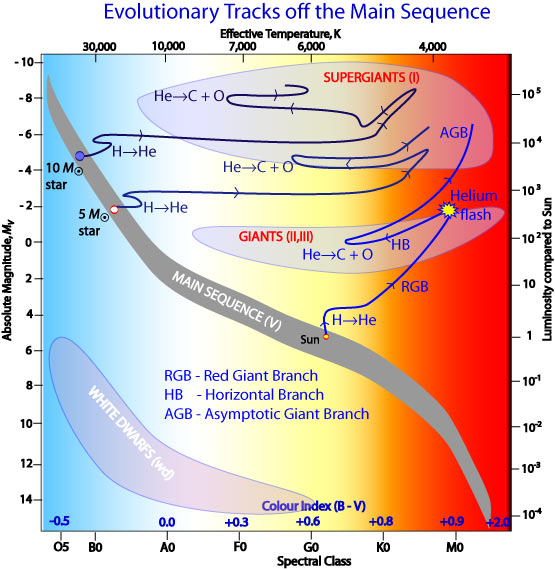
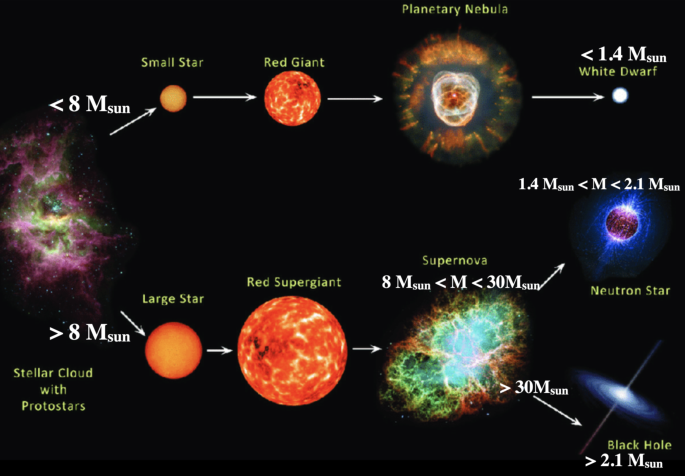
- The evolutionary path and final state of a star are primarily determined by whether its initial mass is above or below approximately 8 solar masses.
Then, much as the hot coals at the heart of a wood fire help burn the wood fuel around it much faster, the higher temperature of a contracted stellar core actually makes the overlying shell of Hydrogen fuel around the core burn even more vigorously!
Post-Main-Sequence Stellar Evolution
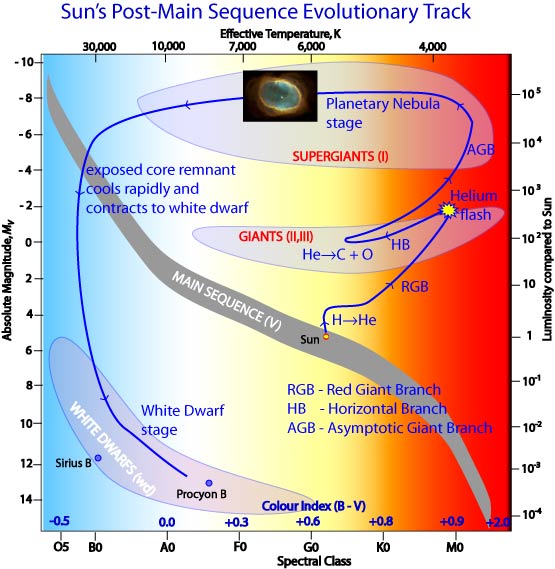
- Excess energy from the hydrogen-shell-burning core causes the star to expand, reversing its initial Kelvin-Helmholtz contraction.
- As the star expands and cools, it moves horizontally across the H-R diagram until it reaches the Hayashi limit of approximately 3500-4000 K.
- Upon reaching the Hayashi limit, the envelope becomes convective, allowing high core luminosity to reach the surface and causing the star to ascend the red giant branch.
- Helium fusion begins via the triple-alpha process, requiring temperatures around 120 million Kelvin to overcome high electrostatic repulsion.
- In low-mass stars like the Sun, helium ignition occurs in an electron-degenerate core, whereas higher-mass stars ignite helium more gradually.
- The specific evolutionary path on the H-R diagram—whether horizontal or vertical—is determined primarily by the star's initial mass.
The star's luminosity thus increases, with now the temperature staying nearly constant at the cool value for the Hayashi limit.
Helium Flash and Post-Main-Sequence Evolution
- In stars with masses less than twice that of the Sun, the helium core becomes electron degenerate due to extreme density.
- Unlike ideal gases, degenerate gases increase in temperature when they expand, leading to a runaway nuclear reaction known as the Helium Flash.
- The Helium Flash marks the tip of the Red Giant Branch, after which the star settles into a stable helium-burning phase on the Horizontal Branch.
- The Horizontal Branch phase is significantly shorter than the Main Sequence because helium fusion yields ten times less energy per unit mass than hydrogen fusion.
- Following core helium exhaustion, stars enter the Asymptotic Giant Branch (AGB) as helium burning shifts to a shell surrounding the core.
In contrast, for a degenerate gas, the expansion from adding heat actually makes the temperature increase even further.
Asymptotic Giants and White Dwarfs
- Stars entering the Asymptotic Giant Branch (AGB) phase experience shell burning of helium and hydrogen, leading to increased luminosity and convective energy transport.
- Lower mass stars fail to reach temperatures necessary for fusion beyond carbon and oxygen because electron degeneracy pressure halts core contraction.
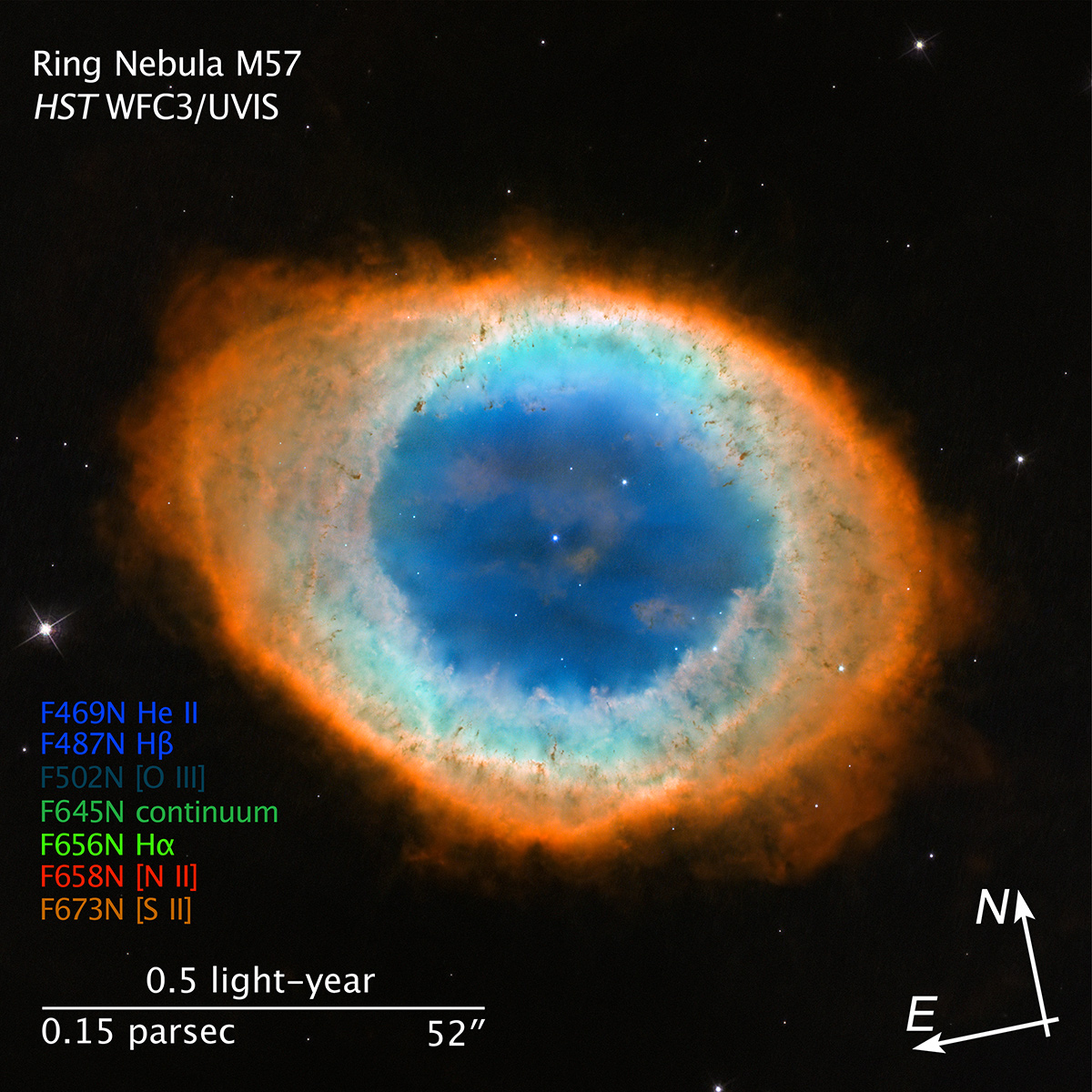
- Pulsational instabilities in AGB stars eventually eject the stellar envelope, creating a planetary nebula and leaving behind a dense, degenerate core.
- White dwarfs possess extreme physical properties, including densities a million times that of water and surface gravity 100,000 times that of Earth.
- The unique hydrostatic equilibrium of a white dwarf results in an inverse relationship where the radius of the star decreases as its mass increases.
This small radius makes them very dense, with a density about a million times (!) the density of water, and so a million times the density of normal main-sequence stars like the Sun.
White Dwarfs and Chandrasekhar Limits
- White dwarf stars exhibit an inverse relationship between mass and radius, where increasing mass causes the star to become more compact.
- The Chandrasekhar limit of approximately 1.4 solar masses represents the maximum mass a white dwarf can support before electron degeneracy pressure fails.
- Exceeding this mass limit, often through binary accretion, triggers a Type Ia supernova which serves as a standard candle for measuring cosmic distances.
- Stars with initial masses greater than 8 solar masses avoid electron degeneracy in their cores due to higher temperatures and lower densities.
- High-mass stars evolve horizontally across the H-R diagram at near-constant luminosity rather than climbing the Hayashi track.
But note that this radius actually decreases with increasing mass.
Nucleosynthesis and Core Collapse
- High-mass stars avoid electron degeneracy during nuclear burning due to lower mean densities and higher central temperatures.
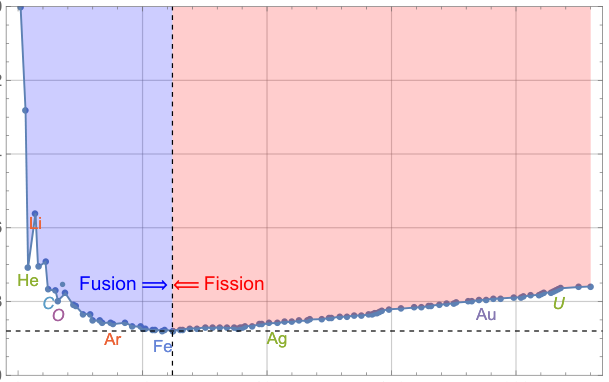
- Nucleosynthesis proceeds through an 'onion-skin' of shells, fusing increasingly heavy elements up to Iron, the most stable nucleus.
- Energy efficiency drops drastically as fusion progresses; the jump from Helium to Carbon yields only 0.06% energy efficiency compared to 0.7% for Hydrogen to Helium.
- Once an Iron core forms, fusion ceases to provide outward pressure, leading to a catastrophic gravitational collapse.
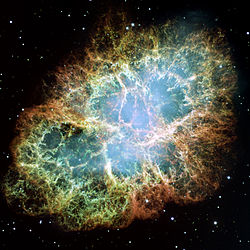
- The collapse is halted by neutron degeneracy, triggering a massive rebound explosion known as a supernova that ejects heavy elements at 10% the speed of light.
This eventually leads to a catastrophic core collapse, halted only when the electrons merge with the protons in the Iron nuclei to make the entire core into a collection of neutrons.
Supernovae and Stellar Remnants
- Core-collapse supernovae occur in stars with initial masses greater than 8 solar masses, ejecting heavy elements into space at 10% the speed of light.
- The final stages of nuclear burning in massive stars accelerate dramatically, with the silicon-to-iron transition occurring in just one day.
- Stars between 8 and 30 solar masses typically leave behind neutron stars, which are city-sized objects with densities 100 million times higher than white dwarfs.
- Neutron stars are supported by neutron degeneracy pressure and nuclear forces, but they have a maximum mass limit known as the Tolman-Oppenheimer-Volkoff limit.
- If a stellar remnant exceeds approximately 2.1 solar masses, no known force can prevent further collapse into a black hole.
For a few weeks, the luminosity of such a supernova can equal or exceed that of a whole galaxy, up to 10^12 L_sun!
The Physics of Black Holes
- The Tolman-Oppenheimer-Volkoff (TOV) limit defines the maximum mass of a neutron star, beyond which it must collapse into a black hole.
- The Schwarzschild radius represents the point where the Newtonian escape velocity equals the speed of light, creating a boundary from which nothing can escape.
- General Relativity describes black holes as extreme curvatures in space-time, analogous to a heavy ball puncturing a hole in a trampoline.
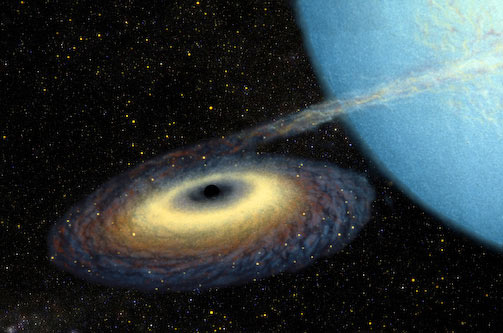
- While isolated black holes are nearly impossible to detect, those in binary systems reveal themselves through their gravitational influence on companion stars.
- Accretion disks around black holes are incredibly efficient, converting up to 25% of accreted mass-energy into radiation, far exceeding the efficiency of hydrogen fusion.
- Friction and gravitational energy in the inner accretion disk heat material to temperatures exceeding 10 million Kelvin, emitting high-energy radiation.
And much as a sufficiently dense, heavy ball could rip a hole in the trampoline, for objects with mass concentrated within a radius Rbh, the bending becomes so extreme that it effectively punctures a hole in space-time.
Observing Stellar Remnants
- Accretion disks around black holes in binary systems can reach temperatures of 10^10 K, emitting high-energy radiation that allows scientists to infer the properties of invisible objects.
- Cygnus X-1 serves as a primary example of a stellar-remnant black hole, with a mass exceeding the 2.1 solar mass limit for neutron stars.
- Stars under 8 solar masses eventually form white dwarfs, which are characterized by high surface temperatures but very low luminosity due to their small radii.
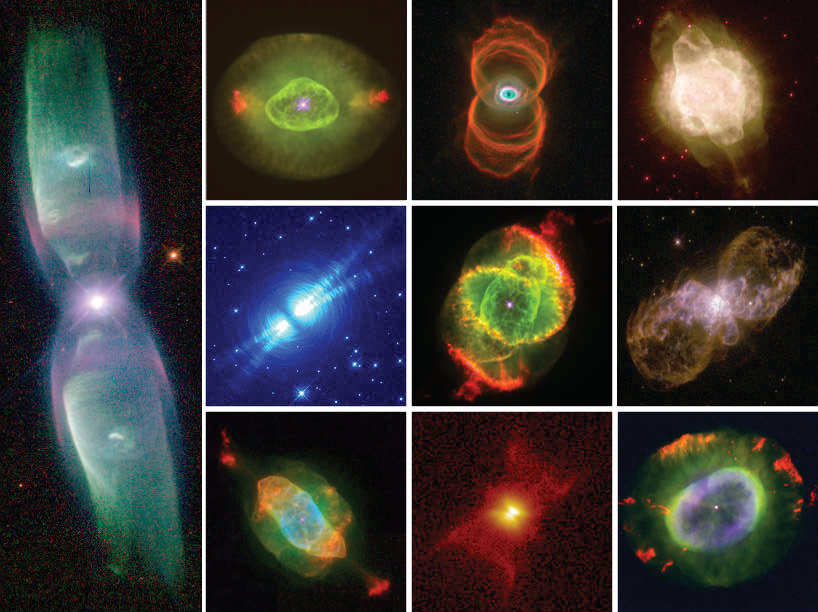
- Planetary nebulae exhibit vivid colors and complex geometric forms, often shaped by interactions with binary companions or planetary systems.
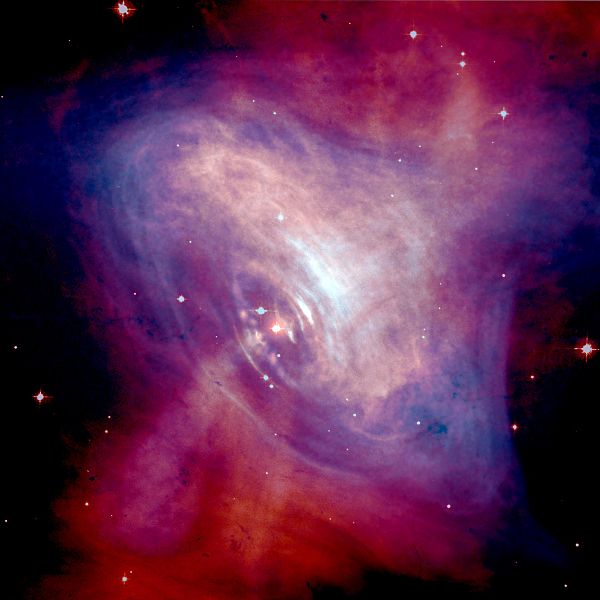
- Neutron stars, resulting from core-collapse supernovae, rotate rapidly due to the conservation of angular momentum and can be detected as pulsars when their magnetic poles sweep toward Earth.
By studying the resulting high-energy radiation, we can infer the presence and basic properties (mass, even rotation rate) of black holes in such binary systems, even though we can't see the black hole itself.
Stellar Remnants and Spacetime Ripples
- Stars with initial masses between 8 and 30 solar masses collapse into neutron stars, which rotate rapidly and can be observed as pulsars when their magnetic poles beam radiation toward Earth.
- The most massive stars, exceeding 30 solar masses, end as black holes that are often detected via high-energy X-ray emissions from accretion disks in binary systems.
- Einstein's General Theory of Relativity predicted gravitational waves—ripples in spacetime caused by accelerating masses—though he doubted they could ever be detected.
- The scale of gravitational wave detection is incredibly minute, requiring the measurement of distance changes equivalent to 1/1000 the size of a proton over a 1-kilometer span.
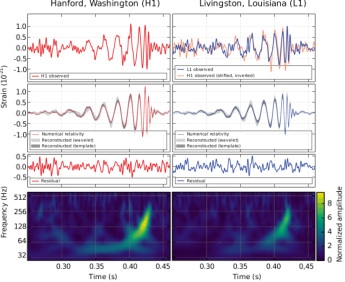
- The Laser Interferometer Gravitational-wave Observatory (LIGO) successfully recorded the first gravitational wave from merging black holes in 2015, confirming a century-old theory.
Thus, for example, over a length of 1 km, this would require measurement of distance changes on a scale of 10-18m, or about 1/1000 the size of a proton!
The Dawn of Gravitational Astronomy
- The Laser Interferometer Gravitational-wave Observatory (LIGO) achieved the first direct detection of gravitational waves in 2015, exactly one century after Einstein's prediction.
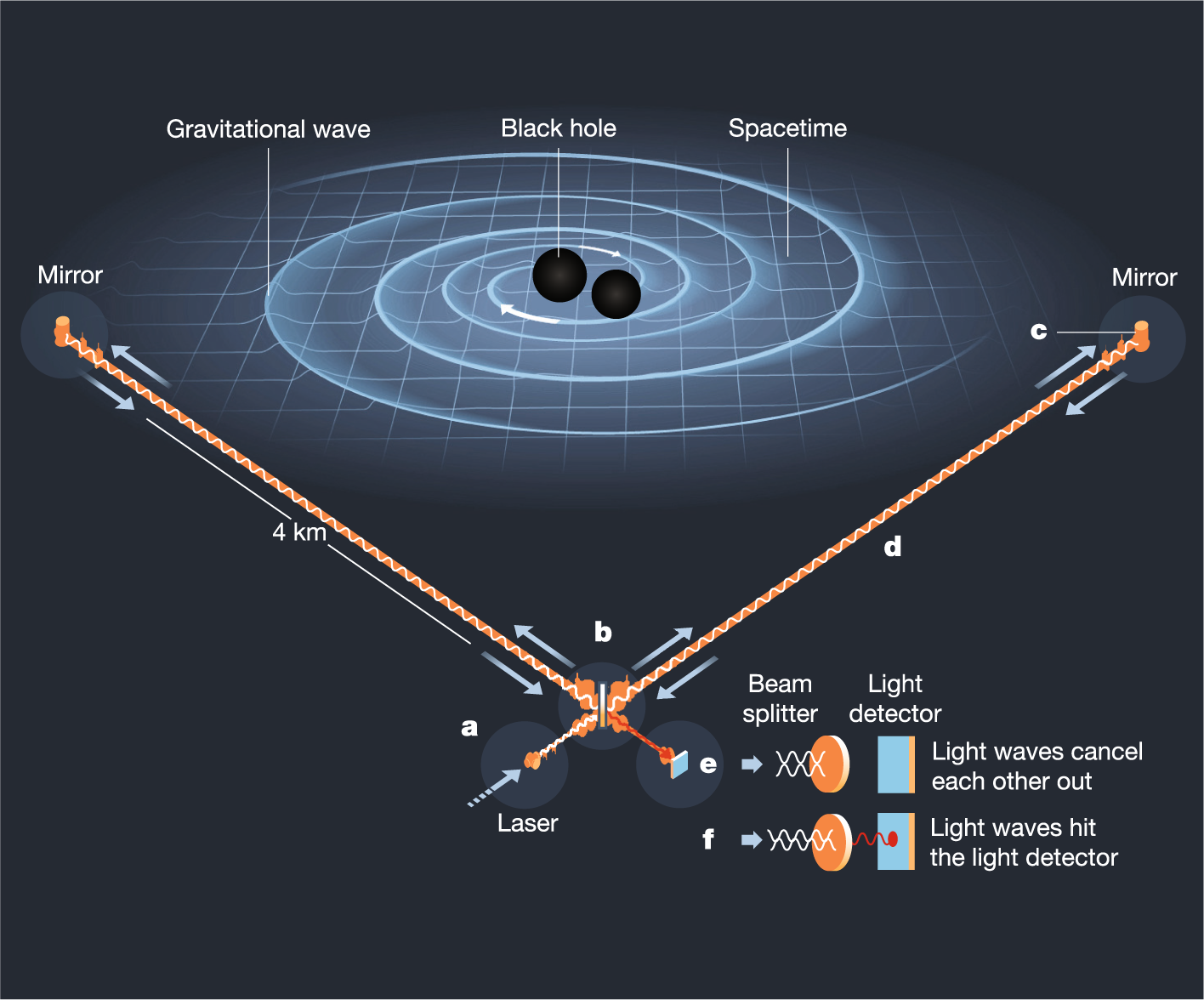
- LIGO uses 4 km long perpendicular laser arms to detect infinitesimal spatial deflections caused by the merger of massive objects like black holes.
- The first detected merger involved two black holes whose combined energy release briefly exceeded the luminosity of all stars in the observable universe by 50 times.
- While black hole mergers are electromagnetically silent, the 2017 detection of a neutron star merger provided a multi-messenger feast of gamma rays, X-rays, and visible light.
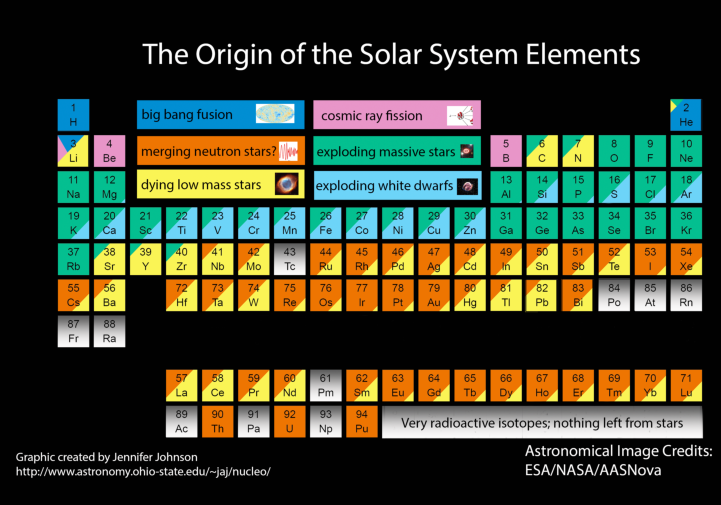
- Spectroscopic analysis of neutron star mergers confirmed they are cosmic factories for heavy elements like silver, gold, and platinum, often referred to as 'bling'.
- The success of LIGO and the indirect evidence from pulsar orbital decay led to Nobel Prizes in 1993 and 2017, validating General Relativity's most elusive prediction.
The final, merged black hole was inferred to be about 62 M, with the extra 3M converted to energy in the emitted gravitational wave, which for brief, few msec of the merger represented some 50 times the luminosity of all the stars in the observable universe!
Kilonovae and Gravitational Precision
- The triangulation of signals from LIGO and VIRGO detectors allowed for the precise localization of neutron star mergers.
- Spectroscopic analysis of these mergers revealed that heavy elements like gold, platinum, and silver are primarily produced in kilonovae rather than supernovae.
- Gravitational wave amplitude decreases only with the inverse distance, unlike energy flux which follows the inverse square law.
- Small improvements in detector precision lead to cubic increases in the volume of observable space and the number of detectable systems.
- Future enhancements in sensitivity are expected to increase detection rates to approximately one new gravitational wave source per day.
- The interstellar medium is composed of a significant fraction of mass shed by stars during their evolution toward final remnants.
This supported earlier suggestions that such high-mass elements, colloquially characterized as 'bling' because of their prominent use as precious metals and in jewelry, are mostly produced in the 'kilonovae' associated with such neutron-star mergers.
The Star-Gas Cycle
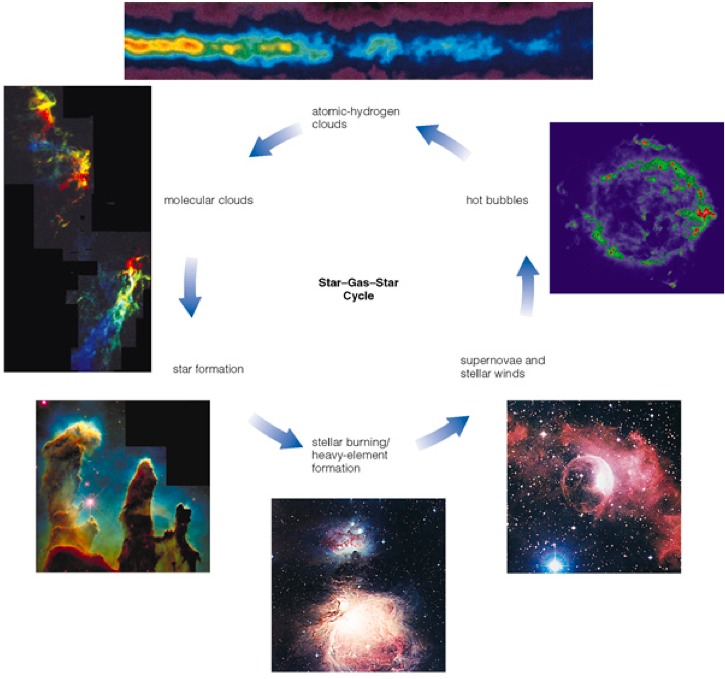
- The interstellar medium (ISM) is not a vacuum but a low-density reservoir of material recycled from stellar remnants like planetary nebulae and supernovae.
- A continuous 'star-gas-star' cycle exists where stars form from the ISM through gravitational contraction and eventually return 30-90% of their mass to it.
- The average density of the ISM is approximately one hydrogen atom per cubic centimeter, which is significantly less dense than the best vacuums created on Earth.
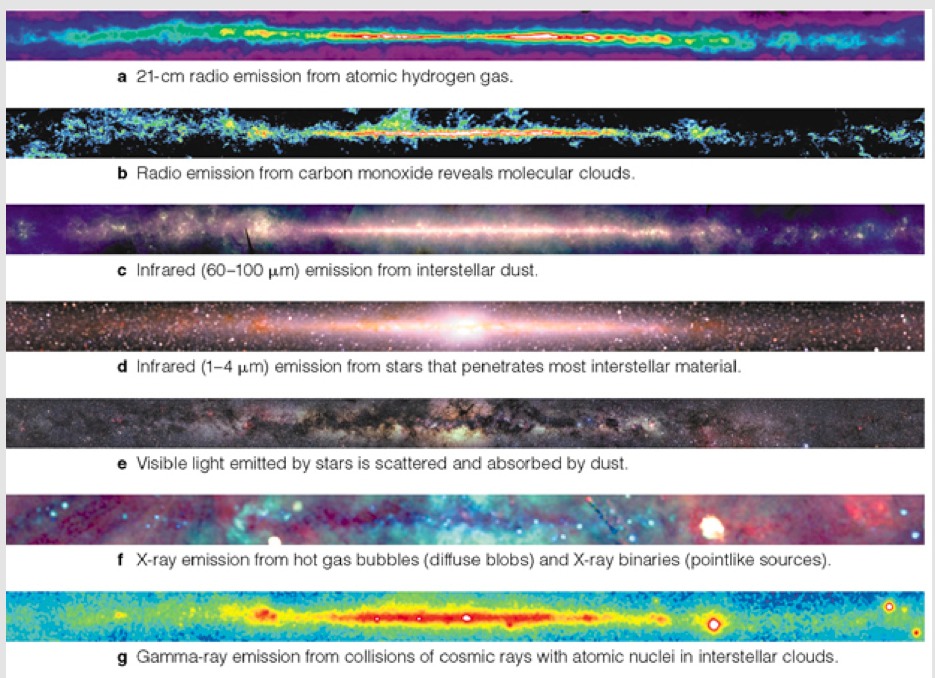
- While the average ISM density is low, it is highly heterogeneous and dynamic, consisting of various phases ranging from hot bubbles to cold molecular clouds.
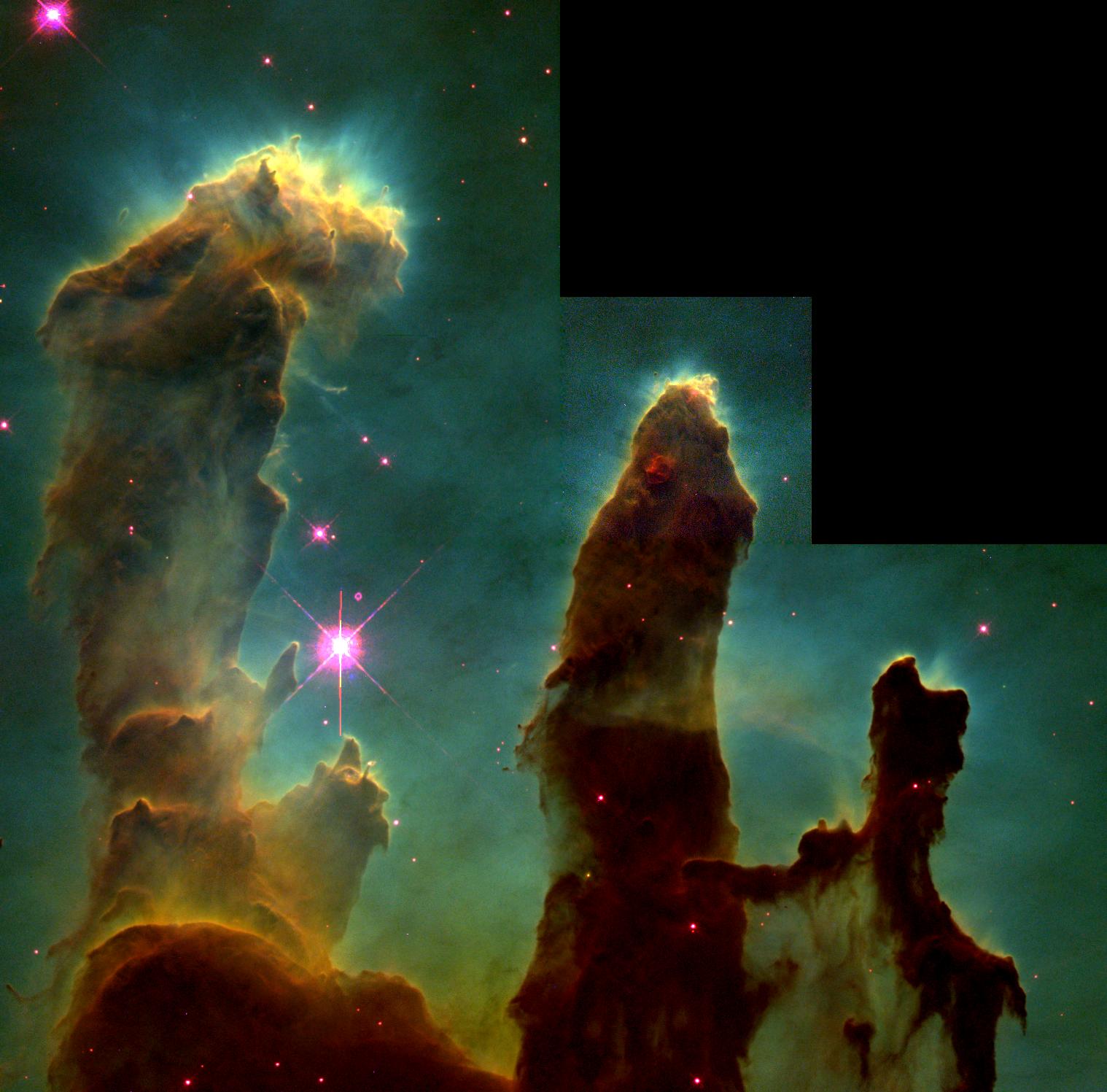
- The 'Pillars of Creation' serve as a primary example of cold molecular clouds undergoing active star formation while being illuminated by nearby massive stars.
Thus while most stars typically have mean densities comparable to matter (like water) here on Earth (i.e., ρ ≈ 1 g/cm3), this ISM density is well below (by a factor ∼ 10^4) even the most perfect vacuum ever created in terrestrial laboratories.
The Multi-Phase Isobaric ISM
- The Interstellar Medium (ISM) is characterized by a complex, heterogeneous structure with wide variations in density and temperature.
- Interstellar gas exists in three distinct temperature phases: cold (10-100 K), warm (5,000-10,000 K), and hot (10^5-10^7 K).
- Despite temperature extremes, the ISM remains nearly isobaric because gravity is generally too weak to confine gas over parsec scales.
- In this pressure-balanced environment, gas density scales inversely with temperature, ranging from 100 atoms per cubic centimeter in cold clouds to 0.001 in hot regions.
- The low density of the ISM prevents it from behaving like a blackbody, as radiation emission depends on collision rates that are suppressed in a vacuum.
In the absence of any restraining force, and ignoring any disturbances from stellar mass ejection, the ISM gas should over time settle into a dynamical equilibrium that is roughly isobaric.
Heating the Interstellar Medium
- The interstellar medium (ISM) consists of hot, warm, and cold components, with the hot phase occupying up to 80% of the galactic volume.
- Hot, massive stars heat the warm ISM to approximately 10,000 K through UV photoionization, creating large volumes of ionized gas known as HII regions.
- Supernova explosions are the primary energy source for the hot ISM, using high-speed shock waves to heat gas to temperatures between 10^5 and 10^8 K.
- Radiative cooling in the hot ISM is extremely inefficient because the high temperatures leave few bound electrons in heavy atoms to facilitate emission.
- Despite the vast volume and thermal energy of the hot and warm phases, the majority of the ISM's mass is concentrated in relatively small, cold, dense clouds.
- Cold ISM regions allow for the formation of molecules like H2 and CO, serving as the primary source material for new star formation.
In such SN explosions, several solar masses of stellar material is ejected at very high speeds, approaching 10% the speed of light.
Giant Molecular Clouds and Dust
- Giant Molecular Clouds (GMCs) form in the cold, dense interstellar medium, allowing atoms to combine into molecules like H2, CO, and even complex species like alcohol.
- The survival of these molecules depends on low temperatures and low UV flux, which are maintained by the shielding effects of high-density interstellar dust.
- Most interstellar dust is not formed within the clouds themselves but is produced in the outer layers of cool giant stars and dispersed by stellar winds.
- Dust grains provide an opacity roughly several hundred times greater than that of free electron scattering, leading to significant extinction of background starlight.
- Because dust opacity decreases at longer wavelengths, light passing through the edges of these clouds undergoes distinct reddening, characterized by a power index.
The dust itself is generally not formed locally, since in even the coldest clouds the density is not high enough for efficient nucleation of microscopic dust grains.
Dust Extinction and Infrared Observation
- Interstellar dust causes wavelength-dependent reddening, where extinction magnitude scales inversely with wavelength.
- Dense molecular clouds often have 10 to 20 magnitudes of visual extinction, rendering stars within them invisible to optical telescopes.
- Mid-infrared and far-infrared wavelengths suffer significantly less extinction, allowing astronomers to peer through dense dust clouds.
- Infrared telescopes must be placed at high, dry altitudes or in space to avoid atmospheric water vapor and must be kept cold to minimize thermal noise.
- Energy absorbed by dust from UV or optical light is re-emitted as thermal radiation, typically peaking in the 60-100 micron range for cold molecular clouds.
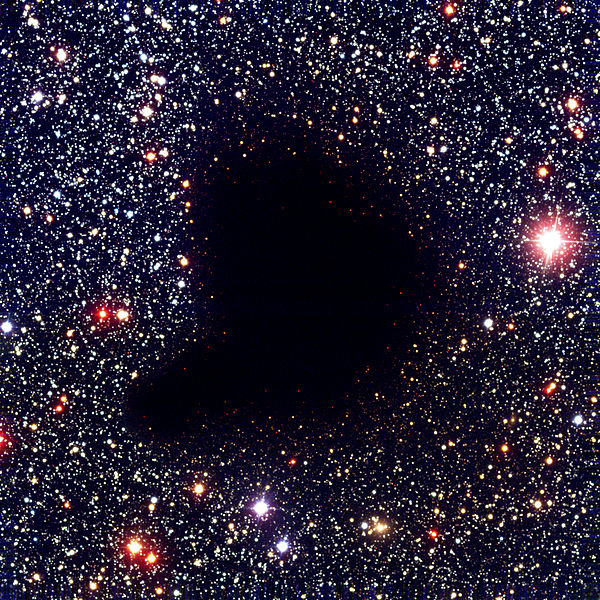
Stars are typically formed out of interstellar gas and dust in very dense molecular clouds, which often have 10 or 20 magnitudes of visual extinction, essentially completely obscuring them at visual wavelengths.
HII Regions and Strömgren Spheres
- HII regions are formed when hot, luminous OB-type stars emit UV photons with energies exceeding 13.6 eV, ionizing surrounding neutral hydrogen.
- The physical size of these regions is defined by the Strömgren radius, where the rate of stellar ionizing photons exactly balances the rate of electron-proton recombinations.
- Recombination rates are temperature-dependent and scale with the square of the number density, typically resulting in gas temperatures around 10,000 K.
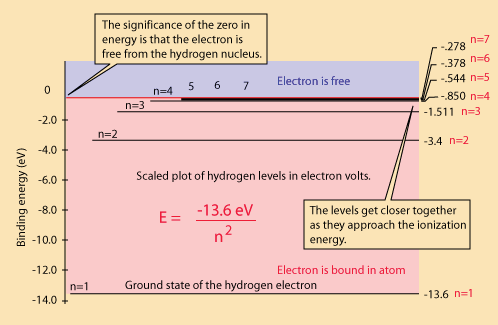
- The characteristic reddish glow of HII regions in optical images is caused by the H-alpha emission line, produced during the n=3 to n=2 electron transition.
- By comparing the calculated physical Strömgren radius with the observed angular radius, astronomers can estimate the distance to these interstellar clouds.
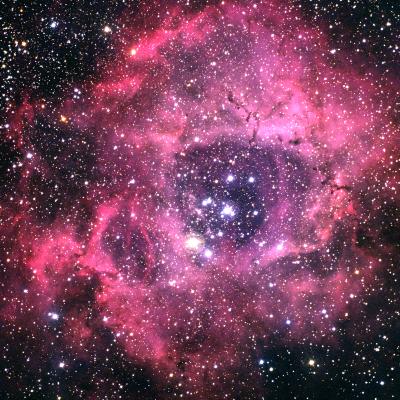
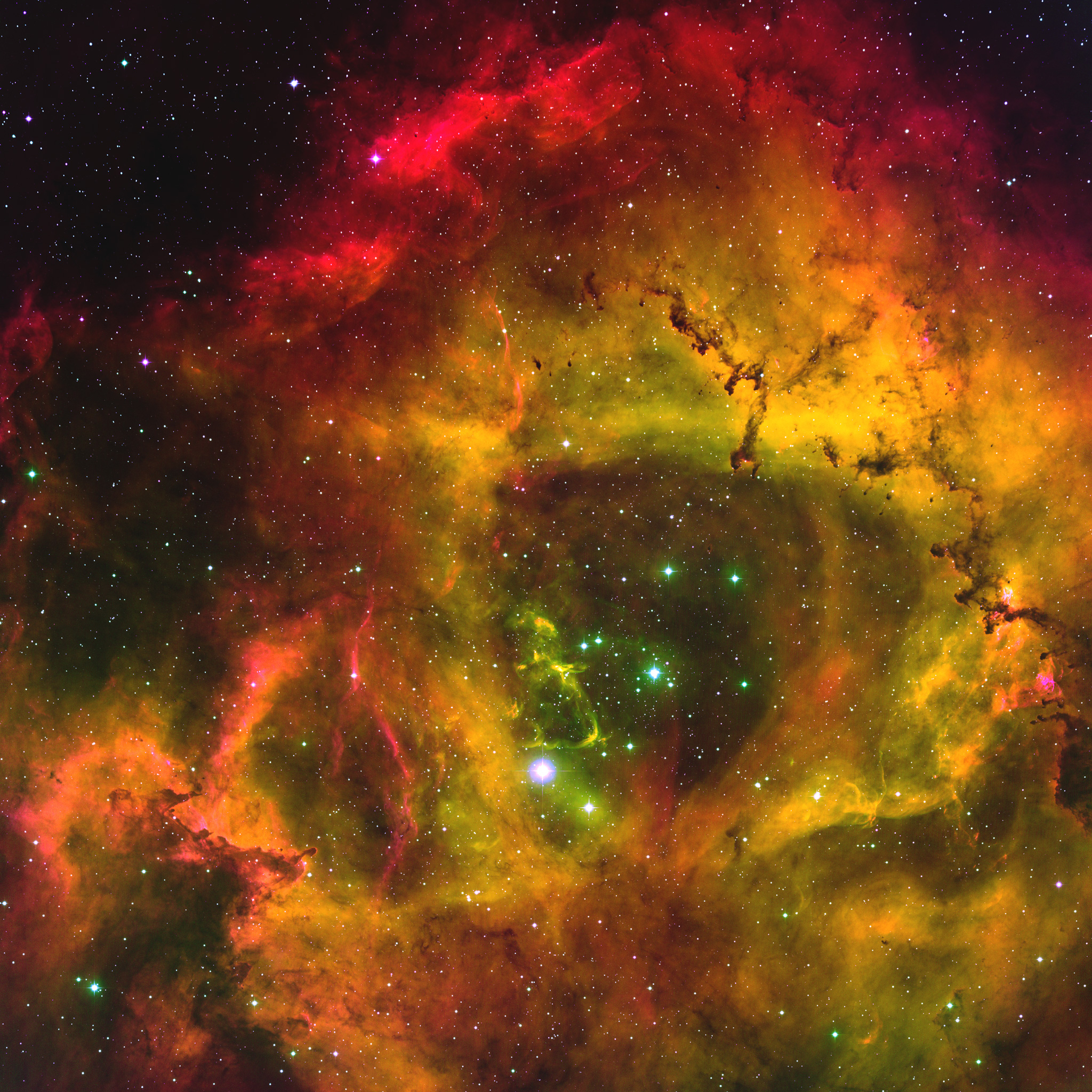
Viewed in the visible, HII regions thus generally have a distinctly reddish glow, as illustrated in the left panel of
HII Regions and Spiral Arms
- HII regions are characterized by a distinct reddish glow caused by the Balmer alpha emission line as electrons cascade through hydrogen states.
- False-color imaging reveals that these nebulae also contain significant line emissions from ionized oxygen and sulfur.
- Giant HII regions form when UV radiation from hot, massive stars photo-ionizes dense hydrogen within cold giant molecular clouds.
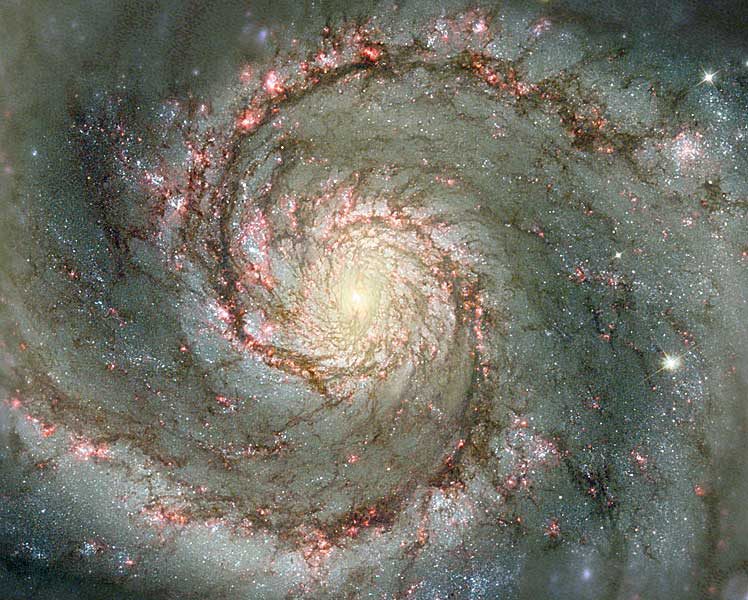
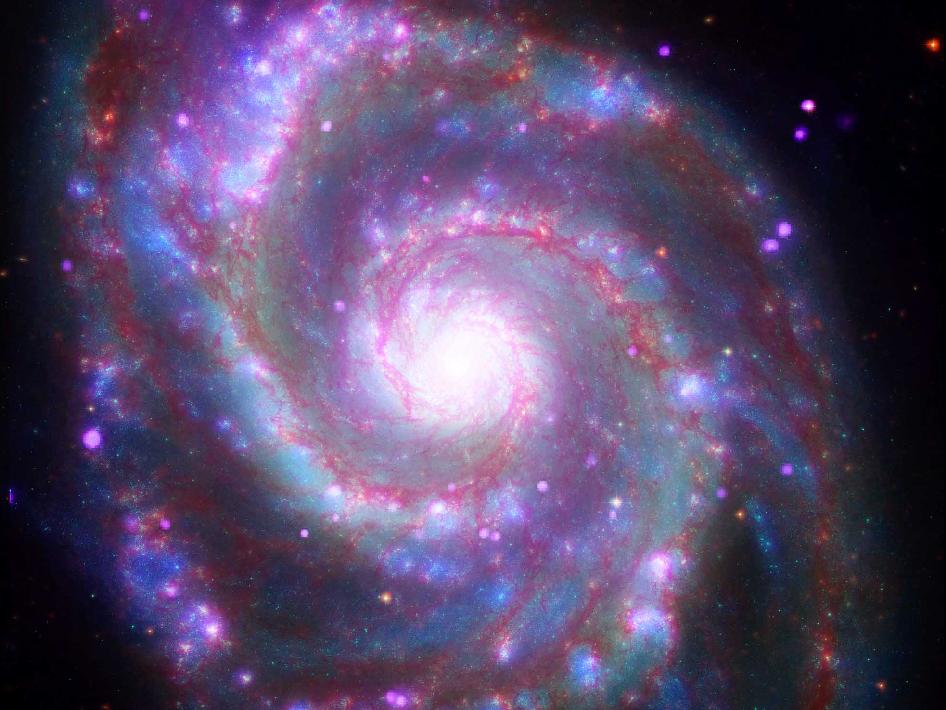
- Observations of the Whirlpool galaxy (M51) demonstrate that these star-forming regions are organized along galactic spiral arms.
- Multi-wavelength composite images show the interplay between black holes, hot gas, dust lanes, and young stars within the galactic structure.
- Star formation begins when gravitational binding energy overcomes internal thermal energy in dense, cold molecular clouds.
Viewed in the visible, HII regions thus generally have a distinctly reddish glow, as illustrated in the left panel of figure 21.4 for the HII region known as the Rosetta nebula.
The Jeans Criterion and Cooling
- Star formation begins when the gravitational binding energy of a Giant Molecular Cloud (GMC) overcomes its internal thermal kinetic energy.
- The Jeans criterion defines the minimum radius and mass required for a cloud to undergo gravitational contraction rather than expanding.
- Under typical interstellar conditions, the required Jeans mass is very high (often exceeding 30,000 solar masses), explaining why stars usually form in large clusters.
- The transition from atomic hydrogen to molecular hydrogen (H2) reduces the Jeans mass by a factor of four, facilitating easier contraction.
- Efficient radiative cooling is essential for star formation, as it allows clouds to shed thermal energy and maintain the low temperatures necessary for collapse.
- Carbon monoxide (CO) is the primary cooling agent in cold clouds, converting kinetic energy into infrared photons that escape the system.
But a general upshot of such a large Jeans mass is that stars tend typically to be formed in large clusters, resulting from an initial contraction of a GMC, with mass of order 10^4 M_sun or more.
Molecular Cooling and Gravitational Collapse
- Carbon monoxide (CO) acts as the primary coolant in molecular clouds by converting kinetic energy into infrared photons that escape the system.
- Efficient CO cooling allows contracting clouds to shed internal energy, reducing pressure support and triggering full gravitational collapse.
- The free-fall timescale for a cloud depends on its density, ranging from less than an hour for a star-like density to several million years for a molecular cloud.
- A theoretical calculation of the galactic star formation rate based on free-fall time predicts 200 solar masses per year, which is 200 times higher than the observed rate.
- The discrepancy in star formation efficiency is likely caused by magnetic fields, interstellar turbulence, and feedback from massive stars that inhibits further contraction.
But in practice CO emission is often so efficient that the cloud interior can stay cool, or even become cooler, as it contracts.
Fragmentation and the Initial Mass Function
- Gravitational collapse in Giant Molecular Clouds (GMCs) leads to fragmentation into smaller, stellar-mass cores as density increases and the Jeans mass decreases.
- The Initial Mass Function (IMF) describes the distribution of stellar masses, characterized by a power-law where high-mass stars are significantly rarer than low-mass stars.
- The Salpeter IMF provides a standard power-law index of 2.35 for stars heavier than the Sun, while various models like Kroupa and Scalo attempt to define the distribution for lower-mass stars and brown dwarfs.
- Feedback from massive stars, including heating and ionization, acts as a self-regulating mechanism that inhibits further cloud contraction and star formation.
- Conservation of angular momentum during the collapse of rotating cores leads to the formation of protostellar disks around the central star.
- The rarity of very high-mass stars (m > 100) creates significant observational challenges in determining if there is an upper mass cutoff to the IMF.
The large power-index reflects the fact that higher-mass stars are much rarer than lower-mass stars.
Angular Momentum and Disk Formation
- The fragmentation of Giant Molecular Clouds into stellar-mass cores results in rotating cores that conserve angular momentum during gravitational collapse.
- While polar material falls directly into the central star, equatorial material is halted by centrifugal forces, forming a protostellar disk.
- The ratio of rotational to gravitational energy, typically around 0.02 in observed cores, predicts disk radii of several hundred astronomical units.
- Viscous friction between Keplerian rings transports angular momentum outward, allowing the majority of the mass to eventually accrete onto the star.
- A small fraction of the original mass remains in the disk, eventually fragmenting to form planets that hold the vast majority of the system's angular momentum.
- Human existence is fundamentally tied to this process, as the material forming Earth originated from the equatorial regions of the proto-solar core.
You and I and everyone on Earth are here today because our source material happened to stem from the equatorial regions of the proto-solar core, with too much angular momentum to fall into the Sun itself.
Rotational Collapse and Disk Formation
- The text describes how rotating protostellar clouds collapse into a central star and a surrounding orbiting disk based on initial latitude.
- Material near the poles contracts toward the center, while equatorial material forms a disk due to high angular momentum.
- Human existence is attributed to source material from the proto-solar core's equatorial regions that avoided falling into the Sun.
- The 'Nebular Model' is introduced as the primary framework for understanding the formation of our solar system and others.
- Mathematical exercises explore the relationship between initial rotational energy and the resulting disk surface density.
- Direct imaging from ALMA provides empirical evidence for these disks, showing gaps where planets are likely forming.
and everyone on Earth are here today because our source material happened to stem from the equatorial regions of the proto-solar core, with too much angular momentum to fall into the Sun itself
The Nebular Model
- The nebular model posits that planetary systems form from the collapse of a protostellar cloud, where conservation of angular momentum creates a rotating disk.
- Initially composed of gas with trace heavy elements, the disk undergoes slow inward diffusion and accretion onto the central star over several million years.
- Heavier elements within the disk nucleate into dust grains, which eventually grow into boulders and planetoids through collisions and self-gravity.
- The largest bodies eventually clear their orbital paths of debris through a chaotic process of accretion and assimilation.
- Modern observations using telescope arrays like ALMA provide direct evidence of these disks, such as the gaps seen in the HL Tauri system.
- T Tauri and Herbig Ae/Be stars serve as primary examples of young stellar objects still hosting these protoplanetary environments.
The disk gaps likely represent regions of planet formation.
Protoplanetary Disks and Solar Architecture
- T Tauri stars exhibit infrared excesses that indicate the presence of warm, dust-filled protoplanetary disks.
- High-resolution ALMA imaging of HL Tauri reveals concentric gaps in its disk, suggesting active planet formation within just 1 million years.
- Protoplanetary disks typically dissipate within a few million years due to stellar accretion, UV dissociation, and stellar winds.
- The nebular model suggests planetary systems are common, a theory supported by the detection of over 4,000 exoplanets.
- Our solar system serves as a prototype, featuring a distinct division between small rocky inner planets and large outer gas or ice giants.
- The solar system's structure includes an asteroid belt influenced by Jupiter and numerous moons formed through angular momentum conservation.
The disk gaps likely represent regions where planet formation is clearing out disk debris, though there is so far no direct evidence of fully formed planets in this system.
Moons, Rings, and the Ice Line
- The gas giants formed multiple satellites through angular momentum conservation within their contracting proto-planetary clouds.
- The Kuiper Belt and Oort Cloud consist of icy bodies and dwarf planets like Pluto, which are often deflected into the inner solar system as comets.
- The 'ice line' marks a thermal boundary where water ice could condense, allowing solid cores to grow large enough to capture hydrogen and helium gas.
- Inner rocky planets remained small because the warmth prevented ice formation, allowing light gases to escape their weaker gravitational pull.
- Equilibrium temperature in the solar system decreases with the square root of the distance from the Sun, following a specific mathematical gradient.
In the colder outer regions these condensed to form ice, which gradually collected into ever larger solid cores, eventually growing massive enough to gravitationally attract and retain the even-more-abundant but lighter gases of Hydrogen and Helium.
Planetary Temperatures and Lunar Origins
- The 'ice line' distinguishes inner rocky planets from outer gas giants based on the decline of equilibrium temperature with solar distance.
- Equilibrium temperature calculations for planets are independent of their size, applying equally to dust grains and massive celestial bodies.
- Earth's actual temperature is a delicate balance between cloud reflection and greenhouse gas warming, whereas Venus suffers from a runaway greenhouse effect.
- Mars currently lacks a significant greenhouse effect, leaving its water locked in ice despite evidence of a warmer, wetter past.
- The Giant Impact hypothesis suggests the Moon formed from Earth's mantle after a collision with a Mars-sized body named Theia.
- Tidal coupling has caused the Moon to migrate from a close initial orbit to its current distance of 30 Earth diameters.
But that is the result of a somewhat fortuitous and delicate cancellation, between the cooling effect of reflection of sunlight by clouds, and the warming effect of greenhouse gases in the Earth's atmosphere.
Origins of Earth's Water
- The Giant Impact theory suggests a Mars-sized body named Thea collided with the proto-Earth, ejecting mantle material that condensed to form the Moon.
- Earth's water likely originated from icy asteroids during the Late Heavy Bombardment, triggered by the orbital migration of Jupiter and other outer planets.
- While the Moon lost its volatile water to space, Earth's gravity and atmosphere allowed it to retain the ice delivered by these cosmic impacts.
- Plate tectonics on Earth are lubricated by water and driven by radioactive decay, whereas Venus suffered a runaway greenhouse effect that stalled its tectonic activity.
- Earth's magnetic field, generated by its molten iron core, acts as a shield against the solar wind, preventing the atmospheric stripping seen on Mars.
This sent the icy minor bodies hurtling toward the inner solar system, to impact the moon, and of course also the Earth.
Planetary Shields and Subsurface Oceans
- Mars lost its atmosphere because the lack of a molten iron core prevented the formation of a protective magnetic field against solar wind.
- Earth's magnetic field acts as a magnetospheric shield, deflecting high-speed protons and creating the aurora at the poles.
- Terrestrial life originated in oceans over 3 billion years ago, and modern organisms still retain a high water content reflecting this ancestry.
- Deep-ocean vents on Earth prove that complex ecosystems can thrive on chemical energy from magma, independent of sunlight.
- Tidal flexing provides enough internal heat to maintain liquid subsurface oceans on icy moons like Europa and Enceladus.
- Future space missions aim to detect biochemistry in the water geysers of Enceladus to find the first evidence of life beyond Earth.
Instead it just guides some fraction of solar particles to impact near the magnetic poles, where they harmlessly light up the upper atmosphere to form the beautiful dance of the northern and southern lights.
Exoplanet Detection and Orbital Mechanics
- The text begins with a series of physics problems calculating the angular momentum and rotational evolution of the Earth-Moon system.
- Direct imaging of exoplanets is difficult because reflected planetary light is typically overwhelmed by the intense direct light of the host star.
- Successful direct imaging usually requires blocking the host star's light with an occulting disk to reveal distant, cooler planets.
- Observations of the star HR8799 demonstrate that multi-year imaging sequences can be used to infer planetary orbital periods.
- Most exoplanets are discovered through indirect methods, specifically the radial velocity and transit techniques.
- These detection methods are analogous to techniques used to study visual, spectroscopic, and eclipsing binary star systems.
This greatly complicates direct detection of extra-solar planets, since this reflected light is generally overwhelmed by the direct light from the star.
Detecting Exoplanets via Stellar Wobble
- The radial velocity method detects exoplanets by measuring the periodic Doppler shifts in a star's spectrum caused by a planet's gravitational pull.
- Wobble speed is directly proportional to a planet's mass and inversely proportional to the cube root of its orbital period, favoring the detection of massive, close-in planets.
- The discovery of 'Hot Jupiters' challenged existing planetary formation theories, suggesting that gas giants can migrate inward from their original positions beyond the ice line.
- Observational bias plays a significant role in exoplanet discovery, as current technology more easily identifies extreme systems rather than Earth-like configurations.
- Detecting an Earth-sized planet at 1 AU remains a long-term goal, as the required precision (9 cm/s) is roughly ten times better than current technological limits.
- The transit method provides a complementary detection technique by measuring the slight dimming of a star as a planet passes in front of it.
In the context of the prevailing idea that such gas giants should only form beyond the ice line, this detection was a real surprise.
The Transit Method Breakthrough
- The transit method detects exoplanets by measuring the slight dimming of a star's brightness as a planet passes in front of it.
- Detection sensitivity is determined by the ratio of the planet's area to the star's area, making Earth-sized planets much harder to spot than Jupiter-sized ones.
- Ground-based telescopes are limited by atmospheric noise to about 1% precision, whereas space-based telescopes are required to reach the 0.01% precision needed for rocky planets.
- The method is geometrically limited, as it only works for planets whose orbital planes are precisely aligned with our line of sight.
- The Kepler satellite mission revolutionized the field by monitoring 150,000 stars simultaneously to overcome the low statistical probability of transit alignment.
For an Earth-size planet around a solar-type star, the alignment must be within an angle ~0.27 degrees.
The Growing Exoplanet Census
- The Kepler mission utilized the transit method to identify thousands of exoplanets, though it was biased toward detecting large planets in close orbits.
- Modern surveys have expanded the census to over 4,000 confirmed worlds, revealing diverse classes such as 'Ocean Worlds,' 'Lava Worlds,' and 'Super-Earths.'
- While early discoveries were dominated by Hot Jupiters, statistical analysis shows these are actually rare compared to smaller, rocky planets.
- Newer missions like TESS and the planned WFIRST utilize methods like gravitational microlensing to find planets further from their host stars.
- The most numerous class of planets discovered so far are 'Super-Earths,' which are rocky planets slightly larger than our own.
- A primary objective of current research is identifying Earth-sized planets within the 'Habitable Zone' where liquid water can persist.
These range from the intermediate size Ice Giants, which when closer to their star become "Ocean Worlds", to Rocky Planets, which when very close can become "Lava Worlds", as the rocks are melted by intense heating from the star's radiation.
Searching for Habitable Worlds
- The most common class of exoplanets discovered so far are 'Super-Earths,' which are rocky planets larger than Earth.
- The Habitable Zone is defined as the orbital region where liquid water can exist, calculated using blackbody equilibrium temperatures.
- Red-dwarf stars have closer-in Habitable Zones, making their planets easier to detect via radial-velocity and transit methods.
- High magnetic activity and flares from red dwarfs pose significant challenges to the viability of life on their close-in planets.
- Atmospheric spectroscopy during transits allows scientists to search for biosignatures like molecular oxygen, which indicates active photosynthesis.
In particular, any signature of molecular oxygen would be viewed as an indicator for life, since this is normally very reactive and would be destroyed unless constantly being replenished by photosynthesis.
Exoplanet Detection and Galactic Structure
- The text outlines mathematical exercises for calculating the transit depth and radial velocity wobble of stars caused by orbiting planets.
- Current technological limits in measuring stellar wobble (1 m/s) significantly restrict the detection of Earth-sized analogs compared to Jupiter-sized planets.
- The formation of the Milky Way's disk is attributed to the conservation of angular momentum during the gravitational collapse of a massive proto-galactic cloud.
- Observing the Milky Way's structure from within is challenging due to the superposition of stars and the presence of obscuring interstellar gas and dust.
- The Milky Way is accompanied by satellite galaxies, specifically the Large and Small Magellanic Clouds, which are visible from the Southern Hemisphere.
We along with our Sun are today still embedded within the Milky Way's disk, orbiting about the galactic center, again because our bits of proto-galactic matter had too much angular momentum to fall further inward.
Structure of the Milky Way
- The Milky Way's disk structure is a result of proto-galactic matter having too much angular momentum to collapse further inward.
- Visible light observations are limited by gas and dust extinction, but infrared and radio waves allow astronomers to map the galaxy's full 30 kpc diameter.
- The galaxy consists of three primary components: a thin disk with spiral arms, a central bulge, and a vast, roughly spherical halo.
- The halo contains ancient Population II stars and stable globular clusters with ages often exceeding 10 billion years.
- In contrast, the galactic disk is home to young, loosely bound open clusters and active star formation along its spiral arms.
- The Sun is located approximately 8 kpc from the galactic center, orbiting at a speed of 220 km/s.
As we look up into a dark night sky, we can trace clearly the direction along this disk plane through the faint milky glow of thousands of distant, unresolved stars, from which we indeed get the name 'Milky Way'.
Galactic Components and Cluster Dynamics
- Open clusters are loosely bound groups of young stars that typically disperse into the galactic disk within a few tens of millions of years.
- The Milky Way is structured into three primary components: the disk, the halo, and the central bulge, each containing distinct stellar populations.
- The galactic bulge dominates the Milky Way's luminosity, though its brightness is significantly obscured by dust absorption within the disk plane.
- Stellar velocity dispersion, measured via Doppler shifts, allows astronomers to calculate the virial mass of star clusters.
- The Sun is located on the Orion spur of the Sagittarius spiral arm, approximately 8 kiloparsecs from the Galactic Center.
They are so loosely bound that they tend to disperse within a few 10 Myr or less, evolving into unbound OB associations.
Mapping Galactic Rotation Curves
- The mass of a bound stellar cluster can be derived using the virial theorem by relating kinetic energy to gravitational binding energy.
- Radio emission from the 21-cm hydrogen line serves as a primary diagnostic tool for mapping the motion of gas clouds in the galactic disk.
- By measuring the maximum Doppler shift at various galactic longitudes, astronomers can calculate the rotation curve of the Milky Way.
- The geometry of the line of sight tangent to inner radii allows for the conversion of observed radial velocities into orbital speeds.
- Observations reveal a surprising result: the orbital speed remains nearly constant at approximately 220 km/s throughout most of the region within the Sun's orbit.
- This constant velocity profile contrasts with expected Keplerian declines and provides foundational evidence for the presence of dark matter.
The results indicate that, inside the Sun's orbit (R < Ro), the rotation speed is nearly constant, with V(R) ≈ Vo.
The Galactic Rotation Curve Mystery
- Observations of the 21 cm line of atomic hydrogen reveal that the Milky Way's rotation speed remains nearly constant at 220 km/s across varying radii.
- This 'flat' rotation curve contradicts Keplerian physics, which predicts that orbital speeds should decline as the inverse square root of the distance from the center.
- The discrepancy suggests that the galaxy's mass is not centrally concentrated like its stellar luminosity, but instead increases in proportion to the radius.
- Because this additional mass exists in regions with very little detectable light, it is categorized as 'dark matter'.
- Similar flat rotation curves observed in external edge-on galaxies indicate that dark matter is a widespread phenomenon beyond our own galaxy.
This comparison illustrates why these flat rotation curves came as a surprise.
Dark Matter and Galactic Centers
- Dark matter is inferred to have a nearly spherical distribution in galactic halos and outweighs luminous matter by a factor of five.
- While its exact nature is unknown, dark matter interacts primarily through gravity and was essential for the formation of large-scale structures in the universe.
- The center of the Milky Way is obscured by 25 magnitudes of visual extinction, requiring infrared and radio observations to penetrate the dust.
- Adaptive optics and speckle imaging allow astronomers to resolve individual stars within the central arcsecond of the galactic center.
- Monitoring the proper motions of stars near Sagittarius A reveals they orbit a supermassive black hole with a mass of approximately 4 million suns.
In short, without dark matter, we wouldn't be here today to wonder about it!
The Galactic Center's Black Hole
- Observations of stellar orbital tracks around Sagittarius A* reveal a common central point of attraction.
- The star S0-2 completed a full orbit in 16.7 years, providing critical data for mass calculations.
- By applying Kepler's third law to these orbits, astronomers have determined the central object is a supermassive black hole with a mass of approximately 4 million suns.
- Technological advances, such as the W. M. Keck Telescopes, allowed for sub-arc resolution of the central arcsecond of the Milky Way.
- The identification of external galaxies began with the resolution of individual stars, specifically Cepheid variables, in the Andromeda nebula by Edwin Hubble.
The star S0-2 has the shortest period, 16.7 years, and so has been tracked over more than a full orbit.
Hubble's Discovery of the Expanding Universe
- The resolution of individual stars in the Andromeda nebula allowed Edwin Hubble to identify Cepheid variables as 'standard candles' for distance measurement.
- Hubble's initial distance estimates proved that spiral nebulae were not local clusters but independent galaxies far outside the Milky Way.
- A calibration error regarding Cepheid types initially led Hubble to underestimate Andromeda's distance by half, which was later corrected to 2 million light years.
- Milton Humason, a former mule driver turned observatory assistant, played a critical role in measuring the spectra and Doppler shifts of faint galaxies.
- The discovery that almost all distant galaxies are moving away from Earth led to the formulation of Hubble's Law, establishing a linear relationship between velocity and distance.
In particular, he was able to measure the Doppler shift of known spectral lines, giving then a direct measure of the galaxies' radial velocity Vr.
Hubble's Law and Cosmic Expansion
- Hubble's Law establishes a linear proportionality between a galaxy's recession velocity and its distance from Earth.
- The Hubble constant (Ho) was originally overestimated at 500 (km/s)/Mpc due to errors in Cepheid variable classification, whereas the modern value is approximately 70 (km/s)/Mpc.
- The inverse of the Hubble constant, known as the Hubble time, provides an estimate for the age of the universe since its expansion began.
- Cosmological redshift is interpreted as the stretching of light's wavelength by the expansion of space itself rather than simple Doppler motion through space.
- While special relativity limits the speed of objects through space, space itself can expand at speeds exceeding the speed of light.
- The Tully-Fisher relation provides an alternative distance-measuring tool by linking a spiral galaxy's luminosity to its maximum rotation velocity.
Einstein's limit really applies to how fast objects can travel relative to space, but that space itself can expand at a speed faster than light!
The Tully-Fisher Relation
- The Tully-Fisher relation is an empirical method used to determine the distance to spiral galaxies by linking their luminosity to their rotational velocity.
- Observations show that a galaxy's luminosity scales approximately with the fourth power of its rotation speed, though the exact exponent varies by spectral band.
- By combining Kepler's law with surface brightness equations, the relation can be theoretically derived, provided the mass-to-light ratio and surface brightness remain constant.
- This method serves as a critical 'standard candle' for measuring cosmic distances that exceed the reach of the Cepheid variable method.
- Beyond distance measurement, the text introduces the morphological classification of galaxies into three primary types: Spiral, Elliptical, and Irregular.
Nonetheless, as a strictly empirically calibrated relation, this Tully-Fisher scaling provides a luminous standard candle to infer distances beyond the range accessible to the Cepheid method.
Morphology and Collision of Galaxies
- Galaxies are categorized into three primary morphological types: Spiral, Elliptical, and Irregular.
- Spiral galaxies feature active star formation within disk-based density waves, while Elliptical galaxies consist of older stars with almost no new star formation.
- Elliptical galaxies range significantly in scale, from dwarf ellipticals to giant central dominant galaxies that anchor large clusters.
- Irregular galaxies often result from the tidal disruption and warping caused by the collision of two or more galaxies.
- While individual stars within galaxies almost never collide due to vast distances, the proximity of galaxies to one another makes galactic collisions relatively common.
- Galactic mergers were more frequent in the early universe and are a primary mechanism for the 'bottom up' formation of large galaxies.
For individual stars, the distance/size ratio is enormous, of order d/s ~ 4 x 10^7, implying a mean-free-path l ~ 10^15 pc!
Galactic Collisions and Quasars
- Galactic collisions were more frequent in the early universe and may drive a bottom-up model of galaxy formation.
- During collisions, individual stars rarely hit one another due to vast distances, but gas clouds compress and trigger massive starbursts.
- The Milky Way and Andromeda are gravitationally bound and projected to collide in approximately 3-4 billion years.
- Quasars are point-like radio sources with non-blackbody spectral distributions that span from radio to gamma-ray wavelengths.
- Despite their star-like appearance, quasars possess immense redshifts and luminosities that can outshine an entire galaxy.
- Quasars are now understood to be Active Galactic Nuclei (AGNs) located at the centers of host galaxies.
When galaxies do collide, their overall pattern of stars become strongly distorted by the mutual tidal interaction of the overall mass of the two galaxies; but the individual stars are too widely separate to collide, and so just pass by each other.
The Power of Quasars
- Quasars are identified as Active Galactic Nuclei (AGNs) that outshine entire galaxies despite being millions of times smaller in diameter.
- The extreme luminosity of AGNs is powered by matter accreting onto supermassive black holes (SMBHs) at the centers of host galaxies.
- Frequent galaxy collisions in the early universe provided the tidal disruption and stellar material necessary to fuel these high-energy accretion disks.
- Accretion near a black hole is highly efficient, capable of converting roughly 10% of a mass's rest energy into pure luminosity.
- As quasar light travels across the universe, it encounters intergalactic hydrogen clouds that create a 'Lyman alpha forest' of absorption lines in the observed spectrum.
This extreme luminosity from such a small volume is thought to be the result of matter accreting onto the supermassive black hole (SMBH) at the center of the QSO/AGN host galaxy.
Quasars as Cosmological Probes
- Quasars act as cosmic flashlights that illuminate intergalactic hydrogen gas located between the source and Earth.
- The Lyman-alpha forest consists of numerous absorption lines in a quasar's spectrum, each representing a distinct hydrogen cloud at a specific redshift.
- The Hubble expansion Doppler-shifts the local Lyman-alpha wavelength, allowing astronomers to map the distance of these intervening clouds.
- Gravitational lensing occurs when the mass of a foreground galaxy cluster bends the light from a distant quasar, as predicted by General Relativity.
- Lensing can produce multiple images, arcs, or circles of a single quasar depending on the alignment of the source, lens, and observer.
In essence, the huge luminosities and huge distances of quasars provide us a set of "flashlights" to probe the inter-galactic Hydrogen gas in the universe between us and the quasars.
Gravitational Effects and Superluminal Motion
- The text outlines the scaling for gravitational bending of light, noting that General Relativity introduces a correction factor of four compared to Newtonian physics.
- Gravitational redshift is explained as the loss of energy light experiences when escaping a gravitational field, defined by the ratio of the emission radius to the Schwarzschild radius.
- Exercises challenge the cosmological origin of quasar redshifts by testing if they could instead be explained by gravitational redshift from a massive central object.
- Quasar jets often exhibit apparent super-luminal motion, where clumps of matter appear to move faster than the speed of light due to relativistic effects and their orientation toward the observer.
- Very Long Baseline Interferometry (VLBI) provides the extreme angular resolution necessary to track these clumpy, variable jet structures across the Earth.
Quite remarkably, individual clumps in these quasar jets can sometimes show an apparent 'super-luminal' motion, meaning that, for the inferred quasar distance, the propagation of individual jet clumps away from the quasar can appear to be faster than the speed of light!
Super-luminal Motion and Cosmic Structure
- Apparent super-luminal motion in quasar jets is an optical illusion caused by relativistic speeds directed toward the observer.
- Mathematical models show that if a jet's speed exceeds 0.707c, its transverse motion can appear to exceed the speed of light.
- Gravitational redshift, a consequence of General Relativity, describes how light loses energy as it escapes a gravitational potential.
- Galaxies are not randomly distributed but organized into a hierarchy of groups, clusters, and massive super-clusters.
- The Milky Way belongs to the Local Group, which is part of the larger Local Supercluster centered near the Virgo constellation.
- Large-scale surveys use redshift measurements and the Hubble constant to map the three-dimensional distribution of millions of galaxies.
From this it is clear that apparent super-luminal propagation is possible whenever the propagation speed v > 0.707c.
The Cosmic Web and Dark Matter
- Large-scale surveys use galactic redshift to map the universe in three dimensions, revealing a complex 'cosmic web' of matter.
- The universe's structure is characterized by thin walls of high galaxy density surrounding vast, nearly empty voids.
- Computer simulations suggest that this structure grew from tiny quantum fluctuations present during the earliest phases of the Big Bang.
- The formation of the observed large-scale structure requires a significant amount of cold dark matter, roughly five times the mass of ordinary matter.
- Cold dark matter is essential because its non-relativistic nature allows it to form the deep gravitational wells necessary to frame the cosmic network.
The result shows a remarkable 'cosmic web' in the overall large-scale structure (LSS) of the universe.
Dark Matter and Cosmic Expansion
- Cold Dark Matter (CDM) is essential for modeling the observed large-scale structure of the universe, as it provides the gravitational wells necessary for galaxy formation.
- The two primary candidates for CDM are Massive Compact Halo Objects (MACHOs) and Weakly Interacting Massive Particles (WIMPs).
- Micro-lensing surveys have largely ruled out MACHOs as the primary component of dark matter, leading to a scientific consensus favoring WIMPs.
- WIMPs are hypothetical particles that do not interact via electromagnetic or strong nuclear forces, making them invisible and difficult to detect.
- Hubble's law describes the expansion of the universe by relating galactic redshift to distance, with the inverse of the Hubble constant defining the approximate age of the universe.
- Underground experiments are currently attempting to detect WIMPs by shielding against cosmic ray contamination to isolate rare weak-force interactions.
The inability to produce light is indeed what makes WIMPs a candidate for dark matter.
Hubble's Law and Critical Density
- Hubble's law establishes a linear relationship between a galaxy's distance and its recession velocity, implying a currently expanding universe.
- The Hubble time, calculated as the inverse of the Hubble constant, provides a simplified estimate of the universe's age since the Big Bang.
- Gravity acts as a decelerating force on cosmic expansion, analogous to an object launched from Earth being slowed by planetary gravity.
- The critical density represents the specific mass density required to eventually halt the expansion of the universe.
- A mass fraction parameter is used to compare the actual density of the universe to the critical density to determine if expansion will reverse.
- The scale factor R(t) allows for a mathematical description of how the universe's expansion rate changes over time due to self-gravity.
Indeed, a key question is whether gravity might be strong enough to stop and even reverse the expansion, much as occurs when an object is launched with less than Earth's escape speed.
Dynamics of Cosmic Expansion
- The expansion of the universe is modeled using a scale factor R(t) that is influenced by the gravitational deceleration of matter.
- The critical-density mass fraction, Omega_m, determines whether the universe's expansion will continue indefinitely or eventually collapse.
- An 'empty' universe with no mass density expands linearly at a constant rate, representing the limit of zero gravitational braking.
- A 'critical' universe contains exactly enough mass to eventually slow the expansion rate to zero, but only at an infinite time in the future.
- In a 'closed' universe where the mass density exceeds the critical value, gravity eventually halts and reverses the expansion entirely.
- The Hubble constant provides the fundamental scale for time and expansion, allowing the equations to be simplified into dimensionless 'Hubble units'.
As the universe thus eventually closes back on itself, this is known as a "closed" universe.
Cosmological Models and Redshift
- The density fraction of the universe determines its ultimate fate: a closed universe reverses expansion, while open and critical universes expand forever.
- A closed universe occurs when the density fraction exceeds one, causing self-gravity to eventually halt expansion at a maximum scale factor.
- Redshift is more accurately viewed as a consequence of the expansion of space itself rather than just a Doppler effect from receding galaxies.
- The linear Hubble law is an approximation valid only for distances small compared to the Hubble distance.
- At vast distances, the relationship between redshift and distance becomes nonlinear and varies significantly depending on the specific expansion model.
- The scale factor R represents the ratio of light's wavelength at the time of emission to its wavelength when observed today.
But an alternative, indeed more general and physically more appropriate perspective, is that this redshift is actually just a consequence of the expansion of space itself!
Hubble Law and Expansion Models
- The relationship between redshift and distance becomes distinctly nonlinear at distances exceeding 1-2 billion light-years.
- All expansion models converge to the simple linear Hubble law at modest distances where the Hubble constant is approximately 70 (km/s)/Mpc.
- Even an empty universe with a constant expansion rate shows substantial deviation from linearity due to the inverse relation between redshift and the scale factor.
- The age of the universe varies significantly between models, with a 'critical' universe (Ωm=1) yielding a different timeline than an 'empty' universe.
- Comparing the calculated age of the universe to the age of globular clusters serves as a primary test for the viability of different cosmological models.
- Distinguishing between different expansion models observationally requires high-precision distance measurements at high redshifts.
Note that, as implied by the expansion (30.22), all the models converge to the simple linear Hubble law (purple line) at modest distances, d << dH = c/H0.
The Discovery of Cosmic Acceleration
- White-dwarf supernovae (Type Ia) serve as essential standard candles for measuring vast cosmic distances due to their consistent peak luminosity.
- By comparing the redshift and distance of these supernovae, astronomers can test different models of universal expansion and deceleration.
- Data collected in the 1990s revealed that distant supernovae are dimmer than expected, placing them below the curve of a constant-rate expansion model.
- This observation led to the revolutionary conclusion that the expansion of the universe is accelerating rather than slowing down under gravity.
- The acceleration implies the existence of a repulsive force, reviving Einstein's 'Cosmological Constant' which was originally proposed for a static universe.
But in one the greatest surprises of modern astronomy, and indeed of modern science, such data points were found to generally lie below the black curve that represents a nearly-empty universe.
Dark Energy and Cosmic Acceleration
- The accelerating expansion of the universe requires a repulsive force to counteract gravity, leading to the resurrection of Einstein's 'Cosmological Constant'.
- Einstein originally proposed the constant to maintain a static universe model but later discarded it as his 'greatest blunder' after Hubble discovered cosmic expansion.
- Modern cosmology characterizes this repulsive effect as 'dark energy', a pressure or tension inherent to space-time itself that dominates the universe's later stages.
- The transition from a gravity-dominated slowing expansion to a dark-energy-dominated accelerating expansion occurs at a specific scale factor determined by mass density.
- General relativity describes the universe's geometry—flat, spherical, or saddle-shaped—based on the balance between mass-energy density and the cosmological constant.
- Theoretical models like inflation suggest the universe is nearly flat, implying a precise balance where the sum of mass and dark energy densities equals the critical density.
Then, after Hubble's discovery that the universe is not static but expanding, Einstein completely disavowed this cosmological constant term, famously calling it 'his greatest blunder'.
Flat Universe and Dark Energy
- Theoretical arguments from inflation suggest the universe is nearly flat, meaning the total energy density equals the critical value.
- In a flat universe, the expansion rate initially declines but eventually increases again due to the influence of dark energy.
- A matter-empty universe dominated by dark energy expands exponentially, doubling in size every Hubble time.
- Current observational data, including supernova and CMB measurements, suggest a universe composed of roughly 30% matter and 70% dark energy.
- The best-fit model for our universe results in an age approximately equal to the Hubble time, similar to a simple coasting expansion model.
Thus, in contrast to the previous case of constant expansion for an empty universe with Ωm = ΩΛ = 0, for a dark-energy-dominated, flat universe with ΩΛ = 1, the expansion actually accelerates exponentially, with an e-fold increase each Hubble time!
Dark Energy and Flatness
- The universe is composed of approximately 30% mass-energy density and 70% dark energy, creating a nearly 'coasting' expansion at present.
- While gravity's pull weakens as the universe expands, the cosmological constant's influence increases quadratically, leading to eventual exponential growth.
- The 'Flatness Problem' arises because the current near-flatness of the universe requires an extreme degree of fine-tuning in the early universe.
- Mathematical models show that any initial deviation from a critical density would have resulted in either immediate collapse or expansion too rapid for galaxy formation.
- In the very early universe (R < 10^-4), radiation density dominated over matter, scaling with the fourth power of the temperature.
If instead, the initial Ω had been even slightly above unity, the fledgling universe would have recollapsed as a tiny, closed universe.
The Hot Big Bang
- The universe required extreme fine-tuning of its initial expansion rate to allow for the eventual formation of galaxies.
- In the early universe, high density and smoothness created a state of thermal equilibrium with a well-defined characteristic temperature.
- The temperature of the universe scales inversely with the scale factor, meaning it increases linearly with redshift.
- At a redshift of 1000, the universe was as hot as a cool star and emitted black-body radiation that has since been redshifted into the microwave spectrum.
- The Cosmic Microwave Background (CMB) was discovered serendipitously in 1965 by Penzias and Wilson while they were trying to eliminate radio static.
- The isotropic nature of the CMB—appearing uniform across the entire sky—confirmed it as a relic of the early Hot Big Bang.
After working hard to reduce electronic and other possible sources of static, they eventually concluded the noise was actually coming from the sky.
The Cosmic Microwave Background
- The discovery of the Cosmic Microwave Background (CMB) provided definitive confirmation of the Hot Big Bang model, earning a Nobel Prize in 1978.
- The CMB is remarkably isotropic and follows a nearly perfect Planck Black-Body function with a present-day temperature of approximately 2.726 K.
- Initial density fluctuations, or 'seeds,' were necessary for gravity to form the large-scale structures of the universe like galaxies and clusters.
- Theoretical models predicted these fluctuations would appear in the CMB at a level of roughly one part in one hundred thousand.
- Successive satellite missions including COBE, WMAP, and Planck have mapped these tiny temperature variations with increasing precision and resolution.
This can be considered as the present-day "temperature of our universe".
CMB Fluctuations and Cosmic Eras
- The Planck satellite provides high-precision maps of Cosmic Microwave Background (CMB) fluctuations, measuring temperature variations down to a few micro-Kelvin.
- CMB fluctuations serve as a cosmological seismology tool, offering insights into the universe's structure and evolution prior to the recombination era.
- Data from the Planck analysis establishes key cosmological parameters, including a universe age of 13.82 billion years and a composition dominated by dark energy (68.2%).
- The temperature of the universe scales inversely with the cosmic scale factor, meaning the universe cools as it expands.
- Radiation energy density scales more steeply than matter density, leading to a transition from a radiation-dominated era to a matter-dominated era at a redshift of approximately 10,000.
Much as measurement of seismological waves generated in an earthquake provide information on the interior structure of the Earth, these measures of CMB fluctuation power peaks provide information on the pre-recombination evolution of the universe.
The Recombination Era
- The universe transitioned from a radiation-dominated era to a matter-dominated era when the scale factor was approximately 1/6000 of its current size.
- Despite matter's current dominance in mass-energy density, CMB photons outnumber hydrogen atoms by a ratio of more than a billion to one.
- The photon-to-proton ratio remains remarkably constant throughout cosmic expansion, significantly influencing the abundance of light elements during nucleosynthesis.
- During the early Hot Big Bang, high temperatures kept hydrogen fully ionized, trapping photons through efficient electron scattering.
- The 'recombination era' occurred when the universe cooled to roughly 3000 K, allowing electrons and protons to form neutral hydrogen and freeing photons to travel as the CMB.
- The formation of the CMB can be modeled similarly to the surface of a star, using electron-scattering optical depth to determine when the universe became transparent.
The photons from this recombination era thus were suddenly free to propagate through the universe, becoming redshifted by its expansion to form the CMB we observe today.
Recombination and Early Nucleosynthesis
- The text derives the electron optical depth and ionization fraction of the early universe using the Saha-Boltzmann equation.
- Calculations show that 50% ionization occurs at a redshift of approximately 1380, corresponding to a temperature of 3700 K.
- The recombination era, where the universe becomes optically thick to radiation, is identified at a redshift of 1150 and a temperature of 3100 K.
- Even a small ionization fraction of 1.2% at the recombination era is sufficient to make radiation transport marginally optically thick due to high density.
- The era of nucleosynthesis occurred within the first few minutes of the Big Bang at temperatures reaching billions of degrees.
- Most of the Helium observed in the universe today was synthesized during this early nucleosynthesis rather than inside stars.
While Helium is synthesized in stars, it turns out that most of the Helium in the universe today was actually formed in the first few minutes or so after the Big Bang, when the temperature was several billion degrees (109K).
The Era of Nucleosynthesis
- Most of the universe's helium was synthesized within the first few minutes after the Big Bang during a period called the era of nucleosynthesis.
- Primordial helium production occurred rapidly because neutrons and protons could combine without overcoming the electrical repulsion that slows down stellar fusion.
- The final abundance of rare isotopes like deuterium and helium-3 is highly sensitive to the density ratio of baryonic matter to photons.
- By measuring current light element abundances and the CMB temperature, scientists can precisely calculate the present-day density of ordinary matter.
- This calculation provides a critical independent verification of the matter density measurements obtained from CMB fluctuations by WMAP and Planck.
- At temperatures above 10 billion Kelvin, photons possessed enough energy to spontaneously create electron-positron pairs, marking the preceding particle era.
Cores of stars are thus relatively low-temperature "slow cookers" of He compared to the rapid nucleosynthesis in the first few minutes of the Hot Big Bang.
Symmetry Breaking and Force Unification
- Stellar cores act as 'slow cookers' for helium synthesis compared to the rapid nucleosynthesis of the early Hot Big Bang.
- Spontaneous symmetry breaking during the particle era resulted in a slight excess of matter over anti-matter, leaving one proton for every billion annihilations.
- At extreme temperatures, the fundamental forces of nature merge, starting with the electroweak unification and moving toward the Grand Unified Theory (GUT) scale.
- The GUT scale occurs at energies far beyond the reach of modern particle accelerators like the Large Hadron Collider, making direct experimental testing impossible.
- The final unification of gravity with other forces occurs at the Planck scale, where physics is currently explored through purely theoretical frameworks like string theory.
In this particle era, the universe was thus very nearly symmetric between matter and anti-matter.
Planck Scales and Cosmic Inflation
- The cosmic scale extends down to the Planck length, where gravity and quantum physics merge into a theoretical 'quantum foam'.
- A massive 'size scale desert' exists between the energy levels reachable by the Large Hadron Collider and the Grand Unified Theory (GUT) scale.
- The standard Hot Big Bang model fails to explain the universe's flatness, its large-scale isotropy (the horizon problem), and the origin of structure.
- Alan Guth proposed the theory of Cosmic Inflation, suggesting the universe expanded exponentially by a factor of 10 to the 30th power in a fraction of a second.
- Inflation solves the flatness and horizon problems by smoothing out curvature and expanding a once-causally connected small region to a cosmic scale.
The upshot is that the Planck era is at the very frontier, where of our current physical understanding is untested and breaks down into a "quantum foam".
Cosmic Inflation and Its Signatures
- Cosmic inflation explains the universe's flatness by expanding its size by a factor of 10 to the 30th power, effectively smoothing out initial curvature.
- The horizon problem is resolved because the pre-inflated universe was small enough for distant regions to be causally connected and homogenized.
- Quantum fluctuations during the inflationary era were amplified to create the large-scale structures and CMB fluctuations observed today.
- Inflation is predicted to have generated gravitational waves that would leave a distinct circular polarization signature in the Cosmic Microwave Background.
- While the 2014 Bicep2 detection claim was likely caused by foreground dust contamination, experiments continue to search for these gravitational ripples.
- The broad scientific consensus supports inflation as a solution to Big Bang model problems, despite uncertainties regarding its specific initiation.
The initially tiny physical scale of these fluctuations was amplified by inflation to much larger structures that we see today in the angular spectrum of fluctuations of the CMB.
The Bohr Atom and Quantization
- The Bohr model explains the discretization of atomic energy by treating electrons as particles in stable circular orbits around a nucleus.
- Classical physics fails at the atomic scale because electrons exhibit wavelike characteristics described by the de Broglie wavelength.
- To avoid self-interference, an electron's orbital circumference must be an integer multiple of its wavelength, leading to the quantization of angular momentum.
- This quantization restricts orbital radii to specific discrete values, with the ground state defined as the Bohr radius (approximately 0.529 Angstroms).
- The total orbital energy is also quantized into discrete levels, where the energy of a hydrogen electron is determined by the principal quantum number n.
- These discrete energy levels provide the physical basis for understanding the spectral lines observed in stellar light.
In the ghostly world of quantum mechanics, electrons are themselves not entirely discrete particles, but rather, much like light, can also have a 'wavelike' character.
Atomic Energy Levels and Spectra
- The size of most atoms is determined by the Bohr radius, which is approximately 0.529 Angstroms for the ground state of Hydrogen.
- Atomic energy levels are quantized, with the binding energy of Hydrogen's ground state defined as 13.6 electron Volts (eV).
- Transitions between energy levels involve the emission or absorption of photons with energies exactly matching the difference between levels.
- Bound-bound absorption occurs when cool surface atoms absorb light from underlying stellar layers, creating absorption line spectra.
- Emission-line spectra are produced when excited electrons in hot or dense gas spontaneously decay to lower energy levels.
- Heisenberg's Uncertainty Principle implies that finite atomic lifetimes result in a 'fuzziness' of energy known as natural broadening of spectral lines.
This leads to what is known as 'natural broadening' of spectral lines.
Atomic Transitions and Spectral Series
- The wavelength of light emitted or absorbed during atomic transitions is determined by the energy difference between discrete electron levels.
- Spectral series are categorized by their lower energy level, such as the Lyman series (n=1) in the ultraviolet and the Balmer series (n=2) in the visible spectrum.
- The Lyman limit represents the wavelength associated with a transition from an infinite bound level to the ground state.
- The Boltzmann equation describes how the population of electrons in different energy levels is distributed based on temperature and quantum mechanical states.
- Thermodynamic equilibrium ensures that atomic excitation and de-excitation are balanced by both radiative processes and particle collisions.
The Lyman series transitions all fall in the ultraviolet (UV) part of the spectrum, which due to UV absorption by the earth's atmosphere is generally not possible to observe from ground-based observatories.
Thermodynamic Equilibrium and Ionization
- The Boltzmann factor determines the relative population of electrons in different energy levels based on temperature and statistical weights.
- At low temperatures, atoms remain in lower energy states, while high temperatures shift populations to excited levels, increasing photon emission.
- Cooler atoms illuminated by continuum light create absorption spectra as they transition to higher energy states.
- The Saha equation extends these principles to ionization, describing the balance between neutral atoms and ions as thermal collisions strip electrons.
- Ionization equilibrium depends on the electron number density and the thermal de Broglie wavelength, which defines the available states for free electrons.
At high temperatures, the energy of collisions can become sufficient to overcome the full binding energy of the atom, allowing the electron to become free, and thus making the atom an ion, with a net positive charge.
Ionization Balance and Atomic Opacity
- The Saha-Boltzmann equation determines the ionization balance between neighboring stages based on available free-electron states and ionization energy.
- A massive number of available free-electron states, often around 10 to the power of 10 in stellar atmospheres, acts as an attractor for the ionized state.
- Hydrogen can reach equal fractions of neutral and ionized states at temperatures where thermal energy is significantly lower than the ionization energy.
- Electron degeneracy occurs only in highly compressed environments, such as white dwarf interiors, where the electron state factor approaches unity.
- Atomic opacity is primarily driven by the interaction of electromagnetic waves with charged particles, specifically the acceleration of low-mass electrons.
This large number of states acts like a kind of "attractor" for the ionized state.
Atomic Origins of Opacity
- Electrons are the primary drivers of radiation interaction because their low mass allows them to be easily accelerated by electromagnetic waves.
- Thomson scattering occurs when a free electron redirects a photon's energy without absorbing it, as an isolated electron cannot store both the energy and momentum.
- The Thomson cross-section is classically derived from the 'classical electron radius,' where electrostatic self-energy equals rest-mass energy.
- Opacity in stellar material depends on the hydrogen mass fraction, as ions provide the bulk of the mass while electrons provide the scattering surface area.
- True absorption, such as free-free or bound-bound processes, requires the presence of ions or atoms to facilitate the exchange of energy and momentum.
- Bound-bound transitions are highly energy-specific, occurring only when a photon's energy matches the difference between an atom's internal energy levels.
Because an isolated electron has no way to store both the energy and momentum of the incoming light, it cannot by itself absorb the photon, and so instead simply scatters, or redirects it.
Atomic Processes and Stellar Opacity
- Bound-bound processes involve photons with specific energies matching atomic levels, creating high-resonance opacities and spectral lines.
- Bound-free processes occur when photons possess enough energy to ionize an atom, contributing to continuum opacity rather than discrete lines.
- Kramer's opacity provides a mathematical model for bound-free and free-free interactions, showing that opacity generally decreases as temperature increases.
- In stellar interiors, the overall opacity is typically a modest factor higher than the base value for Thomson electron scattering.
- The transition from a star's interior to empty space is modeled as a thin planar atmosphere where radiation transport depends on the balance of emission and absorption.
An everyday analogy is blowing into a whistle vs. just into open air.
Radiative Transfer and Limb Darkening
- The transition from a star's interior to empty space occurs in a narrow atmospheric layer that can be modeled as a planar surface.
- The equation of radiative transfer accounts for the competition between local thermal emission and the reduction of intensity due to absorption.
- The Eddington-Barbier relation simplifies emergent intensity by stating it is approximately equal to the Planck function at unit optical depth.
- Solar limb darkening occurs because radial views at the center of the disk penetrate to deeper, hotter layers than oblique views at the edges.
- Sunspots appear dark because magnetic storms inhibit convective heat transport, resulting in locally cooler surface temperatures.
- While the sun's disk can be resolved to study temperature gradients, distant stars are measured via total flux rather than surface intensity.
This so-called "Eddington-Barbier relation" states that when you peer into an opaque radiating gas, the emergent intensity you perceive is set by the value of the blackbody function at the location of unit optical depth along that ray.
Solar Limb Darkening and Temperature
- Limb darkening occurs because viewing the solar disk at an angle reveals cooler, shallower surface layers compared to the center.
- The variation in brightness from the center to the limb serves as a diagnostic tool for measuring the temperature gradient of the Sun's surface.
- The stellar surface is mathematically defined as the layer where the optical depth reaches a value of two-thirds.
- Effective temperature is defined as the blackbody temperature at the specific layer where the optical depth is two-thirds.
- The Eddington-Barbier relation allows for the derivation of emergent intensity based on the linear approximation of the Planck function.
Comparison of the final form of (D.4) with the simple discussion of surface flux in part I shows that we can identify what we've been calling the stellar "surface" as the layer where the optical depth (R) 2/3.
Observational Properties of Stars
And since the Greeks decided to give dimmer stars a higher magnitude, we find that magnitude scales with the log of the inverse flux.
Scales and Orders of Magnitude
As a mneumonic, this is cast as a 10-digit "telephone number", with the 3-digit "area code" representing the 3 steps of 10-5 from us down to the nucleus, and 7-digit main-number representing 7 key steps to the scale of the universe.
Scales of the Universe
The full sequence of steps over this span thus looks something like a 10-digit phone number with area code: 555-711-2555.
Inferring Distances and Angular Size
The apparent angular size that object subtends in our overall field of view is then used intuitively by our brains to infer the object's distance, based on our extensive experience that a greater distance makes the object subtend a smaller angle.
Trigonometric Parallax and Stellar Distance
The key point here is that the parallax angle shift of your finger, which results from switching perspective from one eye to the other, exactly fits the apparent angular separation between your own mirror-image eyes.
Measuring Cosmic Distances
The parallax for even the nearest star is less than an arcsec, implying stars are all at distances more (generally much more) than a parsec.
Solid Angles and Celestial Geometry
Integration over a full sphere shows that there are 4π steradians in the full sky.
Luminosity and Distance Measurement
This is a profoundly important equation in astronomy, and so you should not just memorize it, but embed it completely and deeply into your psyche.
Stellar Luminosity and Surface Brightness
Thus we see that the Sun emits the power of about 4 x 10^24 100-watt light bulbs! In common language this corresponds to four million billion billion, a number so huge that it loses any meaning.
Light Quanta and Black-Body Radiation
- Light behaves both as a wave and as discrete energy packets called photons.
- Wien’s displacement law: hotter objects peak at shorter, bluer wavelengths.
Each photon carries a discrete, indivisible 'quantum' of energy that depends on the wave frequency.
The Hertzsprung-Russell Diagram
- The H-R diagram links observable surface light to the physical evolution of a star’s interior.
- Mass and age are the two primary parameters that place stars across the H-R diagram.
The reason there are so many stars in this main-sequence band is that it represents the long-lived phase when stars are stably burning Hydrogen into Helium in their cores.
Quantum Tunneling and Solar Fusion
- Classical physics says solar core temperatures are far too low to overcome proton-proton electrostatic repulsion.
- Quantum tunneling lets protons bypass the barrier so the strong nuclear force can fuse them.
Within quantum mechanics, it thus has an associated 'fuzziness' in position, characterized by its De Broglie wavelength λ = h/p, where h is Planck's constant.
Nucleosynthesis and Core Collapse
- Massive stars build an onion-skin structure, fusing heavier elements up to iron.
- Once an iron core forms, fusion no longer supplies pressure, triggering catastrophic collapse and supernova ejection.
This eventually leads to a catastrophic core collapse, halted only when the electrons merge with the protons in the Iron nuclei to make the entire core into a collection of neutrons.
The Dawn of Gravitational Astronomy
- LIGO first directly detected gravitational waves in 2015, one century after Einstein’s prediction.
- The first detected black-hole merger briefly released 50 times the luminosity of all stars in the observable universe.
The final, merged black hole was inferred to be about 62 M, with the extra 3M converted to energy in the emitted gravitational wave, which for brief, few msec of the merger represented some 50 times the luminosity of all the stars in the observable universe!
Angular Momentum and Disk Formation
- During collapse, polar material falls inward while equatorial material is halted by centrifugal forces, forming a protostellar disk.
- A small fraction of the original mass remains in the disk and can form planets holding most of the system’s angular momentum.
You and I and everyone on Earth are here today because our source material happened to stem from the equatorial regions of the proto-solar core, with too much angular momentum to fall into the Sun itself.
Detecting Exoplanets via Stellar Wobble
- Radial velocity detects exoplanets through periodic Doppler shifts in a star’s spectrum caused by a planet’s gravity.
- Hot Jupiters challenged formation theories by implying gas giants can migrate inward from beyond the ice line.
In the context of the prevailing idea that such gas giants should only form beyond the ice line, this detection was a real surprise.
The Galactic Rotation Curve Mystery
- The Milky Way’s flat rotation curve contradicts Keplerian expectations that orbital speeds should decline with distance.
- The discrepancy implies mass in low-light regions, identified as dark matter.
This comparison illustrates why these flat rotation curves came as a surprise.
The Galactic Center's Black Hole
- Stellar orbits around Sagittarius A* reveal a shared central point of attraction.
- Kepler’s third law shows the central object is a supermassive black hole of about 4 million solar masses.
The star S0-2 has the shortest period, 16.7 years, and so has been tracked over more than a full orbit.
Hubble's Law and Cosmic Expansion
- Cosmological redshift is the stretching of light by expanding space, not simply Doppler motion through space.
- Special relativity limits motion through space, but space itself can expand faster than light.
Einstein's limit really applies to how fast objects can travel relative to space, but that space itself can expand at a speed faster than light!
The Discovery of Cosmic Acceleration
- Type Ia supernovae serve as standard candles for measuring enormous cosmic distances.
- Distant supernovae appeared dimmer than expected, revealing that cosmic expansion is accelerating.
But in one the greatest surprises of modern astronomy, and indeed of modern science, such data points were found to generally lie below the black curve that represents a nearly-empty universe.
The Cosmic Microwave Background
- The Cosmic Microwave Background gave definitive confirmation of the Hot Big Bang model.
- The CMB is nearly isotropic and follows an almost perfect blackbody spectrum at about 2.726 K.
This can be considered as the present-day "temperature of our universe".
Cosmic Inflation and Its Signatures
- Inflation explains cosmic flatness by expanding the universe by a factor of about 10^30, smoothing initial curvature.
- Quantum fluctuations during inflation were amplified into today’s large-scale structure and CMB fluctuations.
The initially tiny physical scale of these fluctuations was amplified by inflation to much larger structures that we see today in the angular spectrum of fluctuations of the CMB.