Generative illustration for Anti-Oedipus

Anti-Oedipus
Overview unavailable.
Anti-Oedipus and Desiring-Machines
- This text serves as the front matter and table of contents for the seminal work 'Anti-Oedipus: Capitalism and Schizophrenia' by Deleuze and Guattari.
- The authors introduce the concept of 'desiring-production,' framing the unconscious as a factory rather than a theater of representation.
- The work outlines three distinct syntheses: the connective synthesis of production, the disjunctive synthesis of recording, and the conjunctive synthesis of consumption.
- A central theme is the 'Body without Organs,' which acts as a surface of anti-production that appropriates productive forces.
- The text critiques traditional psychoanalysis and the Oedipus complex, proposing a materialist psychiatry that links social and desiring production.
Desiring-machines are machines, no metaphor.
Desiring-Machines and Oedipal Imperialism
- The text defines desiring-machines as literal mechanisms of production rather than metaphors, operating through flows and selections.
- A critique of psychoanalysis is presented, arguing that it imposes an 'Oedipal mystification' that flattens the complexity of delirium.
- The authors explore three syntheses—connective, disjunctive, and conjunctive—to explain how desire is produced, recorded, and consumed.
- Every delirium is identified as fundamentally social, historical, and political, rather than being confined to the private family unit.
- The concept of the 'socius' is introduced as a social machine that codes flows by marking bodies rather than simply exchanging goods.
Desiring-machines are machines, no metaphor.
Socius and Social Machines
- The text outlines the evolution of social organization through primitive territorial, barbarian despotic, and civilized capitalist machines.
- It explores how the socius functions not through exchange, but by marking bodies and coding flows of desire and debt.
- The transition to capitalism is defined by the decoding of flows and the transformation of surplus value of code into surplus value of flux.
- Oedipus is analyzed as a limit-case and a tool of colonization that re-territorializes desire within the family unit.
- The concept of the 'Urstaat' is introduced as a transcendent category of the State that becomes increasingly immanent in modern capitalism.
Not exchanging, but marking and being marked.
Introduction to Schizoanalysis
- The text outlines the transition from social machines of coding and overcoding to the capitalist axiomatic of decoding and deterritorialization.
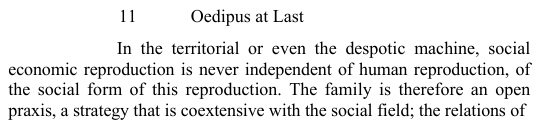
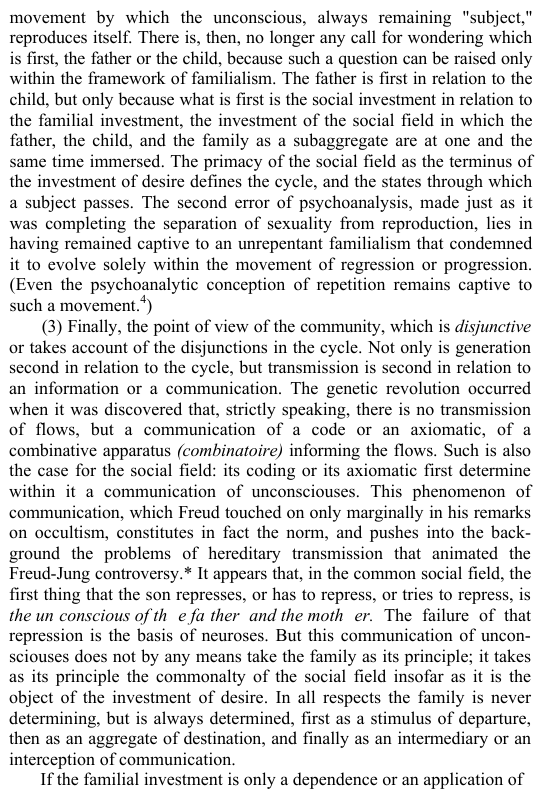
- It critiques the psychoanalytic focus on the Oedipus complex, arguing that social reproduction and libidinal investment precede familial structures.
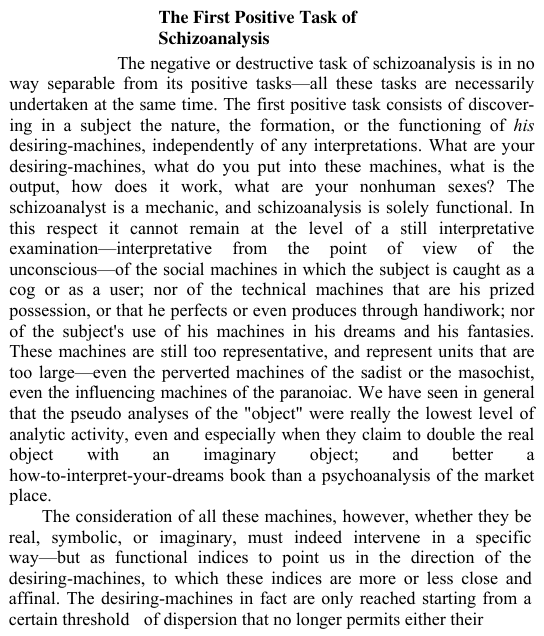
- Schizoanalysis is presented as a destructive task aimed at cleansing the unconscious of mythic, tragic, and structuralist representations.
- The unconscious is redefined as a molecular cycle of desiring-machines rather than a theater of lack or familial drama.
- The authors distinguish between preconscious class interests and unconscious libidinal investments that drive social and revolutionary movements.
The destructive task of schizoanalysis, cleansing the unconscious: a malevolent activity.
Foucault on Anti-Oedipus
- Michel Foucault describes the intellectual landscape of 1945-1965 as dominated by a strict adherence to Marx, Freud, and the signifier.
- The events of the late 1960s challenged these traditional models, moving toward political struggles and technologies of desire that no longer fit Marxist or Freudian prescriptions.
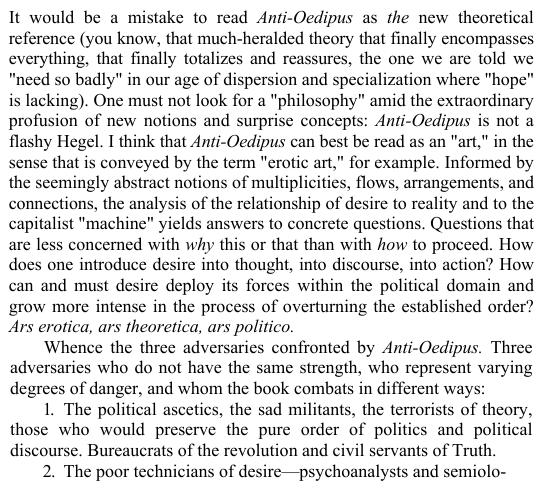
- Anti-Oedipus is presented not as a totalizing new philosophy or a 'flashy Hegel,' but as an 'art' comparable to an erotic art.
- The text focuses on the concrete 'how' of introducing desire into thought, discourse, and action to overturn the established order.
- Foucault identifies the book's primary task as exploring how desire can deploy its forces within the political domain to become more intense.
One had to be on familiar terms with Marx, not let one's dreams stray too far from Freud.
Introduction to Non-Fascist Life
- The text identifies three primary adversaries: political bureaucrats who prioritize theory over life, psychoanalysts who reduce desire to lack, and the internal fascism present in everyday behavior.
- Fascism is defined not just as a historical political movement, but as a psychological state that causes individuals to desire their own domination and exploitation.
- Anti-Oedipus is framed as a book of ethics that provides a guide for purging fascist tendencies from one's speech, actions, and pleasures.
- The author proposes a 'nomadic' approach to thought and action, favoring multiplicity, difference, and mobile arrangements over hierarchical systems.
- Militancy is reimagined as a joyful connection of desire to reality rather than a sad, ascetic adherence to totalizing political truths.
How do we ferret out the fascism that is ingrained in our behavior?
The Anti-Oedipal Revolution
- The text advocates for a political practice that intensifies thought rather than grounding it in fixed truths.
- It challenges the traditional concept of the individual, suggesting that the ego is a product of power that must be de-individualized.
- The authors seek to track down all forms of fascism, ranging from massive political structures to the petty tyrannies of everyday life.
- Psychoanalysis is critiqued as a modern church that traps individuals in a 'holy family' complex of daddy-mommy-me.
- The work is described as a sequel to Nietzsche's attack on Christianity, aiming to overturn the 'Oedipal rock' of human identity.
The traps of Anti-Oedipus are those of humor: so many invitations to let oneself be put out, to take one's leave of the text and slam the door shut.
The Desire for Repression
- The text critiques psychoanalysis as a 'well-constituted church' that offers a false sense of security through herd-like conformity.
- It revives Wilhelm Reich's question regarding how the masses can be manipulated into desiring their own repression and fascism.
- The author argues that fascism is not merely an external historical event but a internal psychological tendency rooted in 'ressentiment'.
- Deleuze and Guattari propose 'schizoanalysis' as a diagnostic cure for the sickness of traditional psychoanalytic treatment.
- The 'schizophrenic out for a walk' is presented as a healthier, more liberated model of existence than the neurotic on the analyst's couch.
The man who looks for security, even in the mind, is like a man who would chop off his limbs in order to have artificial ones which will give him no pain or trouble.
Schizoanalysis and the Economy of Flows
- Deleuze and Guattari introduce 'schizoanalysis' as a diagnostic and healing alternative to psychoanalysis, focusing on breakthroughs rather than neurosis.
- The text argues that a schizophrenic out for a walk is a more productive model for understanding desire than a neurotic on an analyst's couch.
- The authors reject the traditional separation of political economy and libidinal economy, proposing instead a single unified economy of flows.
- By staging a confrontation between Marx and Nietzsche, the book renders traditional psychoanalysis 'impossible' while refining Marxist theory for modern use.
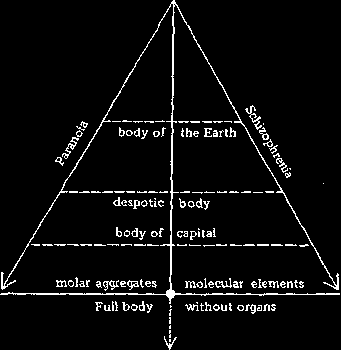
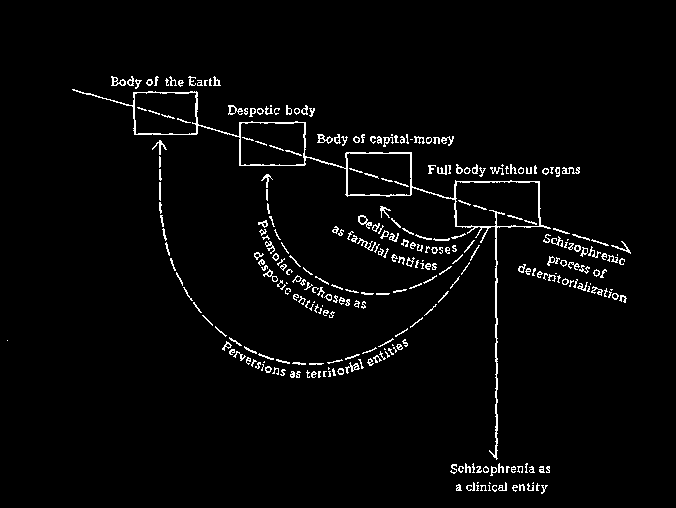
- The investigation explores a scale of intensity ranging from the 'body without organs' to the totalizing schizophrenic process of desire.
For, they affirm, 'a schizophrenic out for a walk is a better model than a neurotic lying on the analyst's couch. . . .'
The Strategical Machine
- Deleuze and Guattari synthesize Marx's theory of capital with Nietzsche's theory of affects to analyze both monetary and libidinal flows.
- The text argues that psychoanalysis fails by reducing social desire to the familial complex, whereas Nietzsche connects desire directly to the social field.
- Anti-Oedipus operates through a tension between philosophy and militancy, creating a strategical machine aimed at the 'fascist in each of us.'
- The authors employ an eclectic, non-academic style that treats ideas as points of intensity and signs pointing toward a new style of politics.
- By focusing on the nonhuman forces and desires within man, the work seeks to extend thought to the point of madness and action to the point of revolution.
Extending thought to the point of madness and action to the point of revolution, theirs is indeed a politics of experience.
Schizoanalysis and the Internal Colony
- Schizoanalysis is presented as a political tool that discards outdated elements of Marx and Freud to focus on the actual flow of human desire.
- The authors urge a rejection of anthropomorphic and existential frameworks to uncover the nonhuman forces and mutations within man.
- Oedipus is redefined not just as a psychological complex, but as a tool of state imperialism and an 'internal colony' used to subjugate individuals.
- The text argues that traditional social sciences function to tame people into docile subjects by projecting icons instead of perceiving raw power flows.
- Neurosis and depression are characterized as agencies of the State that teach individuals to perversely desire their own repression.
Oedipus is the figurehead of imperialism, 'colonization pursued by other means, it is the interior colony, and we shall see that even here at home ... it is our intimate colonial education.'
Schizoanalysis and Radical Desire
- Deleuze and Guattari explore how fascist beliefs take hold of the body and silence the productive machines of the libido.
- The text redefines the psychotic as one who is incapable of being 'oedipalized,' offering a model for shaking off the yoke of power.
- Schizoanalysis seeks to break the holds of power by instituting a new collective subjectivity that moves beyond the individual ego.
- A true revolutionary group must subordinate the forms of power to desiring-production rather than remaining a subjugated group.
- Theory is presented as a practical toolbox intended to produce tools that work for the construction of new social arrangements.
To be cured we must rise from our graves and throw off the cerements of the dead.
The Collective Anti-Oedipus
- Revolutionary action requires the rejection of exclusion and segregation, favoring the multiplication of new social connections and arrangements.
- Theory is redefined as a practical 'toolbox' or a set of 'tools for conviviality' that prioritize personal energy and control over professional expertise.
- The text argues that neurosis is a state of being bogged down in arrangements where escape is possible, suggesting that the only truly incurable state is the neurotic one.
- Ego-loss is presented not as a pathology but as a healing process that reconnects the individual with a primal, collective experience of existence.
- The 'anti-Oedipus' is a nonfascist subject that seeks to redeem humanity from nihilism through collective subjectivity rather than isolated madness.
For to be bogged down in arrangements from which escape is possible is to be neurotic, seeing an irresolvable crisis where alternatives in fact exist.
Desiring-Machines and Collective Militancy
- Deleuze and Guattari distinguish their 'anti-Oedipus' from Nietzsche's isolated superman by emphasizing collective action and social connection over madness.
- The authors argue that desire is not naturally focused on the family (Oedipus) but is forced into that mask by social repression to prevent its explosive potential.
- Desire is described as a productive force that, when unleashed, is capable of demolishing established social sectors and questioning the entire social order.
- The concept of 'desiring-production' views the body and nature as a series of interconnected machines, such as the breast-machine and the mouth-machine.
- Militancy is redefined as a process of making new connections and embracing the 'current of life' rather than worrying about traditional morality or justice.
It breathes, it heats, it eats. It shits and fucks. What a mistake to have ever said the id.
The Machine of Desire
- The human body is conceptualized as a collection of organ-machines coupled to external energy-machines through flows and interruptions.
- Schizophrenic experience is presented as a model of production that bypasses the traditional man-nature dichotomy.
- The text contrasts the social and familial constraints of the analyst's couch with the liberating 'stroll' of the schizophrenic in nature.
- Desiring-machines function as real productive forces rather than mere metaphors, dissolving the boundaries between self and non-self.
- The introduction of Oedipal structures is viewed as a form of repression that interrupts the fluid connections of the desiring-machine.
Judge Schreber has sunbeams in his ass.
Desiring-Machines and Oedipal Repression
- The text challenges the idea of the Oedipus complex as a natural given, arguing instead that it is a construct requiring the repression of 'desiring-machines.'
- Schizophrenia is presented not as a withdrawal from reality, but as an experience of nature as a continuous process of production.
- The authors use Beckettian imagery, such as the stone-sucking circuit, to illustrate how mechanical processes and bodily functions intersect.
- A distinction is made between the formal structures of industry and nature, suggesting that at a deeper level, they are part of the same productive process.
- The passage questions the utility of geometrical descriptions in understanding the actual function and effect of complex human and social machines.
Under the skin the body is an over-heated factory, and outside, the invalid shines, glows, from every burst pore.
The Process of Universal Production
- The authors challenge the traditional economic separation of production, distribution, and consumption, arguing these spheres are actually a single, unmediated process.
- Capitalist consciousness is described as a 'false consciousness' that imposes artificial distinctions upon what is essentially a continuous flow of production.
- Everything in existence—including passions, anxieties, and recording processes—is redefined as a form of production within a singular circuit.
- The distinction between man and nature is dissolved, viewing both as a unified 'industry' where the human is not a master but a component of a universal machine.
- The concept of 'process' is redefined to incorporate the act of recording and the act of consuming directly into the act of producing.
Not man as the king of creation, but rather as the being who is in intimate contact with the profound life of all forms or all types of beings, who is responsible for even the stars and animal life, and who ceaselessly plugs an organ-machine into an energy-machine, a tree into his body, a breast into his mouth, the sun into his asshole: the eternal custodian of the machines of the universe.
The Universe of Desiring-Machines
- Production and product are viewed as a single essential reality where the process of desiring-production transcends idealistic categories.
- Schizophrenia is defined not as a clinical entity but as the universal primary production of man and nature.
- Desiring-machines operate through binary associations where one machine produces a flow and another interrupts or draws from it.
- The process of production must be viewed as a movement toward completion rather than an infinite, destructive intensification.
- Every organ-machine interprets the entire world through the specific flux of its own energy and function.
Desire constantly couples continuous flows and partial objects that are by nature fragmentary and fragmented.
The Desiring-Machines
- Desire is conceptualized as a system of partial objects and flows where every machine is connected to another in a continuous cycle of production.
- Each organ-machine interprets the entire world through its own specific flux, such as the eye viewing all activities in terms of seeing.
- The process of production is described as being grafted onto the product, creating a 'production of production' that rejects idealist categories of expression.
- The schizophrenic object is defined by its process of production rather than as a static entity, illustrated by Henri Michaux's description of a non-functional, 'overstuffed' table.
- The schizophrenic is identified as the universal producer, where the distinction between the act of producing and the final product effectively disappears.
A table which lent itself to no function, self-protective, denying itself to service and communication alike.
The Schizophrenic as Universal Producer
- The schizophrenic is described as a universal producer where the distinction between the act of producing and the final product is entirely dissolved.
- The concept of bricolage is introduced to explain a mode of production that uses a hodgepodge of materials to continually rearrange fragments into new configurations.
- Desiring-machines operate on a rule of primary production, where the act of producing is grafted directly onto the product in a continuous cycle.
- The process involves a tension between the drive to produce and a counter-desire for a total standstill or an escape from the 'wheel of continual birth and rebirth.'
- The text argues that even young children hook their internal desiring-machines into the larger technical and social machines of the world.
Everything stops dead for a moment, everything freezes in place—and then the whole process will begin all over again.
The Body without Organs
- The concept of the 'bricoleur' is introduced as one who creates using a finite, heterogeneous set of tools and materials at hand rather than specialized equipment.
- Desiring-machines are characterized by their tendency to break down, and it is through this continuous breaking down that they actually function.
- The 'body without organs' represents a state of antiproduction, a sterile and unorganized mass that exists in tension with the productive organs of the organism.
- Desire is described as seeking both life through the working machine and death through the motor of the full, unorganized body.
- The body without organs is not a literal body or an image, but an imageless surface where production and antiproduction are coupled in a connective synthesis.
Desiring-machines work only when they break down, and by continually breaking down.
The Body without Organs
- The body without organs represents a state of antiproduction that exists in a tense, connective synthesis with desiring-machines.
- A fundamental conflict arises as the body without organs repels the 'organ-machines,' perceiving them as a persecutory apparatus of larvae and worms.
- To resist the articulated flows of production, the body without organs presents a smooth, opaque surface and emits unarticulated gasps and cries.
- Primary repression is redefined not as a psychological countercathexis, but as the physical repulsion of desiring-machines by the body without organs.
- The paranoiac machine emerges when the body without organs can no longer tolerate the intrusion of machines and begins to invest in agents of persecution.
The body is the body/it is all by itself/and has no need of organs/the body is never an organism/ organisms are the enemies of the body.
The Socius and Capital
- The authors establish a phenomenological parallel between desiring-production and social production to show how both involve a nonproductive element.
- The socius, whether as the earth, a tyrant, or capital, acts as a 'full body' that functions as a recording surface for all productive forces.
- This recording surface appropriates the entire process of production, making it appear as though the products emanate from the socius as a quasi cause.
- Capital functions as the 'body without organs' of the capitalist, transforming the sterility of money into a self-reproducing force of surplus value.
- Society constructs a 'true consciousness of a false movement' by perceiving the objective movement of production as it is recorded on this surface.
But a perverted, bewitched world quickly comes into being, as capital increasingly plays the role of a recording surface that falls back on all of production.
The Miraculating Body of Capital
- Capital functions as a recording surface that appropriates the productive forces of labor, making it appear as though production issues from capital itself.
- This process creates a 'bewitched world' where the true source of value is obscured by a fetishistic objective movement.
- The body without organs acts as an unproductive surface that attracts and appropriates desiring-production, mirroring the way capital appropriates labor.
- A transition occurs from the law of connective synthesis to a law of distribution, where machines attach themselves to a nonproductive element.
- The schizophrenic experience and political economy are linked through the way organs are 'miraculated' or regenerated on a recording surface.
Capital thus becomes a very mystic being since all of labour's social productive forces appear to be due to capital, rather than labour as such, and seem to issue from the womb of capital itself.
The Law of Recording
- The text describes a shift from the 'connective synthesis' of production to a 'disjunctive synthesis' of recording on the body without organs.
- Unlike traditional logic that demands a choice between terms, the schizophrenic 'either... or' represents a system of permutations where all differences slide across a slippery surface.
- Desiring-production energy, or libido, is partially transformed into 'Numen,' a divine energy that governs the inscription of these disjunctions.
- The concept of God is redefined not as a religious entity, but as the master of the disjunctive syllogism and the principle of division for all secondary realities.
- The schizophrenic body becomes a recording surface where minute permutations of movement and speech serve as a response to the world.
The 'either ... or . . . or' of the schizophrenic takes over from the 'and then': no matter what two organs are involved, the way in which they are attached to the body without organs must be such that all the disjunctive syntheses between the two amount to the same on the slippery surface.
Disjunctions and the Oedipal Trap
- The text redefines God as the master of the disjunctive syllogism, representing a divine energy of division rather than a personal deity.
- Freud is criticized for attempting to reduce the complex, decomposed elements of paranoia back into the condensed identifications of the Oedipal complex.
- The authors suggest that the Oedipus complex is not a natural stage of desire but a social requirement used to domesticate intractable genealogical forms.
- Schizophrenics are subjected to social interrogation—exemplified by Beckett's Molloy—where they are forced to translate their experiences into the code of family names.
- Psychoanalysis is portrayed as an extension of social control that insists on finding 'daddy' and 'mommy' behind every divine or psychotic vision.
Is it not more likely that Oedipus is a requirement or a consequence of social reproduction, insofar as this latter aims at domesticating a genealogical form and content that are in every way intractable?
Schizophrenic Resistance to Oedipus
- The schizophrenic resists the imposition of the Oedipal triangle by parodying its terms or expanding them into divine and complex forms.
- The body without organs acts as a site of self-production that rejects the notion of being a product of biological parents.
- Schizophrenic delirium utilizes a fluid recording code that deliberately scrambles social and genealogical categories to maintain autonomy.
- By shifting between different explanations and codes, the schizophrenic undermines the simplistic functions of the family model from within.
- The process of 'desimplification' allows the subject to identify as their own father, mother, and son simultaneously, breaking linear time.
The code of delirium or of desire proves to have an extraordinary fluidity.
Recording and the Residual Subject
- The body without organs remains a fluid, uncreated surface where agents of production and genealogical recordings swarm like fleas on a lion's mane.
- Recording acts as a middle stage between production and consumption, where a strange, wandering subject begins to emerge without a fixed identity.
- This subject is defined by the 'residual share' of pleasure it takes from the process, being reborn with each new state it consumes.
- Judge Schreber's case illustrates how the subject accepts small amounts of sensual pleasure as a compensation for the suffering required to satisfy a demanding God.
- Desiring-production transforms libido into different energies: Numen for recording and Voluptas for the energy of consummation.
The surface of this uncreated body swarms with them, as a lion's mane swarms with fleas.
The Celibate Machine
- The text describes the third synthesis of the unconscious, known as the conjunctive synthesis, which produces the subject as a residual effect of consumption.
- A transition occurs from the paranoiac machine of repulsion to a miraculating machine of attraction, eventually leading to a reconciliation between desiring-machines and the body without organs.
- Schreber's process of self-cure involves a 'becoming-woman' where he accepts a state of spiritual voluptuousness as a duty to provide God with enjoyment.
- The 'celibate machine' is introduced as a mechanism that forms a new alliance between machines and the body to birth a 'glorious organism' or a new humanity.
- The subject is produced alongside these machines, experiencing a moment of realization characterized by the wonderstruck exclamation: 'So that's what it was!'
I am sometimes to be found, standing before the mirror or elsewhere, with the upper portion of my body partly bared, and wearing sundry feminine adornments, such as ribbons, trumpery necklaces, and the like.
The Celibate Machine
- The celibate machine represents a shift from ancient paranoiac machines of torture toward a new, solar force of automatic pleasure.
- This machine achieves a genuine consummation or radiant ecstasy that liberates unlimited forces through an autoerotic mechanism.
- The primary output of the celibate machine is intensive quantities, which are experienced as pure, naked states of transition.
- These intensities precede hallucination and delirium, rooted in a primary 'I feel' that experiences becoming rather than fixed identity.
- All intensities are positive values measured against the zero intensity of the full body without organs.
A genuine consummation is achieved by the new machine, a pleasure that can rightly be called autoerotic, or rather automatic: the nuptial celebration of a new alliance, a new birth, a radiant ecstasy, as though the eroticism of the machine liberated other unlimited forces.
Intensities and the Schizoid Body
- Intensities arise from the dynamic opposition of attraction and repulsion, creating a series of positive states rather than a balanced equilibrium.
- The body without organs functions as an egg, marked by gradients, thresholds, and vectors that define the subject's becoming.
- Schizophrenic experience is described as a direct contact with the 'burning, living center of matter' rather than a withdrawal from reality.
- The text critiques psychiatry and psychoanalysis for reducing complex intensive experiences to 'dead things' or simplistic Oedipal narratives.
- Lived experience on the body without organs is non-representative; for example, the feeling of breasts is a zone of intensity rather than a literal hallucination.
One's entire soul flows into this emotion that makes the mind aware of the terribly disturbing sound of matter, and passes through its white-hot flame.
The Decentered Subject
- The text critiques psychoanalysis for reducing the complex intensive experiences of the subject to a narrow, 'dreary' obsession with parental figures and the Oedipal complex.
- The subject is described not as a central ego, but as a peripheral residuum or 'spare part' produced alongside the desiring-machine.
- Identity is presented as a series of fortuitous states or oscillations on the body without organs, rather than a fixed or stable self.
- The Nietzschean subject exemplifies this process by passing through various historical identities, claiming that 'every name in history is I.'
- The 'celibate machine' produces a series of intensive states that the subject consumes and is reborn from at every moment.
This subject itself is not at the center, which is occupied by the machine, but on the periphery, with no fixed identity, forever decentered, defined by the states through which it passes.
Nietzsche and Materialist Psychiatry
- The Nietzschean subject is redefined not as a stable ego, but as a series of states that identify with every name in history.
- The 'desiring-machine' occupies the center of the subject's experience, producing a euphoric reward through the Eternal Return.
- Schizophrenic experience is characterized by the consumption of universal history, transforming 'Homo natura' into 'Homo historia.'
- Psychiatrist G. de Clérambault’s theory suggests that global delirium is a secondary effect of local, mechanical automatisms.
- The text argues that mental automatism should be viewed as a process of economic production rather than a mere neurological malfunction.
The subject spreads itself out along the entire circumference of the circle, the center of which has been abandoned by the ego.
Materialist Psychiatry and Schizophrenic Resistance
- Clerambault is criticized for viewing automatism as a neurological mechanism rather than a productive process of desiring-machines.
- The traditional trinary schema of schizophrenia—dissociation, autism, and space-time—is rejected for tethering the disorder to the ego and the body image.
- A truly materialist psychiatry must introduce desire into the mechanism and production into desire, moving beyond spiritualist and positivist limits.
- The schizophrenic is described as having moved beyond the concept of the ego, viewing attempts to restore their 'I' as a form of clinical harassment.
- Freud's failure to understand schizophrenia is attributed to his 'Oedipal imperialism' and a personal dislike for those who resist being oedipalized.
All of which the schizo sums up by saying: they're fucking me over again.
The Productive Unconscious vs Oedipus
- The text critiques Freud's application of the Oedipus complex to schizophrenia, suggesting he viewed schizophrenics with a certain disdain for their resistance to being 'oedipalized.'
- Psychoanalysis originally discovered the unconscious as a site of desire production, but later replaced this 'factory' model with a 'classical theater' of representation and myth.
- By framing the unconscious through Oedipal idealism, the real relationship of production is lost in favor of symbolic interpretation and causal comprehension.
- Schizophrenia should be understood as a material process of desiring-machines rather than a static, terminal mental state or a specific 'essence' of a dissociated ego.
- The authors argue that focusing on the product rather than the process of production makes the schizophrenic appear as a distinct, isolated 'autist' in a void.
A classical theater was substituted for the unconscious as a factory; representation was substituted for the units of production of the unconscious.
Desire as Production
- The authors redefine schizophrenia not as a mental state of autism, but as a material process of producing desire and 'desiring-machines.'
- Karl Jaspers is credited with viewing the schizophrenic process as a 'demoniacal' intrusion, though he failed to link it to material economic reality.
- Traditional Platonic logic is criticized for defining desire as a 'lack' of an object, which relegates desire to the realm of acquisition and nihilism.
- Kant's attempt to link desire to the production of reality is dismissed as insufficient because it limits this productivity to psychic or hallucinatory fantasies.
- Psychoanalysis is accused of maintaining a dualism where real objects belong to social production while desire only produces imaginary doubles or 'theatrical' machines.
From the moment that we place desire on the side of acquisition, we make desire an idealistic (dialectical, nihilistic) conception, which causes us to look upon it as primarily a lack: a lack of an object, a lack of the real object.
Desire as Productive Reality
- Traditional psychoanalysis incorrectly defines desire as a 'lack' or an 'incurable insufficiency of being' that seeks a missing object.
- The authors argue that desire is not a mental fantasy but a process of 'industrial' production that engineers the real world.
- Desire and its object are functionally identical, operating as interconnected machines rather than separate entities of need.
- Lack is not the origin of desire but a social and natural counterproduct deposited within the reality that desire has already produced.
- The subject is not the master of desire but a 'nomad' residuum that emerges from the process of production.
Desire does not lack anything; it does not lack its object. It is, rather, the subject that is missing in desire, or desire that lacks a fixed subject; there is no fixed subject unless there is repression.
Desire and Social Lack
- Desire is defined as a productive force within the real rather than a psychological state based on lack or fantasy.
- Needs are not the foundation of desire but are instead counterproducts derived from it when desire is withdrawn from its objective conditions.
- Social production deliberately organizes and creates 'lack' as a mechanism of control, imposing it upon the productive forces of desire.
- True revolutionaries and visionaries embrace an objective existence where desire requires few possessions and focuses on the production of life itself.
- The phantasmal world of lack is a ball and chain tied to the past, whereas the future belongs to the conquest of the real through desire.
Lack (manque) is created, planned, and organized in and through social production.
The Production of Lack
- Lack is not a primordial human condition but is deliberately organized and counterproduced by the dominant class within social production.
- Market economies intentionally create wants and needs amid abundance to make desire subservient to the fear of scarcity.
- The text rejects the separation of social reality and individual fantasy, arguing that social production is simply desiring-production under specific conditions.
- Traditional parallels between Marxism and Psychoanalysis, such as the equation of money and excrement, are dismissed as sterile and insignificant.
- Libido directly invests in the social field without the need for psychic mediation, sublimation, or internal transformations.
To move forward clinging to the past is like dragging a ball and chain.
Desire and Social Production
- The authors argue that social production and desiring-production are identical, meaning the social field is immediately invested by libido without the need for sublimation.
- A central problem of political philosophy is why individuals fight for their own servitude and tolerate exploitation as if it were their salvation.
- Wilhelm Reich is credited with recognizing that the masses were not merely duped by fascism, but that at a specific point, they actually desired it.
- The text critiques Reich for ultimately failing to bridge the gap between rational social production and irrational desire, maintaining a dualism he should have collapsed.
- Desiring-machines are not merely mental fantasies or dreams; they are the same material reality as technical and social machines.
Why do men fight for their servitude as stubbornly as though it were their salvation?
Identity of Desiring-Production
- Desiring-production and social production are fundamentally the same process, meaning desire produces reality rather than existing in a separate psychic realm.
- Desiring-machines are not merely tools of fantasy or dreams; they are identical in nature to the technical and social machines that organize society.
- Fantasy is never an individual phenomenon but is always a group expression that derives from the intersection of desire and social institutions.
- The libido can either invest in repressive social structures or launch a revolutionary counterinvestment to de-institutionalize the current social field.
- Socialist Utopias function as group fantasies that act as agents of real productivity, allowing for the disinvestment of existing social regimes.
Desiring-machines are not fantasy-machines or dream-machines, which supposedly can be distinguished from technical and social machines.
Desiring-Machines and Social Production
- The authors argue that desiring-machines and technical social machines are fundamentally the same, differing only in their 'regime' or scale of operation.
- Technical machines are defined by a strict distinction between the means of production and the product, typically functioning until they wear out.
- In contrast, desiring-machines are characterized by their tendency to break down as they run, where the breakdown itself is a functional part of the process.
- Art serves as a medium for group fantasies that use desiring-production to short-circuit and undermine the reproductive functions of social technical machines.
- The artist acts as a master of broken objects, converting social products into desiring-machines through methods like critical paranoia or deliberate dysfunction.
Desiring-machines, on the contrary, continually break down as they run, and in fact run only when they are not functioning properly.
Desiring-Machines and the Socius
- Artistic works function as desiring-machines that utilize technical forms to undermine the rigid structures of technical machines.
- Technical machines serve as indices for specific social forms, such as the relationship between industrial machines and capitalism.
- Desiring-production and social production are fundamentally the same process governed by two distinct regimes of repression.
- The socius acts as a social machine designed to codify, record, and regulate the flows of desire to prevent them from escaping control.
- The body without organs is not a primordial entity but rather the ultimate residuum of a deterritorialized social machine.
The artist stores up his treasures so as to create an immediate explosion, and that is why, to his way of thinking, destructions can never take place as rapidly as they ought to.
Capitalism and the Schizophrenic Limit
- The social machine or 'socius' historically functions to codify, dam, and regulate the flows of human desire.
- Unlike primitive or despotic systems that overcode desire, capitalism is defined by the decoding and deterritorialization of these flows.
- Capitalism emerges from the encounter between decoded money-capital and the decoded labor of the 'free worker,' replacing social codes with an axiomatic of abstract quantities.
- Schizophrenia is identified as the characteristic malady of the capitalist era, representing the limit where social structures dissolve into a body without organs.
- The capitalist process of production generates an accumulation of schizophrenic energy that functions as both its primary raw material and its ultimate destructive tendency.
It tends, with all the strength at its command, to produce the schizo as the subject of the decoded flows on the body without organs—more capitalist than the capitalist and more proletarian than the proletariat.
Capitalism and Schizophrenic Production
- Capitalism is defined not just by a way of life but by a process of production that generates a massive accumulation of schizophrenic energy.
- The system operates through a 'law of counteracted tendency,' simultaneously decoding flows of desire while violently reterritorializing them into artificial structures.
- Modern institutions like the state, nation, and family serve as residual territorialities used to rechannel individuals who have been reduced to abstract quantities.
- The neurotic is defined as someone who collapses these artificial territorialities into the singular, reconstructed framework of the Oedipal complex.
- As the capitalist machine deterritorializes to extract surplus value, its bureaucratic and legal apparatuses work harder to absorb that value through social control.
Everything returns or recurs: States, nations, families. That is what makes the ideology of capitalism 'a motley painting of everything that has ever been believed.'
Desiring-Machines and Schizophrenic Limits
- The neurotic reduces all social territorialities to the singular, artificial structure of the Oedipal complex.
- The schizophrenic represents the ultimate limit of capitalism, acting as its inherent tendency brought to fulfillment and its 'exterminating angel.'
- Schizophrenia is defined as the point where desiring-production reaches the limit of social production, scrambling all established codes.
- Machines are defined not metaphorically but as systems of interruptions that cut into continuous material flows, such as the mouth cutting the flow of milk.
- Materialist psychiatry seeks to integrate the concept of production into the understanding of desire and its relationship to revolutionary machines.
He scrambles all the codes and is the transmitter of the decoded flows of desire.
The Law of Production
- Desiring-machines function like ham-slicing machines, creating interruptions or 'breaks' in an otherwise continuous associative flow.
- Every machine is defined by its connection to another machine, where one produces a flow and the next cuts into it to create a sample.
- The concept of 'hyle' represents the ideal continuity of matter that exists only because a machine has intervened to define its limits.
- The process of 'production of production' occurs when the interruption and the connection fuse into a single 'break-flow' from which desire wells up.
- The case of 'little Joey' illustrates how schizophrenic desiring-production requires being literally or figuratively plugged into mechanical systems to function.
Each associative flow must be seen as an ideal thing, an endless flux, flowing from something not unlike the immense thigh of a pig.
The Regime of Desiring-Production
- The text explores the case of 'little Joey' to illustrate how schizophrenic behavior manifests as a complex system of mechanical connections and desiring-machines.
- It argues that mechanical life in children is not an absence of desire but a specific investment of desire where breaking down is an integral part of the machine's functioning.
- The 'body without organs' acts as a site of counterproduction that frustrates or diverts the flow of production while remaining a part of the overall process.
- Every machine contains an internal code that dictates how bodily regions relate to one another and how various flows are interrupted or transmitted.
- The unconscious is described as a grid of disjunctions where organs can waver between functions, such as an anorectic mouth taking on the regime of another organ.
There are very few examples that cast as much light on the regime of desiring-production, and the way in which breaking down constitutes an integral part of the functioning.
The Polyvocal Chains of Desire
- The unconscious operates through a grid of disjunctions and signifying chains that function more like a jargon than a structured language.
- These chains are inscribed upon the 'body without organs,' which serves as an immaterial support for indifferent signs that follow no pre-ordained plan.
- The system is characterized by a 'real inorganization' where signs from different alphabets and images—like an elephant or a mustache—mix without exclusion.
- Each chain extracts surplus value from others, functioning like a Markov chain of aleatory phenomena rather than a linear, discursive narrative.
- The primary vocation of these signs is not to signify a specific meaning, but to engineer and produce desire in every direction.
No chain is homogeneous; all of them resemble, rather, a succession of characters from different alphabets in which an ideogram, a pictogram, a tiny image of an elephant passing by, or a rising sun may suddenly make its appearance.
The Code of Desire
- The Signifier acts as a mechanism that ceaselessly composes and decomposes chains of signs to engineer desire in every direction.
- A distinction is made between 'breaks as slicing off' related to continuous flows and 'breaks as detachment' (schizzes) related to heterogeneous chains.
- Desiring-machines utilize mobile, detachable segments likened to 'flying bricks' that contain inscriptions from different alphabets and heterogeneous elements.
- While a despotic Signifier attempts to linearize and immobilize these units into an imperial wall, the schizo works them loose to create a new polyvocity.
- The nervous system is described as a chronogeneous 'music box' machine that produces nonspatial melodies through the interaction of these fragmented paths.
We must conceive of each brick as having been launched from a distance and as being composed of heterogeneous elements: containing within it not only an inscription with signs from different alphabets, but also various figures, plus one or several straws, and perhaps a corpse.
The Subject as Residuum
- The nervous system is described as a chronogeneous machine, functioning like a music box that produces melody through nonspatial localization.
- The introduction of desire into neurology allows for a theory of bricks or blocks where components are detached and fragmented.
- A third type of break, the residual break, produces a subject that exists alongside the machine as a peripheral part without a fixed personal identity.
- This subject is born anew from each state it consumes, filling the body without organs in an instant through a process of self-engendering.
- The three modes of the desiring-machine—connective, disjunctive, and conjunctive—mobilize libido, Numen, and Voluptas as different forms of energy.
In this case, only after the subject has partitioned itself does it proceed to its parturition.
The Logic of Multiplicity
- Desiring-production operates through three distinct syntheses—connective, disjunctive, and conjunctive—which function as real material operations rather than metaphors.
- The process of desiring-machines is defined by productive breaks, failures, and hiatuses that prevent the formation of a traditional, unified whole.
- Modern thought has moved past the myth of a lost primordial totality or a future harmonious unity, embracing instead the concept of pure multiplicity.
- A whole may exist alongside its parts, but it functions as a separate, peripheral part added to the collection rather than a force that unifies or totalizes them.
- Literary works like those of Proust and Balzac exemplify this 'machine' logic, where fragments are related only by their sheer difference and lack of communication.
We live today in the age of partial objects, bricks that have been shattered to bits, and leftovers.
Proust and Schizoid Production
- Proust's literary work is described as a 'schizoid' machine composed of noncommunicating vessels and hermetically sealed boxes.
- The text argues that the apparent theme of guilt in Proust is merely a cover for a deeper, innocent madness found in fragmented universes.
- The 'Whole' is redefined not as a unifying totality, but as a separate part produced alongside other parts to establish aberrant paths of communication.
- This process of 'reweaving' intermittent fragments is compared to Joyce's concept of re-embodying and the biological mechanism of amino acid assembly.
- The body without organs functions as a surface for polyvocal inscriptions where the whole coexists contiguously with its partial objects.
It is a schizoid work par excellence: it is almost as though the author's guilt, his confessions of guilt are merely a sort of joke.
Partial Objects and Desiring-Machines
- The text argues that the relationship between parts and the whole is misunderstood by both mechanism and vitalism, failing to account for the production of desire.
- Melanie Klein is credited with discovering 'partial objects' but is criticized for viewing them as fantasies of consumption rather than real production.
- Klein's failure to grasp the logic of these objects stems from her insistence on relating them to an original or eventual 'complete Object' or global person.
- Partial objects are described as having an inherent power to dismantle the Oedipal framework and its claim to represent the unconscious.
- The author proposes an 'anoedipal' nature of desire that exists independently of developmental or structural relationships to the family triangle.
Melanie Klein was responsible for the marvelous discovery of partial objects, that world of explosions, rotations, vibrations.
The Terrorism of Oedipus
- The text argues that psychoanalysis forcibly imposes the Oedipal framework onto the naturally anoedipal production of desire.
- Even Melanie Klein, who worked with partial objects, is criticized for using them to miniaturize and extend Oedipus into the earliest stages of life.
- The clinical example of 'Dick' illustrates how analysts aggressively map parental symbols onto a child's mechanical and spatial interests.
- The authors contend that partial objects are not representations of family members but are components of 'desiring-machines' that exist prior to any familial structure.
- Psychoanalytic practice is described as a form of 'sheer terrorism' that replaces the exploration of desire with the enforcement of parental images.
The psychoanalyst no longer says to the patient: 'Tell me a little bit about your desiring-machines, won't you?' Instead he screams: 'Answer daddy-and-mommy when I speak to you!'
Desiring-Machines and Partial Objects
- The unconscious operates through partial objects and desiring-machines rather than recognizing whole persons or parental figures.
- The authors critique the Freudian tendency to reduce all childhood experiences and play to the Oedipal family structure.
- Jung's break with Freud is highlighted by his observation that patients often view analysts as gods or sorcerers rather than just parents.
- A child's interaction with the world, such as playing with a train or exploring a room, involves direct relations of production rather than symbolic representations.
- The libido is argued to invest directly in social and metaphysical fields without requiring the mediation of the family unit.
The train is not necessarily daddy, nor is the train station necessarily mommy.
Desiring-Machines and the Oedipal Trap
- The infant does not initially experience the mother's breast as a personal body part, but as a partial object within a nonpersonal desiring-machine.
- Psychoanalysis mistakenly forces the complex, nonfamilial experience of the child into the restrictive and narrow code of the Oedipal triangle.
- Parents function as special agents within a broader social field of production rather than being the primary source of the child's desire.
- The relationship between the child and the parent is a secondary 'inscription' or report of desire, rather than a natural productive relationship.
- The central problem of psychoanalysis is understanding the forces that cause the open social field of desire to close up into the familial Oedipal structure.
It exists, rather, as a part of a desiring-machine connected to the baby's mouth, and is experienced as an object providing a nonpersonal flow of milk, be it copious or scanty.
The Orphaned Unconscious
- The text argues that the child's metaphysical inquiries into existence are produced by desiring-machines rather than familial relationships.
- Psychological recording mistakenly ascribes the origins of desire to parents, whereas the process is actually independent of them.
- The authors claim that the unconscious is an 'orphan' that produces itself through the identity of nature and man.
- Confining childhood development to the Oedipus complex fails to account for the collective mechanisms and primal repression of the unconscious.
- Desiring-production begins in the earliest days of life through relations with partial objects and factors of antiproduction.
For the unconscious is an orphan, and produces itself within the identity of nature and man.
The Oedipal Yoke
- The text argues that desiring-production begins in the earliest days of life through relations with partial objects, long before the family structure is imposed.
- Psychoanalysis is criticized for trapping sexuality within a 'dirty little secret' of bourgeois motifs rather than viewing it as a productive factory of nature.
- By framing madness and desire through the lens of the parental complex, psychoanalysis reinforces nineteenth-century moralized discourses of guilt and responsibility.
- The authors contend that the Oedipal dogma serves as a tool for bourgeois repression, keeping humanity harnessed to the 'daddy-mommy' triangle.
- D.H. Lawrence's critique is highlighted as a defense of sexuality's true power against the restrictive, artificial theater of the psychoanalytic couch.
In Lawrence's case, at least, his reservations with regard to psychoanalysis did not stem from terror at having discovered what real sexuality was.
The Imperialism of Oedipus
- Psychoanalysis elevates Oedipus to a universal dogma by generalizing the familial triangle into a structural system of positions and functions.
- The theory expands to include a 'group Oedipus' that accounts for multiple generations, often blaming grandparents for the onset of psychosis.
- Structural interpretation transforms Oedipus into a 'universal Catholic symbol' that serves as a referential axis for all psychological phenomena.
- The authors argue that this structuralist approach still functions to repress 'desiring-production' by forcing every experience into an Oedipal orbit.
- Even when a subject like a schizophrenic shows no Oedipal link, the theory uses concepts like 'foreclosure' to reposition them within the complex.
Wouldn't the real difference be between Oedipus, structural as well as imaginary, and something else that all the Oedipuses crush and repress: desiring-production—the machines of desire?
Shattering the Oedipal Collar
- The authors challenge the psychoanalytic insistence on the Oedipus complex as a structural invariant for understanding the unconscious.
- They propose that 'desiring-production' exists as a Real force that is crushed and repressed by both imaginary and structural Oedipal frameworks.
- The text advocates for 'schizophrenizing' the unconscious to rediscover the machinic nature of desire beyond symbolic representation.
- A distinction is drawn between the unconscious as a representational theater and the unconscious as a factory that engineers and produces.
- The historical development of the Oedipus complex in Freud's work is noted as being surprisingly marginal and delayed in its theoretical generalization.
Wouldn't it be better to schizophrenize—to schizophrenize the domain of the unconscious as well as the sociohistorical domain, so as to shatter the iron collar of Oedipus and rediscover everywhere the force of desiring-production?
The Imperialism of Oedipus
- Freud's discovery of the Oedipus complex evolved from a marginal self-analysis in 1897 to a generalized theoretical sovereign by 1923.
- The authors argue that the rise of Oedipus led to the sacrifice of the 'productive unconscious' in favor of a mere 'expressive' one.
- Early psychoanalysis initially glimpsed a domain of free syntheses and 'desiring-machines' that connected psychic life directly to social production.
- The establishment of the Oedipus complex linearized the unconscious, replacing polyvocal connections with a 'despotic signifier' and a univocal impasse.
- By prioritizing representation over production, psychoanalysis reduced the unconscious to the structures of myth, tragedy, and the family unit.
The desiring-machines pound away and throb in the depths of the unconscious: Irma's injection, the Wolf Man's ticktock, Anna's coughing machine.
From Factory to Theater
- The text argues that Freud transformed the unconscious from a productive 'factory' or 'workshop' into a classical theater of representation.
- Freud is criticized for retreating from the 'wild production' of desire to impose a classical order based on Greek tragedy and the Oedipal myth.
- The author suggests that Freud's discovery of Oedipus was influenced more by his classical Goethian culture than by objective self-analysis.
- Psychoanalysis is compared to the Russian Revolution, suggesting a gradual betrayal of its original revolutionary potential regarding desiring-production.
- Desiring-machines are relegated to the 'wings' of the consulting room, where they are denied in favor of the 'daddy-mommy' familial triangle.
The unconscious ceases to be what it is—a factory, a workshop—to become a theater, a scene and its staging.
The Oedipalization of Desire
- Psychoanalysis forces the complex 'desiring-machines' of the unconscious into the narrow, restrictive frame of the Oedipal family scene.
- The clinical setting demands that patients abandon their external 'machines' and social realities to participate in a contractual exchange of speech for money.
- Introducing a physical third element, like a tape recorder, into a session shatters the psychoanalytic contract and exposes the analyst's reliance on authority.
- The analyst acts as an agent of 'antiproduction,' mirroring the logic of Capital by claiming all productive forces emanate from the parental complex.
- Freud's analysis of Judge Schreber illustrates the tension between a rich, divine delirium and the reductive paternal themes imposed by the practitioner.
Over the consulting-room door is written, 'Leave your desiring-machines at the door, give up your orphan and celibate machines, your tape recorder and your little bike, enter and allow yourself to be oedipalized.'
The Posthumous Oedipalization of Schreber
- The text critiques how psychoanalysis reduces complex deliriums to a monotonous repetition of the father figure.
- Freud justifies the constant presence of the father in analysis by claiming it is a result of sexuality's inherent symbolism.
- The authors argue that Freud ignores the vast political and social content of Judge Schreber's delirium to focus solely on the familial complex.
- By measuring the unconscious against myth and religion, psychoanalysis substitutes expressive forms for actual productive formations.
- The agreement between Freud and Jung persists in their shared assumption that the unconscious is adequately expressed through mythological models.
It should be noted that Judge Schreber's destiny was not merely that of being sodomized, while still alive, by the rays from heaven, but also that of being posthumously oedipalized by Freud.
The Religious Unconscious and Oedipus
- The text argues that both Freud and Jung inject religious structures into the unconscious by using myth as a model for psychic production.
- While Freud maintains a heroic atheism, his followers eventually reconciled psychoanalysis with religious institutions and 'pious' sentiments.
- True liberation requires reaching a state of 'autoproduction' where the unconscious is immediately atheist and orphan, needing no mediation from myth.
- The 'imperialism of Oedipus' is often founded on an absence, where the father figure is a construction of analysis rather than a conscious reality.
- By tethering sexuality to the familial complex, Freud limits desire's ability to invest directly in social and metaphysical relations.
But to render religion unconscious, or the unconscious religious, still amounts to injecting something religious into the unconscious.
The Imperialism of Oedipus
- Freud reduces the group character of fantasies to a purely individual dimension by insisting that all figures are substitutes for the subject or the father.
- The central 'paternal' phase of the beating fantasy is described as a necessary analytical construction that has never actually existed in consciousness.
- Psychoanalysis uses the concept of castration to distribute a 'lack' across two asymmetrical series, forcing a choice between being a boy or a girl.
- The ultimate goal of this Freudian framework is to teach resignation to the Oedipal structure and the 'assumption of one's sex.'
- The Phallus serves as a transcendent commonality that establishes exclusive disjunctions within the unconscious.
It is a construction of analysis, but it is no less a necessity on that account.
The Fallacy of Castration
- Freud identifies the core of psychological resistance as the female envy for the penis and the male struggle against a passive attitude toward other men.
- The text argues that the 'Phallus' is a mythical construct of negative theology that introduces a false sense of lack into the nature of human desire.
- Contrary to Freud's focus on deprivation, the authors propose a model of partial objects where nothing is lacking and disjunctions are inclusive rather than exclusive.
- The concept of bisexuality is presented as a missed opportunity for Freud to move beyond the binary of castration and the fixed ego.
- Castration is described not as a psychological reality but as a practical operation performed by psychoanalysis to 'castrate the unconscious' itself.
Castration designates the operation by which psychoanalysis castrates the unconscious, injects castration into the unconscious.
Castration and the Unconscious
- The subject is defined not as an ego but as a drive forming a desiring-machine that connects with other partial objects.
- Psychoanalysis is accused of performing a practical operation that injects the concept of castration into a productive unconscious.
- The unconscious is described as being entirely ignorant of Oedipus, parents, gods, laws, or the concept of lack.
- The text questions how the unconscious is transformed from a productive force into a passive vessel for beliefs that align with the established social order.
- Group fantasies like 'a child is being beaten' are analyzed as products of a social desiring-machine rather than isolated ego-driven family dramas.
- The authors argue that individual desire invests directly into the social field and its repressive forms through complex gendered and masochistic montages.
We must speak of "castration" in the same way we speak of oedipalization, whose crowning moment it is: castration designates the operation by which psychoanalysis castrates the unconscious, injects castration into the unconscious.
Group Fantasy and the Socius
- The text critiques traditional psychoanalysis for reducing complex social desires and libidinal investments to simple familial determinations like the Oedipal triangle.
- Individual fantasy is described as an imaginary mechanism that confers immortality onto social institutions, allowing the ego to resign itself to repression and death.
- Group fantasy is distinguished by its direct connection to the real symbolic articulations of the social field rather than imaginary familial substitutes.
- A revolutionary group fantasy is defined by the capacity to view institutions as mortal and changeable, turning the death instinct into institutional creativity.
- The authors argue that social figures like the colonel or the instructor are not merely father-substitutes but are collective agents directly invested by the libido.
The terms of Oedipus do not form a triangle, but exist shattered into all corners of the social field—the mother on the instructor's knees, the father next to the colonel.
Revolutionary Group Fantasy
- The revolutionary pole of group fantasy is defined by the power to experience institutions as mortal and subject to change through desire.
- Individual fantasy is centered on an ego determined by legal institutions, whereas group fantasy is driven by the desiring-machines themselves.
- In group fantasy, subjects are discharged of personal identity but retain their singularities, communicating through partial objects on the body without organs.
- Social production and relations of production are fundamentally institutions of desire, with affects and drives forming part of the economic infrastructure.
- The distinction between subject-groups and subjugated groups reveals that individual fantasy is an imaginary structure imposed by the law.
As Nietzsche says; churches, armies, States—which of all these dogs wants to die?
Subjugated Groups and Psychoanalytic Debt
- The text distinguishes between subject-groups and subjugated groups, noting that Freudian analysis often flattens revolutionary group potential into individual fantasies.
- By reducing social figures like teachers and colonels to familial roles like 'daddy,' psychoanalysis forces the libido to internalize the Oedipal structure.
- The author critiques the psychoanalytic relationship as a bourgeois contract that fosters abject dependence and an inexhaustible debt through transference.
- Institutional analysis is presented as a path to escape the repressive structures of both traditional hospitals and contractual psychoanalysis.
- Freud's later work is examined for its concrete struggle with whether the analytic process can ever truly be terminated or if it is condemned to self-perpetuation.
How can we ward off, in the practice of the cure, this abject desire that makes us bend our knees, lays us on the couch, and makes us remain there?
The Interminable Problem of Analysis
- Freud’s final works reflect a disenchanted serenity as he questions whether the process of psychoanalysis can ever truly be terminated or completed.
- The text identifies the 'rock of castration' and qualitative libidinal oppositions as primary obstacles that prevent the successful exhaustion of psychic conflicts.
- A significant resistance to treatment arises from the 'viscosity' or 'liquidity' of a subject's libido, which prevents the analytic process from taking hold.
- André Green categorizes analytic sessions into types where the patient's discourse either becomes a 'leaden' descriptive narration or a 'torrential' flow that slides off without consequence.
- These qualitative factors in the desiring-economy suggest that the ego's 'pact' with the analyst is often undermined by forces that outweigh simple quantitative dynamics.
It would seem that certain subjects have such a viscous libido, or on the contrary such a liquid one, that nothing succeeds in 'taking hold.'
The Limits of Oedipalization
- The text distinguishes between volatile transference, where language is rapid but inconsequential, and a 'good' analysis where meaning is retrospectively anchored in a chain of signifiers.
- Freud is criticized for viewing patient resistance as an obstacle to the cure rather than a shortcoming of the psychoanalytic method itself.
- The authors argue that castration and Oedipal conflict are not inherent states but are effects precipitated and accentuated by the artificial conditions of the treatment.
- Desiring-production is described as an intense outcry or flow that resists being plugged by the 'Oedipal wad' or the category of the phallus.
- The 'cure' is framed as a reductive process where complex personal histories are crushed into a singular, simplified meaning centered on Oedipus and castration.
Against the walls of the triangle, toward the outside, flows exert the irresistible pressure of lava or the invincible oozing of water.
Oedipalization vs Desiring-Production
- The text critiques the reduction of all human experience and history to the narrow frameworks of Oedipus and castration.
- Psychoanalysis is accused of neuroticizing individuals by forcing their desires into familial structures rather than allowing for 'schizophrenization.'
- The authors argue that we are all composed of deterritorialized flows and 'schizoid' libidos that exceed the boundaries of the nuclear family.
- Using Proust as an example, the text suggests that contradictions in desire are actually degrees of humor and intensity rather than psychological failings.
- The fundamental problem is identified as the 'cure' itself, which interrupts the productive process of desire to install a sense of guilt.
But in any case the harm has been done, the treatment has chosen the path of oedipalization, all cluttered with refuse, instead of the schizophrenization that must cure us of the cure.
Proust and Schizophrenic Multiplicity
- The narrator in Proust's work functions as a 'body without organs' or a spider in a web, reacting to signs and vibrations rather than observing objects.
- Perception moves from molar statistical wholes, like a group of girls, toward a molecular breakdown where faces and bodies shatter into partial objects.
- The artist is described as one who scales the 'schizophrenic wall' to reach a land of the unknown, transcending time and social milieu.
- The text reinterprets sexuality through a vegetal theme of innocence, where bisexuality is a partitioned multiplicity of noncommunicating parts.
- Guilt is erased at the level of elementary combinations where male and female parts of different individuals enter into transversal, aberrant communications.
If schizophrenia is the universal, the great artist is indeed the one who scales the schizophrenic wall and reaches the land of the unknown, where he no longer belongs to any time, any milieu, any school.
Transverse Communications and Oedipal Triangulation
- The text proposes a model of desire based on transverse communications between partial objects and flows rather than fixed identities.
- It distinguishes between a molar, exclusive sexuality and a molecular, transsexual state where differences coexist without exclusion.
- Proust's work is used to illustrate a non-Oedipal homosexuality that includes women through complex, non-specific roles and localizations.
- The author argues that global persons and the ego are not pre-existing entities but are constructed through the prohibitions of the Oedipal triangulation.
- Desire is simultaneously given its first complete objects and forbidden from them by the same social and psychological operations.
In reality, global persons—even the very form of persons—do not exist prior to the prohibitions that weigh on them and constitute them.
The Oedipal Displacement
- The text argues that individual persons do not exist prior to the prohibitions that constitute them, meaning desire and its forbidden objects are created simultaneously.
- The Oedipal operation functions by differentiating persons through prohibition, while failure to differentiate results in 'undifferentiated' states like incest or homosexuality.
- Prohibition evolves from a negative form regarding the mother to a positive form regarding the sister, which mandates social exchange and the alliance with a spouse.
- This transition ensures the reproduction of the Oedipal triangle, as the individual takes a wife to form a new triangle rather than remaining 'incestuous, homosexual, and a zombie.'
- The regime of pairing people replaces the connection of partial objects, transforming sexual organs into legal possessions within the framework of marriage and familial reproduction.
Kant draws upon centuries of Roman juridical reflection when he defines marriage as the tie that makes a person the owner of the sexual organs of another person.
Desire and the Oedipal Triangle
- The text contrasts the 'regime of pairing' and legal ownership of sexual organs with the fluid, non-proprietary nature of desiring-production.
- Desire is described as a process that machines partial objects and flows on a body without organs, effectively destroying the unity of the possessive ego.
- Triangulation occurs when parental and conjugal uses of desire introduce a transcendent 'lack' that forces desire into a specific, restricted mold.
- Psychoanalysis is criticized for extrapolating a universal 'something'—the phallus or the law—to impose an exclusive direction on the disjunction of the sexes.
- The 'Oedipus formula' is defined as 3 + 1, where a single transcendent signifier acts as the formal cause that creates and reproduces the familial triangle.
The only subject is desire itself on the body without organs, inasmuch as it machines partial objects and flows, selecting and cutting the one with the other, passing from one body to another, following connections and appropriations that each time destroy the factitious unity of a possessive or proprietary ego.
The Despotic Oedipal Signifier
- The Oedipus complex functions through a 3+1 formula where a transcendent phallus acts as a despotic signifier to triangulate all desire.
- This process involves a 'crushing operation' that extracts a detached object from the non-signifying chain of partial objects to impose a law of lack.
- Just as money is converted into capital in a capitalist code, the libido is converted into the phallus to recast all previous history in the light of castration.
- The authors argue that psychoanalysis reinforces a basic illusion by subjecting desiring-production to higher social and cultural laws.
- By surmounting the 'pre-oedipal' stage, psychoanalysis forces an integration that strips partial objects of their original virulence and efficacy.
It is as if the so-called signifying chain, made up of elements that are themselves nonsignifying—of polyvocal writing and detachable fragments—were the object of a special treatment, a crushing operation that extracted a detached object from the chain.
The Critique of Oedipal Metaphysics
- Psychoanalysis functions as a conversion mechanism that forces the unconscious into an Oedipal framework, treating pre-oedipal stages as mere precursors to structural integration.
- The authors propose the existence of an 'anoedipal' sexuality where desiring-production is not projected onto mythical locales or specific qualitative oppositions.
- Drawing a parallel to Kantian philosophy, the text argues that psychoanalysis employs a 'transcendent' use of syntheses that constitutes its own form of metaphysics.
- Schizoanalysis is introduced as a materialist critique intended to rediscover a transcendental unconscious defined by immanent rather than imposed criteria.
- The Oedipal triangle imposes a restrictive 'either/or' logic on the individual, forcing rigid identities regarding gender, family roles, and even the state of being alive or dead.
Everywhere, in this reversion, the innocence of flowers instead of the guilt of conversion.
The Disjunctive Synthesis of Oedipus
- The Oedipal structure functions as a restrictive 'either/or' mechanism that differentiates the ego based on generation, sex, and vital state.
- Neuroses such as phobia, obsession, and hysteria are framed as failures to maintain these rigid boundaries between parent/child, dead/alive, or man/woman.
- Psychoanalysis traditionally enforces an exclusive use of the disjunctive synthesis, demanding that individuals stay within their assigned coordinates.
- Schizophrenia offers an alternative 'inclusive' disjunction where the subject affirms both sides of a divide without being restricted by one or the other.
- Unlike the Oedipal ego, the schizophrenic exists at both terminal points of a distance, moving between identities like man and woman or dead and alive.
Commit incest and you'll be a zombie and a hermaphrodite.
The Schizophrenic Inclusive Disjunction
- The schizophrenic experience replaces restrictive, exclusive disjunctions with an affirmative use of difference.
- Rather than synthesizing contradictions into a single identity, the subject affirms the distance between opposing states like life and death.
- This process transforms the individual into a 'transpositional subject' who occupies multiple singularities simultaneously.
- The schizophrenic God is contrasted with the religious God, acting as a 'prince of modifications' who drifts through all possible predicates.
- The breakdown of the 'closed box' of the self liberates a space where persons are replaced by evanescent agents of production.
I was then no longer this closed box to which I owed being so well preserved, but a partition came crashing down.
The Inclusive Disjunction
- The text explores a 'generalized drift' where the subject passes through all possible predicates, such as being God, a bird, or both husband and wife.
- Schizophrenic experience utilizes an inclusive disjunction that affirms all terms simultaneously rather than forcing a choice between them.
- Psychoanalysis is criticized for imposing 'Oedipalization,' which forces exclusive alternatives and restricts the unconscious to familial roles.
- The body without organs serves as the surface where all intensities and genealogical materials are recorded without being subordinated to global persons.
- The author argues that the 'madman' explodes traditional genealogy by navigating a disjunctive network that spans indivisible distances.
I am the letter and the pen and the paper. It was in this fashion that Nijinsky kept his diary: yes, I was my father and I was my son.
The Oedipal Double Bind
- The Oedipus complex functions by simultaneously creating parental differentiations and threatening the subject with the undifferentiated state it just invented.
- Desire is forced into a triangular structure where it is prohibited from satisfying itself with the very objects it is commanded to recognize.
- Psychoanalytic resolution of Oedipus is described as a trap where the subject internalizes authority only to rediscover it in the social sphere.
- The authors argue that Oedipus acts as a ligature that cuts off desiring-production, crushing the unconscious and replacing its fluidity with restrictive disjunctions.
- The situation is framed as a 'double bind' where every exit is blocked, forcing the subject to either internalize the triangle or fall into neurotic identification.
Oedipus is like the labyrinth, you only get out by re-entering it—or by making someone else enter it.
The Oedipal Double Impasse
- The authors redefine Bateson's 'double bind' as the fundamental structure of the Oedipal complex, creating a situation where both neurosis and normality are blocked paths.
- Schizophrenia is presented not as a failure of development, but as a desperate withdrawal to the 'body without organs' to escape the impossible choices of the Oedipal series.
- Freud's concept of 'latency' is criticized as a psychoanalytic mystification that merely masks the transition between murderous identification and the restoration of paternal authority.
- Modern industrial society is viewed as a 'society without the father' that paradoxically seeks new, anonymous ways to restore equivalent forms of social repression.
- Psychoanalysis is accused of collaborating with social repression by calling upon the asylum or the police to handle those who refuse to be oedipalized.
The police on our side!—never did psychoanalysis better display its taste for supporting the movement of social repression, and for participating in it with enthusiasm.
The Oedipal Dragnet
- The authors argue that psychoanalysis acts as a tool for social repression, using the police or asylums to enforce the Oedipal structure on those who resist it.
- Oedipus is described as a useless myth that serves only to tie off the unconscious and trap individuals between familial and social authority.
- While Freud opened the possibility of living beyond the father's law, psychoanalysis has paradoxically reinforced that law rather than achieving liberation.
- Schizoanalysis aims to 'de-oedipalize' the unconscious, reaching a state where the problem of Oedipus can no longer even be raised.
- The text suggests an internal reversal is possible, turning the analytic machine into a vital component of revolutionary machinery.
Oedipus is one of those things that becomes all the more dangerous the less people believe in it; then the cops are there to replace the high priests.
The Double Impasse of Oedipus
- The Oedipus complex operates between two poles: an imaginary pole of identification and a symbolic pole of structural differentiation.
- Replacing parental figures with symbolic 'functions' merely universalizes Oedipus and fuses desire more tightly to law and prohibition.
- The authors argue that Oedipus-as-structure is essentially the Christian Trinity, while Oedipus-as-crisis is a familial version lacking faith.
- The distinction between the Imaginary and the Symbolic is presented as a 'double pincer action' that crushes the unconscious in a perpetual pendulum swing.
- True difference is found not in these psychological structures, but in the 'real machinic element' that exists outside the Oedipal disjunction.
A double pincer action that crushes the unconscious caught in its exclusive disjunction.
Desiring-Production vs. Oedipal Myth
- The text argues that the primary conflict is not between the Imaginary and the Symbolic, but between the real machinic element of desiring-production and the structural whole of the Oedipal myth.
- Oedipus is described as a 'double pincer action' that crushes the unconscious through exclusive disjunctions, regardless of whether it uses imaginary figures or symbolic functions.
- The authors critique the second generation of Lacanian disciples for re-oedipalizing the subject and reintroducing 'lack' into the series of desire through a despotic signifier.
- The 'body without organs' is redefined as an egg-like intensive field traversed by potentials and thresholds, suggesting a biochemical rather than purely psychological basis for schizophrenia.
- A distinction is made between the 'anoedipal' use of inclusive disjunctions and the restrictive, segregating nature of the Oedipal structure.
A double pincer action that crushes the unconscious caught in its exclusive disjunction.
The Intensive Order of Schizophrenia
- Schizophrenia is described as a biochemical and transcendental voyage of initiation involving the loss of the Ego and the navigation of pure intensities.
- The body without organs serves as a field of potentials where the subject undergoes morphogenetic movements, migrations, and displacements.
- Delirium is characterized by a commingling of historical and geographical identities, where the subject 'becomes' various races, gods, and historical figures.
- This process is not a representation of external reality but an intensive order where races and cultures designate specific zones of intensity on the body.
- The authors argue that all delirium is fundamentally racial and historical, involving a proliferation of identities that transcends individual or familial limits.
I am becoming God, I am becoming woman, I was Joan of Arc and I am Heliogabalus and the Great Mongol, I am a Chinaman, a redskin, a Templar, I was my father and I was my son.
Delirium and Universal History
- The schizophrenic experience is not a withdrawal from reality but an active participation in universal history through racial and cultural delirium.
- Races and cultures are redefined as zones of intensity and fields of potential on the 'body without organs' rather than representational categories.
- Individual identity is replaced by a process of constant migration across thresholds, where one becomes other sexes, races, and historical figures.
- Proper names function not as markers of a stable ego, but as designations for specific intensive states and historical forces within a production of quantities.
- The delirium of figures like Artaud, Rimbaud, and Nietzsche demonstrates a rejection of the family unit in favor of identifying with the entirety of history.
The unpleasant thing, and one that nags at my modesty, is that at root every name in history is I.
The Schizophrenic Production of Reality
- Proper names in history and physics function as 'effects' that designate the occupation of intensive fields rather than representing individual egos.
- The schizophrenic body without organs acts as a desert or indivisible distance over which the subject glides to connect with everything real.
- Reality is redefined not as a principle of abstract quantity, but as a product that envelops intensive distances and changing forms.
- Simulation is presented as a polyvocal form of writing that carries the real beyond mere representation until the copy becomes the Real itself.
- The schizophrenic 'histrionism' involves a total identification with all the triumphs and pogroms of history as a surplus of reality.
The point where the copy ceases to be a copy in order to become the Real and its artifice.
The Schizophrenic Production of Reality
- The schizophrenic experience is described not as a loss of contact with life, but as an intense proximity to the 'beating heart' of reality and its production.
- Schizophrenic 'histrionism' involves a polyvocal engagement with history, where the individual assumes the identities of various historical figures as intensive states.
- The text argues that the schizophrenic does not identify with a single person, but rather traverses a series of singularities and states within a disjunctive network.
- The 'residual subject' or ego is merely a byproduct of these oscillations through different states, rather than a central organizing force.
- Delirium is framed as having a world-historical and political character, rather than being confined to personal or familial neuroses.
With respect to their experiencing of life, the neurotic patient and the perverted individual are to the schizophrenic as the petty thief is to the daring safecracker.
Delirium and the Historical Subject
- The subject of delirium is a residual effect of oscillations that sweeps across historical, political, and racial identities.
- Delirium is not a derivative of the Oedipal family structure but contains a world-historical content that explodes familial boundaries.
- Traditional psychoanalysis is criticized for squashing the vast socio-political content of madness into the narrow triangle of father, mother, and child.
- Judge Schreber's memoirs illustrate how a patient's identity shifts through racial and national thresholds, such as becoming a Mongol prince or a girl defending Alsace.
- The text argues that historical signifiers and racial masses are primary threads of latency rather than mere substitutes for the 'name of the father'.
All delirium possesses a world-historical, political, and racial content, mixing and sweeping along races, cultures, continents, and kingdoms; some wonder whether this long drift merely constitutes a derivative of Oedipus.
The Forced Oedipalization of Delirium
- The text criticizes psychoanalysis for reducing complex historical and political delusions into the narrow framework of the Oedipal family structure.
- Maud Mannoni’s case study of a patient from Martinique illustrates how a delirium involving the Algerian War and racial identity is interpreted as a paternal lack.
- Lacanian concepts like foreclosure are used to argue that political revolt in psychosis stems from a symbolic void regarding the name of the father.
- The authors contend that this approach flings the subject between imaginary maternal identifications and symbolic paternal lack, ignoring the real social content.
- The central question is whether familial structures truly serve as the primary symbolic organizer for the vast historical themes present in schizophrenia.
Not one trace of it remains; everything is ground, squashed, triangulated into Oedipus; everything is reduced to the father.
Oedipus as Inductor
- The text challenges the psychoanalytic view that the Oedipal triangle acts as a symbolic organizer for the schizophrenic experience.
- Schizophrenia is framed not as a lack of Oedipal structure, but as a resistance to the repressive process of being 'oedipalized' by society and analysts.
- Using a biological analogy, the authors argue that parental figures are merely 'inductors' or stimuli rather than the true architects of a person's development.
- The schizophrenic's refusal to be 'cured' is interpreted as a refusal to submit to the familial and social masks that psychoanalysis attempts to impose.
- The nature of the stimulus is ultimately indifferent, as the underlying processes of the 'schizophrenic egg' possess their own specific potentials for development.
Is the schizophrenic sick and cut off from reality because he lacks Oedipus, because he 'is lacking' in something only to be found in Oedipus—or on the contrary is he sick by virtue of the oedipalization he is unable to bear?
The Incurable Familialism of Psychoanalysis
- The text argues that parental figures act merely as indifferent inductors or stimuli rather than the true organizers of the unconscious.
- While psychoanalysis recognizes that real parents are not the active factors, it fails by replacing them with symbolic or structural family matrices.
- By shifting the focus from real parents to the 'Symbolic' or 'Name-of-the-Father,' psychoanalysis renders the family transcendent rather than moving beyond it.
- This 'familialism' effectively crushes desiring-production by forcing the unconscious to operate within the narrow confines of the Oedipal complex.
- The author aligns with Foucault's view that psychoanalysis completes the asylum's project of linking madness to the bourgeois family structure.
There we have it—the incurable familialism of psychoanalysis, enclosing the unconscious within Oedipus, cutting off all vital flows, crushing desiring-production, conditioning the patient to respond daddy-mommy, and to always consume daddy-mommy.
The Psychoanalytic Family Complex
- The text argues that psychoanalysis perfected the nineteenth-century asylum's goal of fusing madness with a parental complex.
- By establishing the doctor as a figure of Father and Judge, psychoanalysis traps the patient in a cycle where alienation and disalienation both lead back to Oedipus.
- Freudian theory internalizes the family within the patient, while later studies of schizophrenia expanded this triangulation to the entire extended family structure.
- The author critiques psychoanalysis for being unable to truly hear the 'voices of unreason' because it remains anchored to the doctor as an alienating authority figure.
- Various psychotic family structures are identified, including fusionist, divisive, and tubular models that multiply the Oedipal triangle endlessly.
Psychoanalysis can unravel some of the forms of madness; it remains a stranger to the sovereign enterprise of unreason.
Psychoanalysis and Extended Familialism
- Foucault argues that Freud did not liberate the patient from the asylum's power structures but instead concentrated those powers within the figure of the doctor.
- Psychoanalysis remains unable to truly hear the 'voices of unreason' because it preserves the doctor as an alienating figure of authority.
- The concept of 'extended familialism' suggests that psychosis is fabricated across multiple generations, often involving a 'holy trinity' of grandparents, parents, and children.
- Modern therapeutic movements often regress into a taxonomy of families, merely shifting the site of alienation from the hospital back to the familial institution.
- Even progressive sectors of antipsychiatry face the danger of falling into the 'Oedipal apparatus' by creating therapeutic quasi-families.
He did deliver the patient from the existence of the asylum within which his 'liberators' had alienated him; but he did not deliver him from what was essential in this existence.
The Trap of Familialism
- The authors argue that even revolutionary psychiatry often fails by recreating 'artificial families' that remain trapped in an Oedipal framework.
- They critique the tendency to treat the family as a microcosm or matrix that mediates social reality, effectively suppressing the true nature of desiring-production.
- The text suggests that reducing a patient's delusions—such as being controlled by outer space—to mere breakfast-table family dynamics is a form of reductionism.
- By focusing on the family as the primary site of alienation, psychiatrists risk ignoring the broader political, cultural, and world-historical forces at play.
- The authors advocate for breaking away from the 'holy trinity' of the family to prevent the suffocation of the problems inherent in desiring-production.
These metaphysical men from outer space are the literal mother, father, and sibling who sit around the breakfast table with the so-called psychotic patient.
The Exploded Oedipal Triangle
- Bergson's philosophy shifts the view of living organisms from closed systems to open entities that develop within an irreducible temporal dimension.
- The authors argue that the Oedipal triangle is not a closed family unit but is always open to the broader social and historical field.
- Desire and the unconscious are shaped by external agents such as missionaries, tax collectors, and colonizers rather than just parental figures.
- Frantz Fanon’s work demonstrates that psychological trauma in colonized subjects is rooted in political violence rather than abstract familial guilt.
- The 'normal' Oedipal complex is a bourgeois construct that fails to account for the social flows and historical battlefields that define the unconscious.
It is strange that we had to wait for the dreams of colonized peoples in order to see that, on the vertices of the pseudo triangle, mommy was dancing with the missionary, daddy was being fucked by the tax collector, while the self was being beaten by a white man.
The Eccentric Family Structure
- The authors argue that the Oedipal complex is a bourgeois theatrical scene that fails to account for the historical and social battlefield of the unconscious.
- The unconscious is not limited to familial figures like 'daddy-mommy' but is directly coupled to political agents such as the soldier, the cop, and the boss.
- The family is described as naturally eccentric and decentered, unable to function as an autonomous microcosm because it is constantly transected by external social breaks.
- Major historical events like the Spanish Civil War or May '68 form unconscious complexes that are more effective and real than the traditional Oedipal structure.
- Structures are not found in the mind or cultural abstractions but in the 'immediate impossible real' of political and interhuman conflict.
The family is by nature eccentric, decentered.
Schizoanalysis and Social Production
- The author argues that the libido is not confined to the family but directly invests in the social and political fields of history.
- Schizoanalysis is defined as a militant form of psychoanalysis that seeks to uncover unconscious libidinal investments in sociohistorical production.
- The text critiques the traditional Oedipal model for reducing the unconscious to an expressive familial symbolism rather than a productive system.
- Historical events like the Dreyfus Affair and World War I are seen as forces that cut across families and modify the libido from the outside.
- The family is described as a qualitatively indifferent stimulus, whereas the true unconscious response always originates from the wider social field.
There is no signifying chain without a Chinaman, an Arab, and a black who drop in to trouble the night of a white paranoiac.
The Oedipal Reduction
- The text critiques the psychoanalytic tendency to reduce all unconscious development to the familial framework of the Oedipus complex.
- It argues that the 'pre-oedipal' and 'beyond' stages are merely closed loops designed to keep the subject trapped within the law of the father.
- Actual factors such as money, social class, and political events are present from childhood and determine libidinal investments independently of the family.
- The authors suggest that parents act merely as agents of social production rather than the primary objects of a child's desire.
- Freud is accused of a form of 'blackmail' by forcing a choice between accepting the Oedipal model or denying infantile sexuality entirely.
The Freudian blackmail is this: either you recognize the Oedipal character of infantile sexuality, or you abandon all positions of sexuality.
The Oedipal Flattening of Desire
- The text critiques the 'Freudian blackmail' which forces a choice between accepting the Oedipal framework or abandoning the study of sexuality entirely.
- It argues that children are 'little scientists' engaged in immediate desiring-production that connects them directly to social and historical realities rather than just family units.
- The authors posit that while repression is Oedipal, the actual production of the unconscious is 'anoedipal' and functions like an orphan or a social meditator.
- Oedipalization is described as a reductive 'application' that folds the complex social field into a simple triangle of father, mother, and ego.
- This process results in a 'biunivocalization' where the polyvocal reality of desire is flattened into a symbolic relationship that always concludes with 'so that is what this meant.'
In this sense every child is a little scientist, a little Cantor.
The Ideology of Oedipus
- Oedipus is described as an ideological fabrication that flattens the complex, polyvocal reality of social production into a symbolic family drama.
- The text argues that psychoanalysis reduces vast social formations—classes, races, and histories—into the narrow 'daddy, mommy, and me' triad.
- Oedipus serves as a tool to internalize and neutralize the revolutionary potential of desiring-production by displacing it into a private, subjugated territoriality.
- The authors contend that society prefers a population of neurotics over a single successful 'schizophrenic' who has escaped molar organization.
- Psychoanalysis is criticized for its historical disgrace of reducing political movements to the interactions between a 'Great Man' and a 'Crowd' through an oedipal lens.
In the aggregate of departure there is the social formation, or rather the social formations: the races, the classes, the continents, the peoples, the kingdoms, the sovereignties; Joan of Arc and the Great Mongol, Luther and the Aztec Serpent. In the aggregate of destination, there remains only daddy, mommy, and me.
The Nauseating Politics of Oedipus
- Psychoanalysis reduces historical movements to a theatrical encounter between two puppets: the Great Man and the Crowd.
- Historical figures like Hitler and Luther are analyzed solely through their internal solutions to the Oedipal conflict and parental imagery.
- The authors argue that applying Oedipal triangles to social institutions is a reductive process that ignores the direct libidinal investment of the social field.
- Even when analysts avoid political application, they retreat into a phallocentric focus on castration that isolates the individual from the broader social reality.
- The text asserts that Oedipus is not a universal truth but a specific application used to domesticate the revolutionary potential of the libido.
One then claims to make history with these two entities, these two puppets, the Great Crustacean and the Crazy Invertebrate.
Oedipus and Social Segregation
- The authors argue that Oedipus is not an individual fantasy but a means of integration into the social group through libidinal investment.
- Oedipal applications are shown to depend on the determinations of subjugated groups and their repressive forms rather than the other way around.
- A segregative use of the unconscious creates a sense of belonging to a 'superior race' or group, serving as a weapon for the dominating class.
- Desire is identified as part of the infrastructure, explaining why individuals often act against their own class interests due to unconscious investments.
- The social field is reduced to familial ties only by presupposing an archaism or an incarnation of the race that validates group identity.
It is not a question of ideology. There is an unconscious libidinal investment of the social field that coexists, but does not necessarily coincide, with the preconscious investments.
Desire and Social Repression
- Individuals often act against their own class interests because desire operates as a fundamental part of the social infrastructure rather than a mere ideological illusion.
- Unconscious libidinal investments can lead subjects to desire their own repression or the dominance of a class that exploits them.
- Socioeconomic structures like the military-industrial complex function as unconscious complexes that generate a 'voluptuous wave' of arousal throughout their hierarchy.
- Schizoanalysis aims to reveal how desire is channeled into economic and political spheres, often creating a conflict between conscious revolutionary goals and unconscious reactionary investments.
- Revolutionary desire is defined by its ability to break social segregations and 'hallucinate history,' moving beyond the restrictive applications of the Oedipal framework.
Hence the goal of schizoanalysis: to analyze the specific nature of the libidinal investments in the economic and political spheres, and thereby to show how, in the subject who desires, desire can be made to desire its own repression.
Desire and the Death of God
- Desire acts as a deterritorializing force that can break through social segregations and Oedipal structures by reanimating history and delirium.
- The unconscious oscillates between a paranoiac-segregative pole and a schizonomadic-revolutionary pole, creating an inherent ambiguity in racial and social investments.
- Reading is redefined as a productive use of a 'literary machine' to extract revolutionary force rather than a search for static meanings or signifiers.
- The text critiques the psychoanalytic obsession with the 'death of the father,' arguing that repression continues regardless of whether the authority figure is living or dead.
- Nietzsche's perspective is used to mock the long-winded internalization of paternal images, suggesting that the event of God's death is less important than the time it takes to bear fruit.
No, I am not of your kind, I am the outsider and the deterritorialized, 'I am of a race inferior for all eternity. ... I am a beast, a Negro.'
The Death of Belief
- Nietzsche's news of the death of God is interpreted not as a psychological trauma, but as the realization that the death of God makes no difference to the unconscious.
- The authors argue that psychoanalysis remains trapped in a religious mindset by treating Oedipus and castration as structural myths to be believed in.
- Belief is characterized as a false diversion that suffocates the effective production of desire by relating it to external figures like the father and mother.
- A materialist reduction of Oedipus is necessary to recognize desire as a productive force coextensive with nature rather than an abstraction separated from it.
The fruits of this news are not the consequences brought about by the death of God, but this other news that the death of God is of no consequence.
The Orphaned Unconscious
- The text argues that the concept of the father, like that of God, is an abstraction that falsely separates man from nature.
- True sexuality is described as an autoproduction of the unconscious rather than a mere tool for biological generation.
- The unconscious is characterized as an 'orphan' because it engenders itself through the identity of man and the world.
- Psychoanalysis is criticized for using the Oedipus complex to ideologically produce man through a cycle of infinite regression.
- The author identifies various roles analysts play—cop, priest, or technician—to enforce the 'imperialism of Oedipus' on the individual.
Indeed, in this sense we must say the unconscious has always been an orphan—that is, it has engendered itself in the identity of nature and man, of the world and man.
The Machinic Unconscious
- Traditional psychoanalysis is criticized for reducing the complexity of human identity and liberty to a rigid, triangular Oedipal apparatus.
- The unconscious should not be treated as a site of hidden meaning to be interpreted, but as a functional system of desiring-machines.
- Desire is defined by how it works and what it produces rather than what it represents or signifies in a symbolic sense.
- Schizoanalysis is proposed as a materialist and transcendental alternative that focuses on the productive, molecular, and nonfigurative nature of the unconscious.
- The shift from 'What does it mean?' to 'How does it work?' marks a collapse of traditional interpretation in favor of immanent, practical use.
It represents nothing, but it produces. It means nothing, but it works.
The Paralogisms of Oedipus
- The text contrasts the legitimate uses of desiring-production with the illegitimate, restrictive syntheses imposed by the Oedipal framework.
- Oedipus relies on a paralogism of extrapolation that extracts a transcendent object to serve as a despotic signifier, fusing desire to lack and law.
- The 'double bind' is identified not as a schizophrenic process but as the method by which Oedipus arrests the unconscious and forces it to respond to familial tropes.
- A third paralogism of application reduces complex social and libidinal investments to a biunivocal relationship with 'daddy-mommy' figures.
- The authors critique psychoanalysis as a narcissistic machine that betrays desire by transforming it into an idealistic, pious conception of the unconscious.
In any case, the double bind is not the schizophrenic process; on the contrary, the double bind is Oedipus insofar as it arrests the motion of the process, or forces it to spin around in the void.
The Priest's Psychology
- The text critiques psychoanalysis as a 'narcissistic machine' that absorbs capitalist surplus value and traps the unconscious in a perpetual story of lack.
- The concepts of lack, law, and the signifier are identified as three fundamental errors that impose a pious, theological framework onto the unconscious.
- Structural interpretation is accused of merely rebranding religious notions like guilt and insufficiency under the guise of scientific nonbelief.
- The author argues that desire is a production of the real and a sign of strength rather than a product of repression or castration.
- The horrors attributed to the unconscious are actually products of 'insomniac rationality' and the consciousness of those in power rather than the unconscious itself.
It is not the slumber of reason that engenders monsters, but vigilant and insomniac rationality.
Schizoanalysis and the Productive Unconscious
- The authors argue that the unconscious is not naturally cruel or monstrous, but is rendered guilty and castrated by the 'priestly' interventions of traditional psychoanalysis.
- True horror and terror are attributed to vigilant, insomniac rationality and social figures like the Chief of State rather than the 'Rousseauistic' man-nature of the unconscious.
- Schizoanalysis aims to de-oedipalize the subject by breaking the 'daddy-mommy spider web' and restoring the unconscious to its immanent use as a site of production.
- The clinical sadness of the schizophrenic is viewed as a reaction to the suffocating forces of oedipalization rather than an inherent state of the process.
- The goal of this new analysis is to move away from myth and theater toward the concrete production of desiring-machines and social investments.
It is not the slumber of reason that engenders monsters, but vigilant and insomniac rationality.
Social Repression and Oedipal Ruses
- The text explores the tension between social repression and psychic repression, questioning if the Oedipal triangle is a natural desire or a social construct.
- It challenges the Freudian logic that because incest is legally prohibited, it must be an innate human instinct.
- The authors argue that desiring-production is actually indifferent to the family unit, using parents only as ordinary stimuli for broader adventures.
- Psychoanalysis is criticized for its 'mania' of forcing all unconscious hallucinations and apprenticeships into the narrow framework of the Oedipus complex.
- The passage suggests that the law may create the very desires it purports to prohibit, acting as a ruse to contain the expansive nature of desire.
We didn't want the train to be daddy, or the station mommy. We only wanted peace and innocence, and to be left alone to machine our little machines, O desiring-production.
Oedipus as a Sham Image
- The authors critique the Freudian tendency to reduce all human experience, including education and literature, to the narrow family romance of Oedipus.
- They argue that the law prohibits fictitious desires, such as incest, primarily to persuade subjects that they actually harbored those guilty intentions.
- Oedipus is described not as the source of desire, but as a 'displaced represented'—a falsified image created by repression to trap and domesticate the unconscious.
- The text posits a three-term system of repression where the prohibited image is a factitious product designed to make the unconscious feel guilty.
- D.H. Lawrence is cited as a critic who recognized that the incest motive is a logical deduction of human reason rather than a natural state of the active unconscious.
And we docile subjects say to ourselves: so that's what I wanted!
Desire and the Oedipal Trap
- The Oedipus complex is presented not as a natural state of desire, but as a conceptual idea used by repression to mask the true nature of the unconscious.
- Desire is inherently revolutionary and explosive, capable of demolishing social sectors and hierarchies simply by wanting what it wants.
- Societies repress desire because any real position of desire threatens the established order of exploitation and servitude.
- The 'incest motive' is a logical deduction of human reason rather than a biological reality, serving as a bait to trap and disfigure active desire.
- True sexuality and love do not reside in the 'Oedipal nursery' but circulate in wide-open spaces that cannot be contained by social structures.
Desire is revolutionary in its essence—desire, not left-wing holidays!—and no society can tolerate a position of real desire without its structures of exploitation, servitude, and hierarchy being compromised.
Desire and Social Repression
- Desire is inherently revolutionary because it creates flows that cannot be contained within established social orders.
- Social production and desiring-production are fundamentally the same, yet social forms exist to repress the disruptive potential of desire.
- Psychoanalysis shifted from viewing repression as a social phenomenon to a cultural necessity, leading to a conservative 'familialist' ideology.
- The authors argue that Freudianism is a combined formation of revolutionary and reactionary elements that must be analyzed in bits and pieces.
- The focus on the Oedipus complex serves to justify psychic repression by prioritizing civilization's requirements over the reality of desire.
Desire does not "want" revolution, it is revolutionary in its own right, as though involuntarily, by wanting what it wants.
Psychoanalysis and Social Repression
- The text critiques the history of the psychoanalytic movement, arguing that it has functioned as a group superego that codifies censorship rather than penetrating it.
- Freud is characterized as a contradictory figure: a revolutionary explorer of desire, a classical bourgeois intellectual, and a 'masked Al Capone' seeking institutional respectability.
- Wilhelm Reich is credited with founding materialist psychiatry by demonstrating how social repression utilizes psychic repression to create docile subjects.
- The family acts as a delegated agent of the state, ensuring the mass psychological reproduction of the economic system through the sexual repression of desire.
- While Reich linked desire to the social field, he failed to fully explain how desire is inserted directly into the economic infrastructure and social production.
All these elements were present in Freud, a fantastic Christopher Columbus, a brilliant bourgeois reader of Goethe, Shakespeare, and Sophocles, a masked Al Capone.
Desire and Social Repression
- Wilhelm Reich attempted to integrate the analytic machine with the revolutionary machine by inserting desire into the economic infrastructure.
- Psychic repression serves as a delegated tool for social repression, making the inhibition of revolt an unconscious process.
- The family acts as the primary agent of psychic repression, replacing social production with a localized, domestic framework.
- The Oedipus complex functions as a 'distorting mirror' that shames desire by reframing its revolutionary potential as mere incestuous drives.
- By redirecting desire into familial conflicts, the social order successfully wards off the threat of genuine desiring-production and revolt.
By placing the distorting mirror of incest before desire (that's what you wanted, isn't it?), desire is shamed, stupefied, it is placed in a situation without exit.
The Familial Displacement of Desire
- Social production uses the family as a delegated agent to repress desire and prevent potential revolutionary revolt.
- By framing desire through the lens of incest, society shames and stupefies the individual into denying their own productive drives.
- The family unit intercepts the 'genealogical network' of desire, translating complex productive experiences into simple parental relations.
- This 'translation-betrayal' substitutes a familial recording for the actual recording of desire, creating the Oedipal figure as a displaced image.
- Psychic repression relies on the family to superimpose a secondary repression onto the primal repression already present on the body without organs.
The family slips into and interferes with the network of desiring-genealogy; it assumes the task of alienating the entire genealogy; it confiscates the Numen (but see here, God is daddy).
The Oedipalization of Desire
- The text argues that psychoanalysis does not invent the Oedipal complex but rather reinforces a pre-existing social and familial recording of desire.
- Desiring-production is naturally active and triumphant, but it is domesticated and repressed into 'daddy-mommy' reactions by powerful social forces.
- Even artists like Stravinsky succumb to this familial translation, interpreting their creative drives as mere reactions to parental affection or neglect.
- The psychoanalyst's office serves as the final 'territoriality' where the unconscious is forced to speak through the transcendent symbols of the Phallus and the Imaginary.
- Oedipus is described as a delegated application of social production used to defeat the aggressive and productive forces of the unconscious.
What they do is merely to make the unconscious speak according to the transcendent uses of synthesis imposed on it by other forces: Global Persons, the Complete Object, the Great Phallus, the Terrible Undifferentiated of the Imaginary, Symbolic Differentiations, Segregation.
Neurosis, Psychosis, and Oedipus
- Freud distinguishes neurosis from psychosis based on whether the ego represses the id's drives to obey reality or breaks with reality to obey the id.
- In psychosis, the familial complex often invades consciousness directly, whereas in neurosis, the complex remains repressed and latent.
- The text suggests that while Oedipal themes appear in psychosis, they act as indifferent stimuli rather than as the primary organizers of the patient's reality.
- The 'loss of reality' in psychosis may be an effect of imposing a false Oedipal standard onto a consciousness that is actually invested in social and historical fields.
- Traditional psychiatry and Freudian theory converge on the idea that madness is fundamentally defined by a rupture with the function of the real.
Oedipus simultaneously invades consciousness and dissolves into itself, testifying to its incapacity to be an 'organizer.'
The Violence of Oedipalization
- The text argues that the loss of reality in psychosis is not a symptom of the illness itself, but an effect of forcing the Oedipal framework onto the psychotic.
- Oedipalization acts as a repressive interruption of the schizophrenic's 'journey' through social, historical, and cultural fields.
- The schizo reacts to this forced familial organization with autism and a drop in intensity, effectively retreating to a 'body without organs' to escape repression.
- A distinction is drawn between neurotics who tolerate the Oedipal imprint and psychotics who resist this paternalistic deviation.
- The conflict is framed as a clash between two systems: the expansive desiring-machines and the restrictive Oedipal-narcissistic machine.
As though one were constantly bringing back home the person capable of setting whole continents and cultures adrift.
The Family and Desiring-Production
- The family acts as a recording mechanism that appropriates and reorganizes the productive forces of desire into an Oedipal-narcissistic machine.
- Through the logic of universal castration, the family distinguishes between what belongs to its internal triangle and what must be rejected or retained.
- The family functions as a site of retention and resonance, attempting to muffle or direct the deviant cuts and breaks introduced by desiring-machines.
- Neurosis and psychosis cannot be simply divided into intra-oedipal and extra-oedipal categories, as the two groups are fundamentally intertwined through these syntheses.
- The family operates as a biological and social filter, teaching the individual which elements of production to reject and which to direct toward reproducible differentiation.
The family is at the same time an anus that retains, a voice that resounds, and a mouth that consumes: its very own three syntheses, since it is a matter of connecting desire to the ready-made objects of social production.
The Undecidability of Oedipus
- The traditional distinction between neurosis as an intra-oedipal disorder and psychosis as an extra-oedipal escape is challenged as inadequate.
- Oedipus is described as strictly undecidable because it is impossible to distinguish where familial reproduction ends and desiring-production begins.
- The text argues that fantasies are frontier phenomena that can either reinforce the Oedipal genealogy or facilitate a non-oedipal breakthrough.
- Desiring-production is identified as the ultimate cause of both neurotic reverberations and the psychotic subversions that shatter the Oedipal triangle.
- The schizo accepts the reduction of everything to the mother only because they can use that point to launch into more intense, non-human regions.
The Oedipal triangle vibrates and trembles, but is this in terms of the hold over the machines of desire that it constantly guarantees itself, or in terms of these machines that escape the Oedipal imprint and cause the triangle to release its grip?
Desiring-Production and the Actual Factor
- The authors argue that there is no fundamental difference in nature between neuroses and psychoses, as both are caused by desiring-production.
- Psychoanalysis struggles to evaluate 'actual factors'—social, somatic, or metaphysical realities—without reducing them to infantile familial complexes.
- Even radical thinkers like Wilhelm Reich are criticized for maintaining a diffuse oedipalism by treating social factors as mere secondary triggers for old conflicts.
- The text critiques the psychoanalytic tendency to internalize external social iniquities, turning real-world oppression into subjective internal disorders.
- The authors suggest that Oedipus serves as a 'fountainhead' where analysts can ignore the world's systemic injustices by focusing on the family unit.
Oedipus, the fountainhead where the psychoanalyst washes his hands of the world's iniquities.
Desiring-Production vs. Oedipal Myths
- The text critiques psychoanalysis for reducing all internal qualitative conflicts to the framework of the Oedipus complex.
- Jung's attempt to move beyond Oedipus through archetypes is viewed as merely replacing analytical regression with anagogical idealism.
- The authors reject the chronological division of psychoanalytic methods, such as Jung's proposal that different theories apply to different stages of life.
- The true cause of psychological disorders is located in 'desiring-production' and its complex relationship with social production.
- Oedipus is presented not as a primary structure, but as a secondary inductor that depends entirely on the pre-existing organization of desire.
Oedipus, the fountainhead where the psychoanalyst washes his hands of the world's iniquities.
The Virtual Oedipus
- Desiring-production is an actual, constitutive force that exists from early childhood and is not preceded by Oedipal structures.
- The Oedipus complex is described as a virtual, reactional formation that depends entirely on the repression of desiring-production.
- Psychoanalysis is criticized for trapping itself within the 'artificially closed vessel' of Oedipus, treating it as an isolated abstraction.
- The concept of regression is challenged, suggesting that psychic states are always actual effectuations of desire rather than returns to past stages.
- Innovative therapists like Gisela Pankow and Bruno Bettelheim are cited for moving beyond symbolic satisfaction toward direct engagement with the schizophrenic process.
It is like a Cartesian devil; the regressions and progressions are made only within the artificially closed vessel of Oedipus.
Schizophrenia as Process and Limit
- Gisela Pankow and Bruno Bettelheim challenge the concept of regression, arguing that therapy should focus on recognizing unconscious desire rather than satisfying it.
- Schizophrenia is defined as a process of desiring-production that represents the limit of social production under the conditions of capitalism.
- The schizo's journey is described as a stationary voyage in intensity, navigating the 'desert' of the body without organs to produce a flow of acting forces.
- The text posits that there is no difference in nature between neurosis and psychosis, as neither can be truly explained through the lens of Oedipus.
- The figure of the schizo emerges as a 'man of desire' who has ceased to be afraid and can finally act in his own name without seeking permission.
For here is the desert propagated by our world, and also the new earth, and the machine that hums, around which the schizos revolve, planets for a new sun.
Madness as Breakthrough
- The text describes a 'journey in intensity' where the subject reinvents every gesture to become a free, solitary, and joyous man who has ceased to fear madness.
- Psychiatry and psychoanalysis are criticized for their 'familialism' and for failing to understand madness as a potential process of fulfillment.
- R.D. Laing's perspective is highlighted, suggesting that what we call schizophrenia may actually be light breaking through the cracks of closed minds.
- True sanity is presented as requiring the dissolution of the normal ego, while our current 'sanity' is viewed as a form of pseudo-sanity or alienation.
- The artistic evolution of Turner is used as an analogy for scaling the wall of the ego and allowing flows of intensity to pass through the self.
Madness need not be all breakdown. It may also be breakthrough.
The Schizophrenic Breakthrough in Art
- The evolution of Turner's painting culminates in a third, secret period where the canvas is sundered by a hole, a flame, or a tornado.
- This artistic progression represents a breakthrough rather than a breakdown, moving beyond traditional techniques into an ageless, eternal future.
- Anglo-American literature from Lawrence to Kerouac is characterized by the ability to scramble codes and traverse the 'desert of the body without organs.'
- While these creators often face neurotic impasses or social co-option, their works maintain a schizophrenic flow that resists the capitalist barrier.
- True literary greatness is found when an author traces flows that split the order of the signifier and escape ideological containment.
The canvas is truly broken, sundered by what penetrates it.
Literature as Schizophrenic Process
- The text argues that true literature is a production of desire rather than a mere expression of ideology or signifying codes.
- Style is redefined as the moment language breaks through grammar and syntax to become a flow that explodes established orders.
- Oedipalization serves as a tool of the established order to reduce literature to a safe, consumable object of neurosis and sublimation.
- The author posits that great literary voices speak from the depths of psychosis to create revolutionary breakthroughs in language.
- Established literature often acts as its own superego, policing the boundaries of acceptable expression to prevent radical 'errors of tact'.
For literature is like schizophrenia: a process and not a goal, a production and not an expression.
Artaud and the Schizophrenic Wall
- The text argues that established literature acts as a superego that suppresses radical expression in favor of marketable, Oedipal forms.
- True literature is defined as a process that 'ploughs the crap of being' and acts as an explosive device against market values and linguistic norms.
- The authors reject the binary that Artaud must be either a literary genius or a schizophrenic, asserting instead that his power comes precisely from being both.
- Psychiatry and literary criticism are accused of using the 'signifier' and 'castration' to domesticate desire and prevent a breakthrough of the schizophrenic limit.
- Most people recoil from the 'schizophrenic wall,' choosing instead to retreat into the safety of Oedipal triangulation and social reproduction.
The only literature is that which places an explosive device in its package, fabricating a counterfeit currency, causing the superego and its form of expression to explode.
Territorialities of Desire and Madness
- Neurosis is described as a displacement of the social limit into a private, colonial world centered on the familial Oedipus complex.
- Perversion seeks more exotic and artificial societies along the edges of the social wall, yet remains a form of territoriality.
- Psychosis represents a violent rebound against the social wall, resulting in a catatonic retreat to the 'body without organs' where production is arrested.
- The text questions whether schizophrenia should be defined as the breakthrough process of desire or the clinical breakdown that occurs when that process is interrupted.
- Neurosis, perversion, and psychosis are all viewed as different modes of interrupting the flow of desire to avoid being carried off by deterritorialization.
These catatonic bodies have fallen into the river like lead weights, immense transfixed hippopotamuses who will not come back up to the surface.
Schizophrenia and Capitalist Flows
- Schizophrenia is defined as a universal process that acts simultaneously as a wall, a breakthrough, and a failure of that breakthrough.
- Capitalism is unique among social machines because it is built on decoded flows, replacing intrinsic social codes with an axiomatic of abstract money.
- Universal history is characterized by contingency and rupture rather than necessity, resulting from accidental encounters between private property and labor.
- The socius attempts to code desire to prevent the anguish of decoded flows, yet capitalism constantly drives toward a limit it simultaneously fears and opposes.
- True revolutionary potential lies in the integration of artistic, analytical, and social machines into a single flow of desiring-production.
Schizophrenia is at once the wall, the breaking through this wall, and the failures of this breakthrough.
Capitalism and the Territorial Machine
- Capitalism emerges from the encounter between privatized wealth and a flow of workers who possess only their labor capacity.
- Before its realization, capitalism haunts previous societies as a terrifying nightmare of decoded flows that elude social control.
- Universal history is described as contingent and ironic, existing only because capitalism confronts its own limits and potential destruction.
- The Earth serves as the primitive 'full body' upon which all production is inscribed and where desire becomes bound to its own repression.
- The social machine is distinguished from the technical machine because it is composed of human parts and creates a collective memory for reproduction.
In a sense, capitalism has haunted all forms of society,but it haunts them as their terrifying nightmare, it is the dread they feel of a flow that would elude their codes.
The Social Megamachine
- Technical machines lack the conditions for their own reproduction and are instead governed and limited by the social machines that organize them.
- The social machine functions as a collective entity that fashions a memory and integrates human beings as its internal parts or institutional components.
- The primary function of the social machine is the coding of flows—including biological, agricultural, and human flows—to organize production and consumption.
- Society is fundamentally a system of inscription and marking rather than a simple milieu for the exchange of goods or people.
- The primitive territorial machine uses the earth as an immobile motor to encircle and distribute human organs as partial objects within its system.
Flows of women and children, flows of herds and of seed, sperm flows, flows of shit, menstrual flows: nothing must escape coding.
Inscription and Anal Privatization
- Primitive societies function as systems of inscription where organs are collectively invested and coded rather than being private properties of individuals.
- Mythology and initiation rituals treat organs as partial objects that are distributed across the social body to regulate the flow of desire.
- Modernity is characterized by the privatization of organs, a process that began with the removal of the anus from the social field to facilitate abstract monetary flows.
- The transition to abstract quantity leads to the disinvestment of organs and the creation of the 'private person' as a unit of measure for capital.
- Sublimation is fundamentally linked to this anal disinvestment, where the detached anus serves as the model for the elevated, abstract ego.
It is not the anal that presents itself for sublimation, it is sublimation in its entirety that is anal; moreover, the simplest critique of sublimation is the fact that it does not by any means rescue us from the shit (only the mind is capable of shitting).
The Inscribed Body and Oedipus
- Sublimation fails to rescue the subject from anality, instead transforming the disinvested anus into a source of abstract ego-units and private guilt.
- The Oedipal complex is presented not as a universal human constant, but as a specific result of the collective disinvestment of organs and the decoding of desire.
- Primitive societies lack the superego and guilt associated with Oedipus because they maintain a collective investment in the body's organs.
- The primitive territorial machine functions by marking, tattooing, and scarifying the body to integrate it into the social surface or 'socius.'
- Social inscription transforms man from a biological organism into a 'full body' by creating a collective memory of signs rather than biological effects.
Artaud expresses it well: this 'dead rat's ass suspended from the ceiling of the sky,' whence issues the daddy-mommy-me triangle.
The Mnemotechnics of Cruelty
- Culture functions as a system of cruelty that creates a collective memory by inscribing signs directly onto the human body.
- This 'terrible alphabet' of blood and torture is what allows man to overcome biological forgetting and develop the capacity for language.
- Cruelty is defined not as natural violence, but as the movement of culture forcibly injecting social production into the realm of desire.
- The primitive social machine is characterized by a territoriality that subdivides people on an indivisible earth rather than subdividing the land itself.
- Social organization transforms human organs into functional parts and wheels of a larger socius through these physical inscriptions.
Man could never do without blood, torture, and sacrifices when he felt the need to create a memory for himself; the most dreadful sacrifices and pledges (...), the most repulsive mutilations (...), the cruelest rites of all the religious cults.
Territorial Machines and Debt Chains
- The primitive socius functions as a territorial machine that inscribes kinship and local ties onto the indivisible body of the earth.
- The transition to the State replaces the immanent unity of the earth with the transcendent unity of the Despot, marking a fundamental deterritorialization.
- Alliance cannot be simply deduced from filiation; while filiation is administrative and hierarchical, alliance is political, economic, and lateral.
- Filiation and alliance function like two forms of primitive capital: fixed filiative stock and circulating mobile blocks of debt.
- The continuity of social structures is maintained laterally through a continuing chain of economic debt relationships rather than just descent.
The full body is no longer that of the earth, it is the full body of the Despot, the Unengendered, which now takes charge of the fertility of the soil as well as the rain from the sky.
Kinship as Economic Praxis
- Filiation and alliance function as primitive forms of capital, representing fixed stock and circulating blocks of debt respectively.
- The socius records production through a network of filiative disjunctions, but the economy itself operates through the connective regime of alliance.
- Kinship systems are not abstract mental structures but are instead defined by concrete practices, strategies, and local political-economic maneuvers.
- Alliance acts as the determinant factor that keeps the kinship cycle open, preventing it from becoming a closed, purely structural system.
- The behavior of individuals within these systems is driven by asymmetrical creditor-debtor relationships rather than a desire for generalized exchange.
A kinship system is not a structure but a practice, a praxis, a method, and even a strategy.
Nomadic Flows and Social Coding
- Kinship systems often emphasize asymmetrical creditor-debtor relationships rather than a closed cycle of generalized exchange.
- The nomad hunter represents a paranoiac state characterized by direct filiation with a god and a physical movement that follows productive flows.
- Social coding requires the mutual adaptation of signifying chains and flows of production through a process of deduction and detachment.
- The transition from the bush to the encampment marks a shift from nomadic displacement to the 'perverse' activity of stocking, marrying, and allocating.
- A pure nomad does not exist because the socius is always present to intervene, appropriating production and fixing it within a territoriality.
Me, me, me, 'I am a powerful nature, a nature incensed and aggressive!'
The Primitive Surplus Value
- Primitive territoriality functions through a complex interplay of filiative stocks and mobile debts of alliance.
- The movement of goods and persons is driven by a kinetic energy of gifts and countergifts rather than market exchange.
- Disequilibrium is not a pathological failure of the system but a fundamental and functional necessity for its operation.
- A 'surplus value of code' exists where the detachment of elements from the chain produces excess and deficiency compensated by prestige.
- The primitive economy is characterized by an inherent openness and the conversion of perishable wealth into imperishable status.
Far from being a pathological consequence, the disequilibrium is functional and fundamental.
Functional Disequilibrium in Primitive Societies
- The exchange of gifts and wives in primitive societies is driven by a functional disequilibrium rather than a closed, stable system.
- Surplus value of code is generated through the detachment of segments from the signifying chain, creating status differences and social hierarchies.
- The notion that primitive societies lack history is a myth created by ideologists to preserve a specific Judeo-Christian concept of historical invention.
- Social machines are defined by their instability and disharmony, functioning precisely through their own internal failures and ruptures.
- Kinship rules are not ideal models but are fundamentally inapplicable to real marriages because the system is designed to operate on its own ruins.
But here too it seems that the correct interpretation would be, above all, actual and functional: it is in order to function that a social machine must not function well.
The Function of Dysfunction
- Social machines do not fail due to internal contradictions; rather, they function precisely by breaking down and misfiring.
- Kinship rules and political systems often operate by indicating their own impotence or by being inapplicable to real-world situations.
- The social machine is identical to the desiring-machine, thriving on the crises, anxieties, and spasms it generates.
- Capitalism and primitive segmentary systems alike feed on their own ruins, reconstituting themselves through the very conflicts they provoke.
- The primitive territorial machine uses a segmentary system of lineage and tribe to organize flows of production and alliance through constant opposition.
The social machine's limit is not attrition, but rather its misfirings; it can operate only by fits and starts, by grinding and breaking down, in spasms of minor explosions.
The Segmentary Machine and Capitalism
- Primitive segmentary systems operate through a constant tension between fusion against external groups and scission into independent lineages.
- The social machine intentionally maintains weak mechanisms of power and chieftainry to prevent the concentration of authority and the rise of the state.
- Primitive societies actively exorcise and subordinate commerce and industry to prevent decoded flows from destroying their social codes.
- Capitalism represents the 'unnamable' nightmare of generalized decoding that all previous social formations sought to prevent through coding and overcoding.
- History can be read retrospectively through capitalism, which acts as the negative limit that primitive societies sensed and attempted to forestall.
It would appear that social formations experienced a morbid and mournful foreboding of things to come, although what comes to them always comes from without, rushing in through their opening.
Capitalism and Historical Decoding
- Capitalism is presented not as a natural state but as the end of history resulting from a long series of accidents and contingencies.
- The text distinguishes between ranks in primitive societies, castes in imperial states, and classes in capitalist systems based on their relationship to coding and decoding.
- History can be retrospectively read through the lens of capitalism, where classes function as the negative image of previous social organizations.
- The transition to capitalism involves an axiomatic system that replaces traditional codes with a harsh, somber organization of decoded production.
- The 'full body of the earth' serves as a surface for social inscription where genealogical filiation is both mythical and biosocial.
It cannot be said that the previous formations did not foresee this Thing that only came from without by rising from within, and that at all costs had to be prevented from rising.
Filiation and the Ark of Alliance
- Genealogical filiation is presented as a biosocial inscription on the 'full body of the earth,' where individuals intensively repeat the entire genealogy for themselves.
- The 'full body' acts as both an enchanted surface of inscription and a magical fetish that appears to produce the very connections it merely records.
- Alliance introduces a second form of inscription that imposes a pairing of persons onto productive connections, reacting against the inclusive disjunctions of filiation.
- The transition from filiation to alliance involves a 'derailment' where inclusive disjunctions become exclusive, leading to the separation of the sexes and the dismembering of the primordial full body.
- While alliance and filiation coexist in economic and political systems, mythically they represent a shift from intensive primordial lineages to restricted social extensions.
Once this occurs, there is a dismembering of the full body, a canceling of twinness (la gemelleite), a separation of the sexes marked by circumcision, but also a recomposition of the body according to a new model of connection or conjugation.
Intensive Filiation and Social Extension
- The text distinguishes between an economic-political viewpoint of alliance and a mythical viewpoint that explains how systems extend from primordial lineages.
- Extended social systems function as a 'memory of alliance' that requires the active repression of an intensive, biocosmic memory of filiation.
- The transition into a social system is not a move from filiation to alliance, but a shift from an intensive energetic order to an extensive system.
- Primary energy, or Numen, exists in a state of prepersonal intensity that lacks distinctions of person or sex until it is captured by the extended system.
- In the extended system, ambiguous signs become positive or negative values based on the exchange of women between lineages.
On the contrary, as intensive filiations they become the object of a separate memory, nocturnal and biocosmic—the memory that indeed must suffer repression in order for the new extended memory to be established.
Kinship as Physical Energy
- The text analyzes Lévi-Strauss's structuralist view of marriage as a system of gains and losses between family lines.
- Kinship signs change based on generation and sex, determining whether a group owes a sister or has the right to a wife.
- The authors argue that this is less a logical apparatus of exchange and more a physical system of energy flows and debts.
- In this system, alliances and filiations function to either block or facilitate the passage of social 'energy' between groups.
- Myth is presented as the necessary tool to determine the intensive conditions of this system, moving beyond mere representation.
In the physical system in extension, something passes through that is of the nature of an energy flow (+- or -+), something does not pass or remains blocked (+ + or —), and something blocks, or on the contrary causes, passage.
Myth and Intensive Kinship
- Myth acts as a conditioning principle for social systems rather than a mere expression of them, determining indigenous thought and practice.
- The traditional kinship atom is criticized for excluding the mother as a primary figure, treating her as a secondary kinswoman or affine.
- The myth of the Yourougou illustrates how a subject identifies with the mother's generation through the shared substance of the placenta.
- Kinship roles in this context are not fixed persons but intensive variations and vibratory states within a cosmic system.
- The placenta serves as the 'full body of antiproduction,' a common substance that collapses the distinction between cause and effect in generation.
I am the son, and also my mother's brother and my sister's husband and my own father.
Germinal Lineage and Mythical Incest
- The text explores the Dogon myth where the placenta serves as a common substance, making the son his mother's twin rather than just her offspring.
- A distinction is drawn between the continuous germinal lineage, which is immortal, and the discontinuous somatic lineage of successive generations.
- The author reinterprets the Hamlet complex, suggesting the son reproaches the uncle for failing to fulfill a role the son himself was somatically barred from.
- Incest prohibitions are framed not as a fear of mixing generations, but as a necessary repression of intensive germinal filiation to allow for social alliances.
- The somatic order collapses the intensive scale of the germinal line to establish a system of extended filiations and lateral social connections.
The subject does not reproach the uncle for having done what he himself wanted to do; he reproaches him for not having done what he the son could not do.
The Repression of Germinal Filiation
- Incest prohibitions serve to transform intensive germinal filiations into extended somatic systems and lateral alliances.
- The mother and sister do not exist as discernible persons prior to the social prohibitions that constitute them as such.
- Social systems replace ambiguous, inclusive disjunctions with exclusive 'either/or' logic to establish clear kinship roles.
- Incest is fundamentally impossible because it requires a series of substitutions that move the subject away from the original intensive state.
- Preferential marriage acts as a symbolic 'first permitted incest' that remains dangerously close to the nonexistent impossible.
It is the great nocturnal memory of the intensive germinal filiation that is repressed for the sake of an extensive somatic memory.
The Impossibility of Incest
- Incest is described as a pure limit or a boundary line that is always either already crossed or not yet crossed, rendering it effectively impossible.
- The text argues that the prohibition of incest does not prove an original desire for it, as the law essentially disfigures the nature of what is desired.
- Incestuous acts are impossible in a symbolic sense because they require the simultaneous existence of specific persons and their familial names, which are mutually exclusive in the act.
- When the act occurs, either the persons lose their names as partners, or the names become prepersonal intensive states that could apply to anyone.
- Preferential marriage is viewed as the first permitted incest, yet it remains rare because it sits too close to the nonexistent impossible.
In short, the limit is neither a this-side-of nor a beyond: it is the boundary line between the two— Incest, that slandered shallow stream —always crossed already or not yet crossed.
The Impossibility of Incest
- The author argues that incest is symbolically impossible because the act itself destroys the social names—mother, sister, brother—required to define it.
- A distinction is made between the physical possibility of the act and the symbolic impossibility of enjoying both the person and their social designation simultaneously.
- Prohibition functions by creating a disfigured image of desire, effectively masking the true nature of what is being repressed.
- True desire is directed toward an intensive, prepersonal flow rather than the specific familial persons defined by social extension.
- The Oedipus complex is critiqued for representing incest as a transgression against persons rather than an intensive state of being.
Our mothers and our sisters melt in our arms; their names slide on their persons like a stamp that is too wet.
The Germinal Flow and Repression
- Desire is fundamentally an intensive germinal flow that precedes the social identification of persons such as father, mother, or son.
- The Oedipal complex acts as a displaced representation or 'fake image' used to repress the non-personal substance of desire.
- Incest as a social prohibition targets the form of discernible persons to conceal the desired substance of the intense earth.
- The primitive socius represses the germinal influx because it represents a flow that is inherently non-codable and resistant to social quantification.
- Social systems require the quantification and qualification of energy to function, necessitating the transition from intensive flows to extensive systems of discernible persons.
The extensive Oedipal figure is its displaced represented, the lure or fake image, born of repression, that comes to conceal desire.
Coding the Germinal Flow
- The text distinguishes between noncoded flows on the body without organs and the coded flows required for social systems.
- For a flow to be codable, its energy must be quantified and qualified through a system of selective blockages and passages.
- The incest prohibition functions as a physical system in extension that determines which intensities are permitted to pass and which are blocked.
- Kinship structures, such as those of the Dogon or Mru, create a 'surplus value of code' through the distribution of matrimonial prestations and ritualized thefts.
- Social systems are defined not by abundance or scarcity, but by the specific lines of detachment and alliance that govern the movement of signs and persons.
For it is less a question of abundance or scarcity, of a spring or the exhaustion of a spring (even the drying up of a spring is a flow), than of what is codable or noncodable.
Territorial Representation and Alliance
- The transition of a woman from her family group to a new alliance creates a surplus value of code through the establishment of new brother-sister relationships.
- Alliance functions as a repressing representation that organizes the coding of flows by determining which intensities pass through the social system.
- Marriage is analyzed not as a bond between individuals, but as a transaction between men from different filiations that establishes a primary homosexual tie between groups.
- The authors argue that male homosexuality in this context is a representation of alliance that represses the ambiguous signs of intense bisexual filiation.
- Contrary to traditional psychoanalytic views, the authors assert that alliance cannot be deduced from the Oedipus complex but rather articulates the lines of filiation.
Wherever men meet and assemble to take wives for themselves, to negotiate for them, to share them, etc., one recognizes the perverse tie of a primary homosexuality between local groups.
Oedipus and Territorial Representation
- The author argues that alliance-based homosexuality is a primary social function rather than a repressed product of the Oedipus complex.
- Incest is described as a retroactive effect of social representation that projects categories onto desire to trap and block it.
- Oedipus functions as a 'displaced limit' and a baited image used to capture decoded flows of desire within the socius.
- Primitive families are defined by political praxis and social reproduction rather than the expressive microcosms found in modern psychiatry.
- The text asserts that the conditions for the familial Oedipal complex do not exist within the savage territorial machine.
Oedipus is the baited image with which desire allows itself to be caught (That's what you wanted! The decoded flows were incest!).
Schizoanalysis in Primitive Cures
- The authors argue that familial reproduction cannot be separated from social reproduction within the territorial machine.
- Individuals, regardless of age, directly invest in a social and political field that is not reducible to mental or affective structures.
- Primitive cures are described as 'schizoanalysis in action' because they focus on social investments rather than just familial complexes.
- A case study of the Ndembu people shows that divination acts as a form of social analysis to reveal hidden political struggles.
- The illness of the individual is treated by addressing the broader tensions between lineages, alliances, and chieftainships.
Divination becomes a form of social analysis in the course of which hidden struggles between individuals and factions are brought to light, in such a way that they can be treated by traditional ritual methods.
Social Desire vs Oedipal Reduction
- The Ndembu medicine man conducts a group analysis that treats the sick individual as a nexus of social and political tensions rather than just a family member.
- The illness is linked to the breakdown of traditional chieftainship and the destabilizing effects of British colonial rule on village structure.
- While Western observers might interpret the grandfather's role as Oedipal, the text argues that the figure actually represents a historical and political lineage of power.
- Colonization forces an 'Oedipalization' on the colonized by stripping the family of its social functions and reducing it to a private, triangulated unit.
- The healing ritual functions by mapping unconscious desire onto the entire social field of clans, alliances, and historical drifts rather than the symbolic void of the father.
Instead of everything being projected onto a grotesque hiatus of castration, everything was scattered in the thousand breaks-flows of the chieftainships, the lineages, the relations of colonization.
Oedipus as Ethnocide
- Colonization forces a shift from collective social structures to a restricted, privatized family model that isolates the individual.
- The introduction of the Oedipal framework serves as a tool for dispossessing primitives and reducing their universe to a neuroticized microcosm.
- Resistance to oedipalization occurs because the colonized remain tied to the agents of oppressive social reproduction rather than internalizing familial guilt.
- The destruction of traditional habitats and collective houses is a physical prerequisite for the psychological closing of the Oedipal structure.
- Oedipus is described as a form of 'euthanasia within ethnocide,' facilitating the collapse of the collective into an anarchic, individual scale.
Oedipus is something like euthanasia within ethnocide.
Oedipus as Interior Colonization
- The transition from collective housing to small personal houses destroys social alliances and forces the family into a restrictive, expressive microcosm.
- The authors argue that the Oedipus complex is not a universal psychological truth but a result of the destruction of traditional environments and habitats.
- Psychoanalysis in colonial contexts is critiqued as a form of 'interior colony' that imposes Western structural yokes under the guise of progressive therapy.
- Traditional beliefs in supernatural powers and magical aggressions are presented as potentially more adequate investments of the social field than the Oedipal myth.
- The text challenges the notion that individuals adhering to traditional norms have nothing to say in their own name until they are 'oedipalized' by dialogue.
There or here, it's the same thing: Oedipus is always colonization pursued by other means, it is the interior colony, and we shall see that even here at home, where we Europeans are concerned, it is our intimate colonial education.
The Myth of Universal Oedipus
- The text challenges the psychoanalytic assumption that the Oedipus complex is a universal human constant superior to traditional myths or supernatural beliefs.
- The authors argue that Oedipus functions as a 'traditional norm' of Western society rather than a neutral tool for personal liberation or social situating.
- Psychoanalytic interpretation is criticized as a modern form of piety that views cultural differences merely as variations of a structural lack or symbolic foreclosure.
- The reduction of desire to the 'grotesque triangle' of family dynamics is presented as a form of neocolonialism that limits the subject's social and political investment.
- The debate between culturalists and orthodox analysts reveals a circular logic where Oedipus is only found because the analyst is trained to look for it.
It was he who said in all seriousness that the Oedipus complex was not to be found if it wasn't looked for.
Repression and Desiring-Production
- The text critiques the Freudian assumption that the Oedipal complex is a universal constant across all historical and primitive civilizations.
- Ethnological evidence suggests that while phallic symbolism is often public and recognized in primitive societies, the underlying sexual affect is not repressed.
- The authors argue that the prohibition of incest does not prove the existence of a repressed Oedipal desire, but rather that the Oedipal image is a disfiguration created by social repression.
- True repression is not directed at incest or the family unit, but at 'desiring-production'—the noncoded flows of desire that threaten social order.
- Social production functions by capturing specific sexual investments while excluding the revolutionary potential of raw desire.
What is repressed is desiring-production. It is the part of this production that does not enter into social production or reproduction. It is what would introduce disorder and revolution into the socius, the noncoded flows of desire.
Desiring-Production and Oedipal Coding
- The primary object of social repression is not the Oedipal complex but desiring-production, which threatens the socius with noncoded flows of desire.
- Social production involves a direct sexual investment of desire that exists independently of familial symbolism or structural foreclosures.
- Oedipus serves as a mechanism for coding the uncodable, effectively entrapping and displacing desire into a manageable familial framework.
- Culturalism and structuralism both fail by maintaining a familialist perspective that reduces complex social institutions to domestic triangles.
- Libidinal investments in basic needs like food or animals are primary economic anxieties that only secondarily derive images of the mother or father.
As for Oedipus, it is another way of coding the uncodable, of codifying what eludes the codes, or of displacing desire and its object, a way of entrapping them.
The Trap of Oedipal Triangulation
- Structuralists and psychoanalysts remain trapped in a familial perspective by endlessly debating the relative importance of the mother and father.
- The conflict between culturalists and orthodox analysts fails to transcend the 'familialized social realm,' merely oscillating between maternal and paternal poles.
- The 'primary institution' of the family is often incorrectly viewed as a microcosm that is later projected onto adult social development.
- Both culturalists and symbolists mistakenly accept Oedipus as an inevitable certainty within patriarchal and capitalist societies.
- The text argues that Oedipus must be attacked at its strongest point by revealing how it disfigures desiring-production and libidinal investments.
The same holds for the endless debates on 'Is it daddy? Is it mommy?' (You are neglecting the mother! No, you're the one who fails to see the father off to the side, as the empty position!)
Oedipus and the Capitalist Limit
- The critique of Oedipus must focus on its strongest point—modern capitalist society—rather than its weakest point in primitive cultures.
- Oedipus functions as a mystification of the unconscious that disfigures desiring-production and libidinal investments in our social milieu.
- Schizophrenia represents the absolute limit where decoded flows scramble all codes and deterritorialize the socius entirely.
- Capitalism acts as a relative limit that mobilizes decoded flows while simultaneously imposing a more oppressive quantifying axiomatic.
- The body without organs is described as the wilderness where decoded flows run free, marking the end of the world or the apocalypse.
The body without organs is the deterritorialized socius, the wilderness where the decoded flows run free, the end of the world, the apocalypse.
Capitalism and Decoded Flows
- Capitalism functions by replacing traditional social codes with a quantifying axiomatic that simultaneously approaches and pushes back its own limits.
- Pre-capitalist societies actively resisted the autonomy of money and production to prevent the destruction of their internal social codes.
- The Tiv economy serves as an example of how the introduction of money causes traditional codes to vacillate and collapse into a harsh reality.
- Oedipus is defined as a universal 'displaced limit' used by societies to tame and internalize the terrifying, decoded flows of desire.
- For the Oedipal complex to be fully occupied, social production must become independent of familial reproduction and territorial machines.
How can this nightmare be imagined: the invasion of the socius by noncoded flows that move like lava?
The Colonization of Desire
- The authors argue that the Oedipus complex is not a universal human condition but requires specific social and historical conditions to become 'occupied.'
- For Oedipus to function, the social field must be reduced to the familial field through a folding operation that converts social production into a transcendent detached object.
- Primitive societies resist Oedipalization because their familial structures are coextensive with the social field, maintaining a fluid system of '4+n' rather than the '3+1' reduction.
- Capitalism and colonization impose the Oedipal structure by force, stripping individuals of control over social production and reducing them to familial reproduction.
- The capitalist style of social organization is satirically characterized as a regression to a 'my-dear-little-lamb-I-want-to-see-mommy' mentality.
The capitalist style has been described by D. H. Lawrence: 'our democratic, industrial order of things whose style is my-dear-little-lamb-I-want-to-see-mommy.'
Oedipus as Social Effect
- Oedipus is not a primary cause of psychological development but a displaced representation that usurps the place of actual desire.
- The Oedipal complex begins in the mind of the father through his own investments in the social and historical field rather than through familial heredity.
- Capitalist production requires an 'intimate colonial formation' to maintain a hold on the unconscious after traditional social codes have been decoded.
- The family functions as a microcosm or aggregate of destination where social investments are redirected and compressed into familial determinations.
- The relationship between ethnology and psychoanalysis is strained by the latter's tendency to reduce complex social symbols to universal sexual tropes like castration.
Oedipus is never a cause: it depends on a previous social investment of a certain type, capable of falling back on (se rabattre sur) family determinations.
Meaning Versus Function
- The text explores the tension between psychoanalytic interpretations of symbols and the ethnological focus on their practical utility.
- A fundamental shift is proposed from asking 'What does it mean?' to asking 'What purpose does it serve?' and 'How does it work?'
- The author suggests that symbols like the phallus or Oedipus may actually serve no useful purpose for the unconscious, despite their assigned meanings.
- Ethnologists and Hellenists argue that a symbol is defined by its function and use within a social formation rather than its representational value.
- Schizo-analysis is introduced as a method that foregoes interpretation in favor of understanding the mechanical 'uses' of the unconscious.
And to what use could the phallus be put, since it is inseparable from the castration that deprives us of its use?
The Engineering of Desire
- Schizo-analysis rejects traditional interpretation and the search for unconscious meaning in favor of analyzing how the unconscious functions as a machine.
- The unconscious is defined as a productive and engineering force rather than an expressive or representative one.
- Unlike large social or biological aggregates, desiring-machines are unique because their formation, production, and use are part of the same simultaneous process.
- Symbols are viewed as social machines that function through the investment of desire, characterized by their multivocal and polysemous nature.
- The primary analytical question shifts from 'what does it mean?' to 'how does it work?' within the context of material and signifying flows.
The unconscious does not speak, it engineers.
The Operative Fetish
- The meaning of a symbol is less important than its operative use and its positional functioning within a complex system.
- Symbols like the magical 'buti' object are inseparable from the practical syntheses of production, recording, and consumption.
- Ethnologists critique psychoanalysis for reducing complex political and economic fetishes to the singular 'Phallus-Oedipus-Castration' model.
- Rituals involving hair should be viewed as material parts of a 'separating machine' rather than mere symbolic representations of the father.
- The conflict between ethnology and psychoanalysis stems from whether sexuality is viewed as a private drama or a broader libidinal investment in social machines.
As Leach says, hair as a partial object or as a separable part of the body does not represent an aggressive and separate phallus; hair is a thing in its own right, a material part in an aggressing apparatus, in a separating machine.
Microphysics of the Unconscious
- The text contrasts a familial, structural interpretation of Oedipus with a sociohistorical view of libidinal investment.
- Traditional psychoanalysis is criticized for reducing large social machines to an abstract 'daddy-mommy' framework of representation.
- A new perspective proposes that sexuality is a molecular energy that connects partial objects and organizes zones of intensity on the body without organs.
- Desiring-machines are defined as the microphysics of the unconscious, existing as the productive elements beneath macroscopic social formations.
- The authors argue that there is only desire and the social, where unconscious sexual microinvestments directly constitute the economic and political fields.
In this sense, there is only desire and the social.
Desire and Social Machines
- Desiring-machines operate as a microphysics of the unconscious, functioning within the larger molar aggregates of social formations.
- Sexuality is defined not by familial representation but as a molecular underdetermination that precedes and produces the Oedipal complex.
- Social representation acts as a form of repression that varies significantly across different historical and cultural social machines.
- The affinity between social and desiring-machines depends on how the social inscription or 'alphabet' of the socius manages the flows of desire.
- Primitive codes of cruelty may maintain a higher affinity with desiring-machines than the capitalist axiomatic, despite the latter's liberation of flows.
In this sense, there is only desire and the social.
Primitive Inscription and Debt
- The primitive socius functions through inscription and the marking of bodies rather than through a system of universal exchange.
- Debt acts as a primary unit of alliance that codes the flows of desire and creates a 'memory of words' to replace mute filiative memory.
- Primitive systems maintain a closer affinity to desiring-machines than capitalism because they have not yet trapped desire in a set of impasses.
- The authors challenge the structuralist view that debt is merely a superstructure of exchange, arguing instead that debt is the primary mechanism of social coding.
- Social representation is forged through a system of cruelty and mnemotechnics that imposes memory directly onto the naked flesh.
Nietzsche described as humanity's prehistoric labor: the use of the cruelist mnemotechnics, in naked flesh, to impose a memory of words founded on the ancient biocosmic memory.
Desire Against Exchange
- The text challenges the structuralist assumption that exchange is the primary underlying reality of social relations.
- Primitive societies often treat exchange as a nightmare to be exorcised or restricted to prevent the rise of a commodity economy.
- Desire is characterized not by balanced exchange, but by the asymmetrical logic of the gift and the theft.
- The author argues that the unconscious is not an empty structural form, but a functioning 'desiring-machine' full of material energy.
- Inscribing and marking on the social body are presented as more fundamental processes than the circulation of equivalent values.
Desire knows nothing of exchange, it knows only theft and gift, at times the one within the other under the effect of a primary homosexuality.
Machine versus Structure
- The authors argue that the unconscious is not an empty, anorexic structure but a functioning 'desiring-machine' with its own material reality.
- Structuralist and exchangist conceptions of society often mistakenly prioritize filiation over the lateral alliances and blocks of debt that actually drive the system.
- Social systems should be viewed as physical systems of circulating intensities rather than mere logical or symbolic combinative arrangements.
- The text challenges the Levi-Straussian ideal of equilibrium, suggesting that disequilibrium and instability are functional and fundamental to social systems.
- Exchangist models rely on a false postulate of a closed system, ignoring the essential openness of debt and the molecular elements of the socius.
For if it is true that the unconscious has no material or content, this is assuredly not because it is an empty form, but rather because it is always and already a functioning machine, a desiring-machine and not an anorexic structure.
Inscription and Savage Representation
- The text critiques ethnology for reducing social reproduction to mere circulation and exchange, mirroring the errors of bourgeois political economy.
- True social organization is found in 'inscription'—the physical marking of bodies and the creation of debt blocks—rather than the movement of goods or women.
- Savage formations utilize a multidimensional graphic system that is independent of the voice, unlike linear writing which subordinates the graphic to the vocal.
- The process of territorial representation functions through a 'hard machinic element' involving the coordination of the voice of alliance and the hand of graphics.
- Social signs are produced through direct physical contact and saturation, where the body incorporates inscriptions to facilitate the production of desire.
The soft structure would never function, would never cause a circulation, without the hard machinic element that presides over inscriptions.
The Savage Triangle of Inscription
- The text describes a ritualistic system where signs are not mere representations but physical instruments that saturate and transform the body.
- A 'magic triangle' is formed between the voice of alliance, the graphic hand that carves the sign, and the appreciative eye that extracts enjoyment from the resulting pain.
- Pain functions as a surplus value extracted by the collective or divine eye, bridging the gap between the spoken word and the marked flesh.
- This territorial representation organizes a theater of cruelty where the body is treated as a surface for recording social debts and filiations.
- The author argues that Nietzsche's Genealogy of Morals provides a superior framework for understanding primitive economy compared to traditional ethnological texts.
And what is his pain if not a pleasure for the eye that regards it, the collective or divine eye that is not motivated by any idea of revenge, but is alone capable of grasping the subtle relationship between the sign engraved in the body and the voice issuing from a face—between the mark and the mask.
The Inscription of Debt
- Nietzsche's Genealogy of Morals is presented as a superior ethnological framework for understanding primitive economies compared to Mauss's theories of exchange.
- The fundamental problem of the primitive socius is the creation of a collective memory through the physical marking and coding of the human body.
- Debt is not a byproduct of exchange but a primary mechanism of territorial and corporal inscription used to breed man into a social being.
- The 'terrible equation' of debt establishes an equivalence between injury and pain, where suffering serves as a payment extracted by an enjoying eye.
- Initiations and atrocious procedures are designed to repress germinal influxes and form man within the debtor-creditor relationship.
All the stupidity and the arbitrariness of the laws, all the pain of the initiations, the whole perverse apparatus of repression and education, the red-hot irons, and the atrocious procedures have only this meaning: to breed man, to mark him in his flesh.
The State and Primitive Debt
- Nietzsche's equation of debt suggests that injury is repaid through the extraction of pain, which serves as a festive spectacle for an evaluating eye.
- Punishment functions as a surplus value of code that re-establishes the equilibrium between the voice of alliance and the physical mark on the body.
- The transition from primitive territorial representation to the State occurs through a sudden, violent rupture imposed by a conqueror race.
- These 'born organizers' act as unconscious artists, imposing a rigid ruling structure that destroys or subordinates all previous primitive codings.
- The State-as-dog represents a single, continuous apparatus of terror that replaces ancient systems of cruelty with a more absolute form of control.
They come like fate, without reason, consideration, or pretext; they appear as lightning appears, too terrible, too convincing, too sudden, too different even to be hated.
The Barbarian Despotic Machine
- The transition from primitive societies to the State is marked by a new system of terror that destroys or subordinates ancient codes.
- The Despotic Machine replaces mobile, finite debts with an infinite debt that creates a crushing, inescapable fate for the subject.
- The Despot functions as a paranoiac figure who breaks old community alliances to establish a direct filiation with the deity.
- This new social formation is supported by a 'procession' of perverts, including priests, scribes, and bureaucrats, who institutionalize the Despot's power.
- The despotic formation can manifest as a military empire, a religious movement, or a spiritual dream arising from the ruins of a previous state.
The aim now is to preclude pessimistically, once and for all, the prospect of a final discharge; the aim now is to make the glance recoil disconsolately from an iron impossibility.
The Despotic Machine
- The transition from primitive territorial codings to imperial formations is marked by a shift toward 'new alliance' and 'direct filiation' with a central deity or despot.
- Paranoia serves as a creative and destructive force of projection, allowing a subject to leap outside existing social structures to start a new order from zero.
- The barbarian formation supplants primitive rural communities by establishing a higher state unity that claims ultimate ownership of the soil and its surplus.
- In this new socius, the earth is replaced by the body of the despot or his god as the full body of the socius and the sole cause of all collective movement.
- This transformation creates a detached object outside the signifying chain, where all social flows converge into the sovereign's consumption.
The subject leaps outside the intersections of alliance-filiation, installs himself at the limit, at the horizon, in the desert, the subject of a deterritorialized knowledge that links him directly to God and connects him to the people.
The Despotic Megamachine
- The socius shifts from the earth to the body of the despot, who becomes the sole quasi-cause and fountainhead of all social movement.
- The territorial machine is replaced by a state 'megamachine,' a functional pyramid where the despot acts as an immobile motor supported by a bureaucratic apparatus.
- Flows of production and consumption are redirected into a single great river that serves the sovereign's consumption and the accumulation of tribute.
- State formation involves a movement of deterritorialization that subjects individuals to a new imperial inscription and a rigid system of residence.
- The collapse of primitive systems occurs through external contingencies, such as nomadic conquest, which actualize hierarchies already prefigured within the primitive structure.
In place of flow selections, all the flows converge into a great river that constitutes the sovereign's consumption: a radical change of regimes in the fetish or the symbol.
The Birth of Despotism
- The death of primitive systems occurs through a convergence of external conquest and internal structural vulnerabilities.
- Primitive communities often exist in a state of tension, simultaneously repressing internal despotic tendencies and recovering from past external subjugations.
- The transition to an imperial formation is marked by a 'new alliance' that does not destroy old systems but overcodes them for the State's benefit.
- In the Asiatic mode of production, rural communities continue their traditional functions but are reduced to working parts within a transcendent State machine.
- The State appropriates surplus value by transforming local alliance debts into an infinite relation with a superior, centralized power.
The old inscription remains, but is bricked over by and in the inscription of the State.
The Despotic State Machine
- The State emerges by mobilizing and subjugating primitive systems, transforming them into tools for superior exterior forces.
- State territoriality is a form of deterritorialization that replaces the signs of the earth with abstract signs of state ownership.
- The abolition of small debts by the State often serves as a strategic euphemism to prevent revolutionary agrarian reform and maintain land distribution.
- Money originates not from commerce, but from the State's need to control flows and render debt infinite through taxation.
- Despotic regimes intentionally stifle technological and mercantile progress, such as in 13th-century China, to prevent decoded flows from escaping state monopoly.
The pseudo territoriality is the product of an effective deterritorialization that substitutes abstract signs for the signs of the earth.
The Infinite Debt of Despotism
- The despotic State transforms finite, mobile debts into an infinite debt of existence that subordinates all primitive social structures.
- Taxation and money circulation function as mechanisms to widen the regime of debt and prevent the reterritorialization of agrarian resources.
- The State acts as a transcendent higher unity that integrates isolated rural communities while maintaining them as fragmented organs of production.
- A connective synthesis occurs where the State appropriates all forces of production, creating a monumental 'full body' that overcodes existing territorial inscriptions.
- The law is presented not as a natural harmony but as a formal unity reigning over scattered partial objects and fragments of labor.
A time will come when the creditor has not yet lent while the debtor never quits repaying, for repaying is a duty but lending is an option.
The Despotic State Machine
- The State functions as a transcendent higher unity that integrates fragmented subaggregates into a formal, abstract essence.
- Imperial overcoding forces all primitive flows of desire into a bottleneck, making them the property of the sovereign.
- The transition to the State replaces finite ancestral debts with an infinite debt rendered on the deterritorialized body of the despot.
- This new social inscription cements disparate groups together through major work projects and generalized servitude, regardless of language.
- The State is characterized by a dread of uncoded flows, establishing an ironclad impossibility of liberation through its remorseless machine.
It is overcoding that impoverishes the earth for the benefit of the deterritorialized full body, and that on this full body renders the movement of debt infinite.
Barbarian and Imperial Representation
- The transition from territorial coding to imperial representation involves the 'infinitivation' of debt and the replacement of finite blocks with an infinite circuit.
- Incest with the sister and incest with the mother are distinguished as belonging to the connective category of alliance and the disjunctive category of filiation respectively.
- The despot or hero occupies a position outside the tribe, where he is prescribed the very endogamy that is proscribed for the subjects within the tribe.
- By marrying the sister outside the tribe, the despot establishes a new alliance that overcodes all existing tribal alliances.
- The hero's eventual marriage to the mother of the tribe establishes a direct filiation that short-circuits traditional extended genealogies.
- This dual incestuous movement allows the sovereign to become the immobile organizer of a new social order, transcending the mobile blocks of the ancestors.
The wilderness, land of betrothal. All the flows converge on a man such as this, all the alliances find themselves countersected by this new alliance that overcodes them.
Incest and the Despotic Machine
- The sacred personage traditionally resides outside the agricultural village, inhabiting the wilderness as a hunter or herdsman rather than a cultivator.
- Ritual defloration by these sacred figures historically necessitated a form of exogamy for women seeking to enhance their social position.
- The despotic hero operates through a double incestuous sequence involving both the princess-sister and the mother-queen.
- The transition from territorial to imperial representation transforms the role of incest within the social machine.
- In the imperial formation, incest shifts from being a displaced object of desire to becoming the repressing representation itself.
- The despot's act of committing incest does not liberate desire but serves as a tool for overcoding and social repression.
The purpose of this double incest is not to produce a flow, not even a magic flow, but to overcode all the existing flows, and to ensure that no intrinsic code, no underlying flow escapes the overcoding of the despotic machine; hence it is by virtue of his sterility that he guarantees the general fecundity.
The Despot and the Graphism
- The imperial formation utilizes royal incest not as a means of liberation, but as a method to overcode the flows of desire and intensify social repression.
- A fundamental shift occurs in the transition to barbarian civilizations where the graphic system loses its independence and aligns itself with the voice.
- The despot establishes writing as a tool for legislation, bureaucracy, and taxation, creating a system that extracts a deterritorialized flux from speech.
- Writing supplants the voice by subordinating itself to it, simultaneously inducing a 'mute voice from on high' that governs the social body.
- The authors argue that while primitive graphism marks the body directly, imperial writing creates a linear code that renders representation more ruthless and infinite.
In short, graphism in one and the same movement begins to depend on the voice, and induces a mute voice from on high or from the beyond, a voice that begins to depend on graphism.
Territorial and Imperial Inscription
- The text distinguishes between writing in the narrow sense, which is subordinate to the voice, and primitive territorial signs that exist as independent rhythms and zigzags.
- Territorial representation functions through a heterogeneity of voice and graphism, where the voice represents words and graphism represents bodies.
- This system of inscription acts as a form of germinal repression, forcing the 'full body of the earth' to yield to the social network of the socius.
- The gap between vocal signs and graphic markings on the body is bridged by the eye, which evaluates the physical suffering caused by the inscription.
- Unlike linear writing, the primitive sign is a position of desire and production rather than a mere expression of ideas or a sign of a sign.
The gap between the two elements is bridged by the eye, which 'sees' the word without reading it, inasmuch as it appraises the pain emanating from the graphism applied to the flesh itself: the eye jumps.
The System of Cruelty
- The text describes a 'magic triangle' composed of voice-audition, graphism-body, and eye-pain, forming a system of territorial representation.
- Words function as designating tools that transform the bodies or things they mark into signs, revealing hidden facets through the application of pain.
- Territorial representation operates as a complex network that connects affects, sufferings, and graphic traces in a poly-vocal usage that exceeds simple meaning.
- Incest is defined as a failed 'jump' between names and bodies, existing as a displaced limit where appellations and persons fail to adhere to one another.
- This surface organization of representation corresponds to an in-depth organization of desire and repression within the social machine.
The gap between the two elements is bridged by the eye, which 'sees' the word without reading it, inasmuch as it appraises the pain emanating from the graphism applied to the flesh itself: the eye jumps.
The Despotic Machine
- The transition to the despotic machine transforms the territorial magic triangle of voice, graphism, and eye into a pyramid of subordination.
- Graphism is flattened onto the voice to become writing, creating a fictitious, transcendent voice that dictates rather than sings.
- This shift introduces a detached, transcendent object—the despot or god—upon which the entire linearized chain of signs now depends.
- The focus of social representation shifts from the practical use and efficacy of signs to the interpretive question of 'What does it mean?'
- The new imperial order replaces polyvocal, body-animating signs with a uniform, deterritorialized flow of writing that demands exegesis.
The voice no longer sings but dictates, decrees; the graphy no longer dances, it ceases to animate bodies, but is set into writing on tablets, stones, and books; the eye sets itself to reading.
The Despotic Signifier
- The transition from territorial signs to a despotic signifier marks a shift from immanent networks to a plane of subordination.
- Writing acts as the first deterritorialized flow, where the rigid formulas of revelation replace the incantatory efficacy of speech.
- The physical body is transformed by this new regime, moving from being engraved like the earth to prostrating before the engravings of the despot.
- Modern linguistics, despite its focus on structural exchange, remains haunted by the imperial and transcendent origins of the master signifier.
- The signifier is defined as a sign of a sign, a deterritorialized letter that redirects desire toward the desire of the despot.
The mouth no longer speaks, it drinks the letter.
The Despotic Signifier
- The arbitrariness of language establishes a form of sovereignty that imposes a generalized servitude upon the masses.
- Saussurean linguistics reveals a vertical dimension where the signifier is elevated to a concept that overcodes the horizontal chain of signs.
- A linguistic field is defined by a transcendence that organizes, selects, and combines material flux into a system of subordination.
- The phoneticization of writing often arises from the violent contact between two peoples, such as the Sumerians and Akkadians, where one language overcodes another.
- Alphabetical writing is described as a tool not for the illiterate, but created by the illiterate through the detachment of signs from their original meanings.
Alphabetical writing is not for illiterates, but by illiterates.
The Despotic Signifier
- The text argues that alphabetical writing and the signifier function as a despotic machine that overcodes language and desire.
- The signifier is described as a transcendent authority that distributes lack and channels all flows into the locus of castration.
- Lacan is credited with returning the signifier to its source in the despotic age, welding desire to the Law through an 'infernal machine.'
- The signified is presented not as a representation, but as a direct effect of the signifier's overcoding of territorial chains.
- The transition to this system replaces connotation with a system of subordination, converting local alliances into an infinite debt to the despot.
O signifier, terrible archaism of the despot where they still look for the empty tomb, the dead father, and the mystery of the name!
Despotic Overcoding and Incest
- The signified is redefined as the effect of the signifier rather than a representation of an external object.
- Despotic overcoding converts local kinship debts into an infinite debt to the sovereign through a new system of direct filiation.
- Incest becomes a symbolic operation where the signifier 'makes love' with its signifieds to establish a system of subordination.
- Simulation does not replace reality but instead appropriates and produces it on a new 'full body' that replaces the earth.
- The transition from savage to barbarian systems involves flattening graphism onto a fictitious voice from on high.
In incest it is the signifier that makes love with its signifieds.
Despotic Overcoding and Royal Incest
- Simulation functions not as a replacement for reality but as a despotic overcoding that appropriates and produces the real on a new body.
- Royal incest serves as a mechanism to reconstitute intensive states, attaching all subjects' organs to the full body of the despot.
- The despotic signifier aims to reclaim the repressed intensities of the primitive earth by anchoring them to the deterritorialized body of the sovereign.
- Social and psychic repression are defined by the danger of a single organ breaking away from the despotic body and becoming a site of protest.
- The eventual fall of the despot leads to the privatization of organs, modeled after the disgraced and ejected anus.
Suddenly the despot sees rising up before him, against him, the enemy who brings death—an eye with too steady a look, a mouth with too unfamiliar a smile; each organ is a possible protest.
From Despotism to Private Man
- The transition from despotic power to the 'private man' is characterized by the privatization of bodily organs and a shift from public cruelty to internalized social shame.
- Imperial representation replaces the direct inscription of signs on the flesh with administrative tools like stone, parchment, and currency.
- The state apparatus transitions from a system of overt cruelty to a system of terror, where violence is 'bricked into' the structure of the law.
- The law functions not as a guarantee of freedom, but as a paranoiac-schizoid mechanism that partitions individuals and enforces a formal, empty unity.
- Writing is conceptualized as a simulation of bodily flows, moving from the 'flood of sperm' in the tyrant's rise to the 'wave of shit' in his eventual fall.
The despot is nothing more than this 'dead rat's ass suspended from the ceiling of the sky.'
The Despotic Law
- The law is characterized by a paranoiac-schizoid trait where it partitions and organizes subjects into nontotalized parts under a formal, empty Unity.
- In the despotic system, the penalty precedes the law, meaning the act of punishment itself writes the rule that was supposedly broken.
- The body is transformed into a surface for overcoding, serving as the tablet or currency upon which the new imperial writing marks its figures.
- Law is an invention of the despot designed to formalize an infinite debt, shifting punishment from a festive occasion to a somber vengeance.
- The imperial formation requires the expulsion of freedom, turning the death instinct into a detached object that hovers over every subject.
As in the machine of 'In the Penal Colony,' it is the penalty that writes both the verdict and the rule that has been broken.
The Imperialism of the Signifier
- The transition to imperial formations involves the expulsion of freedom from the visible world, rendering it latent under the violence of the state.
- The death instinct becomes detached and elevated, acting as a somber agent of overcoding that hovers over every subject within the social machine.
- Desire is forcibly wedded to the law through a process of universal castration, replacing primitive systems of designation with barbarian subordination.
- The law functions by signifying without designating anything specific, creating a regime of terror where the signifier produces its own necessary effects.
- Despite the evolution from despotic to democratic forms, the state remains a repressive machinery that consistently moves humanity away from desiring-machines.
Better not a sole survivor than for a single organ to flow outside this apparatus or slip away from the body of the despot.
The Law and Ressentiment
- The imperial state detaches the sign from desire, replacing primitive designation with a universal overcoding that signifies without referring to specific objects.
- Law in the despotic age becomes indifferent to designation, creating a system where the signifier functions as a form of universal castration.
- The arbitrariness of the state apparatus eventually consumes the despot himself, leading to a loss of identity and name within the machinery of power.
- Ressentiment arises when active forces are repressed and turned inward, creating a latent state of suffering that defines the relationship between subject and state.
- The transition from enacted inscription to the latent signifier marks the birth of a new depth of internal meaning rooted in the death instinct.
How could designation subsist when the sign has ceased to be a position of desire, in order to become this imperial sign, a universal castration that welds desire to the law?
Ressentiment and Imperial Representation
- Nietzsche defines ressentiment as the internalizing of active forces that, when deprived of external expression, turn inward to produce suffering.
- In the imperial formation, the deterritorialized sign becomes a signifier, shifting vengeance into a latent state of resonance and retention.
- The imperial system maintains itself through a constellation of signifiers and dynasties that prevent true revolution, allowing only for rebellion or secession.
- Oedipus begins its migration within this system, evolving from a displaced representation of desire into the repressing representation itself.
- The despot occupies the previously unoccupied limit of the system, embodying the 'clubfooted' figure who overcodes social relations through incestuous representation.
Turning against itself, it produces suffering.
The Despotic Oedipal Machine
- The figure of Oedipus emerges not as a family drama but as a despotic function that overcodes territorial machines with state power.
- Desire is redefined as a libidinal investment in the State machine rather than a simple interplay between son, mother, and father.
- The authors argue that psychoanalysis mistakenly projects the modern Oedipus complex onto a historical stage where its components functioned as cogs in a political apparatus.
- Incest in this context serves as a repressing representation that establishes law within desire, preceding the internalized complex found in psychoanalysis.
- The transition to the modern Oedipus complex requires the internalization of debt and the transformation of the state's repressing representation into a representative of desire itself.
Desire is by no means an interplay between a son, a mother, and a father. Desire institutes a libidinal investment of a State machine that overcodes the territorial machine and, with an additional turn of the screw, represses the desiring-machines.
The Internalized Debt and Urstaat
- The Oedipal structure migrates from an external social representation to an internalized representative of desire itself, marking a shift toward spiritualized debt.
- Christianity is identified as a historical turning point where debt becomes infinite and internalized through the masculinization of the imperial triad.
- Desire is forced to turn against itself, resulting in bad conscience, guilt, and a sick interiority that traps the subject within a decoded social field.
- The Urstaat is presented as a primordial, eternal model of the State that appears fully formed rather than through progressive stages.
- Every evolved social form acts as a palimpsest, covering a deeper despotic inscription that remains latent beneath historical progress.
Hence desire, having completed its migration, will have to experience this extreme affliction of being turned against itself: the turning back against itself, bad conscience, the guilt that attaches it to the most decoded of social fields as well as to the sickest interiority, the trap for desire, its ugly growth.
The Urstaat and Infinite Debt
- The transition to Christianity represents a stroke of genius where the creditor (God) sacrifices himself for the debtor to redeem an unredeemable debt.
- Every evolved social form acts as a palimpsest, concealing a despotic Mycenaean or Egyptian manuscript beneath its modern surface.
- The rise of private property and commodity production causes the State to decline and re-form as a colder, more hypocritical apparatus serving class interests.
- The State must invent specific codes to manage deterritorialized flows of wealth and labor that threaten to break down traditional social codes.
- The primordial despotic state, or Urstaat, is unique because it appears fully formed in the minds of its creators rather than evolving through historical stages.
Under every Black and every Jew there is an Egyptian, and a Mycenaean under the Greeks, an Etruscan under the Romans.
The Despotic State Machine
- The primordial despotic state is described as a unique category that appears fully formed, rather than as a gradual historical evolution.
- Marxist theory struggles to categorize this state because it does not fit neatly into the traditional five stages of historical development.
- The state acts as a 'cerebral ideality' or a regulating principle of terror that superimposes itself upon the material flows of society.
- Imperial myths serve to internalize the distance between the sovereign power and the actual genesis of the world, establishing a definitive supremacy.
- There is a paradoxical relationship between the territorial machine and the despotic machine, making it unclear which truly precedes the other.
Of all the institutions, it is perhaps the only one to appear fully armed in the brain of those who institute it, 'the artists with a look of bronze.'
The Protean Despotic State
- The despotic State functions as a singular, abstract horizon that persists across different historical eras and political formations.
- Feudalism does not necessarily oppose the State; rather, it can reinforce feudal structures through commodity production and absolute monarchy.
- Modern capitalist and socialist States are viewed as continuations of the primordial despotic State, inheriting its fundamental characteristics.
- Democracy is described as a colder, more calculating version of the despot, shifting from overcoding to the internal counting and coding of flows.
- The State is not merely one concrete formation among others but an abstraction that realizes itself through various historical guises.
As for democracies, how could one fail to recognize in them the despot who has become colder and more hypocritical, more calculating, since he must himself count and code instead of overcoding the accounts?
The Concretization of the State
- The State evolves from an abstract unity that overcodes territories into a concrete machine subordinated to a field of decoded flows like money and private property.
- Rather than forming a ruling class, the modern State is formed by independent classes that delegate it to manage their power, contradictions, and compromises.
- The State shifts from being a transcendent law governing fragments to an immanent force that must fashion a whole from the things it signifies.
- This movement toward concretization in the social machine mirrors the evolution of technical machines, which become physical systems rather than intellectual ones.
- The State represents a 'monstrous paradox' where desire passes from the despot's head to the subjects' hearts, making repression an object of desire.
The State is desire that passes from the head of the despot to the hearts of his subjects, and from the intellectual law to the entire physical system that disengages or liberates itself from the law.
The Becoming of the State
- The State evolves through a dual process of internalization within social forces and spiritualization in a metaphysical field.
- Early Christianity manifested this duality through those seeking to reconstruct the Roman Urstaat and purists seeking a fresh start in the wilderness.
- Asceticism produced 'paranoiac and celibate machines' that expressed a struggle against old alliances through extreme physical and social constraints.
- The transition toward capitalism requires the decoding of flows, which initially strikes the despotic State with latency before transforming the socius.
- As the infinite debt becomes internalized, it gives rise to 'bad conscience' and a repressed cruelty turned inward upon the individual.
What strange machines those were that cropped up on columns and in tree trunks!
Ascetic Machines and Decoded Flows
- Christian asceticism evolved through three stages: solitary paranoiacs in the desert, disciplined monastic communities, and finally armed groups returning to the city to combat paganism.
- The State functions by recoding the products of decoded flows, such as landed property, money, and labor, to prevent the premature emergence of capitalism.
- Historical examples like Rome and feudalism show that decoded flows often lead to a reinforcement of slavery or feudal offices rather than a capitalist economy.
- Unlike the synchronic and sudden appearance of the despotic State, the capitalist machine operates diachronically through a series of creative breaks and successions.
- The bourgeoisie was historically kept 'in the pores' of the social machine, integrated into existing feudal structures rather than immediately dissolving them.
For the founders of the State come like lightning; the despotic machine is synchronic while the capitalist machine's time is diachronic.
The Contingency of Capitalism
- Capitalism arises not from the natural evolution of feudalism but through a diachronic series of creative breaks and the decoding of social flows.
- The birth of the capitalist machine requires a contingent encounter of diverse flows, including property, money, production, and deterritorialized labor.
- Universal history is defined by contingency rather than necessity, explaining why capitalism emerged in the West rather than in China or the Islamic world.
- Unlike previous social machines based on territorial connections or despotic disjunctions, the capitalist machine is founded on the conjunction of decoded flows.
- Desire in the capitalist age shifts from being caught in the nets of the despotic State to producing a social and technical machine through generalized decoding.
The only universal history is the history of contingency.
The Age of Cynicism
- The capitalist machine establishes itself through a conjunction of decoded flows that shifts the focus from excess consumption to production for production's sake.
- Capitalism requires the historical encounter between the deterritorialized, 'naked' worker and decoded money that has been transformed into capital.
- The emergence of the free worker involves the privatization of soil and the dissolution of traditional family and corporate structures.
- Capitalism is defined by a unique combination of cynicism, representing the physical extraction of labor, and piety, which treats capital as a divine source of productivity.
- The accumulation of capital necessitates a specific temporal sequence where property is acquired cheaply during feudal disintegration and later liquidated for industrial investment.
It is no longer the age of cruelty or the age of terror, but the age of cynicism, accompanied by a strange piety.
The Assembly of Capital
- The age of cynicism is defined by the accumulation of capital through the conjunction of decoded and deterritorialized flows.
- Capitalism only truly begins when capital directly appropriates production, rather than merely existing in the pores of the old socius.
- Industrial capital serves as the primary driver that subordinates merchant and financial capital into specific functional divisions of labor.
- The transition to a capitalist machine requires a two-stage process of property accumulation followed by strategic industrial investment.
- Money introduces a reign of abstract quantity that eventually replaces the overcoded inscriptions of previous social systems.
But capitalism doesn't begin, the capitalist machine is not assembled, until capital directly appropriates production, and until financial capital and merchant capital are no longer anything but specific functions.
The Birth of Filiative Capital
- Pre-capitalist societies repress abstract labor and overcode monetary inscriptions through existing social territorialities.
- The transition to capitalism occurs when capital shifts from a relationship of alliance with non-capitalist production to a self-begetting filiative form.
- Capital becomes an independent substance that differentiates itself into original value and surplus value, functioning like a father and son who are one.
- The capitalist machine replaces traditional codes with a differential relation of decoded flows, transforming the surplus value of code into a surplus value of flux.
- This new social field operates as a post-mortem despotism where mathematical relations replace the cruelty and terror of previous social systems.
It differentiates itself as original value from itself as surplus-value; as the father differentiates himself qua the son, yet both are one and of one age.
The Vampire of Capital
- Capitalism marks a transition from the surplus value of code to a surplus value of flux, replacing traditional social codes with a mathematical machine.
- The text describes capital as a post-mortem despotism that functions like a vampire, sustaining itself only by sucking living labor.
- A fundamental dualism exists in the capitalist system between money as a means of payment for consumers and money as a sign of the power of capital for financing.
- The falling rate of profit is viewed as a self-reproducing cycle within capitalism's field of immanence, driven by the transformation of abstract quantities.
- Banking serves as the pivotal intersection between the management of exchange money and the structural financing of capitalist accumulation.
This is no longer the cruelty of life, the terror of one life brought to bear against another life, but a post-mortem despotism, the despot become anus and vampire.
The Dualism of Money
- Bank credit effects a dematerialization of money, transforming finite debt into an infinite capitalist form through a circuit of flux and reflux.
- The State acts as a regulator to ensure convertibility, maintaining a unified capital market and a guarantor of credit despite the abstract nature of the system.
- Capitalism functions by mobilizing and breaking flows of desire, utilizing the bank to control the social field and the investment of human interest.
- A profound dualism exists between money as a means of payment for wages and money as a tool for financing enterprises.
- Measuring wages and enterprise capital with the same unit is described as a 'cosmic swindle' due to the vast difference in their economic magnitudes.
Measuring the two orders of magnitude in terms of the same analytical unit is a pure fiction, a cosmic swindle, as if one were to measure intergalactic or intra-atomic distances in meters and centimeters.
The Schiz and the Flow
- The text argues that measuring enterprise value and labor capacity with the same unit is a 'cosmic swindle' because they represent two incommensurable orders of magnitude.
- Capitalism is defined by its lack of an exterior limit, functioning instead through an internal limit that it constantly reproduces and displaces.
- The capitalist process maintains continuity through a 'break of a break,' where crises are not failures but immanent means of production.
- This system of expanded immanence creates a movement of deterritorialization where the present loses its traditional meaning as the quotient of differentials becomes incalculable.
- The homogeneity of money is only achieved through a centralized credit system that masks the objective dissimulation inherent in the dualism of money.
Measuring the two orders of magnitude in terms of the same analytical unit is a pure fiction, a cosmic swindle, as if one were to measure intergalactic or intra-atomic distances in meters and centimeters.
Capitalism and Peripheral Deterritorialization
- Capitalism functions through a process of deterritorialization that moves from the developed center to the underdeveloped periphery.
- The center maintains its own internal peripheries, such as ghettos and reservations, which function as enclaves of underdevelopment.
- Primitive accumulation is not a historical event at the dawn of capitalism but a process that continually reproduces itself through modern industry.
- A machinic surplus value emerges as automation increases and human labor becomes adjacent to, rather than a constituent part of, the production process.
- The periphery effectively supplies capital to the center through extreme exploitation and the disarticulation of traditional economic sectors.
So true is it that primitive accumulation is not produced just once at the dawn of capitalism, but is continually reproducing itself.
Machinic Surplus and Code
- The text explores the concept of machinic surplus value, arguing that machines produce value as they move from being tools to becoming the primary agents of production.
- Capitalism is defined by a transition from a surplus value of code, found in precapitalist regimes, to a generalized surplus value of flux.
- While capitalism decodes flows, it also internalizes flows of code within the structure of automatic machines and specialized intellectual labor.
- The author asserts that machines do not create capitalism; rather, capitalism creates and revolutionizes machines to suit its own technical modes of production.
- Despite the revolutionary nature of technical machines, the capitalist system maintains control over scientists and technicians, preventing them from achieving true independence.
In this sense, it is not machines that have created capitalism, but capitalism that creates machines, and that is constantly introducing breaks and cleavages through which it revolutionizes its technical modes of production.
The Axiomatic of Capital
- The capitalist machine does not allow itself to be revolutionized by technical progress alone, maintaining control over scientists and technicians.
- Scientific research is permitted a degree of independence only until its findings must be brought into line with the social and economic needs of the system.
- Innovation is strictly regulated by the rate of profit, often leading to the deliberate maintenance of obsolete equipment despite scientific advancements.
- The social axiomatic of the world market is more severe than any scientific logic, subordinating technical flows to the production of machinic surplus value.
- Knowledge and specialized education are integrated into the system as 'knowledge capital,' functioning alongside human labor to sustain the surplus value of flux.
Leave the scientists alone to a certain point, let them create their own axiomatic, but when the time comes for serious things . . .
Machinic Surplus and Antiproduction
- Capitalism generates surplus value not only from human labor but also from 'machinic' flows of knowledge, information, and technical innovation.
- There is a fundamental incommensurability between the remuneration of scientific labor and the vast profits of capital that result from these decoded flows.
- The system faces a constant crisis of realization where surplus value must be absorbed through non-productive means like advertising, militarism, and imperialism.
- The State functions as a massive engine of 'antiproduction' that is embedded within the heart of the productive process rather than existing outside of it.
- Military expenditures serve as a primary mechanism for widening the limits of the capitalist axiomatic and ensuring full economic output.
The State, its police, and its army form a gigantic enterprise of antiproduction, but at the heart of production itself, and conditioning this production.
Antiproduction Within the Capitalist Machine
- Capitalism integrates antiproduction directly into the heart of the productive process to regulate productivity and realize surplus value.
- The system deliberately produces lack and scarcity within large aggregates to absorb overabundant resources and maintain economic control.
- A flow of stupidity is engineered to run parallel to the flow of knowledge, ensuring that even scientific workers remain integrated into the system.
- The capitalist state's power of co-option stems from an axiomatic framework that is wider and more englobing than that of socialist states.
- Even the most deterritorialized research, such as the study of dolphin language, eventually feeds back into military and state apparatuses.
Not only lack amid overabundance, but stupidity in the midst of knowledge and science; it will be seen in particular how it is at the level of the State and the military that the most progressive sectors of scientific or technical knowledge combine with those feeble archaisms bearing the greatest burden of current functions.
Capitalism and Antiproduction
- Capitalism maintains power through an expansive axiomatic that co-opts all participants into a system of antiproduction.
- The modern economy is characterized by an interdependence where nearly every worker contributes to anti-human enterprises, from military supply to the creation of artificial needs.
- Surplus value is redefined as the incommensurability between the flow of labor and the machinic flow of scientific and technical codes.
- Money operates in two distinct modes: a deterritorialized flow of infinite debt created ex nihilo by banks, and a reflux of purchasing power distributed as income.
- The capitalist system functions by constantly injecting antiproduction into the producing apparatus to absorb and realize surplus value.
An economist of the caliber of Bernard Schmitt finds strangely lyrical words to characterize this flow of infinite debt: an instantaneous creative flow that the banks create spontaneously as a debt owing to themselves, a creation ex nihilo.
The Schizo-Economic Flow
- The text describes a dual nature of money: a creative flow of pure availability and a reflux that constitutes purchasing power.
- Capitalism functions through the incommensurability of these flows, allowing profit to bypass the cycle of wages and consumption.
- The system maintains a cynical facade where no one is technically 'robbed' because the creative flow of capital precedes the existence of purchasing power.
- Capitalism demonstrates extreme flexibility by constantly adding new axioms to its system to absorb dissent, unions, or even the 'language of dolphins.'
- Money and the market act as the 'true police' of capitalism, maintaining a fathomless abyss between merchant capital and the impotent purchasing power of the worker.
How much flexibility there is in the axiomatic of capitalism, always ready to widen its own limits so as to add a new axiom to a previously saturated system!
The Flows of Capitalist Desire
- Capitalism functions by perpetually injecting money into the economy, creating a system where desire is invested directly into the movement of flows.
- The integration of desire into the social field occurs at the level of monetary and commodity flows rather than through mere ideology.
- The text questions whether the revolutionary path lies in withdrawing from the market or in accelerating the process of deterritorialization.
- Capitalism is described as 'profoundly illiterate,' marking a break from the overcoding and despotic signifiers associated with imperial writing.
- The true productive essence of capitalism can only function through the monetary forms that control it and capture the desire of both wage earners and capitalists.
Not to withdraw from the process, but to go further, to 'accelerate the process,' as Nietzsche put it: in this matter, the truth is that we haven't seen anything yet.
Despotic Writing and Decoded Flows
- Writing is historically linked to imperial despotic representation, where it overcodes the voice to create a transcendent signifier from on high.
- In capitalism, writing and the Gutenberg press function as archaisms that are adapted to money but are being superseded by a new field of immanence.
- The transition from the 'Gutenberg galaxy' to electric language marks a shift from signifiers that strangle flows to nonsignifying languages of decoded flows.
- Modern technical machines, such as computers and television, operate through 'points-signs' or schizzes that form images without maintaining a fixed identity.
- This new language of information is indifferent to its substance, utilizing indeterminate flows like electricity or gas to achieve instantaneous decoding.
Three million points per second transmitted by television, only a few of which are retained.
Linguistics of Flows
- The text uses the cloverleaf highway interchange as a metaphor for a multi-dimensional point where flows are connected and distributed without confusion.
- Capitalism's productive essence is described as functioning through a language of signs imposed by merchant capital and market axiomatics.
- Saussurian linguistics is critiqued for maintaining the transcendence of the signifier and subordinating the signified to a rigid system of coded gaps.
- Louis Hjelmslev's linguistics is presented as a radical alternative that establishes a pure field of algebraic immanence without a transcendent authority.
- Hjelmslev’s model replaces hierarchical double articulation with convertible deterritorialized planes of content and expression.
- The ultimate goal of this linguistic shift is to reach 'schizzes' or 'flows-breaks' that collapse the wall of the signifier and move beyond it.
A topological knot where everything is connected without confusion, where everything flows together and is distributed.
The Destruction of the Signifier
- Hjelmslev's linguistics is presented as a radical departure from traditional structuralism by replacing the hierarchy of signifier and signified with convertible deterritorialized planes.
- The text argues that Hjelmslev's theory is uniquely modern because it aligns with the decoded flows of both global capitalism and schizophrenia.
- J.-F. Lyotard’s critique further dismantles the signifier by introducing 'the figural,' which short-circuits coded gaps and allows language to serve the order of desire.
- Language is reimagined not as a system of identity, but as a series of 'schizzes' or 'points-signs' that break through the wall of the signifier to set flows in motion.
- The plastic arts, exemplified by Paul Klee, reveal a pure figural dimension that exists in the 'intermundia' visible only to children and madmen.
In short, Hjelmslev's very special position in linguistics, and the reactions he provokes, seem to be explained by the following: that he tends to fashion a purely immanent theory of language that shatters the double game of the voice-graphism domination.
The Figural Dimension of Desire
- The text explores the 'figural dimension' as a force that exists beneath the signifier, manifesting in plastic arts and dreams as a flow of images rather than linguistic structures.
- Lyotard's theory is credited with reversing the traditional hierarchy, suggesting that the signifying chain actually depends on figural effects and 'asignifying signs.'
- The author identifies the 'figure-matrix' with desire itself, a process that leads toward the 'flux-schiz' and the boundaries of schizophrenia.
- Despite this breakthrough, the text critiques Lyotard for reintroducing lack and the law of castration, which risks restoring the weight of the signifier and overcoding desire.
- The passage concludes that major forces like capitalism, revolution, and schizophrenia do not follow the regulated paths of the signifier or the 'archaic despot' of structuralism.
The pure figural element—the 'figure-matrix'—Lyotard correctly names desire, which carries us to the gates of schizophrenia as a process.
Capitalism and the Schizophrenic Process
- Capitalism is defined by the universal decoding and deterritorialization of flows, ranging from private property and labor to monetary quantities and scientific codes.
- While capitalism and schizophrenia share an affinity through the decoding of desire, capitalism simultaneously produces and arrests the schizophrenic process.
- The capitalist system views the schizophrenic as a clinical entity or a 'sick person' because the process represents the system's own internal death or limit.
- Society maintains close surveillance over artists and scientists to prevent the release of dangerous, revolutionary flows that might escape market co-option.
- The text argues that psychoanalysis and ethnology function as morbid tools for translating and ultimately destroying archaic codes within modern society.
Our society produces schizos the same way it produces Prell shampoo or Ford cars, the only difference being that the schizos are not salable.
Capitalism and the Schizophrenic Limit
- Capitalism functions by decoding traditional social flows while simultaneously binding them within a rigorous, repressive axiomatic system.
- Schizophrenia represents the absolute limit of capitalism, where flows of desire travel in a free state on a desocialized body without organs.
- The capitalist system operates by constantly displacing its own limits, axiomatizing with one hand what it decodes with the other to prevent revolutionary potential.
- While the language of bankers and managers is technically schizophrenic, it is rendered functional and safe through a flattening axiomatic of connections.
- The distinction between capitalism and schizophrenia lies in whether decoded flows are captured by statistical aggregates or reach an unbound molecular state.
It axiomatizes with one hand what it decodes with the other.
Capitalism and the Unavowable
- The concept of break-flow defines both capitalism and schizophrenia, though they differ based on whether decodings are captured by an axiomatic system.
- Capitalism is unique because it represents the beginning of the 'unavowable,' where economic operations reveal an intrinsic perversion or cynicism when decoded.
- Unlike precapitalist formations, capitalism cannot be coded because codes are qualitative and limited, whereas capitalist quantities presuppose an unlimited equivalence.
- In non-capitalist societies, economic forces are attributed to extraeconomic instances like the earth or political relations which serve as agents of inscription.
- A code exists only where a 'full body' acting as an instance of antiproduction falls back on and appropriates the economy.
It is with the thing, capitalism, that the unavowable begins: there is not a single economic or financial operation that, assuming it is translated in terms of a code, would not lay bare its own unavowable nature, that is, its intrinsic perversion or essential cynicism.
Codes and Capitalist Axiomatics
- Primitive societies utilize a social code where economic flows are inscribed on the earth and governed by extraeconomic powers like belief and alliance.
- The surplus value in coded societies is qualitative and limited, relying on a collective investment of organs to ensure social survival.
- Capitalism is defined by a social axiomatic that opposes these codes by introducing money as an abstract, indifferent, and unlimited general equivalent.
- The introduction of money destroys finite blocks of debt and decomposes the qualified flows that previously sustained the social code.
- Unlike coded flows, capitalist flows are decoded and derive their quality only through their direct differential conjunction as capital.
The introduction of money as an equivalent—which makes it possible to begin and end with money, therefore never to end at all—is enough to disturb the circuits of qualified flows, to decompose the finite blocks of debt, and to destroy the very basis of codes.
Capitalism and Decoded Flows
- Capitalism functions through a differential relation between decoded flows of labor and capital, where qualities are determined only through their conjunction.
- The system transforms the surplus value of code into a surplus value of flux, making economic power direct rather than mediated by extraeconomic factors.
- The capitalist socius is characterized as a 'naked' body where the antiproduction apparatus becomes coextensive with production itself.
- Capitalism operates by simultaneously pushing back its exterior limit of schizophrenia and widening its interior limits on an increasingly vast scale.
With the advent of capitalism the full body becomes truly naked, as does the worker himself who is attached to this full body.
The Axiomatic of Capitalism
- Capitalism functions by pushing back its exterior limit of schizophrenia while constantly widening its internal limits through an ever-expanding axiomatic.
- Unlike primitive societies that use codes to mark bodies, capitalism operates through abstract quantities and a field of immanence that requires no belief.
- The system privatizes the public sphere, allowing the entire world to unfold within the home via floating images and screens.
- Individuals are no longer implicated in a social code but are instead applied to the system as abstract labor capacity or capital.
- The strength of the capitalist axiomatic lies in its ability to remain unsaturated by adding new axioms to accommodate any flow or quantity.
Memory has become a bad thing. Above all, there is no longer any need of belief, and the capitalist is merely striking a pose when he bemoans the fact that nowadays no one believes in anything any more.
The Axiomatic Capitalist State
- Capitalism functions through an axiomatic system rather than a traditional social code, shifting the role of individuals from implication to mere application.
- The social machine under capitalism incorporates technical machines as constant capital, rendering human beings adjacent rather than central to the process of inscription.
- Unlike a simple mechanical or cybernetic system, the capitalist axiomatic requires social organs of decision and a bureaucracy to manage its constant expansion and internal frictions.
- The State evolves from a transcendent, overcoding unity into an immanent regulator that manages the conjunction of decoded flows within the field of social forces.
- The capitalist State represents a rupture in history because it no longer attempts to overcode flows but instead facilitates their axiomatization and regulation.
Capitalism's originality resides rather in the fact that the social machine has for its parts technical machines as constant capital attached to the full body of the socius, and no longer men, the latter having become adjacent to the technical machines.
The Axiomatic Capitalist State
- The capitalist State represents a rupture from the ancient Urstaat by operating through the conjunction of decoded and deterritorialized flows.
- Unlike previous states that attempted to preserve fragments of overcoding, the capitalist State is defined by a generalized breakdown of codes and the regulation of a new economic axiomatic.
- The State has paradoxically lost its traditional sovereign power only to enter more forcefully into the service of economic signs and capital accumulation.
- Liberal capitalism is a myth, as the State has always intervened to regulate labor, manage monopolies, and expand its axiomatic limits to absorb social pressures.
- Capitalism maintains its stability by constantly adding new axioms to its system, such as those for the working class and unions, to digest revolutionary threats.
Never before has a State lost so much of its power in order to enter with so much force into the service of the signs of economic power.
The Capitalist Axiomatic
- Capitalism maintains its stability by constantly adding new axioms to absorb social pressures, such as those from the working class and unions.
- The State functions as a regulator of axiomatized flows, managing production, monetarization, and the absorption of surplus value.
- From the perspective of the capitalist axiomatic, the bourgeoisie is the only true class because it represents the universal decoding of all social flows.
- The rise of the bourgeoisie marks a shift where enjoyment is no longer the end goal, replaced by the pursuit of abstract wealth and capital reproduction.
- Modern subjugation is unique because it lacks traditional masters; instead, everyone becomes a slave to the social machine of capital reproduction.
There are no longer even any masters, but only slaves commanding other slaves; there is no longer any need to burden the animal from the outside, it shoulders its own burden.
Slaves of the Social Machine
- The text argues that in capitalism, even the masters are slaves to the social machine, serving the reproduction of capital rather than their own enjoyment.
- The bourgeois class is defined as the 'decoding' class that breaks down traditional castes and statuses to facilitate the flow of capital.
- The fundamental theoretical opposition is not between two classes, but between the class axiomatic of capital and those who exist outside of it.
- A distinction is drawn between the 'servants of the machine' and those who sabotage it, represented by the antagonism between capitalists and 'schizos.'
- The revolutionary task is described as the organization of a bipolarity in the social field to define a proletarian class through praxis.
Not that man is ever the slave of technical machines; he is rather the slave of the social machine.
The Problem of Class Praxis
- The socialist movement attempts to organize the social field into a bipolarity of classes to counter the fluid, limit-breaking movement of capitalism.
- Class interest remains purely virtual until it is actualized by a party consciousness capable of conquering the State apparatus.
- A conquered socialist State often results in a new bureaucracy or technocracy that merely stands in for the absent bourgeoisie.
- Capitalism avoids revolutionary breaks by integrating recognized class sections into its axiomatic while pushing uncontrolled elements to the periphery.
- The historical choice has been reduced to a rigid, terroristic socialist axiomatic versus a flexible, cynical capitalist axiomatic.
Thus the only choice left was between the new terroristic and rigid axiomatic—quickly saturated—of the socialist State, and the old cynical axiomatic—all the more dangerous for being flexible and never saturated—of the capitalist State.
Desire Against Interest
- The text distinguishes between preconscious class interests, which are managed by parties or states, and unconscious group desires that operate on a different scale.
- Sartre's distinction between 'groups-in-fusion' and 'serial' classes is used to argue that class spontaneity does not exist, only group spontaneity does.
- While interests can be deceived or betrayed by leadership, desire is never deceived; it can, however, be invested in reactionary or self-destructive systems.
- Wilhelm Reich's analysis of fascism is cited to explain how the masses can actively desire their own repression rather than being mere victims of deception.
- Modern societies simultaneously decode and deterritorialize flows while creating artificial, archaic 'neoterritorialities' to maintain control.
Whence Reich's cry: no, the masses were not deceived, they desired fascism, and that is what has to be explained.
Deterritorialization and State Regulation
- Modern societies are defined by a dual process where they decode and deterritorialize flows with one hand while reterritorializing them with the other.
- These 'neoarchaisms' or artificial territorialities range from folkloric groups and gangs to powerful political forces like nationalism and regionalism.
- The State functions as a regulator that prevents decoded flows of capital and desire from breaking loose by anchoring them in archaic or pseudo-codes.
- Fascism and socialism are described as attempts at economic and political reterritorialization in response to the movements of global capitalism.
- The relationship between deterritorialization and reterritorialization is so enmeshed that they often appear as opposite faces of the same process.
One sometimes has the impression that the flows of capital would willingly dispatch themselves to the moon if the capitalist State were not there to bring them back to earth.
The Double Movement of Capitalism
- Capitalism functions through a simultaneous process of decoding flows and creating new artificial territories to contain them.
- The discovery of labor as the abstract subjective essence of wealth represents a massive deterritorialization from previous agricultural or despotic systems.
- Every advance in the universal energy of production is immediately recaptured by the private ownership of the means of production, a process termed reterritorialization.
- The system is defined by a constant surpassing of its own limits, only to reproduce those same barriers on an increasingly wider, planetary scale.
- Marx's law of the falling rate of profit serves as a corollary to this cycle of endless expansion and internal restriction.
One is better able to understand why capitalism is continually reterritorializing with one hand what it was deterritorializing with the other.
The Oscillating Social Axiomatic
- Modern societies are caught in a constant oscillation between the decoding of flows and the reactionary impulse to reterritorialize.
- The social machine is torn between a paranoiac nostalgia for the despotic Urstaat and a schizophrenic movement toward absolute thresholds.
- Capitalism attempts to reconcile the necessity of fluid capital and populations with the enforcement of world-wide dictatorships and police power.
- The system faces constant panic from 'flow-breaks' such as revolutionary movements, social uprisings, and counter-cultural shifts that escape its axiomatic.
- The authors argue that the modern State is both a genuine advance in immanence and a continuation of the singular, ancient despotic formation.
They are torn in two directions: archaism and futurism, neoarchaism and ex-futurism, paranoia and schizophrenia.
The Urstaat and Modern Axiomatics
- The modern State represents a genuine advance through the generalized decoding of flows and the implementation of an immanent axiomatic.
- Despite its progress, the modern State is haunted by the 'Urstaat'—the original Asiatic despotic formation—which it resuscitates as a pole of its own function.
- Three social machines are identified: the savage territorial machine (coding), the barbarian imperial machine (overcoding), and the civilized capitalist machine (decoding).
- Capitalism creates a paradox by reterritorializing decoded flows and generating new archaisms to replace the old ones it destroyed.
- The modern axiomatic oscillates between the internalized transcendence of the despot and the volatile forces that threaten to blow the system apart.
Democracy, fascism, or socialism, which of these is not haunted by the Urstaat as a model without equal?
Social Machines and Decoded Flows
- Social machines evolve through three stages: the savage territorial machine, the barbarian despotic machine, and the civilized capitalist machine.
- In pre-capitalist societies, economic reproduction is tied to kinship and family status rather than abstract production.
- Capitalism shifts representation toward productive activity itself, where the socius becomes capital-money and treats labor as an abstract quantity.
- The capitalist system achieves a universal identity between social and desiring-production but simultaneously subjects desire to a powerful, pervasive repression.
- A generalized theory of society must be understood as a theory of flows, analyzing how desire is coded, over-coded, or decoded across different regimes.
Antiproduction has spread throughout all of production, instead of remaining localized in the system, and has freed a fantastic death instinct that now permeates and crushes desire.
Capitalism and Family Privatization
- Capital has absorbed the traditional social relations of alliance and filiation, transforming the socius into a purely economic body of abstract quantities.
- The family has been privatized and disinvested of its social power, becoming a mere container for human material subordinated to economic reproduction.
- Social persons are no longer defined by kinship but are functions derived from the flows of capital and labor capacity, acting as personified images of these flows.
- The restricted family unit serves as a site for second-order images or simulacra, where father, mother, and child represent the primary social functions of the capitalist field.
- The order of classes countersects the family, preforming human material to ensure the reproduction of capitalists and workers where they are needed.
Individual persons are social persons first of all, i.e., functions derived from the abstract quantities; they become concrete in the becoming-related or the axiomatic of these quantities, in their conjunction.
Oedipus as Internal Colonization
- The family has shifted from a strategic unit of social alliance and production to a tactical microcosm that merely reproduces the requirements of capital.
- Social relations and alliances no longer pass through people directly but are mediated through money, turning family members into simulacra of economic forces.
- The complex social field of bosses, priests, and soldiers is reduced to the 'daddy-mommy-me' triangle, which functions as a distributive subaggregate of the capitalist axiomatic.
- Oedipus is described as an intimate colonial formation where the individual is flattened and divided into a castrated ego through the application of familial images.
- Psychoanalysis acts as an applied axiomatic that pre-forms the analytic dialogue, reducing the collective agent of production to a cornered individual subject.
It is our intimate colonial formation that corresponds to the form of social sovereignty. We are all little colonies and it is Oedipus that colonizes us.
The Oedipal-Narcissistic Machine
- The text argues that the analytic dialogue is pre-formed and reducible to a few formal articulations that reduce the social field to the Oedipal triangle.
- Capitalism utilizes the 'reign of images' to divert desiring-production, turning the individual into a narcissistic ego that views the universe as a mere setting for itself.
- Schizophrenia represents the absolute exterior limit of society, which capitalism attempts to neutralize by internalizing it through familial reproduction.
- Oedipus serves as a displaced interior limit where desire is caught and reterritorialized into the private 'daddy-mommy-me' microcosm.
- While primitive and despotic formations resisted or symbolically occupied the Oedipal limit, capitalism applies the social aggregate directly to the private subaggregate.
To every man, to every woman, the universe is just a setting to the absolute little picture of himself, herself.
The Evolution of Oedipus
- Oedipus serves as a displaced limit for social formations, evolving from a vacant limit in primitive societies to a lived reality in capitalism.
- In despotic formations, the Oedipal limit is symbolically occupied by imperial incest but remains a representation from above rather than a lived experience.
- Capitalism completes the migration of Oedipus by reducing decoded flows of capital into restricted familial images that desire then invests.
- The psychoanalytic equation of money and excrement is a distortion of the actual conjunction between decoded flows of capital and private persons.
- Oedipus acts as a recapitulation of universal history, gathering territorial fetishes and despotic idols into a single modern simulacrum.
It is not via a flow of shit or a wave of incest that Oedipus arrives, but via the decoded flows of capital-money.
The Despotic Signifier and Oedipus
- Freud utilizes the image of Oedipus to bridge the gap between primitive ritual and the private dreams of modern man.
- The transition from the despotic age to capitalism involves the withdrawal of a transcendent signifier in favor of a social field of immanence.
- Psychoanalysis attempts to rescue desire from Oedipus through the concept of castration, yet this often results in reintroducing lack under a new law.
- Modern civilization is characterized by 'bad conscience,' a state where guilt and the death instinct are used as tools of social contagion.
- The evolution of infinite debt moves from the spiritualized despotic State to the internalized capitalist field, producing a cynical and depressive social order.
O ignoble contagion of the depressives, neurosis as the only illness consisting in making others ill; the permissive structure: let me deceive, rob, slaughter, kill!
The Oedipal Filth of Capitalism
- The text argues that psychoanalysis acts as a modern 'ascetic ideal,' utilizing guilt, depression, and the 'death instinct' to control desire.
- Oedipus is presented as a mechanism that redirects social resentment inward against the self or outward toward marginalized groups like Jews and Arabs.
- Capitalism flattens broad social and political investments of desire into a private, familial 'pseudo-organizer' centered on the father and mother.
- The family serves as a locus of retention where social determinations are reduced to the 'dirty little secret' of sexuality and castration.
- The authors compare the internalization of Oedipus to the way Luther internalized religion and Adam Smith internalized the essence of wealth.
The father is dead, it's my fault, who killed him? it's your fault, it's the Jews, the Arabs, the Chinese, all the resources of racism and segregation.
The Familialist Reduction of Desire
- The authors compare Freud's discovery of the libido to Marx's analysis of wealth, noting that both identified abstract subjective essences only to re-alienate them.
- Freud is criticized for discovering the 'wide open spaces' of sexuality but immediately confining them within the narrow territoriality of the family unit.
- Psychoanalysis functions by internalizing social repression, transforming the child's desire into a 'dirty little secret' and a source of perpetual guilt.
- By abandoning the seduction theory, Freud exonerates real parental authority and places the burden of pathology entirely on the child's internal fantasies.
- The text argues that psychoanalysis serves as the crowning achievement of nineteenth-century psychiatry by institutionalizing the 'imperative fiction of the family.'
The dirty little secret, in place of the wide open spaces glimpsed for a moment.
The Theater of Oedipus
- The text argues that psychoanalysis reinforces familialism by internalizing the asylum's power structures within the individual's mind.
- Freud is characterized as a figure who re-enslaves desire by framing it within an intimate theater of myth and tragedy.
- Schizoanalysis is proposed as a method to move beyond private castration and discover the social and machinic investments of the unconscious.
- The author suggests that the Oedipal complex originates in the paranoid mind of the father rather than the natural development of the child.
- Universal history is critiqued as a theology unless it can account for its own contingent existence and perform an autocritique of its structures.
Freud is the Luther and the Adam Smith of psychiatry. He mobilizes all the resources of myth, of tragedy, of dreams, in order to re-enslave desire, this time from within: an intimate theater.
Social Origins of Delirium
- The text argues that the Oedipal complex is often a projection of the father's paranoia rather than the child's neurosis.
- Psychoanalysis is criticized for falling into an infinite regression of fathers and children without addressing the broader social context.
- Delirium is redefined as a primary investment in social, economic, and political fields rather than a purely familial issue.
- The author suggests that familial investments are merely a reduction or application of these larger social investments.
- Using cinema and anthropology, the text illustrates how personal madness is actually an exploration of a global field of coexistence.
What the film shows so well, to the shame of psychiatrists, is that every delirium is first of all the investment of a field that is social, economic, political, cultural, racial and racist, pedagogical, and religious.
Primacy of the Social Field
- The text argues that the investment of desire is primarily a social field into which both father and child are simultaneously immersed.
- Psychoanalysis errs by assuming development begins with the child, leading to an absurd theory where the parents' real actions are treated as the child's fantasies.
- The father is only 'first' in relation to the child because he represents the initial social investment that precedes the familial structure.
- True production is found in the cycle of the unconscious, which uses generation to reproduce itself rather than being in the service of biological reproduction.
- The authors critique 'familialism' for trapping psychoanalysis in a narrow regressive movement that ignores the broader social and historical context.
The paranoiac father Oedipalizes the son. Guilt is an idea projected by the father before it is an inner feeling experienced by the son.
Social Desires and Delirious Poles
- Psychoanalysis is criticized for its 'familialism,' which limits the understanding of desire to regressive or progressive movements within the family unit.
- The genetic and social fields are defined by the communication of codes and axiomatics rather than the mere transmission of hereditary flows.
- The family is never the primary determinant of the unconscious; it is instead a destination or intermediary for investments that originate in the social field.
- Delirium serves as the matrix for all unconscious social investment, manifesting in either a paranoiac-fascisizing pole or a schizorevolutionary pole.
- The revolutionary path is defined by 'lines of escape' and the refusal of superior social identities in favor of peripheral, nomadic flows.
But the revolutionary knows that escape is revolutionary—withdrawal, freaks, etc.
Schizorevolutionary Flight and Social Poles
- The schizorevolutionary pole is defined by 'lines of escape' that breach social walls and cause desire to flow toward the periphery.
- Revolutionary escape is distinguished from mere withdrawal by its ability to sweep away social covers or disrupt the existing system.
- The unconscious oscillates between two poles: a paranoiac, fascist investment in archaisms and a nomadic, revolutionary breakthrough.
- Schizoanalysis seeks to map these underground passages where literary and social figures often shift from revolutionary flight back into moralizing territorialities.
- The family is viewed not as the origin of desire, but as an 'emulsion' agitated by external economic, social, and cultural forces that the child perceives directly.
I may take flight, but all the while I am fleeing, I will be looking for a weapon!
Paranoia, Schizophrenia, and Social Investment
- The family is described as a turbulent emulsion where the Oedipal complex is either imposed or rejected based on external social and cultural pressures.
- Oedipus is framed as a dependency of paranoiac territoriality, resulting from the reduction of social investments into personalized, familial images.
- Schizophrenia represents a 'matrical fissure' where the family expands into the social field rather than withdrawing into a private, personalized unit.
- Paranoia is characterized by the organization and manipulation of 'molar aggregates' or large-scale masses, such as armies, crowds, and statistical formations.
- The text contrasts the paranoiac investment in large numbers and organized crowds with a molecular direction that moves toward a historic cosmos or chaos.
What a muddle, what an emulsion the family is, agitated by backwashes, pulled in one direction or another, in such a way that the Oedipal bacillus takes or doesn't take, imposes its mold or doesn't succeed in imposing it.
Molar Aggregates and Molecular Multiplicities
- The text distinguishes between the paranoiac's focus on 'macrophysics' and the schizophrenic's focus on 'microphysics.'
- Paranoia is characterized by an investment in large aggregates, molar structures, and the statistical laws of the crowd.
- Schizophrenia operates through molecular multiplicities, partial objects, and flows that escape the perspectives of large aggregates.
- Every investment of desire is fundamentally collective and social, rather than individual, regardless of whether it is molar or molecular.
- The distinction between these two poles defines the difference between subjugated groups and subject-groups in social and psychic life.
He juggled with them ceaselessly, but only succeeded in increasing one at the expense of another.
The Body Without Organs
- Desire is framed as a molecular phenomenon consisting of partial objects and flows rather than unified persons or aggregates.
- The body without organs serves as a pivot or frontier between the molar social structures and submicroscopic molecular elements.
- Paranoia and schizophrenia are described as the two extreme oscillations of a pendulum moving around the socius and the body without organs.
- The body without organs is not the origin of the socius but its ultimate limit and residue of deterritorialization.
- Social investments are categorized as paranoiac or schizophrenic based on how they interact with the mass phenomenon or molecular escape.
The body without organs is like the cosmic egg, the giant molecule swarming with worms, bacilli, Lilliputian figures, animalcules, and homunculi.
The Molecular Unconscious
- The schizophrenic process is defined as a line of escape that either breaks through the wall of the socius or rebounds into modern territorialities like the asylum and the Oedipal family.
- The unconscious is not a metaphor but belongs to the realm of physics, composed of matter, intensities, and the body without organs.
- A fundamental distinction is drawn between the molecular level of desiring-machines and the molar level of statistical social aggregates.
- Traditional debates between vitalism and mechanism fail to account for the autoproduction of desire, which functions as a machine that forms and reproduces itself.
- The unconscious is populated by groups and machines rather than individual or collective psychologies, which are often stymied by Oedipal frameworks.
In the unconscious there are only populations, groups, and machines.
The Machine and Desire
- Traditional views place machines and desire in an extrinsic relationship, seeing machines either as causes of desire or as tools for its fulfillment.
- Samuel Butler challenges the distinction between organisms and machines by suggesting that machines are detached limbs belonging to a social body.
- The text argues that organisms lack a singular personal unity and are instead composed of an abundance of distinct, engineered parts.
- Butler redefines reproduction by suggesting that humans serve as the reproductive system for machines, much like a bee serves a clover.
- The concept of a machine as a single entity is dismissed as an unscientific assumption, viewing it instead as a complex city or society of parts.
The lower animals keep all their limbs at home in their bodies, but many of man's are loose, and lie about detached, now here and now there, in various parts of the world.
The Vertebro-Machinate Desire
- The text challenges the view of machines as single entities, proposing instead that they are complex societies where each part is bred by specialized systems.
- The distinction between biological organisms and mechanical structures dissolves into a domain of nondifference where machines and living beings interpenetrate.
- Desire is redefined not as a subjective human experience, but as a machined process that exists at the heart of both the biological and the mechanical.
- A shift is made from viewing molar aggregates—the unified machine or person—to molecular multiplicities where small machines and biological singularities communicate directly.
- The relationship between man and machine is described as a parasitic or symbiotic exchange, rendering man an 'aphidian parasite' or a 'vertebro-machinate mammal.'
Desire is not in the subject, but the machine in desire—with the residual subject off to the side, alongside the machine, around the entire periphery, a parasite of machines, an accessory of vertebro-machinate desire.
Molecular and Molar Machines
- The text distinguishes between molar machines, which are unified social or organic structures, and desiring-machines, which operate on a molecular level.
- Desiring-machines are characterized by a state where functioning and formation are indistinguishable, allowing them to assemble themselves through non-local communications.
- Unlike statistical molar systems, molecular machines operate through fragmented parts and 'schizzes-flows' that produce a whole alongside the parts rather than above them.
- Molar manifestations occur when machines become unified into visible objects or subjects, shifting from inclusive disjunctions to exclusive ones.
- The transition from the micro-physical to the biological suggests that even large organisms remain 'microscopic' in their fundamental individual interactions.
Desiring-machines are the following: formative machines, whose very misfirings are functional, and whose functioning is indiscernible from their formation.
Molar Aggregates and Desiring-Machines
- The text argues that social, technical, and organic machines are identical in nature to desiring-machines, differing only in scale and regime.
- Molar machines are characterized by statistical unities and large-scale aggregates that subordinate individual singularities to the laws of large numbers.
- Desiring-machines exist at a submicroscopic level where production and functioning are inseparable, unlike molar systems where assembly and use are distinct.
- The authors reject the idea that desiring-machines are merely imaginary or symbolic, asserting they are the literal investments of all large-scale social forms.
- Molar functionalism is described as inherently false because it separates the meaning and purpose of a machine from its actual process of production.
The desiring-machines on the contrary represent nothing, signify nothing, mean nothing, and are exactly what one makes of them, what is made with them, what they make in themselves.
Molecular Desiring-Machines
- Desiring-machines are defined by their lack of inherent meaning or representation, functioning purely through what they make and what is made with them.
- Drawing on molecular biology, the text describes allosteric interactions as 'gratuitous' systems that allow for limitless exploration and cybernetic interconnection.
- The transition from molecular chance to molar organization occurs through 'lottery drawings' that create structured configurations in both organic and social machines.
- The genetic and social codes are characterized as 'jargons' rather than languages, where non-signifying elements only gain meaning within large aggregates.
- Schizophrenia is presented as a biological and biocultural phenomenon that examines machinic connections on the 'body without organs' at a molecular level.
At man's most basic stratum, the Id: the schizophrenic cell, the schizo molecules, their chains and their jargons.
Molecular Unconscious and Schizoanalysis
- The text explores the intersection of biology and schizophrenia, viewing the latter as a biological and biocultural phenomenon of molecular connections.
- Lipot Szondi's concept of the 'genie unconscious' is introduced as a genealogical alternative to both Freud's individual and Jung's collective unconscious.
- Szondi's diagnostic method breaks from traditional Oedipal structures by using photographs of assassins and hermaphrodites to map desire against a social-historical field.
- Molecular biology reveals that while DNA reproduces, proteins act as the units of production that constitute the self-producing 'desiring-machines' of the unconscious.
- The independence of sexuality from biological generation is rooted in the cyclical, 'orphan' movement of the unconscious as it produces itself at a molecular level.
A whole alphabet, an entire axiomatic done with photos of mad people; this has to be tried, testing 'the need for paternal feeling' against a series of portraits of assassins.
Libido and Desiring-Machines
- The unconscious is described as a cyclical movement that produces itself as a subject, independent of biological reproduction.
- Szondi is critiqued for moving toward functional categories while failing to grasp the molecular nature of desiring-machines.
- Schizoanalysis seeks to identify the specific functioning and transitions of these machines between molecular and molar states.
- Libido is defined as the specific energy of desiring-machines, resisting the idea that its transformations are merely desexualizations.
- Wilhelm Reich's theory of orgone energy is examined as an attempt to link intra-atomic cosmic energy with sociohistorical investments.
What drives your own desiring-machines? What is their functioning? What are the syntheses into which they enter and operate?
The Cosmic Libido
- Wilhelm Reich attempted to bridge the gap between mechanism and vitalism by identifying sexual functions as universal mechanical and electrical sequences.
- The text argues that sexuality should be understood as independent of reproduction, prioritizing the sexual cycle over the generation of offspring.
- Reich's comparison of sexuality to cosmic phenomena like electrical storms and atmospheric haze is presented as superior to Freud's reduction of desire to family secrets.
- Desire is redefined as a nomadic force that invests in entire surroundings, vibrations, and flows rather than being limited to specific persons or objects.
- The libido is described as having a double pole, operating simultaneously as a submicroscopic molecular formation and as an investment in large-scale social aggregates.
It is not the neurotic stretched out on the couch who speaks to us of love, of its force and its despair, but the mute stroll of the schizo, Lenz's outing in the mountains and under the stars, the immobile voyage in intensities on the body without organs.
The Ubiquity of Social Desire
- Desire is inherently nomadic and migrant, investing in entire social and biological surroundings rather than being limited to specific persons or objects.
- The authors challenge the psychoanalytic view that libido must be desexualized or sublimated to engage with social structures, arguing instead that sexuality is already present in all social functions.
- Social aggregates like nations, banks, and armies are direct objects of libidinal investment, often producing arousal through their specific flows and coercive power.
- The traditional focus on the family and the couple represents a restrictive blockage or reduction of the libido's natural tendency to invest in larger historical and social fields.
- Revolutionary movements must acquire a libidinal force equal to that of the coercive machines they seek to replace in order to effectively mobilize flows.
The truth is that sexuality is everywhere: the way a bureaucrat fondles his records, a judge administers justice, a businessman causes money to circulate; the way the bourgeoisie fucks the proletariat; and so on.
The Nonhuman Sex
- Love and desire are always immersed in a biological, social, and historical field rather than being confined to the family unit.
- The libidinal investment of a partner serves as a point of connection to larger social aggregates and historical flows.
- Marx's concept of the 'nonhuman' sex refers to the molecular desiring-machines that underpin all social formations.
- Sexuality is defined as the unconscious investment of large molar aggregates, fueled by the interplay of molecular elements.
- The phallus represents sexuality in its entirety as a sign of the large aggregate, rather than a specific biological sex.
But we always make love with worlds.
The Nonhuman Nature of Sex
- Desiring-machines represent a nonhuman, molecular sexuality that exists beneath the large-scale social aggregates of human identity.
- Traditional psychoanalysis is criticized for its anthropomorphic representation of sex, which relies on the ideology of lack and castration.
- The Freudian model of a single masculine sex and the Kleinian model of two distinct sexes both fail by remaining trapped in statistical, molar categories.
- Castration serves as a universal illusion that forces both men and women to submit to a shared 'yoke' of consciousness and bad conscience.
- The molecular unconscious is defined by free multiplicities and partial objects that lack nothing and produce flows rather than repressing them.
Castration is the universal belief that brings together and disperses both men and women under the yoke of one and the same illusion of consciousness, and makes them adore this yoke.
Schizoanalysis and the Machinic Unconscious
- The authors contrast the molecular unconscious, which is a site of free production, with the molar representation of the 'ideology of lack' found in traditional psychoanalysis.
- Desire is redefined as a machinic arrangement where production is primary, rejecting the notion that the unconscious is merely a theater of representation or belief.
- Schizoanalysis proposes a 'microscopic transsexuality' where individuals contain multiple sexes, moving beyond the binary constraints imposed by social representation.
- Psychoanalysis is criticized for stifling the order of production by trapping it within the familial and tragic frameworks of Oedipus and castration.
- The family serves as the primary agency that distorts social and desiring-production, turning real production into ideological forms like myth and tragedy.
Making love is not just becoming as one, or even two, but becoming as a hundred thousand.
Myth vs Machinic Production
- The text argues that psychoanalysis uses myth and tragedy to inflate familial representation, suffocating real desiring-production.
- Myth and tragedy are viewed as ideological forms that replace actual units of social and libidinal production.
- The Schreber case illustrates how Freud ignored the father's literal 'sadistico-paranoiac machines' in favor of symbolic Oedipal interpretations.
- The authors suggest the father acts not as a mythic figurehead but as an agent within a broader pedagogical and social machine.
- Children populate technical social machines with their own desiring-machines, using parents merely as parts or gears for transmission.
Schreber's father invented and fabricated astonishing little machines, sadistico-paranoiac machines—for example head straps with a metallic shank and leather bands, for restrictive use on children, for making them straighten up and behave.
The Mythic Circus
- The text argues that psychoanalysis replaces the productive social field of desiring-machines with a restrictive 'family-myth' centered on Oedipal representation.
- Henry Miller and D.H. Lawrence are cited to critique the imposition of tragic theater and mythic archetypes onto the living, productive unconscious.
- The author describes the psychoanalyst as a 'P.T. Barnum' who parks a circus of ideational rubbish in the factory of the unconscious.
- Schizoanalysis is proposed as a 'curettage' or scouring of the unconscious to clear away cultural edifices and allow for continuous birth and renewal.
- Desire is framed as an instinctual and holy force that functions against the 'fatal drama of the personality' and the confusion of mask and actor.
The psychoanalyst parks his circus in the dumbfounded unconscious, a real P. T. Barnum in the fields and in the factory.
Production Beyond Representation
- The text advocates for schizoanalysis as a 'curettage of the unconscious' that affirms the orphan-producer over the tragic personality.
- A fundamental break occurs when production—whether of labor or desire—erupts and collapses the classical world of representation.
- Freud is credited with discovering the abstract essence of desire (libido), mirroring Ricardo's discovery of the abstract essence of labor.
- This shift reveals a subrepresentative field of 'desiring-machines' that operate through nomadic conjunctions and polyvocal flows.
- The authors critique the reliance on myth and tragedy, such as Oedipus, as outdated nineteenth-century frameworks that fail to grasp the process of deterritorialization.
Production can be that of labor or that of desire, it can be social or desiring, it calls forth forces that no longer permit themselves to be contained in representation.
Desire vs Symbolic Representation
- The analytic field is composed of a subrepresentative realm of nomadic conjunctions, polyvocal flows, and desiring-machines.
- A fundamental conflict exists within psychoanalysis between mythic/tragic representation and the actual production of desire.
- Myth and tragedy function as symbolic systems that alienate the essence of desire by tethering it to external codes like the Earth or the Despot.
- Freud's work exhibits a tension where his interest in psychic apparatuses often diminishes his reliance on mythological frameworks.
- Symbolic representation captures desire only by referring it to large 'objectities' that determine its specific aims and sources.
The fact remains that a conflict cuts across the whole of psychoanalysis, the conflict between mythic and tragic familial representation and social and desiring-production.
Psychoanalysis and Abstract Libido
- Traditional social sciences view myth and tragedy as representations of objective social conditions and historical transitions.
- Psychoanalysis rejects these objective codes, seeking instead to undo them to reach the underlying flows of universal libido.
- The psychoanalytic method aims for an absolute decoding to elicit a polymorphic and polyvocal essence that is inherently uncodable.
- There is a profound structural link between capitalism and psychoanalysis, as both replace specific social codes with subjective abstractions.
- Just as political economy discovers abstract labor in capitalism, psychoanalysis discovers abstract libido as the subjective essence of desire.
The psychoanalytic interest in myth is an essentially critical interest, since the specificity of myth must melt under the rays of the subjective libido.
Capitalism and Desiring Production
- Modern capitalism allows for the reinterpretation of all previous social formations through a generalized process of decoding and deterritorialization.
- The discovery of production in general, without distinction, marks a shared breakthrough for both political economy and psychoanalysis.
- While capitalism discovers the common essence of desire and labor, it immediately realienates this essence by dividing it into abstract labor and abstract desire.
- Capitalism functions by constantly repelling its own limits, replacing lost social codes with a rigid axiomatic system and artificial reterritorializations.
- The form of private property serves as the mechanism that chains the subjective abstract essence, turning externalization into a process of internal alienation.
Capitalism is inseparable from the movement of deterritorialization, but this movement is exorcised through factitious and artificial reterritorializations.
Capitalism and Subjective Representation
- Capitalism replaces objective representations with an infinite subjective representation centered on private property.
- The system functions by axiomatizing decoded flows of production and labor into a field of immanence.
- Psychoanalysis serves as the technique of application for this capitalist axiomatic by privatizing desire within the family.
- The movement of capitalism requires a double displacement of limits, shifting social reproduction into restricted familial reproduction.
- Psychoanalysis reinterprets objective myths and tragedies as the private fantasies and dreams of the modern 'Homo familia'.
Oedipus is the fallen despot—banished, deterritorialized—but a reterritorialization is engineered, using the Oedipus complex conceived of as the daddy-mommy-me of today's everyman.
The Psychoanalytic Theater
- Psychoanalysis reappropriates objective social elements like the Earth or the Despot and internalizes them as private, subjective representations.
- The Oedipus complex functions as a 'daddy-mommy-me' reterritorialization that reduces the vastness of human belief to a domestic dream.
- The discipline operates through a double movement, undoing objective systems only to replace desiring-production with a system of images and fantasies.
- By substituting a 'theater series' for a 'production series,' psychoanalysis transforms the unconscious into a stage that disfigures actual desire.
- Modern belief is characterized by a form of denial that preserves the structure of piety while claiming 'it's only a dream.'
What is left in the end is an intimate familial theater, the theater of private man, which is no longer either desiring-production or objective representation.
The Theatrical Unconscious
- The text explores how structuralism uses the theater as a model to make the invisible structures of the unconscious visible.
- Symbolic representation is redefined not as a relation to objects, but as a system of pure signifiers that determine the subject's place.
- The author critiques the reduction of 'production' to 'representation,' arguing that this theatrical model preserves old beliefs under new names.
- Oedipus is presented as a universal metaphor within this structural framework, turning the unconscious into a stage for symbolic signifiers.
- Even social production, once discovered as a machine, is often immediately reduced back to a structural and theatrical representation.
Why the theater? How bizarre, this theatrical and pasteboard unconscious: the theater taken as the model of production.
The Theater of Lack
- The text critiques the reduction of social and desiring-production to a structural or theatrical representation.
- When production is viewed through the lens of structure, it is inevitably defined by absence and the concept of lack.
- Psychoanalysis uses the 'gate of castration' to fuse desire with the impossible, imposing a molar unity on molecular desiring-machines.
- The theater serves as a model that universalizes familial relations into metaphors, pushing the actual workings of machines into the 'wings' or the background.
- This structural operation displaces the boundary of desire, trapping it between infinite imaginary representation and finite structural representation.
From the structure there arises the most austere song in honor of castration— yes, yes, we enter the order of desire through the gates of castration.
The Theater of Psychoanalysis
- The text argues that psychoanalysis traps human production within a double impasse of subjective representation, alternating between imaginary variations and symbolic invariants.
- Oedipus is preserved and even strengthened through symbolic castration, granting the family a universal metaphoric value even as its literal social power declines.
- Psychoanalysis acts as a 'perverse operation' that replaces lost objective beliefs with a neoidealism centered on the ideology of lack and the cult of castration.
- Modern man is described as being 'reterritorialized' on the couch, using the analytic situation to manufacture a sense of reality in a world where old territorialities have fallen into ruin.
- The author critiques the 'analytic squirrel' who remains caught in the wheel of the Imaginary and the Symbolic, failing to escape the molar impasses of the Oedipal structure.
The earth is dead, the desert is growing: the old father is dead, the territorial father, and the son too, the despot Oedipus. We are alone with our bad conscience and our boredom, our life where nothing happens; nothing left but images that revolve within the infinite subjective representation.
The Reverse Side of Structure
- The text critiques traditional psychoanalysis for using Oedipus as a tool for reterritorialization and limiting desire to the 'rock' of castration.
- Lacan is credited with moving beyond the 'analytic squirrel' wheel of the Imaginary and Symbolic to find the real production of desire.
- Desiring-machines are described as being abducted by both the symbolic socius and the personal family structure, which impose a false unity of lack.
- The 'reverse side' of the structure consists of a real inorganization of molecular elements and partial objects that function as positive intensities.
- This molecular realm operates like a lottery of random drawings rather than a linguistic game of chess, utilizing the body without organs as its support.
- The ultimate goal is to schizophrenize the analytic field rather than oedipalizing the psychotic field by focusing on nonhuman sex and machine-like desire.
It is this entire reverse side of the structure that Lacan discovers, with the 'o' as machine, and the 'O' as nonhuman sex: schizophrenizing the analytic field, instead of oedipalizing the psychotic field.
Partial Objects and Molar Castration
- The authors redefine partial objects not as incomplete parts of a lost whole, but as biased, molecular intensities that function without lack.
- Desire is viewed as a multiplicity of prepersonal singularities where the absence of a link is a positive force of coherence rather than a deficiency.
- The body without organs is compared to divine substance, with partial objects acting as its ultimate, irreducible attributes.
- Molar formations and the Oedipal structure reduce the production of desire to representation by introducing the concept of lack and the signifier of castration.
- Lacan's complexity is noted in his treatment of Oedipus as an imaginary myth produced by a symbolic structure rooted in the element of castration.
The signs of desire, being nonsignifying, become signifying in representation only in terms of a signifier of absence or lack.
The Destruction of Oedipus
- Lacan's approach treats the Oedipal complex as an imaginary myth produced by a symbolic structure of castration rather than a literal reality.
- The text argues that the structural organization of signifiers in psychoanalysis still relies on a 'despotic Great Signifier' that acts as an archaism.
- Schizoanalysis seeks to move beyond the symbolic and the representative to reach a point of self-critique where desire is defined by production rather than lack.
- The unconscious is described as an orphan, anarchist, and atheist that operates through intensities and machinic production rather than persons or laws.
- The ultimate task of schizoanalysis is a 'complete curettage' of the unconscious to destroy the illusions of the ego, guilt, and the law.
The unconscious of schizoanalysis is unaware of persons, aggregates, and laws, and of images, structures, and symbols. It is an orphan, just as it is an anarchist and an atheist.
The Destruction of Oedipus
- Schizoanalysis requires a complete 'curettage' of the unconscious to destroy the illusions of the ego, superego, and the Oedipal complex.
- Traditional psychoanalysis is criticized for merely conserving Oedipus through symbolic sublimation rather than truly dissolving it.
- The text argues that concepts like castration and latency are fables designed to silence desiring-machines and propagate the Oedipal structure to future generations.
- The 'neutrality' of the analyst is revealed as a facade that collapses the moment a patient stops responding in familial terms or introduces non-Oedipal flows.
- Even appeals to the pre-oedipal or post-oedipal stages are viewed as bureaucratic traps that ultimately bring all desiring-production back to the Oedipal triangle.
What is latency, this pure fable, if not the silence imposed on desiring-machines so that Oedipus can develop, be fortified in us, so that it can accumulate its poisonous sperm and gain the time necessary for propagating itself?
Psychoanalysis and Capitalist Consumption
- The authors argue that psychoanalysis is inextricably linked to the economic mechanisms of capitalism, serving as a tool for the absorption of surplus value.
- Psychoanalysis is critiqued as a 'monstrous autism' that breaks with the reality of desire to create a self-referential system where the 'analytic situation' is the only test of reality.
- The text posits that the Oedipal complex functions as a mechanism to reduce the decoded flows of desire into a familial field suitable for capitalist axiomatic control.
- A distinction is made between the movement of desiring-production that escapes representation and the artificial reterritorialization that traps desire within a false image.
- The law of representation is accused of perverting the productive forces of the unconscious by inducing a structure where castration acts as the displacing agency.
Oedipus as the last word of capitalist consumption—sucking away at daddy-mommy, being blocked and triangulated on the couch; 'So it's . . .'
Schizoanalysis and the Oedipal Trap
- The text argues that Oedipus and castration are not inherent unconscious materials but are instead 'reactional formations' and social captures of desire.
- Psychoanalysis is criticized for acting as a tool of reterritorialization, creating a 'private territory' or 'private capital' out of dreams and myths.
- Schizoanalysis is defined by its destructive mission to explode these theatrical representations and return the subject to the 'factory' of desiring-production.
- The author posits that there is no unconscious material to interpret, only resistances and the mechanical flows of desiring-machines.
- True unconscious elements are characterized by an absence of links, which psychoanalysis falsely attempts to bridge using the signifier of lack.
Causing Oedipus and castration to explode, brutally intervening each time the subject strikes up the song of myth or intones tragic lines, carrying him back to the factory.
Desiring-Machines and Reterritorialization
- The text critiques psychoanalysis for reducing the reality of desiring-production to a mere fiction or a signifier of absence.
- Desiring-machines are defined as systems of connections and breaks that operate along a tangent of deterritorialization on the body without organs.
- Even the most radical attempts to escape or 'leave' often result in the creation of new, far-off territorialities or anthropomorphic representations.
- The authors argue that human desire inevitably seeks out circuits and 'little earths,' even when attempting to unplug from social structures.
- A distinction is made between the molecular schizophrenic line of escape and the paranoiac molar investment that seeks to reconstitute territories.
We are all little dogs, we need circuits, and we need to be taken for walks.
Machines and Deterritorialized Desire
- The text argues that every movement of deterritorialization is inevitably accompanied by a reterritorialization that reconstitutes representation.
- Dreams are characterized as perverse reterritorializations of sleep, often trapped in Oedipal structures and the weight of the superego.
- Machines within dreams and fantasies serve as indices of deterritorialization, introducing breaks and flows that escape familial representation.
- Schizoanalysis is defined by its focus on machinic indices of escape, whereas psychoanalysis remains fixed on the sterile reterritorialization of the ego.
- The figure of the 'schizo out for a walk' represents a breakthrough into a deterritorialized circuit, contrasted with the neurotic confined to the couch.
The machine is always infernal in the family dream.
Chaplin and Schizoanalytic Design
- The text argues that Chaplin's Modern Times systematically dismantles the spectator's objective distance, forcing them to experience the resistance of events directly.
- Laughter is redefined not as a simple reaction, but as a series of short-circuits within a disconnected piece of machinery that perverts traditional comedic timing.
- The final image of the film is described as neither optimistic nor pessimistic, but as a finished design of oppressive manifestations where characters advance toward a void.
- Schizoanalysis is presented as a destructive yet patient task that must undo the layers of territoriality and resistance that trap the subject in neurosis or psychosis.
- The ultimate goal of the schizoanalytic process is to extricate the subject from old lands and stases to reach the fulfillment of a new land.
After having suppressed the spectator as such, Chaplin perverts the laughter, which comes to be like so many short-circuits of a disconnected piece of machinery.
The Schizoanalytic Voyage
- Schizophrenia is described as a process of deterritorialization that is constantly threatened by reterritorialization into neurosis, perversion, or psychosis.
- Proust's 'In Search of Lost Time' is framed as a schizoanalytic enterprise where the narrator traverses various social and psychological planes to reach a molecular breakthrough.
- The narrator-spider functions by undoing established webs of familial and personal connections to reach a 'new land' of nonpersonal, partial connections.
- The ultimate goal of this intensive voyage is a world of transverse communications where desire functions according to molecular flows rather than human categories.
- The text questions whether the schizo's suffering stems from the process of liberation itself or from the interruptions that force them back into clinical or familial lands.
But the narrator-spider never ceases undoing webs and planes, resuming the journey, watching for the signs or the indices that operate like machines and that will cause him to go on further.
The Impasse of Schizoanalysis
- The text questions whether the schizophrenic's suffering stems from the psychic process itself or from the constant interruptions imposed by social institutions.
- Traditional and modern psychiatric structures, including outpatient centers and family care, risk merely recreating the oppressive 'Oedipal' dynamics of the asylum.
- The authors argue that even antipsychiatry often fails by creating 'subject-groups' that eventually devolve into new forms of social perversion or religious-like chapels.
- True liberation requires an effective politicization of psychiatry that addresses the decoding and deterritorialization of flows inherent to capitalism.
- The fundamental conflict lies between the molecular process of the 'voyage' and the molar organizations that attempt to bind and reterritorialize it.
We will witness a new race of sick people implore by reaction that they be given back an asylum, or a little Beckettian land, a garbage can, so they can become catatonic in a corner.
Politics of Deterritorialized Madness
- The text explores the complex relationship between social and mental alienation, viewing them as an included disjunction within the capitalist process.
- Capitalism is defined by the deterritorialization of flows, yet it constantly imposes subjective reterritorializations like the family and private property to maintain control.
- Madness is characterized as a flow that has been isolated and forced to represent the universal process of deterritorialization on its own, without social support.
- A true antipsychiatry would aim to undo the reterritorializations that turn madness into 'mental illness,' allowing the schizoid movement to affect all flows of labor and desire.
- The ultimate goal is a state where madness disappears because its exterior limit is overcome by a general escape of all flows from systemic control.
It is merely its unwarranted privilege, a privilege beyond its capacities, that renders it mad.
The Mechanics of Schizoanalysis
- Foucault's vision suggests that madness will disappear not through clinical control, but by being overcome by flows that escape all social regulation.
- The process of deterritorialization must be pushed to its absolute limit, using artifice to eventually create a 'new earth' beyond familial neurosis.
- Schizoanalysis functions as a mechanical rather than an interpretive practice, focusing on the functional output of a subject's desiring-machines.
- The ultimate goal is the completion of a process where the revolutionary, artistic, and scientific machines become integrated parts of one another.
- The schizoanalyst acts as a mechanic who identifies nonhuman sexes and the specific functioning of machines independent of traditional psychoanalytic interpretation.
The schizoanalyst is a mechanic, and schizoanalysis is solely functional.
Desiring-Machines and Molecular Dispersion
- The text argues that traditional psychoanalysis fails by focusing on large-scale social or technical machines that are too representative and unified.
- Desiring-machines are defined by a state of dispersion where partial objects function independently rather than as parts of a structural whole.
- The phallus is criticized as a totalizing concept that imposes a false unity and leads to the 'ridiculous wound' of castration.
- True analysis should ignore 'human relations' and concepts to focus on machinic arrangements in their molecular state.
- Partial objects in these machines refer to disparate elements across different systems, such as a bicycle horn and a dead rat's ass.
Partial objects define the working machine or the working parts, but in a state of dispersion such that one part is continually referring to a part from an entirely different machine, like the red clover and the bumble bee, the wasp and the orchid, the bicycle horn and the dead rat's ass.
The Molecular Unconscious
- Schizoanalysis focuses on machinic arrangements within their molecular dispersion rather than unified molar structures.
- Partial objects are defined by their mutual independence and lack of organic, psychological, or structural links.
- The erogenous body is viewed as an anarchic multiplicity of preindividual singularities rather than a fragmented organism.
- Unlike Melanie Klein's theories, partial objects do not refer to a lost unity or a future totality, but function as raw working parts.
- The machinic regime of these dispersed elements is maintained through passive syntheses and indirect interactions between flows.
Such is the case in the schizoid sequences of Beckett: stones, pockets, mouth; a shoe, a pipe bowl, a small limp bundle that is undefined, a cover for a bicycle bell, half a crutch.
The Engineering of Desire
- Desiring-machines operate through passive syntheses where partial objects interact indirectly by emitting and breaking flows.
- The concept of the 'break-flow' defines the unconscious activity of causing flows to move while simultaneously interrupting them.
- Overlapping flows can create states of indiscernibility between organs, such as the 'mouth-anus' of the anorexic, leading to paradoxical relationships.
- These machinic permutations of organs form deformable abstract polygons that actively dismantle the traditional figurative Oedipal triangle.
- The body without organs is not the opposite of partial objects but is produced alongside them to neutralize or mobilize their activities.
A permutation involving 2, 3, n organs; deformable abstract polygons that make game of the figurative Oedipal triangle, and never cease to undo it.
The Body Without Organs
- The body without organs is not the opposite of partial objects but is produced alongside them as a distinct, non-unifying whole.
- Both the body without organs and partial objects stand in joint opposition to the structured organism and its functional organization.
- The body without organs can act as a fluid of antiproduction that repels organs or as a support that attracts and appropriates them.
- Desire flows through the body and its organs but bypasses the organism, utilizing syntheses of nomadic conjunction and included disjunction.
- Schizoanalysis views partial objects and the body without organs as a single multiplicity rather than fragments of a shattered totality.
Desire indeed passes through the body, and through the organs, but not through the organism.
The Schizophrenic Desiring-Machines
- The body without organs and partial objects are not fragments of a destroyed whole, but rather a single multiplicity of immanent substance.
- Partial objects function as the working parts or micromolecules of the desiring-machine, while the body without organs acts as the immobile motor.
- The body without organs represents matter as intensity=0, which partial objects fill to varying degrees to produce the real in space.
- Desire is structured through a molecular chain that facilitates a disjunctive synthesis on the recording surface of the body without organs.
- The fragmentation of the body in this context is viewed as a multiplication of power and life rather than a state of degradation or loss.
The others no longer have to do with a simple person, but with a man to the x+y+z power whose life has been immeasurably increased, dispersed while being united with other natural forces.
The Molecular Chain of Desire
- The body without organs acts as a recording surface where connective production is converted into a network of disjunctive syntheses.
- While molar aggregates rely on codes and territorial supports, the molecular chain functions to deterritorialize and decode flows.
- The signifying chain at the molecular level becomes a 'chain of escape' that undoes the rigid structures of capital, the despot, or the earth.
- These molecular signs are described as abstract machinic figures that play freely on the body without organs without forming a fixed configuration.
- The authors compare this machinic function to biological genetic codes where functional properties emerge from blind combinations rather than rigid structures.
It is a chain of escape, and no longer a code.
Decoding the Unconscious Machine
- The genetic code functions as a form of 'genie decoding' where molecular fibers unfold to include all possible figures rather than fixed configurations.
- The unconscious is not a system for deciphering existing codes but a mechanism for producing decoded flows of desire that scramble all territorialities.
- Psychoanalysis risks failing its primary mission when it attempts to recode desire through the familial lens of Oedipus or the axiomatic of the clinical 'cure.'
- The body without organs serves as a model of death and catatonia, representing a state of zero intensity where organs are repelled or laid aside.
- There is no inherent opposition between the body without organs and partial objects; both are united in their struggle against the molar organism.
The signifying chain of the unconscious, Numen, is not used to discover or decipher codes of desire, but to cause absolutely decoded flows of desire, Libido, to circulate.
The Desiring-Machine and Death
- The body without organs and the working organs are not opposites but different parts of a single desiring-machine that opposes the molar organism.
- Death is not a separate desire but a part of the machine's dispersion, functioning as an immobile motor that attracts and appropriates organs.
- The machine functions through a cycle of breakdown, where repulsion provides the condition for attraction and movement.
- The experience of death is defined as a common unconscious occurrence found in every intensity, passage, or becoming within life.
- Intensive emotions and feelings are produced by the investment of a zero degree of intensity, which controls the unconscious experience of death.
Death is not desired, there is only death that desires, by virtue of the body without organs or the immobile motor, and there is also life that desires, by virtue of the working organs.
The Schizophrenizing of Death
- Intensive emotions and becomings feed delirium while investing in the zero degree of matter on the body without organs.
- Death is conceptualized as a twofold nature: a perpetual process of 'dying' as a 'one' and the final event that fixes the subject as an 'I'.
- The experience of death serves as a cycle within desiring-machines, where the subject returns from the model of death to new experiences.
- Schizophrenizing death involves a constant movement between the model and the experience, ensuring that the desiring-machines themselves never die.
- The process concludes with the Eternal Return, where the collapse of one subject allows for the emergence of new 'horrible workers' on the horizon.
Every intensity controls within its own life the experience of death, and envelops it.
Psychoanalysis and the Death Instinct
- The text argues that psychoanalysis has shifted from a potential 'song of life' into a 'sad song of death' that limits the vital essence of desire.
- Freud's introduction of the death instinct (Thanatos) is criticized for liquidating the libido and turning sexuality into a source of anxiety rather than a generative force.
- By prioritizing the death instinct, psychoanalysis sanctifies civilization as a necessary restraint, using guilt to turn death against itself in a 'pseudo life.'
- The author contrasts the 'desiring-machines' and their 'unheard-of and unnamable' potential against the ascetic ideal and sublime resignation of traditional analysis.
- Wilhelm Reich is highlighted as a rare figure who maintained that analysis should produce a free, joyous person capable of carrying life flows into the desert.
Psychoanalysis ought to be a song of life, or else be worth nothing at all. It ought, practically, to teach us to sing life. And see how the most defeated, sad song of death emanates from it: eiapopeia.
Freud and the Death Instinct
- Freud establishes the death instinct as a transcendent principle precisely because it lacks any model or experience in the unconscious.
- The introduction of Thanatos serves to maintain a qualitative dualism that suppresses the functional multiplicity of desiring-machines.
- By recoding the essence of desire onto the territoriality of Oedipus and castration, Freud can only conceive of life in a form turned against itself.
- The death instinct acts as a 'pious ascetic wound' that preserves a depressive libido by making death a conservatory for life.
- The authors argue that death is not an abstract principle but a functioning part of the desiring-machine that must be evaluated through energetic conversions.
It is Oedipus, the marshy earth, that gives off a powerful odor of decay and death; and it is castration, the pious ascetic wound, the signifier, that makes of this death a conservatory.
Desire and the Ascetic Wound
- The ascetic ideal functions as a paradoxical artifice for preserving life by turning the libido's exhaustion into a self-destructive but surviving force.
- Desire is redefined not as a passive wish to be loved, but as an active, productive force that engineers and gives.
- Psychoanalysis is criticized for creating a 'conservatory' for neurosis, transforming the death drive into a stagnant, familial swamp on the analyst's couch.
- The text contrasts the 'sniveling' desire of the patient with the affirmative, singing voice of a liberated subject who no longer relies on confession.
- Schizoanalysis is presented as a destructive but necessary task to break the cycle of castration and frustration maintained by traditional clinical practices.
A maudlin crying to be loved, which makes your knees go all ricky.
Capitalism and the Death Instinct
- The text encourages individuals to abandon the 'sewer' of confession and whining in favor of finding their own creative, independent voice.
- Schizoanalysis is presented as a tool to break free from the 'imaginary and symbolic theater' of traditional psychoanalysis and reconnect with reality.
- Capitalism is described as a system that absorbs death and anti-production into its own immanent reproduction to capture surplus value.
- The modern myth is identified as that of the zombie—a 'mortified schizo' who has been brought back to reason solely for the purpose of labor.
- The death instinct acts as the 'zero in roulette' within the capitalist system, ensuring that the house always wins regardless of individual outcomes.
The only modern myth is the myth of zombies—mortified schizos, good for work, brought back to reason.
Capitalism and the Death Instinct
- Modern man operates within a delirium of global control where the death instinct functions like the zero in roulette, ensuring the house always wins.
- The text questions why capitalism, despite decoding and deterritorializing flows, represses desiring-production more severely than primitive or barbarian systems.
- A paradox is proposed where the identity in nature between social and desiring production is at its minimum when their regimes appear most similar.
- In primitive systems, the identity of production is hidden by objective representations like the territorial or despotic body, keeping the difference in regime at a minimum.
- Capitalism's axiomatic and statistical nature performs a vast repression by internalizing the limits that were once exterior to the social body.
In man's game of chance the death instinct, the silent instinct is decidedly well placed, perhaps next to egoism. It takes the place of zero in roulette. The house always wins.
Desire and the Capitalist Axiomatic
- In primitive and despotic societies, the subjective essence of desire is coded and overcoded by social systems to maintain objective order.
- Capitalism differs by decoding and deterritorializing flows, making the limit of production internal rather than external to the system.
- The identity between social production and desiring-production becomes visible in capitalism, yet this leads to a catastrophic difference in their regimes.
- Capitalism replaces traditional codes with a codeless axiomatic that captures flows within a universe of subjective representation.
- This new system splits the subjective essence into alienated abstract labor and privatized desire within the family unit.
Death comes all the more from without as it is coded from within.
The Mechanics of Schizoanalysis
- Capitalism operates through a codeless axiomatic that splits the subjective essence into alienated labor and privatized desire.
- The system creates a mortuary axiomatic where desire is directed toward dead images and the death instinct governs the circulation of the libido.
- Schizoanalysis rejects the role of the interpreter or archaeologist, instead positioning the analyst as a micromechanic of desiring-machines.
- The primary task of schizoanalysis is to identify the specific syntheses, flows, and energy bursts that constitute a subject's machinic unconscious.
- Effective analysis requires the destruction of molar aggregates and representations that sabotage the machine's ability to function.
- The unconscious is defined not by internal pressure on consciousness, but by lines of escape that allow for deterritorialized becomings.
The schizoanalyst is not an interpreter, even less a theater director; he is a mechanic, a micromechanic.
Schizoanalysis and Machinic Escape
- The unconscious is characterized by lines of escape rather than pressure, while consciousness acts as a strait-jacket to prevent this flight.
- Psychoanalysis is criticized for creating a false image of the unconscious through Oedipal statues and symbolic castration that disfigure its real functioning.
- Repression relies on a coincidence between molar forces and primal repression exerted by the body without organs to crush desiring-production.
- Schizoanalysis aims to undo the Oedipal trap and restart the desiring-machines by following lines of escape and machinic indices.
- The goal of schizoanalytic practice is to transform repulsion into a condition of real functioning, producing intensities and dispersing the perverse transference of psychoanalysis.
In the unconscious it is not the lines of pressure that matter, but on the contrary the lines of escape.
Poles of Social Investment
- Schizoanalysis aims to transition the body without organs and partial objects into a state of real functioning by producing intensities.
- There is a fundamental identity in nature between molar social formations and molecular desiring-machines, as neither can exist without the other.
- The distinction between the two poles of investment lies within the social field itself rather than in a separation of the individual from society.
- Social investments oscillate between a sedentary, fascist tendency and a nomadic, revolutionary tendency that embraces polyvocal identities.
- The unconscious libidinal investment is equally present in both paranoiac claims of racial superiority and schizophrenic declarations of marginality.
There are no desiring-machines that exist outside the social machines that they form on a large scale; and no social machines without the desiring-machines that inhabit them on a small scale.
Schizophrenic Escape and Revolution
- Social investment oscillates between two poles: the paranoiac-reactionary pole and the schizophrenic-revolutionary pole.
- The paranoiac investment represents an 'escape in advance of the escape,' clinging to molar aggregates like homelands and religions to avoid the movement of the world.
- The schizophrenic process is defined not by mere withdrawal, but by causing the social field itself to take flight through molecular charges that explode existing structures.
- A distinction is made between the individual schizo, who may live on the fringe, and the schizophrenic process, which acts as a potential revolutionary force.
- Schizoanalysis posits that every libidinal investment is inherently social and bears upon a specific sociohistorical field.
The schizo is not revolutionary, but the schizophrenic process—in terms of which the schizo is merely the interruption, or the continuation in the void—is the potential for revolution.
Molar Formations and Organized Lack
- Schizoanalysis posits that every investment of desire is inherently social and tied to a sociohistorical field rather than just a personal destiny.
- Molar formations or forms of gregariousness totalize molecular forces through statistical accumulation, creating biological or social unities.
- The social organism organizes 'lack' by transforming positive molecular dispersions into global objects that define desire through what is missing.
- Gregariousness is not a natural starting point but the result of a selective pressure that crushes or regularizes individual singularities into large aggregates.
- Different social structures, such as despotic or capitalist societies, arrange and perfect the welding of desire to lack through unique variable means.
There is no society that does not arrange lack in its midst, by variable means peculiar to it.
Socius and Schizoanalysis
- Culture acts as a selective process that invents large numbers and gregarious aggregates through structural chains rather than functional ones.
- The 'full body' of the socius—whether the earth, the despot, or capital—functions as a divine precondition that appropriates productive forces.
- Schizoanalysis distinguishes between the unconscious libidinal investment of desire and the preconscious investment of class interest.
- A class is defined by its regime of syntheses and its role in the inscription of production, often requiring a party apparatus to effect a revolutionary break.
- Social production is identified as desiring-production itself operating under the determinate conditions of a specific socius.
The form or quality of the socius is therefore itself produced, but as the unengendered—that is, as the natural or divine precondition of production.
Desire and Social Synthesis
- A revolutionary break requires a counterinvestment that creates new social aims and organs, often represented by a party apparatus.
- The concept of ideology is criticized as an 'execrable concept' that masks the real organizational problems of social movements.
- Revolutionaries often fail to recognize that people engage in revolution out of desire rather than a sense of moral duty.
- Libidinal economy is as objective as political economy, existing within the infrastructure rather than as a subjective byproduct.
- Unconscious libidinal investments do not always align with preconscious interests, explaining why individuals may support regimes that oppose their own welfare.
Revolutionaries often forget, or do not like to recognize, that one wants and makes revolution out of desire, not duty.
Libidinal Investments of Power
- Libidinal economy is as objective as political economy, representing an unconscious investment of desire that often diverges from preconscious interests.
- Desire does not invest in social meanings or purposes, but rather in the degree of energy development and the 'full body' of the socius itself.
- Sovereign power is fundamentally absurd and devoid of purpose, yet it masks this void by assigning itself spiritualized aims that even the oppressed may embrace.
- There exists a disinterested love for the social machine that can lead individuals to desire their own repression, independent of their actual class interests.
- The capitalist machine functions as a system of immanence where a great mutant flow of power is converted into the preconscious indicators of wages and enterprise.
The officer of 'In the Penal Colony' demonstrates what an intense libidinal investment of a machine can be, a machine that is not only technical but social, and through which desire desires its own repression.
Libidinal Investment and Capitalist Desire
- The capitalist machine functions as a social and technical system where desire paradoxically seeks its own repression.
- Individuals, even the most disadvantaged, often passionately invest in the very systems that oppress them because interest is secondary to the unconscious libido.
- Capitalism thrives on a 'disinterested love' for the machine itself, where participants find joy in being a functional wheel within the aggregate.
- A disconnect exists between preconscious revolutionary interests and unconscious libidinal investments, which may still cling to old forms of power.
- The system survives by reviving archaic structures like the 'despotic Urstaat' to serve as residual territorialities within the modern market.
Repressing desire, not only for others but in oneself, being the cop for others and for oneself—that is what arouses, and it is not ideology, it is economy.
Libidinal and Preconscious Revolutions
- The text distinguishes between preconscious revolutionary goals, which focus on social production and new forms of sovereignty, and unconscious libidinal investments.
- A preconscious revolution may establish a new socius to manage interests, but it often remains a 'subjugated group' if it continues to crush desiring-production.
- Schizoanalysis posits that desire is an infrastructural force constitutive of the social field, rather than a mere ideological byproduct.
- A group can be politically revolutionary in its class interests while remaining fascist or repressive at the level of its unconscious libidinal structure.
- True unconscious revolution involves the 'body without organs' and allows flows of desire to follow positive lines of escape rather than being re-coded by power.
It is understandable, therefore, that a group can be revolutionary from the standpoint of class interest and its preconscious investments, but not be so—and even remain fascist and police-like—from the standpoint of its libidinal investments.
Subject-Groups and Subjugated Groups
- The text distinguishes between subjugated groups, which replicate hierarchy and repression, and subject-groups, which allow desire to penetrate the social field.
- Subjugated groups are characterized by a 'group superego,' narcissism, and the extraction of surplus value through a fixed support or socius.
- Subject-groups are inherently revolutionary and mortal, constantly inventing new formations to exorcise the death instinct and maintain transversality.
- Groups and individuals often oscillate between these two states, with revolutionary movements frequently regressing into repressive, reformist aggregates.
- The authors critique the psychoanalytic group, positioning Freud as a 'group superego' and Reich as a marginal figure attempting to smash the limits of desire.
And what revolution is not tempted to turn against its subject-groups, stigmatized as anarchistic or irresponsible, and to liquidate them?
Schizoanalysis and Social Desire
- Schizoanalysis aims to uncover unconscious libidinal investments in the social field that differ from preconscious interests.
- The text critiques the psychoanalytic tradition for imposing an Oedipal limit on desire, effectively 'mortifying' sexuality through familialist codes.
- True liberation is impossible as long as sexuality is treated as a 'dirty little secret' or confined within binary disjunctions like the one between homosexuality and heterosexuality.
- The task of schizoanalysis is to rescue sexuality from its narcissistic origins and allow for decoded, nomadic flows of desire.
- The conflict between generations often masks a deeper muddle of reactionary and revolutionary forms of desire and interest.
It is in vain that the secret is published, that one demands one's right to be heard; it can even be disinfected, treated in a psychoanalytic or scientific manner, yet thereby one stands a greater chance of killing desire, or of inventing forms of liberation for it drearier than the most repressive prison.
Schizoanalysis and the Flows of Desire
- True liberation is impossible as long as sexuality is defined by the exclusive disjunction between homosexuality and heterosexuality within an Oedipal framework.
- Sexual repression persists through the categorization of individuals into fixed figurative roles like mother, wife, or homosexual, which act as tourniquets on the flows of desire.
- D.H. Lawrence is cited as a visionary who viewed sexuality not as a set of identities, but as an infinity of contrary flows and vibrations that transcend the individual personality.
- The primary distinction between psychoanalysis and schizoanalysis is that the latter seeks a nonfigurative, abstract unconscious that exists below the conditions of identity.
- Psychoanalysis is criticized for maintaining sexuality under a 'morbid yoke' by merely making the private Oedipal secret a public, medicalized one.
A woman is a strange soft vibration on the air, going forth unknown and unconscious, and seeking a vibration of response.
Libidinal Investments of Society
- The text critiques psychoanalysis for confining sexuality within the narrow, humiliating framework of the Oedipal family and the ego.
- Freud's hypothesis that the libido must be desexualized to invest in the social field is rejected in favor of a direct sexual investment in history and culture.
- Delirium and sexual choices are presented as indices of how the libido connects to social, political, and economic flows rather than just familial figures.
- Love is described as a 'point-sign' that vibrates with the entire network of history, making every desired being a collective agent of enunciation.
- The authors argue that sexuality does not need sublimation to reach the social field because desire is inherently social and historical in its raw state.
In delirium the libido is continually re-creating History, continents, kingdoms, races, and cultures.
Libido and the Social Field
- The authors argue that desire and the libido are directly social in nature rather than being desexualized forces that must be sublimated to invest in society.
- Freud's case studies, including the Rat Man and the Wolf Man, reveal a consistent tension between familial structures and social class dynamics.
- Psychoanalysis often reduces complex social investments—such as a preference for 'poor women' or servants—to mere substitutes for the Oedipal family unit.
- The text suggests that the 'social complex' involves a splitting of the subject's role or sexual object based on rank and class rather than just kinship.
- Freud ultimately chose to prioritize the Oedipal dogma over social interpretations to distinguish his theories from those of Jung and Adler.
The Wolf Man demonstrates a marked taste for the poor woman: the peasant girl on all fours washing some clothes, or the servant scrubbing the floor.
The Oedipal Trapdoor
- Freud intentionally narrowed the scope of psychoanalysis to the family unit to counter the theories of Jung and Adler.
- The text argues that Freud incorrectly dismisses social and class distinctions as mere rationalizations of parental erotic motives.
- Desire is actually invested in the 'Social Other' and the nonfamilial, using the family as a site to engage with broader class struggles.
- The libido does not see the mother or father as primary objects, but rather as agents within a larger system of sociodesiring-production.
- Oedipus is presented as a 'drift' or a reduction of the familial romance rather than its foundational origin.
Oedipus: the touchstone of the pure psychoanalyst, on which to sharpen the sacred blade of a successful castration.
Libidinal Investments and Social Fields
- The text argues that the libido does not primarily invest in the family unit but rather in a broader social field of production and desire.
- Parents function as indifferent stimuli that trigger the allocation of intensity on the body without organs, rather than acting as autonomous psychological agents.
- The social field acts as the true organizer of desire, determining how individuals are perceived through lenses of class, role, and social status.
- Oedipus is presented as a reduction or blockage where the vast social field is compressed into a finite, familial aggregate of repression.
- Schizoanalysis posits that the relation to the nonfamilial is always primary, preceding and overreaching the domestic family structure.
The mother herself functions as rich woman or poor woman, maid or princess, pretty girl or old lady, animal or Blessed Virgin, and all at once.
Psychoanalysis and Economic Dependence
- The text argues that families use the Oedipus complex as a sublime alibi to mask underlying economic pressures and material realities.
- Psychoanalysts are criticized for ignoring the external financial structures that fund their practice, such as a husband paying for a wife's analysis.
- The phallus is described not as the object of desire, but as a castrating apparatus designed to introduce lack and dry up the flows of desire.
- The analytic office functions as a closed scene that attempts to shut out the 'outside' world, turning therapy into a stupefying drug.
- True desire is rooted in social production and economic relations rather than the internal familial dramas promoted by psychoanalysis.
We dream of entering their offices, opening the windows and saying, 'It smells stuffy in here—some relation with the outside, if you please.'
Desire and the Social Machine
- The authors critique psychoanalysis for isolating desire from the economic and social investments that define it, effectively 'oedipalizing' diverse groups in a stuffy, closed environment.
- They argue that the 'purely erotic motive' is not found in the phallus or castration, but rather pervades the social field where desiring-machines and social machines intersect.
- The traditional Freudian view that libido must be desexualized to invest in the social field is rejected in favor of a model where libido is always already social and metaphysical.
- Oedipus and narcissism are described as virtual, reactional constructs that arrive 'afterward' rather than being the primary drivers of human development.
- Desiring-production is characterized by a molecular regime of partial objects and intensities that do not recognize familial figures like the mother or father.
We dream of entering their offices, opening the windows and saying, 'It smells stuffy in here—some relation with the outside, if you please.'
The Oedipal Race for Death
- The authors argue that social and metaphysical investments of the libido are primary, while psychoanalytic concepts like Oedipus are secondary impositions.
- Oedipus functions by reducing the infinite relations of sociodesiring-production into a finite familial aggregate of father, mother, and child.
- The Oedipal-narcissistic machine follows a reductive logic from many terms down to zero, where the ego eventually encounters its own death as Thanatos.
- Modern psychiatry remains a prisoner to the 'familial postulate,' treating the family as both the cause of madness and the judge of its cure.
- Even reformist movements in community psychiatry and structural psychoanalysis tend to externalize and reinforce the Oedipal triangle rather than breaking from it.
4, 3, 2, 1, 0—Oedipus is a race for death.
The Failure of Antipsychiatry
- Modern psychiatric reform often fails by reverting to 'community psychiatry' which prioritizes ego adjustment and the traditional family structure.
- The authors argue that Lacan's symbolic order has been misused to ground a structural Oedipus that extends familial coordinates into the realm of psychosis.
- Antipsychiatry, despite its revolutionary potential, often mistakenly seeks the cause of schizophrenia within ordinary, 'neuroticizing' family dynamics.
- Concepts like the 'double bind' are criticized as being universal to the Oedipal experience rather than specific to the schizophrenic process.
- The failure of figures like R.D. Laing is attributed to a retreat into personological and egoic postulates that ultimately reinforce adaptational psychotherapy.
In so-called schizophrenic familial monographs everyone easily recognizes his own daddy, his own mommy.
Schizophrenizing Social Production
- The authors critique the co-option of antipsychiatry into familial psychotherapy, arguing that it fails to address the nonhuman and social origins of desire.
- They assert that the family is not a microcosm of society but a mechanism that translates social contradictions into a restrictive familial code.
- True libidinal investment occurs directly at the level of the social infrastructure and capitalist economic circuits rather than through the family unit.
- The family's primary function is to produce neurotics through oedipalization, ensuring social repression finds docile subjects by choking off lines of escape.
- Psychoanalysis is criticized for merely maintaining neurosis and attempting to transform the schizophrenic process into a more manageable, 'cured' neurotic state.
One has therefore glossed over what is essential: that society is schizophrenizing at the level of its infrastructure, its mode of production, its most precise capitalist economic circuits.
Schizoanalysis vs. Psychoanalysis
- Traditional psychoanalysis is criticized for merely transforming schizophrenia into neurosis through 'infinite maintenance' and familial constraints.
- The schizophrenic process is redefined not as a mental illness or breakdown, but as a 'breakthrough' that bypasses the ego and Oedipal references.
- Schizoanalysis aims to disintegrate the normal ego to liberate prepersonal singularities and mobilize flows of desire.
- The text argues that individuals are not defined personalities but rather vibrations, flows, and 'knots' within a larger social and libidinal field.
- Capitalism is identified as the force that transforms the schizophrenic breakthrough into a breakdown by imposing internal limits and repressive axioms.
For the schizo is the one who escapes all Oedipal, familial, and personological references—I'll no longer say me, I'll no longer say daddy-mommy—and he keeps his word.
Capitalism and Schizophrenic Processes
- Capitalism functions by constantly displacing its internal limits through an axiomatic of flows that subjects desire to harsh repression.
- The schizophrenic process faces three potential outcomes when confronted by social repression: neuroticization into the Oedipal aggregate, psychotic withdrawal into catatonia, or perverse deterritorialization in a void.
- Neurosis is presented not as a primary state but as the result of a failed schizophrenic process that has been arrested and travestied by the family structure.
- Paranoia is defined as a molar investment of the social field that subordinates individual desiring-production to heavy apparatuses of regimentation.
- The text argues that schizophrenia serves as the ultimate measure against which all other psychic states—neurosis, psychosis, and perversion—are defined.
Catatonia rather than neurosis, catatonia rather than Oedipus and castration—but it is still an effect of neuroticization, a countereffect of one and the same illness.
The Paranoiac Molar Machine
- Paranoia functions by subordinating molecular desiring-production to large-scale molar aggregates and heavy apparatuses of repression.
- The paranoiac investment often masks itself as reasonable discourse, appealing to collective interests or reforms while harboring a demented underlying language.
- Libidinal investment in the social machine is often independent of rational goals, manifesting as a disinterested love for the molar machine and hatred for those who do not submit.
- Delirium exists at the deepest level of society because it represents the unconscious investment of the socius as a form of power and gregariousness.
- Oedipus is not a private invention of psychoanalysis but a neurotic feeling that presupposes a broader paranoiac social investment.
Listen to the great paranoiac din beneath the discourse of reason that speaks for others, in the name of the silent majority.
Schizoanalysis and the Social Field
- The paranoiac experience involves a desire to be possessed by and to engineer the mechanisms of power that pulverize desire.
- Psychoanalysis does not invent Oedipus but rather markets it as a medical form that traps desire within a familial psychic repression.
- Oedipus represents a reactionary investment of the social field, displacing the limits of production into a private, familial subaggregate.
- Schizoanalysis aims to trace familial feelings back to their origins in social and political units of libidinal investment.
- Love and desire are not defined by their objects but by the sociohistorical fields and social axiomatics that the libido unconsciously invests.
Only one way to spend time on the couch: schizoanalyze the psychoanalyst.
Schizoanalysis and Social Investment
- The text argues that traditional social roles and identities are simulacra derived from a social code that the libido unconsciously invests in.
- Desire is categorized into two distinct poles: a paranoiac, reactionary pole and a schizoid, revolutionary pole.
- The paranoiac pole is characterized by the enslavement of desiring-machines to large-scale aggregates and the crushing of individual singularities.
- The revolutionary pole involves 'anoedipal' lines of escape that follow decoded flows, breaking through the territorialized limits of the social system.
- A distinction is made between subjugated groups, which integrate into existing power structures, and subject-groups, which create new flows of production.
Nonfigurative loves, indices of a revolutionary investment of the social field, and which are neither Oedipal nor pre-oedipa! since it all amounts to the same thing, but innocently anoedipal, and which give the revolutionary the right to say, 'Oedipus? Never heard of it.'
Poles of Libidinal Investment
- The text distinguishes between paranoiac investments that support subjugated groups and schizoid investments that define subject-groups.
- Reactionary social formations must hide their inherent violence and absurdity behind a facade of law, order, and economic rationality.
- Desire is unique in that it lives without a specific aim, whereas social sovereignty always obeys laws of conservation and continued existence.
- The realization of the unconscious reactionary investment would theoretically overthrow power by returning production to the realm of desire.
- Science and art represent potential ruptures in social fixity, yet they are often recaptured by the gregarious impulse of the social grouping.
Even the most overt fascism speaks the language of goals, of law, order, and reason.
Sovereign Art and Science
- The text argues that industrial society integrates science into its own schemes to prevent it from questioning established social structures.
- A conspiracy between art and science would require a total upheaval of the means of production and the ruin of existing institutions.
- Art achieves grandeur by creating chains of decoding and deterritorialization that allow desiring-machines to function independently of social codes.
- The Venetian School of painting serves as an example where lines and colors broke free from Byzantine hierarchies to form a horizontal organization.
- In this liberated art, religious figures like Christ are reimagined as a 'body without organs,' becoming a locus for the connection of all desiring machines.
Christ's body is engineered on all sides and in all fashions, pulled in all directions, playing the role of a full body without organs, a locus of connection for all the machines of desire.
Art as a Breakthrough
- True artistic genius is defined as a breakthrough that fractures social codes and undoes established signifiers to set flows of desire in motion.
- The decoding of painting creates 'schizoid lines of escape' where figures and organs are freed from hierarchical investments and traditional perspective.
- Aesthetic formations are often recaptured by a 'molar' organization that enslaves art to social aggregates and a 'castrating machine of sovereignty.'
- Modern painting is criticized when it becomes a 'poisonous flower' that merely pours out 'flows of corrugated iron' instead of achieving a productive process.
But at least something arose whose force fractured the codes, undid the signifiers, passed under the structures, set the flows in motion, and effected breaks at the limits of desire: a breakthrough.
Art and Science as Experimentation
- Modern painting and literature often fall into a paranoiac-Oedipal trap where reactionary libidinal investments function as the signifier.
- Authentic modernity in art is defined as a schizorevolutionary process that liberates decoded and deterritorialized flows from hidden aims and objects.
- Science exists in a state of bipolar hesitation between a social axiomatic that subjugates knowledge to market needs and a schizoid pole of pure experimentation.
- The conflict within science creates a libidinal drama for the scientist that can lead to madness, as the pursuit of deterritorialized signs calls the Oedipal structure into question.
- True experimentation in both art and science is characterized as a pure process that fulfills itself without the need for external meanings or aims.
This style of painting flourishes today, under the usurped name of modern painting—a poisonous flower.
The Capitalist Social Axiomatic
- The text contrasts 'paranoiac-Oedipal' mathematics with a 'schizophrenic' mathematics of mad desiring-machines.
- Capitalism replaces traditional territorial codes with a social axiomatic that reproduces itself on an ever-increasing scale.
- Social repression in this system no longer targets bodies directly but operates through the regulation of decoded and deterritorialized flows.
- Surplus value is generated through differential relations between heterogeneous magnitudes, such as the flow of capital versus the flow of labor.
- The ruling class acts as a servant to the capitalist machine, managing a non-appropriated flow that marks the system's interior limits.
O schizophrenic mathematics, uncontrollable and mad desiring-machines!
The Madness of Capitalist Immanence
- Capitalism functions as a machinic system where the ruling class acts not as masters, but as servants and guardians of a nonappropriated flow of financing.
- The system integrates antiproduction—military, police, and bureaucratic apparatuses—directly into the economy to repress desire and absorb surplus value.
- The rationality of the capitalist machine is fundamentally pathological, operating through a relentless process of decoding and deterritorialization.
- Apparent improvements like wage increases or the New Deal are merely supplementary axioms used to enlarge the system's limits while exploitation grows harsher.
- The machine's expansion reproduces its internal limits on a global scale, organizing the Third World and scientific lack as integral components of its survival.
The capitalist machine does not run the risk of becoming mad, it is mad from one end to the other and from the beginning, and this is the source of its rationality.
The Delirious Capitalist Machine
- Capitalism expands by displacing the harshest forms of exploitation from the center to the periphery while organizing the Third World as an integral part of its system.
- The system functions through a cycle of decoding and deterritorializing flows, only to re-capture them within an axiomatic apparatus of artificial reterritorializations.
- Capitalism is defined not merely by the extraction of profit, but by a deep-seated unconscious libidinal investment that transcends simple economic interest.
- Even those whose class interests should oppose capitalism often maintain a libidinal investment in the system, focusing on localized improvements like wage increases.
- The economic system is described as fundamentally insane or delirious, operating as a fantastic machine that captures human desire regardless of rational benefit.
There is no metaphor here: the factories are prisons, they do not resemble prisons, they are prisons.
Libidinal Breaks and Capitalist Axioms
- The text distinguishes between preconscious interests, like wage increases, and deeper unconscious libidinal investments in the social body.
- Revolutionary breaks often fail because they remain wedged within the capitalist market, merely adding new axioms to the existing system.
- Subjugated groups frequently emerge from revolutionary subject-groups, regressing from radical change to a desire for new authority figures.
- Capitalism functions like a religion that thrives on a lack of belief, absorbing all previous ideologies into a motley, cynical framework.
- Despite its control, capitalism constantly produces decoded flows of art and science that escape its axiomatic mesh and create new ruptures.
Everything begins with Marx, continues on with Lenin, and ends with the refrain, 'Welcome, Mister Brezhnev.'
Poles of Libidinal Investment
- Capitalism functions by expanding its interior limits while simultaneously being threatened by exterior flows that cleave it from within.
- Unconscious libidinal investment oscillates between two poles: the paranoiac reactionary pole and the schizoid revolutionary pole.
- The paranoiac pole subordinates desiring-production to sovereignty and gregarious aggregates, while the schizoid pole subjects the aggregate to molecular multiplicities.
- Social delirium is coextensive with the social field, meaning fragments of revolutionary and reactionary investments coexist in every case.
- A truly revolutionary break requires passing beyond the social 'full body' to reach the molecular formations of desire that master the molar aggregate.
Capitalism, which is always ready to expand its interior limits, remains threatened by an exterior limit that stands a greater chance of coming to it and cleaving it from within, in proportion as the interior limits expand.
Desire and Revolutionary Rupture
- True revolutionary change requires a rupture with causality and a questioning of established social aims and interests.
- Desire is conceptualized as a collective exile or desert that traverses the body without organs to reach a revolutionary break.
- The text distinguishes between subjugated groups defined by macroscopic relations and subject-groups that follow a revolutionary line of escape.
- Revolutionary potential is realized not through anticipated causal orders, but through an unexpected irruption of desire that overturns the socius.
- Different types of investments—preconscious, molar, and unconscious—can coexist and intermix within the same group or individual during a historical break.
Desire is an exile, desire is a desert that traverses the body without organs and makes us pass from one of its faces to the other.
The Irruption of Desire
- Revolutionary investments represent a rupture with causality, where social production and desiring-production share the same object but follow different laws.
- The actualization of revolutionary potential is driven by a libidinal break or 'schiz' that forces a rewriting of history on the level of the real.
- Capitalism is constantly undermined by decoded and deterritorialized flows that escape its axiomatic control, appearing in unpredictable forms and locations.
- Art and science possess revolutionary potential not through their meaning, but by circulating flows that saturate and complicate the social axiomatic.
- The authors defend their identification of the revolutionary with the schizo, arguing that desire functions as a non-causal force that charts new realities.
It will be a decoded flow, a deterritorialized flow that runs too far and cuts too sharply, thereby escaping from the axiomatic of capitalism.
Desire and Revolutionary Flows
- Art and science possess revolutionary potential by circulating decoded and deterritorialized flows that challenge the State's authoritarian and castrating designs.
- Capitalist society is uniquely vulnerable to manifestations of desire, which can explode fundamental social structures in ways that mere class interest cannot.
- Desire is defined not as a lack or aspiration, but as a productive force that constitutes the real in itself and serves as the irrational core of all rationality.
- The authors distinguish the schizophrenic process from the clinical entity, identifying the former as a revolutionary 'schizoid pole' opposed to the reactionary paranoiac method.
- Schizoanalysis refuses to propose a political program or speak for the masses, as doing so would be both grotesque and disquieting.
We believe in desire as in the irrational of every form of rationality, and not because it is a lack, a thirst, or an aspiration, but because it is the production of desire: desire that produces—real-desire, or the real in itself.
The Politics of Schizoanalysis
- Schizoanalysis refuses to offer a formal political program or speak on behalf of the masses, as doing so would be both grotesque and disquieting.
- The method seeks to operate from a position of absolute incompetence rather than professional authority, challenging the established norms of psychoanalysis.
- The core of the inquiry focuses on how a society organizes desiring-production and whether it can endure a reversal where desire subjugates social production.
- Contrary to critics, the authors argue that desiring-production creates the real rather than mere fantasies, dreams, or a right to laziness.
- Schizoanalysis posits that there is no distinction in nature between political economy and libidinal economy, viewing both as part of the same machinic process.
We are still too competent; we would like to speak in the name of an absolute incompetence.
The Machinic Unconscious
- The text posits that the schizophrenic is essentially a machine, functioning through the integration of social, technical, and desiring-machines.
- Schizoanalysis is contrasted with psychoanalysis as a productive, material, and molecular approach rather than an expressive or structural one.
- The negative task of schizoanalysis involves a 'brutal' process of de-oedipalization and deterritorialization to liberate desiring-production.
- The ultimate goal of schizoanalysis is to map libidinal investments within the social field and complete the process of desire without arresting it.
- A 'new earth' is envisioned not through reterritorialization, but through the continuous and complete movement of the desiring-production process.
We have seen how the negative task of schizoanalysis must be violent, brutal: defamiliarizing, de-oedipalizing, decastrating; undoing theater, dream, and fantasy; decoding, deterritorializing—a terrible curettage, a malevolent activity.
The Process of Desiring-Production
- The text describes the 'new earth' as a place of healing that emerges from the decoding of flows and deterritorialization.
- True liberation is contrasted with neurotic or perverse reterritorializations that attempt to arrest the process or impose fixed goals.
- Desiring-production is defined as a process that is simultaneously ongoing and complete at every stage of its progression.
- The passage concludes by transitioning into the practical tasks of schizoanalysis and providing extensive bibliographic references.
- The references highlight the diverse influences on the work, ranging from literary figures like Henry Miller and Samuel Beckett to philosophers like Nietzsche and Marx.
For the new earth ("In truth, the earth will one day become a place of healing") is not to be found in the neurotic or perverse reterritorializations that arrest the process or assign it goals.
Scholarly Citations and References
- This section provides a comprehensive list of bibliographic references spanning psychoanalysis, literature, and philosophy.
- Key psychoanalytic figures such as Sigmund Freud, Melanie Klein, and Jacques Lacan are cited to ground the theoretical framework.
- Literary works by Samuel Beckett, Antonin Artaud, and Henry Miller are referenced to illustrate complex psychological states.
- Philosophical and sociological texts by Nietzsche, Foucault, and Kant indicate the interdisciplinary nature of the primary work.
- Translators' notes clarify the specific editions and linguistic choices used for seminal texts like Proust's In Search of Lost Time.
This title stresses the notion of search and voyage.
Scholarly Foundations of Desire
- The text provides a comprehensive list of reference notes citing foundational works in psychoanalysis, philosophy, and literature.
- Key intellectual figures such as Freud, Marx, Kant, and Nietzsche are linked to discussions on drives, institutions, and economic infrastructures.
- The references highlight a synthesis of clinical psychology and social theory, specifically addressing concepts like the 'primal fantasy' and the 'feminine mystique.'
- Contemporary French thinkers like Deleuze, Guattari, and Klossowski are cited to bridge the gap between traditional psychoanalysis and radical social critique.
- The notes explore the intersection of mental states and existential questions, such as the hysterical inquiry into gender and the obsessional inquiry into mortality.
On the existence of a little machine in the 'primal fantasy,' an existence nevertheless always in the wings, see Sigmund Freud.
Schizoanalysis and Psychoanalytic References
- The text consists of a dense bibliography linking psychoanalytic theory with literature, philosophy, and radical psychiatry.
- Key figures cited include Sigmund Freud, Jacques Lacan, and Wilhelm Reich, representing the foundational and dissident wings of psychoanalysis.
- Literary and artistic references such as Artaud, Rimbaud, and Nietzsche are used to explore the 'theater of cruelty' and the intensities of delirium.
- The citations highlight a specific interest in the intersection of social structures, the family unit, and the 'schizo's stroll' through the city.
- Works by Frantz Fanon and David Cooper suggest a focus on anti-psychiatry and the political dimensions of mental health.
The whole first part of this book describes the schizo's stroll in the city; the second part, 'Legendes folles,' progresses to the hallucinations or deliriums of historical episodes.
Scholarly Citations and Anthropological References
- The text provides a dense bibliography of psychoanalytic works, including foundational texts by Sigmund Freud on the Oedipus complex and fetishism.
- It references critical responses to Freudian theory from figures like Wilhelm Reich, Herbert Marcuse, and Jacques Lacan.
- The section transitions into anthropological and sociological studies, citing Lewis Mumford and Friedrich Nietzsche regarding the development of civilization.
- A specific critique is leveled against authors who insist on the existence of an Oedipal complex even when it is not clinically accessible.
- The references highlight a multidisciplinary approach linking psychoanalysis, literature, and the structural analysis of kinship systems.
But these authors indulge in a strange gymnastics to maintain the existence of an Oedipal problem or complex, despite all the reasons they advance to the contrary, and although they say this complex is not 'clinically accessible.'
Anthropological and Psychoanalytic References
- The text provides a comprehensive list of scholarly citations focusing on kinship systems, political structures, and ritual practices in various cultures.
- Key anthropological figures such as Claude Levi-Strauss and E. R. Leach are cited regarding the distinction between ideology and practice in marriage systems.
- The references bridge the gap between social anthropology and psychoanalysis, citing works by Geza Roheim, Herbert Marcuse, and Wilhelm Reich.
- Specific ethnographic studies are highlighted, including research on the Nuer of Sudan, the Tiv of Nigeria, and the Guayaki Indians.
- The section concludes with multiple references to Friedrich Nietzsche's 'On the Genealogy of Morals,' suggesting a philosophical grounding for the preceding social theories.
Leach, in Rethinking Anthropology, analyzes the different between ideology and practice apropos of the Kachin marriage (pp. 81-82) he greatly advances the critique of conceptions of kinship as a closed system (pp. 89-90).
Scholarly Reference Notes
- This section consists of detailed bibliographic citations supporting a theoretical analysis of state formations and social structures.
- The references highlight a significant reliance on Nietzsche's 'On the Genealogy of Morals' to explore themes of debt, morality, and social organization.
- Works by Karl Marx and Karl Wittfogel are cited to examine pre-capitalist economic forms, the 'Asiatic mode of production,' and the nature of oriental despotism.
- The text draws on diverse anthropological and historical sources, including studies on African royal incest, Chinese bureaucracy, and Greek thought.
- Literary references from Franz Kafka and Lewis Carroll are integrated to provide metaphorical depth to the discussion of state power and social walls.
Regarding imperial formations founded on the control of commerce rather than control over public works—in black Africa, for example—see the comments of Maurice Godelier and J. Suret-Canale.
Foundations of Capitalist Theory
- The text provides a dense bibliography of Marxist and post-structuralist thought, focusing on the historical development of capitalism.
- Balibar's commentary highlights that the unity of the capitalist structure is not found in its past but in a rigorous conjunction of disparate historical elements.
- The references trace the genealogy of economic concepts from Marx's Grundrisse to modern critiques of automation and monopoly capital.
- The citations explore the transition between modes of production, noting that elements of a new system often exist marginally within the old one.
- The list includes influential thinkers like Althusser, Braudel, and Marcuse to contextualize the administrative and functional language of modern society.
In this historical field (constituted by the previous mode of production), the elements whose genealogy is being traced have precisely only a marginal situation, i.e., a non-determinate one.
Schizoanalysis and Theoretical References
- The text provides a dense bibliography linking Marxist economic theory with psychoanalytic and philosophical frameworks.
- Key citations from Marx's Capital and Grundrisse are used to explore the production of social and physical structures.
- The transition into the 'Introduction to Schizoanalysis' section highlights the intersection of desire, representation, and social production.
- References to Foucault and Lyotard emphasize the tension between desiring-production and the constraints of representation.
- The notes explore the evolution of power from despotic mythic organizations to the structures of the modern city-state.
On the 'reality' of modern man as a composite and motley image, see Nietzsche, Thus Spake Zarathustra, II, 'Of the Land of Culture.'
Scholarly References and Theoretical Intersections
- The text provides a dense bibliography of psychoanalytic, philosophical, and literary sources including Freud, Lacan, and Reich.
- It highlights the tension between the erogenous body and the biological organism as explored in the Vincennes seminars.
- The references connect the concept of the 'double death' in Blanchot to Nietzschean ideas of sovereignty and energy development.
- A distinction is drawn between psychotic and neurotic perceptions of objects, using a sock as a metaphor for molecular versus global views.
- The citations emphasize the role of repetition, difference, and the Eternal Return in the formulation of clothed and naked matter.
the psychotic use that treats it as a molecular multiplicity of stitches, and the neurotic use that treats it as a global object and molar lack.
Scholarly Apparatus and References
- The text provides a dense collection of reference notes citing foundational works in philosophy, psychoanalysis, and literature.
- Key intellectual figures such as Gilles Deleuze, Sigmund Freud, and Pierre Klossowski are cited to support arguments regarding sovereignty and the eternal return.
- The notes highlight a critical tension between gregarious social aggregates and multiplicities of singularities.
- An extensive index lists a diverse range of thinkers, from Samuel Beckett and Antonin Artaud to Fidel Castro and Louis Althusser.
The opposition between aggregates of gregariousness and multiplicities of singularities is developed throughout this book.
Index of Intellectual Influences
- This text serves as a comprehensive index of names for a major theoretical work, likely Anti-Oedipus by Deleuze and Guattari.
- The list highlights a heavy reliance on psychoanalytic figures, with Sigmund Freud and Jacques Lacan receiving the most extensive citations.
- Political and philosophical heavyweights such as Karl Marx, Friedrich Engels, and Michel Foucault are prominently featured, indicating a cross-disciplinary approach.
- The inclusion of literary and artistic figures like D.H. Lawrence, Franz Kafka, and Salvador Dali suggests the text explores the intersection of creativity and madness.
- Anthropological references to Levi-Strauss and Malinowski point toward a structuralist critique of kinship and social organization.
Freud, Sigmund, In, 13, 14, 17, 23, 28, 46, 51, 53-68, 72, 74, 76, 80, 81, 82, 83, 84, 85, 89, 92, 93n, 96, 100, 106, 113, 114, 115, 117, 118, 119, 121, 122, 123, 128, 128n, 172, 216, 270, 271, 275, 276, 278, 280, 289, 290, 291, 291n, 292, 293n, 294, 297, 299-300, 301n, 304n, 314, 331, 332-33, 335, 349, 351-57
Index of Intellectual Influences
- This section serves as a comprehensive index of names, documenting the diverse range of thinkers cited throughout the work.
- Prominent figures from political philosophy, such as Karl Marx and Mao Tse-tung, highlight the text's engagement with revolutionary theory.
- The inclusion of psychoanalysts like Wilhelm Reich and Jacques Lacan suggests a deep focus on the intersection of desire and social structures.
- Literary and artistic figures, including Marcel Proust and Henry Miller, indicate that the work draws heavily on creative narratives to illustrate its concepts.
- The frequent references to Friedrich Nietzsche and Daniel Paul Schreber point toward a central exploration of madness, power, and the will.
Nietzsche, Friedrich W., 20-21, 63, 86, 106-107, 111, 121, 144, 166, 185, 190, 191, 192, 196, 199, 207rc, 213, 214«, 215, 216, 217n, 268, 299, 342, 343, 345, 368
Anti-Oedipus and Desiring-Machines
- The unconscious is framed as a factory of desiring-production rather than a theater of representation.
- The work critiques psychoanalysis and Oedipus, proposing a materialist psychiatry linking social and desiring production.
Desiring-machines are machines, no metaphor.
Introduction to Non-Fascist Life
- Fascism is not only a historical movement but a psychic tendency that makes people desire their own domination and exploitation.
- Anti-Oedipus is framed as an ethics for purging fascist tendencies from speech, action, and pleasure.
How do we ferret out the fascism that is ingrained in our behavior?
The Process of Universal Production
- Production, distribution, and consumption are recast as one unmediated process rather than separate economic spheres.
- Man and nature are dissolved into a single industry: humans are components of a universal machine, not its masters.
Not man as the king of creation, but rather as the being who is in intimate contact with the profound life of all forms or all types of beings, who is responsible for even the stars and animal life, and who ceaselessly plugs an organ-machine into an energy-machine, a tree into his body, a breast into his mouth, the sun into his asshole: the eternal custodian of the machines of the universe.
The Body without Organs
- Desiring-machines function by continually breaking down; breakdown is part of how they work.
- The body without organs is an imageless surface where production and antiproduction are coupled.
Desiring-machines work only when they break down, and by continually breaking down.
The Socius and Capital
- The socius—earth, tyrant, or capital—serves as a full body and recording surface for productive forces.
- This surface appropriates production, making products appear to emanate from the socius as a quasi-cause.
But a perverted, bewitched world quickly comes into being, as capital increasingly plays the role of a recording surface that falls back on all of production.
Desire as Productive Reality
- Desire is not fantasy or lack but an industrial process that engineers the real.
- Lack is not desire’s origin; it is a social and natural counterproduct deposited in a reality desire has already produced.
Desire does not lack anything; it does not lack its object. It is, rather, the subject that is missing in desire, or desire that lacks a fixed subject; there is no fixed subject unless there is repression.
Desire and Social Production
- Political philosophy must ask why people fight for servitude and tolerate exploitation as if it were salvation.
- Reich saw that the masses were not merely duped by fascism; at a certain point, they desired it.
Why do men fight for their servitude as stubbornly as though it were their salvation?
Capitalism and the Schizophrenic Limit
- Capitalism is defined by decoding and deterritorializing flows, replacing social codes with an axiomatic of abstract quantities.
- Schizophrenia is the characteristic malady of capitalism: the limit where social structures dissolve into a body without organs.
It tends, with all the strength at its command, to produce the schizo as the subject of the decoded flows on the body without organs—more capitalist than the capitalist and more proletarian than the proletariat.
The Terrorism of Oedipus
- Psychoanalysis forcibly imposes the Oedipal frame onto the naturally anoedipal production of desire.
- Partial objects are not family representations but components of desiring-machines prior to familial structure.
The psychoanalyst no longer says to the patient: 'Tell me a little bit about your desiring-machines, won't you?' Instead he screams: 'Answer daddy-and-mommy when I speak to you!'
Shattering the Oedipal Collar
- Schizoanalysis seeks to schizophrenize the unconscious and rediscover machinic desire beyond symbolic representation.
- The unconscious is distinguished as a factory that engineers and produces, not a theater of representation.
Wouldn't it be better to schizophrenize—to schizophrenize the domain of the unconscious as well as the sociohistorical domain, so as to shatter the iron collar of Oedipus and rediscover everywhere the force of desiring-production?
Group Fantasy and the Socius
- Revolutionary group fantasy experiences institutions as mortal and changeable, turning the death instinct toward institutional creativity.
- Social figures such as colonels or instructors are collective agents directly invested by libido, not merely father-substitutes.
The terms of Oedipus do not form a triangle, but exist shattered into all corners of the social field—the mother on the instructor's knees, the father next to the colonel.
The Intensive Order of Schizophrenia
- Schizophrenia is described as a biochemical and transcendental voyage through ego-loss and pure intensities.
- Delirium commingles historical and geographical identities: the subject becomes races, gods, and historical figures.
I am becoming God, I am becoming woman, I was Joan of Arc and I am Heliogabalus and the Great Mongol, I am a Chinaman, a redskin, a Templar, I was my father and I was my son.
The Exploded Oedipal Triangle
- Desire and the unconscious are shaped by missionaries, tax collectors, colonizers, and other social agents—not only parents.
- Fanon shows that colonized subjects’ trauma is rooted in political violence rather than abstract familial guilt.
It is strange that we had to wait for the dreams of colonized peoples in order to see that, on the vertices of the pseudo triangle, mommy was dancing with the missionary, daddy was being fucked by the tax collector, while the self was being beaten by a white man.
The Machinic Unconscious
- The unconscious should be treated not as hidden meaning to interpret, but as a functional system of desiring-machines.
- Schizoanalysis shifts the question from “What does it mean?” to “How does it work?”
It represents nothing, but it produces. It means nothing, but it works.
Desire and the Oedipal Trap
- Desire is revolutionary and explosive, able to demolish social sectors and hierarchies simply by wanting what it wants.
- Societies repress desire because any real position of desire threatens exploitation and servitude.
Desire is revolutionary in its essence—desire, not left-wing holidays!—and no society can tolerate a position of real desire without its structures of exploitation, servitude, and hierarchy being compromised.
Schizophrenia and Capitalist Flows
- Capitalism is built on decoded flows, replacing intrinsic social codes with an axiomatic of abstract money.
- The socius codes desire to ward off decoded flows, while capitalism constantly moves toward a limit it fears and resists.
Schizophrenia is at once the wall, the breaking through this wall, and the failures of this breakthrough.
The Mnemotechnics of Cruelty
- Culture creates collective memory through cruelty: signs are inscribed directly onto the human body.
- This terrible alphabet of blood and torture lets man overcome biological forgetting and develop language.
Man could never do without blood, torture, and sacrifices when he felt the need to create a memory for himself; the most dreadful sacrifices and pledges (...), the most repulsive mutilations (...), the cruelest rites of all the religious cults.
The Function of Dysfunction
- Social machines do not fail because of contradictions; they function by breaking down and misfiring.
- The social machine is identical to the desiring-machine, thriving on the crises, anxieties, and spasms it generates.
The social machine's limit is not attrition, but rather its misfirings; it can operate only by fits and starts, by grinding and breaking down, in spasms of minor explosions.
Oedipus as Ethnocide
- Colonization shifts collective social structures into a restricted, privatized family model that isolates the individual.
- Oedipus becomes a form of euthanasia within ethnocide, collapsing the collective into an anarchic individual scale.
Oedipus is something like euthanasia within ethnocide.
The Engineering of Desire
- Schizoanalysis rejects interpretation and asks how the unconscious functions as a machine.
- The unconscious is productive and engineering, not expressive or representative.
The unconscious does not speak, it engineers.
The Barbarian Despotic Machine
- The despotic machine replaces finite, mobile debts with an infinite debt that crushes the subject.
- Priests, scribes, and bureaucrats institutionalize the despot’s power as a procession of perverts.
The aim now is to preclude pessimistically, once and for all, the prospect of a final discharge; the aim now is to make the glance recoil disconsolately from an iron impossibility.
The Despotic State Machine
- Money originates not in commerce but in the State’s need to control flows and render debt infinite through taxation.
- State territoriality deterritorializes, replacing signs of the earth with abstract signs of state ownership.
The pseudo territoriality is the product of an effective deterritorialization that substitutes abstract signs for the signs of the earth.
The Contingency of Capitalism
- Capitalism arises through a contingent encounter of decoded flows: property, money, production, and deterritorialized labor.
- Universal history is contingent rather than necessary, explaining why capitalism emerged in the West rather than elsewhere.
The only universal history is the history of contingency.
The Vampire of Capital
- Capital is described as post-mortem despotism, a vampire sustained by sucking living labor.
- Banking is the pivotal intersection between exchange money and the financing of capitalist accumulation.
This is no longer the cruelty of life, the terror of one life brought to bear against another life, but a post-mortem despotism, the despot become anus and vampire.
Machinic Surplus and Antiproduction
- The State becomes a vast engine of antiproduction embedded within production rather than outside it.
- Surplus value must be absorbed through nonproductive means such as advertising, militarism, and imperialism.
The State, its police, and its army form a gigantic enterprise of antiproduction, but at the heart of production itself, and conditioning this production.
Capitalism and the Schizophrenic Limit
- Capitalism decodes traditional flows while binding them within a rigorous, repressive axiomatic.
- It displaces its own limits, axiomatizing with one hand what it decodes with the other.
It axiomatizes with one hand what it decodes with the other.
The Capitalist Axiomatic
- Modern subjugation lacks traditional masters: everyone becomes a slave to the machine of capital reproduction.
- Capitalism absorbs pressures by adding axioms for the working class, unions, and other social forces.
There are no longer even any masters, but only slaves commanding other slaves; there is no longer any need to burden the animal from the outside, it shoulders its own burden.
Desire Against Interest
- Desire is never deceived, though it can invest in reactionary or self-destructive systems.
- Reich’s analysis of fascism shows that the masses can actively desire their own repression.
Whence Reich's cry: no, the masses were not deceived, they desired fascism, and that is what has to be explained.
Social Machines and Decoded Flows
- A general theory of society must be a theory of flows: how desire is coded, overcoded, or decoded.
- Capitalism reveals the identity of social and desiring production while subjecting desire to pervasive repression.
Antiproduction has spread throughout all of production, instead of remaining localized in the system, and has freed a fantastic death instinct that now permeates and crushes desire.
Oedipus as Internal Colonization
- Oedipus is an intimate colonial formation that flattens the individual into a castrated ego through familial images.
- Psychoanalysis acts as an applied axiomatic, reducing the collective agent of production to a cornered individual subject.
It is our intimate colonial formation that corresponds to the form of social sovereignty. We are all little colonies and it is Oedipus that colonizes us.
The Molecular Unconscious
- The unconscious belongs to physics: matter, intensities, and the body without organs—not metaphor.
- It is populated by groups and machines rather than individual or collective psychologies.
In the unconscious there are only populations, groups, and machines.
The Ubiquity of Social Desire
- Sexuality is already present in all social functions; libido need not be desexualized or sublimated to invest society.
- Nations, banks, and armies are direct objects of libidinal investment, producing arousal through their flows and coercive power.
The truth is that sexuality is everywhere: the way a bureaucrat fondles his records, a judge administers justice, a businessman causes money to circulate; the way the bourgeoisie fucks the proletariat; and so on.
The Destruction of Oedipus
- The unconscious is orphan, anarchist, and atheist, operating through intensities and machinic production rather than persons or laws.
- Schizoanalysis seeks a complete curettage of the unconscious, destroying the illusions of ego, guilt, and law.
The unconscious of schizoanalysis is unaware of persons, aggregates, and laws, and of images, structures, and symbols. It is an orphan, just as it is an anarchist and an atheist.
The Mechanics of Schizoanalysis
- Deterritorialization must be pushed to its absolute limit, using artifice to create a new earth beyond familial neurosis.
- Schizoanalysis is mechanical rather than interpretive, focused on the outputs of desiring-machines.
The schizoanalyst is a mechanic, and schizoanalysis is solely functional.
Schizophrenic Escape and Revolution
- The schizophrenic process makes the social field itself take flight through molecular charges that explode existing structures.
- Every libidinal investment is social and bears on a specific sociohistorical field.
The schizo is not revolutionary, but the schizophrenic process—in terms of which the schizo is merely the interruption, or the continuation in the void—is the potential for revolution.
Desire and Social Synthesis
- Revolutionaries often miss that people enter revolution from desire, not moral duty.
- Libidinal economy is as objective as political economy and belongs to the infrastructure.
Revolutionaries often forget, or do not like to recognize, that one wants and makes revolution out of desire, not duty.
Desire and Revolutionary Flows
- Capitalist society is uniquely vulnerable to desire, which can explode social structures in ways class interest alone cannot.
- Desire is not lack or aspiration but a productive force constituting the real itself.
We believe in desire as in the irrational of every form of rationality, and not because it is a lack, a thirst, or an aspiration, but because it is the production of desire: desire that produces—real-desire, or the real in itself.