Generative illustration for Anathem

Anathem
Overview unavailable.
Arbre Reading Guide
- Introduces Neal Stephenson’s Anathem, set on the Earthlike planet Arbre and centered on Erasmas, a secluded scholar summoned to help face a looming catastrophe.
- Provides publication-style front matter, including dedication, table of contents, glossary/calca sections, acknowledgments, and copyright notice.
- Defines the title word “Anathem” through an in-world dictionary entry, linking it to both ritual song and expulsion from the mathic world.
- Offers a reader’s note explaining pronunciation, translated units, invented vocabulary, and Earth-equivalent names for Arbran species.
- Includes a condensed chronology of Arbre’s history leading up to the story’s opening, followed by the start of Part 1, “Provener,” and another dictionary-style term definition.
The Cultural Divide
- Fraa Orolo, a scholar within a secluded 'math,' interviews an outside artisan using archaic and provocative questions about modern society.
- The narrator, Erasmas, serves as an amanuensis and experiences intense physical embarrassment at Orolo's blunt inquiries into the artisan's culture.
- A linguistic gap is revealed between the 'avout' (scholars) and the 'extramuros' (outsiders) regarding technology, specifically moving pictures.
- The scholars use stable, descriptive language to avoid the rapid evolution of slang and brand names that occur in the outside world.
- The artisan, Flec, is confused by the scholars' terminology, highlighting the isolation of the intellectual community from the secular world.
Embarrassment is something I can feel in my flesh, like a handful of sun-warmed mud clapped on my head.
The Cartasian Discipline
- Fraa Orolo explains that the monastic order lives under the Cartasian Discipline, which restricts their media to chalk, ink, and stone.
- The monks lack modern technology like 'speely-devices' or 'Farspark resonators,' relying instead on human observation and verbal translation.
- A cultural divide is highlighted between the artisan's technical jargon and the monks' philosophical, low-tech lifestyle.
- The artisan, Flec, is confused by the monks' lack of money and their 'attention surplus disorder' regarding long-form conversation.
- Despite strict rules against technology, Orolo allows the artisan to use a 'speelycaptor' to record a ritual, provided he follows specific protocols.
I suffer from attention surplus disorder, Fraa Orolo liked to say, as if it were funny.
The Architecture of Orth
- The term 'Cloister' has evolved over three millennia from a simple locked space to a contemplative garden at the heart of a 'math.'
- The narrator moves through a Scriptorium where the scent of ink is permanently embedded into the ancient stone and wood.
- The Old Library features a stone floor worn so smooth by centuries of use that it can be navigated by the memory in one's feet.
- The physical environment is a collection of artifacts ranging from simple geometric forms to complex riddles and depictions of social types.
- Every architectural detail represents the lifetime labor or sudden insight of 'clever people' from the distant past.
- The narrator expresses a scholarly ambition to eventually understand the meaning and history behind every carved capital and forged hinge.
I could have found my way with my eyes closed by letting my feet read the memory worn into it by those gone before.
The Clock-Winding Penance
- The narrator and Fraa Lio are members of a monastic-style community governed by the 'Book of Discipline' and a strict list of allowed flora.
- Fraa Lio is performing penance by weeding herb beds in the heat after forgetting his duty to wind the community's great clock.
- The community's structure is defined by 'crops' of children collected at a young age and assigned specific labor roles based on physical traits.
- Lio possesses a singular, often distracted mind and a penchant for spontaneous wrestling, requiring the narrator to manage him with caution.
- The scene establishes a looming deadline as the narrator attempts to redirect Lio's focus toward their impending clock-winding duties.
- Lio's fascination with nature, specifically ants, highlights the tension between the community's rigid rules and the curiosity of its members.
Lio tumbled backward as if I’d smacked him with a quarter-staff. His feet flew up and spun back to find purchase on the roots of the apple tree.
Ant Wars and Clockwork Rituals
- Fraa Lio observes a conflict between two ant colonies, questioning if collective behavior can be considered strategic without a central commander.
- The conversation touches on Saunt Taunga’s Question, exploring whether large systems of simple agents can exhibit genuine thought or coordination.
- Lio’s eccentric personality is highlighted by his tendency to drop conversations abruptly and his casual disregard for social decorum.
- The text introduces the 'Aut,' a term evolving from individual action to formal collective ritual within the monastic community.
- A detailed description of the Mynster’s central clock reveals a complex, multi-dialed machine that tracks time, lunar phases, and cosmographical data.
- The architecture of the Præsidium transitions from a square base to a circular roof, housing the starhenge and the clock's internal works.
Lio worried such terms loose from old books of vlor-as if pulling dragon’s teeth from a fossil jaw.
The Architecture of the Mynster
- The Mynster is a complex architectural marvel centered around the Præsidium tower, stabilized by plunging stone buttresses and a web of arches.
- The Warden Fendant maintains an aerie and an open walkway for sentinels to monitor the horizon in all directions.
- Gargoyles serve as symbolic and functional watchers, with Fendant statues looking outward and Regulant statues peering down into the concent.
- The term 'Saunt' is revealed to be a linguistic evolution of 'Savant,' resulting from centuries of 'lazy stonecarver' errors and declining standards.
- The narrator navigates the physical layout of the concent, choosing back alleys and galleries to avoid bottlenecks of fellow 'Tenners' and 'suurs.'
- The environment is characterized by its ancient, academic atmosphere, evidenced by niches stuffed with yellowing, half-written manuscripts.
Half of them (the Fendant gargoyles) gazed outward, the other half (the Regulant gargoyles) bent their scaly necks and aimed their pointy ears and slitted eyes into the concent spread below.
The Meadow and the Mynster
- The narrator describes a meadow buffer zone between the Decenarian and Centenarian math, separated by a sixteen-foot stone wall.
- A past incident is recounted where Fraa Lio and Fraa Jesry accidentally incinerated the entire meadow while attempting to burn invasive plants.
- The fire escalated because Lio attempted to use 'fire vlor' to set counterfires, leading to a chaotic chain of failed containment efforts.
- The aftermath of the fire allowed the community to transition the meadow into a clover field for beekeeping, providing a source of honey for trade or survival.
- The narrator observes the Mynster's architecture, specifically the chancel's octagonal symmetry and the intricate 'screens' that define its boundaries.
Jesry had dragged Lio to safety as he was attempting to set a counter-counterfire to contain a system of counterfires that was supposed to be containing the original fire but that had gotten out of hand.
The Architecture of the Mynster
- The Mynster is a massive, four-naved structure designed with optical illusions that make each separate group feel as though they alone occupy the central chancel.
- Different sections of the Mynster are strictly partitioned between the Unarians, Tenners, Centenarians, and Thousanders, reflecting the hierarchical 'math' system.
- The north nave serves as the interface for visitors from the outside world, or 'extramuros,' provided they are not contagious and remain well-behaved.
- The Tenners suffer from overcrowding in the southwest corner, leading to architectural asymmetries like bulging side-towers to accommodate their population.
- Historical changes, such as the 'Second Sack' and the evolution of the Discipline, have resulted in the removal of musical instruments and the abandonment of the east nave.
- The Ita, a separate class, occupy the northeastern corner, which connects directly to their secluded living quarters.
The screens were made dark on the nave side and light on the chancel side, so that it was easy to see into the chancel but impossible to see beyond it, creating the illusion that each nave stood alone, and owned the chancel.
The Architecture of Ritual
- The narrator navigates a complex network of secret doors and storage rooms to reach the Mynster for the Provener rite.
- The Ita, a mysterious group, are rumored to live in the subterranean workings of the clock, though much of their life is considered folklore.
- The Tenners prepare for the ceremony by donning scarlet robes and arranging themselves on adjustable spheres that serve as seating.
- The Mynster's design uses light and opaque screens to isolate different monastic orders while allowing them to witness the same central ritual.
- The upcoming Apert festival has reduced attendance, as many fraas and suurs are occupied with preparations for the decennial opening.
- The ritual of Provener is described as an unchanging performance, identical to versions enacted thousands of years in the past.
Then we filed out and, like grains of sugar dropped in a mug of tea, dissolved in a vast space.
The Liturgy of Saunt Bly
- The narrator describes the architectural grandeur of the Mynster, featuring fluted stone pillars and a central well that reaches up to the starhenge.
- A formal ritual begins with the arrival of robed hierarchs and a choir of Unarians, signaling the start of the daily 'aut' or liturgy.
- The current liturgical period, known as Ordinal time, focuses on a slow recapitulation of history, specifically the development of finite group theorics.
- The story of Saunt Bly is recounted, detailing his exile to a butte and his eventual martyrdom at the hands of followers who misunderstood the source of his intellect.
- The Mynster houses a massive clock mechanism driven by a four-billion-year-old meteorite weight that descends from the ceiling.
- Four additional weights, shaped as Platonic solids and carved from volcanic stone, are mounted on rails to power other functions of the complex.
He even inspired them to stop consuming blithe, whereupon they became surly, killed him, and ate his liver out of a misconception that this was where he did his thinking.
The Mechanics of Time
- The clock’s time is measured by the vertical position of massive geometric weights, allowing observers to estimate the year simply by looking at their height.
- A sixth weight, a metal sphere, acts as a fail-safe that allows the clock to enter a century-long hibernation mode if the daily winding ritual is missed.
- The clock has historically survived periods of abandonment and plague, including a seventy-year stretch following the Third Sack where it ran unattended.
- Winding the clock requires four people to push a massive capstan, a task made difficult by the immense static friction of the ancient machinery.
- To overcome the inertia of the weights, the practitioners use vocal resonance and song rather than brute force to initiate the movement of the gears.
Our combined strength could not overcome the static friction of all the bearings and gears between us and the sprocket hundreds of feet above from which the chain and the weight depended.
The Hylaean Anathem
- The Hylaean Anathem is a central piece of mathic liturgy that has evolved through various historical ages, now centered on the ritual winding of a clock.
- While thousands of versions exist, the polyphonic rendition at Saunt Edhar involves a complex weaving of melodies from both live voices and screened transmissions.
- The music is designed to mirror the transition from chaotic, non-systematic thought to the clarity of intellectual enlightenment.
- A specific moment of musical resonance is engineered to break the static friction of the clock's winding-shaft, initiating the physical labor of the avout.
- The act of winding the clock is a synchronized effort where the movement of the meteorite weight corresponds to the rhythmic structure of the hymn.
- The liturgy personifies philosophical concepts, representing the 'Light' of Cnous and the competing strains of his daughters, Deat and Hylaea.
But then, sort of as when you are looking at some geometric shape that looks like a tangle having no order at all, and you rotate it just a tiny bit, and suddenly all its planes and vertices come into alignment and you see what it is, all of those voices fell in together over the course of a few measures and collapsed into one pure tone.
Winding the Clock
- The narrator describes the physical labor of winding a massive clock, where most energy powers auxiliary systems like orreries and telescopes rather than the timekeeping mechanism itself.
- During the repetitive task, the narrator experiences a deep, inescapable melancholy, contemplating suicide as a means to silence his intrusive thoughts.
- The text contrasts the 'avout' (monastic scholars) with the outside world, suggesting that the general population's genetically modified diet may chemically suppress such dark emotions.
- A definition of 'Mystagogue' is provided, tracing its evolution from a term for specialized researchers to a pejorative for those who fetishize mystery and discourage research.
- Fraa Orolo conducts interviews with artisans using ancient questionnaires, seeking to understand the current state of the outside world and its 'slines' (secular population).
As I wound the clock on that day I was wondering what it would be like to climb up to the Warden Fendant’s ledge and jump off.
Causal Domain Shear
- Fraa Orolo suggests that the cloistered math serves as a diagnostic tool for society, identifying radical changes that those living 'extramuros' are too close to perceive.
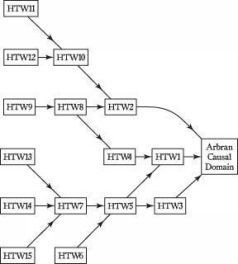
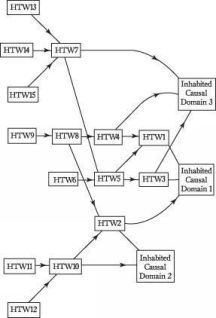
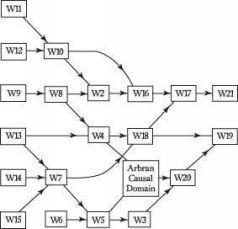
- The concept of 'Causal Domains' is introduced as collections of things linked by mutual cause-and-effect relationships, defined by their light cones.
- Orolo argues that the purpose of the monastic life is to minimize causal linkages with the outside world, creating a distinct domain.
- The dialogue explores a thought experiment regarding whether separate universes would experience time at the same rate without causal connection.
- Orolo posits the theory of 'Causal Domain Shear,' suggesting that loosely connected domains might experience a slippage or difference in the flow of time.
“The man who looks at a mole on his brow every day when he shaves may not see that it is changing; the physician who sees it once a year may easily recognize it as cancer.”
Causal Domain Shear and Bulshytt
- Fraa Orolo explores the theoretical possibility of 'Causal Domain Shear,' where a math could sever causal links with the outside world to experience time at a different rate.
- The protagonist recalls Orolo’s 'crazy stories' about Ten-thousander avout appearing at Apert, despite the current monastic system being much younger.
- A cultural clash occurs between the avout and Artisan Quin regarding the evolution of technology and communication in the world extramuros.
- Quin demonstrates 'Kinagrams,' moving pictures on clothing tags that have replaced traditional 'Logotype' symbols used for reading.
- Orolo dismisses the technological advancement as 'bulshytt,' an ancient Orth word that creates immediate social tension with the secular artisan.
- The scene highlights the vast intellectual and linguistic gap between the cloistered scholars and the changing society outside their walls.
“But if one could do it, then one’s math would become a separate universe and its time would no longer be synchronized with the rest of the world’s.”
The Gates of Apert
- Artisan Quin and Fraa Orolo discuss how market forces and planned obsolescence replaced the 'Logotype' system with 'Kinagrams.'
- Quin reveals that while he rarely reads the formal script of Orth, he has taught his son to read books despite social stigmas.
- Orolo questions Quin on the nature of justice and criminality, listing various hypothetical and historical methods of legal judgment.
- The dialogue highlights the cultural divide between the secular 'Artisans' and the cloistered scholars of the 'concent.'
- The narrative establishes the timeline of the Reconstitution and the significance of 'Apert,' a rare period when the gates of the math open to the public.
Does a woman with shaved eyebrows say ‘you are a criminal’ and ring a silver bell? Or is it rather a man in a wig who strikes a block of wood with a hammer?
The Labyrinth of Law
- Fraa Orolo explains the hierarchical structure of the mathic world, where scholars are periodically summoned to higher labyrinths to be questioned by Centenarians.
- The scholars maintain vast records of secular judicial practices spanning over thirty-seven hundred years, documenting how outside societies manage crime.
- Artisan Quin describes a fragmented secular justice system involving roaming magistrates in purple boxes, surveillance 'speelycaptors,' and spinal clamps for criminals.
- A mysterious third authority known as the 'Warden of Heaven' is identified as a potential source of religious or ideological law.
- Fraa Orolo reveals that the Warden of Heaven is likely a fraudulent entity using the prestige of the mathic world to claim illegitimate secular power.
“Some charlatan will appear and make a claim on Sæcular Power based on an association with the mathic world—which happens to be fraudulent.”
The Warden and the Discipline
- The protagonist realizes Artisan Flec is a disciple of the 'Warden of Heaven,' a figure who claims a connection to the mathic world to bolster his own power.
- Quin reveals that Flec’s advanced recording technology was confiscated because its high-end optics could potentially breach the monastery's privacy screens.
- Fraa Orolo intervenes to stop Quin from sharing information obtained from the Ita, as such communication violates the rules of their Discipline.
- Orolo expresses concern regarding whether the Warden of Heaven is a 'Throwback-turned-Mystagogue,' a potentially vengeful figure seeking to settle scores with the institution that anathematized him.
- The narrative introduces the term 'Kefedokhles,' referring to a historical figure whose pedantic interruptions once saved a philosophical debate, now used as a term for smug interlocutors.
- The tension between the secular world's technological capabilities and the monastic community's strict isolationist protocols begins to surface.
Fraa Orolo’s hand came down on my wrist and prevented me from writing any more. And I suspect that his other hand wanted to clamp down on Quin’s mouth.
The Threat of a Sack
- Fraa Orolo explains the 'Bottle Shaker' phenomenon, where less advanced societies are easily awed by technological artifacts they cannot replicate.
- The conversation reveals rising tensions regarding the upcoming Apert, leading to increased security measures and the involvement of the Sæcular Power.
- The characters discuss the historical precedent of 'Sacks,' which are violent purges of the monastic communities by the outside world.
- Orolo downplays the likelihood of a 'Sack-General,' noting that only three have occurred in 3,700 years, though the protagonist remains anxious.
- The avout prepare for potential unrest by hiding their most valuable knowledge and artifacts within deep labyrinths.
I wouldn’t be surprised to see a bit of roughhousing on Tenth Night; but that’s why we prepare for Apert by moving all of the stuff we really care about to the labyrinths.
The Art of Being Planed
- The narrator, Fid Erasmas, finds himself trapped in a formal Socratic-style dialog with his mentor, Fraa Orolo, after a careless remark about historical 'reforms.'
- Erasmas compares the intellectual pressure of the debate to a physical nudge on the collarbone that leaves him off-balance and vulnerable to a fall.
- The surrounding community of 'fids' stops their chores to witness the intellectual 'planing,' a process where a student is systematically dismantled by a teacher's logic.
- Orolo uses the debate to mock the idea that words are arbitrary, forcing Erasmas to defend the specific meanings and connotations of the terms he uses.
- Despite the embarrassment, Erasmas submits to the process because it is a rare opportunity to hear Orolo speak on subjects beyond astronomy.
It was just like the moment in a dialog when Thelenes has tricked his interlocutor into saying something stupid and is about to begin slicing him up like a carrot on a plank.
The Tension of Mathic Reform
- A debate arises between Fid Erasmas and Fraa Orolo regarding whether historical changes to their monastic lifestyle were 'reforms' or forced impositions.
- Orolo critiques the modern curriculum, suggesting that translations of historical texts are biased by a 'Procian' mentality that sanitizes the past.
- The text introduces the philosophical divide between the Syntactic Faculty (followers of Proc) and the Semantic Faculty (followers of Halikaarn).
- Orolo argues that Saunt Cartas viewed the mathic world as a counterbalance to secular power rather than a subordinate entity to be reformed by it.
- The conversation highlights the tension between the 'Concent-as-fortress' mentality and the reality of secular influence over the avout.
But Fraa Orolo only shook his head sadly, as if he could scarcely believe what thin gruel was being spooned out to us in the chalk halls.
Recruitment and the Coming Apert
- The narrator reflects on the shifting social dynamics as the Apert festival approaches, bringing new initiates and making current residents feel older.
- The complex 'wiring diagram' of the math is described, detailing how members are recruited from the outside world, feeder maths, or even hospitals.
- Fraa Corlandin of the New Circle begins courting the narrator, signaling a potential shift in the narrator's future monastic affiliation.
- The narrator contrasts the rigorous, equation-heavy work of the Edharians with the polite, superficial social graces of the New Circle.
- A tension is revealed between the narrator's loyalty to his mentor Orolo and the political maneuvering of other orders within the Concent.
Even though they were not here yet, they seemed to surround us like ghosts, which made me seem older by contrast.
The Final Gathering
- The protagonist experiences a moment of social confusion and sudden urgency as fellow fids begin to gather under the watchful eye of Grandsuur Tamura.
- A dictionary entry defines 'Incanters' and 'Rhetors,' suggesting that historical misunderstandings of mathic abilities contributed to the catastrophic Third Sack.
- Thirty-two fids are crowded into a small chalk hall, a deliberate choice by the Grandsuur to ensure total focus and visibility during a significant moment.
- The atmosphere is heavy with emotion, as several suurs are visibly weeping, signaling a gravity that the male fids are slower to comprehend.
- The protagonist realizes with a shock that this meeting marks the final time their specific cohort will ever be gathered together in their lives.
She reacted as if I had hit her with a spitball from across a crowded chalk hall, swiveling her head to strafe me with her eyes.
The Study of Iconographies
- Grandsuur Tamura tests the avout on their knowledge of Iconographies to determine if they are safe to leave the Cloister during Apert.
- Iconographies are defined as simplified, recurring caricatures that the Secular world uses to understand the complex existence of the avout.
- The Temnestrian Iconography is identified as a dangerous 'two-phase' caricature that depicts the avout as harmless clowns before revealing them as sinister corrupters of society.
- This specific iconography originates from an ancient satirical play used as evidence to execute the philosopher Thelenes.
- The avout must recognize these mental patterns in Seculars to predict their reactions and potential hostility toward abstract ideas.
- The discussion highlights the difference between orderly judicial threats and the unpredictable danger of mob actions.
“It depicts us as clowns,” Fraa Ostabon said, a little brusquely. “But… clowns with a sinister aspect.”
The Twelve Iconographies
- Grandsuur Tamura leads a pedagogical exercise to identify the 'iconographies' or cultural stereotypes that the secular world uses to categorize the mathic community.
- The Doxan Iconography portrays theoricians as brilliant but cold and unemotional subordinates who must be led by intuitive, common-sense leaders.
- The Yorran Iconography depicts the scholar as a 'mad scientist' figure—criminally insane, physically mutated by chemicals, and obsessed with world domination.
- The Rhetor Iconography suggests a conspiracy where scholars use subtle linguistic manipulation and mathematics to groom puppets for secular influence.
- Other archetypes range from the 'Muncostran' (the lovable, disheveled eccentric) to the 'Baudan' (cynical frauds living in luxury at the expense of the public).
- These stereotypes serve as a warning to the fids about how they are perceived and the specific dangers or prejudices they will encounter when interacting with the Sæcular Power.
They’ll be curious about our knowledge, impressed by us, but patronizing—certain that we must be subordinated to intuitive, common-sense leaders.
Iconographies and Internal Politics
- The group analyzes various 'iconographies' or belief systems held by those outside the walls, identifying the Moshianic hybrid as the most dangerous due to its delusional expectations of a coming new age.
- The Warden Fendant and Grandsuur Tamura lead these discussions to prepare the 'crop' for Apert, the period when the gates open to the outside world.
- The monastic Discipline requires residents to change sleeping cells every night, a practice intended to maintain detachment and communal fluidity.
- The narrator experiences guilt over neglected astronomical calculations after spotting his mentor, Fraa Orolo, in the Cloister.
- A sense of unease grows regarding how quickly private conversations are being leaked to influential factions like the New Circle.
- The transition of power is noted as Suur Trestanas, a young member of the New Circle, is unexpectedly named the new Warden Regulant.
It was dangerous because it raised people’s expectations to the point of delirium, and drew many pilgrims and much attention.
Suspicions and Scholastic Castes
- The narrator suspects that the hierarchs, specifically Suur Trestanas, may be using surveillance devices to monitor private conversations.
- A linguistic analysis of Fraa Corlandin's words reveals subtle rhetorical manipulation and potential hostility toward Orolo's research.
- The narrator suffers from an identity crisis, fearing that his mentors view him as intellectually unfit for the prestigious Edharian order.
- The text introduces the 'Ita,' a specialized and segregated caste responsible for maintaining ancient 'syntactic devices' or information technology.
- The definition of 'Ita' highlights a historical tension between pure theorics and the practical, often proscribed, use of technology within the concents.
I had the upsight that the things Fraa Orolo said—even when they caused me embarrassment or outright pain—never made me wrestle with my bolt in the night-time in the way that these words from Fraa Corlandin had.
The Dream and the Apert
- The narrator experiences a vivid dream where the monastery's ancient orrery and clock fall out of sync with the celestial bodies.
- In the dream, the mechanical failure is linked to the Ita, the group responsible for maintaining the complex machinery beneath the Mynster.
- The dream-logic presents a breakdown of order where the Day Gate opens at midnight and the bells ring incorrect sequences.
- Upon waking, the narrator hears the bells ringing for Apert, the first day of the year 3690 when multiple gates to the outside world open.
- The monastery uses a complex system of bell-ringing changes to communicate coded messages across the concent.
- Despite knowing the calendar, the residents of the concent wait for the specific, mathematically transformed melody of the bells before beginning the day.
The marble, crystal, steel, and lapis spheres that represented the planets had moved to positions that were at odds with what Fraa Orolo could plainly see even in the smallest of telescopes.
The Ritual of the Bolt
- Three fraas perform a complex, collaborative dressing ritual involving long bolts of fabric and chords.
- The process requires the men to move like 'planets in an orrery' to properly wind and pleat each other's formal wraps.
- The community subtly stretches the rules of their Discipline by wearing non-standard footwear like tire sandals and mukluks for protection.
- The fraas carry versatile spheres that can change size and emit colored light to signify their status as 'Tenners'.
- The group prepares for Apert, a time when they may leave their secluded math and interact with the outside world.
Arsibalt and I pleated Holbane’s bolt and then backed away from each other as Holbane made it three times as long and much thinner.
The Opening of the Decade Gate
- The avout gather in the Mynster for the Decennial Apert, a rare ceremony occurring only once every ten years.
- A specific melody triggers a profound emotional and physical reaction in the narrator, recalling the moment they first entered the math.
- The ceremony is synchronized with a massive clock that serves as both a metronome and a conductor for the ritual.
- At sunrise, the clock's weights descend to open the Year and Decade Gates, causing an eruption of cheers and tears among the observers.
- The narrator reflects on the tension between the clock's mechanical nature and the overwhelming spiritual significance of the event.
- The sound of running water outside signals the physical opening of the gates to the outside world.
To hear that melody now penetrated so deep into my brain that it literally threw me off balance, and I leaned into another fraa: Lio, who for once did not use it as an excuse to flip me over his hipbone and slam me to the ground, but rather pushed me back up straight, as if I were a crooked ikon.
The Hydraulics of Saunt Edhar
- The Concent of Saunt Edhar is situated in a strategic riverbend, surrounded by a landscape that fluctuates between urban sprawl and desolate ruins across different eras.
- The physical boundaries of the concent are defined by ancient walls and bastions that house specific gates for the Unarian, Decenarian, and Centenarian maths.
- To solve the problem of operating distant gates without electricity, the ancient 'praxics' engineered a complex gravity-fed water system.
- A high-altitude cistern feeds an aqueduct and pressurized underground pipes that power fountains and gate mechanisms through monumental granite ball-valves.
- The system is designed so that the central clock's descending weights trigger the flow of water only during Apert, the designated time for the gates to open.
During some eras it would grow and engulf our walls, and office workers in skyscrapers would gaze down on the tops of our bastions.
The Opening of the Gates
- The monastery's waterworks are designed to fill slowly, allowing the inhabitants to follow the flow toward the outer gates.
- A complex mechanical system of aqueducts, water-wheels, and stainless steel gears uses hydraulic power to physically swing open the massive gates.
- The narrator indulges in a fantasy of the unknown, imagining everything from mobs and corpses to virgin wilderness waiting beyond the walls.
- Upon opening, the reality of the outside world is revealed to be mundane, featuring people with recording devices, bored children, and families.
- The crowd outside includes a mix of secular observers, grieving individuals, political flag-wavers, and religious proselytizers.
- The first to actually enter the math are a family dressed in formal secular attire, signaling the start of a scheduled exchange.
The most interesting moment was when the gap between the gates grew just wide enough to admit a single person. Who would it be? Male or female, old or young, carrying an assault rifle, a baby, a chest of gold, or a backpack bomb?
Encounters at the Apert
- A family of 'Burgers' arrives at the concent to donate a sapling in memory of their father, a former supporter of the monastic community.
- Tensions rise as a religious activist attempts to dissuade a desperate woman from leaving her baby at the concent, nearly sparking a physical confrontation.
- The monks receive literature in Kinagrams that they cannot read, following protocols to avoid intellectual engagement with outsiders.
- Artisan Quin introduces his son, Barb, who displays an immediate and obsessive fascination with the engineering and geometry of the concent's architecture.
- Barb demonstrates a precocious understanding of structural principles, correctly identifying catenary curves and the mechanics of the gate's driveshaft.
- The interaction highlights the stark cultural and linguistic divide between the secular 'extramuros' world and the disciplined life of the fraas.
The woman, unencumbered, moved faster, but in a gait that looked all wrong until I recollected that women extramuros wore shoes that made them walk so.
Crossing the Decade Gate
- The math opens its doors to the extramuros world, leading to awkward encounters between the cloistered avout and the secular public.
- A desperate woman mistakenly attempts to sell her baby to the suurs, highlighting the profound disconnect between the math and the outside world.
- Fraa Haligastreme and other scholars navigate social interactions with religious figures and curious visitors during the Apert.
- The text introduces the term 'sline,' a derogatory or descriptive label for uneducated commoners living outside the math walls.
- Erasmas and Jesry step outside the walls for the first time in ten years, observing the physical clutter and contemplating the nature of romantic liaisons with outsiders.
- The concept of the 'Atlanian Liaison' is discussed, referencing a historical monk who maintained a long-distance romance through poetry.
Apparently, this woman had been told by some ignorant person that we’d give her money for the baby.
Navigating the Fauxburbs
- The protagonists discuss the presence of the Warden of Heaven, a religious group whose leader imitates monastic attire.
- The characters navigate a shifting landscape of warehouses and workshops, observing the evolution of local vehicle styles like drummons and fetches.
- Jesry reveals he has been performing practical orbital mechanics calculations for Fraa Orolo's research group.
- The conversation touches on the protagonist's potential future in the hierarchy, a topic he finds frustrating and over-discussed.
- The dialogue hints at a mysterious astronomical discovery, specifically an asteroid that Orolo is tracking with local telescopes.
Anyway, the styles had changed quite a bit, and so Jesry and I would stop talking and stare whenever a particularly strange or gaudy fetch went by.
The Disappointing Fauxburbs
- The avout reflect on a historical 'near-miss' asteroid event that led to the creation of a space-faring mission and a new concent.
- The group navigates a decaying infrastructure of rusted bridges and 'newmatter' repairs while dodging reckless motorists.
- The landscape reveals a stark contrast between the disciplined life of the avout and the 'extras' who suffer from simultaneous starvation and obesity.
- Jesry's uncharacteristic aggression and suggestion of fighting locals stems from a deep-seated frustration with the outside world.
- The protagonists realize that the world outside the concent is a repetitive cycle of consumerism, religious monuments, and discarded packaging.
Beneath a grey film of congealed exhaust, faded Kinagrams fidgeted like maggots trapped in a garbage bag.
The Trap of Time
- The protagonists discuss the 'Ten-thousanders' and 'Causal Domain Shear,' debating whether these concepts are genuine mysteries or mere retention strategies to keep scholars committed to the monastic life.
- Jesry expresses cynicism regarding the 'Apert' system, suggesting that the cycle of opening the gates only to find a decaying world encourages scholars to sign up for longer terms in hopes of a better future.
- The dialogue highlights the mathematical tragedy of their timing: they were born too late to be part of the thousand-year orders and too early to see the next significant opening of the hundred-year orders.
- The narrative distinguishes between different types of dialogue, identifying this walk as a 'peregrin'—a conversation between equals trying to solve a problem.
- The setting shifts to the 'slines' world, a landscape of mass-produced businesses, casinos, and 'newmatter' advertisements that the scholars find intellectually and aesthetically repulsive.
- The characters touch upon the biological influence of 'allswell' in the bloodstream, implying that the outside world relies on chemical contentment to ignore its own stagnation.
You and I were born too early to be Hundreders and too late to be Thousanders.
The Ambition of Jesry
- Jesry and Raz discuss the contrast between the artificial happiness of the secular world and the intellectual pursuits of the concent.
- Jesry expresses a deep-seated frustration with the hierarchy of the math, mocking the idea of 'illumination' while fearing a life of mediocrity.
- The conversation reveals Jesry's desire for personal significance, specifically his refusal to be a 'knee-hugger'—a minor figure in the shadow of a great Saunt.
- The characters compare the happiness of common people to that of intellectual giants like Fraa Orolo, questioning if fulfillment is merely getting what one wants.
- Jesry admits he craves for 'something to happen' and values meaningful events over the chemical contentment provided by the plant blithe.
- The pair navigates the secular world, noting the presence of 'stabils' and the cultural differences between their monastic life and the outside society.
“You don’t want to end up as a knee-hugger,” I said. “That is correct. How does that work? Why some, but not others?”
Return to the Secular World
- The protagonists experience a jarring cultural disconnect as they transition from the monastic 'math' back into the secular world.
- The narrator observes a visible decline in his childhood neighborhood, noting boarded-up rooms and a shrinking population.
- The secular environment is characterized by sensory overload, featuring raucous lights, constant media consumption, and aggressive signage.
- A visit to the narrator's childhood home reveals a fractured family history and a sense of being forgotten by those who remained.
- The interaction with a former neighbor highlights the vast emotional and intellectual gulf created by ten years of monastic isolation.
Inside the math, it didn’t matter that he had come from burgers and I had come from slines. But as soon as we had stepped out of the Decade Gate, this fact had been released, like a bubble of swamp gas deep in dark water.
Searching for Cord
- The protagonists interact with a woman who displays skepticism and impatience toward their status as avout.
- Jesry observes that the woman's language suggests she views entering the math as a voluntary choice rather than a religious abduction.
- The narrator identifies a connection to a former resident named Cord through a piece of machinery.
- The woman provides vague directions to Cord's current location, hinting at a place near the Decade Gate.
- The narrator reflects on the permanence of leaving their former life, imagining they might not return for decades.
- The concept of a 'sib' is introduced to describe complex, non-traditional family structures in the outside world.
She ended by exhaling sharply, dropping her shoulders, setting her chin, and putting on a smile that I guessed was meant to be obviously fake.
Jesry's Empty Home
- Erasmas and Jesry visit Jesry’s family home in the burger neighborhood, only to find it empty of family members.
- Jesry’s mother left a machine-generated note explaining that his father is away on business for the Sæcular Power and she has joined him for a social event.
- The note highlights the cultural gap between the mathic world and the secular one, including the mother's imperfect use of the Orth language.
- The pair explores the house, finding it strangely similar to a math but with fewer people and more mechanical luxuries like a fancy clock.
- They compare the local Bazian cathedral to their own Mynster, noting that the secular architecture feels 'puny' in comparison to their monastic home.
- The journey continues toward the industrial compound where Cord works, a site characterized by ancient metal structures and Praxic Age technology.
Now I had an upsight, which was that he’d been expecting his family to be standing in front of the gate to meet him.
The Industrial Cavern
- The protagonists explore a perimeter of repurposed Praxic Age shipping containers and oversized structural overkill.
- They discover a domestic shelter module that has been crudely repurposed into a cluttered, utilitarian office space.
- The main facility is a massive hall straddling a canal, filled with heavy machinery and ancient iron castings.
- The interior is a dark, oily environment where massive metal masses are bolted to the floor and powered by copper wiring.
- The space is populated by workers in dark coveralls who appear more engaged in deep thought than manual labor.
- The atmosphere is defined by a mix of industrial decay, 'azure-tinged lightning' from moving parts, and organic-looking mechanical growth.
Tendrils of wire and of artfully bent tubing had grown over these machines like ivy exploring a boulder, and my eye followed them to concentrations where I was sometimes surprised to see a human being in a dark coverall.
The Spark of Apert
- The protagonists enter a quiet, industrial hall filled with massive cables and humming machinery, encountering a few distant, unapproachable workers.
- They discover a house-sized machine shielded by a red jelly-like curtain designed to block lethal ultraviolet radiation from an electrical arc.
- Inside the red glow, two humans operate a complex system of moving tables and a 'sizzling blaster' that emits high-energy blue light.
- The machine is controlled by a sheet-metal box containing 'syntactic processors' that display rapidly changing numerical coordinates and countdowns.
- The observers are shocked to hear the workers using sophisticated mathematical terminology like 'cubic spline' and 'pylanic interpolation.'
- While the narrator feels an instinctive urge to flee the dangerous energy, his companion Jesry is captivated by the advanced technology.
As Jesry and I drew closer, we perceived it as a giant cube of red amber with two black forms trapped in it: not insects but humans.
The Encounter with the Ita
- The narrator and Jesry observe a complex numerical countdown that mirrors the sacred clocks of their own Mynster.
- A tense confrontation occurs when a customer is revealed to be anIta, a group typically avoided or looked down upon by the narrator's kind.
- The Ita defies social expectations by refusing to cringe, instead displaying a sense of pride and territoriality over the mechanical space.
- The narrator reflects on the cultural divide, noting that the Ita views their presence as a profanation of his own sacred domain.
- A philosophical internal debate arises regarding whether the machines possess inherent meaning or if meaning is merely projected onto them by the observer.
- The narrator experiences a 'legitimate upsight,' connecting the physical environment to ancient philosophical teachings about shadows and reality.
His long black beard avalanched down his chest as his mouth fell open.
Shadows and Plasma Carvings
- The narrator reflects on the philosophy of Protism, which posits that physical reality consists of imperfect shadows of higher, more perfect forms.
- This 'upsight' originated from observing how clouds cast distorted shadows on irregular terrain and how mountains change shape based on the viewer's perspective.
- The narrator draws a parallel between this ancient doctrine and the modern Mynster and machine hall, suggesting they are both shadows of a singular sacred place.
- In the machine hall, Cord uses an advanced electrical discharge machine to carve complex metal components by turning solid material into plasma.
- The process is described as a subtractive art, removing 'all the bits that aren’t wanted' to reveal a silver, antler-like sculpture.
- The finished piece is identified as a replacement part for a great clock, intended to repair something worn or broken in the depths of the Mynster.
They made glinting music as they found their way to the floor, and some left corkscrews of fine smoke along their paths.
A Meeting and a Melee
- Erasmas reunites with Cord, a mechanically-minded woman whose solid, horse-like presence and tool-laden attire contrast with the academic setting.
- Cord joins Erasmas and Jesry as they rush back to the mathic grounds to perform the ritual of winding the clock.
- The group encounters Secular picnickers who treat the monks' urgent duties as a source of amusement and a spectacle to be recorded.
- Upon returning, they find their companions Lio and Arsibalt battered and bleeding after a violent encounter with outsiders.
- Arsibalt describes being targeted by men in a vehicle, suggesting rising tensions or hostility from the world outside the walls.
- Lio, a practitioner of martial arts (vlor), expresses deep disillusionment because his training failed him during the actual confrontation.
She seemed as though she could sleep standing up, like a horse.
Blood and Discipline
- Lio demonstrates the practical effectiveness of his martial arts training by easily incapacitating Jesry using his own monastic robes.
- Cord, an outsider and sibling of Erasmas, provides efficient medical assistance to the injured Arsibalt using advanced tools like membrane gloves and fibrous plugs.
- The interaction between the stern Suur Ala and the pragmatic Cord shifts from potential hostility to mutual respect through their shared focus on medical care.
- Despite his injuries, Arsibalt maintains his eccentric dignity, jokingly attributing his survival to his 'enormous' blood supply.
- The group identifies their attackers as a local gang that mimics the aesthetics of fictional criminals from old media.
- The incident highlights the cultural clash between the cloistered monks and the practical knowledge of the 'extramuros' world represented by Cord.
So bossy, so stern a person was Suur Ala that, until this moment, I had feared that she and Cord were going to fall upon each other like two cats in a pillowcase.
Architecture and Academic Frustration
- The protagonist and Cord observe Delrakhones's failure to understand that local gangs act out of boredom rather than ideology.
- Frustrated by the circular questioning, the siblings escape the meeting to explore the heights of the Mynster.
- The narrative details the unique architectural philosophy of the Mathic architects, who prioritize arches and tracery over solid walls.
- The lack of traditional walls makes the buildings vulnerable to the elements but provides exceptional visibility and views of the concent.
- The pair ascends a southwestern tower to reach a high-altitude cupola featuring elaborate stone carvings of cosmographers and celestial bodies.
Where anyone else in the world would construct a wall, they’d fill in the space with a system of arches and tracery.
Ascending the Praesidium
- The narrator and Cord ascend the Praesidium, navigating complex architectural features like flying buttresses and portcullises.
- Cord, an outsider, is fascinated by the intricate clockwork mechanisms and the 'fractal foam' of hand-carved stone tracery.
- The narrator reflects on the grueling labor of being a 'fid,' specifically the tedious task of cleaning bird droppings from the ornate stonework.
- The architecture serves a social function, using physical barriers like portcullises to maintain the segregation of different monastic orders (Maths).
- Access to the starhenge is strictly regulated by the Master of the Keys to ensure that different groups do not interact outside of designated times.
The walls were a fractal foam of hand-carved, interlocking stone.
The Mechanics of Discipline
- The protagonist explains that the monastic maths are not hermetically sealed but rely on disciplined conduct and hierarchs to manage information flow.
- Hierarchs act as specialized intermediaries who use ancient languages and traditional dress to prevent secular 'leakage' into the more isolated maths.
- Communication between different levels of the math can occur through visual signals, such as the opening of portcullises or the use of labyrinths.
- Historical artifacts, like I-beams from ancient skyscrapers, reveal a cycle of civilizational collapse and the manual labor of past eras.
- Cord criticizes the clock's design, arguing that its complex mechanical linkages are prone to failure and corrosion over long periods.
- The protagonist defends the design by explaining that the clock was intended to be maintained by the avout as a statement of perpetual human presence.
They speak only in a very conservative ancient version of Orth. And we also have ways to communicate without speech.
The Danger of Information
- While climbing through the clock's internal machinery, the narrator and his sister Cord debate the strict social barriers between the monastic scholars and the Ita.
- The narrator explains that the prohibition against interacting with the Ita is a form of 'hygiene' meant to prevent the spread of dangerous, 'promiscuous' information.
- He reveals that the scholars are kept sterile to prevent the breeding of a superior human species within the concents, highlighting the genetic parity between those inside and outside.
- Using Cord's advanced machining tools as an analogy, the narrator argues that automated 'syntactic devices' can amplify human capabilities to a catastrophic degree.
- The conversation touches on the 'First and Second Sacks,' historical periods of collapse caused by the misuse of genetic and protein-adjusting technologies.
I took a moment to feel the chain. It was like a trickle of ice water over my fingers.
The Photomnemonic Tablet
- The narrator leads Cord to the starhenge atop the Præsidium, a site blending ancient megalithic markers with advanced astronomical structures.
- They enter a quiet, archaic chapel to examine a photomnemonic tablet, a device that stores visual data across a temporal dimension.
- The tablet contains a record of Saunt Tancred’s Nebula, capturing the evolution of a supernova from the moment of explosion in 490 through the year 2999.
- By sliding a finger along the side of the glass disk, the user can navigate through thousands of years of astronomical history in seconds.
- Cord identifies that the tablet must contain a 'syndev' (synthetic device) or internal processor to manage such complex data.
- The presence of this technology raises questions about potential violations of the Mathic Discipline, which generally restricts advanced machinery.
She traced her finger up the side of the tablet a few times, running it forward thousands of years in a second.
Praxis and the Incanter Myth
- The protagonist explains that current monastic rules regarding technology and the Ita were established following the violent 'Sacks' of the past.
- A distinction is made between the legendary Rhetors, who could supposedly change the past, and Incanters, who could change the future.
- The Thousanders living on the crag are identified as Edharians, a lineage associated with the Incanter side of folk mythology.
- The Ita are a separate class of technicians who maintain the monastery's machinery but are despised as potential spies for the Secular Power.
- The concept of 'Voco' is introduced, where members are 'Evoked' to perform practical work for the outside world and are never seen again.
One sort of glib explanation I heard once was that Rhetors could change the past, and were glad to do it, but Incanters could change the future—and were reluctant.
The Last Idea
- The Sæcular Power uses the Ita to navigate the vast knowledge of the concents when specific expertise is required.
- Cord suggests that the fear of 'Terrible Events' is a social control mechanism used by the authorities to manipulate the scholars.
- The protagonist explains Saunt Lora’s Proposition, which claims that every possible human idea has already been conceived.
- Lorite scholars act as intellectual gatekeepers, debunking 'new' ideas by proving they are actually ancient rehashes.
- The primary mission of the concent is not necessarily innovation, but the preservation of the existing stock of human knowledge.
- The protagonist admits that while new ideas are rare, they occasionally occur through intellectual 'mutations' or cosmic rays.
Each tread was a slab of rock cantilevered straight out from the side of the building: a daring design, and one that required some daring from anyone who would climb it, since there was no railing.
The View from the Pinnacle
- The narrator and Cord reach the top of the Pinnacle, where they examine astronomical and timekeeping instruments.
- A quartz prism held by a marble statue is used to synchronize a massive clock daily at noon, even during long-term nuclear winters.
- The narrator explains 'Clesthyra’s Eye,' a stationary fisheye lens designed to track fast-moving objects like meteorites across the entire sky.
- The technology dates back to the 'Big Nugget' era, a time of intense global concern regarding asteroid impacts.
- Cord remains focused on practical mechanics and her secular schedule, eventually questioning the validity of Saunt Patagar’s Assertion regarding social control.
- The conversation highlights the cultural divide between the scholarly life within the walls and the time-pressured lives of those 'extramuros.'
'Clesthyra-that’s the monster from ancient mythology that could look in all directions at once.'
Defending the Mathic World
- The narrator experiences a psychological conflict between their personal discontent and an instinctive urge to defend the cloistered system against outside criticism.
- A dictionary entry defines 'newmatter' as synthetic materials with atomic properties altered through nucleosynthesis, now strictly regulated after historical reforms.
- The avout interact with the secular world during a period of openness, highlighting the cultural divide between the intellectual mathic world and the material-focused 'extramuros'.
- Lio experiments with the durability of his newmatter garments, eventually testing them against projectile weapons in a quarry to prove their resilience.
- The narrator observes that secular people often possess great intelligence and certainty but lack a fundamental understanding of the 'why' behind their knowledge.
Fraa Lio perfected a new wrap that made him look like a parcel that had fallen from a mail train, but that could not under any circumstances be pulled over the face by a foe.
Apert and the Discipline
- Lio conducts ballistics tests on a mysterious sphere, discovering its potential as a flexible defense against gunfire.
- The narrator experiences emotional turmoil and a complex crush on his sister, Cord, during the Apert festival.
- The narrator reflects on the impending ten-year separation from his family once the gates of the concent close.
- A formal definition of 'Liaison' reveals the evolving and strictly regulated nature of romantic relationships within the Mathic orders.
- Fraa Orolo notices the narrator's distraction and summons him to the starhenge for a meeting at the telescope.
The bullets poked it nearly inside-out and knocked it back like a batted balloon.
Beauty as a Defense
- The narrator seeks counsel from Fraa Orolo regarding his complex emotional attachment to his biological sister, Cord.
- Orolo validates these feelings as a natural consequence of the narrator's limited connections to the world outside the monastery.
- The conversation addresses the common phenomenon of 'avout' questioning their vows and discipline during the period of Apert.
- Orolo emphasizes that questioning the Reconstitution is a necessary tradition to clear the mind for the next decade of seclusion.
- The pair witnesses a dramatic atmospheric shift as a storm breaks, revealing a fleeting, golden ray of sunlight on the mountainside.
- Orolo argues that appreciating immediate, physical beauty is a vital psychological defense against the inevitable ugliness of life.
The sky had hurled itself against the mountains like a sea attacking a stony headland, and spent its cold energy in half an hour.
The Origin of Beauty
- Orolo challenges the protagonist to view beauty not as a subjective experience, but as a light shining in from another world.
- The protagonist experiences a profound moment of clarity while watching the sunset over the Millenarian math, finding a reason to live in the perception of beauty.
- The narrative distinguishes between different forms of beauty: the natural world, theoric proofs, and the craftsmanship and character of individuals like Cord.
- The protagonist realizes that partaking in beauty suggests a connection to a reality beyond the physical, bordering on spiritual or 'Deolater' territory.
- The philosophical moment is interrupted by the reality of monastic discipline as the characters descend to face their superiors.
- Orolo hints that the approaching confrontation with the Master of the Keys is not routine 'ugliness' but something exceptional and ominous.
I was surprised by a little sunrise above the mountains: the ray, sweeping invisibly up through empty sky, had found a couple of small wispy clouds and set them alight, like balls of wool flung into a fire.
A Tense Departure
- The Master of the Keys, Gredick, appears visibly unsettled while locking down the portcullis, suggesting a broader security lockdown across the different mathic communities.
- Erasmas is led away by Gredick, realizing that the Warden Regulant, Suur Trestanas, has orchestrated his removal to speak with Orolo in private.
- Orolo and Trestanas engage in a heated argument, a departure from Orolo's typical calm and logical demeanor, indicating a matter of grave importance.
- The encounter reinforces a mysterious and urgent resolution in Erasmas's mind regarding his survival and the ideas he and Orolo shared.
- The following morning, Orolo remains distant and secretive about the confrontation, quickly departing for the secular world through the Decade Gate.
When Orolo answered-which he did only after a long pause-it was in a voice that was wound up tight.
Aesthetic Proofs and Mathic Melancholy
- The narrator reflects on a conversation with Orolo, realizing that his new ideas rely on aesthetic judgment rather than the strict logic of Diax’s Rake.
- Arsibalt exhibits conspicuous distress over his strained relationship with his father, prompting Tulia to ask the narrator to intervene.
- The history of the Concent of Saunt Edhar is detailed, describing how the first Thousanders carved the monastery directly from the mountain's heart.
- The narrator observes the strange juxtaposition of the avout and the 'slines' or visitors during Apert, highlighting the isolation of the mathic world.
- Arsibalt reveals his ambitious goal to reconcile his family's religious faith with the rigorous intellectualism of the mathic world.
They judged theorical proofs not logically but aesthetically.
Social Dynamics and Mathic Origins
- The narrator endures a one-sided conversation with Arsibalt, who is too preoccupied with his own theories and a crush on Cord to listen to the narrator's concerns.
- Suur Tulia's backstory is revealed: she was an abandoned infant found at the Day Gate and raised within the Unarian math due to her early exposure to the secular world.
- Tulia's lack of external family provides her with a detached, bemused perspective on the emotional complexities other monks face during Apert.
- The Unarian math serves as a grand, public-facing interface designed to impress secular visitors and educate those taking short-term vows.
- The narrator describes the social stratification of the Unarian math, where students often seek prestige or specific training under Halikaarnian or Procian masters before returning to secular life.
Seventeen years ago, Tulia had been found at the Day Gate, wrapped in newspapers and nestled in a beer cooler with the lid ripped off.
The Year Gate Tour
- The narrator begins the day amidst excitement over a rare theft of mead from the apiary by local ruffians.
- To reach the Year Gate for tour duty, the narrator navigates the lower labyrinth, retracing a childhood path taken by Tulia.
- The narrator observes a diverse group of visitors, including disciplined students from a religious school and 'slines' with distinct subcultural markers.
- Sline fashion is described as oversized athletic jerseys, long shorts, padded shoes, and beverage-branded headgear with goggles.
- Despite the slines' hostile and 'cool' posturing, the narrator feels safe based on the peaceful history of recent tours.
- The tour group gathers at the bridge, where the narrator prepares to lead the diverse mix of burgers, artisans, and outsiders.
The current sline fashion was to wear a garment evolved from an athletic jersey (bright, with numerals on the back) but oversized, so that shoulder seams hung around the elbows, and extremely long—descending all the way to the knee.
The Wedge of Return
- The narrator leads a tour group through the Unarian math, passing a red stone monument that marks a mass grave from the Third Sack.
- During the siege, five hundred avout staged a desperate raid on the town to gather essential supplies for the Thousanders on the crag.
- The raid was a suicide mission where three hundred returned and two hundred died immediately, ensuring the survival of the Millenarian math.
- The monument is oriented toward the clock rather than the city to symbolize the choice of the avout to return to their discipline rather than flee.
- The narrator expresses relief at the absence of Barb, a pedantic and overly inquisitive boy whose parents seem to want him 'Collected' by the math.
- The group enters the Hylaean Way, an architectural complex designed in a horizontal Bazian style meant to resemble welcoming arks.
This wedge of granite was their tumulus. The stuff that they had gathered was sent up to the Thousanders.
The Rotunda of Cnous
- The narrator leads a diverse group of tourists through a dark, fossil-embedded entryway made of ancient shale.
- Tensions arise as the narrator recognizes a group of 'slines' who previously attacked his companions, Lio and Arsibalt.
- The chamber serves as a dual metaphor for biological evolution and the history of human thought, highlighting 'dead ends' that preceded modern logic.
- The tour culminates in the Rotunda, featuring a massive, ancient marble sculpture of Cnous, the legendary figure who transitioned humanity toward structured reason.
- The statue depicts Cnous in a moment of divine or intellectual revelation, surrounded by the tools of geometry and shielded from a triangular beam of light.
As if to shield himself from the vision, he had raised a hand, but could not resist the temptation to peek over it.
The Vision of Cnous
- Cnous, an 'elevated' stonemason, experienced a life-altering geometric vision while working on a temple for his king.
- The historical account of Cnous's vision is preserved indirectly through the legends of his fraternal twin daughters, Hylaea and Deat.
- The Emperor Tantus commissioned statues of the daughters to accompany an ancient sculpture of Cnous, using marble from the original quarry.
- A dark legend claims Tantus executed the sculptor to preserve the artistic ambiguity of Hylaea’s expression and prevent her 'words' from ever being defined.
- Modern pilgrims, or 'Deolaters,' show a fervent devotion to the statue of Deat, covering her pedestal with candles and offerings despite the narrator's view of the art as propaganda.
Tantus, fascinated, had asked him a number of questions on that theme, then drew the Imperial sword and plunged it into the sculptor’s heart so that he would never be able to undermine his own work of art by answering the question.
The Forking of Cnous
- Following the exile and death of Cnous, his daughters Deat and Hylaea offered competing interpretations of his final vision of a 'pyramid of light.'
- Deat founded a religious path, the Deolaters, arguing that the vision revealed a divine kingdom of heaven and that physical idols are merely crude effigies of true gods.
- Hylaea interpreted the vision as a mathematical 'upsight,' viewing the pyramid as a pure, theoretical isosceles triangle existing in a higher world of perfect geometry.
- This philosophical split created two distinct paths: the religious exit toward the Unarian Gate and the intellectual 'Hylaean Way' toward the study of pure forms.
- The Hylaean Way led to the founding of Orithena by Adrakhones, a temple dedicated to the Hylaean Theoric World (HTW) and the exploration of mathematical theorems.
- The narrator observes how modern visitors, including crude 'slines,' interact with these historical symbols of theology and geometry.
What her sister Deat had misinterpreted as a pyramid in heaven was actually a glimpse of an isosceles triangle: not a crude and inaccurate representation of one, such as Cnous drew on his tablet with ruler and compass, but a pure theorical object of which one could make absolute statements.
Diax's Rake and Ancient Theors
- The narrator explains a fresco of Diax, a figure who violently expelled 'Enthusiasts' from a temple for using dice to cast fortunes.
- Diax established the term 'theorics' to distinguish disciplined mathematical thought from superstitious number-worship.
- The principle of 'Diax's Rake' serves as a philosophical reminder to avoid believing things simply because they are emotionally appealing.
- The narrator observes a 'spine clamp' on one of the slines, a mechanical device used to disable the man's arm as a form of control or punishment.
- The tour continues through galleries depicting the destruction of Orithena and the golden age of Ethras, featuring figures like Protas and Thelenes.
- The term 'suvin' is revealed to originate from the practice of theors teaching their students under vine-covered bowers.
Diax said something that is still very important to us, which is that you should not believe a thing only because you like to believe it.
The End of the Hylaean Way
- The tour of the Hylaean Way concludes by tracing the decline of theors and the rise of the Ark of Baz's religious influence over secular power.
- A stark, empty stone chamber symbolizes the retreat to the maths and the beginning of the Old Mathic Age following the Sack of Baz.
- The physical layout of the museum leaves space for future history, though the current tour ends before reaching the modern Praxic Age.
- The narrator interacts with various visitors, including curious children and 'slines' who are captivated by the violent imagery of burning libraries.
- Two sophisticated latecomers, identified by their professional attire and identity flashers, approach the narrator with nuanced questions.
- The visitors challenge the narrator's interpretation of the 'daughters of Cnous,' seeking a deeper connection or commonality between philosophical lineages.
Theors had to be sought out as small figures in the deep background, reclining on the steps of the Library or going into the Capitol to spill wise counsel into the dead ears of the high and mighty.
The Symbol and the Thing
- The narrator encounters two visitors from the Sæcular Power who appear to have some past experience with monastic life.
- A debate ensues regarding the distinction between a symbol and the thing it represents, referencing the historical figures Deat and Hylaea.
- The visitor criticizes the narrator's cautious, academic phrasing, demanding a more direct and honest expression of belief.
- The narrator explains that his storytelling was influenced by the presence of religious 'Deolaters' in the audience, leading to a diplomatic emphasis on commonalities.
- The conversation reveals a deep-seated philosophical divide between the Procian and Halikaarnian schools of thought regarding absolute truth.
- The visitors' use of the word 'mentality' suggests a condescending or pejorative view of the monastic intellectual culture.
He looked as if I’d poked him in the eye. “What kind of way to begin a sentence is that? ‘I think many scholars would agree…’ Why don’t you just say what you mean?”
The Inquisition at Saunt Edhar
- The narrator engages in a tense, cryptic conversation with two well-informed secular visitors during the final days of Apert.
- The visitors probe the narrator's philosophical views on Deat and Hylaea, questioning if they have been influenced by the 'Warden of Heaven' or other secular pressures.
- The narrator explains the historical fragmentation of the Edharian order following the Third Sack and the forced integration of rival factions like the Procians.
- As the religious service of Provener begins, the narrator is shocked to discover that the two visitors are actually high-ranking members of the Inquisition.
- The chapter concludes with the physical labor of preparing the meadow for a massive influx of pilgrims, highlighting the long-standing traditions of the concent.
“It appears that we have two honored guests from the Inquisition,” he said. I looked across the chancel and recognized the faces of the man and woman I’d been talking to earlier.
Preparations and Inquisitorial Politics
- The avout are engaged in the physically demanding task of setting up a vast array of eclectic furniture, ranging from ancient wooden relics to advanced aerospace composites, for a major event.
- Arsibalt provides historical context on the Inquisition, describing it as a now-bureaucratized process essential for maintaining consistent standards across the world's concents.
- The Warden Regulants serve as an elite class of traveling hierarchs who monitor the monastic communities to ensure the Reconstitution remains valid.
- The protagonist and Arsibalt struggle with a complex piece of military surplus furniture, highlighting the technological stagnation and the loss of simple knowledge like the wheel.
- The narrative shifts to a moment of shared frustration and confidence as the protagonist reveals his unsettling encounter with two disguised Inquisitors to Arsibalt.
“You’d think that after all this time someone might have invented…oh, say… the wheel,” Arsibalt mentioned at one point, as we were wrestling with a twelve-foot-long monster that looked like it might have stopped spears during the Old Mathic Age.
The Invisible Inquisitor
- The protagonist expresses anxiety over being tricked into revealing his true opinions to an Inquisitor disguised as a common traveler.
- Arsibalt argues that Inquisitors must use public transport and civilian clothing to remain effective, leading to a natural selection bias in how they are perceived.
- The protagonist fears his candid remarks have 'burned his bridge' with the New Circle, potentially ruining his chances of being chosen for a prestigious position.
- Arsibalt reveals that Fraa Orolo has been quietly influencing the younger generation, suggesting a major shift toward the Edharian order.
- The text introduces the concept of 'Bulshytt,' a technical term used to describe deceptive or rhetorically hollow speech associated with political and commercial interests.
“I would guess that they happened to come in from the aerodrome just as your tour was beginning, and decided on the spur of the moment to tag along so that they could view the statues in the Rotunda, which anyone would want to see.”
The Dilemma of Bulshytt
- The text explores the linguistic evolution and social risks of a specific 'offensive' word used to interrupt discourse.
- A fundamental divide exists between the mathic world and the Sæculum regarding the perception of vulgarity and truth-telling.
- Mathic observers face a paradox: use a blunt term and be excluded from polite society, or use euphemisms and become a purveyor of 'bulshytt' themselves.
- The resiliency of 'bulshytt' is attributed to the fact that pointing it out often causes the speaker to take offense, silencing the critic.
- The narrative shifts to the celebration of Tenth Night, a harvest festival featuring advanced 'tangle' agriculture.
- The 'tangle' is a sophisticated symbiotic farming system of eight plants, including cob, podbeans, and tommets, designed for maximum efficiency.
It is inherent in the mentality of extramuros bulshytt-talkers that they are more prone than anyone else to taking offense (or pretending to) when their bulshytt is pointed out to them.
The Purpose of the Math
- The Apert festival serves as a seasonal bridge where the avout share their superior agricultural yields and take in vulnerable infants from the extramuros.
- A social gathering brings together the cloistered avout and their secular family members, highlighting the lack of inherent intellectual difference between the two groups.
- The character Dath questions the necessity of the walls and the physical separation between the math and the outside world.
- Orolo introduces the concept of 'pinprick maths'—minimalist, solitary cloisters—to challenge Dath to think about the internal motivations of the avout.
- The protagonists conclude that the life of an avout is defined not by social phobia, but by being 'infected' by the vision of an intellectual world more compelling than physical reality.
You might say that the difference between us and you is that we have been infected by a vision of…another world.
The Contrast of Two Worlds
- The narrator describes an ideal world or alternate universe that exists in the soul, defined largely by its lack of intrusive modern technology.
- A disruptive cell phone call from Jesry’s brother highlights the jarring disconnect between the secular world and the monastic environment.
- The brother’s loud, public negotiation over medical biopsies and larvae serves as a comedic yet grotesque display of worldly concerns.
- The Primate, Statho, struggles with language barriers while attempting to command the audience to be entertained by the monastic performers.
- A group of Edharians performs a complex motet combined with a physical dance that mathematically models the curvature of a four-dimensional manifold.
As they moved to and fro, crossing over one another’s paths and exchanging places while traversing in front of the high table, they were acting out a calculation on the curvature of a four-dimensional manifold.
Rituals and Rhetoric at the Concent
- The avout and their visitors participate in a formal dinner filled with symbolic performances, including a 'tensor dance' and choral singing.
- Statho manages the event with mechanical precision to satisfy the requirements of the Inquisition and avoid official rebuke.
- Fraa Haligastreme delivers a fragmented speech, concluding that the ambiguity of their lifestyle is a source of relief for those who truly belong.
- Corlandin offers a polished, sentimental comparison between the rituals of the math and the domestic traditions of secular families.
- While the visitors are charmed by Corlandin’s speech, the avout are irritated by his glibness and the way he simplified their complex existence.
- Orolo acknowledges that despite the speech's superficiality, it successfully garnered necessary sympathy from the outside world.
“If this all seems ambiguous, that’s because it is; and if that troubles you, you’d hate it here; but if it gives you a feeling of relief, then you are in the right place and might consider staying.”
Geometry and Sheet Cake
- The avout and their visitors find common ground through music, as many secular carols are revealed to be derived from ancient liturgical melodies of the maths.
- The narrator uses the practical task of cutting a sheet cake to teach a young visitor, Dath, a geometric proof that is thousands of years old.
- The conversation evolves into a philosophical discussion about the 'purity' of geometry and how it applies to disparate objects like land and cake.
- The avout suggest that mathematical truths exist in an independent plane of reality that remains constant regardless of the era or the observer.
- Visitors like Cord and Rosk begin to recognize this abstract reality in their own professional lives, from mechanical design to medical modeling.
- The exchange bridges the cultural gap between the 'bolt-wrapped weirdos' of the math and the secular visitors through shared intellectual fascination.
“Uh huh,” Dath said, gobbling a vertex from his serving.
The Transition of Jurisdiction
- A conversation about shared mental spaces and historical sacks highlights the cultural divide between the mathic and secular worlds.
- The formal presentation of newcomers at the high table categorizes foundlings and youngsters into different 'maths' based on age and health.
- The ceremony marks a legal shift where individuals cease to be secular citizens and become the lifelong responsibility of the mathic community.
- A local mayor uses the solemn occasion to deliver a long-winded political speech filled with bureaucratic jargon and religious platitudes.
- The secular official's speech about shifting political boundaries and 'Tetrarchies' is met with immediate intellectual skepticism from Orolo.
- The tension between the solemnity of the mathic tradition and the 'tedium' of secular authority is palpable during the Apert dinner.
It was as if they ceased in this moment to be citizens of one country and became citizens of another.
Tensions and Turf Wars
- A formal gathering dissolves into petty bickering between the scholarly avout and their secular families over historical pedantry and religious euphemisms.
- The local mayor delivers a sugary, superficial speech that masks an underlying sense of foreboding and potential hostility toward the monastic community.
- Lio, a student of martial arts who paradoxically hates conflict, quietly slips away from the social friction of the dinner to find solitude in the meadow.
- The protagonist discovers Lio in the moonlight, where he is being confronted by four outsiders wearing numbered jerseys.
- Lio utilizes his 'bolt'—a monastic garment—as a versatile weapon to expertly neutralize two of the larger men in a display of fluid, dance-like combat.
- The encounter escalates into a physical confrontation that forces the protagonist to intervene as Lio is pursued by the remaining antagonists.
Lio’s bolt slapped down on top of Number 86 and draped him, making him look like a ghost.
The Inquisitor in the Meadow
- Lio successfully neutralizes his remaining attackers using a combination of martial skill and the physical entanglement of his monastic bolt.
- The final assailant attempts to use a firearm but is instantly incapacitated by a remote-activated spine-clamp that causes total muscle failure.
- A hooded figure watching the fight is revealed to be Varax, an Inquisitor, who applauds the display rather than punishing the breach of conduct.
- Varax dismisses the violence as a triviality, urging the protagonist to focus on much larger, more significant matters than local skirmishes.
- The encounter highlights a hierarchy of power where the Inquisitor commands immediate, silent respect from the high-ranking Wardens.
- The incident creates a jurisdictional headache for the Wardens, as the usual boundaries between internal and external law are blurred during the Apert festival.
His spine-clamp exploded in light, flashing alternately red and blue. He uttered a common profanity. He dropped the gun and collapsed.
The Warden's Discipline
- Lio faces potential disciplinary action for a physical confrontation with outsiders during the Apert festival.
- Suur Trestanas, the Warden Regulant, expresses deep suspicion regarding the narrator's private interactions with the visiting Inquisitors.
- The narrator inadvertently offends Trestanas by quoting rules about the Inquisition's power to replace existing hierarchs.
- As punishment for his perceived arrogance and secrecy, the narrator is sentenced to 'the Book,' specifically Chapters One through Five.
- The Warden cruelly denies the narrator the chance to say goodbye to his visiting family before the gates close for another decade.
- The conflict highlights the tension between the monastic discipline of the concent and the personal desires of the younger fraas.
But Suur Trestanas was—I realized too late—jealous of me for this.
The Architecture of Penance
- The narrator is forced to choose between remaining in the concent or leaving forever to be with family, ultimately choosing the Mynster.
- Apert concludes with the closing of the Decade Gate, effectively severing the narrator's connection to the outside world and his family.
- The narrator is confined to a penance cell designed by a 'cunning architect' to maximize frustration through limited, tantalizing views of the outside.
- The cell's layout allows the prisoner to hear the music and see the mechanical workings of the clock but prevents any human contact.
- Penance involves the study and memorization of 'the Book,' a text specifically designed to be a form of intellectual punishment.
- The Warden Regulant utilizes tedious labor and psychological isolation as tools to maintain the social and moral order of the concent.
Boredom is a mask that frustration wears. What better place to savor the truth of Fraa Orolo’s saying than a penance cell of the Warden Regulant?
The Torture of Nonsense
- The mathic community uses a tiered system of penance, ranging from useful physical labor to the purely psychological torment of 'the Book.'
- The Book consists of twelve chapters that increase in difficulty exponentially, with higher chapters leading to years of isolation or permanent insanity.
- Unlike random data, the Book is composed of 'intellectual poison'—writings that almost make sense but are fundamentally illogical and maddening.
- The Inquisition actively curates and refines failed or humiliated academic works to make them more 'wicked' for inclusion in the Book's later chapters.
- The narrator is currently serving a Chapter Five sentence, a punishment designed to keep them isolated while Inquisitors are present at the concent.
- Completing a sentence requires mastering the nonsensical material as thoroughly as a complex science, forcing the victim to internalize mental rot.
The punishment lay in knowing that you were putting all of that effort into letting a kind of intellectual poison infiltrate your brain to its very roots.
Solitude and the Sound of Bells
- The narrator maintains a strict regimen of study and physical exercise while confined to a monastic cell for penance.
- His teammates show silent solidarity by holding symbolic 'picnic' toasts in the meadow beneath his window.
- While writing a chronicle of recent events, the narrator becomes obsessed with the feeling that he has overlooked a significant pattern.
- He deciphers the call to Eliger by visually tracking the movement of bell-ropes, a method that succeeds where his hearing failed.
- The induction of his peers into different orders, particularly Ala's move to the New Circle, triggers an unexpected sense of personal loss.
- The process of recording his conversation with Fraa Orolo begins to reveal the hidden connections he had previously sensed.
I could see the way in which a given rope’s movement was conditioned by what its neighbors had done on the previous beats.
The Sealed Starhenge
- The narrator observes that the starhenges at the Concent of Saunt Edhar have been unprecedentedly sealed off since the eighth day of Apert.
- There is a suspected link between the closure of the starhenges and the sudden arrival of the Inquisitors, Varax and Onali.
- The narrator theorizes that a global order was sent over the Reticulum to prevent the avout from observing something specific in the sky.
- The closure is baffling because starhenges typically observe timeless cosmic phenomena rather than the 'Sæcular' information the Discipline seeks to restrict.
- The narrator experiences a sense of alarm and shame for failing to recognize the significance of these events sooner.
- Personal anxieties about academic standing and future career paths within the mathic world contrast with the unfolding mystery.
Like a fraa who wakes in his cell in the hours before dawn smelling smoke, and who knows from this that a slow fire must have been smoldering and gathering heat for many hours while he slumbered in oblivion, I felt not only alarm but also shame at my own slowness.
The Call of Voco
- The narrator is confined to a cell for penance while other novices are recruited into various philosophical chapters, creating internal political tension.
- A unique sequence of bell changes signals a rare and momentous event, initially causing the narrator to fear an 'Anathem' or expulsion.
- The Primate invokes the 'Voco,' a formal summoning that calls a member of the secluded Centenarian Chapter back into the world.
- The announcement of Fraa Paphlagon's summoning causes an emotional uproar, as the Hundreders mourn the permanent loss of their brother.
- Realizing the gravity of the event has caused a breakdown in normal monastic discipline, the narrator breaks his confinement to observe the chaos.
- The narrator suspects that even the authorities were unprepared for the Voco, leading to a total lapse in the usual procedures and oversight.
As I absorbed that, a gasp and then a deep moan welled up from the floor of the chancel: the gasp, I reckoned, from most of the avout, and the moan from the Hundreders who were losing their brother forever.
Escape to the Starhenge
- The narrator exploits a rare window of freedom during the Voco ritual while the Warden and staff are trapped below.
- Using their physical training, the narrator climbs through the clockwork and chronochasm to reach the starhenge.
- A powerful five-part hymn of mourning rises from the Hundreders as they bid farewell to Fraa Paphlagon.
- The narrator feels a profound emotional connection to Paphlagon as they both venture into unknown territory.
- Upon reaching the starhenge, the narrator is nearly exposed when Paphlagon looks up and sees the light from the open door.
- Despite the risk of discovery, the narrator successfully enters the starhenge laboratory to find it surprisingly well-maintained.
He had chosen this moment to tilt his head back and gaze straight up. And why not? It was the last time he would ever look on this place.
The Eye of Clesthyra
- The narrator attempts to bypass the hierarchs' secrecy by recording celestial data despite the closure of the starhenge.
- Suspecting a large asteroid is the cause of the lockdown, the narrator realizes traditional telescopes are too conspicuous and difficult to aim without precise data.
- The narrator decides to use Clesthyra’s Eye, a fixed fisheye instrument capable of capturing a wide-angle view of the sky over a long duration.
- To avoid detection, the narrator uses a photomnemonic tablet and attempts to conceal their identity while installing it in the Pinnacle.
- The tablet is set to record for several months, creating a future challenge regarding its eventual retrieval and analysis.
- The narrator acknowledges the technical limitations of the plan, noting that any potential discovery would likely be faint and difficult to distinguish.
The tablet was a featureless disk, like the blank used for grinding a telescope mirror, but darker-as if cast in obsidian.
The Departure of Fraa Paphlagon
- The narrator witnesses a high-tech aerocraft with rotating wings landing near the Day Gate, nearly losing their balance from the shock of its arrival.
- Fraa Paphlagon is escorted by two purple-robed figures, Varax and Onali, into the craft amidst a violent hurricane of rotor wash.
- The aerocraft departs rapidly toward the west, leaving the narrator in a state of awe that is quickly dampened by the reality of their status as an escaped prisoner.
- Desperate to return unnoticed, the narrator navigates the 'chronochasm' as the Mynster empties following the Voco ceremony.
- The narrator narrowly avoids detection by two young hierarchs by hiding among the grim statues of the Warden Fendant’s court.
- The scene highlights the contrast between the ancient, ritualistic environment of the Mynster and the sudden intrusion of advanced technology.
It was a thousand feet away, but it felt as immediate as a slap in the face.
A Narrow Escape
- Fraa Erasmas narrowly avoids detection by sprinting back to his cell and feigning a calm vigil after a clandestine excursion.
- Suur Trestanas confronts Erasmas about missing the Voco, but she surprisingly declines to formally punish him for the offense.
- Erasmas realizes that the departure of the Inquisitors has shifted the political tension, making his confinement feel like a mere formality.
- Despite his relief, Erasmas is preoccupied with the logistical challenge of retrieving a hidden tablet from Clesthyra’s Eye.
- The Voco process continues the following day, resulting in the unexpected but logical selection of Lio for the New Circle.
I’d never thought I’d be happy to see the place.
Narrowing Paths and Shifting Loyalties
- The narrator reflects on the unexpected career paths of his close friends, Lio and Arsibalt, as they join different monastic orders.
- Lio's combat prowess has earned him a position as a hierarch in the New Circle, a move that surprises the narrator's assumptions of group unity.
- Arsibalt joins the Reformed Old Faanians, a nearly extinct order, causing the narrator significant confusion and distress.
- The narrator suspects that his isolation and the 'throwing of the Book' at him were tactical moves to force him into a subservient hierarch role.
- As the narrator prepares for his examination, he realizes his options are dwindling as his peers are rapidly absorbed into various factions.
- Only the narrator and Tulia remain unassigned from their original group as the final examinations begin.
In my gloomier moments I wondered if throwing the Book at me had been a sort of recruiting tactic on the part of Suur Trestanas-a way of forcing me to join some non-Edharian order and thereby pushing me down the path that would lead to my toiling in the Primate’s compound as a lesser hierarch, always under someone’s thumb.
Penance and Rebellion
- The protagonist completes a grueling month-long penance, successfully passing a rigorous oral examination by reciting digits of pi and demonstrating mastery of complex texts.
- Despite the examiners' attempts to catch him with trick questions, the protagonist's thorough preparation and the panel's hunger lead to a lenient conclusion.
- Fraa Spelikon, a disgruntled hierarch, attempts a final challenge but ultimately grants the protagonist freedom and a temporary pass to the Regulant court.
- Upon retrieving his journal, the protagonist is seized by a sudden, reckless impulse to visit the starhenge and collect a mysterious tablet.
- A chance encounter with Lio reveals a sense of urgency among his peers, with Lio insisting that the protagonist must speak to Tulia and Orolo immediately.
- Defying Lio's warnings of being 'Thrown Back,' the protagonist chooses to risk his status in the mathic world to pursue a discovery he deems more important than his safety.
“It’s more important that I do this than that I not be Thrown Back,” I said. Which was pretty stupid, but I was feeling rebellious and not thinking very hard.
Tensions in the Refectory
- The narrator encounters Lio, who uses physical force to restrain him and warn him against further unauthorized activities.
- A mysterious procession of black-clad Ita is observed performing maintenance or rituals in the starhenge area.
- Lio reveals that Fraa Paphlagon was a mentor to Fraa Orolo, hinting at a lineage of intellectual influence.
- Upon entering the Refectory, the narrator experiences social isolation as his peers from the Edharian order pointedly ignore him.
- The atmosphere at the math is shifting, with the 'New Circle' gaining prominence and the narrator becoming a social pariah after his confinement.
I had a choice: move, and spend the next two months with my arm in a sling, or not move. I chose not to move.
The Legend of the Library Grape
- Fraa Corlandin presents Fraa Erasmas with an ancient firkin of wine as a gesture of reconciliation following Erasmas's period of penance.
- The wine is a product of the 'library grape,' a genetically engineered fruit created before the Second Sack that contains the genetic sequences of every known grape species.
- The library grape functions as a biological archive, capable of expressing thousands of different flavors based on subtle environmental data and historical memory.
- The grape is notoriously temperamental, reacting to the specific actions of its cultivators and even retaining 'bad memories' of past pruning errors through pheromones.
- Cultivating this complex fruit is a rare skill, largely lost after the Second Sack and now practiced only by dedicated fanatics like Fraa Orolo.
Each nucleus was an archive, vaster than the Great Library of Baz, storing codes for shaping almost every molecule nature had ever produced that left an impression on the human olfactory system.
The Living Casks of Vrone
- The Vrone oak used for wine casks remains biologically active after being harvested, interacting with the chemical composition of the wine.
- These 'living' casks are sensitive to their environment, requiring specific human-like temperatures and humidity to prevent the loss of desirable resins.
- The wood's cellular structure responds to acoustic vibrations, meaning wine aged during choir rehearsals develops a distinct flavor profile.
- Saunt Edhar’s is a renowned site for aging wine because the casks respond favorably to the constant talking and singing within the Mynster.
- Fraa Erasmas celebrates his release from confinement with a rare, high-quality vintage that tastes 'like drinking your favorite book.'
- Following the celebration, Erasmas meets Tulia in the garden to discuss mysterious events that occurred during his isolation.
The casks, like musical instruments, resonated in sympathy with the human voice, and so wine that had been stored in a vault used for choir rehearsals would taste different from that stashed along the walls of a dining room.
Political Shifts and Secret Teams
- The closure of the starhenge and recent inquisitions have caused a political shift within the concent, leading fids to rethink their monastic allegiances.
- Some students are strategically joining less prestigious orders to gain rapid influence and protect the intellectual Edharians from political fallout.
- A secret deal between high-ranking officials has created a zero-sum situation where only one of the two protagonists can join the Edharian order.
- Despite the Edharians' internal skepticism, Orolo specifically requested the narrator for his team, prioritizing his unique capabilities.
- The narrator reveals his illicit activities during Voco, which Tulia interprets as definitive proof that he belongs with the Edharians.
- The tension between personal desire, political utility, and Orolo's mysterious agenda forces a difficult decision regarding their future paths.
“Because it’s not what Orolo wants. He says he needs you as part of his team.”
The Weight of Adulthood
- Tulia confronts the narrator about his preoccupation with blame and social standing, suggesting he has failed to mature as quickly as his peers.
- The narrator experiences a moment of painful realization and decides to stop seeking emotional validation from Tulia.
- Despite the fear of joining a chapter where he may be unwelcome or seen as a replacement, the narrator finds a sense of purpose in self-reliance.
- Fraa Haligastreme confirms that while the narrator is wanted in the Edharian order, many members are skeptical of his intellectual capabilities.
- The narrator chooses to forgo a comforting conversation with his mentor, Orolo, in favor of accepting his new, difficult path.
- The interaction concludes with a defensive display of wit, as the narrator acknowledges his status as an underdog within the scholarly community.
It’s like the rest of us became adults while you were up there—and you didn’t.
The Harvest of Pages
- The narrator reflects on the sacrifices made by his peers to improve the future of the concent and its leadership.
- Fraa Haligastreme expresses skepticism that the next generation of hierarchs will remain uncorrupted by their positions of power.
- The text details the intricate, century-long process of cultivating and curing 'page trees' to produce high-quality writing material.
- The narrator struggles with complex mathematical problems involving hypersurfaces and seeks clarity through a walk in the woods.
- A nostalgic visit to a favorite climbing tree reveals how the narrator's perception of the world has changed since his youth.
- The narrator reluctantly heads toward Shuf’s Dowment to visit Arsibalt, overcoming physical barriers and his own social hesitation.
All those blank pages made an uproar as I sloshed through them, searching for one especially grand tree I’d always loved to climb.
The Secrets of Shuf’s Dowment
- The narrator explores a neglected boundary wall built by Shuf’s Lineage, reflecting on how physical barriers were designed to elicit feelings of trespassing.
- The Reformed Old Faanians (ROF) have repurposed an old stone shell into a luxurious, wood-paneled retreat filled with high-quality craftsmanship.
- A dictionary entry defines Gardan’s Steelyard, a philosophical principle favoring simpler, 'lighter' hypotheses over complex ones.
- Arsibalt is discovered in the retreat reading an ancient text with tongs, revealing the existence of secret 'islands of luxury' within the various monastic orders.
- The conversation touches on the ideological differences between orders, including the ROF's openness to Deolaters and the concept of God.
- The two friends depart for a meal, noting the rare freedom they now enjoy as younger fraas take over the manual labor of winding the clock.
Islands of luxury that must make Saunt Cartas roll over in her chalcedony sarcophagus.
Avocations and Polar Anomalies
- The avout must choose an avocation, a practical skill to improve life at the concent once their initial training period ends.
- An avocation serves as a safety net called 'falling back' for those who lack the intellectual capacity for advanced theoretical work.
- Fraa Erasmas considers working on starhenge instruments, though he currently lacks access to the facility due to a lockout.
- Erasmas and Arsibalt observe that Fraa Orolo's telescope was last pointed toward the celestial pole before he was barred from the starhenge.
- The positioning of the telescope is baffling because there are no known asteroids or significant celestial bodies in that specific polar region.
There was another reason you needed an avocation: so that if you turned out to be incapable of doing anything else, you could give up on books and chalk halls and dialog and work as a sort of laborer for the rest of your life.
The Steelyard and Secret Observations
- Orolo and Arsibalt debate the statistical likelihood of an unusual rock's trajectory using 'Saunt Gardan’s Steelyard' as a philosophical guideline.
- Orolo reminisces about his two teachers, Estemard and Paphlagon, and their differing paths of departure from the monastic life.
- The conversation shifts to a tense political comparison between the current restrictions on telescopes and historical atrocities of the Third Harbinger.
- Erasmas attempts to hide his illicit astronomical observations by framing them as a joke about daytime viewing.
- Orolo presses Erasmas for specific details about what he might have been looking for, shifting the tone from playful to interrogation.
- The presence of Jesry, listening intently, heightens the sense of secrecy and potential danger surrounding their astronomical findings.
“That damned luminous orb!” Orolo spat. Then something crossed his mind. “But you know that our equipment can see some things during the daytime, if they are very bright.”
Converging at the Poles
- Fraa Orolo and the narrator debate the astronomical logic of observing the sky from a polar orientation versus the plane of the ecliptic.
- The socially awkward Barb interrupts the intellectual banter to point out that polar orbits make the poles a prime location for detecting satellites.
- The narrator intentionally causes Barb to drop his food tray to silence him and prevent others, specifically Fraa Corlandin, from overhearing sensitive talk of orbital detection.
- The narrator takes responsibility for the mess to manage Barb's reaction and avoid further public scrutiny in the Refectory.
- The text introduces the concept of a 'Calca,' a technical or tedious calculation or lesson moved to an appendix to avoid distracting from a main argument.
“My arm was acted on by a force of unknown origin!” he stated.
Theorics and Orbital Elements
- The narrator and Barb discuss the counterintuitive nature of learning complex mathematics before intuitive visualizations.
- Barb observes that raw coordinates (x, y, and z) obscure the physical reality of orbits that a common person could see by simply looking at the sky.
- The narrator explains that advanced 'orbital elements' provide a more elegant way to describe stability than raw velocity and position data.
- The narrator realizes that the difficult curriculum is a pedagogical tool designed to make more efficient methods feel like a relief.
- The interaction highlights Barb's rapid intellectual progress, as he is learning in his second month what others learn in their second year.
- The narrator accepts a new responsibility in mentoring Barb, deciding when to transition him to more advanced theoretical concepts.
'Yeah! It’s like knowing all of the theorics only makes us stupider!' he laughed excitedly, and cast a theatrical glance over his shoulder, as if we were up to something incredibly mischievous.
Abstract Spaces and Existential Worry
- The narrator explains Hemn spaces to Barb, describing them as abstract theorical dimensions governed by action principles rather than physical measurements.
- A dictionary entry defines 'going Hundred' as losing one's mind or straying from the path of theorics, referencing historical disasters at various maths during the Third Centennial Apert.
- The historical failures of the Hundreder maths, ranging from mass suicide to the discovery of nuclear reactors, led to the creation of the Inquisition and strict disciplinary oversight.
- The narrator confronts Fraa Orolo about his cryptic behavior, fearing he might leave the concent to become a 'Hundreder' or a 'Feral' like Estemard.
- Orolo deflects the narrator's concerns by engaging him in a Socratic dialogue about the nature and logic of worrying.
- Through the metaphor of a nerve-gas-farting dragon, Orolo challenges the narrator to distinguish between rational foresight and incoherent anxiety.
At Saunt Rambalf’s, a mass suicide that had taken place only moments earlier. At Saunt Terramore’s, nothing at all-not even human remains.
The Logic of Imaginary Dragons
- The group discusses how scientific laws like scaling and chemistry preclude the existence of massive, gas-generating dragons.
- They explore the psychological 'filter' that prevents people from worrying about an infinite variety of impossible threats.
- A convincing myth is built by ensuring internal consistency and linking it to observable phenomena, such as claiming shooting stars are dragon farts.
- The conversation shifts to a mathematical exercise, demonstrating how the number of possible imaginary threats grows exponentially when minor variations are allowed.
- The dialogue reveals a tension between playful speculation and formal 'theoric' philosophy, specifically referencing the works of Saunt Evenedric.
- The characters conclude that once the door is opened to one absurdity, there is no logical way to exclude millions of other equally plausible fantasies.
As soon as you open the door wide enough to admit pink nerve-gas-farting dragons, you have let in all of those other possibilities as well.
The Mechanics of Plausibility
- The group discusses how the human mind filters out an infinite number of nonsensical hypothetical scenarios to focus on plausible outcomes.
- Jesry argues that this filtering ability is an intrinsic feature of human consciousness, allowing the mind to reject invalid scenarios without effort.
- Erasmas connects this cognitive process to 'Hemn space' and 'action principles,' suggesting that the mind instinctively seeks an internally consistent story.
- The dialogue reveals a tension between using complex theoretical physics to explain human intuition versus simpler, more direct explanations.
- Arsibalt suggests that Saunt Evenedric’s work implies human consciousness might have a deeper, more rigorous connection to the laws of configuration spaces.
Jesry snapped back, and looked around at me, Lio, and Arsibalt, as if he’d just been mugged, and needed witnesses.
The Right Side of the Gate
- A tense intellectual debate between Jesry and Arsibalt is broken up by Orolo, who redirects the group toward the necessity of physical sustenance.
- Orolo recounts his experiences during Apert, admitting he was briefly seduced by the charm and intelligence of the secular 'slines' outside the concent.
- The illusion of secular intellectualism shattered for Orolo when a brilliant outsider insisted the sun revolves around the planet, highlighting the fragility of unpreserved knowledge.
- Orolo reveals he received letters from Estemard, a former colleague living as a 'Feral,' who continues to perform astronomical observations with hand-built tools.
- The conversation shifts to the difficulty of living outside the monastic structure and the fundamental question of what humans seek beyond basic survival.
- Orolo hints at a shared intuitive faculty with Erasmas for predicting future outcomes, suggesting they may eventually be readmitted to the starhenge.
And somehow, toward the end, it came out that he believed that the sun revolved around Arbre.
Stability and the Longcut
- Orolo discusses the human psychological need to belong to a sustainable project or 'ark' that outlasts the individual.
- Different social strata, from the sline subculture to the avout, achieve stability through distinct cultural frameworks.
- The narrator reflects on the risk of taking intellectual shortcuts that eventually become 'longcuts' due to social pressure.
- Barb, an unconventional student, is identified as a valuable learning partner because he lacks the social anxiety of falling behind.
- The narrator decides to mentor Barb out of self-interest, recognizing that Barb's obsessive focus on immediate understanding improves his own grasp of theorics.
I saw now that in my desire to know theorics I had taken shortcuts that, just like shortcuts on a map, turned out to be longcuts.
Observations from the Tower
- The narrator reflects on the intense intellectual synergy between Barb and his partner, whose constant, loud debates lead to deep mutual understanding.
- While teaching music to new initiates, the narrator realizes that the painstaking process of basic instruction is not his true calling.
- Fraa Lio leads the narrator into restricted high levels of the tower to discuss observations made during the recent Apert.
- The two discuss the physical state of the city outside the walls, noting it appears 'weedy' and 'overgrown,' suggesting a decline in the secular world.
- Lio reveals a surprising interest in gardening as a potential avocation, despite his background in martial discipline and penance.
The sound of them furiously explaining things to each other gave the rest of us headaches.
The Botanical Battle of Trantae
- Lio and the narrator observe the winter meadow from the Fendant’s ledge, noting the encroachment of invasive weeds from the riverbank.
- Lio proposes a botanical re-enactment of the historical Battle of Negative 1472, using plants to represent military forces.
- The plan involves using fast-growing starblossom vines as light cavalry and slashberry bushes as infantry to conquer the clover 'breadbasket'.
- The project serves as a metaphor for the fall of the Bazian Empire to the Sarthian steppe hordes.
- The narrator is skeptical of the eccentric plan but considers it a welcome alternative to teaching music to younger students.
“I got the idea during Apert from seeing how weeds and even trees are invading the town. Taking it back from humans so slowly that the humans don’t notice.”
The Ridiculous Weed War
- Lio and the narrator plan a whimsical reenactment of the Battle of Trantae using aggressive weed species to represent historical armies.
- The narrator views this 'flagrantly silly' project as a way to signal his commitment to the order and defy those who expected him to leave.
- To document the botanical battle, the narrator constructs a grid-based drawing frame to create a time-lapse series of technical illustrations.
- The project involves physical preparation of the 'battlefield,' including marking historical sites where generals fell and scouting for invasive plants.
- The arrival of Fraa Spelikon and a younger hierarch in the Refectory signals that the authorities have taken notice of their unusual activities.
- Despite the looming confrontation with the hierarchs, the narrator feels a rare sense of confidence, amused by the absurdity of being questioned over growing weeds.
To spend the summer doing something absolutely ridiculous would flaunt the fact that I had no such intentions.
The Formal Inquiry
- Fraa Erasmas is led to a private interview in the ancient and prestigious Saunt Zenla’s chalk hall, signaling a serious disciplinary or legal matter.
- The hierarch Spelikon and a scribe named Rotha conduct a formal transcript using a specialized, rapid shorthand reserved for high-ranking officials.
- Erasmas discovers that his private journals and transcripts have been seized from their hiding places, a severe breach of monastic social norms.
- The inquiry focuses on Erasmas's role as an amanuensis during a meeting between Fraa Orolo and an outsider named Quin.
- Despite the violation of his privacy, Erasmas feels a sense of relief as he realizes the questioning pertains to documented conversations rather than unknown transgressions.
- The power dynamic is starkly displayed when Spelikon signals the scribe to stop recording his own dismissive and authoritative remarks.
“Where did you get that?” I demanded, now sounding no older than Barb. Rotha’s hand flitted across the leaf and immortalized it.
The Discrepancy in the Journal
- Fraa Spelikon interrogates the narrator regarding discrepancies between official transcriptions and personal journal entries about a conversation with an artisan.
- The investigation focuses on a specific technical discussion about 'speelycaptors' and their advanced imaging capabilities.
- The narrator explains that the Ita (a group within the math) barred an artisan from using his device because its high-resolution features could see through privacy screens.
- The narrator admits to using 'educated guesses' to translate commercial jargon into technical cosmographical terms like magnification and image stabilization.
- The tension peaks as Spelikon questions why Fraa Orolo physically stopped the narrator from recording certain parts of the conversation.
- The narrator views the interrogation as petty harassment intended to discredit Orolo before the upcoming Apert festival.
It says in your journal that Fraa Orolo’s hand came down on your wrist just after that, and stopped you from writing. Why?
Interrogation and Observation
- Fraa Erasmas undergoes a cryptic interrogation by Spelikon regarding Fraa Orolo's past interactions with the Sæcular world.
- The questioning shifts to Erasmas's whereabouts on the ninth night of Apert, hinting at a potential investigation into unauthorized movements.
- Erasmas discovers his cellmates, Branch and Ostabon, are also being questioned, suggesting the hierarchy is cross-referencing alibis.
- Despite the bureaucratic pressure, Orolo reveals that the hierarchs are finally allowing him to resume his astronomical observations.
- Erasmas concludes that the hierarchy's recent paranoia and investigations were likely triggered by a misunderstanding of Orolo's activities.
“Where were you on the ninth night of Apert?” I thought for a minute, and frowned. “That’s one of those simple-sounding questions that is hard for a normal person to answer.”
Secrets and Starhenges
- Orolo reveals that the observatory restrictions are lifting, allowing him to finally access a specific tablet in the M&M.
- The protagonist realizes that the reopening of the starhenge puts them at risk of being caught for leaving a tablet in Clesthyra’s Eye.
- A coded message from Tulia regarding unusual bell-ringing suggests an upcoming Voco, providing a window for a clandestine mission.
- The protagonist plans to sneak up the Mynster stairs and hide before the ceremony begins to retrieve their incriminating evidence.
- Orolo offers a cryptic and emotional farewell, expressing pride in the protagonist's progress while hinting at an imminent departure.
“Yes,” he said, and then winked. “Or perhaps not.”
The Ringing of Anathem
- The narrator navigates a crowded Mynster, using drawing equipment as a disguise to bypass the suspicion of Suur Trestanas.
- Lio assists the narrator in finding a hiding spot, revealing he has pre-planned 'opportunities' for such a moment.
- The narrator is hidden inside a dark ammunition locker within a muster room to avoid detection during the Voco.
- While waiting, the narrator reflects on the dangerous nature of the stored ammunition and the logistics of its disposal.
- After the building is cleared by Fraa Delrakhones, the narrator emerges and heads toward the starhenge behind the clock face.
- The sequence culminates in the narrator hearing the word 'Anathem' intoned from below, causing a physical reaction of shock.
I was about halfway to the starhenge, high up behind the face of the clock, when I first heard the word Anathem.
The Anathem of Orolo
- The narrator witnesses the rare and severe ritual of Anathem, a ceremony of expulsion not performed for two centuries.
- Despite the personal risk of being 'Thrown Back,' the narrator continues a clandestine mission to retrieve data tablets for Orolo.
- The tension peaks as the name of the expelled is revealed to be Orolo, confirming the narrator's long-held fears.
- Orolo accepts his fate with stoic dignity, immediately stripping of his mathic garments and symbols of his order.
- The narrator experiences a profound emotional collapse, realizing the inevitability of this 'declaration of war' against their mentor.
Why did I cry out “No!” when I’d known it all along? Not out of disbelief. It was an objection. A refusal. A declaration of war.
The Anathematization of Orolo
- The narrator experiences a profound, saturating grief as the long-dreaded expulsion of Orolo finally occurs.
- In a moment of desperation, the narrator retrieves a tablet from Clesthyra’s Eye, recalling the memory of Orolo stripping off his bolt.
- The narrator discovers that the tablet Orolo previously placed in the M&M control chamber has already been confiscated by authorities.
- From a hidden vantage point, the narrator watches Orolo exit the Day Gate, dressed in a gunny sack and oversized boots, beginning his life in the Sæculum.
- The sight of Orolo moving under his own power provides a small mercy compared to the terrifying finality experienced by those inside the Mynster.
- The ritual concludes with the remaining avout reaffirming their vows, marking a permanent schism between the community and the exiled monk.
His skinny white ankles were lost in a pair of old black work boots and he had to shuffle lest they fall off.
The Reconstruction of Orolo's Fall
- The narrator avoids the formal rededication ceremony, hiding a forbidden tablet and preparing to face potential expulsion to find the exiled Orolo.
- Orolo's expulsion is pieced together by his peers over several weeks, a process hindered by misinformation and collective emotional trauma.
- It is revealed that Orolo anticipated trouble with the starhenge and took elaborate steps to shield his students from the consequences of his research.
- Orolo engaged in illicit activities, including stealing mead to trade for a high-tech camera and building a makeshift observatory in a hidden vineyard.
- The narrator faces social stigma within the Edharian community, as some view him as the traitor who inadvertently exposed Orolo to the authorities.
The story of how Orolo had come to be Thrown Back had to be reconstructed over the next few weeks, like a skull in an archaeological dig being fitted together one shard at a time.
The Polar Orbit Discovery
- The narrator feels a deep, personal resentment toward Fraa Spelikon and Suur Trestanas for their perceived role in Orolo's downfall.
- The group attempts to reconstruct Orolo's research using Jesry's memory after the Warden Regulant confiscated the original computations.
- Evidence suggests Orolo was tracking an object in a polar orbit around Arbre, a trajectory highly unlikely for a natural celestial body.
- Jesry concludes that the object is artificial and man-made, potentially explaining the sudden hostility and secrecy from the authorities.
- The group discusses the implications while burning garden waste, acknowledging the social risk of speculating about such a paradigm-shifting discovery.
- The closure of the starhenge is theorized to be a direct response by the Secular Power to the presence of this mysterious artificial satellite.
The orientation of the M & M suggested that Orolo had been using it to take pictures of an object in a polar orbit, which was unlikely in a natural object.
The Mystery in Orbit
- The group debates whether the objects Jesry calculated were secular reconnaissance satellites launched by warring factions on Arbre.
- Lio notes that changing orbital planes requires immense energy, suggesting the presence of multiple objects rather than one maneuvering satellite.
- Erasmas argues that Orolo’s secretive behavior implies the discovery was more significant than a routine secular event, which would normally be ignored by the avout.
- Arsibalt reasons that if Orolo was a disciplined monk, he wouldn't have risked expulsion for a mere piece of known technology or a secular satellite.
- The logical impasse leads Barb to suggest the objects are of alien origin, a hypothesis the others find scientifically improbable but difficult to dismiss.
- The tension between the characters highlights their struggle to reconcile the strict rules of their order with an anomaly that defies conventional explanation.
“Whatever it was that he had seen, he knew that it was a Sæcular event and that the hierarchs would make him stop looking at it as soon as they found out. That wouldn’t have been true if it was just a rock.”
The Legacy of Orolo
- Erasmas experiences a shift in his social dynamics, asserting authority over his peers as he navigates a newfound sense of cold, implacable fury.
- The group discusses the dangerous task of retrieving and examining a forbidden tablet, acknowledging the risks that led to Orolo's expulsion.
- Erasmas claims he is willing to face 'Chapter Six' or expulsion to protect his friends, though he secretly harbors a growing resentment toward the authorities of the Discipline.
- Arsibalt challenges Erasmas by reminding him that the true stake is not the punishment, but the violation of his sacred monastic vows.
- Erasmas justifies his rebellion by declaring his loyalty to Orolo, whom he now considers a 'Saunt'—a holy or enlightened figure—rather than a rule-breaker.
- The section concludes with a definition of 'Lineage,' hinting at the historical and material complexities of the monastic world.
The grief that had hit me at the moment Statho had called Orolo’s name was still with me all the time, but I had learned that it could transform in a flash to anger.
The Labyrinth of Shuf’s Dowment
- The cellars of Shuf’s Dowment are a chaotic, unplanned network of foundations built by successive generations of masons.
- Originally intended as a simple meditation tower, the structure became a sprawling mess as heirs dug deeper to stabilize the leaning building.
- The wealthy Lineage eventually used these subterranean spaces to store riches, exploiting less-fortunate avout to perform the labor.
- Centuries after the Third Sack, the earth has reclaimed much of the cellar system, leaving it a 'wilderness' ignored by modern inhabitants.
- Arsibalt, an unlikely explorer, uses ancient maps and a pickaxe to search for a legendary lost treasure vault to dispel rumors of hidden wealth.
- The narrator is led into a secret, cramped sub-basement via a pilfered ladder, discovering the reality behind the myths of the Lineage.
It was a real accomplishment, in a way, to have left such a mess under a building so small.
The Hollowed Book Conspiracy
- The protagonists utilize a hollowed-out, obsolete theorics textbook to smuggle a forbidden photomnemonic tablet into a secure location.
- Arsibalt prepares a workspace in Shuf’s Dowment, a damp and graffiti-ridden basement, to facilitate secret night-time observations.
- Erasmas exploits inter-Order rivalries and political friction to justify his frequent visits to the Dowment without raising suspicion.
- A new rumor circulates among the Edharians suggesting that Orolo’s expulsion was a political retribution rather than a result of his actual crimes.
- Tulia observes that the community is struggling to accept the truth of Orolo's actions, preferring to invent complex conspiracies to explain his fate.
We cut a circle from each page until we had formed a cavity in the heart of this tome that was large enough to swallow the photomnemonic tablet.
Beauty and Secret Signals
- The narrator reflects on Fraa Orolo’s teaching that the monastic concent is just as prone to human malice and pettiness as the outside world.
- A discussion on the Hylaean Theoric World reveals the intellectual constraints placed on Tulia by her new order, which views such concepts as superstition.
- The narrator adopts a strategy of seeking beauty as a sign of a higher truth, contrasting it with the cynicism of conspiracy theories.
- A system of visual signals involving book spines and door positions is established to allow the narrator to access a secret sub-cellar.
- The group uses the cover of academic cooperation and manual labor to hide their clandestine work with a forbidden photomnemonic tablet.
Our knowledge doesn’t make us better or wiser. We can be just as nasty as those slines that beat up Lio and Arsibalt for the fun of it.
The Fisheye Tablet
- The narrator reviews a phototype tablet activated during a Voco ceremony, which captures a 360-degree fisheye view of the sky and horizon.
- The tablet's unique geometry distorts human figures into spoke-like shapes, where 'down' points toward the rim and 'up' toward the center.
- A zoomed-in examination reveals the narrator's own arm and elbow, proving that their attempt to remain anonymous while placing the device was a failure.
- The recording captures the departure of Fraa Paphlagon in an aerocraft, including high-detail glimpses of the pilot and the passenger's face.
- The narrator manipulates the time-lapse to watch the sun set, transitioning the recording from daylight to a dark sky filled with stars and the lights of passing aircraft.
The first time I saw this I laughed out loud because it made my elbow look as big as the moon, and by zooming in on it I could see a mole and count the hairs and freckles.
The Evidence of Discovery
- The narrator reviews seventy-eight days of footage recorded by a tablet hidden within Clesthyra’s Eye.
- To protect their identity, the narrator erases the footage of themselves retrieving the device during Fraa Orolo’s Anathem.
- The recording reveals anIta named Sammann cleaning the lens and discovering a discarded dust jacket left behind by the narrator.
- Sammann realizes the tablet is hidden in the slot and examines the setup with intense curiosity.
- The narrator is shaken by the realization that their secret surveillance was discovered by someone else almost immediately.
- The discovery creates a new layer of vulnerability and connection between the narrator and the Ita.
I could see all the way up into his nostrils and count the hairs; I could see the tiny veins in his eyeballs and the striations in his iris.
Transmuting Anger into Inquiry
- The narrator experiences a visceral reaction to a past mistake caught on recording, realizing that Sammann holds potentially damaging information.
- Feeling powerless within the Edharian order's hierarchy, the narrator struggles with violent fantasies of revenge against those who wronged Orolo.
- The investigation of the tablet's data serves as a psychological outlet, converting destructive fury into manageable grief and intellectual purpose.
- The narrator aims to use the tablet's findings to publicly humiliate their rivals before potentially leaving the concent voluntarily.
- Technical analysis of the 'Clesthyra’s Eye' data begins, noting the lack of a polar axis system which causes stars to trace arcs in the recordings.
- The narrator shifts focus from personal vulnerability to the rigorous task of interpreting astronomical data from seventeen clear nights.
And I’d found that taking such action was the only way to transmute my anger back into grief.
The Polar Orbit Search
- The narrator uses a photomnemonic tablet to integrate light over time, mimicking ancient chemical plate photography to reveal faint celestial objects.
- By adjusting the start and stop times of the exposure, the narrator creates a still image of the night sky showing star tracks as concentric arcs.
- The search focuses on identifying objects in polar orbits, which would appear as straight lines moving north-south, perpendicular to the east-west star arcs.
- A low-orbit satellite is expected to create a 'pie-cutting' pattern of streaks separated by twenty-two and a half degrees due to the planet's rotation.
- The experiment successfully reveals multiple satellites in polar orbits, suggesting a crowded sky filled with both ancient and modern technology.
- The discovery feels like an anticlimax because the presence of multiple satellites makes it difficult to isolate the specific object Fraa Orolo was tracking.
It was a black disk etched with thousands of fine concentric arcs, each of which was the track made by a particular star or planet as Arbre spun beneath it.
The Census of Birds
- The protagonist struggles with the blunt, competitive nature of theorics, where reinventing existing knowledge is met with dismissive indifference rather than praise.
- The conversation shifts to Fraa Orolo’s motivations for risking expulsion (Anathem) to observe polar satellites through a speelycaptor.
- The characters deduce that Orolo was likely timing the orbits of various satellites, which Lio refers to as 'birds' in military slang.
- They conclude that Orolo was attempting to compile a comprehensive census of all objects in polar orbit to establish a baseline of normalcy.
- By identifying every known satellite and its orbital period, Orolo would be able to detect any new or anomalous objects appearing in the sky.
- The protagonist realizes that their modern technology makes this task significantly easier than it was for Orolo, who had to observe them manually in the cold.
But still it stung to risk so much and do so much work to get a result, only to be told it was nothing new.
The Evocation of Paphlagon
- Jesry and the narrator discuss the mysterious Evocation of Fraa Paphlagon, a Hundreder and mentor to Orolo.
- Jesry investigates the connection between Paphlagon’s work and his sudden removal to the Sæcular world.
- Research reveals Paphlagon had a dual career: traditional cosmography and controversial 'metatheorics' or philosophy.
- The investigation focuses on who in the outside world was tracking Paphlagon’s specific philosophical ideas.
- A Unarian teacher named Suur Aculoa at the prestigious Baritoe math is identified as a key scholar of Paphlagon’s work.
- Jesry suggests that influential Sæculars who studied at the 'Big Three' maths may have been the ones to trigger the Evocation.
“Someone out there in the Sæcular world must have said ‘Paphlagon’s our man—yank him, and bring him to us!’”
The Paphlagon Mystery
- The characters speculate that a former student of Suur Aculoa has become a powerful Panjandrum and urgently summoned Fraa Paphlagon.
- Arsibalt has claimed all of Paphlagon's writings for study, while Tulia investigates Aculoa's past students for clues.
- The text provides a dictionary definition of the Ringing Vale, a math specializing in martial arts, military strategy, and 'vlor.'
- The narrator feels behind on current events due to their manual labor and redoubles their efforts analyzing astronomical data on a tablet.
- The investigation centers on why a specific scholar's presence is suddenly required by the secular world.
'But it’s rather difficult when Arsibalt’s using them as a semaphore.'
A Census and Combat Training
- The narrator completes a meticulous seventeen-night census of orbital 'birds,' finding a sense of belonging through illicit intellectual labor.
- Time has passed rapidly within the concent, moving from the autumnal equinox to the cusp of the vernal equinox as the seasons shift.
- The group of friends deals with the loss of Orolo in divergent ways, ranging from the narrator's private revenge fantasies to Lio's obsession with martial arts.
- Lio explores increasingly eccentric forms of 'vlor' or combat training, utilizing garden tools like rakes and shovels as improvised weaponry.
- In a secluded spot by the river, Lio requests that the narrator punch him in the face to overcome the psychological shock of physical violence.
- The dialogue highlights the disconnect between their peaceful, cloistered society and the visceral reality of hand-to-hand combat.
“I’d like you to punch me in the face,” he said. As if he were asking me to scratch his back.
Combat Practice and Ita Secrets
- Lio convinces Erasmas to punch him in the face repeatedly to test if he has overcome his instinctive flinch response from a previous trauma.
- The two engage in a series of rough takedowns on a muddy riverbank, hiding their activities from passing Grandsuurs.
- Lio concludes the exercise after sustaining several blows, satisfied that he has successfully adjusted his combat reflexes.
- Erasmas reflects on the physical toll of the practice and takes a final opportunity to shove Lio into the river.
- The conversation shifts to Sammann, anIta whose presence in different sensitive contexts suggests he may be more influential than initially thought.
- Erasmas begins to suspect that Sammann's discovery of a specific dust jacket and his visits to the machine hall are not coincidental.
I got my center of gravity low, planted my feet in the mud, made a bone connection from hip to fist, and drilled him right on the cheekbone.
The Politics of Surveillance
- Lio suggests that the Ita, who manage the technical infrastructure of the math, may be selectively withholding information from the Warden Regulant.
- The protagonist realizes that the sheer volume of data collected through total surveillance requires the Ita to act as gatekeepers and decision-makers.
- Lio argues that the Ita use their control over knowledge as a form of power to navigate their own political interests with the hierarchy.
- The conversation shifts to whether the Ita member, Sammann, is leaving hidden messages or signals within the data on the protagonist's tablet.
- The protagonist begins to see the Ita not just as technicians, but as strategic actors in a complex, hidden political landscape.
The Ita must make decisions as to what they will pass on and what they will withhold.
The Boundary of Metatheorics
- The narrator finds himself barred from his secret research in the cellar due to equinox preparations and the sudden popularity of Shuf’s Dowment.
- Arsibalt and the narrator discuss the metatheoretical works of Fraa Paphlagon, suggesting Orolo intended for them to study these complex ideas.
- The conversation touches on the Hylaean Theoric World (HTW), a controversial concept that Procians dismiss as naive but which Paphlagon evolved into a sophisticated system.
- Arsibalt posits that the boundary between 'theorics' and 'philosophy' is defined solely by the technical limits of available test equipment like particle accelerators.
- The characters speculate on why the Secular Power, specifically the Inquisitor Varax, would take such a keen interest in these abstract philosophical lineages.
“If you can’t test it, it’s not theorics—it’s metatheorics. A branch of philosophy.”
The Limits of Theorics
- The transition from the Praxic Age to Cosmography was driven by the prohibitive cost of building larger particle accelerators.
- Arsibalt notes that societal resources are often diverted from scientific inquiry toward pornography, sugar water, and bombs.
- Theors began looking to the cosmos for data when they realized no machine built in their lifetime could test their advanced theories.
- The concept of the polycosm emerged as a way to explain the existence of multiple realms, ranging from physical universes to the realm of pure forms.
- Fraa Paphlagon represents a tradition that views classical Protism—the belief in a realm of ideal forms—as just one specific type of polycosmic theory.
- Some researchers, like those at Saunt Bunjo’s, wait for centuries in underground mines for rare particle flashes to validate their work.
There might as well be, but most of it gets spent on pornography, sugar water, and bombs.
The Tablet and the Eye
- The characters discuss the Hylaean Theoric World and the possibility of other cosmi as the catalyst for recent high-level interest and the closure of the starhenge.
- The narrator recounts spending hours reviewing surveillance footage of Sammann, anIta, who performs a daily ritual of eating lunch on a parapet in view of a hidden camera.
- A breakthrough occurs on 'Day Sixty-nine' of the footage, where Sammann is seen carrying a heavy dust jacket containing a tablet, rather than his usual book.
- The timing of this event correlates with the intensification of the investigation into Orolo, shortly before he was 'Thrown Back' from the community.
- The protagonists deduce that Sammann was likely ordered to retrieve a tablet from a hiding spot, but they suspect he may be playing a more complex game regarding a second hidden tablet.
It always seemed as if they were taunting us.
The Sun and the Secret
- The protagonist and Lio discuss Sammann's suspicious behavior, specifically his lack of fear regarding the Warden Regulant due to his status as Ita.
- Sammann is observed on video wearing heavy arc-welding goggles to stare directly into the sun, a behavior that only began after he acquired Fraa Orolo's tablet.
- The protagonist interprets Sammann's actions as a deliberate 'gift' or hint, suggesting that the mystery they are investigating is linked to solar phenomena.
- The search for the 'Important Fid' (IFOSA) leads Tulia to identify Ignetha Foral, a member of a wealthy and well-established secular family.
- The group begins to coordinate their efforts in secret, using the cover of a fine spring day to discuss their findings without drawing attention.
But the entire time that he’s eating, he’s staring directly into the sun. Sammann is watching the sun.
The Secrets of Baritoe
- Saunt Baritoe is described as a worldly, urban math with deep ties to secular commerce and the Procian philosophical order.
- The mathic world filters secular news through a decennial summary process, preserving only information that remains interesting after ten years.
- Ignetha Foral, a high-ranking secular official, was ousted after opposing the Warden of Heaven but retains significant influence.
- Foral authored a treatise on 'Polycosmic Ideation,' suggesting a scholarly interest in the Halikaarnian theory of multiple worlds.
- The characters speculate that recent astronomical observations of the sun and aurora are linked to Foral's interest in the polycosm.
The only criterion for a news item to make it into a summary was that it still had to seem interesting.
Solar Observations and Polycosmic Theory
- The group discusses using a tablet as a specialized instrument to observe solar disks and auroras that are invisible to the naked eye.
- They speculate on why Paphlagon, a cosmographer, was 'Evoked' or summoned by the secular authorities.
- Jesry explains the historical link between stellar formation and the polycosm theory, which suggests our universe is one of many with life-sustaining conditions.
- The characters hypothesize that a solar anomaly might be contradicting established theories of stellar physics, necessitating Paphlagon's expertise.
- Jesry expresses a firm determination to investigate the solar data personally, regardless of the risks or help from others.
“If Suur Trestanas finds it, it’ll go back to being ‘your’ tablet,” Tulia said.
Confrontation in the Meadow
- The protagonist and his companions are confronted by Suur Ala, who has noticed their suspicious behavior and secret meetings over the past few months.
- Ala reveals that the group's attempts at secrecy have been ineffective, as their glances at the sky and private huddles have become obvious to observers.
- Instead of reporting them or expressing anger, Ala displays a complex, collapsing emotional reaction before walking away in a resolute silence.
- Jesry and the protagonist debate Ala's motives, weighing the possibility of her reporting them to the Warden Regulant versus her potentially offering a warning.
- The encounter forces the group to realize their lack of discretion and leads them to plan future clandestine meetings in the sub-cellar of Shuf’s Dowment.
Ala was squared off against the three of us, scanning our faces with those searchlight eyes.
Trapped in Shuf’s Dowment
- The narrator and Jesry attempt a secret observation of the sun using a hidden tablet, but the operation is plagued by poor coordination and public visibility.
- Tensions rise between the two as Jesry’s lack of familiarity with the equipment and loud behavior threaten their secrecy.
- Their solar observations yield no obvious anomalies or solar flares, leading them to doubt their initial hypothesis regarding Sammann.
- The mission is compromised when Suur Ala arrives at the building, trapping the protagonists in the cellar to avoid discovery.
- Realizing their secret is likely exposed, they decide to hide the equipment and retreat further into the depths of the structure.
Arsibalt must be in a state of animalistic terror.
A Sub-Cellar Confrontation
- Raz and Jesry finish burying a mysterious tablet four feet deep in a sub-cellar to hide their illicit activities.
- The pair attempts a desperate escape plan where Jesry hoods himself to flee while Raz distracts Suur Ala.
- Ala anticipates their move, setting a physical trap with a cord that causes Jesry to trip and fall during his escape.
- Ala reveals she has not reported them yet, claiming she is the only one observant enough to have noticed their behavior.
- The encounter ends in a tense standoff where Raz challenges Ala's motives, suspecting she is acting as a spy for the Warden Regulant.
Now that my eyes had adjusted to the light I could see that Ala had stretched her chord across the doorway at ankle level and tied it off between a couple of chairs flanking the exit.
The Weight of Guilt
- The narrator experiences a profound sense of monstrosity and guilt after a devastating social interaction with Ala.
- Ala’s cryptic parting remark about needing a bath serves as a metaphor for the narrator's moral and social uncleanness.
- Despite Ala's silence on the matter, the narrator becomes a social pariah as the community of suurs intuitively blames him for her visible misery.
- The lack of specific information regarding the narrator's 'crime' leads to wild imaginative leaps and collective shunning by the math's female population.
- Arsibalt, rattled by the social tension, relocates a hidden tablet to a more secure location that the narrator and Jesry fear they will never find.
- Ala and Tulia avoid the narrator by immersing themselves in bell-ringing duties at the Mynster, further isolating him from reconciliation.
I leaned back against the wall and let my head thud back as if attempting to escape from my own, hideously guilty skin.
A Floral Peace Offering
- The narrator reflects on the damage done to his relationship with Ala, realizing he has made a 'mess inside of someone else’s soul.'
- Distracted by the arrival of spring and the mystery of the spire, he decides that 'unilateral disarmament' is the only way to reconcile.
- He gathers a bouquet of wildflowers, including a forbidden variety, and smuggles them through the Warden Regulant’s court.
- The narrator navigates a restricted maintenance route up the Mynster to reach the belfry where Ala and Tulia are working.
- Overcome with nerves and sweat, he makes a clumsy entrance by shoving the flowers through a trapdoor before showing his face.
- The encounter highlights the narrator's insecurity and his desperate desire to reopen a connection that he fears is permanently closed.
I had made a mess inside of someone else’s soul at a moment when that soul had been open to me.
A Secret Camera Obscura
- The narrator climbs into a dark, cluttered attic space to present a bouquet of forbidden flowers to Ala.
- The inclusion of 'Saunt Chandera’s Bane' in the bouquet serves as a symbolic gesture regarding the forbidden nature of their relationship.
- Tulia discreetly exits the room, leaving the narrator and Ala alone in the darkness to reconcile.
- Ala reveals a natural camera obscura effect created by light leaking through a boarded-up ventilation opening.
- The two characters share a moment of physical and emotional closeness while observing the projected light in the pitch-black room.
Something brushed past me-a bat? But the next time I took a count of persons in the room-which was much later-there were only two of us.
Sparks in the Camera Obscura
- The narrator and Ala use a simple pinhole camera obscura to observe the sun's disk on a screen in a darkened room.
- The intimate setting leads to a romantic moment between the two, momentarily distracting them from their scientific observations.
- Their attention is recaptured by a series of mysterious, blue-tinted sparks appearing in a line near the sun's image.
- The sparks appear at regular intervals, flaring up quickly and fading slowly, suggesting a moving object in space.
- Ala and the narrator work together to record the trajectory of these sparks by pricking holes in the paper screen with a pin.
- They synchronize their data collection with the striking of the clock to establish a precise timeline for the observed phenomenon.
A pinprick of light, brighter than the sun, gone before I could be certain it was there.
Sparks in the Camera Obscura
- The protagonists observe a celestial object through a camera obscura that appears to be changing course, suggesting an active propulsion system.
- The object emits blue plasma-like sparks, similar to high-temperature metal-cutting tools or hot stars, which stop once it clears the sun's disk.
- They hypothesize that the object is intentionally using the sun's glare to hide its maneuvers from the general population.
- The characters realize that the object's presence is known to 'knowledgeable' people, and that Orolo was likely exiled for observing it.
- The discovery creates a bridge between their scientific investigation and their personal lives as they decide to be honest about their findings and relationships.
“I think it’s hiding,” I said. “If it did what it just did in the night sky, anyone could see it with the naked eye.”
Liaisons and Alien Discoveries
- Erasmas and Ala formalize their relationship by choosing an Etrevanean liaison, a middle-tier commitment within the social structure of the math.
- The formal announcement of liaisons serves as a social mechanism to prevent gossip and intrigue within the monastic community of Saunt Edhar.
- The characters grapple with the jarring transition between personal romantic developments and the discovery of an alien spacecraft in orbit.
- Erasmas informs Lio of the astronomical findings, specifically noting the curved spark track and plasma evidence.
- Lio claims to already know the nature of the object but refuses to explain it until he can provide proof from a historical text.
- The discovery is described as so bizarre that it requires the authority of an old book to be believable.
Her agility in jumping between the love topic and the alien spacecraft was making me dizzy. Or perhaps giddy.
Tensions and Celestial Secrets
- The narrator experiences social friction and strained relationships with peers like Lio and Arsibalt following a tense interaction.
- A secret liaison between the narrator and Ala is being formalized through a ritual called an 'aut' to be recorded in the Chronicle.
- The narrator spends a solitary night observing the sky, obsessing over a hidden spaceship that remains invisible to the naked eye.
- The community's daily life continues with rigid duties like kitchen service and cleanup despite the underlying 'intrigue' of the Two Topics.
- Lio signals a shift in focus by presenting a book on ancient exoatmospheric weapons, hinting at a darker turn in their investigation.
I needed to sit there alone for a while and stare into the black just to settle my thoughts.
The Voco Ritual
- The narrator experiences a moment of normalcy and camaraderie while winding the clock and sharing a meal with his team.
- A romantic liaison with Ala is officially sanctioned, leading to a boisterous celebration that draws disciplinary warnings.
- The narrator reflects on the exile of Orolo and his own desire to remain within the concent to be with Ala.
- The ringing of the Voco bells signals that the Secular Power is evoking another member of the math for outside service.
- The community gathers in the Mynster for the formal rite of Evocation, creating an atmosphere of high anxiety and speculation.
“Voco,” he announced, “the Sæcular Power will Evoke one of us.”
The Unprecedented Voco
- An unprecedented six names are called for Voco, a rare and permanent summons from the monastic community to the outside world.
- The announcement causes a state of 'pandemonium' among the avout, as such a large-scale summons has no historical precedent.
- Key characters including Jesry and Ala are among those chosen, leading to sudden and emotional departures.
- The protagonist experiences a moment of intense personal loss as Ala is taken, receiving a mysterious perforated note from her at the last second.
- The remaining group gathers in the aftermath to consult historical texts about 'Terrible Events' and ancient weapons systems, suggesting a global crisis.
Jesry turned and socked me on the shoulder, hard enough to leave a charley horse that would still ache three days later. Something to remember him by.
The Nuclear Pulse Engine
- The characters examine an ancient, detailed diagram of a spaceship that utilizes a non-traditional propulsion system.
- The vessel lacks standard rocket engines, featuring instead a massive flat disk and large shock absorbers at its aft end.
- Lio explains that the ship moves by ejecting and detonating a series of small atomic bombs against the rear plate.
- To illustrate the physics of heat protection, Lio performs a dangerous demonstration by briefly picking up a hot coal with wet fingers.
- The group struggles to emotionally and intellectually process the concept of riding a vessel powered by nuclear explosions.
- The scene is set against a backdrop of mourning as the community uses music and fire to cope with a sudden, massive loss.
“This is where it would spit out the atomic bombs, one after another.”
The Alien Propulsion Hypothesis
- The group analyzes physical evidence of a celestial object, debating whether it represents a lost human technology or something extraterrestrial.
- A theory is proposed that the ship could be a human vessel from the Praxic Age that returned after thousands of years due to relativistic time dilation.
- Lio dismantles the human-origin theory by pointing out that the ship designs in their records were only conceptual and never actually built.
- The realization that the vessel does not match known historical capabilities leads the group to consider the possibility of an alien civilization.
- The characters discuss the Conjecture of Saunt Mandarast, which posits that while life is common, advanced multicellular civilizations are extremely rare.
- Despite the gravity of their discovery, the group maintains a sense of academic camaraderie, including lighthearted ribbing and disciplinary distractions for Barb.
It takes time and effort to tear down and stow away an idea you were that excited about.
The Shift to Phase Two
- The protagonists deduce that an alien vessel has been in a polar orbit for reconnaissance, mapping Arbre and learning its languages.
- The secular authorities (Panjandrums) were aware of the ship and ordered the closure of starhenges to prevent the mathic world from interfering.
- A massive course correction involving 'bombs' shifted the ship from a polar orbit to a 45-degree inclination, focusing its path over the most populated regions of the planet.
- The group concludes that the reconnaissance phase is over and the visitors have begun an active, unknown second phase.
- The sudden 'Voco' (evocation) of scholars like Ala suggests the government had a pre-planned contingency list that included even the exiled Orolo.
“Like a fugitive who walks in a river not to leave footprints,” Barb put in.
Raising Sights at Saunt Edhar
- Tulia expresses her grief and confusion over Ala's sudden departure, questioning why the Inquisitors would specifically select her for her organizational skills.
- The narrator reflects on a cryptic conversation with the Inquisitor Varax, who urged him to 'think bigger' and 'raise his sights' toward larger cosmic matters.
- To cope with the loss of Orolo and Ala, the narrator and his companions immerse themselves in a technical project to calculate the alien ship's precise orbital path.
- The group discovers that the ship's orbit is inclined at 51 degrees, a trajectory that allows it to pass directly over every major concent in the world.
- Arsibalt realizes that the ship's specific orbit is likely calibrated to monitor Saunt Edhar, which sits at the northernmost latitude of all major concents.
- Despite the hierarchy's attempts at secrecy, knowledge of the ship spreads through the math, leading to intense theoretical study of the vessel's potential mechanics.
I was still feeling bad that I’d just stood there like a stunned animal while she’d walked out of my life.
Universal Truths and Alien Music
- The avout are engaged in advanced theoretical work to understand the mechanics of an alien starship, discovering proofs they believe are unique to Arbre.
- Arsibalt questions whether the laws of theorics are universal, wondering if aliens on other worlds have discovered the exact same mathematical truths.
- The characters speculate on alien communication, suggesting they might use music or harmonious chords instead of written equations to prove truths.
- The discussion touches on the Hylaean Theoric World, a philosophical concept suggesting that mathematical forms exist independently of the species observing them.
- Arsibalt proposes that these shared Protan forms and universal truths may be the only viable bridge for communicating with an extraterrestrial intelligence.
“Did some two-headed, eight-limbed alien draw the same equations on the equivalent of a slate on another planet a thousand years ago?”
The Glowing Millenarian Math
- Erasmas and his companion observe an unnatural ruby red glow emanating from the Millenarian math after sunset.
- The light possesses a grainy, sparkly quality and illuminates the roofs from above, suggesting a source high in the sky.
- Theoricians identify the light as a laser beam, drawing parallels to guidestar lasers used in astronomical observation.
- Erasmas concludes that the light source must be the alien spaceship, capable of projecting a beam from thousands of miles away.
- Initial fears of a 'death ray' are dismissed when Erasmas realizes the light is visible rather than infrared.
- The inhabitants of the math appear to be intentionally creating smoke to make the laser beam more visible or to interact with it.
It was a shade of red that was most un-sun-like. It had a grainy, sparkly quality.
The Laser and the Voco
- The Thousanders use smoke and steam to scatter light, making a high-altitude laser beam visible as a glittering line in the sky.
- Erasmas uses his knowledge of the alien ship's orbital plane to spot a red point of light arcing across the atmosphere.
- The sighting of the alien vessel shifts the perspective of the observers, making their previous life worries seem trivial and misplaced.
- An emergency Voco is called at 3:00 AM, summoning specific members of the math to leave their lives behind for an unknown mission.
- Erasmas and several close companions are Evoked, marking a permanent departure from their community and the life they knew.
- The ceremony reaches a shocking climax when a Millenarian, Fraa Jad, is summoned, an event so rare it leaves the officiant visibly shaken.
“I feel like a fool,” Arsibalt said. “When I think of all the things I’ve worried about and been afraid of in my life—and now it’s plain that I’ve been scared of the wrong things.”
The Evocation of Fraa Jad
- The Thousanders emerge from their seclusion to participate in a powerful, mourning-filled farewell ceremony for Fraa Jad.
- The Evoked avout are stripped of their traditional monastic identity, receiving mundane clothing and supplies for their journey into the secular world.
- Suur Trestanas reveals that the group must travel two thousand miles to the Concent of Saunt Tredegarh, which has been declared a Convox.
- Contrary to expectations of a swift transport, the avout are told they must find their own way across the continent to avoid aerial surveillance.
- The group expresses deep skepticism and reluctance regarding the plan to rely on religious 'Warden of Heaven' organizations for transportation.
The Thousanders shook the Mynster with a mighty croaking bass line, so deep you felt more than heard it.
The Beginning of Peregrin
- Fraa Jad observes the chaos with amusement, suggesting that the secular authorities are deeply intimidated by recent events.
- The protagonist takes charge of the stunned group, organizing a secret rendezvous point at a large machine-hall outside the concent.
- The text defines 'Peregrin' as a state where avout travel through the secular world while attempting to maintain their monastic discipline.
- The characters struggle with the physical constraints of secular clothing, which hinders their movement and comfort compared to their traditional bolts.
- Arsibalt explains that this mass evacuation constitutes a 'Convox,' allowing them to preserve their way of life by traveling as a community rather than as isolated individuals.
- The group prepares to depart under the cover of the secular world, marking a significant and rare break from their cloistered existence.
“The Powers That Be must be pissing their pants,” he said, “or whatever they wear nowadays.”
Departure of the Evoked
- The protagonist reflects on the burden of 'babysitting' Barb, a pedantic and rule-obsessed new fid, during their upcoming journey to the Convox.
- The hierarchy pairs Tenner avout with Hundreder avout to help the latter navigate the secular world and speak the common language, Fluccish.
- Fraa Jad, a mysterious Thousander, remains in deep meditation until the very last moment of departure, causing hesitation among the others.
- In a moment of mundane curiosity, Fraa Jad questions the scientific principles behind a modern disposable razor's lubricating strip.
- The tension between ancient monastic discipline and the modern world is highlighted when Fraa Jad bluntly silences Barb's complaints about rules.
- The group's departure begins with Fraa Jad's sudden and unceremonious transition from his traditional monastic robes to secular clothing.
“What principle explains the powers imputed by this document to the Dynaglide lubri-strip?” he asked. “Is it permanent, or ablative?”
Topology and the Secular World
- Fraa Jad, a Thousand-year monk, adapts to wearing secular clothing and navigating the physical world outside the concent.
- The group traverses a decaying commercial district where authentic markets have been replaced by artificial 'Olde' tourist traps and failing casinos.
- The characters seek a free breakfast buffet in a windowless, mildewed casino, highlighting the stark contrast between monastic life and secular poverty.
- Fraa Jad experiences modern media for the first time, becoming transfixed by a 'speely' display showing sports and news.
- A news broadcast reveals a grainy red glow over a distant monastic spire, suggesting the celestial events of the previous night are occurring globally.
- The narrator struggles to reconcile the ancient dignity of Fraa Jad with the mundane, logo-driven assumptions of the secular public.
“Topology is destiny,” he said, and put the drawers on. One leg at a time.
The Three Inviolates
- The protagonists identify the 'Three Inviolates'—maths that survived the Third Sack—as targets of alien interest.
- Fraa Jad theorizes that the aliens are highlighting these locations because they serve as repositories for ancient nuclear waste.
- Global navigation systems have failed, suggesting the alien presence is actively jamming or destroying orbital satellites.
- The secular public remains largely oblivious to the threat, dismissing the anomalies as religious festivals or temporary technical glitches.
- The group decides to navigate toward Saunt Tredegarh using physical maps and road signs rather than reinventing the sextant.
“No,” said Fraa Jad, “they are probably telling us that they have figured out that Edhar, Rambalf, and Tredegarh are where the Sæcular Power stored all of the nuclear waste.”
Cultural Clashes and Consequences
- Fraa Jad, an avout monk, struggles to understand the secular world, mistaking an office supply store for a temple of geometry.
- Erasmas explains that secular society lacks awareness of the Hylaean Theoric World, viewing their use of math as purely practical and 'praxic.'
- The group arrives at a machine hall where Erasmas’s sister, Cord, has been fired due to the disruption caused by his unauthorized meeting.
- The interaction highlights the friction between monastic law and secular legalities, including insurance and employment hierarchies.
- Cord rejects Erasmas's apologies and instead demands an 'adventure' as compensation for her lost livelihood.
“Yes, it’s crazy for me to get fired because of a decision you made without my knowledge. But no, in a way it’s not, because I’m weird here.”
A Massive Adventure or Nothing
- Cord and Raz discuss the gravity of their situation, acknowledging that their mission has escalated into a 'massive adventure' with potentially fatal consequences.
- The group faces a staggering technological disadvantage, attempting to counter an atomic-armed alien starship with primitive tools like protractors and string.
- Raz struggles with a 'cartabla' device, finding its user interface nearly unusable because it is designed for illiterate users rather than scholars.
- Arsibalt reveals he stole relics of Saunt Bly, initially planning to join Orolo as a 'Feral' before realizing the scale of the current Convox.
- A conflict arises over whether to follow orders to Saunt Tredegarh or make an illicit detour to find the anathematized Orolo at Bly’s Butte.
- The section concludes with the group being approached by an outsider asking for their leader, signaling the start of their journey.
“Our opponent is an alien starship packed with atomic bombs,” I said. “We have a protractor.”
The Accidental Leader
- Erasmas assumes the role of leader when a local driver, Ferman Beller, approaches him for guidance.
- The group of avout navigates the social complexities of interacting with 'extras' who have different conversational norms.
- Erasmas reveals he has summoned anIta named Sammann, causing immediate friction with the more traditional Arsibalt.
- The sound of the Provener bells triggers deep-seated psychological and physical habits in the displaced monks.
- Erasmas prepares to conduct a meeting in Orth to maintain control, despite the presence of non-monastic participants.
The bells of Provener flipped switches in my brain, as if I were one of those poor dogs that Saunts of old would wire up for psychological experiments.
An Accidental Leadership
- Erasmas finds himself the de facto leader of a mixed group of avout and extramuros people because more natural candidates are absent or unsuitable.
- The group faces the logistical challenge of organizing transport for Tenners, Hundreders, and Thousanders while navigating language barriers and social hierarchies.
- Erasmas makes the controversial decision to include Sammann, anIta, in the same vehicle as the high-ranking Fraa Jad.
- Internal friction arises as the avout struggle to reconcile the ancient Discipline with the urgent, modern necessity of their journey.
- Arsibalt provides a logical defense for breaking tradition, arguing that the new order to reach Saunt Tredegarh takes precedence over isolationist protocols.
So through no rational process whatsoever I was the leader. And I had no idea what I was going to say.
A Revelation in the Caravan
- Erasmas attempts to lead a fractured group of avout and secular 'extras' toward Bly’s Butte to find Orolo.
- Fraa Jad speaks for the first time, silencing the group and lending weight to the proposed travel arrangements.
- Sammann, anIta, shocks the traditionalist avout by speaking and revealing a secret copy of Orolo's photomnemonic tablet.
- The image on the tablet provides a profound distraction, shifting the group's internal politics and silencing dissenters.
- The process of assigning people to vehicles becomes a chaotic exercise in shifting alliances and social friction.
- A religious 'extra' named Ganelial Crade joins the caravan, adding a new layer of ideological tension to the journey.
The novel sight of a fraa touching anIta broke the others’ concentration for a moment.
The Burden of Leadership
- The expedition splits into two contingents: one heading directly to Tredegarh and another smaller group bound for Bly’s Butte.
- The secular authorities have recruited religious volunteers from 'arks' to serve as drivers, causing cultural friction and discomfort among the academic avout.
- Ganelial Crade attempts to seize control of the Bly’s Butte group by claiming exclusive knowledge of the destination's location.
- The narrator realizes that in the secular world, admitting ignorance is viewed as a weakness to be exploited rather than a step toward truth.
- To reclaim authority, the narrator asserts that the avout can navigate using their own ancient documents and technical skills rather than relying on Crade.
Inside the concent it was fine to admit ignorance, because that was the first step on the road to truth. Out here, it just gave people like Crade an opening to seize power.
A Brittle Departure
- The protagonist forces a tense logistical split from Ganelial Crade, asserting independence despite the risks of losing contact in traffic.
- The group reorganizes into different vehicles, placing the protagonist with Sammann, Arsibalt, and a Hundreder named Fraa Carmolathu.
- The scholars struggle to bridge the cultural gap with their driver, Ferman Beller, attempting to speak the common tongue, Fluccish, instead of their academic Orth.
- The departure from the town is abrupt and emotionally charged, leaving Tulia behind to lead a separate contingent to Tredegarh.
- The travelers experience the jarring reality of secular life through a drive-thru restaurant, viewing the greasy food and litter through the critical eyes of the mathic world.
- The journey transitions from the urban 'slines' quarter into a desolate 'tidal zone' of suburban decay and scrawny wilderness.
Ganelial Crade sprayed us with loose rocks as he gunned his fetch out into the open.
The Journey to Bly's Butte
- The group departs through an industrial landscape of fuel-tree processing plants and vegetable gardens.
- The narrator observes a significant gender imbalance in the search party, noting that only one female, his sister Cord, is present.
- The party consists of twelve members, a number the narrator reflects is evolutionarily linked to Stone Age hunting parties.
- Using historical chronicles and digital data, the team identifies three potential locations for Bly’s Butte roughly two hundred miles away.
- The guide, Ferman Beller, warns that 'new gravel' roads—deteriorated pavement—will delay their arrival until the following day.
- Social tensions emerge within the vehicle, specifically Arsibalt’s visible discomfort and forced politeness toward Sammann.
It almost would have been faster to drive directly over the earth than to pick our way over this crazed puzzle of jagged slabs.
The Origins of Sconic Thought
- The narrator observes Ferman Beller, a Bazian Orthodox driver, noting the contrast between traditional religious predictability and the perceived 'craziness' of other faiths.
- A theological tension arises as the narrator wonders why religious believers do not mention God constantly if they truly believe He is omnipresent.
- Arsibalt attempts to explain the 'Sconic Discipline' to Beller, clarifying that it is a philosophical framework rather than a simple denial of deity.
- The term 'Sconism' is revealed to be named after tea-cakes served at a high-society salon during the Praxic Age, a period of harmony between the mathic and secular worlds.
- Lady Baritoe is identified as the central figure who synthesized these ideas from the collective discussions of metatheoricians in her home.
“I’m serious,” Arsibalt said. “Sconism is named after the little tea-cakes.”
The Sconic Third Way
- Arsibalt explains Sconic thought as a middle ground between naive realism and the belief that the external world is a total illusion.
- The core of the Sconic system is that the human brain only has access to 'givens'—sensory data like sight and touch—rather than the physical objects themselves.
- While the driver Beller initially views this as a 'distinction without a difference,' Arsibalt argues it is the foundation of all modern metatheorics.
- The Sconic system leads to the conclusion that certain metaphysical topics are logically 'out of bounds' for the human mind.
- Ultimately, this philosophy suggests that the existence of God is not something the mind can think about in a productive or useful way.
I felt as I would’ve if we’d been on a mountain track with a thousand-foot cliff to one side, which Beller could have spilled us into with a twitch of the controls.
The Sconic Discipline and God
- Arsibalt explains the Sconic Discipline, a philosophical framework that discourages discussing things existing outside of space and time, such as God or free will.
- The Sconics argued that humans cannot think usefully about anything that cannot be experienced through the senses, leading to a long-standing silence on metaphysics within the maths.
- Despite thousands of years of isolation, the avout have largely remained within this Sconic framework, though some internal orders have debated the existence of the divine.
- Arsibalt suggests that pure mathematics (theorics) might allow a relationship with non-spatiotemporal objects, challenging the strict Sconic view.
- The secular volunteers, like Ferman Beller, view the avout as a mysterious but necessary mechanism of civilization, activated by the Secular Power to solve a specific puzzle.
- Arsibalt clarifies that while theorics might touch the eternal, it does not reveal a God that traditional religions would recognize.
“Not God,” Arsibalt said, “not a God that any ark would recognize.”
The Icosahedron in the Sky
- The travelers traverse an arid landscape marked by the decline of the Secular Power, where crumbling infrastructure and fouled irrigation ditches signal a waning civilization.
- Sammann reveals that Ferman Beller is secretly communicating with a Bazian installation, suggesting hidden agendas among the group's members.
- The narrator examines a high-quality photomnenomic tablet containing Orolo’s hard-won images of the mysterious celestial object.
- The object is revealed to be a perfect icosahedron, a twenty-sided geometric shape that blurs the line between a natural phenomenon and an artificial construct.
- The image quality is the result of Orolo’s meticulous calibration and Sammann’s advanced syntactic processing to reduce motion blur.
It could have been an alien life form, adapted to live in the vacuum of space, that shot bombs out of a sphincter.
The Geometry of Spacecraft
- The observers analyze a mysterious icosahedral object, debating whether it is a biological life form, a natural crystal, or a manufactured vessel.
- The structure's flat surfaces suggest it is not pressurized, as pressure vessels typically require rounded geometries like spheres or cylinders.
- The ship's frame is identified as a complex network of thirty shock absorbers and twelve spherical vertices designed for extreme flexibility.
- The triangular facets appear to be constructed from low-cost, rugged materials like gravel or rock, possibly held in place by a mesh for radiation and micrometeoroid shielding.
- A unique, rigid triangular face with an inscribed circle is discovered, which the narrator identifies as a 'pusher plate' for propulsion.
The frame of this ship was just a network of thirty shock absorbers that came together at a dozen spherical vertices.
The Cousins and the Shroud
- The protagonists analyze the structure of an alien vessel, identifying it as an 'envelope' design where a massive outer shell acts as a shock absorber, shield, and shroud.
- Inscriptions found on the ship's hull consist of glyphs that bear a haunting resemblance to the characters of the local Bazian alphabet, suggesting a shared origin.
- The observers begin referring to the occupants as 'the Cousins,' concluding that these beings are biologically or culturally related to the people of Arbre.
- Technical estimates suggest the ship is three miles in diameter and could generate Arbre-level gravity by spinning at a rate of once every eighty seconds.
- The group debates the origin of the Cousins, dismissing the 'ancient seeding' theory due to Arbre's long fossil record and considering the possibility of parallel universes.
And yet they were so close to our letters that this alphabet seemed almost like a sib of ours. Some of them were Bazian letters turned upside-down or reflected in a mirror.
The Universal Language of Proof
- The protagonists discover a geometric diagram meticulously crafted as a mosaic on the exterior of the alien ship.
- The diagram is identified as a proof of the Adrakhonic Theorem, a fundamental mathematical concept familiar to the characters.
- The group discusses the 'creepy' nature of the discovery, which stems from the aliens' accurate assumption that this specific logic would be universally understood.
- By using geometry, the aliens have bypassed the need for linguistic translation, communicating through pure logic.
- The realization dawns that these 'Cousins' share the same intellectual traditions as the Avout, the planet's cloistered scholars.
- The narrator speculates that the alien ship is essentially a mobile, nuclear-powered version of their own monastic concents.
“An intuition of the numenous,” Fraa Jad hazarded, “combined with a sense of dread.”
The Ita Conspiracy
- The Secular Power used the Ita as secret intermediaries to prompt the cosmographer Orolo to investigate an unidentified ship.
- By bypassing the official hierarchy, the Secular Power hoped to obtain high-quality astronomical data while maintaining plausible deniability.
- The plan backfired when the resulting images revealed a connection to the 'avout' that the Secular Power wanted to keep suppressed.
- Orolo's expulsion and the closure of the starhenge were reactive measures to contain the information leak.
- Sammann, the Ita operative, fled the concent because he feared being scapegoated for his role in the operation.
- Sammann kept a copy of the evidence as leverage to ensure his own survival and safety.
I went to his vineyard one night while he was alone, cursing at his grapes, and told him this-told him I had stumbled across it while reviewing logs of routine mail-protocol traffic.
Journey into the High Desert
- The narrator struggles to bridge the gap between the monastic language of Orth and the common tongue of Fluccish while traveling in a vehicle called a fetch.
- A Thousand-year monk, Fraa Jad, experiences extramuros popular music for the first time, showing surprising calm toward the alien culture.
- The narrator reflects on the rare moments of 'upsight' or genuine beauty found in secular songs despite his prejudices against outside culture.
- The landscape shifts from ruined irrigation systems and dying towns into a purified, high desert environment as the group nears their destination.
- The emotional weight of the journey intensifies as the narrator prepares for a potential reunion with Orolo, who was previously considered 'dead' due to his Anathem.
- The group stops to coordinate with Ferman, who suggests they seek lodging with Bazian monks, finding common ground in their shared monastic lifestyles.
That was what Anathem did: killed an avout without damaging the body.
The Oasis and the Emblem
- The group observes a monastery and summer camp situated on a natural terrace of a nearby mountain, suggesting the presence of water and life in a harsh landscape.
- Erasmas realizes that the secular concept of a 'retreat' is actually the permanent state of his own monastic existence.
- The characters debate the survival of 'Ferals' like Orolo on distant buttes, questioning how they obtain food and medical care without external support.
- Erasmas argues that the beauty of the landscape and the presence of water make survival more plausible than their previous mental image of men eating lichens.
- Lio shifts the conversation to a geometric emblem—an icosahedron—and warns that despite shared intellectual symbols, the mysterious ship is heavily armed.
The concept of a retreat didn’t make sense to me until I realized that it was how I lived my entire life.
Hidden Weapons and Ancient Waste
- Lio argues that the alien ship contains concealed military technology, including phased arrays for aiming lasers or impactors.
- The presence of four planet icons on the alien ship is interpreted by Lio as 'kill' markers rather than a depiction of home worlds.
- Fraa Jad reveals that the Millenarian math at Saunt Edhar serves as a repository for dangerous nuclear waste from the Praxic Age.
- The alien ship has specifically targeted the locations of these nuclear waste sites with lasers, suggesting a strategic interest in the 'Three Inviolates.'
- Fraa Jad describes his role as a 'thatcher' who maintains grass roofs over waste cylinders to prevent corrosion from cavern condensation.
- A disturbing revelation occurs when Fraa Jad mentions his predecessor from a century ago, hinting at the extreme longevity of the Thousanders.
“Wait a minute, you think that they are kills?” Lio shrugged.
Pawns in a Divine Strategy
- Raz and Lio discuss the true nature of Jad, concluding that his extreme longevity implies the forbidden ability to repair cellular nuclei.
- Lio argues that Jad’s revelation of his nature was a deliberate act of trust rather than a slip, effectively recruiting them into his service.
- The protagonists realize they have been 'chosen' as pawns in a larger strategy that Jad is developing for an unknown purpose.
- The conversation highlights the danger of their situation, noting they could be 'burned at the stake' for harboring such heretical knowledge.
- The group arrives at a modest, decaying wooden retreat center run by Bazian monks, contrasting with the permanent stone structures of their own order.
- Despite the gravity of their new obligations, Lio finds comfort in being a pawn for a visible leader rather than an abstract power.
“He was entrusting us with his life,” Lio said. “Haven’t you noticed how he was sizing everyone up today? He chose us, my fraa.”
A Convergence of Rituals
- The avout and the Bazian Orthodox monks share a meal, highlighting the cultural and linguistic overlaps between their distinct monastic traditions.
- Arsibalt arrives in a state of intellectual agitation after discovering a geometric proof on the alien ship's tablet, though he is forced into polite social silence.
- A moment of social friction occurs during the pre-meal rituals, contrasting the deolaters' symbolic sacrifice with the avout's invocation of Saunt Cartas.
- The group discovers a shared musical heritage when the monks' ancient prayer proves nearly indistinguishable from the music of the maths.
- Despite the monumental nature of recent events, the conversation remains superficial and strained due to the need for secrecy and the use of Fluccish.
- Fraa Jad demonstrates a powerful, physical presence during the invocation, producing a vocal drone so resonant it vibrates the silverware.
Fraa Jad handled the drone, and I could swear he made the silverware buzz on the tables.
The Fly, Bat, and Worm
- Arsibalt uses a traditional Sconic calca to explain complex theories of time and space to Ferman Beller.
- The thought experiment uses three idealized creatures—a fly (vision), a bat (hearing), and a worm (touch)—to represent different sensory modes.
- Unlike the parable of the blind men, this exercise explores how different sensory inputs can lead to a unified, correct understanding of reality.
- The discussion touches on how organisms integrate thousands of separate signals into a coherent picture of 'spacetime' to detect threats.
- Arsibalt raises the stakes of the experiment by replacing a simple object with a 'trap' to emphasize the necessity of accurate perception for survival.
“Look at that fly crawling around on the table,” Arsibalt said. “No, don’t shoo it away. Just look at it. The size of its eyes.”
The Fly, Bat, and Worm
- Arsibalt presents a thought experiment involving three species—flies, bats, and worms—trapped in a cavern filled with lethal, evolving traps.
- Each species has sensory limitations that prevent them from detecting certain types of traps, necessitating inter-species cooperation for survival.
- The dialogue explores how these disparate creatures might develop a shared language or alphabet to communicate complex mechanical concepts.
- Arsibalt suggests that humans are effectively hybrids of these sensory types, possessing the collective intelligence to deconstruct and understand their environment.
- The experiment serves as a metaphor for the 'Cousins' and the necessity of developing a common language to describe physical reality and its dangers.
“How?” This was the sound of Arsibalt’s trap closing on his leg.
The Shared Language of Consciousness
- Arsibalt and Beller use a thought experiment involving a worm, a bat, and a fly to explore how different sensory perspectives can communicate.
- They conclude that the only universal language shared by disparate observers is the description of geometry and time.
- Arsibalt proposes that the human brain functions as a collection of these different 'observers' working together for mutual advantage.
- Consciousness is defined as the constant translation of various sensory perceptions into a coherent geometric model of the world.
- The dialogue suggests that while the brain didn't literally evolve from worms and bats, it is functionally indistinguishable from such a cooperative system.
- This model explains how the mind integrates fragmented data into a unified experience of reality.
“Our brains are flies, bats, and worms that clumped together for mutual advantage. These parts of our brains are talking to each other all the time.”
The Interstellar Anomaly
- Arsibalt discusses post-Sconic metatheory and its connection to the mysterious vessel currently under observation.
- Calculations by the Hundereders suggest the ship's size is paradoxical: too small for interstellar travel but too large for a shuttle.
- Arsibalt proposes a radical hypothesis that the ship originates from another cosmos entirely, explaining the Evocation of Paphlagon.
- Erasmas reflects on the cognitive labor of sleep, noting how the brain reorganizes itself to accommodate a changing reality.
- Upon waking, Erasmas hears a mysterious, rhythmic low-frequency sound that defies easy identification as nature or machinery.
“I think it is from another cosmos,” he said, “and that is why they Evoked Paphlagon.”
The Cosmographical Chant
- The narrator is awakened in the predawn gloom by a mysterious sound that he initially mistakes for a truck or an animal.
- He discovers Fraa Jad, a 'Thousander,' sitting atop a stone pillar and performing an incredibly slow, droning chant directed toward the fading stars.
- The narrator perceives the chant as a 'requiem for the stars,' noting that Jad possesses a specialized breathing technique to sustain notes for immense durations.
- A contrast is drawn between the formal religious rituals of the monastery and Fraa Jad's chant, which is rooted in ancient theorical research and musical tradition.
- The narrator reflects on how prolonged singing and physical vibration can induce altered states of consciousness or changes in brain function.
I got the idea—which might have been just my imagination—that Fraa Jad was singing a cosmographical chant: a requiem for the stars that were being swallowed up in the dawn.
The Road to Samble
- Erasmas observes Fraa Jad’s meditative chanting, suspecting that such altered mental states allow for unique cognitive breakthroughs beyond normal reach.
- The group shares a final breakfast with the hospitable monks, where the Thousander Fraa Jad is treated with immense reverence by the local residents.
- Arsibalt’s diplomatic speech causes tension as he implies a future connection between the avout and the monks that may be impossible to fulfill.
- The travelers depart the monastery and navigate toward Samble, a small settlement nestled against the flank of Bly’s Butte.
- Upon arrival in Samble, they find the town deserted as the entire population is gathered inside a counter-Bazian ark for a religious service.
- The group begins to theorize that the 'Ferals' they are tracking, Orolo and Estemard, may have survived by trading with this isolated community.
I didn’t think Fraa Jad had been up all night chanting just because he was a music lover. He was doing something.
The Ascent of Samble
- The avout debate whether their predecessors, Estemard and Orolo, survived in the secular town of Samble as useful service providers or as religious beggars.
- The group observes the local culture of Samble, noting a raucous religious service in the 'ark' that contrasts with their own contemplative traditions.
- Finding their vehicles blocked by the townspeople's parked fetches, a small group of avout decides to hike the four-mile spiral road to the top of the butte.
- The hike reveals a landscape littered with military relics, including skeletal aerial towers and polyhedral domes from past eras.
- The journey becomes a competition against their own transport, spurred by a desire for exercise and the silence of the desert wind.
- A connection is established between the hikers as they realize they share a lineage of mentorship linking the exiled Orolo back to the elder Fraa Paphlagon.
A minute after that, we were no longer able to hear the shouting inside the ark, just the rush of a dry crackling wind coming at us from across the desert, carrying the sharp perfume of the tough resinous plants that grew down there.
The Geometry of Information
- The characters discuss the shared history of Paphlagon and Orolo, noting that both were exceptional thinkers with unconventional interests.
- Criscan explains that the Hylaean Theoric World (HTW) is traditionally modeled as a two-box diagram representing a flow of information into our cosmos.
- The conversation explores the physical nature of thought, suggesting that the influence of theoretical forms on the brain should be measurable.
- Criscan introduces the concept of Complex Protism, which challenges the simplicity of the standard two-box model of reality.
- The origin of this theory is traced back to a historical interaction between Suur Uthentine and Fraa Erasmas regarding Directed Acyclic Graphs (DAGs).
- The dialogue implies that the structure of the polycosm may be far more intricate than a single arrow pointing from one world to another.
That kind of diagram is an assertion that information about theorical forms can get to our cosmos from the HTW, and cause measurable effects here.
The Complex Protism and Teglon
- Criscan explains Complex Protism, a theory where information flows through a web of multiple cosmi like oil through a wick.
- The group discusses Estemard, a former member who likely left the mathic world before being expelled for his obsessive research.
- Estemard was secretly pursuing the Teglon, an ancient and notoriously difficult tiling geometry problem dating back to the Temple of Orithena.
- The Teglon is associated with historical tragedies and madness, having been the final focus of several famous thinkers at the moments of their deaths.
- Lio reveals the existence of 'The Lineage,' an ancient group of thinkers dedicated to the Teglon that predates the current mathic system and its rules.
- The characters express apprehension about visiting Estemard's house given the obsessive and potentially dangerous nature of his work.
It’s a tiling problem, and it dates all the way back to the Temple of Orithena.
The Edharian Conspiracy
- Criscan and Lio discuss the dangerous rumors surrounding Estemard and his alleged membership in a secret lineage.
- The Edharian Order faces accusations of being a 'false front' for a mystical cult of Teglon-worshippers.
- Critics argue that Edharian devotion to the Hylaean Theoric World undermines their loyalty to the Discipline and the Reconstitution.
- Estemard’s suspicious behavior included studying ancient texts, observing Millenarians, and frequenting the upper labyrinth.
- The core of the conspiracy theory suggests that certain Edharians believe their pursuit of truth justifies violating the boundaries between maths.
Some have gone so far as to lodge the accusation that the Edharians are a sham—a false front whose real purpose is to act as a host body for an infestation of Teglon-worshippers.
The Summit of Bly’s Butte
- The protagonists discuss the potential risks of their association with 'extras' and the illicit pursuit of ancient theorics problems.
- The group realizes that their delay in arriving at Saunt Tredegarh may look suspicious to the hierarchs, especially given their Edharian background.
- The physical ascent of Bly’s Butte reveals a complex archaeological site layered with millennia of masonry, synthetic stone, and rusted metal.
- The summit contains a sophisticated, hand-built reflecting telescope constructed from scavenged industrial parts and high-quality mirrors.
- Evidence of domestic life, including a cooking area and neatly stored children's toys, suggests the site is inhabited by someone living outside traditional monastic rules.
The stone—synthetic and natural—was stained a deep ochre by the rust of all the metal structures that had been here at one time or another.
The Pinprick Math
- The protagonists accidentally trespass into a secular Deolater home, highlighting the social divide between the avout and the common people.
- They discover the workspace of Estemard, a tiler obsessed with solving the Teglon, a complex geometric puzzle.
- The group locates Orolo's actual residence, described as a 'pinprick math'—a tiny, improvised monastic space scrubbed of secular influence.
- Orolo's living conditions are revealed to be austere and handmade, featuring a makeshift cloister and basic survival tools.
- Inside Orolo's cell, they find a contrast between primitive furniture and a high-precision modern digital clock.
- The walls of the cell are covered in a complex mosaic of astronomical observations and mysterious images of an open-pit mine.
We saw it as a miniature cloister. All vestiges of the Sæcular had been carefully scrubbed away; all that remained was the ancient, stained stone, and a few necessaries, all hand-made.
A Violent Introduction
- The group discovers complex lineage charts in Orolo's cell, suggesting deep historical research into specific family lines.
- A sudden physical confrontation occurs when a local man named Estemard bursts into the cell and is immediately neutralized by Lio.
- The tension escalates over a confiscated projectile weapon, revealing a cultural clash between the avout's defensive instincts and local traditions.
- Fraa Jad's presence as a 'Thousander' visibly intimidates Estemard, shifting the power dynamic of the encounter.
- The conflict is de-escalated by Cord, who explains the local customs and invites the group to a communal picnic.
- The narrator realizes that Estemard, despite his mundane appearance, has become a 'Deolater,' a term for those following religious paths.
The door opened, and there was violence. Not prolonged—it was finished in a second—and not severe.
The Thousanders Departure
- Fraa Jad, a Thousander, correctly deduces that Orolo has traveled north and commands the group to attend a village picnic.
- Before leaving, Fraa Jad systematically destroys Orolo's research by burning the phototypes and notes in a brazier.
- The group travels to the village of Samble, where it is revealed that the local religious sect speaks Classical Orth to avoid relying on scriptural translations.
- Fraa Jad stops the vehicle to contemplate the northern landscape, comparing their view to the classical philosophical works of Protas.
- The Thousander challenges Erasmas to move beyond appreciating surface beauty and instead question the deeper connections Orolo perceived in the world.
“We shall attend the picnic,” Fraa Jad announced, pronouncing the Fluccish word with tweezers.
The Command to Go North
- Fraa Jad, a mysterious Thousander, instructs the narrator to abandon the planned route to Tredegarh and instead track down the exiled Orolo in the north.
- The narrator expresses concern over the disciplinary consequences of being late, but Jad dismisses the importance of short-term time and promises protection.
- Fraa Jad's high disciplinary standing (Chapter Nine) suggests a complex history of rule-breaking or eccentricity that contrasts with his high status as an Evoked monk.
- The narrator reluctantly agrees to the mission despite not understanding its purpose, leading to a journey into 'Feral' territory.
- A diverse group including Cord, Ganelial Crade, and Sammann joins the expedition, pooling resources from their respective communities to fund the trek.
“Then keep going north until you understand it,” Fraa Jad said.
Northward Toward the Mountains
- The group prepares for a cold journey into the mountains, packing winter gear and fuel based on the assumption that Orolo has fled there.
- Erasmas observes the uneasy but functional leadership dynamic between the religious Crade and the technologically-focused Sammann.
- The protagonist feels a profound sense of relief leaving the complex social and intellectual burdens of the concent behind for a simpler physical mission.
- Erasmas reflects on the jarring cultural differences of the outside world, such as the bizarre sight of thatched roofs on nuclear waste containers.
- Cord's frequent digital communication with her partner prompts Erasmas to confront his own unresolved feelings and lack of communication with Ala.
- The journey shifts from a frantic escape to a more contemplative pursuit, allowing Erasmas to process recent world-altering revelations.
I was much more at ease sitting next to my sib, staring out the windscreen, my sole responsibility being to chase a wild fraa across the waste.
Letters and Complicated Detours
- The narrator reflects on his complex relationship with Ala, which shifted from lifelong mutual hatred to a sudden romance just before her Evocation.
- The narrator's current status as a 'Feral' and his detour with Fraa Jad have created a significant physical and social rift between him and Ala.
- Cord provides emotional guidance, suggesting that the narrator ignore the logistical chaos and simply tell Ala how he feels about her.
- The narrator observes that the current global upheaval is the greatest since the Third Sack, threatening the stability of the Discipline.
- Despite the high-stakes mission, the narrator struggles to compose a simple letter on a maintenance log, frustrated by the unfamiliar writing materials.
- The group transitions from paved roads to dirt tracks as they ascend mountain slopes covered in fuel tree plantations.
“That’s right,” Cord said, “we’re the girl Ita and if you don’t do what we say, we’re going to Throw the Book at you!”
Beyond the Concent Walls
- The group transitions from a dangerous industrial logging zone into a remote, high-altitude wilderness suitable only for recreation.
- While camping by a tarn, the narrator struggles with new equipment and writes a final, simplified letter to Ala, contemplating the possibility of never seeing her again.
- The narrator observes Crade's behavior, concluding that he is an intellectual misfit who would have thrived in a concent but is instead trapped in a sect that stifles his potential.
- Sammann and Cord adapt to the journey in their own ways, with Sammann utilizing a kit of tools and Cord retreating into a grumpy silence.
- The narrator experiences a profound shift in perspective, comparing the ancient, trodden paths of the concent to the vast, unpredictable possibilities of the wild landscape.
- The change in scenery prompts the narrator to wonder where his mind and future events will lead now that he has been forced into the world.
I just kept asking myself: if fate had it that we’d never see each other again, what would I need to say to her?
Patriotism for a Planet
- The narrator experiences a profound sense of planetary patriotism while listening to a lament for the Third Sack against the backdrop of a massive mountain wall.
- The arrival of the 'Cousins' shifts the narrator's identity from a member of a specific order to a citizen of the entire world of Arbre.
- Traveling 'extramuros' provides insights into the 'ground state' of nature and history from which both secular and mathic civilizations originally diverged.
- The group searches for Orolo, identifying a small, isolated math built on a fire lookout tower as a potential refuge for the wanderer.
- A stop at a refueling station in Norslof highlights the social friction between the travelers and the solitary, suspicious secular drummon operators.
Seeing it while I heard the lament, I felt what I can only describe as patriotism for my planet.
Outsiders in the Secular World
- The narrator and his companions struggle to blend into a secular environment due to their distinct ethnic, religious, and cultural markers.
- The group experiences sensory overload from 'speelies'—screens displaying a repetitive, violent, and sensationalist media feed.
- The narrator reflects on his own inability to pass as a secular 'extra' after a lifetime of isolation in a monastic concent.
- A sense of tactical vulnerability pervades the group as they realize they have trapped themselves in a corner table with no easy exit.
- The narrator worries about the social consequences of breaking ancient taboos regarding contact between the 'avout' and the 'Ita'.
- The absence of Lio, a tactically minded companion, leaves the narrator feeling exposed and responsible for assessing potential threats.
I kept watching to see what happened next, but instead the speely cycled back and showed the baby drop two more times in slow motion.
The Discovery at Ecba
- Erasmas realizes that Orolo was studying high-resolution satellite imagery of a specific geographic feature before his departure.
- The power dynamic between the avout and the Ita is highlighted, with Erasmas feeling that the Ita act more like minders than servants.
- Using advanced technology, Sammann instantly identifies the location of the mystery hole as an island called Ecba in the Sea of Seas.
- Erasmas uses basic solar geometry to debunk a peer's suggestion that the site is in the tundra, asserting his intellectual rigor.
- The group discovers that the massive hole is not a mine, but a meticulously gridded and massive archaeological excavation.
Not for the first time I got the feeling that we avout were children and the Ita, far from being a subservient caste, were our minders.
The Trail to Orithena
- The group identifies a remote archaeological dig near a volcanic caldera as the Temple of Orithena, which was buried by an eruption millennia ago.
- The site has been transformed into a 'math' or monastic cloister, where an order of fraas is manually excavating the ruins without heavy machinery.
- Ganelial Crade reveals that Orolo is no longer in the immediate mountains, having stayed with a cousin in Norslof only two nights prior.
- Orolo specifically sought out high-quality cold-weather gear before hitching a ride on a northbound transport vehicle.
- The search shifts toward the desolate northern regions, a vast expanse of tundra and ice filled with the faint ruins of ancient infrastructure.
I thought it was just a few eccentric fraas with shovels and wheelbarrows, though.
Orolo's Journey and Secular Power
- Orolo is revealed to be traveling to the distant continent of Ecba by crossing the northern pole via a sledge port.
- The avout use the term 'Sæcular Power' as a convenient generalization for whatever political entity exists outside their walls.
- The narrator suggests that modern secular history is merely a repetitive, less majestic imitation of ancient political structures.
- Travel between continental political units requires identity documents that are nearly impossible for the avout to obtain.
- Since the Reconstitution, the avout have lived in a state of total legal separation from the Sæcular Power, lacking both its burdens and its protections.
- The geography of Arbre is traditionally defined as ten continents, though this is a cultural relic of ancient explorers rather than a geological reality.
They had no records of us, no jurisdiction over us, no responsibility for us; they could not draft us into their armies, levy taxes on us, or even step through our gates except at Apert.
The Northern Land Bridge
- Geographical history reveals that what was once thought to be a new continent is actually a northern extension of the oldest continent, connected via the North Pole.
- The extreme arctic conditions and ice cap make travel between these regions nearly impossible for normal people without using monitored aerocraft or ships.
- Orolo is likely exploiting this land connection to travel undetected, avoiding ports of entry where he lacks the necessary legal documentation.
- The group discusses the 'sledge trains' that traverse the ice, which have recently resumed operation to transport materials stripped from the Deep Ruins.
- The narrator hypothesizes that the excavation shown in the phototypes was initiated during the Millennial Convox 690 years ago, explaining Fraa Jad's immediate recognition of the site.
The ice cap separated the two even more absolutely than an ocean would have, and no normal person ever traveled between them that way.
The Orithena Analemma
- The group identifies the Orithena dig site by recognizing an analemma—a solar pattern traced on the floor of a camera obscura temple.
- Fraa Jad's instant recognition of the site suggests the Millenarian order possesses deep, potentially secretive knowledge of the location.
- Sammann confirms the excavation was initiated by Edharian avout in A.R. 3000, linking the project to Erasmas's own intellectual lineage.
- Sammann explains the 'meta-information' of the Reticulum, where data is filtered by the reputation of its sources.
- The search for Orithena reveals a strange mix of high-repute academic data and low-repute 'crap' spanning seven centuries.
- Erasmas expresses concern that investigating the site too deeply might lead to 'crazy talk' regarding the mysterious Lineage.
The speed with which Fraa Jad had recognized this hole in the ground suggested that he, and presumably the other Millenarians, knew a lot about it.
The Long Road North
- Sammann explains the digital filtering process, distinguishing between high-repute sources like monastics and low-repute sources like conspiracy theorists.
- The group discovers that Orolo is likely heading to the far north, thousands of miles away, rather than staying in the local mountains.
- Despite the change in mission scope, the companions refuse to abandon the journey, citing safety in numbers and personal loyalty.
- The team prepares for the arctic climate by modifying their vehicles with specialized tires, coolants, and lubricants at a fueling station.
- Erasmas is haunted by a news feed image of a massive rocket launch, which Sammann finds unremarkable compared to typical sensationalist media.
- The local proprietors mistake the group for well-financed scavengers or 'vagabonds' heading to mine ancient ruins.
“The filters tell me that a lot has been posted in that vein,” Sammann said, “as you appear to know very well. Sorting it out is difficult. When I see such a pattern emerging in the filter interface, my gut tells me that most of it is probably crap.”
The Arrival of the Apostate
- A large, mud-splattered vehicle arrives at the fueling station, carrying Gnel’s cousin, Yulassetar Crade.
- Gnel reveals that Yul is an 'apostate,' causing visible tension and disapproval among the religious locals.
- Despite the social friction, Yul is gregarious and immediately begins preparing hot beverages for the group.
- A brief, awkward encounter between Yul and Cord suggests a possible shared history that remains unacknowledged.
- The narrator travels into town with Yul to mail a letter to Ala, realizing the difficulty of communicating with someone inside a concent.
- The narrator regrets not smuggling the letter through friends, fearing the hierarchs will intercept it under the Discipline.
“Yul is a here-” Gnel began, and stopped himself before he had got to the end of the word. “An apostate.”
Provisions and Wilderness Wisdom
- The narrator reflects on the passage of time and how his future self will be perceived through his current writings.
- Yul, an experienced wilderness guide, assists the narrator in procuring specialized gear like 'suitsacks' for extreme northern climates.
- Yul demonstrates practical frugality by favoring improvised household items over expensive professional outdoor equipment.
- The pair navigates the dense, unfamiliar traffic of Norslof in a ramshackle vehicle that draws stares from local children.
- Yul shares stories of his past as a river guide in southern sandstone canyons to pass the time during their travels.
- The narrator realizes that while Orolo is a significant figure to him, to Yul, he is simply another inexperienced traveler.
I could only imagine what she’d think of me at that time, reading this yellowed document written by a boy not yet twenty years of age.
The Scale of Deep Time
- Yul shifts from a detached advisor to a committed partner, signaling his transition from using 'you' to 'we' regarding the mission's logistics.
- His living space is a chaotic repository of gear and geology books, reflecting a mind more focused on practical exploration than domestic order.
- Through years of river rafting, Yul observed the physical evidence of frequent rock falls but never witnessed a single event in person.
- This lack of observable change led him to conclude that the world must be significantly older than the five-thousand-year religious dogma suggests.
- Yul's empirical observations of geological time scales created a fundamental rift between him and his original community, the Samble ark.
If Arbre is only five thousand years old-if all the rocks in that canyon have fallen down in that short a time-I should have seen some rocks fall.
The Monopoly on Story
- The narrator reflects on the contrast between Yul’s spontaneous, narrative-driven life and the repetitive, story-less existence of the secular masses.
- Modern economic productivity is described as a system that intentionally bleeds the 'story' out of life, turning people into interchangeable parts.
- The 'Powers That Be' are portrayed as jealous of story, ensuring that employees only experience narrative through artificial means like sports or religion.
- The avout find meaning through the collective project of learning, while Yul finds it through daily adventure and oral tradition.
- The group prepares to travel north as Cord and Yul engage in a rapid, familiar banter while consolidating their gear.
- Sammann reveals that the mysterious rocket launch involves a payload capable of carrying up to eight humans, though its purpose remains hidden.
The people who’d made the system thus were jealous, not of money and not of power but of story.
The Journey Northward
- The group begins a long journey toward the North Pole, traveling through coastal plains and the ruins of a once-great ancient port.
- The landscape shifts from forested hills to desolate taiga, where human settlements and road traffic almost entirely disappear.
- A mysterious unmanned vehicle under 'syndev' control is mentioned, suggesting high-level technological testing or surveillance.
- The travelers face practical challenges, including a failed chemical stove that highlights the reliance on ancient, low-tech 'praxis.'
- Internal group dynamics are explored through Yul’s rejection of his family's religion and the contrast between modern spheres and old-world machinery.
“In a few days,” he said, “that might be a wise place to be.”
The Conflict of Praxis
- The narrator critiques the unreliability of primitive technology, arguing that thousands of years of history should have produced a 'perfect' stove that never breaks.
- Cord and Yul defend the 'non-system' of repairable technology, valuing the ability to understand and fix their own tools over high-tech dependency.
- The narrator reflects on the historical tension between 'theors' (intellectuals) and the public, noting that people resent the dependency created by advanced praxis.
- A cultural divide is highlighted where the common people treat cosmic, world-altering events with the same stoic pragmatism as a mechanical repair.
- The group debates whether the advanced technology of the 'Cousins' implies a global dictatorship, as such massive projects require total resource control.
- The narrator fears that without advanced praxis, they will be unable to oppose a potentially hostile alien force with superior organization.
But the more clever the praxis became, the less people understood it and the more dependent they became on us—and they didn’t like that at all.
Jealousy and Theoretical Warfare
- The narrator experiences feelings of jealousy and exclusion as a romantic connection develops between Cord and Yul during their long journey.
- A discussion regarding the 'Cousins' spaceship suggests that their technology may not be beyond the reach of current human understanding or sabotage.
- The group speculates that the Convox at Tredegarh is likely struggling with logistical chaos while attempting to develop theoretical weapons against the orbital threat.
- The narrator expresses frustration at being a 'pawn' assigned to a seemingly minor archaeological task while the world's greatest minds gather elsewhere.
- Cord formally reveals her relationship with Yul, highlighting the social divide and different communication styles between the avout and the secular world.
‘Their electrical systems could be disabled by a burst of whozamajigger fields.’
Human Complexity and Industrial Ruin
- Cord reveals that her seemingly mundane conversations with Rosk were actually the process of ending their relationship, highlighting the opaque nature of human interactions.
- The narrator reflects on Cord's preference for machines over people, suggesting she masters technology because it is logical and fixable, unlike the chaotic misery of family dynamics.
- The landscape is described as a graveyard of past civilizations where billions once lived, now reduced to a desolate tundra supporting only a few thousand.
- The text details the massive historical effort of electrification, estimating that a billion man-years were spent simply installing copper wiring across the continent.
- Industrial-scale scavenging is depicted through 'factories on tank treads' that ground entire city blocks into rubble to extract valuable metals from the ruins.
- Hand-stripping ruins remains a desperate, expensive profession for miners who venture into remote, unreached cities to feed an anarchic market for salvaged materials.
I’d seen pictures of factories on tank treads that rolled across the north and engulfed whole city blocks at a time, treating the fabric of the ruins just as a mining robot would an ore-rich hill, grinding the buildings to rubble and sorting the shards according to density.
The Frozen Road to Mystery
- The travelers join a caravan of rusted, ice-covered drummons for protection, navigating a road plagued by falling debris and freezing mud.
- As the climate worsens, the landscape is obliterated by ice, leaving only the ruins of former sledge ports and ancient fortifications visible.
- The journey becomes a claustrophobic crawl through a twenty-foot-deep trench of black snow, choked by oily exhaust fumes.
- To escape the sickening air, the travelers take turns walking on the snow-crust using improvised snowshoes made from scavenged materials.
- During the final leg of the trip, Yul questions the narrator about a legendary 'parking ramp dinosaur' associated with the historical Incanters and Rhetors.
- The narrator reveals that discussing the mysterious incident with 'Seculars' is strictly forbidden by their order's teachings.
The snow-piles along the sides of the road grew higher and blacker until our way became a carbon-black slit trench twenty feet deep, crammed with drummons moving about as fast as a healthy person could walk.
The Ripples Without the Splash
- The narrator and Yul travel via snow machines toward a sledge port while discussing historical anomalies near the Muncoster concent.
- A story is recounted regarding a parking ramp where a prehistoric skeleton suddenly appeared in recently poured synthetic stone.
- The appearance of the fossil caused religious and political unrest among Deolaters who felt threatened by the scientific implications.
- After a night of chanting by the Thousanders, the physical skeleton vanished, but the secondary effects of its presence remained.
- The narrator explains that while the object disappeared, the 'ripples'—such as worn tires and paperwork—created logical contradictions in reality.
- The conversation explores the idea of an incoherent world where physical evidence and historical records no longer align.
The tires of the lumber drummon didn’t suddenly get un-worn. The paperwork at the lumberyard didn’t vanish from the files. But now there is a conflict.
Arrival at Eighty-three North
- The narrator reflects on a past philosophical dialogue with Orolo, realizing it was a coded warning about current anomalies.
- The group arrives at a remote sledge port located on a massive plateau of pack ice under a perpetual sun.
- The port is a chaotic hub of scrap dealers, hostels, and mobile housing modules built on adjustable stilts.
- The landscape is dominated by a colossal sledge train, featuring a locomotive that resembles a city-eating factory.
- The travelers navigate the hazardous, lawless movement of vehicles within the port to secure passage on the train.
- They confirm that while one train has already departed, the current one will remain for several days of loading.
The locomotive looked like one of those city-eating scrap processors: a power plant and a village of housing modules built on a bridge that spanned the interval between two colossal tracks.
Staging at the Sledge Port
- The group secures passage on a massive locomotive sledge, living in a cramped, primitive housing module while waiting for departure.
- Despite their religious differences, Yulassetar and Ganelial Crade share a common obsession with weaponry, stocking a significant arsenal for the journey.
- The sledge port functions as a predictable center of commerce where the travelers search for Orolo and wait out the arctic gales.
- Sammann uses his technical skills to forage for data on the Reticulum, attempting to gain access to restricted networks to track their progress.
- The social dynamics of the group begin to shift as boredom sets in, leading to religious tension and the risk of breaking the Discipline.
The toilet was a hole in the floor covered, when not used, by a trapdoor weighed down with slugs of scrap iron so that arctic gales wouldn’t blow it open.
Noisy Data and Secret Launches
- Sammann explains how his identity and story were corroborated through surveillance images and a complex reputation-based verification process called an 'asamocra.'
- The verification process relies on 'reputon glass' and phase transitions, a system that took several days to grant Sammann the necessary information access.
- Sammann successfully acquired evidence regarding a secretive rocket launch, confirming that eight people were on board rather than the official reported number.
- The evidence consists of low-quality, 'noisy' surveillance footage from a janitor's vehicle that requires careful interpretation of movement and silhouettes.
- By analyzing the gait and attire of the passengers, the group identifies one individual as a Warden of Heaven priest based on his ceremonial rope-like garb.
The information we trade in is noisy and ambiguous and suggestive. Often it’s images or acoustical signatures instead of words.
Recognizing the Avout
- Cord identifies four figures in a video feed as 'avout' based solely on their distinct, self-contained manner of walking compared to the swagger of 'extras.'
- The group realizes that one of the figures is Fraa Jesry, a close friend of the narrator who was supposed to be in a different location.
- The revelation that Jesry is in orbit with the Warden of Heaven causes a mix of shock, awe, and personal frustration for the narrator.
- The team prepares for departure, securing their vehicles and draining coolants as their massive transport train begins its journey.
- The narrative shifts to a journey toward the North Pole, marked by a celebratory breakfast and a sense of displacement.
- The narrator struggles with feelings of being in the 'wrong place' while his peer has ascended to a much more significant role in space.
Extras swagger and slouch. They walk like they own the place. Avout—and Ita—are more self-contained.
Conspiracies and Heavenly Wardens
- The narrator expresses jealousy and frustration that his peer, Jesry, has been selected for a space mission to meet aliens while he remains on a 'junk train.'
- Gnel reveals that the Warden of Heaven is a heretical offshoot of his own faith, the Samblites, centered around the figure of Saunt Bly.
- The Warden of Heaven believes Saunt Bly was a prophet who proved God's existence and was suppressed by the mathic world for it.
- The narrator identifies this belief as a 'Brumasian Iconography,' a specific type of conspiracy theory that is notoriously difficult to debunk.
- The group speculates that the Warden of Heaven will interpret the alien arrival as a divine miracle intended to expose the 'evil conspiracy' of the avout.
- A revelation that the 'Three Inviolates' are actually nuclear waste dumps shocks the Crades, highlighting the gap between secular reality and spiritual myth.
That is disheartening, because of all the iconographies, the ones based on conspiracy theories are the hardest to root out.
The Warden and the Book
- The group discusses how the Warden of Heaven likely interprets the mysterious laser light as a divine benediction or invitation.
- Gnel explains his faith's perspective on the 'avout' (scholars), viewing them as people who have 'put out their own eyes' to explore the world through limited senses.
- The religious group identifies with Saunt Bly, an atheist scholar, because they value his struggle to find truth even if he didn't share their theology.
- Gnel clarifies that while his faith holds the 'Book' as absolute truth, they believe there are other truths that can be felt but not yet known.
- The narrator struggles to reconcile his secular, disciplined worldview with the religious group's emotional and seemingly contradictory beliefs.
To us you’re like people who’ve put out your own eyes and are now trying to explore a new continent.
Fading Faith and Frozen Borders
- Ganelial Crade reveals that his traditional religious community is dying, being replaced by the aggressive and simplistic creed of the Warden of Heaven.
- The narrator reflects on Orolo’s mental state, wondering if his mentor's focus on beauty was a sign of a breakdown or a profound realization.
- A strategic connection is made between the laser signals on the Three Inviolates and Orolo's sudden, calculated departure for Ecba.
- The text introduces 'Allswell,' a ubiquitous, genetically engineered drug used to maintain a sense of well-being in a harsh world.
- The group prepares for a dangerous border crossing, learning from the logs of economic migrants that they must jump the sledge train before reaching the port.
He had departed for the north only a couple of days before we had—the morning after the lasers had shone down upon the Three Inviolates.
Smuggling on the Ice
- Travelers must jump from the main sledge train before reaching a border outpost to avoid inspections by the Sæcular Power.
- Smugglers operate in two tiers: established long-haul sledge trains for mountain crossings and nimble snow machines for local bypasses.
- The protagonist prepares for the crossing by swapping high-quality gear for a conspicuous military backpack and gathering local currency.
- The Sæcular Power appears to tolerate the smuggling trade as long as it remains discreet and follows certain unspoken protocols.
- Safety during the transition depends on strict rules, such as never letting one's feet touch the ground to avoid being abandoned in the snow.
- Harsh weather conditions force the travelers to use larger, less ideal smuggling trains as the smaller, agile machines cannot operate.
Like a litter of cubs following their mother, three much smaller sledge trains were now shadowing us on that side.
Boarding the Ice Sledge
- The narrator navigates a chaotic market of independent sledgemen to find transport across the ice, wary of both price and safety.
- Safety protocols are paramount, specifically the requirement for a 'sonic' device to detect hidden crevasses that could swallow a tractor.
- The narrator chooses a small, one-sledge train headed for Kolya to catch a scheduled icebreaker, paying half the fare upfront per local custom.
- The departure is stealthy and synchronized, with small sledges peeling away from the main train to avoid upcoming inspections.
- The isolation of the journey is immediate, as the massive main train vanishes into the snow and silence within minutes.
- Reflecting on the journey's absurdity, the narrator notes the contrast between their monastic origins and the gritty, routine reality of polar travel.
A glowing screen was mounted above it, showing a jagged trace that scrolled horizontally as we moved: a sonic.
Sledge Journey Through the Ice
- The narrator, using the alias Vit, travels on a noisy sledge with three taciturn companions named Laro, Dag, and Brajj.
- The physical conditions are harsh, characterized by extreme cold, swirling snow, and a lack of modern entertainment or books.
- To cope with the boredom and discomfort, the narrator retreats into a vivid daydream of his former life at the concent.
- The narrator fantasizes about a successful reunion with Orolo and a celebratory future with Ala at the prestigious Tredegarh.
- The journey traverses a massive ice sheet covering a buried mountain range formed by colliding tectonic plates.
- The sledge moves southward along the western side of the continent, navigating a landscape of glaciers and subduction-zone mountains.
I set my catalytic heater to the lowest power level that would keep my digits alive, folded my arms, propped my legs up on my pack, slumped down on the wooden bench, and tried not to think about how slowly time was passing.
The Smuggler's Detour
- The narrator is forced to take a circuitous route via a smuggler's sledge train due to severe weather and logistical failures.
- The group splits up, with the narrator's companions driving south while the narrator attempts to reach the port of Mahsht by sea.
- Smugglers navigate the treacherous coastal range by choosing between three mountain passes based on real-time wireless reports of avalanches.
- The narrator experiences a sense of isolation and uncertainty, unable to communicate with the driver or confirm the chosen route.
- After a grueling sixteen-hour journey through the storm, the sledge reaches a mountain pass as the weather finally begins to clear.
- The narrator reflects on the hasty nature of 'Plan B' and the potential for forgotten details in their improvised travel strategy.
Brajj hurled a tent-flap aside to flood our sledge with grey light, bright but directionless.
A Military Column in the Pass
- The travelers cross the summit of a coastal range and pause as their drivers exit the tractor to listen to fragmented wireless transmissions.
- The group observes a massive ten-mile-long military convoy snaking through the valley below, wreathed in steam and moving toward the mountains.
- Brajj, demonstrating military knowledge, identifies the lead units as mountain divisions followed by 'flatlanders' in heavy drummons.
- The sheer scale of the mobilization suggests something more significant than a mere exercise, prompting Brajj to remark that it looks like a war is starting.
- The narrator realizes that the heavy military presence is likely jamming or consuming the available wireless bandwidth, explaining the poor communication signals.
They were looking at a black snake, ten miles long, wreathed in steam, slithering up the valley toward the mountains: a convoy of heavy vehicles, jammed nose to tail.
Abandoned on the Pass
- The travelers discover that the mysterious loss of communication bandwidth was caused by a massive military convoy occupying the mountain pass.
- The sight of thousands of military vehicles creates a moment of stunned paralysis for the group's younger members.
- The drivers suddenly disconnect the sledge and begin to drive the tractor away without warning.
- The group realizes they are being abandoned in the snow as the tractor picks up speed and leaves them behind.
- The drivers justify their desertion by claiming the military presence forces a longer, steeper route for which they lack sufficient fuel.
- The abandonment is punctuated by a final, dismissive gesture as the drivers toss a single carton of energy bars into the snow.
The tractor was fifty feet away from us and picking up speed. The hitch that had linked it to our sledge was dragging on the snow behind it.
Stranded in the Cold
- Smugglers abandon the group in a frozen wasteland to avoid military detection while they seek fuel.
- The protagonists face a crisis of survival, realizing they may be left to die if the drivers do not return.
- A cultural divide emerges between the pragmatic Brajj and the Deolaters, who resort to frantic prayer.
- Brajj takes command, forcing the group to prepare for a self-rescue by packing snow for water and replenishing fuel.
- The group dismantles their only shelter and a suitcase of pharmaceuticals to improvise snowshoes for a trek.
Frost grew with visible speed on our face-masks as we talked.
Descent from the Heights
- The group improvises survival gear by dismantling a sledge into a toboggan and splicing together tent rigging to create safety ropes.
- Brajj establishes a dangerous descent protocol, including a 'ripcord' plan to slide down the ice and surrender to the military if things go wrong.
- The party ropes themselves together at intervals to prevent fatal falls into crevasses, with Brajj and the narrator acting as anchors.
- Initial equipment failures and freezing conditions give way to a steady rhythm as the group begins their trek down the mountain.
- The narrator realizes that eating 'extramuros' food for two weeks has likely introduced 'Allswell' into his system, chemically altering his judgment.
The thought hit me like a snowball in the nose. I’d been out of the concent for a little more than two weeks, eating extramuros food the whole time.
The Descent Toward the Coast
- The narrator struggles with internal anxiety and the psychological effects of a substance called Allswell while navigating a dangerous glacial path.
- The group decides to break away from established tractor tracks to avoid a military convoy, venturing into trackless snow.
- Despite a desire to surrender to the authorities, the narrator realizes they are physically and morally bound to their companions by a climbing rope.
- Reaching a ridge provides a clear view of the port, revealing military activity and the potential for escape via civilian ships.
- The party prepares for a final, arduous push toward the coastline, buoyed by the sight of their destination and sufficient supplies.
But for better or worse I was roped up to them and couldn’t cut myself free without endangering their lives and mine; I had to wait for them to pull the ripcord.
Descent into the Crevasse
- The group navigates a steep, curving descent toward a port, managing the physical strain of heavy toboggans and snowshoes.
- Brajj maintains a cautious, methodical pace by probing the snow, while the younger laborers, Laro and Dag, grow impatient.
- The narrator experiences frustration as the group's tracks diverge, forcing them onto unprobed and potentially dangerous ground.
- A sudden loss of balance occurs on a steep slope as the tension on the safety rope increases dramatically.
- The narrator is dragged face-down across the snow by the combined weight of the toboggan and their companions.
- The section ends in a crisis as the narrator realizes Dag has fallen into a crevasse, questioning why the safety rope failed to hold.
I felt like reeling him in and smacking him.
The Crevasse Fall
- The narrator attempts a desperate self-arrest with a metal pick after a rope connection breaks, leaving them responsible for the lives of Laro and Dag.
- Fresh powder from a recent storm creates a mini-avalanche, preventing the pick from gaining purchase on the firm ice below.
- The weight of three men and a toboggan eventually pulls the narrator over the edge of a crevasse in a terrifying free fall.
- The fall is abruptly halted when the narrator becomes wedged against something hard, likely the toboggan lodged sideways in the chasm.
- While being partially buried by falling snow, the narrator experiences auditory hallucinations of their friends' voices as a coping mechanism against panic.
- The narrator manages to create a small air pocket and realizes they are temporarily stable in the dim light of the crevasse.
Then there was nothing under my toes. Nothing under my ankles. Nothing under my knees. My hips. The rope jerked me straight down with the weight of three men.
The Avout's Calculation
- After falling twenty feet into a crevasse, the narrator uses a gesture-controlled expanding sphere to break through the snow and reach air.
- The narrator confronts Brajj, who has cut the rope connecting them to save himself while the other companions fell to their deaths.
- Brajj admits his actions were based on cold self-interest, viewing the fallen companions as 'useless' compared to the narrator's potential utility.
- The narrator recognizes Brajj as a ruthlessly rational man who operates entirely on calculation rather than loyalty or emotion.
- The narrator prepares to use ancient, ingenious techniques developed by the 'avout' to escape the crevasse using only basic tools.
- The interaction highlights the cultural divide between the 'avout' (intellectuals) and those living 'extramuros' (outside the walls).
It had been severed at exactly the point where the blade of his sticker would have intercepted it in a moment of panic-or of calculation.
The Mechanics of Fibers
- The protagonist utilizes knowledge of fiber manipulation gained from childhood experimentation with Jesry.
- Chords and bolts are composed of versatile fibers that can transition between a coiled helix and a straight filament.
- The physical properties of the fabric change based on fiber state, providing warmth when coiled and sheerness when straightened.
- By expanding a sphere wrapped in cloth, the narrator creates a mechanical wedge to ascend a narrowing crevasse.
- The irregular nature of the rock walls requires a repetitive process of expanding and pushing to gain height.
- Brajj successfully interacts with the sphere as it moves upward through the gap.
In the winter we told the fibers in our bolts to coil up.
Escape from the Crevasse
- The narrator manages to free themselves from the heavy equipment anchoring them to the bottom of a crevasse using a chord and an inflatable sphere.
- The narrator discovers that their fall was stopped by the toboggan, which was wedged between the ice walls like a stick in a monster's jaws.
- Using a combination of mechanical ratcheting and manual labor, the narrator and Brajj haul the toboggan and Laro's body to the surface.
- The narrator realizes that Dag likely fell to his death at the bottom of the crevasse after a knot failed during the initial accident.
- Despite Brajj's skepticism about the rescue effort, the 'corpse' of Laro unexpectedly shows signs of life upon reaching the surface.
Looking down at it, I verified that it was indeed the toboggan, wedged at an angle between the crevasse walls like a stick thrust between a monster’s jaws.
Survival on the Ice
- The narrator assesses their injuries and the dire situation after a catastrophic fall on a snowy slope.
- Brajj considers abandoning the group but ultimately decides to stay and assist with the injured Laro.
- The narrator uses advanced technology, a controllable sphere membrane, to create a makeshift pressurized air-bed for the wounded Laro.
- The survivors begin a treacherous descent, towing the injured on improvised sleds while probing for hidden crevasses.
- The narrator is haunted by the possibility of leaving a companion behind and the grim reality of those lost to the ice.
- The primary focus shifts to immediate survival and avoiding becoming another corpse hidden in the snow.
He screamed and cried out to his mother and his deity as we were doing this. I took that as a good sign because he was seeming more alert.
Abandonment and Rescue
- The narrator survives a grueling trek across a crevasse-ridden landscape by meticulously following Brajj’s footprints.
- Upon reaching a safe military road, Brajj cuts the rope and deserts the narrator and the traumatized Laro without a word.
- The narrator struggles to manage Laro’s mental breakdown, eventually using the inflatable sphere to physically restrain him for his own safety.
- A military convoy discovers the pair and provides transport, showing a professional indifference to their legal status or origins.
- Laro is left at a religious charity clinic while the narrator, exhausted and grieving, secures passage on a transport ship to Mahsht.
- The narrator reflects on the 'simpleminded' assumption that soldiers act as law enforcement, noting they are focused only on their specific mission.
The rope that had connected us had fallen victim to his sticker.
A Harrowing Recovery
- The narrator recovers from physical injuries sustained during a dangerous polar crossing while reflecting on the failure of Fraa Jad’s plan.
- He realizes the avout overestimated the safety of ancient migrant routes, assuming longevity implied a level of order that does not exist extramuros.
- A linguistic misunderstanding occurs when a stranger uses the word 'harrowing,' which the narrator interprets literally as agricultural labor rather than a metaphor for trauma.
- The narrator observes the stranger's stilted, formal speech, which mimics the artificial language found on mass-produced secular greeting cards.
- The stranger offers clean clothes to the narrator on the condition that he attends a religious service for the Kelx faith.
Finally I remembered that I was extramuros, where the old literal meaning of harrowing had been forgotten thousands of years ago, and it had become a cliche, uprooted from any concrete meaning.
The World of the Condemned
- The narrator, seeking to understand the secular world, accepts an invitation to join a religious service on a ship's 'ark.'
- The faith, known as the Kelx-a Triangle, centers on the teachings of an obscure, self-effacing prophet from two millennia ago.
- The core theology is built upon a parable of a murderer who avoids execution by arguing that every soul contains the potential to create an entire world.
- To prove his worth, the condemned man must narrate the history of an imagined world to a skeptical magistrate.
- The man's life depends on his ability to resolve the conflicts and cruelties within his fictional world to the magistrate's satisfaction.
- This belief system posits that our current reality is merely the mental creation of a prisoner fighting for his life in a higher realm.
The Condemned Man’s stay of execution was only as good as the world he had invented.
The Trial of Existence
- The Kelx faith posits that the entire world exists solely within the mind of a Condemned Man who is narrating its history to a Magistrate.
- The world's survival depends on the Magistrate's judgment: if the world is deemed decent, the man lives; if depraved, he is executed and the world vanishes.
- The faith is built on a triad consisting of the creative but flawed Condemned Man, the judging Magistrate, and the redeeming Innocent.
- Believers are urged to perform good deeds to improve the world's moral balance and delay the final judgment.
- The narrator, an avout, treats this apocalyptic theology as a cosmographical hypothesis to be explored through the lens of theorics.
- The Condemned Man must translate the parallel lives of billions into a serial narrative for the Magistrate to process.
If that-if our-world seemed, on balance, like a decent place to him, he would let the Condemned Man live and our world would go on existing in his mind.
The Pitiless Inspection
- The Kelx religion centers on the belief that a 'Condemned Man' recounts the lives of the living to a divine Magistrate, one story at a time.
- Followers develop a sixth sense for when their actions are under scrutiny, believing that moral choices determine their ultimate fate.
- A viral 'Inspiration' allows every person the power to create worlds, with the hope that a future 'Chosen One' will create a perfect world and save all previous creators.
- The narrator attempts to provide a sanitized version of his journey but finds himself emotionally compelled to confess the dark details of a companion's death.
- The religious service is revealed to be a sophisticated psychological trap designed to force strangers and congregants into raw, honest confession.
- Despite feeling manipulated by the 'witch doctor' Magister, the narrator experiences a profound sense of relief when his actions are judged as neutral.
It just fell out of me, like an intestine that keeps uncoiling from the belly of a wounded animal.
Judgment in the Heavens
- Magister Sark delivers a fiery sermon claiming that a celestial 'Magistrate' has arrived to judge the avout and the secular world.
- The sermon suggests that the 'Warden of Heaven' has been cast out in wrath, causing the narrator to worry about the fate of his friend Jesry.
- A fellow traveler named Malter identifies the narrator as an avout in disguise, based on rumors of a traveler coming down the glacier.
- The narrator chooses to drop his facade and admits his true identity to Malter, who views meeting an avout as an honor.
- The ship arrives at the large city of Mahsht but is denied entry to the harbor due to military congestion and social disarray.
- The narrator observes the city from the deck, noting the contrast between the temperate weather and the lethal cold of the Arctic.
The Magistrate, or his bailiff, has been sighted in the heavens above! He has turned his red eye upon the avout in their concents and rendered his judgment upon them.
The Chaos of Old Mahsht
- Mahsht is a fjord city divided into three distinct arms: a busy military sector, a commercial district from the Praxic Age, and an ancient stone-built old town.
- The city's geography is defined by steep stone ridges housing luxury casinos and radar stations, while the surrounding mountains feature mysterious snow-sliding constructs.
- A sudden change in protocol leads the narrator's ship to dock in Old Mahsht rather than the expected commercial district, complicating a planned reunion with friends.
- Old Mahsht has become a 'kingdom of broken plans,' absorbing the overflow of people and chaos that the military and commercial sectors refuse to tolerate.
- The area is densely packed with contractors and laborers sleeping in vehicles or on the streets due to a massive military mobilization toward the north.
- Despite the apparent disarray and lack of housing, the narrator observes that the crowd is driven by an abundance of available work rather than simple poverty.
Since the military part of town could not tolerate disarray and the commercial part found it unprofitable, all of the chaos had been pushed into the old town, which had become the kingdom of broken plans and improvisations.
The Chaos of Mahsht
- The narrator arrives in a bustling, chaotic port city where a desperate labor market exists alongside street vendors and religious preachers.
- The city is a melting pot of diverse cultures and isolated ethnic groups who have developed distinct physical traits and customs in the mountain valleys.
- Despite the squalor and lack of sanitation, the narrator finds the local street food to be of exceptional quality compared to his recent travels.
- Seeking his companions, the narrator considers finding a 'math' or cloister for shelter as the sun begins to set in the northern latitude.
- The narrator decides to stand still in a public plaza to be visible to surveillance technology, hoping his friend Sammann is tracking him.
- The plan to remain conspicuous backfires immediately when the narrator is distracted by a street performer and violently assaulted.
I turned my face straight into an onrushing fist.
The Sphere and the Struggle
- The protagonist is physically assaulted and pinned to the ground by a group of men attempting to steal a mysterious package.
- The attackers dismantle a complex geometric configuration known as the Eight-fold Envelope, releasing a sphere.
- Using defensive techniques learned from a mentor named Lio, the protagonist maneuvers into a position of leverage while being mounted.
- The protagonist uses the sphere's expansion property to force an attacker's foot off their hand and escape the hold.
- The attackers misinterpret the protagonist's use of the sphere as casting a 'spell' and refer to them by the name 'Vit' or 'vout'.
- Fleeing the scene, the protagonist notes a haunting familiarity in the faces of the unknown pursuers.
The expanding sphere forced the man’s foot up, and when it became head-sized his foot rolled right off and my hand came free.
The Mob and the Canal
- The narrator attempts to flee a hostile crowd of Gheeths who manipulate public sentiment by falsely labeling him a thief.
- A coordinated pursuit involving local scooter riders and armed guards forces the narrator into a narrow, muddy canal.
- Trapped in the muck between bridges, the narrator is pelted with stones and bottles by a growing mob.
- The crowd's composition shifts from curious bystanders to a unified group of Gheeths with a specific agenda.
- Laro, a previous acquaintance, arrives to provide false testimony, accusing the narrator of using 'vout sorcery' and abandoning a kinsman.
- The narrator is left stunned by the sincerity of Laro's lies as the police approach the scene.
I looked at him like you have got to be kidding but the look on his face was so sincere it made me doubt my own version of the story.
The Mob and The Scream
- The protagonist is cornered in a canal by a hostile mob that accuses him of being a 'vout' and a spy.
- The mob leaders use stolen personal items as 'evidence' of the protagonist's crimes to incite a violent frenzy.
- After a desperate attempt to escape via a stone stairway, the protagonist is tackled and beaten by the crowd at street level.
- A terrifying, inhumanly expressive scream suddenly halts the violence, causing the mob to freeze in confusion.
- A mysterious shaven-headed man intervenes, using an expanded sphere to shield the protagonist from further attacks.
- The savior demonstrates incredible balance by perching on the flaccid sphere with one foot, a feat usually reserved for childhood games or specialized exercise.
The Scream was definitely a human voice but it was unlike anything I’d ever heard. The only way I can convey just how disturbing it was, is to say that it fully expressed the way I was feeling.
Violence at the Canal
- An unknown protector uses acrobatic combat skills to defend the narrator from a violent mob, including a midair somersault that breaks an attacker's arm.
- The narrator witnesses a brutal counter-attack where an assailant's teeth are knocked out and another is subjected to an agonizing wrestling grip.
- A small group of 'redshirts'—shaven-headed individuals—coordinates a tactical retreat while holding a hostage and fending off a hail of stones.
- The crowd's focus shifts from the narrator to the more dangerous and skilled redshirts, though the narrator remains a captive of the mob's leader.
- The narrator is forced at gunpoint to march toward a public square as the chaotic confrontation escalates into a pursuit.
Blinking the blood out of my eyes, I perceived that they weren’t pebbles but teeth.
The Redshirt Ambush
- A mob of attackers is systematically outmaneuvered and routed by a disciplined group of redshirted Vale-lore experts.
- The redshirts utilize psychological warfare, using unearthly war-cries to paralyze and panic their opponents.
- A tactical pincer movement involving hidden fighters climbing the canal walls seals off the mob's retreat, forcing a chaotic dispersal.
- The redshirts establish a defensive perimeter around the narrator, with one fighter acting as a human shield against a gunman.
- A female redshirt uses mesmerizing, high-speed gymnastics to distract and approach a sniper, preventing him from taking a clear shot.
- The distraction allows the redshirts to neutralize the remaining immediate threat by disarming the leader of the hostile group.
If I’d been in his shoes, I couldn’t have fired, even to save my own life, because her gymnastics were so fascinating to watch.
Rescue and the Ringing Vale
- Yulassetar and Ganelial Crade stage a daring rescue using a three-wheeler and a long-range rifle to neutralize a sniper.
- The sniper, a Gheeth, is spared but forced to flee after Yulassetar shoots the weapon out of his hands.
- The mysterious group of 'redshirts' who were performing gymnastics and combat maneuvers join the escape party.
- Sammann and Cord arrive with larger vehicles to evacuate the group through the warehouse district of Old Mahsht.
- The narrator realizes the redshirts are actually avout from the Ringing Vale, a math specializing in martial arts.
- The narrator suffers deep embarrassment after speculating about the group's origins out loud, only to be corrected by the experts themselves.
“The first shot was to make you freeze,” he explained. “The second was to make you helpless. The third you’re never going to know about.”
The Aftermath of Violence
- The narrator experiences a delayed psychological and physical collapse as the adrenaline from a violent mob encounter wears off.
- The group retreats to a derelict industrial site by a river to perform emergency field medicine away from the chaos.
- Improvised medical treatments are administered using a mix of household items like salt, germicide, superglue, and fishing line.
- A systematic physical examination reveals extensive injuries including a concussion, cracked ribs, and multiple bone fractures.
- The narrator struggles with feelings of shame over their emotional reaction to the pain and trauma once the immediate danger has passed.
All of my injuries began sending pain to my brain, like soldiers sounding off at roll call.
The Arrival of the Valers
- The narrator recovers from injuries sustained in a violent mob encounter while being tended to by members of the Ringing Vale.
- Fraa Osa, a leader of the Valers, explains that his group was Evoked and ordered to travel to Tredegarh via the city of Mahsht.
- The Valers were recruited to intervene in the melee by Sark, a figure who frequently visits their math to preach his ideas.
- Osa describes their intervention as an 'emergence,' a term rooted in the ancient lore of their order's founding during the Reconstitution.
- The historical context of the Ringing Vale involves a group of avout who were besieged by locals while attempting to establish a math in a remote desert.
He’d have died of shame to know that I’d been less than totally immune to pain in the presence of these people.
The Concept of Emergence
- The Ringing Vale math was founded by survivors of a violent encounter where unarmed scholars used ancient martial arts against drug-running criminals.
- The philosophy of 'emergence' dictates that training is useless without the instinct to know exactly when to act, as acting too early or too late can be fatal.
- Fraa Osa explains that their tactical success relied on exploiting the 'thoughtless aggression' of their enemies through nerve pressure techniques and psychological traps.
- In high-stakes situations, there is no time for new plans; instead, the group uses historical military precedents as shorthand to coordinate complex maneuvers instantly.
- Despite their martial prowess, the avout are currently displaced from their traditions, wearing donated secular clothing and having lost their monastic belongings in the retreat.
There is no time in an emergence to think up plans. Much less to communicate them.
Aftermath and Deceptive Serenity
- The narrator reflects on the loss of his mathic items, feeling a sense of isolation and a severed connection to his former life.
- The Ringing Vale avout use their legendary reputation to manipulate the local constables, projecting a false image of meditative peace.
- The narrator realizes the Valers are not inherently 'nice' but are strategic and formidable figures who were evoked for their utility.
- A tense encounter with the police ends in a quiet deal where the narrator declines to press charges in exchange for the group's freedom.
- The arrival of Magister Sark coincides with the narrator's growing confusion regarding military movements and cryptic religious warnings.
- Cord and the narrator reconcile after the day's violence, though she hints at a much larger geopolitical situation he has yet to grasp.
They showed us the meaning of posture, and pretended to meditate. The cops ate it up.
The Logic of Emergence
- Magister Sark organizes a coach to transport the Valers and avout south to escape the chaos of Mahsht and avoid complex legal paperwork.
- The narrator experiences a moment of internal conflict, feeling resentment toward Sark's religious proselytizing before acknowledging that Sark's faith and the Valers' philosophy led to the same life-saving actions.
- A philosophical exchange occurs between the narrator and Sark regarding the 'Condemned Man' and the 'Innocent,' highlighting the gap between secular logic and religious devotion.
- Despite their fundamental disagreements on theology, the narrator and Sark find a moment of mutual respect and a temporary truce through shared gratitude.
- The Valers prepare to depart for Tredegarh, with Fraa Osa viewing the recent violent events not as a tragedy, but as a nested 'emergence' that provided a necessary training opportunity.
Not for the first time I was astonished by Magister Sark’s ability to be intelligent and wise while spouting prehistoric nonsense.
A Choice of Duty
- The protagonist entrusts Fraa Osa with letters for friends at the Convox, including a special message for Lio, a student of martial 'vlor' arts.
- Despite a deep longing to abandon his difficult journey and join the Ringing Vale avout on their comfortable coach to Tredegarh, the protagonist chooses to stay his course.
- The mention of Fraa Jad, a Millenarian (Thousander), visibly startles Fraa Osa and reinforces the gravity of the protagonist's unfinished task.
- Physical and emotional exhaustion take a toll on the protagonist, evidenced by his injuries and a brief, deep sleep in the back of a vehicle.
- Sammann reveals a low-quality, clandestine video recording taken from a spacecraft, showing evidence of a rushed construction process.
- The footage introduces a mysterious geometric visual—a circle within a triangle—captured through a window clouded by outgassing.
“I want to climb on board that thing and go to Tredegarh with you like that water wants to find the ocean,” I said, gesturing to the river. “But to quit in the middle”—just because I’m beat up and homesick and scared—“seems wrong.”
The Alien Pusher Plate
- The alien ship, belonging to the 'Cousins,' maintains a constant orientation with its nuclear-proof pusher plate facing the human capsule.
- This defensive posture serves multiple purposes: protecting the aliens from potential human warheads, hiding military intelligence, and allowing them to deploy their own nukes instantly.
- A video recording (speely) captures the tense atmosphere inside the human capsule as an unidentified 'bogey' approaches from the alien vessel.
- The Warden of Heaven, suffering from severe space sickness and nausea, is being forcibly dressed in a specialized suit for an impending encounter.
- The crew, including Jesry, displays a mix of military discipline and cynical humor as they prepare for the first-ever human-alien conversation.
“Some serenity?” cracked Jesry, off-camera.
The Warden's First Contact
- The Warden of Heaven is fitted into a complex space suit in preparation for a solo meeting with the alien 'Geometers'.
- Jesry advises the Warden to maintain scientific detachment, suggesting he observe the aliens' biological symmetries and metabolic rates like one would study insects.
- A skeletal, mechanical alien craft grapples the human capsule, initiating the final stages of the boarding process.
- The decision to send the Warden alone is revealed as a requirement from the Geometers, serving as a strategic test of human priorities.
- Sammann highlights the political tension between the scientific 'Convox' and the 'Sæcular Power' regarding the choice of representative.
- The Warden is sealed into an airlock, signaling the start of a high-stakes diplomatic encounter with an unknown species.
Through the bubble the Warden’s eyes could be seen moving back and forth uncertainly, responding to inscrutable hisses and creaks from the suit as its systems came alive.
The Warden's Silent Departure
- A Geometer robot probe successfully retrieves the Warden of Heaven from his ship using a mechanical arm.
- The Geometers immediately jam all communications and telemetry, leaving the Warden's fate unknown to his crew.
- After an hour of silence, the jamming ceases, but the Warden's suit telemetry remains dead, suggesting he either exited the suit or perished.
- The crew engages in tense philosophical debates and speculation while waiting for further contact from the alien 'Hedron'.
- The Geometers eventually illuminate the ship with a high-power, narrow-beam microwave signal, resembling a weapons-grade target acquisition.
- The alien vessel opens a central pore, prompting the human ship to execute a violent emergency acceleration maneuver.
The Geometers understood our engineering, and knew a bracket for a bracket.
The Warden's Cold Descent
- A leaked speely video captures the moment a pinkish object is ejected from the Geometers' icosahedron through a nuclear exhaust port.
- The object is identified as the Warden of Heaven, cast out into space naked and dead.
- Sammann explains that while an autopsy revealed a burst aneurysm, the physical trauma of the vacuum makes the exact cause of death uncertain.
- The global authorities have shut down most of the Reticulum to prevent the footage from spreading, leading to a climate of dangerous rumors.
- The protagonists discuss the military's strategic retreat to the poles, questioning why the Geometers haven't used their propulsion to follow.
- The group reflects on the massive energy cost of orbital plane changes, which previously confined the alien ship to an equatorial track.
“It’s him,” said the woman holding the speelycaptor. “It’s the Warden of Heaven! They threw the Warden of Heaven out the airlock!”
Nuclear Raiding and Southern Migration
- The alien ship's propulsion system relies on nuclear bombs, and their dwindling fuel supply necessitates a raid on planetary stockpiles.
- The protagonists realize that the alien message coincided with the targeting of specific technical centers like Edhar and Rambalf.
- A rapid four-day journey south reveals a landscape transitioning from industrial fuel-tree tracts to hyper-dense urban sprawl.
- The narrator reflects on the feeling of being 'harrowed,' describing a sense of vulnerable survival after the traumatic events in Mahsht.
- The geography shifts into an ancient, sere landscape where modern infrastructure withers, leaving behind stone strongholds and primitive agriculture.
- The journey concludes with the sighting of a 'naked mountain,' signaling a departure from the lush, forested terrain of the north.
The roads shed lanes, then insensibly narrowed, grew rougher and more tortuous, until without having noticed any sudden transitions we found ourselves driving on endless one-lane tracks and stopping to avoid flocks of livestock so tough and emaciated they looked like jerky on the hoof.
Arrival at the Sea of Seas
- The narrator observes a stark, desolate mountain range that appears chemically burned and devoid of life, glowing flesh-pink in the sunset.
- The journey reaches the Sea of Seas, where the group camps on a beach before taking a ferry to the Island of Ecba.
- A dictionary entry defines the Semantic Faculties, a mathic faction believing that symbols can carry actual semantic content.
- The narrator experiences a restless, half-conscious dream state focused on the mechanical complexity of the Geometers' probe arms.
- The dream shifts from the physical actuators of the probes to the blinding glare of their imaging devices, symbolizing an inability to truly 'see' the enemy.
But those lenses—supposing they were there—were guarded by clusters of spotlights, and when I tried to stare into them and meet the Geometers’ gaze, all I could see was explosions of glare held apart by utter blackness.
Rest and Recovery on Ecba
- The group establishes a temporary camp in a secluded, rocky cove on the island of Ecba to escape the harsh sun.
- The location is isolated and unclaimed, situated miles away from the island's only settlement and desalination plant.
- A period of collective rest allows the narrator to perform self-surgery and reflect on the biological process of healing.
- The narrator experiences strange dreams linking their own bodily regeneration to the mechanical nature of an alien probe.
- A circumnavigation of the island reveals the volcano's steep profile, signaling a high risk of explosive eruptions.
- The geography of the island is defined by ancient magma flows and a single harbor that serves as the gateway to the mainland.
I borrowed a pair of long-nosed pliers from Cord and yanked my stitches out, then sat in the surf up to my neck until the wounds went numb.
The Ruins of Ecba
- The travelers arrive at Ecba, an island scarred by a massive volcanic explosion in 2621 that buried the ancient Temple of Orithena.
- They observe a breakdown of traditional Discipline, as avout are seen wearing their robes openly in public and running a souvenir stand for tourists.
- The narrator speculates that the 'Geometers' might not be biological beings at all, but rather ancient automated programs or machines.
- Sammann, anIta, is energized by the prospect of interacting with a purely deterministic system, viewing it as a monumental code-breaking challenge.
- The conversation shifts to the 'Aboutness Problem,' a philosophical or technical concept that bridges the interests of the avout and the Ita.
At one point, though, as we had slowly rounded the island’s southeastern curve, and had come to a place where we could look straight up into the yawning rupture in the volcano’s cone, we had seen a separate track, teed into the coastal road, that ran straight uphill for some distance, then veered off into the first of a series of switchbacks.
The Philosophy of Aboutness
- The group discusses the historical 'Split' between Procians and Halikaarnians regarding the nature of consciousness and semantic content.
- The concept of 'Aboutness' distinguishes between a mind that understands meaning and a syntactic device that merely processes digits.
- Gnel suggests that if the aliens are purely algorithmic without 'Aboutness,' they could be vulnerable to simple technical sabotage.
- Sammann notes that systems with true semantic understanding are much harder to deceive than those following rigid syntactic rules.
- The conversation shifts to the mysterious ownership of the island, which has been held by a single entity since the Old Mathic Age.
- Sammann reveals that the island's current private foundation owners likely have deep, long-standing ties to the mathic world.
The question is, can a syntactic device think about things, or merely process digits that have no Aboutness-no meaning-
The Long-Term Thinkers
- The group debates the origins of a mysterious 'Dowment' that has managed to maintain control of an island for centuries, challenging the avout's belief that they are the only ones capable of long-term planning.
- Cord suggests that secular organizations could have infiltrated the mathic world over generations by recruiting members during the annual Apert festivals.
- Sammann proposes a provocative counter-theory: that the avout themselves may have established a secular front to purchase the island and operate outside their usual constraints.
- Gnel argues that only religious institutions, rather than businesses, possess the longevity required to sustain such a project for nine hundred years.
- The protagonist decides to take a direct approach by visiting the gates of Orithena immediately, despite the group's uncertainty about the nature of the entity running it.
- The discussion touches on the blurred lines between theoric belief in the Hylaean Theoric World and religious faith, especially regarding the 'Lineage' and fringe groups.
I guess what troubled me about it was that we, the avout, liked to believe that we were the only long-term thinkers, the only ones capable of hatching plans over centuries, and her scenario envisioned a Dowment in the Sæcular world turning the tables on us.
The Gates of Orithena
- Erasmas arrives at the gates of Orithena, a site historically buried by volcanic ash and linked to the legendary Old Lineage.
- The architecture of the wall suggests advanced ancient engineering, featuring uniform blocks cast from fused volcanic ash.
- A gatekeeper challenges Erasmas in Fluccish, reciting the traditional vow required for those seeking to enter the secluded world of the avout.
- Erasmas identifies himself as a Fraa of the Edharian chapter, but his lack of traditional monastic attire (bolt, chord, and sphere) causes suspicion.
- The gatekeeper, Suur Dymma, remains inhospitable, prioritizing the local interpretation of the Discipline over traditional customs of welcoming pilgrims.
- Erasmas attempts to gain leverage by pointing out the hypocrisy of the math's commercial activities and the lax behavior of its members in the nearby town.
On the whole the wall looked as if it had been snapped together out of a child’s building toy kit.
The Gates of Orithena
- Erasmas negotiates entry into a mysterious compound by correctly identifying it as Orithena, a lineage predating the established Mathic Discipline.
- The gatekeepers challenge Erasmas's status, noting that as an outcast and an evoke, his presence violates traditional monastic laws.
- Erasmas realizes that the architecture and customs of the place signify a hidden history that bypasses the rules of his own order.
- Upon entering, Erasmas is reunited with his mentor Orolo, who has transformed physically and emotionally since his exile.
- The emotional weight of the reunion makes Erasmas feel as though he has entered an afterlife, effectively dying to his former world.
- Orolo dismisses the need for past apologies, suggesting that time and thought have already resolved those old grievances.
The Discipline had taught me nothing of how to cope with such an event: throwing my arms around a dead man.
The Oasis of Orithena
- The narrator transitions back into monastic life by trading secular clothes for a traditional bolt and chord.
- Orolo reveals a massive excavation pit shored up with fused ash, where the avout dig manually at night to avoid the heat.
- The geography of Orithena is defined by two wall systems that stretch from the main gate up to the volcano's caldera.
- The 'Lineage' has transformed the harsh volcanic mountainside into a lush oasis through sophisticated irrigation and agriculture.
- As the pair ascends the mountain, the environment shifts from cultivated orchards to a wild meadow of gnarled trees and white wildflowers.
- The physical labor of the community is contrasted between the downward digging into the earth and the upward cultivation of the slopes.
If we had built our monument by piling stone on stone, building up from the ground, they had built theirs by digging down, a shovel-load at a time.
The Mathic Cover Story
- The narrator and Orolo find relief in mundane conversation about local flora and archaeology, avoiding the heavy topics of the Geometers and the Convox.
- The site features unique scrub-trees that Orolo claims are the oldest living things on Arbre, having survived a volcanic eruption.
- The narrator experiences 're-entry shock' while adjusting back to the mathic world's perception of time after living extramuros.
- The community functions as a pseudo-math, using the appearance of being avout as a cover story to protect their work from the Inquisition.
- Unlike traditional mathic life, this group prioritizes their research over rigid rules and does not require formal vows of its members.
Being avout was their cover story. And yet it was no lie, for they were as dedicated to their work as any who lived in Saunt Edhar.
The Ruins of Adrakhones
- The narrator reluctantly agrees to a tour of the ancient ruins with Suur Spry, despite a pressing desire to discuss secular matters with Orolo.
- The narrator's mood shifts from peevishness to awe upon walking the same stones as historical figures like Diax and Metekoranes.
- Suur Spry reveals that archaeologists found a body cast of Metekoranes, frozen in a posture of deep thought as the city was buried in ash.
- The ruins feature the Teglon, a decagonal plaza designed for a complex tiling puzzle using seven unique shapes that allow for infinite non-repeating patterns.
- The narrator begins to interact with modern reproductions of the ancient tiles, immediately attempting the most difficult configuration of the puzzle.
They found, standing upright, a cast of his whole body—he even had his head bowed, you know, as if he were looking at the tiles.
The Geometry of the Teglon
- The Teglon is a complex game involving seven aperiodic tile shapes that must pave a large Decagon.
- Players must create a single, continuous groove connecting opposite vertices while passing through every tile in the pattern.
- The difficulty arises from the conflict between filling the surface and maintaining the unbroken curve, often leading to 'marooned' segments.
- Ancient philosophers believed the puzzle was only solvable by those capable of perceiving the Hylaean Theoric World.
- The protagonist becomes so absorbed in the geometric challenge that they lose track of time in the intense heat of the archaeological dig.
- The site serves as a historical record of Orithenan architecture, marked by the grids and annotations of centuries of researchers.
But beyond a certain point, the two objectives-that of tiling the whole surface, and that of keeping the curve going- began to conflict.
The Sconic Inquiry
- Erasmas and Orolo reunite to discuss the nature of the 'Geometers' after a grueling hike that tests Erasmas's physical recovery.
- Orolo explains that he studied the aliens by observing himself, applying Sconic philosophy regarding how sensory organs mediate our perception of the universe.
- The Sconic framework suggests that any sentient being must integrate sensory data into a spatiotemporal frame, explaining why aliens would share human concepts of geometry.
- Erasmas reveals that the aliens have emblazoned the Adrakhonic Theorem on their ship, a fact Orolo was unaware of due to his exile.
- Despite the new evidence of alien symbols and planets, Orolo dismisses these 'new givens' as potential distractions from his primary philosophical inquiry.
- The dialogue highlights a tension between Erasmas's focus on empirical evidence and Orolo's pursuit of fundamental theoretical truths.
“I could not see a thing with that. So, my work concerning the aliens had to be based on what I could observe.” “All right,” I said, “what was that?” He looked at me, mildly startled, as if it ought to have been obvious. “Myself.”
The Study of Datonomy
- Orolo explains Evenedrician datonomy as the study and identification of the 'givens'—the basic thoughts and impressions the mind uses to process reality.
- The discipline seeks to reconcile ancient Sconic thought with modern theorics and the physical world's mathematical applicability.
- Orolo defends his pursuit of this abstract philosophy against the narrator's skepticism, arguing its relevance is heightened by the arrival of the alien Geometers.
- The conversation marks a shift in their relationship from teacher and student (Pa and Fid) to equal colleagues (Fraa and Fraa).
- Orolo demystifies the perceived secrets of his lineage, suggesting that shared conclusions among scholars arise from observing the same phenomena rather than conspiracy.
- The 'family tree' of their lineage is revealed to be a map of thinkers who have attempted to understand the Hylaean Theoric World.
Nine-tenths of what you think of as mysterious Lineage machinations is explained by this.
The Logic of Lineage
- Orolo explains that the perceived 'conspiracy' of the Lineage is actually just shared intellectual focus, likening it to meteorologists watching the same cloud.
- Fraa Jad's ability to predict Orolo's location and research was based on logical deduction of their shared philosophical history and the necessity of shelter.
- The protagonist realizes his mission to 'go north until you understand' was intended to lead him to Orolo and potentially bring him back to the Convox.
- Orolo expresses skepticism toward the Convox, fearing they are collecting the wrong data and that his involvement would lead to political complications he dislikes.
- Orolo agrees to explain his radical new theories to the protagonist, despite warning that they may sound insane to the established Mathic community.
- The conversation shifts toward the nature of identity and consciousness as Orolo asks the protagonist to define what 'Orolo' actually is.
“Meteorologists watching the same cloud.”
The Geometry of Consciousness
- Orolo and the narrator debate how a 'Geometer'—an alien or advanced entity—might perceive reality versus how humans do.
- The discussion highlights the difficulty of defining a conscious being based solely on its ability to recognize physical objects like 'meat' or 'bolt-stuff.'
- Orolo challenges the narrator's assumptions by invoking Sconic philosophy, which argues we can only know our perceptions, not things in themselves.
- They explore the concept of inference, noting that consciousness involves assuming the existence of unseen parts, such as the back of a robe or skin.
- The dialogue concludes that consciousness is a complex process of integrating sparse sensory data into a coherent, three-dimensional understanding of the world.
‘I see nothing there but vacuum with a sparse dusting of probability waves.’
Consciousness and Counterfactual Universes
- Orolo argues that human perception relies on innate theoretical laws to infer unseen physical realities, such as the continuation of a bolt or the presence of skin.
- The mind constantly constructs 'counterfactual universes' to simulate physical consequences and explore hypothetical scenarios in fast-forward.
- Empathy is described as a functional process of consciousness where one simulates a nearly identical replica of the universe from another's physical perspective.
- The dialogue challenges the idea that memory or simple pattern recognition can account for the complex synthesis of identity across different times and spaces.
- The narrator attempts to use radar tracking as a mechanical example of pattern recognition, highlighting the difference between data processing and conscious perception.
Your ability to have empathy with the Geometer-to imagine what it would be like to be someone else-isn’t a mere courtesy. It is an innate process of consciousness.
Plausibility and World-Tracks
- Orolo and Erasmas discuss how mental models of reality require periodic updates with 'new givens' to remain accurate.
- They use a radar system's tracking of multiple 'bogeys' as an analogy for how consciousness interprets discrete data points as continuous movement.
- Erasmas explains that a synthetic device must be programmed to choose the most plausible interpretation of data based on the laws of dynamics.
- Orolo suggests that even simple machines and animals possess a crude understanding of 'action principles' that govern movement through space.
- The conversation shifts to the unique human capacity for abstract worry, which Orolo distinguishes from the immediate, concrete reactions of animals.
So we have taught this device a little of what we know of the action principles that govern the movement of our cosmos through Hemn space, and commanded it to filter out possibilities that diverge from a plausible world-track.
Theories and Mathic Hospitality
- Erasmas and Orolo debate a theory of mind where consciousness envisions and rejects possible futures based on realistic action principles.
- Orolo dismisses a self-imposed three-day deadline as arbitrary, choosing instead to ignore the pressure of time.
- Fraa Landasher invites Erasmas's secular friends to stay within the math of Orithena, a surprising breach of typical monastic isolation.
- The secular visitors, including the religious Ganelial Crade, integrate into the community and are formally welcomed with a toast.
- Sammann discovers that the island of Ecba is governed by an ancient, complex foundation established by a wealthy enthusiast after the Third Sack.
- The group begins to settle into the unique rhythms of Orithena, balancing secular backgrounds with mathic traditions.
“I still think it seems fanciful to think we are all the time erecting and tearing down counterfactual universes in our minds.”
Quantum Thought and Saunt Grod
- The text defines the 'Dialog' as a cornerstone of mathic literary tradition, often involving specific roles like the savant, the seeker, and the imbecile.
- Orolo describes the struggle of intellectual discovery as treading water in a sea, catching only brief glimpses of a beacon over the waves.
- A controversial theory is proposed that the human brain utilizes quantum effects to achieve sudden moments of clarity or insight.
- The concept of 'Saunt Grod’s Machines' is introduced as ancient devices that used quantum superposition to solve complex problems like the 'Lazy Peregrin.'
- These machines functioned by examining all possible solutions simultaneously until an observation caused the wavefunction to collapse into a single answer.
- Orolo links these quantum mechanical processes to his developing theory regarding the existence of counterfactual cosmi.
I dream of being in the sea, treading water, trying to see a beacon on shore. But the view is blocked by the crests of the waves.
The Polycosmic Brain Theory
- Orolo proposes a 'grand unification theory of consciousness' where the brain functions by erecting and evaluating models of counterfactual universes.
- The processing power required for such modeling is so immense that it would be impossible for a standard biological system without quantum mechanics.
- The dialogue contrasts the traditional 'fid' view of quantum superposition with a 'polycosmic' interpretation involving bifurcating universes.
- In the polycosmic model, alternate universes exist and interfere with one another through 'crosstalk' before an observation separates them.
- The brain is theorized to maintain a generalized model of the local cosmos that exists in a vast number of possible states simultaneously.
- Orolo argues that while the polycosmic view sounds insane, theors eventually adopt it because all other alternatives are even more irrational.
But it’s better to say that those two cosmi exist before the measurement is made, and that they interfere with each other—there is a little bit of crosstalk between them—until the observation is made.
The Polycosmic Brain
- The characters discuss a model of the cosmos where the human brain does not need to simulate hypothetical scenarios internally.
- In the polycosmic interpretation, different versions of the brain exist in parallel universes, each perceiving a single, definite state.
- Quantum interference acts as 'crosstalk' that knits these different versions of the brain together across the polycosm.
- Consciousness is redefined as an extension across multiple cosmi, utilizing the natural structure of the universe rather than complex internal modeling.
- The dialogue concludes with the observation of a strange, moving star that changes color and develops a comet-tail as it rises.
“The variations—the myriad alternative scenarios—have been moved out of your brain and out into the polycosm, which is where they all exist anyway!”
The Geometers' Descent
- A celestial object initially mistaken for a meteor reveals itself to be a descending craft heading directly toward the observers.
- The craft utilizes a massive circular parachute and sophisticated rocket thrusters to manage its atmospheric entry and landing.
- Orolo realizes the Geometers have deciphered his analemma, confirming an intentional and calculated arrival at their specific location.
- The landing occurs within the Decagon of the Temple of Orithena, causing significant physical displacement of tiles and structures.
- Orolo immediately takes command of the situation, organizing a recovery team for the parachute and rushing to meet the probe.
- The probe is described as a saucer-bottomed, bucket-shaped vessel with insect-like legs and advanced automated stabilization systems.
The meteor’s bearing had never changed: it was headed right at us, and the brighter and fatter it grew, the more it seemed to hang motionless in the sky, like a thrown ball that is coming straight at your head.
The Arrival of the Probe
- Orolo and Erasmas investigate a landed alien probe that appears to use clean hydrogen/oxygen propulsion and lacks visible windows.
- Orolo anticipates an immediate 'invasion' by the Sæcular Power (the Panjandrums) and urges Landasher to bolt the gates to buy time for scientific study.
- The team begins a frantic, improvised analysis of the probe using vehicle headlights and handheld sensors before the government can seize it.
- Orolo dismisses fears of biological infection, arguing that the arrival itself implies a lack of concern for such risks or a total vulnerability on the part of the inhabitants.
- Erasmas and others handle the massive alien parachute with little regard for sterile protocol, noting that the material feels remarkably similar to local textiles.
“If they were afraid of being infected by us, they would not have come here,” Orolo said. “If we are at risk of being infected by them, then we are at their mercy.”
The Parachute Canopy
- Erasmas organizes the population of Orithena to repurpose a massive parachute as a canopy over the excavation pit.
- The community demonstrates collective intelligence by self-organizing and solving logistical problems with minimal intervention.
- The parachute is successfully suspended over the Teglon plaza, anchored to the concent's walls, pillars, and natural features.
- Despite previous orders to stay away, the Orithenans follow Yul and Erasmas into the pit in a moment of general rebellion.
- The arrival of a supersonic jet overhead adds a layer of tension and urgency to their unauthorized activities.
- Yul expresses a sense of profound camaraderie and historical significance as they approach the alien probe.
The look on his face was as if he were just on the verge of hysterical laughter.
Investigating the Alien Probe
- The protagonists use emergency blankets and improvised wooden scaffolds to reach and measure the fallen alien probe, which is roughly twenty feet in diameter.
- A helicopter hovers above the compound, signaling that the group is running out of time before outside authorities intervene.
- Cord examines the probe's exterior, identifying a trapezoidal hatch and stenciled writing that appears to be instructional in nature.
- The probe's hull is made of a non-ferrous, extremely hard material that resists scratching even with a steel knife blade.
- The group debates the nature of the alien technology, questioning if the markings are truly arrows and if the fasteners follow a recognizable logic of praxis.
“Yeah. In the sense that they took a piece of paper with letter-shaped cutouts and held it up to the metal and slapped paint on it.”
Opening the Alien Probe
- Cord uses mechanical intuition to identify alien tool marks and successfully unbolts the probe's access panels.
- The discovery that the bolts turn counterclockwise leads the gathered scholars to conclude the aliens are right-handed.
- As the hatch is opened, a pressure differential causes a hiss of air, signaling the probe was sealed in a different environment.
- The event is being broadcast live to a global audience of a billion people via the Reticulum.
- Upon opening the hatch, Cord discovers a deceased, non-human female passenger holding a mysterious box.
- The chaotic scene is interrupted by the arrival of military forces as Yul and Cord rush to inspect the interior.
“A dead girl,” she said, “with a box on her lap.”
The Fallen Geometer
- Yul and Cord investigate the interior of the crashed capsule, discovering that the alien pilot is bleeding and potentially still alive.
- The observers grapple with the profound realization that the 'Geometer' is biologically similar to humans yet distinctly alien in skin texture and bone structure.
- Despite the chaos of the ongoing attack on the concent, Orolo insists on the moral imperative to provide medical aid to the visitor.
- The group carefully extracts the wounded alien from the wreckage and transports her to a nearby vehicle for emergency treatment.
- Suur Maltha, the physician, performs an initial examination but finds no pulse, noting only faint internal sounds as the alien lies on a camp pad.
Like a rafting guide hauling a drowned customer from a river, he brought the Geometer out with the full power of both arms and legs, and ended up lying on his back with the alien sprawled full-length on top of him.
The Fallen Geometer
- Examination of the deceased alien pilot reveals she was killed by a heavy-gauge shotgun blast to the back at medium range.
- The alien's body temperature is found to be similar to humans, and she had been dead for only a few minutes upon discovery.
- Among the pilot's belongings are blood samples labeled with icons of four different planets, none of which are the home world Arbre.
- Soldiers in biohazard suits seize control of the site, forcibly fitting the scholars with electronic tracking and surveillance collars.
- The legal authority of the military intervention is questioned by Fraa Landasher, but the soldiers remain silent and focused on data collection.
The sky fell on us. Or so it seemed, for a few moments. Someone above had cut the shroud lines of the parachute and it had collapsed on our heads.
The Information Gap
- Soldiers securing the site are oblivious to the presence of a dead alien Geometer due to their sensory gear and strict adherence to protocol.
- A massive global audience watching a live feed knows more about the situation than the military personnel on the ground.
- The protagonist and his companions observe the irony of their captors' ignorance with a mix of amazement and amusement.
- Yul demonstrates physical defiance and the fallibility of the restraint collars by forcing one over his head and then replacing it.
- The military's refusal to communicate with or listen to the 'avout' creates a dangerous vacuum of information during the occupation.
- The soldiers begin clearing the plaza for heavy aircraft landings, signaling an imminent mass transport of the prisoners to a detention facility.
The billion people watching Sammann’s feed over the Reticulum all knew this. The soldiers, isolated in their own secure, private reticule, had no idea.
The Geometers Strike Back
- A sudden shift in military behavior occurs as soldiers receive urgent orders to evacuate the plaza and the alien probe site.
- The protagonist realizes that the military's sudden panic is not due to the discovery of the dead alien, but an incoming threat from the sky.
- Chaos ensues as vehicles and pedestrians jam the evacuation ramp, creating a dangerous bottleneck for the fleeing avout and soldiers.
- Orolo explains that exactly one orbital period has passed since the probe's launch, making this the predicted moment for a retaliatory strike.
- The text suggests a violent internal conflict among the 'Geometers,' with one faction attempting to share information and another willing to kill to stop it.
“So, if the Geometers wanted to drop something on us at the next opportunity, then now would be the time to expect it.”
The Praxis of the Elders
- Orolo and the narrator face potential separation as they are processed into a chaotic new environment.
- Orolo suggests that high-ranking scholars like Fraa Jad view their theoretical discussions as more than mere speculation.
- He theorizes that ancient monastic orders have conducted secret experiments for a millennium to turn philosophy into a functional 'praxis.'
- Orolo suspects he was being tested or monitored by the higher maths to see if he had rediscovered these hidden truths.
- The conversation is interrupted by a violent celestial event as a white streak strikes the nearby volcanic caldera.
- The impact is so deafening and powerful that it renders the narrator effectively deaf for a significant period.
A white streak sliced heaven in half, moving west to east, and ending, with no loss of speed, in the caldera of the volcano a few thousand feet above us.
The Geometers' Kinetic Strike
- The Geometers initiate a devastating attack by firing a dense metal rod into a volcano, triggering a massive earthquake and eruption.
- The impact causes the volcano's lava to depressurize and explode into ash and a lethal, glowing pyroclastic cloud.
- A desperate evacuation begins as soldiers abandon their gear to make room for passengers on a limited number of aerocraft.
- Pilots use sidearms to enforce strict weight limits, calculating exactly how many lives can be saved before the cloud hits.
- In the chaotic scramble, the narrator is hauled onto a departing craft while losing sight of his companions, Orolo and Sammann.
The lava, inflated by the steam, blew itself up into ash, most of which went straight up, which is why everything for a thousand miles downwind ended up buried in grey dust.
The Sacrifice of Orolo
- Overloaded aerocrafts struggle to gain altitude as passengers discard personal belongings to lighten the weight during a desperate evacuation.
- Orolo performs a final heroic act by hauling the dead Geometer's body to the last departing craft, ensuring its recovery while sacrificing his own chance at escape.
- The narrator experiences a moment of paralyzing guilt and considers jumping to give Orolo his seat, but is held at gunpoint by a soldier to prevent interference.
- Orolo spends his final seconds with calm detachment, drawing an analemma in the dust as he faces the oncoming destruction.
- A massive, high-velocity avalanche of heat and pressure obliterates the concent of Orithena, reducing its ancient walls to rubble.
- The narrator witnesses Orolo's death as he is consumed by the radiant heat and the glowing cloud of the volcanic flow.
For a fraction of a second he was a blossom of yellow flame in the stream of light, and then he was one with it.
Arrival at the Convox
- The narrator arrives at Tredegarh for a Convox, a rare and politically charged gathering of scholars summoned by the Secular Power.
- Due to potential exposure to alien germs, the narrator is forced to wear a restrictive 'balloon suit' and carry a life-support suitcase.
- The narrator observes that the suit is a product of political compromise rather than logic, illustrating the friction between rational thought and administrative necessity.
- The Precipice, a legendary mathic site, is revealed to be less a poetic sanctuary and more a pragmatic fortress built over nuclear waste storage.
- Tredegarh is described as a massive, ancient complex that, despite its reputation for isolation, is surrounded by secular wealth and sophisticated medical facilities.
It happened all the time that the compromise between two perfectly rational alternatives was something that made no sense at all.
Isolation and Aftermath
- The narrator is placed in a high-security, sealed housing module equipped with reinforced windows and surveillance.
- Despite the bleak surroundings, the narrator finds a sense of luxury in being alone for the first time in weeks.
- The narrator experiences a profound emotional breakdown in the shower, processing the trauma of recent events.
- The text recounts the chaotic evacuation of Ecba, where many avout survived by using their spheres as life buoys.
- The survivors established 'New Orithena' in a military-cordoned camp, undergoing rigorous decontamination and biometric scanning.
- The narrator is eventually singled out and moved to a new location as civilian and religious authorities arrive.
I collapsed back against the wall, sank down until I was all folded up over the drain, and utterly lost control of myself.
Sacrifice and Shifting Perspectives
- A contingent of avout from various concents arrives at Tredegarh to transport the 'givens'—the alien body and biological samples—to the Convox.
- The narrator finds a sense of closure and purpose by treating the preparation of the dead Geometer with the same reverence they would have shown Orolo.
- The text highlights the heavy cost of knowledge, noting that two lives—one from Arbre and one from another world—were sacrificed for the data.
- Cord begins adopting the Kelx worldview of Magister Sark, interpreting the traumatic events at Orithena through a new spiritual or philosophical lens.
- The narrator realizes that complex theoretical explanations are often inaccessible to those outside the mathic world, comparing it to a machine one cannot fix.
- Settling into a new home at Tredegarh, the narrator finds a mix of mundane supplies and a diverse collection of hand-copied philosophical and scientific texts.
Since Orolo had traded the rest of his life for the theorical knowledge contained in the body of the Geometer, preparing it for shipment to Tredegarh had given me an opportunity to show it the same respect as I would have shown the body of Orolo.
Return to the Avout
- Erasmas returns to a monastic lifestyle within a temporary module, shedding his secular clothing for the traditional bolt, chord, and sphere.
- The transition back to the mathic world feels surreal, making his recent journey and the events at Orithena seem like a distant dream.
- Arsibalt visits Erasmas, providing a moment of emotional reconnection and confirmation that Erasmas has not yet been formally expelled (Anathematized).
- The narrative reflects on the final night Erasmas spent with his secular companions, highlighting the deep bonds formed during their shared trauma.
- The group's future paths diverge as Gnel decides to join the Orithenans and Sammann prepares to return to the Convox to leverage his new reputation.
- Erasmas grapples with the emotional weight of Orolo's death, realizing that witnessing the event provided a form of closure his friends back home lack.
“They are far too busy to fit your Anathem into their schedules-don’t flatter yourself.”
A Rare Ring and Farewells
- Yul and Cord reveal their engagement, having survived the destruction of the probe and the events at Orithena.
- Yul fashions a unique engagement ring by hammering a metal piece salvaged from the Geometers' alien parachute.
- The announcement sparks a spontaneous celebration on the beach involving Orithenans, soldiers, and Convox members.
- The protagonist departs for Tredegarh shortly after the festivities, leaving his sister and friend behind.
- Arsibalt discusses the 'Visitation of Orithena' and the symbolic analemma drawn by Fraa Orolo before his fate.
- The survivors grapple with their new status as leading experts on alien technology due to their firsthand experiences.
Not your normal jewel, but—being that it’s from another world and all—it’s the rarest, isn’t it?
The Deciphered Analemma
- Erasmas and Arsibalt discuss Orolo’s final words, which suggest the alien Geometers successfully decoded his beach-drawn analemma.
- The group reflects on the emotional weight of Orolo’s death and the symbolic, almost religious importance he placed on the ancient analemma.
- Arsibalt explains the social and psychological 'awkwardness' of those summoned in Voco who must now transition into the Convox.
- Jesry reveals a scientific anomaly: the red lasers used by the Geometers do not match any known spectral lines or gas mixtures.
- The discovery of the impossible laser wavelength challenges fundamental quantum-mechanical assumptions held by the scholars.
“They didn’t recognize the color of the Geometers’ laser.”
The Chemistry of Newmatter
- Jesry reveals that every atom of the Geometers' probe and the deceased pilot consists of 'newmatter' with unnaturally structured nuclei.
- The unique nuclear structure of newmatter causes electrons to behave differently, resulting in physical properties and laser colors not found in nature.
- Despite the probe's destruction, researchers have recovered fragments including blood samples, hardware, and the body of a female pilot for study.
- The characters discuss the legacy of Saunt Orolo, whose sacrifice secured the alien remains despite emerging academic debates over his status.
- The fundamental chemical incompatibility between the Geometers and the protagonists' world prevents complex biological interactions like viral infection.
Everything that came down in that probe-all the hardware, all the flesh-is what we would call newmatter, in the sense that the nuclei are put together in a way that is not natural-not in this cosmos, anyway.
Liaisons and Physical Laws
- The protagonist and Jesry discuss the physical nature of the 'Geometers,' noting that while they can interact physically and share similar elements like hydrogen, their biological systems are currently incompatible.
- The conversation touches on the 'polycosmic interpretation' of their reality, though the protagonist hides his full knowledge to protect secrets regarding the Incanters.
- Jesry reveals that he and Ala have begun a romantic liaison, a revelation that deeply shocks the protagonist and leaves him feeling betrayed and foolish.
- The protagonist realizes Jesry likely visited him while he was still in quarantine specifically to deliver the news of the liaison from behind a protective barrier.
- The arrival of Suur Maroa, a Centenarian who casually disregards quarantine protocols, signals a shift in the protagonist's isolation and the introduction of new intellectual allies.
My ears caught fire and serrated bristles popped out of my spine. Or at least it felt that way.
Olfactory Evidence and Quantum Noses
- Suur Maroa, a Fifth Sconic theor, interviews the narrator about his sensory experiences during the encounter with the alien 'Geometers.'
- The narrator describes the squalid living conditions of 'extras' and the social friction between the academic Avout and the general population.
- Maroa warns the narrator to be careful with his words, as the intellectual community is rife with jealousy and second-guessing regarding the mission.
- The investigation focuses on whether the narrator smelled anything unique during the probe recovery, specifically regarding the alien's bodily fluids.
- Maroa concludes that the ability to smell the aliens proves their organic molecules can interact with human biology.
- The conversation reveals a scientific theory that the human sense of smell may operate through quantum-mechanical interactions.
“This place is the world capital of know-it-alls. Everyone is jealous. Wishes they’d been there instead of you and a bunch of Lineage weirdos.”
Contradictions and Convox Traditions
- Maroa discusses the biological paradox of the Geometers, who appear human but are composed of fundamentally different matter.
- The protagonist, Raz, remains confined in an airlock-style room, reflecting on his isolation and the complex academic politics of the Convox.
- Lio visits Raz in secret, revealing that he is undergoing rigorous physical training with the Ringing Vale avout despite the risks.
- The text introduces the concept of 'messals,' a highly structured dining tradition where small groups of seven engage in focused intellectual discourse.
- Lio highlights the vast cultural and economic differences between their home at Edhar and the wealthy, sophisticated environment of the Convox.
The Geometers looked like us, but were made of matter so fundamentally different that Maroa had entertained the possibility that we wouldn’t even be able to smell it.
The Customs of Tredegarh
- Lio explains the decentralized structure of the Tredegarh concent, which lacks a central kitchen and instead uses numerous 'dowments' and chapterhouses.
- The social hierarchy involves a 'servitor' system where junior members prepare meals and wait on senior 'doyns,' standing behind them during dinner.
- The servitor role offers a unique educational opportunity to overhear high-level intellectual discourse and occasionally participate in conversations.
- Tredegarh’s vast and fragmented nature allows for a diversity of thought that has prevented the 'aut of Anathem' (expulsion) for nearly a millennium.
- The conversation reveals a tense political backdrop where the characters realize they are essentially acting as hostages in a potential global provocation.
- The protagonist struggles to understand the purpose of his assigned reading, which includes novels that seem out of place in a scholarly environment.
“Hostages!” Lio said cheerfully. “Good night, Raz.”
The Arrival at Inbrase
- The narrator awakens from a deep sleep induced by studying parallel-universe themes to find Tulia urgently demanding they move.
- The pair navigates a series of ancient Mathic catacombs and a forest of page trees to reach the heart of the new location.
- A moment of shared laughter and relief between the narrator and Tulia highlights their mutual pride in Orolo’s legacy despite his death.
- The narrator observes the architectural grandeur of the new math, noting the contrast between its vast lawns and the austerity of Edhar.
- The destination is the Precipice, a massive granite cliff face sculpted into a series of ancient clocks over millennia.
- The narrator realizes they are late for Inbrase, the formal induction ceremony that marks the official end of their Peregrination.
Since no artificial clock-tower could compete with the Precipice, they had built their Mynster at the base of the cliff and then cut tunnels and galleries and ledges into the granite above, sculpting the Precipice into their Clock, or vice versa.
Arrival at the Mynster
- Erasmas and Tulia race to the Mynster, arriving just as the bells stop and the formal Inbrase ceremony begins.
- The physical architecture of the concent reflects its history, with ancient, crumbling chapterhouses surrounded by newer, loftier towers.
- Tulia warns Erasmas about an upcoming Plenary, describing it as a piece of political theater where dialogue is stilted and filtered.
- Erasmas is advised to remain honest and avoid political maneuvering, as Tulia handles the 'political end' while he focuses on intellectual pursuits.
- The Inbrase ritual serves as a psychological transition, using ancient phrases and symbolic movements to return 'peregrins' to a mathic frame of mind.
We ran up steps whose only purpose was to support steps that held up other tiers and hierarchies and systems of steps.
The Pomp of Tredegarh
- The narrator observes the intimidating hierarchy of the Convox, noting the presence of high-ranking Primates who have been Evoked to manage the mathic side of the assembly.
- A stark contrast is drawn between the opulent raiments of the hierarchs and the ascetic, fraying bolts of various orders of avout.
- The narrator encounters an equatorial order whose ancient, ropy garments suggest a lineage thousands of years old and a lifestyle unaccustomed to being indoors.
- The narrator realizes with growing dread that each contingent is expected to perform a musical piece as part of the opening ceremonies.
- As a 'group of one' representing the Feral, the narrator feels woefully unprepared and physically out of place among the polished and accessorized delegations.
I got the feeling one gets only in an especially sadistic nightmare: I was perfectly trapped. Each group had to sing something! I was a group-of one!
A Computational Chant
- The narrator reflects on the musical heritage of the Concent of Saunt Edhar and the pressure of performing at a major gathering called the Convox.
- Seeking to distinguish himself and reach a distant love interest named Ala, the narrator rejects simple lessons in favor of something more complex and personal.
- He chooses to perform a style of 'computational chanting' derived from cellular automata, a tradition used by the avout to perform calculations without computers.
- While the Edharian version of this music is often harsh, the narrator utilizes a more melodic variation he learned from the Orithenans.
- The performance is intended to demonstrate his personal growth and the 'adventures' he has had since leaving his home concent.
- The narrator's performance triggers an immediate and unexpected wave of astonishment from a specific section of the audience.
It was a way of carrying out computations on patterns of information by permuting a given string of notes into new melodies.
The Aut of Inbrase
- The narrator experiences a moment of panic after realizing their musical performance may have inadvertently provoked a reaction from the Thousanders and the Inquisitor.
- A group of ascetics in loincloths performs a complex computational chant, claiming it is a single phrase in a calculation spanning thirty-six hundred years.
- The Matarrhites, a rare God-fearing Mathic order, perform a dirge that serves as a resentful lament for their forced participation in the Convox.
- The ceremony of Inbrase concludes the formal transition of the participants from secular travelers back into the registered ranks of the avout.
- The ritual ends with a symbolic procession through the chancel, marking the official commencement of the Convox's collective work at the concent of Tredegarh.
When they got to the end of the sequence, the potbellied one sang a sort of coda that, if I understood it correctly, stated that this was only the latest phrase of a computation that his order had been carrying out continuously for thirty-six hundred years.
The Plenary Interlocutor
- Erasmas returns to the mathic world only to be immediately intercepted for a formal Plenary session.
- The Unarian nave is being transformed into a high-tech stage with Sæcular equipment, scaffolding, and speely projection screens.
- Erasmas is introduced to Fraa Lodoghir, a sophisticated and somewhat condescending interlocutor who will lead their public dialogue.
- Lodoghir highlights the cultural and linguistic drift between different monastic orders, noting Erasmas's formal pronunciation and traditional background.
- The upcoming event is designed as an extemporaneous dialogue to provide eyewitness testimony regarding the Visitation of Orithena.
I was on my own, back in the mathic world, officially decontaminated, free to pursue my own interests-for two seconds.
The Plenary Debate Begins
- Erasmas and Fraa Lodoghir ascend a geometric stage-platform to begin a formal Plenary debate in front of a massive audience.
- Lodoghir reveals himself as the First Among Equals of the Centenarian Chapter of the Order of Saunt Proc, marking him as a world-class intellectual adversary.
- The debate starts with Lodoghir using sophisticated rhetorical baiting, mocking Erasmas’s background and his 'old-fashioned' monastic origins.
- Lodoghir attempts to delegitimize Erasmas by highlighting his 'Feral' status and his time spent at the less-prestigious Orithena.
- Erasmas manages a quick-witted retort about manners to win over the crowd, but realizes he is being lured into a trap of factual quibbling.
- Despite the pressure, Erasmas finds comfort in the memory of Fraa Jad’s promise that his status would be protected at Tredegarh.
Instead I was musing about this funny structure that my loctor and I were standing on: a snatch of geometric plane held in a three-dimensional space grid.
A Duel of Rhetoric
- Fraa Lodoghir attempts to discredit the protagonist by framing his journey to Orithena as a 'self-destructive' act of desertion from the mathic world.
- The protagonist realizes Lodoghir is using a 'sneak attack' strategy to pressure him into blaming Fraa Jad for his unauthorized travel.
- Drawing strength from the trauma of the attack at Mahsht, the protagonist remains calm and refuses to implicate Jad, taking full personal responsibility for his actions.
- Lodoghir pivots to mocking the protagonist's motives, but the audience begins to grow restless with his diversionary political tactics.
- The confrontation shifts toward the official purpose of the Convox: providing testimony about the 'Visitation' and the recorded evidence from the probe landing.
Fraa Lodoghir was off balance for a moment when he saw that his first gambit had failed, but like a fencer, he had a riposte.
The Interrogation of Erasmas
- Fraa Lodoghir interrogates the narrator regarding the arrival of an alien space probe at the Orithena excavation site.
- The narrator describes the probe's descent, initially mistaking it for a meteorite before realizing its trajectory was intentional.
- A point of contention arises regarding why the narrator and Saunt Orolo were high on the volcano's slopes after dark during the event.
- Lodoghir uses dry wit and personal jabs to fluster the narrator, attempting to uncover the specific nature of their private discussion.
- The narrator struggles to protect the complexity of Orolo's theorical ideas while under the scrutiny of the entire Convox assembly.
“What on earth were you and Orolo doing on the top of the volcano after dark?” Fraa Lodoghir managed, somehow, to ask this in a tone that elicited some titters from the audience.
Consciousness and the Geometers
- The narrator reveals that Orolo’s theories about the alien Geometers were derived from introspection rather than external data.
- Despite being Anathematized and cut off from scientific instruments, Orolo used the 'givens' of his own consciousness to model alien thought.
- Fraa Lodoghir challenges the validity of this approach, arguing that humans have failed to understand their own minds for six millennia.
- The narrator suggests that shared mental processes must exist among all conscious beings, regardless of their origin.
- The presence of extraterrestrial life is proposed as a way to finally settle ancient philosophical disputes between the Sphenic and Protan systems.
- The debate highlights the deep-seated intellectual rivalry between the Halikaarnian and Procian factions at the Convox.
“Are you trying to say that just because you and Orolo are conscious, and the Geometers are too, that you can learn something about how the Geometers’ minds work, simply by gazing at your own navel long enough?”
The Accusation of Lodoghir
- The Convox participants realize the Geometers provide new data that could resolve long-standing philosophical debates.
- Fraa Lodoghir dismisses Orolo’s theories, arguing that the physical similarity between humans and Geometers renders Orolo's abstract philosophy irrelevant.
- Lodoghir constructs a conspiracy theory, suggesting Orolo’s presence at the Geometers' landing site was no coincidence but a planned rendezvous.
- The debate shifts from scientific inquiry to a direct accusation that Orolo was secretly signaling the aliens.
- Erasmas realizes that engaging in a formal Dialog with Lodoghir would be a tactical disaster that could destroy Orolo’s reputation.
- The presence of Secular authorities adds political weight to Lodoghir’s inflammatory claims of treachery.
“How did Orolo signal the Geometers? What trick was he using to send them his secret messages?”
The Rhetor's Indictment
- Fraa Erasmas attempts to defend Orolo's reputation against the sophisticated arguments of Lodoghir, a Rhetor from the Order of Saunt Proc.
- Lodoghir challenges the application of the Steelyard, arguing that Orolo communicating with the Geometers is the simplest explanation for recent anomalies.
- The Rhetor identifies three mysteries: the probe's landing at Orithena, Orolo's apparent suicide, and the analemma he drew before his death.
- Lodoghir posits that Orolo's death was not just a sacrifice for a specimen, but a self-imposed penance for inadvertently causing the destruction of Orithena.
- Erasmas finds himself vulnerable to Lodoghir's rhetorical power, which seems to reshape the past and manipulate the listener's perception of truth.
What was it people used to say of the Rhetors? That they had the power to alter the past, and that they did so every chance they got.
The Aftermath of Dialog
- The protagonist defends Orolo's final actions, arguing that his death on the analemma was a defiant stand rather than an admission of guilt.
- Lodoghir challenges the protagonist's stance by suggesting that Orolo should have deferred to secular authorities regarding the alien threat.
- The protagonist gains a small moral victory by remaining silent, allowing the audience to realize the absurdity of trusting secular powers with such complex matters.
- The formal Dialog concludes abruptly, shifting the focus of the Convox toward the practical threat of the Geometers.
- A secular official, Emman Beldo, expresses frustration that the intellectual debate ignored the immediate physical danger posed by the aliens.
- The protagonist feels physically and mentally exhausted, likening the intellectual exchange to being a punching bag.
I was alone on the platform, and it was dark; Fraa Lodoghir had scurried down the steps, probably so that I could not tear his tongue out with my bare hands.
The Arse-End of the Convox
- Fraa Erasmas is assigned as a servitor to Fraa Lodoghir, a humbling role that involves menial tasks like folding napkins and preparing face-cloths.
- The group is relegated to the Plurality of Worlds Messal at Avrachon’s Dowment, a location Lodoghir considers the lowest point of the mathic world.
- Erasmas discovers that Emman Beldo serves Ignetha Foral, a powerful secular figure known as Madame Secretary who has deep ties to the mathic world.
- Madame Secretary discusses the strategic patience of the 'Geometers,' noting they have the resources to observe Arbre indefinitely without rushing to act.
- The text introduces the Lorites, an order of historians who believe all human ideas have already been conceived and work to prevent the 'reinvention of the wheel.'
- Despite his social demotion, Erasmas finds amusement in Lodoghir's irritation and the opportunity to investigate the strange topics raised during the Plenary.
“The Geometers have us pinned down like a biological sample on a table,” said Ignetha Foral, after we had served the soup.
The Plurality of Worlds Messal
- Ignetha Foral, representing the Sæcular Power, challenges the scholars to justify the existence of their intellectual gathering against claims of irrelevance.
- The scholars are viewed by some in the outside world as exiled, incomprehensible figures who are a waste of resources.
- Suur Asquin attempts to defend the value of pure metatheorics by framing her estate, Avrachon’s Dowment, as a museum of scientific history.
- The narrator observes the stiff social dynamics and intellectual tensions of the dinner while performing the duties of a servitor.
- Behind the scenes in the kitchen, the atmosphere is chaotic and smoky, contrasting sharply with the formal debate occurring in the messallan.
- The scholars in the kitchen express frustration and boredom with the slow, formal opening arguments of the political discussion.
I pushed through-it was hinged to swing both ways-and entered the kitchen, a sudden and shocking plunge into heat, noise, and light.
Kitchen Politics and Culinary Chaos
- The servitors discuss an old tradition of showing disdain for boring dialogue by withdrawing to the kitchen to signal their disapproval to the doyns.
- The kitchen staff struggles with unfamiliar ingredients and a temperamental stove, leading to culinary results they liken to strategic nuclear warfare.
- Madame Secretary attempts to motivate the group by insulting the messal, a tactic the staff views with skepticism given the social dynamics at play.
- Fraa Lodoghir aggressively summons his servitor via a jangling bell to demand the removal of 'unpalatable' Edharian gruel.
- The tension between different factions is highlighted by the bizarre dining habits of the Matarrhites, who eat through hoods made of their bolts.
- A mysterious new girl arrives in the kitchen heavily swathed in black fabric, interrupting the staff's dark jokes about drugging the guests.
Arsibalt, picking up a huge knife, like a barbarian warlord called to single combat. “This stove, your produce, your cuts of meat—all strange to us.”
The Procian Laboratory
- Fraa Lodoghir argues that communication with the Geometers is currently impossible because language is merely a stream of symbols given meaning through shared culture.
- He interprets the Geometers' violent actions, such as 'rodding a volcano,' as incomprehensible gestures resulting from a lack of shared experience.
- Lodoghir views the arrival of the aliens as a 'perfect laboratory experiment' to prove the Procian philosophy that thought and meaning are entirely cultural constructs.
- The proposed goal of the 'Plurality of Worlds' messal is to merge these hermetically sealed cultures into one by developing a shared language.
- The narrator perceives Lodoghir’s philosophical stance as a political maneuver to transform the messal into a power base for the Procian faction.
I only hope that they haven’t watched so many of our speelies that their minds have been contaminated, and the experiment ruined.
The Plurality of Worlds Lorite
- Servitors debate the political motivations behind inviting Matarrhite Deolaters to the Convox, suggesting they serve as a bridge to the Secular Power.
- Grandsuur Moyra humorously proposes a new discipline called 'meta-Lorite' or 'Plurality of Worlds Lorite' to account for ideas originating on other planets.
- The conversation highlights the tension between the Lorites' focus on historical precedent and the reality of extraterrestrial intelligence.
- Fraa Lodoghir attempts to maintain his skeptical stance on cultural contamination, but is increasingly met with impatience by the other guests.
- Fraa Paphlagon, a figure previously seen at Saunt Edhar, interrupts the philosophical debate to steer the messal toward practical theorics.
‘I’m terribly sorry, Fraa Lodoghir, but your idea was actually dreamed up by a bug-eyed monster on Planet Zarzax ten million years ago!’
The Incompatible Matter
- Scientific analysis of blood samples from the Ecba probe reveals that the Geometers are composed of matter alien to this cosmos.
- The four distinct fluid samples are as different from one another as they are from the matter found in the local universe.
- Fraa Paphlagon explains that atomic nuclei are forged in stars according to specific rules, and the Geometers' nuclei follow four incompatible sets of rules.
- The discovery suggests the Geometers may originate from different cosmi, lending weight to the Plurality of Worlds Messal.
- Fraa Jad reframes the discovery, suggesting that what they perceive as the universe is merely one 'Narrative' among many in a shared space.
- The revelation shifts the discussion from pure physics to a metaphysical debate about the nature of existence and multiple narratives.
Each of them is as different from the other three, as it is from the matter we are made of.
The Geometry of Hemn Space
- Fraa Paphlagon and Suur Moyra attempt to explain the complex concept of Hemn space, or configuration space, to political leaders.
- Theors have largely abandoned traditional three-dimensional Adrakhonic space in favor of Hemn space to conduct their work.
- Unlike the popular sci-fi trope of parallel universes stacked like pages in a book, Hemn space is a mathematical construct where a single point represents the entire state of a system.
- The cosmos is described as one specific 'track' or history through an unimaginably vast Hemn space containing all possible states.
- While most points in this space represent incoherent or impossible physical states, a tiny fraction represent legitimate alternative universes.
- The distinction between possible and impossible states is defined by whether a coherent past history could lead to that specific configuration.
In Hemn space, any point—which means any string of N numbers, where N is how many dimensions the Hemn space has—contains all the information needed to specify everything that can possibly be known about the system at a given moment.
Hemn Space and Narratives
- The characters discuss Hemn space, a configuration space where all possible states of the universe exist as mathematical points.
- Arsibalt raises a metatheorical question regarding what imbues a specific 'worldtrack' or sequence of points with the quality of 'realness.'
- The group transitions to discussing 'Narratives,' a loaded term used by Fraa Jad to describe different worldtracks or cosmi.
- Fraa Paphlagon explains that the existence of matter depends on specific physical constants, such as the speed of light, which may vary across different cosmi.
- The Geometers are theorized to originate from different Narratives, evidenced by the varying types of matter they possess.
- The conversation highlights the tension between mathematical possibility and the physical reality of the universe's configuration.
So what is it that imbues one set of those points—one worldtrack—with what we call realness?
The Fine-Tuning of Matter
- The constants of nature are compared to a combination lock where twenty specific values must be perfectly aligned to produce a complex, life-sustaining universe.
- Saunt Conderline’s analogy describes the range of viable physical constants as a thin oil sheen floating on a vast, thousand-mile-deep ocean of sterile possibilities.
- The concept of 'newmatter' involves manipulating these constants slightly to create materials with more useful properties than those found in nature.
- The Geometers appear to use naturally occurring matter from their own respective universes rather than advanced synthetic 'newmatter'.
- The alien visitors are categorized into four groups—Antarcts, Pangees, Diasps, and Quators—named after the geographical features of their home planets.
The sets that do, are like an oil sheen, no wider than a leaf, floating on the top of that ocean: an exquisitely thin layer of possibilities that yield solid, stable matter suitable for making universes with living things in them.
The Diffusion of Real Information
- The protagonists realize that information within the Convox is often filtered by hierarchs or delayed by the secretive nature of 'Lucub' work.
- A major revelation is confirmed: the four alien races originate from different 'Narratives' or cosmos where physical constants differ slightly from their own.
- The group previously favored a propulsion-based theory for these physical differences because it was less philosophically unsettling than the existence of multiple universes.
- Fraa Jad criticizes the assembly for ignoring 'the Rake' in favor of explanations that do not require a new way of thinking.
- Political tensions rise as Ignetha Foral expresses frustration over being kept in the dark regarding these fundamental scientific findings.
- Erasmas is recruited by Emman to infiltrate the 'Lucub' circles to ensure the Secretary has access to raw, unvetted information.
They longed for an explanation that would not force them to learn a new way of thinking, and forgot the Rake.
Lucub and Cosmic Contingency
- The daily schedule of the mathic world transitions from structured Laboratorium and Messal into Lucub, a period of self-directed work and intellectual initiative.
- A high-level discussion unfolds regarding the nature of physical constants and whether they are necessary or merely contingent results of the early universe.
- The existence of 'newmatter' on different worlds like Pangee and Arbre serves as empirical proof that the laws of physics could have congealed differently.
- Scholars attempt to reconcile traditional cosmology with Fraa Jad’s theories of worldtracks and configuration space (Hemn space).
- Paphlagon explains that tracing the universe's worldtrack back to the Big Bang reveals a state where physical constants had the freedom to take on any value.
I was drowned out by indignant shushing from Arsibalt and Karvall. Barb turned to me and announced: “They want you to be quiet, because they want to hear what is being said in the-” I shushed Barb. Arsibalt shushed me. Karvall shushed him.
Converging Narratives and Hemn Space
- Scientific findings suggest that the worldtracks of five different cosmic narratives converge in Hemn space near the Big Bang.
- Fraa Jad challenges the fundamental concept of time, suggesting that the perceived 'backwards' trajectory is a misunderstanding of reality.
- Physical constants differ slightly between these narratives, leaving a unique atomic 'fingerprint' on the matter of different races.
- Lodoghir realizes that the discussion is being subtly steered toward the Hylaean Theoric World, a higher plane of existence.
- The narrator struggles with personal animosity toward Lodoghir, whose intellectual gamesmanship is viewed as a detached rhetorical tool.
- The group faces external pressure from the Inquisition, adding a layer of political danger to their theoretical debates.
“Fraa Jad doesn’t believe in the existence of time,” Moyra said; but she sounded as if she were realizing it and saying it at the same moment.
The Gift of Chapter Five
- Raz misinterprets a cryptic comment from Varax as a threat, but Arsibalt and Tris realize it is actually a strategic 'gift' of immunity.
- Because Raz is already serving a high-level punishment, any further discipline from Lodoghir would trigger an automatic right to appeal to the Inquisition.
- The messal descends into a tense debate between the Procians and Halikaarnians, frustrating the secular leadership represented by Ignetha Foral.
- Fraa Jad and Zh’vaern defend the importance of metatheorics against accusations that their academic disputes are merely partisan bickering.
- Lodoghir attempts to undermine the concept of the Hylaean Theoric World by equating it to a leap of faith, setting the stage for a formal debate.
- The text concludes with a definition of the 'Everything Killer,' a devastating weapon from the Terrible Events that led to the current restrictions on theors.
We came into a room of flushed faces and bitten lips: a tableau of strained and awkward body language.
The Meta-Lorite Hypothesis
- Suur Moyra reveals she orchestrated the distribution of books and the formation of the messal days before the official Laboratorium results.
- The group discusses the 'Reconstitution,' a historical policy mandating the segregation of theorical and non-theorical societies.
- Moyra challenges the young avout to consider the 'Plurality of Worlds' theory in relation to the mysterious alien ship.
- She posits that there may be one-to-one correspondences between the great thinkers (Saunts) of different worlds.
- The conversation suggests that universal truths or specific minds might manifest across multiple planets, explaining parallel technological development.
- Moyra expresses her belief that the fresh, agile minds of the younger generation are better suited to solve these cosmic mysteries than the hierarchs.
“Fraa Erasmas, who discovered Halikaarn’s Diagonal on the world of Diasp?”
Narratives in Configuration Space
- The narrator experiences growing unease as conversations increasingly drift toward the forbidden praxis of the Thousanders and the legends of the Incanters.
- Arsibalt and Grandsuur Moyra debate how knowledge might propagate between different worldtracks or from a common Hylaean Theoric World.
- Moyra challenges the group to consider if mental connections between different worlds are still actively occurring.
- The discussion shifts to the concept of 'Narratives' and how to explain complex theoretical physics to 'hardheaded' secular authorities.
- The narrator uses the metaphor of a block of ice inside a star to illustrate how certain points in configuration space are mathematically possible but physically 'ridiculous.'
- The group grapples with the definition of what it means for an event to 'happen' within the context of multiple possible worldtracks.
Moyra had been edging toward the back door as she tossed these mind bombs into the kitchen, and now almost collided with Emman Beldo, fresh in from escorting his doyn home.
The Logic of Compossibility
- The dialogue explores the distinction between what is theoretically possible in Hemn Space and what is 'compossible' within a coherent worldtrack.
- A thought experiment involving a block of ice inside a star illustrates that natural laws require a consistent history or 'worldtrack' to exist.
- The concept of 'datonomy' is introduced as the study of what is observed and given to us, emphasizing the coherence of series of points over isolated moments.
- To make an anomaly like ice in a star exist, an entire universe of supporting facts—such as rocket launches, heat shields, and human memories—must also be true.
- The discussion concludes that reality is not just a collection of possible points, but a string of events that must agree with one another to form a valid history.
It’s not just about what is possible—since anything is possible in Hemn space—but what is compossible, meaning all the other things that would have to be true in that universe, to have a block of ice in a star.
Hemn Space and Worldtracks
- The characters discuss how memories and physical recordings are encoded as specific configurations of atoms within Hemn space.
- Compossibility is defined as the requirement that a state, such as ice in a star, must include a coherent narrative or 'traces' of how it came to exist.
- A worldtrack is described as a sequence of points in Hemn space strung together to maintain the appearance that the laws of nature are being followed.
- The conversation highlights the difficulty of explaining complex theoretical physics to laypeople who already take the laws of nature for granted.
- The model accounts for quantum mechanics by allowing worldtracks to fork when multiple outcomes are equally compatible with natural laws.
That’s what a worldtrack is—a sequence of Hemn space points strung together just so, to make it look like the laws of nature are preserved.
Hemn Space and Impending Events
- The characters discuss the theoretical implications of Hemn space (configuration space) and its role in simplifying quantum mechanics and accounting for the existence of time.
- Erasmas (Raz) reflects on the impressive, austere presence of the Edharian avout, noting how their simple lifestyle commands respect from more cosmopolitan orders.
- Jesry dismisses the concerns of the 'Panjandrums' (secular authorities), arguing that complex theoretical models only become relevant when multiple universes collide.
- The group discovers that the world's telescopes are being synchronized to observe the Geometers' ship simultaneously.
- Jesry predicts that a significant event is about to occur in space that will reveal a new perspective of the alien vessel beyond its propulsion system.
In the moonlight these people looked as though they’d been sketched in ash on a fireplace floor.
The Radioactive Bird Maneuver
- Emman reveals a secret plan to use a silent, radioactive reconnaissance satellite to provoke the Geometers' ship.
- The satellite is being moved into an intercept orbit to force the alien vessel to rotate its protective pusher plate away from Arbre.
- This maneuver is designed to expose the hidden 'cool stuff' on the ship's far side to ground-based telescopes for the first time.
- The characters discuss the high-stakes risk of nuclear retaliation from the Geometers following this provocation.
- While political leaders have retreated to bunkers, the mathic world relies on its historical experience with nuclear aftermaths.
- The protagonists realize the gravity of the situation, abandoning their work for the night as they await the potential fallout.
“Our bird,” he said, “is approaching from this direction. It is radioactive as hell.”
The Everything Killers
- Characters witness a high-altitude military strike against an alien vessel, signaling a shift toward active orbital warfare.
- The protagonist learns that his friend Ala has been recruited into the military side of the conflict, reflecting the mobilization of the avout.
- Lio reveals he is working in a secret laboratory deciphering ancient technical documents from before the Terrible Events.
- These documents are believed to be the original blueprints for the 'Everything Killers,' weapons of mass destruction that violate the fundamental laws of the post-Reconstitution world.
- A secret group (Lucub) is forming to bypass their own government and forge a direct alliance with a specific alien faction known as the Antarcts.
- The plan for alliance is based on forensic evidence suggesting an internal conflict between different alien groups, the Antarcts and the Pangees.
The Everything Killers were only ever mentioned in the same way as we might talk of God or Hell.
The Post-Mathic Conspiracy
- A secret network of cells called Lucubs is using guidestar lasers to communicate with the alien Geometers without the Secular Power's knowledge.
- The group is debating whether to negotiate independently with the aliens, viewing the Reconstitution as a 'dead letter' due to the threat of 'Everything Killers.'
- Radical factions within the movement believe the Geometers are 'brothers' who will intervene to protect the intellectuals from secular violence.
- The movement is gaining traction among servitors and younger avout who are discussing a 'Second Rebirth' and a 'post-mathic' future.
- In a shocking revelation, Lio informs the narrator that Ala, who has been suspiciously absent, is actually the founder of this underground movement.
“That kind of talk could lead to a Fourth Sack!” I said. “Some people are way ahead of you,” Lio said. “They are saying, ‘Fine. Bring it on. The Geometers will intervene on our side.’”
Rhetoric and Cosmic Truths
- Lodoghir's lengthy rhetorical performance is finally silenced by hunger, allowing Paphlagon to critique his use of logical fallacies and appeals to authority.
- Paphlagon challenges Lodoghir to provide a substantive argument against the Hylaean Theoric World, a realm of non-spatial mathematical entities.
- The debate shifts to the Geometers' ship, where high-resolution phototypes have definitively proven that the Adrakhonic Theorem diagram was not a forgery.
- In the kitchen, observers discuss the political necessity of the Convox producing tangible results to justify its high costs to the 'Powers That Be.'
- Paphlagon poses a fundamental philosophical question regarding whether mathematical truths exist independently of sentient observation.
- Lodoghir dismisses the Protist framework as being intentionally designed to be immune to rational debate or proof.
Lodoghir fell silent, picked up his glass, and doused his flaming vocal chords.
The Nature of Cnoons
- Secular leaders express frustration over the perceived lack of tangible results from the massive mathic effort invested in the Convox.
- A philosophical debate erupts between Lodoghir and Paphlagon regarding whether mathematical truths are human constructs or independent realities.
- Paphlagon argues that the consistency of mathematical proofs across different eras and cultures suggests that 'cnoons' exist outside the causal domain.
- The dialogue shifts to Complex versus Simple Protism, utilizing diagrams like the Freight Train and the Wick to explain the relationship between worlds.
- Paphlagon introduces the radical idea of a Directed Acyclic Graph where Arbre itself could serve as the Hylaean Theoric World for other inhabited planets.
- The discussion implies a hierarchy of existence where one world's physical reality is another world's realm of pure, abstract forms.
“Do you mean to suggest,” Lodoghir asked, as though not quite believing his ears, “that Arbre might be the Hylaean Theoric World of some other world that has people living on it?”
Conflicting Theories and Growing Suspicion
- Fraa Jad suggests that the hypothesis of multiple worlds can only be verified if those worlds come to them, a claim Lodoghir dismisses as entertaining nonsense.
- Ignetha Foral expresses frustration over the shifting explanations for the Plurality of Worlds, noting that the theories change from one day to the next.
- The narrator explains 'light bubbles' to Emman, illustrating how cause and effect move through space and time despite philosophical jokes about their non-existence.
- The narrator begins to suspect Emman might be a secular spy tasked with ferreting out a subversive movement involving Ala and Lio.
- A flashback reveals the narrator's exhaustion and a brief, distant sighting of Ala engaged in serious discussion with military and academic leaders.
“I’d best fortify myself,” he explained, to no one in particular, “as I am condemned to spend the remainder of the evening drawing light bubbles.”
The World Burner's Payload
- The Convox analyzes phototypes of a mysterious grey metal egg attached to the alien ship's shock absorbers.
- Calculations of the mounting brackets' size suggest the object is composed of incredibly dense, unstable, and fissionable elements.
- The device is identified as a thermonuclear weapon of unprecedented scale, capable of incinerating half the planet Arbre in a single detonation.
- Emman questions the utility of the Ringing Vale avout's martial arts training against such an overwhelming technological threat.
- Scholars discuss the history of Complex Protism and the isomorphism between causality-arrows in information networks and the flow of linear time.
If it were detonated, it would shine enough radiant energy onto Arbre to set fire to whatever half of the planet could see it.
Clathrand’s Contention and Taboos
- The group discusses Clathrand’s Contention, which posits that mathematical truths (cnoons) affect human nerve tissue but are themselves unchangeable by human action.
- Theors use 'light bubbles' to track how knowledge and causality propagate through spacetime at the speed of light.
- Paphlagon argues that perceiving these truths is akin to a cosmographer seeing a distant star: the event is in the past, but the perception is in the present.
- The dialogue takes a dangerous turn when Zh’vaern breaks a social taboo by linking these theories to the historical catastrophe of the Third Sack.
- The mention of the Third Sack in front of powerful Secular officials is viewed as a reckless act verging on treason against the mathic world.
- Fraa Jad and others react with a mix of shock and cynical humor to the Matarrhite's bluntness regarding the guilt of the avout.
But for Zh’vaern to raise the topic in a messal attended (and under surveillance) by Sæculars, went far, far beyond disastrously rude.
Tensions at the Convox
- Zh’vaern explains that his people's distasteful cuisine is a cultural memory of surviving the Third Sack in polar regions.
- A confrontation arises when Zh’vaern questions why Fraa Jad’s math, Edhar, survived the Sack for seventy years while others fell.
- Suur Asquin reveals the 'open secret' that the Three Inviolates were likely spared because they served as Sæcular nuclear waste repositories.
- Ignetha Foral shuts down the historical debate, demanding the focus shift to the identity and origin of the Geometers.
- The narrator reflects on Fraa Jad’s mysterious nature and his previous hint regarding his unnatural longevity.
“We remember the Third Sack with every bite of food we take.”
Modeling the Geometer Ship
- The narrator navigates the social risks of a seditious conspiracy, noting that his companions are ill-suited for such secrecy.
- The Convox has suspended all activities except for essential labor and meals to focus entirely on analyzing the alien starship.
- Teams are tasked with creating a precise three-dimensional model of the Geometers' ship based on recent phototypes.
- The narrator is assigned to a team investigating the large-scale dynamics and maneuverability of the icosahedral vessel.
- Analysis suggests the ship uses massive internal momentum wheels, like circular railways, to rotate without visible thrusters.
- The goal is to deduce the ship's internal composition and power capabilities by measuring its precise movements.
Imagine a circular railway built around the inner surface of the icosahedron, making a complete circuit, and a freight train running around it in an eternal loop.
A Reorganized Convox
- The Convox has been abruptly restructured along Secular lines, forcing theors to work on isolated technical fragments of a larger problem.
- The narrator experiences a shift in power dynamics, noting that Mathic hierarchs seem to have ceded control to the Secular Panjandrums.
- A chance breakfast meeting occurs between the narrator and Ala, who has been distant due to the rapid, traumatic succession of events.
- Ala describes her life as having been split into three distinct lifetimes by the Voco and the death of Orolo, rendering past correspondence obsolete.
- The narrator reflects on the potential suppression of Lio’s underground movement by the new, compartmentalized organizational structure.
- The interaction highlights the emotional distance and exhaustion felt by those at the center of the unfolding cosmic crisis.
“I read your letter. I think-” Her brow folded. “I don’t know what I think. It’s like I’ve had three different lifetimes.”
The Second Rebirth
- Ala explains that her role in organizing the Convox has evolved into managing a self-sustaining logic beyond her initial planning.
- The Geometers are now referred to by the acronym PAQD to reduce anthropomorphic associations, despite their human-like nature.
- The 'Antiswarm' is a contingency plan designed to systematically disperse the avout into the secular population if the Convox is attacked.
- This planned dispersal effectively mirrors a second Rebirth, potentially ending the traditional isolation of the mathic world.
- The necessity of constant communication during the Antiswarm will force the integration of the avout and the Ita, breaking ancient segregation.
What the Sæcular Power had asked me to lay plans for-without understanding-was in many ways indistinguishable from a second Rebirth.
The Second Praxic Age
- Ala describes a shift toward 'immediate Sæcular relevance' for the avout, potentially ushering in a new era of practical application known as a Second Praxic Age.
- The Convox has been secretly organized into cells with designated leaders to prepare for an 'Antiswarm' dispersal in the event of an attack.
- The gathering in the open-air Refectory is a deliberate deterrence strategy designed to show the PAQD that the avout are ready to disperse at a moment's notice.
- Military personnel are distributing prepacked rucksacks and instructions to the avout, signaling the end of the secrecy surrounding the evacuation plans.
- Ala reveals that intellectual curiosity among cell leaders led to deeper historical and philosophical dialogues that coincided with the Visitation of Orithena.
She sensed this too, and clamped her face down into the kind of expression I imagined she wore when sitting in council with high military leaders.
The Weight of Terrible Decisions
- Ala reveals that a consensus has been reached among the cell leaders to initiate contact with the alien faction, regardless of Secular authority.
- Evidence has surfaced that Orolo used the Edhar observatory's guidestar laser to signal the visitors a year prior, confirming past accusations against him.
- The organization of the 'Antiswarm' relies on a decentralized system where members' badges will activate and guide them to their cells only when necessary.
- Ala shares a moment of profound grief and urgency with Erasmas, hinting at the immense personal and ethical stakes of their current mission.
- The conversation concludes with Ala admitting she has made a 'terrible' but necessary decision, mirroring Orolo's ultimate sacrifice at Orithena.
“No! I mean, I made a terrible decision in the way that Orolo made a terrible decision before the gates of Orithena.”
Reflections on the Convox
- The narrator experiences a painful emotional parting with Ala, whose vulnerability contrasts with her fierce and defensive nature.
- While performing menial tasks at Avrachon’s Dowment, the narrator admires the architectural beauty and historical weight of the mathic world.
- The prospect of a 'Second Rebirth' and the removal of monastic gates prompts a meditation on whether such progress would destroy 3,700 years of culture.
- The narrator anticipates their assignment to an 'Antiswarm' cell, weighing the boredom of theoretical work against the dangerous allure of the Ringing Vale monks.
- A sense of transience pervades the scene as the narrator realizes the unique, temporary nature of their access to these elite academic circles.
She let go my hand and began to totter away, shoulders hunched as if she’d just been stabbed in the back.
Quantum Narratives and Thousanders
- The narrator anticipates being separated from his Edharian companions as they are likely to be distributed among different cells to serve as leaders.
- Fraa Jad, a rare Millenarian, reflects on the loss of Orolo, suggesting Orolo was destined to join the Thousanders on the Crag.
- The conversation explores a theoretical 'praxis' where quantum-level events, such as radiation damage and aging, might be manipulated across different Narratives in Hemn space.
- Fraa Jad acknowledges that while the secular world might view their longevity as mythology, some at the Convox desperately want it to be proven fact.
- Despite the narrator's skepticism toward the Matarrhites, Fraa Jad asserts that these 'cloaked ones' are the most important group to observe at the Convox.
“Yes, and so a cell that has just undergone a mutation, and one that has not, lie on Narratives that are separated by only a single forking in Hemn space.”
Secrets of the PAQD Ship
- Barb reveals that a critical piece of the PAQD ship is missing, hypothesizing it is a top-secret inter-cosmic transport drive hidden elsewhere.
- Arsibalt’s investigation suggests the ship is an archaeological patchwork of subassemblies from four different cosmi, with Quator being the most recent addition.
- The protagonist, Raz, determines through orbital physics that the ship's 'Hedron' contains a large mass of sloshing water based on its unsteady rotation.
- A cryptic conversation with Fraa Jad leads Arsibalt to suspect that the 'Matarrhites' are actually a different, disguised group referred to as 'the cloaked ones.'
- The narrative shifts to a philosophical debate involving Fraa Lodoghir regarding the Hylaean Theoric World and the nature of physical reality.
“That ship is patched together from subassemblies built in all four of the PAQD cosmi,” Arsibalt announced. “It is like an archaeological dig.”
Biological Evolution and the Wick
- The assembly shifts focus to the PAQD (Geometers) and the unsettling physical similarities between the alien species and the inhabitants of Arbre.
- Fraa Lodoghir proposes parallel evolution as the cause for these similarities, while others argue the anatomical correspondences are too precise for coincidence.
- The discussion introduces the concept of 'percolation' along the world-DAG, suggesting information flows between worlds through the Wick.
- A radical hypothesis is debated: whether information leakage through the Wick could influence biological evolution across different realities.
- The tension between traditional evolutionary theory and the grander claims of modern Protism creates a philosophical divide among the scholars.
- The setting remains tense and practical, with the characters keeping their survival rucksacks within reach at all times in case of a sudden dispersal order.
“Correct me if I’m wrong: but did you just try to link percolation of information through the Wick to biological evolution?”
The Hylaean Flow and Evolution
- Fraa Paphlagon argues that the Hylaean Flow—the movement of information from 'more real' worlds—is a physical mechanism rather than a mystical one.
- He posits that this flow affects all matter, not just the nerve tissue of scholars, but is usually obscured by observational bias.
- The theory suggests that the Hylaean Flow acts as a constant influence on the physical world, analogous to how starlight is present even during the day.
- Paphlagon uses this logic to explain the parallel evolution between Arbrans and the alien Geometers, suggesting the Flow guides biological development.
- By framing the Flow as a universal physical law, he attempts to reconcile theorical Protism with natural evolution and Gardan’s Steelyard (parsimony).
- The debate highlights the tension between the Edharian and Procian schools of thought regarding the nature of consciousness and the cosmos.
Starlight falls on Arbre all the time—even at high noon—but we would never know of the stars’ existence if we slept all night.
The Matarrhite Stew Wager
- The characters confront a repulsive meal consisting of 'stewed hair' and crunchy exoskeletons, which they believe was selectively bred to be offensive to outsiders.
- Arsibalt and the narrator engage in a playful debate over the culinary merits of the dish, leading to a wager to determine who must perform kitchen cleanup.
- Driven by the presence of female onlookers, the narrator agrees to taste the bubbling, 'dangerous-looking' concoction to prove it is not as bad as it seems.
- The narrator experiences a visceral and near-choking reaction to the fibrous, thorny texture of the food but manages to swallow it through sheer willpower.
- By successfully consuming the sample and maintaining his composure, the narrator wins the bet, leaving a disgruntled Arsibalt to handle the chores.
They dragged the cube down with them, like seaweed killing a swimmer.
The Laboratory of Consciousness
- Fraa Paphlagon proposes that consciousness is the only observable setting for the Hylaean Flow, a theoretical percolation of information from prior cosmi.
- Erasmas recounts Orolo’s theory that consciousness functions by spanning an ensemble of slightly different versions of the brain across multiple cosmi.
- Paphlagon refines this by describing consciousness as a 'searchlight beam' moving over Hemn space, where crosstalk occurs between variants of the brain in the bright center.
- The intellectual atmosphere shifts from reciting historical philosophy to generating new ideas, spurred by the arrival of the PAQD and new data.
- Lodoghir challenges the group's reliance on Evenedrician datonomy, highlighting the tension between traditional scholarship and radical new theories.
- The dialogue reveals a growing realization that human thought might be a physical bridge between parallel universes.
If Hemn space is the landscape, and one cosmos is a single geometric point in it, then a given consciousness is a spot of light moving, like a searchlight beam, over that landscape.
The Introspectionist and the Bowl
- The narrator reflects on his lack of romantic courage compared to his intellectual bravery, contrasting a pleasant interaction with Karvall against his intense attraction to Ala.
- The Lorite Order's elaborate customs, such as intricate knotwork and shaved heads, are described as a method of honoring intellectual predecessors and maintaining competence.
- Zh’vaern introduces Saunt Atamant, a Matarrhite 'introspectionist' who spent thirty years meditating on a single copper bowl to understand the nature of perception.
- Atamant’s work posits a metatheorics of counterfactuals, suggesting that all possible worlds are as real as the current one, aligning with the polycosmic interpretation.
- The discussion shifts to the nature of time, suggesting that the cosmos is time-oblivious and that consciousness itself is what 'constitutes' time through sensory records.
- The group connects these philosophical meditations to the scientific framework of Hemn space and worldtracks discussed in previous sessions.
He devoted the last thirty years of his life to looking at a copper bowl.
The Miracle of Thisness
- Zh’vaern argues that consciousness possesses a unique, almost miraculous ability to confer 'thisness' on sensory data, transforming noisy patterns into identifiable objects and ideas.
- The debate contrasts the Procian view of consciousness as mere pattern recognition with Atamant’s view that consciousness is a primary reality of the cosmos.
- Zh’vaern critiques the 'Syntactic' approach as circular, arguing that one cannot use a theory of consciousness to explain the very cognitive powers required to build that theory.
- Atamant’s philosophy suggests that without consciousness, the universe is merely 'dust,' but with it, the physical world gains structure, time, and meaning.
- The discussion links the mechanics of perception to the polycosmic interpretation of quantum mechanics, suggesting consciousness is enacted on physical 'hardware' but remains the primary reality.
The full cosmos consists of the physical stuff and consciousness. Take away consciousness and it’s only dust; add consciousness and you get things, ideas, and time.
Consciousness and the Polycosmic Web
- The group debates whether quantum crosstalk between parallel universes is the same phenomenon as the Hylaean Flow.
- Lodoghir argues that experimental evidence only supports crosstalk between nearly identical universes differing by a single particle.
- Paphlagon counters that current experiments are limited in scope, comparing them to looking at the world through a straw.
- Fraa Jad asserts that consciousness acts as an amplifier for weak inter-cosmic signals, creating feedback loops that steer narratives.
- Moyra explains that when quantum interference occurs in the brain, it can alter the behavior of large organisms and entire societies.
- The discussion suggests that consciousness is the mechanism by which different worldtracks or 'cosmi' influence one another.
Consciousness amplifies the weak signals that, like cobwebs spun between trees, web Narratives together.
Consciousness and Inter-Cosmic Crosstalk
- The transition from a solipsistic to an intersubjective world occurs when conscious beings use their spatiotemporal bodies to communicate shared cognitions.
- Inter-cosmic crosstalk affects all matter, but its effects on inanimate objects like rocks are statistically average and predictable.
- Consciousness-bearing systems, such as nerve tissue, act as selective amplifiers for specific inter-cosmic signals.
- The brain is not a passive receiver of these signals; it computes and cogitates, leading to unpredictable outcomes and social interactions.
- A feedback loop is created because crosstalk steers the worldtracks of cosmi, which in turn determines which cosmi are close enough to exchange signals.
- The presence of conscious organisms fundamentally alters the behavior and configuration of a cosmos's narrative compared to a lifeless one.
This is how we get from a solipsistic world—one that is perceived by, and real to, only one subject—to the intersubjective world—the one where I can be certain that you see the copper bowl and that the thisness you attach to it harmonizes with mine.
Feedback and Polycosmic Shifting
- The group discusses how 'feedback' between worldtracks might explain why different alien races share similar biological and mathematical traits.
- Moyra cautions that feedback in complex systems usually leads to chaos, but stable systems require it to persist in a tumultuous universe.
- The Adrakhonic Theorem and other shared concepts are identified as 'attractors'—recurring points of stability within the feedback system.
- Zh’vaern introduces the legend of Atamant, who allegedly shifted to a cosmos where a scratch on his bowl no longer existed despite historical records of it.
- This shift implies the existence of inconsistent realities where the past and present do not perfectly align, suggesting the power of 'Incanters' or 'Rhetors.'
- The discussion ends abruptly as Ignetha Foral shuts down the meeting following the controversial suggestion of reality manipulation.
“He found his way to a cosmos the same as the one he’d been living in—except that in this cosmos the bowl wasn’t scratched.”
The Messal Experiment
- After winning a wager for free time, the narrator falls into a deep sleep and wakes with subconscious insights into alternate versions of reality.
- The narrator and Arsibalt prepare a simple but mysterious physical experiment involving a shallow depression in the earth and scavenged materials.
- A group of companions is enlisted to create a diversion in the kitchen, sabotaging the meal to distract the Warden Regulant and silence the speakers.
- Arsibalt uses the distraction to publicly challenge Fraa Zh'vaern on his failure to perform religious rituals, suspecting him of being an impostor.
- The confrontation creates a tense atmosphere in the messal, breaking the traditional silence and social hierarchy of the concent.
The hours of night had not gone to waste, though, for I awoke with ideas and intentions that had not been in my head when I’d closed my eyes.
The Faraday Cage Revelation
- The protagonists reveal they have trapped the alien visitors in a 'Saunt Bucker’s Basket,' a grounded mesh cage that severs all wireless communication with the outside world.
- Zh’vaern drops his disguise, revealing himself as Jules Verne Durand from the world of Laterre, confirming he is an extraterrestrial.
- The group learns that the four alien worlds—Laterre, Urnud, Tro, and Fthos—correspond to the planets the Arbrans have named Antarct, Pangee, Diasp, and Quator.
- Jules Verne Durand warns that the inhabitants of Urnud and Tro are hostile and pose an immediate danger to both the Arbrans and his own people.
- The informational blackout is only temporary, as the aliens' monitors will soon realize the signal has been lost and likely retaliate or investigate.
He stood up and shrugged his bolt off over his head, then tossed it to the floor.
The Laterran Infiltrator
- Jules Verne Durand reveals himself as a Laterran linguist from another cosmos, sent to infiltrate the Convox disguised as a Matarrhite.
- The 'Pedestal'—an alliance of the Urnud and Tro worlds—fears the legendary power of the Incanters and is considering a pre-emptive strike.
- The infiltration was achieved by seizing a concent and using its distinctive dress to mask the physical differences of the off-worlders.
- Durand explains that inter-cosmos travel is based on the principles of geometrodynamics and the rotation of the universe.
- The visitor admits his loyalty is questioned by his superiors, noting that his companion Orhan is actually a minder assigned to watch him.
Stop. This is what you call bulshytt. No time.
The Mechanics of the Polycosm
- Jules Verne Durand explains that the Urnudans built atomic-powered ships capable of navigating a rotating universe to travel through time.
- Instead of reaching their own past, the travelers were shunted into a separate causal domain to prevent paradoxes, arriving at the planet Tro.
- The universe preserves causality by diverting those who attempt to violate it into an entirely different Narrative or cosmos.
- The ship Daban Urnud has traveled through multiple worlds, including Tro and Laterre, before arriving at Arbre.
- A biological barrier exists between the different races, meaning Durand will starve unless he receives food compatible with his specific home cosmos.
- The history of these 'Advents' reveals a pattern of cultural collision and technological adaptation across the polycosm.
One is shunted into an altogether different Narrative, and thus causality is preserved.
The Cycle of Advents
- Jules Verne Durand explains that the Daban Urnud's arrival triggers a total societal and political reconstruction in every world it visits.
- The visitors believe each successive world they encounter is more 'ideal' or closer to a theoretical perfection than the last.
- The Urnudans harbor a deep-seated fear that the inhabitants of Arbre possess incomprehensible powers, specifically those of Incanters and Rhetors.
- Durand confesses that his philosophical stories were a ruse designed to trick the Arbre scholars into revealing their true capabilities.
- The dialogue is interrupted by controlled demolitions as the concent begins a massive, coordinated evacuation of its inhabitants.
There is a suspicion, you see, planted deep in the minds of the Urnudans, that with each Advent they are finding themselves in a world that is more ideal—closer to what you would call the Hylaean Theoric World—than the last.
The Evacuation of Tredegarh
- Lio takes command of the situation using a powerful, weaponized voice to silence dissent and force immediate action among the scholars.
- The ancient concent of Tredegarh undergoes a massive, chaotic evacuation as thousands of avout flee toward waiting aerocraft and military transport.
- The protagonist realizes that the seemingly simplistic badge and rucksack system was a necessary design by Ala to manage the inherent chaos of a mass exodus.
- Military efficiency clashes with the scholarly lifestyle as soldiers and medics aggressively push the avout through a blasted gap in the ancient walls.
- The scene shifts from the historical sanctity of the concent to a vast, dark field filled with idling military drummons prepared for transport.
Doing it in the dark squared the amount of chaos, doing it in a hurry cubed it.
Boarding Cell 317
- Erasmas navigates a chaotic scene of departing avout, guided by a digital badge toward a specific transport vehicle.
- The designated transport is a repurposed casino coach, creating a surreal contrast between its gaudy exterior and the gravity of the mission.
- Upon boarding, Erasmas discovers he has been assigned to a cell composed of elite Valer combatants and the Ita, Sammann.
- The atmosphere is tense and somber, as those aware of the mission's true danger contrast with the cheerful ignorance of other departing groups.
- Jesry joins the group, acknowledging the high probability of their death with a grim but loyal sense of camaraderie.
“Good to be with you,” he said, “there is no one I would rather be vaporized with, my fraa.”
Departure of Cell 317
- The members of Cell 317 assemble on a coach, including Fraa Jad, the Valers, and the Ita, marking the beginning of a high-stakes mission.
- Fraa Arsibalt expresses deep anxiety about the mission's danger, suggesting that their entire way of life may be at risk of self-destruction.
- Jules Verne Durand joins the group as a last-minute addition, bringing a sense of historical irony and sharp-eared enthusiasm to the grim proceedings.
- Lio is revealed as the cell leader, demonstrating his status through the specific ways he greets the various factions of the group.
- The group is whisked through military security and taken directly to an aerodrome, signaling the official start of their journey into the unknown.
“I had damned well better get my own stained-glass window for this.”
Departure and the Teglon Challenge
- The narrator boards a flight with their companions, reflecting on Ala's decision to group her favorite people together despite the collective risk.
- A message is sent to Suur Ala confirming that her 'terrible decision' to keep the group together was the right choice.
- The narrative introduces the 'Teglon,' a complex geometry problem involving the tiling of a decagon that has challenged thinkers for generations.
- Jules Verne Durand, the Laterran, is being intensely interrogated or 'pumped dry' for information via a wireless link while in transit.
- The narrator observes the difficulty of the Orth language and marvels at Jules's proficiency despite his limited time studying Arbre's signals.
- The group attempts to determine their location by observing the icy landscape and mountain ranges from the aircraft windows.
The risk was greater for her—the risk, that is, that we’d all be lost, and she’d spend the rest of her life knowing she’d been responsible for it.
Descent and Deadly Secrets
- The group travels across time zones toward a temperate, forested region, realizing they are being moved to a secure ground location.
- A communication blackout occurs as the Reticulum is jammed, forcing the cells to rely on land lines and pre-positioned equipment.
- The protagonist concludes that their ultimate destination is space, as that is where the primary threat is located.
- Lio reveals the terrifying mechanics of the 'Everything Killers,' which are microscopic nuclear reactors the size of a pinhead.
- These devices are inert until triggered by environmental factors like body heat or human voices, at which point they emit lethal neutron radiation.
- The efficiency of these weapons lies in their ability to kill biological life within a half-mile radius without destroying physical infrastructure.
You could eat these reactors by the spoonful and it would be no worse than eating one of Suur Efemula’s bran muffins.
Arrival at the Caravansery
- Lio and the narrator discuss the Sæcular Power's potential use of 'Everything Killers'—miniature orbital weapons designed to infiltrate the Daban Urnud.
- The protagonists suspect they are being used as a tactical diversion to distract the enemy while the actual weapons are deployed.
- The group travels across the steppe and lands at a sprawling military airbase before being transported into an ancient, densely built city.
- The journey ends at the Caravansery of Elkhazg, a fortified courtyard characterized by yellow brick, polychrome tiles, and lush vegetation.
- They are greeted by Magnath Foral, the Heritor, who serves as their host in this secluded and historically rich location.
With the amount of energy it takes to launch a single human, you could get thousands of Everything Killers into orbit.
The Tiling Legacy of Elkhazg
- Elkhazg was founded as a remote Cartasian math by survivors of the Fall of Baz, seeking isolation near an oxbow lake.
- A natural shift in the river's course transformed the secluded math into a strategic trade crossing, leading to the growth of a secular community.
- The wardens established a caravansery and ferry, charging a unique tariff: the right to copy every book, scroll, and geometric pattern that passed through.
- This focus on patterns made Elkhazg a global center for plane geometry and tiling theory, with many theorems named after its inhabitants.
- Following the Rebirth, the math was secularized and eventually acquired by the same secretive financial interests that control Ecba.
- The complex now serves as a massive, sparsely populated architectural museum where the art is permanently integrated into the walls.
In a compromise that would have made Ma Cartas kick her way out of her chalcedony sarcophagus and come after them with a broken bottle, they had spun off a thriving side business in the form of a caravansery adjacent to the math, and a ferry across the river.
The Burden of Fascination
- The narrator experiences sensory and intellectual overload from the intricate, theoretically significant tiling patterns that cover every surface of their host's estate.
- The group discovers a courtyard containing a solved Teglon, a complex geometric puzzle that none of them had ever seen completed in person.
- The travelers are housed in an 'Old Cloister' that has remained unchanged for five thousand years, lacking modern amenities like electricity and plumbing.
- Arsibalt and Erasmas discuss the nature of the estate, noting that it represents a form of preservation that exists outside the traditional mathic world and its historical 'Sacks.'
- Erasmas admits to 'fascination burnout,' choosing to ignore the complex history and organizational structure of their mysterious hosts in order to maintain his sanity.
The pattern of tiles was not merely a mesmerizing, intricate work of art, but a profound theorical statement as well, shouting at me in a language I was too tired or stupid to understand.
The Chronology of the Daban Urnud
- Sammann uses his jeejah to calculate the duration of the Daban Urnud's inter-cosmic journey, estimated at 885.5 Urnud years.
- The group discusses the difficulty of converting alien time units into Arbre years without a direct conversion factor from the linguist Jules.
- Information recovered by Valers during the evacuation of Tredegarh provided the necessary timestamps to correlate alien records with Arbre events.
- By identifying phonetic transliterations of names like Jesry in captured documents, cryptanalysts established a timeline based on recent historical events.
- The conversion reveals that the Urnudans began their journey approximately 910 Arbre years ago.
- The calculation aligns the start of the alien journey with the Third Sack, a significant and traumatic historical period on Arbre.
He closed with it like a wrestler and ripped off a hunk.
The Dinner Bell Theory
- The group explores a potential cause-and-effect link between events on Arbre and the Urnudans' decision to begin their interstellar journey.
- Arsibalt suggests that the trigger for the Urnudan voyage aligns with a forty-year window surrounding the Third Sack.
- Erasmas proposes that a forbidden 'praxis' developed by ancient theors reached a zenith that sent signals propagating down the Wick.
- The theory suggests that Arbre acts as a Higher Theoretical World (HTW) whose intellectual 'emanations' were detected by other civilizations.
- The arrival of the Urnudans is likened to being drawn by the fragrance of bread or the sound of a half-heard, intriguing conversation.
- Jules Verne Durand, a visitor from another world, listens intently while consuming a mix of local and native food, lending silent weight to the theory.
Something about what they did, circa 2760, when the praxis reached its zenith, sent out a signal that propagated down the Wick, and was noticed, somehow, by the theors of Urnud.
The Fourth Solution
- The Geometers have evolved from rational theorists into a priesthood that increasingly fears the 'god' they are approaching.
- Jesry posits that Fraa Jad is not a divine figure but a sensitive receiver picking up signals from higher levels of reality.
- Fraa Jad demonstrates his extraordinary intellectual capacity by solving the complex Teglon puzzle overnight, creating a seamless new pattern.
- The discovery of multiple layers of tiles beneath the surface reveals that this is only the fourth time in history the puzzle has been solved.
- The group transitions from philosophical awe to the physical reality of their mission as they begin inventorying space-bound supplies.
- The nature of the equipment confirms their imminent departure for space, shifting the narrative focus toward the practicalities of the journey.
This morning, though, the baskets were empty, and Fraa Jad was enjoying his breakfast on a seamless white courtyard decorated with a wandering black line.
The Improvised Space Mission
- The protagonists prepare for a clandestine mission by shedding heavy gear for lightweight coveralls suited for zero gravity.
- The mission's objective is revealed to be the Daban Urnud, a heavily armed alien vessel.
- Standard launch sites and rockets are unusable due to the threat of orbital bombardment from the Pedestal.
- The plan involves repurposing mobile ballistic missiles, originally designed for war, to launch payloads into space.
- Lio reveals a 'gazebo-like' spacecraft, a cramped and spindly vehicle designed to carry a single person in a fetal position.
- The improvised craft relies on a small rocket stage and storable propellants to reach orbit from the back of a treaded vehicle.
The 'gazebo' was a very small one—though, as Lio demonstrated, it was large enough to house one person in a fetal position.
The Personal Rocket Stage
- Lio reveals that the group will ascend in individual, ultra-lightweight rocket stages rather than a shared pressurized capsule.
- The design eliminates redundant life support systems by relying entirely on the occupants' space suits for atmosphere and sanitation.
- Jesry supports the minimalist design, citing the physical discomforts and lack of hygiene inherent in shared, cramped space capsules.
- The space suits utilize cryogenic liquid oxygen and hydrogen, powered by a fuel cell that requires active chilling to maintain stability.
- A specialized 'tender' device allows the crew to recycle carbon dioxide scrubbers by baking out the waste gas for reuse.
You don’t know the meaning of nasty until you’ve been blindsided by a drifting blob of someone else’s vomit.
Donning the Matte Black
- Jesry explains the life-support mechanics of the space suits, which function as portable reservoirs for air, fuel, and waste recycling.
- The suits utilize a nuclear power source to electrolyze water into oxygen and hydrogen, while heat is used to recycle air scrubbers.
- Arsibalt undergoes the awkward process of entering a 'Head and Torso Unit' (HTU) while his companions provide a makeshift privacy screen.
- The suit's design features a series of bulbous, rotating segments joined by airtight bearings to allow limb movement without complex joints.
- Unlike traditional depictions in media, these suits are described as matte black, solid, and significantly more robust in construction.
- The demonstration concludes with Arsibalt fully enclosed, relying on an external amplifier to communicate with his fellow monks.
Each arm and each leg was built up out of several short, stiff, bulbous pods, stacked like beads on a string.
The Mechanics of the Suit
- Arsibalt tests a specialized space suit featuring a chest-mounted screen that displays a live feed of his face from inside the helmet.
- The suit's arms terminate in mechanical 'skelehands' that mimic natural movement through direct physical connections rather than electronic servos.
- Jesry explains that these purely mechanical hands are more effective and easier to manufacture than traditional pressurized gloves.
- Internal controls include a glove for fine motor tasks and a hidden array of buttons and switches for data entry and manual overrides.
- The design philosophy favors complex mechanical craftsmanship over modern electronics, reflecting the unique technological constraints of the mathic world.
We all jumped back as something like a giant metal spider sprang out of it, flailing its limbs.
The Ancient Space Suit
- Arsibalt demonstrates the suit's 'sanitary elimination cycle,' which uses inflatable bags to isolate the pelvic region and automated water sprays for hygiene.
- The suit is designed for long-term habitation, featuring advanced air-conditioning and mechanical joints that allow for complex movement like hip swiveling.
- Contrary to expectations of recent design, the suits were engineered twenty-six centuries ago for the 'Big Nugget' project and preserved through historical sacks.
- The suits are designed to integrate directly with the spacecraft (monyafeek) via triangular sockets, eliminating the need for traditional furniture or acceleration couches.
- Massive financial resources and secret 'Vocos' were utilized over the last year to restart production of this ancient technology in response to the Geometers.
- While technologically superior, the suits are visually conspicuous due to numerous status lights and displays, potentially hindering covert operations.
The plans were archived at Saunt Rab’s, and preserved during the Third Sack by fraas and suurs who carried the books around on their backs their whole lives.
The Launch Window Decision
- The group is introduced to advanced, matte-black stealth suits designed to evade detection by the Geometers.
- A massive, synchronized launch of hundreds of missiles is planned for a ten-minute window in three days to overwhelm enemy surveillance.
- Eleven members of the cell will be launched as payloads, while other missiles serve as decoys, equipment carriers, or secret weapons.
- The mission involves assembling a makeshift thrust platform in orbit to rendezvous with the Daban Urnud.
- Fraa Osa challenges the group to accept the mission despite the humiliation of not knowing the full, potentially flawed plan.
- The protagonists realize that despite the risks and lack of information, turning back is psychologically unthinkable.
Arsibalt was matte black from head to toe, as if he’d been sculpted out of damp carbon.
Orbital Mechanics and Simulations
- The group spends eighteen hours a day in intensive training using syndev simulations to prepare for low orbit maneuvers.
- The simulation hardware consists of wraparound screens and chairs equipped with disembodied spacesuit arms for tactile control.
- Orbital movement is counterintuitive: accelerating forward raises one's orbit, causing the target to drop below and away.
- Training focuses on the distinction between simple rotation and the complex manipulation of the six orbital elements.
- Small errors in inclination or eccentricity can lead to being 'lost' in space, separated from allies and decoys alike.
- The protagonist takes on the role of instructor, using simulation fast-forwarding to demonstrate the long-term consequences of pilot errors.
Everything we knew down here was going to be wrong up there.
Life Within the Daban Urnud
- Jules describes the internal structure of the Daban Urnud, which consists of sixteen hollow spheres called the Orbstack.
- The Laterran community functions like a provincial university town where residents live on houseboats atop water-filled orbs.
- Education is treated as a survival necessity and a competitive tool for children to gain power within the ship's Command.
- Jules explains that as a linguist, he is considered a strategic asset essential for the ship's mission of 'Advents' in new worlds.
- The conversation turns personal as Jules reveals the tragic loss of his wife, Lise, whose death has been publicized across the Convox.
- The small population of ten thousand creates a closed social environment where the loss of a unique individual feels permanent and irreplaceable.
Linguistics got me into this excellent mess-only physics can get me out.
Closing Cycles and Orbital Ascent
- Jules Verne Durand reveals that the woman found in the Orithena probe was his wife, Lise, leading to a moment of profound grief and cross-cultural comfort.
- The protagonist reflects on the connection between Orolo's sacrifice for Lise and his own physical gesture of support for Jules, describing it as 'closing a cycle.'
- A conversation with Sammann highlights the cultural differences regarding family and relationships between the Ita and the avout.
- The protagonist sends a bold, definitive message to Ala, declaring his desire to spend a potential 'fourth life' with her despite the lack of privacy.
- The narrative shifts to the terrifying physical experience of being launched into orbit inside a windowless, vibrating rocket fairing.
- The launch is described through visceral metaphors of sensory overload and extreme violence, emphasizing the primitive and desperate nature of the transport.
I spent the entire journey to orbit convinced that the rocket had failed and that this was what dying was.
The Improvised Astronaut
- The narrator reflects on the irony of their previous philosophical acceptance of death as the physical reality of a rocket launch begins.
- The ascent involves violent transitions, including the fairing blowing off and the booster separating, leaving the narrator alone with the 'monyafeek' engine.
- The narrator describes being 'mummified' in kitchen wrap, packing tape, and expanding foam by a makeshift launch crew using yardsticks and hand-annotated diagrams.
- Atmospheric friction creates blades of plasma that lick around the narrator's feet as they are pushed toward orbital velocity.
- The final stage of the burn is expected to produce 'near-fatal' acceleration as the craft loses mass, with the narrator likely to lose consciousness.
A system of cracks split the darkness into quadrants, then expanded to crowd it out.
Arrival in Low Arbre Orbit
- The narrator survives a high-G rocket ascent, emerging from a restrictive, pressurized suit designed to prevent organ failure during launch.
- Upon reaching orbit, the narrator must use voice commands and manual tools to break free from the foam and tape restraints within the spacecraft.
- The orbital environment is filled with intentional visual clutter, including chaff and large metallized balloons, designed to confuse the 'Geometers.'
- Due to satellite jamming by the enemy, the narrator must transition from automated guidance to manual control for the final rendezvous.
- The narrator identifies a specific 500-foot-wide balloon as their target and begins using thrusters to navigate through the debris field.
Those grew blurry as my eyes began to water, and the eyeballs themselves were mashed out of shape by their own weight, like Arsibalt sitting on a water balloon…
Orbital Rendezvous and Stealth
- The narrator successfully maneuvers their 'monyafeek' propulsion suit to rendezvous with a central balloon and other team members in orbit.
- Esma demonstrates superior skill by towing a drifting and incoherent Jules back to the group, highlighting the Valers' exceptional capabilities.
- The team establishes a short-range network connection, feeling a profound sense of relief upon hearing human voices in the void of space.
- The spacecraft and equipment are disguised as 'red pompoms' using expanded fibrous netting to minimize their visual signature against the stars.
- The group performs a 'star check' to ensure the balloon remains positioned as a shield between them and the Geometers' telescopes on the Daban Urnud.
- The mission relies on a precise orbital window where Arbre blocks the Geometers' view of a massive two-hundred-missile launch.
I grappled Jules. He was drifting. He was speaking incoherently of cheese.
Orbital Deception and Assembly
- The mission utilizes a low-orbit launch window to avoid detection by the Daban Urnud during a period of planetary occlusion.
- A massive cloud of radar-jamming chaff and decoy balloons is deployed to mask the movement of the crew and their equipment.
- The crew is divided into 'Getters' who retrieve drifting payloads and a 'Glommer' who assembles them into a single mass.
- Physical challenges of space travel are highlighted by the protagonist's struggle with motion sickness and the use of a 'scupper' for waste.
- The assembly process relies on specialized maneuvering rigs called monyafeeks to secure human and cargo payloads color-coded for identification.
After that, anyway, I felt better, and didn’t throw up again for almost ten seconds.
Orbital Chaos and Recovery
- The narrator faces a chaotic orbital environment filled with red and blue 'fuzzball' payloads containing essential survival supplies.
- Individual cell members must maneuver through space to rendezvous with drifting payloads, some of which are in decaying orbits.
- A crisis emerges when Fraa Jad is found unconscious and entangled with a payload, threatening a fatal atmospheric re-entry.
- The team begins coordinating a complex recovery effort, linking payloads together into 'molecules' near a central balloon shelter.
- The narrator utilizes a specialized grapnel system, involving a gas-pressurized fabric tube, to secure a drifting payload.
The red and the blue payload had merged into a slowly rotating binary star.
Orbital Grappling and Rescue
- The narrator successfully deploys a spring-loaded grapnel to capture a payload, confirming the connection through a physical jerk.
- A crisis unfolds as Fraa Jad becomes 'welded' to a payload after his suit's hot nozzle melts the plastic netting upon contact.
- Arsibalt attempts a difficult recovery of both Jad and the payload as a single unit, despite uncertainty regarding Jad's life signs.
- The narrator manages complex orbital mechanics and fuel consumption to synchronize with the group while towing double the mass.
- The team experiences a moment of chaotic celebration and intense relief over the radio as the immediate danger of the retrieval passes.
- The mission transitions to a delicate docking phase with the balloon as Sammann is tasked with receiving the unresponsive Fraa Jad.
For a couple of seconds I don’t think my heart beat at all. Then a jerk backwards told me my grapnel had engaged the netting.
Chasing the Red Payload
- The protagonist abandons a blue payload to pursue a 'red' payload—a nuclear device—that narrowly missed the main group at high speed.
- The nuke's orbit is slightly misaligned from the rest of the cell due to launch errors, requiring a difficult and fuel-expensive plane change maneuver.
- Communication with the group becomes sporadic and disjointed as the protagonist drifts out of range while struggling with suit controls.
- A critical deadline is established with only thirteen minutes remaining until they reach line of sight with their target.
- The protagonist realizes that the nuke is essential for survival, as its power is needed to generate oxygen for the entire team.
- The mission becomes a solitary, high-stakes pursuit where failure to retrieve the device means certain death for the group.
If I lost my nerve and retreated to the balloon without it, my empty-handed arrival would be a death sentence for the whole cell.
Orbital Mechanics and Trust
- The protagonist successfully intercepts a nuclear warhead but finds themselves unable to return to their decoy balloon in time.
- A realization occurs that their current orbit is stable and will intersect with their comrades' position again in forty-five minutes.
- The protagonist decides to remain stationary to ensure their position remains predictable for a future rescue by their team.
- The narrative emphasizes the shared training and mental synchronization between the protagonist and their 'fraas,' all students of Orolo.
- To avoid detection by the Daban Urnud, the protagonist uses a metallized poly blanket to mask their thermal signature and blend in with orbital debris.
If it had been anyone else, I wouldn’t have been able to read their minds, nor they mine.
Hiding in the Junk Cloud
- The narrator attempts to remain undetected by hiding behind a blanket amidst a vast cloud of orbital debris.
- Urnudan space warfare experts use advanced telescopes and synthetic devices to identify decoys by monitoring orbital drag and trajectory changes.
- The mission's success relies on 'safety in numbers' and the hope that the narrator's sudden orbital shift goes unnoticed by the enemy Pedestal.
- Physical and mental exhaustion, combined with oxygen deprivation, make it nearly impossible for the narrator to perform necessary orbital calculations.
- The narrator struggles to distinguish between natural exhaustion and the lethal symptoms of carbon dioxide poisoning while drifting in zero gravity.
But now all I could see was the back side of a crinkly blanket, as if I were poultry in a roasting pan.
A Second Chance in Orbit
- The narrator experiences drowsiness and confusion while drifting in a low orbit, struggling to trust his own readings of the life support systems.
- He reflects on the chaotic nature of the mission, recalling a near-fatal incident where his companions barely escaped while securing payloads.
- The mission's fragility is highlighted by the limited resources of Arbre, which only had two hundred missiles to launch this makeshift orbital fleet.
- The narrator realizes he has been unconscious for ninety minutes, inadvertently sleeping through the first scheduled rendezvous attempt.
- Fraa Jesry successfully initiates a second rendezvous, approaching with a cluster of retrieved payloads and a complex backup plan in place.
- The narrator's oxygen levels have reached a critical red status, emphasizing the narrow margin for error in their current situation.
What were the symptoms after being kicked up a hundred-mile-high staircase by a monyafeek?
Rendezvous and Reactor Activation
- Erasmas successfully retrieves the nuclear device and returns to the group using Jesry's precise orbital calculations.
- The team captures Erasmas and the nuke using grapnels, securing them to a complex tangle of nets and payloads.
- Arsibalt activates the nuclear reactor to power a system that splits scavenged water into hydrogen and oxygen for life support.
- The crew dons protective white overgarments to shield against micrometeoroids and solar radiation while they prepare for the next phase.
- Strict oxygen conservation is enforced as the team waits for the tender to replenish their depleted air and fuel supplies.
“I have powered up the reactor. Avoid the ends of the poles. They are hot.”
Orbital Logistics and Ground Support
- The crew establishes a connection to the Reticulum, allowing for real-time communication and data sharing with support cells on Arbre.
- Fraa Erasmas connects with Tulia, who provides a 3-D rendering of their orbital payload tangle and a navigation route to his next objective.
- Ground-based support cells, hidden in mundane locations like equipment sheds and swimming pools, monitor the crew's vitals and optimize their movements.
- The crew begins the arduous process of unstrapping from their transport units and sorting the supplies gathered during their ascent.
- Fraa Jad and the Laterran recover from the physical toll of the journey, though Jad remains characteristically enigmatic about his status.
In the act, though, it was—as the old joke goes—a whole hour’s work packed into just one twenty-four-hour day.
Assembling the Cold Black Mirror
- The crew works under the cover of a high-altitude balloon to assemble a decoy and a stealth device called the Cold Black Mirror.
- The decoy is constructed from scavenged propellants, inflatable structures, and manikins to distract the Geometers.
- The Cold Black Mirror is a fifty-foot square designed to deflect radar beams and reflect the blackness of space to remain invisible.
- To avoid detection via infrared sensors, the mirror utilizes solid-state chillers powered by a nuclear source to stay extremely cold.
- The mission involves a high-stakes race against time, as staying too long would result in atmospheric re-entry and incineration.
- The team relies on the vastness of the planet's backdrop to hide their small signature, comparing themselves to a bacterium on a dinner plate.
If we did this for more than a couple of days, we’d re-enter the atmosphere along with the balloon, and there would be a sort of race to see whether incineration or crushing deceleration would kill us first.
The Educable Astronauts
- The protagonists are embarking on a stealth space mission using scavenged propulsion and suits that function as all-in-one living quarters.
- The narrator describes the sensory overload of the spacesuit's interface as being 'chained' to a device, contrasting it with the quiet contemplation of monastic life.
- Mandatory rest breaks are enforced not for physical recovery, but to protect the pilots' minds from the relentless barrage of digital information.
- A conversation with Tulia reveals that the 'avout' (monastic scholars) were chosen over military commandos for this mission due to their unique linguistic skills and adaptability.
- The ultimate justification for sending scholars into space is their lifelong training in being 'educable,' allowing them to handle unpredictable challenges beyond mere technical maneuvers.
But this was like living inside of a jeejah: a super-ultra-mega jeejah whose screen wrapped all the way around my field of vision, whose speakers were jacked into my ears, whose microphone transmitted every word, breath, and sigh to attentive listeners on the other end of the line.
Nostalgia and Decoy Deployment
- The protagonist and Tulia share a nostalgic moment reflecting on their early days at the math and their shared history.
- The conversation shifts to Ala's heavy burden of responsibility for the mission and the cell's survival.
- The crew prepares for a critical maneuver while orbiting Arbre, hidden from the Daban Urnud's line of sight.
- The protagonist successfully inflates a highly detailed decoy designed to mimic their actual vessel.
- The decoy features intricate stagecraft, including hand-painted scorch marks and memory-wire antennas to fool observers.
- The mission enters a high-stakes phase with only ten minutes remaining before they are exposed to enemy view.
The suit was built to handle just about every excretory function except for crying.
The Decoy and the Tether
- The crew executes a critical maneuver, separating from a decoy and using a final engine burn to set a trajectory toward the Geometers' ship.
- A pre-programmed explosion of the decoy is used to trick the Geometers into believing the mission failed due to a mechanical malfunction.
- The destruction of the decoy serves as a distraction, drawing enemy sensors toward falling debris while the 'Cold Black Mirror' remains undetected.
- The mission transitions into a quiet, multi-day phase of free fall without high-bandwidth communication with the ground.
- To avoid a high-velocity collision with the Daban Urnud, the crew must decelerate without using visible rocket engines.
- The solution for stealth deceleration is an electrodynamic tether, a five-mile-long conductive string that generates thrust through electromagnetic interaction.
The thing just turned into a rapidly expanding mess of smithereens, and ceased to exist.
Orbital Maneuvers and Kinetic Strikes
- The crew executes a dangerous centrifugal maneuver to deploy a five-mile tether and counterweight system.
- The resulting slow rotation creates a stable orientation and a tiny amount of pseudogravity, pinning the crew against their equipment.
- From their vantage point, the crew witnesses a devastating kinetic bombardment as the Pedestal 'rods' orbital launch facilities on Arbre.
- The strikes create massive non-radioactive explosions that resemble nuclear blasts across the planet's surface.
- To avoid detection by the Geometers, the crew switches to physical hard-wire communication and low-bandwidth line-of-sight data links.
- The mission transitions into a period of high stealth and delayed communication as they orbit the embattled world.
The incoming rods drew brilliant streaks across this backdrop, as if chthonic gods, trapped beneath Arbre’s crust, were slicing their way to freedom with cutting torches.
A High Wire Act
- The protagonists find a rare moment of privacy by hard-wiring their suits together, escaping the constant surveillance of the 'Panjandrums.'
- Upon unpacking their supplies, they realize there is no equipment designed for atmospheric re-entry or a return trip to their home planet, Arbre.
- The landscape below is marred by the sight of mushroom clouds and streaking kinetic rods, signaling the destruction of potential rescue sites.
- Arsibalt calmly accepts their doomed situation, noting that their mission is essentially a one-way trip.
- The gravity of their predicament is met not with hysteria, but with a dark, shared humor regarding the elaborate expense of their 'execution.'
Out of habit I looked at his face-mask, but saw nothing except for the distorted reflection of a mushroom cloud.
Thrust and Reflection
- The crew successfully activates an electrodynamic tether, using the ionosphere to complete an electrical circuit and generate thrust against Arbre's magnetic field.
- Unlike a violent rocket burn, this method provides a subtle, continuous force that will gradually spiral the craft into the desired orbit over several days.
- Despite the technical success of the launch and assembly, the narrator experiences a sobering realization that the journey remains a suicide mission.
- Social dynamics evolve within the cramped cell as the crew develops conventions for private conversations and scheduled all-hands meetings.
- The physical and psychological toll of the mission begins to manifest as the crew members struggle to sleep during their designated rest periods.
The result was not dramatic, but it was perfectly obvious: we saw the tether adopt a slight bow, just like a taut string being acted on by wind.
Drifting Between Worldtracks
- Arsibalt and Raz discuss the psychological toll of their mission, noting how the boundary between dreaming and waking has become indistinct.
- Arsibalt reflects on the improbable success of his actions, replaying near-misses where any small deviation would have resulted in death.
- The characters explore the idea of the anthropic principle versus the possibility that they are existing in a state of quantum superposition.
- They liken their isolation to a 'causal domain' cut off from the cosmos, where multiple histories remain possible until they reach their destination.
- The narrative shifts to a technical description of the Daban Urnud, a massive alien vessel composed of sixteen steel orbs stacked in a complex geometric pattern.
- The alien ship's design features a central chimney packed with advanced technology, contrasting with the simple, water-filled spheres that provide its bulk.
“I wake up and see you and Jad. But the boundary between waking and dreaming is so indistinct here that sometimes I can’t make out whether I’ve gone from dreaming to waking, or the other way round.”
The Architecture of the Orbstack
- The Orbstack is a massive space vessel utilizing a steel trusswork structure to hold multiple orbs while spinning to create pseudogravity.
- Nuclear propulsion charges and atomic power provide the thrust necessary to move the ship through the vacuum of space.
- Inhabitants live in houseboats on the surface of water inside the orbs, where the liquid naturally adjusts to the forces of spin and acceleration.
- The entire living construct is protected by gravel walls and shock pistons to mitigate the dangers of cosmic rays and debris.
- The ship's command centers and external systems are located at the vertices of a giant icosahedron surrounding the internal orbs.
- Despite the complex engineering, residents live lives remarkably similar to their ancestors, often forgetting they are in a metal balloon propelled by atomic bombs.
People live as their ancestors did on the home planet, and may go for days, weeks, without thinking very much about the fact that they’re sealed in a metal balloon being spanked through space by A-bombs.
Models and Miscommunications
- The Antiswarm has provided the crew with a detailed digital model of the Geometers' ship, though its core remains speculative.
- Fraa Jad acquires a high-tech sextant to calculate orbital elements using celestial bodies and an internal ephemeris.
- Jules provides critical intelligence on the ship's interior, including the Geometers' extreme dread of fire in zero-gravity environments.
- Erasmas reveals the existence of the 'Everything Killers' to Jesry, who treats the information with the gravity of a formal lecture.
- The crew discovers disturbing discrepancies in communications with their ground support cells, suggesting a breakdown in the Antiswarm's coordination.
- Conflicting reports about crew fatalities lead the group to suspect that their status is being misrepresented or misunderstood on Arbre.
I found hovering, semitransparent notes that had been posted by diffident avout, writing in perfect Orth, informing me, with regret, that everything beyond this point was pure conjecture.
The History of Artificial Inanity
- Sammann reveals a critical low-level bug in the Reticulum's reputation space that threatens the integrity of their information.
- The Reticulum's history includes a 'Dark Age' where businesses deliberately poisoned the information well to sell filtering services.
- The concept of 'good crap' is introduced: misinformation that is 99% verifiable and subtly false in one crucial detail.
- Military-grade 'Artificial Inanity' programs were developed to automate the creation of sophisticated misinformation at scale.
- These programs eventually leaked into the commercial sector and evolved into Rampant Orphan Botnet Ecologies (ROBE).
- Modern Ita maintain the Reticulum by co-opting these systems, resulting in thousands of 'bogons' for every legitimate document.
Good crap would be a beautifully typeset, well-written document that contained a hundred correct, verifiable sentences and one that was subtly false.
The Severed Link
- A low-level bug in the Reticulum, exacerbated by the Antiswarm, has made it difficult to distinguish legitimate messages from 'bogons.'
- Fraa Jad physically destroys the group's wireless transmitter with a screwdriver to prevent the 'leakage' of information from forcing unnecessary choices.
- Sammann reveals that he had a premonition or dream about destroying the device himself, feeling a sense of relief at the prospect.
- The group discovers a massive discrepancy in their communication logs: while they have only sent a few dozen messages, the transmission queue contains over fourteen hundred items.
- The destruction of the device effectively isolates the group, leaving them 'locked in a room with a madman sorcerer' as they face the unknown nature of the queued data.
He was stabbing it with a screwdriver again and again. From time to time a piece of shrapnel would float away from it, and he would fastidiously pluck it out of space with a skelehand.
The Surveillance Experiment
- Sammann discovers encrypted, high-priority files in the communication queue that appear to be audio and video recordings.
- The group realizes they are being selectively monitored through their personal communication devices despite a broken transmitter.
- An experiment reveals that the system does not record academic proofs but triggers on specific conversational topics.
- The recording system prioritizes and immediately uploads files containing sensitive keywords related to violence or betrayal.
- The team identifies a list of trigger words including 'attack', 'mutiny', and 'Everything Killers'.
- The discovery confirms that their actions and private discussions are being actively filtered by an automated surveillance system.
“That’ll come in handy when we betray Arbre to the Pedestal,” I pointed out.
The Logic of Emergence
- The group discusses the nature of loyalty, which Fraa Osa describes as a non-rational bond akin to family that transcends cosmic boundaries.
- Fraa Osa introduces the concept of 'Emergence-ology,' explaining that complex crises require instinctive responses rather than slow rational analysis.
- The analogy of swordfighting and complex board games is used to show how humans process vast decision trees through pattern recognition rather than brute-force calculation.
- Fraa Jad's successful completion of the Teglon is cited as proof of a holistic mental grasp that cannot be achieved through trial and error.
- Jesry warns that abandoning rational analysis (the Rake) risks falling into the trap of 'Enthusiasm' or self-indulgent mysticism.
- The Valers argue that this 'Something Different' is not mere feeling, but a discipline cultivated through decades of practice and contemplation.
It was obvious that such a thing was far too complex to be evaluated in a rational way during a rapid exchange of cuts and thrusts, and so it must be the case that sword-fighters who survived more than one or two such encounters must be doing Something Different.
The Living Weapons
- Fraa Jad explains that disciplined consciousness can forge connections to other cosmi, allowing for correct decision-making during unpredictable 'Emergence' events.
- The group moves past emotional arguments regarding loyalty, realizing that their conflicting allegiances make traditional decision-making frameworks fail.
- A shocking realization emerges that the 'core temperature transponders' the travelers swallowed are actually 'Everything Killers' or nuclear weapons.
- The travelers deduce they have been turned into biological delivery systems for these weapons, likely without the knowledge of their leader, Ala.
- Fraa Jad and Jules are the only ones not carrying the weapons, as they both managed to avoid or expel the transponders during the launch.
- The group must now navigate their mission knowing that their physical bodies are the primary ordnance intended for the Daban Urnud.
“Until those things are surgically removed, we are all living, breathing nuclear weapons.”
Infiltration of the Daban Urnud
- The team discusses the moral implications of their mission and the potential for internal Geometer resistance to assist them.
- The crew transitions into stealth mode, donning matte-black suits and concealing all light-emitting displays to avoid visual detection.
- Fraa Jad performs a high-stakes orbital maneuver by manually severing a tether at a precise astronomical alignment to sync their path with the alien ship.
- The team jettisons their protective 'Cold Black Mirror' at the last possible moment to exploit a blind spot in the Geometers' short-range radar systems.
- The Daban Urnud's surface is revealed to be a 'shingle beach' of asteroid fragments scavenged from multiple different universes.
- The infiltration concludes with a chaotic grappling-hook landing where the team must manage tangled safety lines while snagging onto the ship's rubble shield.
At the instant when a particular star came into alignment with the tether, he slashed through it with a knife.
Landing on the Daban Urnud
- The team survives a chaotic, collision-heavy landing on the nickel-iron rubble surface of the massive icosahedral ship.
- Using cold gas thrusters and magnetic boots, the group navigates the treacherous terrain while tethered together by ropes.
- The mission is under a strict time constraint to move between facets of the ship to avoid being spotted by the sun's sudden illumination.
- The ship's geometry consists of massive shock pistons and vertices topped with complex citadels and solar-collecting parabolic horns.
- Despite their clumsy locomotion, the group must reach their objective—the World Burner—before the enemy detects their presence or the light reveals them.
I spun and punched another 4.5-billion-year-old rock with the stumpy end of my suit-arm just in time to avoid planting my face on it.
The World Burner Emergence
- The team navigates the complex mechanical gaps of a massive icosahedral starship, using pulleys and cables that resemble sailboat rigging.
- They enter the interior volume of the ship, witnessing sixteen rotating orbs that house high-ranking officials in a zero-gravity environment.
- Stealth is prioritized as the group moves across shock pistons, avoiding magnetic boot snaps to prevent acoustic detection.
- The mission faces a critical time constraint with only one hour of oxygen remaining and no extraction vessel available.
- A massive hydrogen bomb, dubbed the World Burner, is discovered being prepared for launch by a large contingent of workers.
- The Ringing Vale monks initiate a specialized tactical maneuver known as an Emergence to address the imminent threat.
Two miles away-directly across the facet-was a hydrogen bomb the size of a six-story office building.
The Valers' Silent Infiltration
- Four Valers utilize cold gas thrusters to glide stealthily across a rubble plane toward the World Burner weapon.
- The mission is a high-stakes boarding operation where the Valers intend to hide and wait until the last possible moment to strike.
- Lio emphasizes the extreme urgency of the situation, noting that the team must find oxygen and entry before the Daban Urnud is locked down.
- The group acknowledges that the Valers and those on the World Burner are likely on a suicide mission.
- Jules, the Laterran, expresses a moral conflict regarding the impending havoc but ultimately supports the destruction of the horrific weapon.
- The team shifts their focus to infiltrating the main ship, with Lio demanding to be taken to the Geometers' leadership.
At first their movement was achingly gradual, but they rapidly picked up speed, sometimes porpoising up, then correcting it with a calm inflection of the wrist, spreading out as they vectored themselves toward different parts of the World Burner complex, sliding with a kind of wicked, silent beauty over the glossy purple-blue rubble plane.
A Spent Delivery Mechanism
- The group faces a crisis of purpose after the sudden departure of the Valers, who have left to disable the 'World Burner' weapon.
- Erasmas reflects on his shifting identity, moving from horror at the mission's violence to a sense of pride that is now shattered by abandonment.
- The protagonists realize they may have been 'boosters'—disposable tools used only to deliver the combat specialists to their target.
- Fraa Jad dismisses the ultimate importance of the World Burner, calling it a bluff and urging the group to continue their specific mission.
- The team decides to infiltrate the Urnudan observatory rather than the military command post, seeking a way to finally exit their vacuum suits.
Is it possible that we are a spent delivery mechanism? Like those boosters that threw us into space—to be dumped into the sea?
Infiltration of the Daban Urnud
- The group reaches the vertex of the massive alien ship, seeking shelter within a giant observatory dome housing a thirty-foot segmented mirror.
- Jules intentionally obscures the telescope's objective with a reflective blanket to force an interaction with the ship's crew.
- The protagonists face critical resource depletion, with oxygen supplies dwindling to as little as ten minutes for some members.
- Jules initiates contact with a Fthosian cosmographer by shouting through the glass of a hatch, using direct contact to transmit sound vibrations through the vacuum.
- The encounter is interrupted by a sudden, violent light source that suggests an 'explosive sunrise' or a nearby energetic event.
Sound would not travel through the vacuum of space, but, by shouting loud enough, Jules could excite vibrations in his face-mask that would be transmitted by direct contact into the glass of the porthole and thence into the cosmographer’s ear.
Breathing Alien Air
- The crew experiences a massive concussion as the 'World Burner' propellant tanks are likely destroyed, signaling a major shift in their mission.
- The icosahedron dome seals shut, trapping the group inside as it begins a slow pressurization process with an unknown atmosphere.
- Running dangerously low on oxygen, the narrator is forced to open their suit and breathe the alien air just as their life support fails.
- The physical sensation of the new atmosphere is overwhelming, causing immediate physiological distress and a desperate need to hyperventilate.
- The crew reflects on the Warden of Heaven, the only other Arbran to breathe this air, who died shortly after exposure.
- Despite the successful pressurization, the narrator's racing heart and gasping breath suggest the alien atmosphere may be toxic or insufficient for their biology.
My nose stung, and registered a funny smell: that of something, anything, other than my own body.
Divergent Narratives and Worldtracks
- The protagonists emerge from their space suits into a state of physical shock and disorientation, causing a temporary loss of consciousness.
- Fraa Jad explains that this lapse in consciousness caused the group to split across different 'worldtracks' or narratives.
- In one narrative, the rest of the crew survived and went to explore the ship, believing the narrator and Jad to be dead.
- In the current narrative inhabited by Jad and the narrator, the rest of their friends are dead, a reality Jad describes as common in the confusion of war.
- Jad reveals he is sustaining multiple narratives simultaneously, a task made difficult by the narrator's questioning.
- The narrator expresses a desire to return to the track where his friends are alive, but Jad insists there is only moving forward.
“The others regained consciousness in a worldtrack in which you and I are dead.”
Navigating the Daban Urnud
- The protagonist faces a grim choice between suicide or following Fraa Jad into a dangerous, uncertain narrative.
- In response to extreme trauma and grief, the narrator's mind dissociates, focusing on mechanical details like door latches to suppress emotional distress.
- The narrator realizes his primary value to Fraa Jad may be his physical strength, specifically his ability to force open heavy, pressurized hatches in zero gravity.
- A simple disguise involving fire extinguishers and respirators proves surprisingly effective at bypassing the ship's inhabitants.
- The duo transitions from the ship's outer vertex-citadels toward the 'Tendon,' a massive structural conduit leading to the populated Orbstack.
- The ship's architecture is described as a living organism, with the Tendons acting as limbs that brace and move the central population hub.
Subsystems responsible for irrelevancies such as grieving for my friends, fearing death, being confused about the worldtracks, and wanting to strangle Fraa Jad, were starved of resources.
Chaos at the Forward Bearing
- The protagonists navigate a massive 'Tendon' shaft, a complex structural conduit filled with hidden machinery and control panels.
- They encounter a group of Geometers while flying through the shaft but manage to bypass them without engagement.
- The duo reaches the forward bearing chamber, a massive domed space where the stationary structure meets the rotating Orbstack.
- The chamber is in a state of violent disorder as soldiers and workers swarm the entrance to the damaged World Burner complex.
- The chaotic environment allows the protagonists to move unnoticed, though the narrator struggles to keep track of Fraa Jad in the crowd.
- The central aperture in the chamber floor, which leads to the rotating section of the ship, is observed to be closing.
People were flying in to, or issuing from, it at a rate of about two per second-it was like watching the entrance of a hornet’s nest in high summer.
Escape Through the Ball Valve
- The protagonists encounter a massive ball valve acting as a gateway between major sections of the Core.
- As the valve begins to close like a 'drifting eyeball,' Fraa Jad and the narrator must navigate zero-gravity physics to reach the aperture.
- The narrator uses a fire extinguisher as a makeshift thruster to propel them through the narrowing gap before they are trapped.
- They successfully reach the Orbstack's central shaft, a two-mile-long corridor leading into the heart of the Core.
- The narrator realizes that the surrounding chaos and military embarrassment provide them with a temporary cover for their suspicious behavior.
It moved ponderously, but by the time Fraa Jad managed to draw my attention to it, the thing was already about half closed, like an eyeball slowly drifting into sleep.
Navigating the Core Nexus
- The travelers transition from zero gravity to micro-gravity by grabbing a rotating grid on the Core wall, experiencing a weight less than that of a newborn infant.
- A conveyor-belt-cum-ladder system serves as rapid transit for soldiers and firefighters, but the group avoids it to remain inconspicuous.
- The Core contains four major Nexi that connect to stacks of Orbs assigned to different races: Urnudans, Troans, Laterrans, and Fthosians.
- Political conflict between the Pedestal and Fulcrum factions has physically divided the Command torus, resulting in locked hatches and severed cables.
- The group identifies the shaft leading to Orb One, the residence of high-ranking Urnudan VIPs, marked by a universal glyph for unity.
The effect was gentle but inexorable acceleration that made our feet spin out to find purchase on the grid.
The Descent and the Detonation
- The narrator and Fraa Jad descend a ladder as gravity returns, causing the narrator intense physical distress and disorientation.
- Fraa Jad uses a Thousander chant to anchor the narrator's consciousness, preventing him from slipping into another worldtrack.
- Jad successfully guesses a four-digit access code, implying a multiversal selection process where only the 'right' version of Jad succeeds.
- Upon entering a spherical dome inhabited by the Urnudans, the pair is immediately intercepted by armed soldiers.
- The narrator is knocked into a free fall just as Fraa Jad is shot, triggering the 'Everything Killers' device.
- The mission concludes with the narrator becoming a human nuclear weapon, ensuring the destruction of the Urnudan community.
My vision whited out again, and my viscera caught on fire and melted.
The Amanuensis and the Admiral
- Fraa Erasmas and Fraa Jad meet with Gan Odru, the strategic leader of the Daban Urnud, in a minimalist spherical chamber.
- Jad explains that Erasmas is present as an amanuensis, a 'consciousness-bearing system' whose observation influences the state of the cosmos.
- Fraa Jad reveals a metaphysical reality where he is 'absent' in many versions of the cosmos while Erasmas remains 'present,' implying Jad's impending death or multiversal thinning.
- The meeting begins with a symbolic tea ceremony, bridging the gap between the visitors and the Urnudans despite their biological differences.
- Gan Odru introduces himself as the forty-third 'Admiral,' a title signifying a focus on long-term strategy rather than immediate tactics.
“Much pruning has taken place in recent weeks. I am now absent in many versions of the cosmos where you are present.”
The Evolution of Command
- Gan Odru explains the historical shift in power dynamics aboard the Daban Urnud, where the Gan became a spiritual authority and the Prag assumed secular control.
- The original mission to colonize a new star system evolved into a multi-generational journey as links to their home world, Urnud, were severed.
- The third Gan interpreted signals from Arbre as ancestral voices, leading the ship on a trajectory he believed would fly into the past to redeem their civilization.
- A long-standing conflict exists between the Gans and the Prags, with the latter viewing their centuries of wandering as a meaningless consequence of an ancient mistake.
- The Prag faction has prioritized self-preservation over the Gan's ideological or spiritual goals, leading to a 'poisoned' relationship between the two offices.
The clothing that I wear is but little changed from the formal dress uniforms worn by the Gans of Urnud’s ocean-going fleets thousands of years ago.
The Cycle of Advent
- The interstellar journey is marked by 'Advents' where cynical travelers settle on new planets while believers from those worlds join the quest.
- A power struggle exists between the 'Pedestal' (religious/ceremonial leaders) and the 'Prag' (pragmatic/resource-driven leaders).
- The Warden of Heaven died accidentally after removing his spacesuit in a ceremonial chamber, a death the Prag faction used to mock the Pedestal.
- The desecration and disrespectful return of the Warden's body was a calculated political move to show contempt for spiritual symbols.
- In response, the 'Fulcrum' faction attempted a symbolic peace offering by sending blood samples and a messenger to Arbre.
- The mission to Ecba was a covert act of atonement that went tragically wrong, resulting in the messenger Lise being shot.
And so here you see me, virtually alone in this place of ceremony, doing what my predecessors did, but with little respect and no power.
The Hylaean Flow
- A tense negotiation unfolds between Gan Odru and Fraa Jad following a violent confrontation that left thirty-one dead and eighty-seven held in a welded chamber.
- Prag Eshwar is reportedly shaken by a 'gut feeling' of danger, which Fraa Jad implies was a deliberate mental signal sent to steer her toward a safer course.
- The characters discuss the nature of information flow between parallel universes, referred to as the Hylaean Flow, which allows for cross-cosmos influence.
- It is revealed that the ancient prophecy guiding the Geometers' culture was actually a vision of the 'Third Sack' from the protagonists' own history.
- Fraa Jad challenges Gan Odru to reconsider his doubts about their ability to manipulate these signals and influence the minds of others across realities.
I had just seen a glimpse of an alternate Narrative in which we had visited appalling destruction upon one of the Orbs.
Awakening in the Requiem
- Fraa Jad departs the narrative, leaving Erasmas to find his own answers about the nature of their mission and the 'false religion' of the Warden.
- Erasmas wakes up in a medical facility on the Daban Urnud after a significant, yet unspecified, passage of time.
- The recovery process involves a diverse team of Arbran and Laterran medical staff, highlighting the newfound cooperation between the different worlds.
- Erasmas is reunited with Ala, whose emotional presence serves as a literal and figurative source of warmth during his recovery from extreme hypothermia.
- The setting has shifted from the sterile tension of the mission to a lush environment featuring open water and greenery, suggesting a successful resolution to the conflict.
Ala was just what the doctor ordered as a way to raise my temperature, and using me as a mattress seemed to be good for what ailed her.
The Valers' Last Stand
- The Geometers were initially deceived by an inflatable decoy, leading them to believe they had successfully destroyed the Arbran launch infrastructure.
- Arbran commandos, specifically the Valers, successfully infiltrated the World Burner and planted shaped charges to disable the weapon.
- The mission came at a high cost, with Suur Vay dying in a brutal vacuum combat against five workers and Fraa Gratho being killed by debris.
- The destruction of the World Burner's primary systems and propellant tanks was witnessed firsthand by the Geometer leadership through a conference room window.
- The physical superiority of the Arbran hard suits over the Geometers' soft suits played a decisive role in the close-quarters space combat.
The Geometers’ space suits are soft. Ours are hard. Just imagine.
The Cost of the Terrible Decision
- Esma and Osa successfully seize a vertex of the Daban Urnud by herding Geometers into a sealed room and venting the atmosphere to space.
- The protagonist learns that the physical distress experienced upon boarding was due to subtle differences in oxygen molecules between planetary atmospheres.
- While the protagonist was unconscious for a week in a hyperbaric chamber, Osa and Esma were killed when the Urnudans breached their stronghold.
- The protagonist struggles with survivor's guilt, contrasting his survival with the sacrificial deaths of the Valers.
- Ala experiences profound emotional trauma and shame for making the 'Terrible Decision' to send her friends on a near-suicidal mission.
Hemoglobin is a classy molecule. Finely tuned to do what it does-take oxygen from the lungs and get it to every cell in the body.
The Aftermath of Conflict
- Ala carries a private burden of guilt for sending her friends on a dangerous mission while she remained in safety.
- The Geometers were paralyzed by fear and confusion following the unmasking of their spies and the dispersal of the Mathic world into the 'Antiswarm.'
- A series of strategic strikes and the perceived threat of the 'Incanters' forced the Geometers to the negotiating table.
- A new global power structure has emerged, consisting of a four-way dialogue between the Pedestal, the Fulcrum, and the two Magisteria.
- Ala has risen to a position of significant influence within this new world order, though she deflects credit for her strategic successes.
- A diplomatic delegation has arrived at the ship with medical supplies and food to retrieve the survivors of the mission.
“You sent your friends to do what!? While you sat on the ground, safe!?” So it was going to be a private thing between us, I knew, forever.
The Rhetor's Revision
- Erasmas discovers a profound discrepancy between his memory and the official record regarding the fate of Fraa Jad.
- Ala describes a detailed sequence of events where Jad died during a missile launch, a reality she believes with absolute certainty.
- The text introduces the concept of a 'Rhetor,' a legendary figure capable of altering the past by manipulating memories and physical records.
- Despite the existential confusion, the survivors focus on the immediate physical need for food and traditional Arbran clothing.
- The setting is revealed as a series of interconnected houseboats within the artificial environment of the Daban Urnud orbs.
- The protagonist realizes that the world's history has been rewritten, leaving him as the only one who remembers a different timeline.
She believed—better, she knew—that what she’d just reminded me of was true. There were, I was sure, records down on Arbre to prove it.
Illusions of the Orb
- The physical environment of the orb uses spin to simulate gravity, creating a disorienting visual effect where the water's surface appears to curve upward like a trough.
- The sky is a painted blue dome featuring a 'sun' made of optical fibers that harvest and route external light to simulate a natural day-night cycle.
- Advanced agricultural systems in houseboat cellars use fiber-piped light to sustain a population density comparable to a crowded city.
- The protagonists reunite in a hospital setting but feel forced to maintain a facade of silence and secrecy due to potential surveillance.
- To protect the secret of Fraa Jad's survival and actions, the group establishes a 'cover story' claiming he died during the initial mission launch.
- The tension between the survivors is palpable as they navigate the political sensitivities of their Laterran hosts and the aftermath of their assault.
Our inner ears told us that we were at its lowest point. If we gazed across it to the other side, rather less than a mile away, our eyes gave us the alarming news that the water was above us.
A Tense Reunion
- The survivors gather to share a meal and toast their fallen comrades, including Fraa Jad, while grappling with fragmented memories and neurological side effects.
- Sammann joins the group in traditional Ita garb, maintaining a reserved and stoic demeanor that evokes old social conventions.
- Jules Verne Durand reveals that the bodies of the fallen Valers are a point of diplomatic contention, with some wanting to dissect them as specimens.
- The protagonist realizes that the Arbran delegation may have brought 'Everything Killers' onto the Daban Urnud as a fail-safe weapon.
- A chilling realization sets in that the delegation might be willing to sacrifice themselves to sterilize the enemy ship.
- The atmosphere shifts from a celebratory reunion to one of silent, shared dread regarding the potential for mass destruction.
When I saw the five of you, out of your spacesuits, gasping for air, like beached fish, in the observatory, I feared I would never be able to look on a scene such as this one.
Stifling Orbs and Silent Threats
- The protagonists experience the oppressive, stagnant atmosphere of the alien orbs, where sound echoes strangely and the air feels deadening.
- The group is being moved to Orb Four, the lowest and most residential tier of the hierarchy, while the elite and mysterious leaders reside in Orb One.
- The characters discuss the tactical implications of their location, noting that Orb One is the primary target for a potential strike but is almost inaccessible.
- A diverse Arbran delegation is already present in Orb Four, including media-friendly figures like Cord and Yul, alongside high-ranking secular officials.
- Tension remains high as the characters communicate through subtext about the 'Everything Killers' and the potential for a catastrophic narrative shift.
The air felt dense, the place closed-in, deadening, stifling. Or perhaps that was just the food catching up with me.
Navigating the Floating City
- The narrator identifies Emman Beldo as the likely operative for a high-tech praxis weapon disguised as an innocuous device.
- A distinction is drawn between the political 'clown-fight' of the Sæcular Power and the mysterious, independent agenda of the Foral lineage.
- The group is discharged from the hospital under the guard of Troan soldiers, whose non-lethal weaponry reflects the safety constraints of a pressurized environment.
- The Troan community utilizes a unique urban layout where rights-of-way traverse private rooftops and terraces instead of traditional streets.
- Social conventions in this dense habitat dictate a polite mutual ignorance between residents and travelers to maintain privacy.
- The environment is revealed to be an artificial construct, featuring a 'fake sky' made of blue scrim and fiber-optic bundles that pipe in filtered sunlight.
I had turned into Artisan Flec’s speelycaptor: all eyes, no brain.
Ascent to the Core
- The group reaches Orb Twelve, the final and highest-numbered orb in the Laterran sequence, marking the end of the residential sections.
- They encounter a massive ball valve at the zenith, designed in a brutalist 'Heavy Intercosmic Urnudan Space Bunker' style.
- Jesry theorizes that the ball valve's design serves as a latent threat, allowing the ship's command to depressurize the orbs instantly.
- To reach the Core, the travelers must climb a twelve-hundred-foot vertical shaft where gravity weakens as they approach the axis.
- The group is forced to wear padded blindfolds to mitigate the severe motion sickness caused by Coriolis effects during the ascent.
In its design I recognized the massive, thunderous praxic style—call it Heavy Intercosmic Urnudan Space Bunker—that dominated the look of the ship as seen from the outside.
Multiversal Consequences and Core Maneuvers
- The narrator reflects on the lethal consequences of Fraa Jad’s actions, realizing that guessing the correct keypad code triggered a violent response from the Orb's security.
- In alternative timelines where the code was entered incorrectly, the narrator posits they would have been detained and taken to parley rather than killed.
- The group successfully navigates a vertical shaft, emerging into the massive, two-mile-long Core of the ship characterized by artificial sunlight and conveyor belts.
- A logistical bottleneck occurs at the nexus of the Core as multiple delegations wait to use the ladders leading to different Orbs.
- While waiting, the narrator and Lio attempt to achieve zero-gravity stability in the center of the Core, resulting in clumsy physical comedy and a minor injury.
- The Troan soldiers observe the protagonists' struggle with weightlessness with growing amusement, highlighting the cultural and physical gap between the groups.
Opening that ball valve had been a way of putting a gun to the head of the whole Orb. No wonder those soldiers had simply rushed up and blown us away!
Reunion in the Core
- Soldier escorts assist the narrator in navigating the zero-gravity environment of the alien starship's core.
- A group of Arbran tourists and diplomats arrives, including the narrator's sister, Cord, leading to an emotional reunion.
- A stylishly dressed man attempts to record the reunion with a speelycaptor, narrating the event in a dramatic, performative baritone.
- Yulassetar Crade intervenes by body-checking the cameraman, using conservation of momentum to physically eject him from the scene.
- The soldiers express amusement and approval of Yul's blunt intervention, highlighting his unique value to the diplomatic mission.
- The presence of the media figure creates a sense of surveillance that prevents the narrator from speaking freely with his loved ones.
“Conservation of momentum,” he announced, “it’s not just a good idea—it’s the law!”
The Weight of Fraa Jad
- The narrator reunites with Cord and Yul, noting Cord's attempt to balance formal attire with her practical, barefoot nature.
- A tense confrontation occurs between the narrator and Fraa Lodoghir regarding the mysterious fate of Fraa Jad.
- Lodoghir reveals he is aware of the 'worldtrack' manipulation that allowed Fraa Jad to exist in two places simultaneously.
- The dialogue highlights a strategic alliance between the traditionally rival Procians and Halikaarnians to influence cosmic events.
- Lodoghir suggests that Fraa Jad’s sacrifice or 'culmination' has fundamentally altered the terms of ongoing inter-cosmic peace negotiations.
He knew what I knew—which probably meant he knew a lot more than I knew—and he was apprehensive that I was getting ready to blurt something out.
The Banality of Technocracy
- The protagonists observe that the advanced alien ship, the Daban Urnud, is surprisingly mundane and bureaucratic.
- Arsibalt argues that high-level technocracies inevitably converge into a sterile, uniform state across different worlds.
- The group discusses the Hylaean Flow and how it leads to the convergent development of consciousness and technology.
- There is a tension between the 'religious quest' of the Geometers and the banal reality of their thousand-year journey.
- The characters use humor and 'Procian-bashing' to mask their anxiety about the potential for the past to be altered.
But this place has been sterilized of all that, it’s a technocracy. And the more technocratic it becomes, the more closely it converges on what we are.
The Conference of Orbs
- The delegation arrives at Orb Four, a houseboat-mat featuring a central elliptical pool and plaza used as a diplomatic meeting center.
- The architecture of the alien houseboats is largely utilitarian and obscured by dense, fruit-bearing vegetation, suggesting a highly productive agricultural system.
- Native Urnudan pedestrians display submissive behavior toward the visitors, raising questions about the intersection of their native culture and a millennium of military life.
- The meeting area is divided into quadrants with specialized 'aquarium' pavilions designed to accommodate the different atmospheric needs of various alien species.
- Advanced translation infrastructure is in place, utilizing species-specific earbuds and human translators like Jules Verne Durand to facilitate communication.
- The Arbran contingent, including political leaders and support staff, prepares for formal opening ceremonies at the water's edge.
They had welded stairs to their sky, and painted them blue.
Reunions and Secret Pills
- The narrator observes a diplomatic pavilion where Panjandrum and Geometer dignitaries meet under makeshift conditions.
- A moment of romantic reflection occurs as the narrator contemplates his relationship with Ala, likening their partnership to two people with complementary disabilities walking together.
- Cord and Yul reunite with the narrator, recounting their experiences being interrogated and moved between secure locations by the authorities.
- Yul describes the frustration of repetitive questioning and the eventual media leak that forced them into hiding at a missile base.
- The narrator surreptitiously collects a mysterious 'pill' from Yul, which the authorities claimed was a tracking device but the narrator treats with extreme caution.
- Cord expresses a sense of sacrifice, suggesting that even if she dies, the current events represent a 'good trade' for the greater cause.
I thought that I was like a man lame in one leg, who had learned to move about well enough that all awareness of his disability had passed out of his mind.
The Power of Praxis
- Erasmas collects concealed weapons, referred to as 'Everything Killers,' from his companions under the guise of medical pills.
- Emman Beldo uses a 'garble-box' device to create an acoustic shield of randomized syllables, allowing for a conversation free from surveillance.
- The political landscape of Arbre has shifted significantly following the successful counter-strike against the alien invaders by the avout.
- The 'Antiswarm' has gained immense political clout because the secular military proved ineffective compared to the scientific 'praxis' of the scholars.
- A new narrative of 'Two Magisteria' is emerging to define the relationship between the secular powers and the intellectual orders.
- The group prepares for a high-stakes diplomatic encounter with Urnudan and Troan dignitaries by the water's edge.
It sounded like Emman and a couple of other people, recorded and run through a blender.
The Wrong Narrative
- The protagonist outlines a historical cycle of 'Sacks' where the Sæcular Power repeatedly strips the mathic world of technology to maintain control.
- Despite these purges, the avout consistently develop new, more terrifying forms of praxis that require no physical tools, only pure thought.
- A theory is proposed that a specific 'dowment' or lineage was grandfathered in after the Third Sack, surviving unnoticed through centuries of chaos.
- This hidden entity, represented by figures like Magnath Foral, may hold more true power than the current Sæcular 'Panjandrums' realize.
- The protagonist argues that the Sæcular authorities are operating on a flawed understanding of history and should not be blindly obeyed.
- The conversation culminates in the suggestion that orders to activate 'Everything Killers' should be ignored if they stem from this incorrect narrative.
Sufficiently smart people locked up on crags with nothing to do but think can actually come up with forms of praxis that require no tools and are all the more terrifying for that.
A Grim Procession
- The narrator identifies a high-end, custom-milled 'jeejah' on a Geometer, linking it to equipment previously seen with Jad.
- A formal funeral procession begins as leaders from different cosmi emerge from an inflatable airlock to honor the fallen.
- The narrator reflects on the universal nature of music, noting that the funeral march feels familiar despite its alien origin.
- The solemnity of the event is undercut by the narrator's simmering resentment over the deaths of Orolo and Lise.
- The narrator experiences a moment of profound grief while recalling the selfless bravery of the Valers who protected him.
My right arm departed the conversation. Ala had made off with it.
A Universal Requiem
- The protagonists perform a funeral rite for Lise and the fallen Valers, bridging the gap between their cultures through song.
- Despite the gravity of the moment, the group struggles with grief and the surreal nature of their surroundings thousands of miles from home.
- The ceremony involves a symbolic crossing of water, representing the cosmic gulf between the different worlds and peoples involved.
- A moment of dark, nervous humor arises among the friends as they watch the slow-moving ceremonial boat, highlighting the tension of the event.
- The ritual concludes with a shared recognition of all who died in the conflict, followed by the universal human tradition of eating after a funeral.
- The setting shifts from mourning to diplomacy as the ceremonial barge is refitted with tables and documents for formal negotiations.
Alone, in the dark, the blue face of Arbre thousands of miles away, knowing in the last moments she’d never breathe its air again, never hear the thousand brooks of the Ringing Vale.
The Price of Peace
- A group of friends uses a stolen conversation-jamming device to maintain privacy during a historic peace ceremony.
- Leaders from four major factions convene on a barge to sign a treaty, signaling the end of the conflict.
- The protagonist counts the coffins of the fallen, realizing that the current peace is contingent upon the deaths of specific individuals like Saunt Orolo.
- Fraa Lodoghir explains that certain worldtracks and states of affairs are only compatible with the absence of certain people.
- The conversation shifts to the nature of the Incanters and whether their presence or absence is a matter of choice or cosmic necessity.
- The protagonist questions Magnath Foral about the origins of the Urnudans and whether their arrival was a summons or a religious destiny.
Peace is only compatible with Lise and Orolo being dead—and staying that way.
Reconstitution and New Beginnings
- Magnath Foral reflects on the unprecedented peace between the avout, the secular world, and the Ita, noting that the walls of the old world have finally fallen.
- Foral admits that while the Lineage would love to claim credit for these cosmic shifts, the truth of how they occurred remains a mystery to those within this universe.
- The narrative shifts to the aftermath of a massive impact, where survivors and volunteers are laboring to build a new settlement named Orolo.
- Erasmas describes a long-term vision for the site, moving from temporary wood and earth structures to permanent stone edifices built by future generations.
- The physical landscape has been permanently altered, featuring a new crater lake and exposed limestone that will serve as the foundation for a new civilization.
- The chapter introduces the concept of 'Upsight,' a sudden moment of clear understanding, as the characters begin the process of social and physical reconstitution.
“The walls of Tredegarh have been brought down. The avout have escaped from their prisons. Ita mingle and work by their sides.”
The Second Reconstitution
- The avout have regained fertility and are integrating with the outside world following the end of the Antiswarm.
- A new social order establishes two coequal Magisteria, aiming to prevent the species from forking into two separate races.
- The avout are physically staking out new territory, using Procians to navigate legal hurdles and claim land for their new home.
- New walls are being constructed with symbolic gateways but no gates, representing a shift in the boundary between the secular and the intellectual.
- Despite the peaceful rhetoric, some avout are secretly designing the new walls with military defensive capabilities in mind.
- The appearance of yellow starblossom on the crater slope signals the return of life and the arrival of the 'barbarian invasion' of pilgrims.
They have symbolic content. They say, ‘you’re passing into a different Magisterium now, and there are certain things you must leave behind.’
Poets, Mystics, and New Beginnings
- The survivors establish a new Magisterium in a high-altitude crater, planting grapevines from Orolo’s vineyard as a symbol of continuity and growth.
- A discussion arises regarding the role of religion and 'Deolaters' within this new intellectual and social order.
- The protagonist defines the community's boundary: inclusion is based on intellectual humility and the rejection of absolute certainty.
- A philosophical distinction is drawn between the 'mystic,' who fixes symbols to static meanings, and the 'poet,' who accepts that truth and symbols are in constant flux.
- The narrative suggests a fundamental, perhaps biological, divide between those capable of poetic thought and those who crave the rigid certainty of mysticism.
The mystic nails a symbol to one meaning that was true for a moment but soon becomes false.
Day Zero, Year Zero
- The survivors are establishing a new headquarters and capitol for the Magisterium on a remote island.
- A makeshift causeway and pontoon system, utilizing a fallen launch gantry, connects the island to the mainland.
- The community is marking a new era by establishing a new calendar, starting with 'Day Zero, Year Zero' at high noon.
- Infrastructure development is underway, beginning with a masonry oven and plans for a future Refectory and kitchen.
- The group is intentionally seeking a new terminology for their settlement, moving away from the traditional word 'Concent.'
- The formal establishment of the site involves two 'auts' or ceremonies before a communal feast can begin.
“Why today? Is this a special day in your calendar?” “It will be after today,” I said. “Day Zero, Year Zero.”
The Clock and the Cornerstone
- Jesry and Cord labor to build a functional prototype of a long-term clock on the island's summit.
- The clock utilizes a parabolic mirror to focus sunlight, acting as a solar-powered trigger for the upcoming ceremony.
- The group prepares for a significant ritual, referred to as an 'aut,' involving the laying of a cornerstone.
- The cornerstone is a cube fashioned from a fragment of a rod dropped from space by the Geometers.
- The stone honors the late Savant Orolo and marks 'Year 0' of a new era called the Second Reconstitution.
- The characters experience a mix of nervous anticipation and solemnity as they prepare to initiate a project intended to outlast their lifetimes.
Jesry was up there alone with his machines, like a half-mad holy hermit, watching through goggles as a spot of blinding light crept across a slab of synthetic stone.
A Double Wedding at the Clock
- A diverse assembly of monks, geometers of four races, and secular guests gather for a ceremonial event centered around the completion of a clock mechanism.
- The successful drop of a massive stone weight, timed to solar noon, signals the completion of the physical task and the beginning of the formal rites.
- The protagonist and Yul undergo a chaotic dressing process inside a tent, aided by unlikely figures like Fraa Lodoghir, before the tent is literally removed by impatient friends.
- The ceremony serves as a double wedding, joining Cord to Yul and the narrator to Ala in a complex 'aut' designed by their peers.
- The proceedings blend ancient religious traditions with scientific history, featuring a sermon that mixes profound human truths with obsolete cosmography.
Lio and some of the Valers had lost patience, cut the tent’s guy ropes, and swept it off over our heads, like unveiling a couple of statues.
A Union of Cosmos and Mind
- Fraa Paphlagon delivers a concluding address that serves as a respectful counterpoint to the religious perspectives of Magister Sark.
- Paphlagon acknowledges that religious 'upsights' often stem from genuine, historical glimpses into the nature of the polycosm, even if the resulting traditions fail to communicate that truth to everyone.
- The speech honors the late Fraa Orolo, highlighting his belief that the natural evolution of the mind is more miraculous than any supernatural claim.
- The arrival of visitors from other worlds (Urnud, Tro, Earth, and Fthos) is framed as a catalyst for a total re-examination of Arbran knowledge and belief.
- The narrative concludes by framing the union of Erasmas and Ala as a symbolic beginning that mirrors the larger intellectual and cosmic shifts occurring.
- Erasmas ends his account at this moment of personal and philosophical transition, drawing a definitive line across his leaf.
Orolo said that the more he knew of the complexity of the mind, and the cosmos with which it was inextricably and mysteriously bound up, the more inclined he was to see it as a kind of miracle.
Glossary of Arbre
- The text provides a lexicon for the world of Arbre, detailing the chronological system centered on the Reconstitution (A.R.).
- It defines the 'mathic' world, a monastic-like society of 'avout' who live under the Cartasian Discipline, separate from the 'Sæcular' world.
- Key cultural concepts are introduced, such as 'Apert,' a rare festival where the gates of the math open to outsiders for ten days.
- The glossary highlights linguistic parallels to Earth, such as the 'Adrakhonic Theorem' (Pythagorean Theorem) and 'Bulshytt' (rhetorical subterfuge).
- It describes the biological and social control of emotions through 'Allswell' and the forbidden weed 'blithe.'
- The entries establish a history of intellectual and religious conflict, including the 'Fall of Baz' and the martyrdom of figures like Saunt Bly.
Bulshytt: Speech (typically but not necessarily commercial or political) that employs euphemism, convenient vagueness, numbing repetition, and other such rhetorical subterfuges to create the impression that something has been said.
Glossary of the Mathic World
- The Cartasian Discipline defines the rules of the mathic world, established by Saunt Cartas after the Fall of Baz.
- Avout are categorized by their level of isolation, including Decenarians (Tenners) and Centenarians (Hundreders) who only emerge during specific Aparts.
- The concept of Cnoon refers to eternal, changeless entities like geometric shapes that exist in the Hylaean Theoric World.
- A fundamental philosophical divide exists between Deolaters, who believe in a creator God, and those who follow Hylaea's interpretation of Cnous's vision.
- The text outlines various forms of Dialog, ranging from the collaborative Peregrin to the competitive Periklynian and the instructional Suvinian.
Cnoon: According to Protan metatheorics, the pure, eternal, changeless entities, such as geometric shapes, theorems, numbers, etc., that belong to another plane of existence.
Glossary of Mathic Terms
- The Dialog is a formal discourse between theors that serves as the cornerstone of the mathic literary tradition through re-enactment and study.
- Diax's Rake is a fundamental intellectual principle stating that one should never believe something simply because they wish it to be true.
- The mathic world maintains strict internal regulations, such as the Eleven, a list of forbidden plants that must be uprooted and burned.
- Historical figures like Diax and Edhar established the rigorous intellectual and physical foundations of theors and their concents.
- The transition from a student (fid) to a full member of a chapter is marked by a specific rite called the Eliger.
- The text defines various social structures and physical objects, ranging from senior avouts (Doyns) to heavy freight vehicles (Drummons).
Its general import is that one should never believe a thing only because one wishes that it were true.
Glossary of the Mathic World
- The Reconstitution established a policy of segregating theoricians from secular society following the devastating 'Terrible Events.'
- The secular world, or Extramuros, is characterized by 'Fluccish' languages and a lack of formal theorical training.
- The term 'Feral' describes theorically minded individuals living outside the mathic walls, often former members who renounced their vows.
- Historical conflicts between the Halikaarnians and Procians define the philosophical and academic landscape of the Orders.
- The 'Harbingers' were a series of three global calamities—revolution, war, and genocide—that preceded the collapse of the Praxic Age.
- Mathic hierarchy is maintained through specific ranks and procedures, including 'Graduation' through labyrinths between different time-scales.
The belief is widely held, but unproved, that the complicity of theors in the development of this praxis led to universal agreement that they should henceforth be segregated from non-theorical society.
Glossary of the Mathic World
- The text defines the Hylaean Theoric World (HTW) as a higher plane of existence containing perfect geometric forms and pure ideas.
- It details the cultural divide between the 'avout' (mathic world) and 'Sæculars,' highlighting the latter's use of oversimplified iconography and handheld 'jeejahs.'
- Various levels of romantic 'liaisons' are categorized, ranging from the casual Tivian to the decade-spanning Atlanian liaison.
- The glossary describes the 'Ita' as a segregated caste responsible for technical functions and the 'Reticulum' within the mathic world.
- It introduces specialized terminology for rhetorical tactics, such as 'Hypotrochian Transquaestiation,' used to manipulate debates by assuming controversial points are settled.
Incanter: A legendary figure, associated in folklore with Halikaarnian orders, said to be able to alter physical reality by the incantation of certain coded words or phrases.
Glossary of Mathic Terms
- The text defines various roles and orders within the mathic world, such as Lorites, who act as historians of thought to prevent the 're-invention of the wheel.'
- It details the concept of Lineage, specifically the Old Lineage tracing back to Metekoranes, which predates the standard mathic tradition.
- The glossary explains the hierarchical and temporal structure of the avout, including Millenarians (Thousanders) and the reclusive, religious Matarrhites.
- Technical and philosophical terms are defined, such as Metatheorics (metaphysics) and Newmatter (artificially synthesized matter).
- The text highlights the linguistic divide between the avout and the 'Sæcular' world, including the transition from Logotypes to Kinagrams.
Lorites are, therefore, historians of thought who assist other avout in their work by making them aware of others who have thought similar things in the past, and thereby preventing them from re-inventing the wheel.
Glossary of the Mathic World
- The text provides definitions for specialized terminology used within the mathic system, including the 'Discipline' which regulates plant cultivation and behavior.
- It details the history of Orithena, an ancient temple of physiologers destroyed by a volcano and later excavated by modern avout.
- The evolution of 'Orth' is explained as a classical language that transitioned from the Bazian Empire to become the modern language of science and the avout.
- The term 'Peregrin' is defined across multiple contexts, ranging from ancient wandering theors to modern avout traveling through the secular world.
- Historical eras like the Praxic Age are defined by the application of theory to technology (Praxis) following the dispersal of the old mathic system.
- Key social and architectural terms are introduced, such as 'Primate' for high-ranking leaders and 'Præsidium' for the central clock tower of a concent.
Plane: Used as a verb, utterly to destroy an opponent’s position in the course of a Dialog.
Glossary of Arbran History
- The text defines Protism as the philosophical belief that human perceptions are imperfect manifestations of pure, ideal forms from a Hylaean Theoric World.
- Complex Protism is introduced as a modern interpretation that posits multiple causal domains linked in a Directed Acyclic Graph known as the Wick.
- Historical milestones like the Rebirth and the Reconstitution define the shifting relationship between the mathic (academic) and sæcular (worldly) populations.
- The glossary details the 'Sack,' a violent breach where mathic sanctuaries are despoiled by outside forces, often occurring on a global scale.
- Specific cultural and military terms are defined, such as 'Rodding'—a method of orbital bombardment using kinetic energy rather than explosives.
The objects and ideas that humans perceive and think about are imperfect manifestations of pure, ideal forms that exist in another plane of existence.
Lexicon of Arbre
- The text provides a glossary of terms defining the philosophical, social, and technological landscape of the world of Arbre.
- It distinguishes between Semantic and Syntactic Faculties, representing a fundamental divide between those who believe symbols hold inherent meaning and those who view them as empty tokens.
- The 'tangle' is described as a vital agricultural technology that allows mathic communities to remain self-sufficient and independent of secular trade.
- Social hierarchies are defined through terms like 'Sline' for the uneducated lower class and 'Suur' or 'Servitor' for members of the mathic world.
- Historical and philosophical lineages are traced back to ancient figures like Protas and Thelenes, whose debates still shape modern intellectual factions.
- The glossary includes specialized terminology for common concepts, such as 'Sequence' for DNA and 'Syndev' for a computer.
Their most prominent champion was Uraloabus, who in the Dialog of the same name was planed so badly by Thelenes that he committed suicide on the spot.
Lexicon of the Mathic World
- Theorics serves as a rigorous intellectual framework encompassing mathematics, logic, and philosophy, designed to separate disciplined thought from magical thinking.
- The mathic world is governed by a strict hierarchy, including Wardens Regulant who maintain internal discipline and Wardens Fendant who protect against secular interference.
- The Voco is a rare and significant event where the Secular Power forcibly removes an avout from their sanctuary to utilize their talents in the outside world.
- Complex Protism introduces the concept of the 'Wick,' a causal web where information flows unidirectionally between different cosmi.
- The glossary highlights the tension between the cloistered avout and the secular world, evidenced by derogatory terms like 'vout' and the finality of the Anathem process.
Information flows from cosmi that are more “up-Wick” to those that are more “down-Wick” but not vice versa.
The Geometry of Cake
- A teacher uses a cake-cutting exercise to demonstrate geometric principles to a student named Dath.
- The lesson explores the relationship between side length and area, showing that doubling a square's sides quadruples its area rather than doubling it.
- The student experiences a moment of intellectual growth by acknowledging his own ignorance before finding the solution.
- By using diagonal cuts to create a square from four triangles, the student successfully constructs a square with exactly eight servings.
- The exercise reenacts a classic Socratic dialogue, bridging ancient philosophical methods with a practical, modern setting.
“But we’re getting warmer. And now an important thing has changed, which is that you know you don’t know.”
Mapping Configuration Space
- The narrator uses a kitchen floor's grid pattern to teach a companion named Barb about coordinate systems and configuration space.
- By tracking an empty wine bottle's position (x, y) and its rotation (theta), they expand a simple 2D plane into a 3D configuration space.
- The exercise demonstrates that configuration space can include non-spatial dimensions, such as angles or polar coordinates, alongside physical distances.
- The narrator illustrates how physical movement—like a bottle skidding and spinning—can be represented as a continuous path of data points in this abstract space.
- The lesson emphasizes the transition from intuitive physical reality to a mathematical model that provides 'perfectly correct' answers through rigorous thinking.
“Now, this is already a configuration space—just about the simplest one you could possibly imagine,” I told him. “And the bottle’s location, (2, 3), is a point in that space.”
Mapping Configuration Space
- The concept of configuration space uses dimensions to represent not just physical location, but also angular displacement and rotation.
- A single object like a bottle requires six dimensions to fully describe its state: three for spatial position and three for rotational degrees of freedom.
- Complex systems involving multiple objects require additive dimensions, such as a twelve-dimensional space to track a bottle and a potato simultaneously.
- In this mathematical framework, a 'point' represents the entire state of every object in the system at a specific moment in time.
- A 'trajectory' in configuration space describes how the entire system evolves, even if the space itself does not resemble physical reality.
- Theors use these multi-dimensional charts to simplify the tracking of interactions, such as collisions, by treating them as movements through high-dimensional space.
But I don’t follow what you mean when you use that word in this twelve-dimensional space that isn’t like a space at all.
The Power of Configuration Space
- The narrator uses a collision between a bottle and a potato to demonstrate how physical events can be mapped as data points.
- By plotting the coordinates of two objects as a single point in a two-dimensional 'configuration space,' complex interactions become geometric trajectories.
- The collision is represented as a 'hairpin turn' on a graph, where the spacing of points reveals energy loss and velocity changes.
- The narrator argues that this abstract 'Hemn space' is simpler and more elegant than traditional three-dimensional coordinates because it reveals the underlying truth of a system.
- The discussion extends to orbital mechanics, explaining that a satellite's state is best defined by six specific numbers in a six-dimensional space rather than simple X, Y, and Z positions.
- The dialogue touches on the philosophical divide between practical coordinate systems and the more abstract, 'Hylaean' approach favored by Edharian theors.
'It’s like Saunt Hemn has turned the whole situation inside out.'
The Mechanics of Protism
- Protism is defined by the premise that theoretical entities exist independently of human perception and are discovered rather than created.
- The Hylaean Theoric World (HTW) contains pure concepts called 'cnoons' which can influence the physical Arbran Causal Domain.
- A central philosophical challenge is explaining how the human mind perceives non-spatiotemporal entities that lack a normal causal relationship to the cosmos.
- The philosopher Halikaarn proposed a specific 'faculty' or 'organ' within the brain that allows humans to perceive these theoretical truths.
- The 'Hylaean Flow' acts as a one-way conduit, symbolized by Halikaarn’s Arrow, through which information about cnoons enters the human consciousness.
The arrow says that entities in the Hylaean Theoric World are capable of causing effects within the Arbran Causal Domain but not vice versa.
The Topologies of Protism
- Criscan explains the transition from Simple Protism to complex metatheoretical models using Directed Acyclic Graphs (DAGs).
- The 'acyclic' property is essential to Protism because it prevents causal loops, ensuring that the physical universe cannot alter the changeless Hylaean Theoric World.
- Metatheoricians find the 'two-world' model arbitrary and suspicious, arguing that a system containing exactly two worlds is as logically fragile as one claiming exactly 173.
- The 'Freight Train' topology proposes an infinite hierarchy of worlds with varying gradations of 'Protanness' rather than a binary state.
- The 'Firing Squad' topology suggests multiple independent Hylaean domains that connect to the causal world without interacting with each other.
Lio reacted melodramatically, sprawling off to the shoulder of the road as if he had been struck by a speeding fetch.
The Wick and Polycosmic Flow
- Criscan introduces complex topological diagrams like the Reverse Delta and the Strider to explain the flow of mathematical ideas between worlds.
- The Strider topology suggests multiple inhabited cosmi that are causally disconnected but non-causally correlated through shared knowledge of the same 'cnoons'.
- The Wick model represents a fully generalized Directed Acyclic Graph where all worlds are potentially habitable and similar in kind.
- A radical implication of the Wick is that the protagonists' own world acts as a source of the Hylaean Flow for other worlds, effectively serving as their 'Heavenly Theoric World'.
- The characters speculate that the mysterious 'Cousins' might originate from one of these alternate, causally disconnected cosmi rather than just another solar system.
The Wick introduces the notion that our world might, in effect, be the HTW of some other world.
Anathem Acknowledgments and Credits
- The author acknowledges a deep philosophical lineage for the book's ideas, spanning from Thales and Plato to modern thinkers like Gödel and Husserl.
- The narrative incorporates historical scientific influences, specifically citing the Orion project of the mid-20th century.
- Due to the fictional nature of the work, the author opted against using footnotes, which would have clarified the origins of complex intellectual concepts.
- Readers are directed to a specific website for detailed acknowledgments and resources that bridge the fiction with real-world philosophy.
- The text provides a comprehensive list of Neal Stephenson's previous bibliography, including acclaimed works like Snow Crash and Cryptonomicon.
- Standard legal disclaimers and international publishing information for HarperCollins are detailed to conclude the volume.
The premise of the story, as well as the simple fact that it is a work of fiction, rule out the use of footnotes.
The Cultural Divide
- The avout use stable, descriptive language to avoid the rapid drift of secular slang and brand names.
- Orolo’s interview with an outside artisan exposes the linguistic and technological gulf between the math and extramuros society.
Embarrassment is something I can feel in my flesh, like a handful of sun-warmed mud clapped on my head.
The Clock-Winding Penance
Lio tumbled backward as if I’d smacked him with a quarter-staff. His feet flew up and spun back to find purchase on the roots of the apple tree.
Ant Wars and Clockwork Rituals
- Lio’s ant-war observations invoke Saunt Taunga’s Question: can simple agents in large systems exhibit real coordination or thought?
- The Mynster’s central clock is a multi-dialed cosmographical machine tracking time, lunar phases, and celestial data.
Lio worried such terms loose from old books of vlor-as if pulling dragon’s teeth from a fossil jaw.
The Architecture of the Mynster
Half of them (the Fendant gargoyles) gazed outward, the other half (the Regulant gargoyles) bent their scaly necks and aimed their pointy ears and slitted eyes into the concent spread below.
The Architecture of the Mynster
- The Mynster’s four-naved design uses optical illusion so each segregated order feels alone in the central chancel.
- The building’s partitions mirror the hierarchy of Unarians, Tenners, Centenarians, Thousanders, visitors, and Ita.
The screens were made dark on the nave side and light on the chancel side, so that it was easy to see into the chancel but impossible to see beyond it, creating the illusion that each nave stood alone, and owned the chancel.
The Liturgy of Saunt Bly
- The liturgy recounts Saunt Bly’s exile and martyrdom by followers who misunderstood the source of his intellect.
- The Mynster clock is powered by a four-billion-year-old meteorite weight descending from the ceiling.
He even inspired them to stop consuming blithe, whereupon they became surly, killed him, and ate his liver out of a misconception that this was where he did his thinking.
Causal Domain Shear
- Orolo defines causal domains as things linked by mutual cause and effect, bounded by their light cones.
- He proposes Causal Domain Shear: loosely connected domains might experience slippage in the flow of time.
“The man who looks at a mole on his brow every day when he shaves may not see that it is changing; the physician who sees it once a year may easily recognize it as cancer.”
The Study of Iconographies
- The avout study secular iconographies—recurring caricatures used to understand and fear the mathic world.
- The Temnestrian Iconography is especially dangerous: avout appear as harmless clowns, then sinister corrupters of society.
“It depicts us as clowns,” Fraa Ostabon said, a little brusquely. “But… clowns with a sinister aspect.”
The Photomnemonic Tablet
- A photomnemonic tablet stores Saunt Tancred’s Nebula across time, capturing a supernova’s evolution from 490 to 2999.
- Sliding a finger along the glass disk lets the user scan thousands of years of astronomical history in seconds.
She traced her finger up the side of the tablet a few times, running it forward thousands of years in a second.
Beauty as a Defense
- Orolo teaches that questioning the Reconstitution during Apert is a necessary cleansing before renewed seclusion.
- He argues that attention to immediate physical beauty is a vital defense against life’s inevitable ugliness.
The sky had hurled itself against the mountains like a sea attacking a stony headland, and spent its cold energy in half an hour.
The Purpose of the Math
- Orolo’s ‘pinprick math’ thought experiment forces Dath to ask what truly motivates avout life.
- The avout conclude they are not social fugitives but people ‘infected’ by a vision of an intellectual world more compelling than physical reality.
You might say that the difference between us and you is that we have been infected by a vision of…another world.
The Torture of Nonsense
- The Book is intellectual poison: texts that almost make sense but are fundamentally illogical and maddening.
- The Inquisition refines failed academic works into more wicked forms for the Book’s later chapters.
The punishment lay in knowing that you were putting all of that effort into letting a kind of intellectual poison infiltrate your brain to its very roots.
The Call of Voco
- A rare Voco summons Fraa Paphlagon from the Centenarian Chapter back into the world.
- The Hundreders mourn Paphlagon’s permanent loss, and normal monastic discipline collapses around the ceremony.
As I absorbed that, a gasp and then a deep moan welled up from the floor of the chancel: the gasp, I reckoned, from most of the avout, and the moan from the Hundreders who were losing their brother forever.
The Anathem of Orolo
- Erasmas witnesses Anathem, the rare ritual of expulsion, not performed for two centuries.
- The expelled name is Orolo; he accepts it stoically, stripping away his mathic garments and symbols.
Why did I cry out “No!” when I’d known it all along? Not out of disbelief. It was an objection. A refusal. A declaration of war.
The Polar Orbit Discovery
- The group reconstructs Orolo’s work and finds he was tracking an object in a highly unnatural polar orbit.
- Jesry concludes the object is artificial, explaining the secrecy, starhenge closure, and hostility from authorities.
The orientation of the M & M suggested that Orolo had been using it to take pictures of an object in a polar orbit, which was unlikely in a natural object.
Sparks in the Camera Obscura
- The camera obscura reveals an object changing course, implying active propulsion.
- They suspect it is using the sun’s glare to hide its maneuvers, and that Orolo was exiled for observing it.
“I think it’s hiding,” I said. “If it did what it just did in the night sky, anyone could see it with the naked eye.”
The Unprecedented Voco
- An unprecedented six names are called in Voco, throwing the avout into pandemonium.
- Jesry and Ala are among those taken, leaving the survivors to consult old texts on Terrible Events and ancient weapons.
Jesry turned and socked me on the shoulder, hard enough to leave a charley horse that would still ache three days later. Something to remember him by.
The Shift to Phase Two
- A massive course correction moves the alien ship from polar orbit to a 45-degree inclination over populated regions.
- The group concludes reconnaissance is over and the visitors have begun an unknown second phase.
“Like a fugitive who walks in a river not to leave footprints,” Barb put in.
The Laser and the Voco
- The alien vessel’s laser-lit passage makes ordinary personal worries seem trivial.
- An emergency Voco summons Erasmas and others, climaxing with the shocking call of the Millenarian Fraa Jad.
“I feel like a fool,” Arsibalt said. “When I think of all the things I’ve worried about and been afraid of in my life—and now it’s plain that I’ve been scared of the wrong things.”
The Icosahedron in the Sky
- Orolo’s images reveal the object as a perfect icosahedron, blurring natural phenomenon and artificial craft.
- The high-quality image depends on Orolo’s meticulous calibration and Sammann’s syntactic processing.
It could have been an alien life form, adapted to live in the vacuum of space, that shot bombs out of a sphincter.
The Universal Language of Proof
- A geometric mosaic on the alien hull proves the Adrakhonic Theorem, bypassing translation through pure logic.
- The discovery is eerie because the aliens correctly assumed this proof would be universally understood.
“An intuition of the numenous,” Fraa Jad hazarded, “combined with a sense of dread.”
Hidden Weapons and Ancient Waste
- The ship’s lasers target the Three Inviolates, which Jad reveals are ancient nuclear-waste repositories.
- Jad’s casual mention of a predecessor from a century ago hints at the extreme longevity of Thousanders.
“Wait a minute, you think that they are kills?” Lio shrugged.
The Interstellar Anomaly
- The ship seems too small for interstellar travel yet too large for a shuttle.
- Arsibalt proposes the radical explanation that it came from another cosmos, clarifying Paphlagon’s Evocation.
“I think it is from another cosmos,” he said, “and that is why they Evoked Paphlagon.”
The Ripples Without the Splash
- A prehistoric skeleton once appeared in fresh synthetic stone, then vanished after Thousander chanting.
- The object disappeared but its ‘ripples’—worn tires, paperwork, and records—remained, making reality logically inconsistent.
The tires of the lumber drummon didn’t suddenly get un-worn. The paperwork at the lumberyard didn’t vanish from the files. But now there is a conflict.
The World of the Condemned
- The Kelx faith claims reality exists in the mind of a Condemned Man narrating a world to a Magistrate.
- The world survives only if the imagined history proves morally worthy.
The Condemned Man’s stay of execution was only as good as the world he had invented.
The Warden's Cold Descent
- A leaked speely shows a pinkish object ejected from the Geometers’ icosahedron through a nuclear exhaust port.
- The object is the Warden of Heaven, cast naked and dead into space.
“It’s him,” said the woman holding the speelycaptor. “It’s the Warden of Heaven! They threw the Warden of Heaven out the airlock!”
The Geometers' Descent
- A descending craft heads directly toward Orithena and lands within the Decagon of the ancient temple.
- Orolo realizes the Geometers have deciphered his analemma, confirming the landing was intentional.
The meteor’s bearing had never changed: it was headed right at us, and the brighter and fatter it grew, the more it seemed to hang motionless in the sky, like a thrown ball that is coming straight at your head.
Opening the Alien Probe
- Cord reads the alien tool marks and opens the probe’s access panels.
- Inside, she finds a deceased non-human female passenger holding a mysterious box.
“A dead girl,” she said, “with a box on her lap.”
The Sacrifice of Orolo
- Orolo sacrifices his escape to haul the dead Geometer’s body onto the last departing craft.
- In his final seconds, he calmly draws an analemma in the dust before the volcanic flow consumes him.
For a fraction of a second he was a blossom of yellow flame in the stream of light, and then he was one with it.
The Chemistry of Newmatter
- Jesry reveals that the Geometers’ probe and pilot are made of newmatter with unnaturally structured nuclei.
- Their chemistry is fundamentally incompatible with Arbre’s, preventing complex biological interactions like viral infection.
Everything that came down in that probe-all the hardware, all the flesh-is what we would call newmatter, in the sense that the nuclei are put together in a way that is not natural-not in this cosmos, anyway.
The Incompatible Matter
- The Geometers’ blood samples show four mutually incompatible kinds of matter, each unlike matter in Arbre’s cosmos.
- Paphlagon explains that their nuclei follow four different sets of stellar-forging rules, implying origin in different Narratives.
Each of them is as different from the other three, as it is from the matter we are made of.
The Nature of Cnoons
- Paphlagon argues that mathematical truths, or cnoons, exist outside causal domains because proofs recur across cultures and eras.
- He proposes a Directed Acyclic Graph in which Arbre itself could be the Hylaean Theoric World for other inhabited planets.
“Do you mean to suggest,” Lodoghir asked, as though not quite believing his ears, “that Arbre might be the Hylaean Theoric World of some other world that has people living on it?”
The Second Rebirth
- The Antiswarm plan would disperse avout into the secular population if the Convox is attacked.
- This dispersal would amount to a Second Rebirth, dissolving the ancient isolation of the mathic world.
What the Sæcular Power had asked me to lay plans for-without understanding-was in many ways indistinguishable from a second Rebirth.
The Faraday Cage Revelation
- Trapped in a grounded mesh cage, Zh’vaern drops his disguise and reveals himself as Jules Verne Durand from Laterre.
- He warns that Urnud and Tro are hostile and pose an immediate danger to Arbre and his own people.
He stood up and shrugged his bolt off over his head, then tossed it to the floor.
The Mechanics of the Polycosm
- The Urnudans tried to navigate time with atomic ships but were shunted into another Narrative to preserve causality.
- The universe prevents paradox by diverting attempted time travelers into separate cosmi.
One is shunted into an altogether different Narrative, and thus causality is preserved.
Descent and Deadly Secrets
- Lio explains the Everything Killers: pinhead-sized nuclear reactors triggered by conditions such as body heat or voices.
- They kill biological life within a half-mile radius by neutron radiation while leaving infrastructure intact.
You could eat these reactors by the spoonful and it would be no worse than eating one of Suur Efemula’s bran muffins.
The Living Weapons
- The crew realizes the swallowed ‘core temperature transponders’ are actually Everything Killers.
- They have been made into biological delivery systems for nuclear weapons, likely without Ala’s knowledge.
“Until those things are surgically removed, we are all living, breathing nuclear weapons.”
Infiltration of the Daban Urnud
- Fraa Jad severs a tether at a precise astronomical alignment to sync their path with the Daban Urnud.
- The team lands by grappling onto the ship’s rubble shield, a beach of asteroid fragments from multiple universes.
At the instant when a particular star came into alignment with the tether, he slashed through it with a knife.
The World Burner Emergence
- Inside the icosahedral ship, the team sees sixteen rotating orbs housing the vessel’s population.
- They discover the World Burner, a massive hydrogen bomb being prepared for launch, and the Valers initiate an Emergence.
Two miles away-directly across the facet-was a hydrogen bomb the size of a six-story office building.
Divergent Narratives and Worldtracks
- After the crew loses consciousness, Fraa Jad says they have split across different worldtracks.
- In one track their friends live; in the one Jad and Erasmas inhabit, the others are dead.
“The others regained consciousness in a worldtrack in which you and I are dead.”
The Descent and the Detonation
- Jad guesses a four-digit access code, implying a multiversal selection where only the successful Jad persists.
- When he is shot, Erasmas becomes a human nuclear weapon as the Everything Killer triggers.
My vision whited out again, and my viscera caught on fire and melted.
The Amanuensis and the Admiral
- Jad tells Gan Odru that Erasmas is present as an amanuensis, a consciousness-bearing system whose observation matters.
- Jad implies he is absent in many versions of the cosmos while Erasmas remains present.
“Much pruning has taken place in recent weeks. I am now absent in many versions of the cosmos where you are present.”
The Cycle of Advent
- The Daban Urnud’s history is a cycle of Advents: cynical travelers settle on new worlds while believers join the quest.
- The Warden of Heaven died accidentally after removing his suit, and Prag leaders used his desecrated return as political contempt.
And so here you see me, virtually alone in this place of ceremony, doing what my predecessors did, but with little respect and no power.
The Hylaean Flow
- The Geometers’ ancient prophecy was actually a vision of Arbre’s Third Sack.
- Jad implies he can send mental signals through the Hylaean Flow to steer minds across realities.
I had just seen a glimpse of an alternate Narrative in which we had visited appalling destruction upon one of the Orbs.
The Rhetor's Revision
- Erasmas remembers Jad aboard the Daban Urnud, while the official record says Jad died during launch.
- This discrepancy invokes the legendary Rhetor: one who can alter the past by changing memories and records.
She believed—better, she knew—that what she’d just reminded me of was true. There were, I was sure, records down on Arbre to prove it.
The Wrong Narrative
- Erasmas argues that Sacks repeatedly strip the avout of tools, yet the avout develop more terrifying praxis through pure thought.
- He concludes secular orders based on a flawed historical narrative should not automatically be obeyed.
Sufficiently smart people locked up on crags with nothing to do but think can actually come up with forms of praxis that require no tools and are all the more terrifying for that.
The Price of Peace
- At the peace ceremony, Erasmas counts the coffins and realizes peace depends on specific deaths, including Orolo’s.
- Lodoghir explains that some worldtracks are only compatible with the absence of certain people.
Peace is only compatible with Lise and Orolo being dead—and staying that way.
Reconstitution and New Beginnings
- Magnath Foral reflects that the walls between avout, seculars, and Ita have finally fallen.
- Survivors begin building a new settlement named Orolo beside a crater lake, envisioning stone structures for future generations.
“The walls of Tredegarh have been brought down. The avout have escaped from their prisons. Ita mingle and work by their sides.”
The Clock and the Cornerstone
- The new cornerstone is a cube cut from a Geometer rod dropped from space.
- It honors Savant Orolo and marks Year 0 of the Second Reconstitution.
Jesry was up there alone with his machines, like a half-mad holy hermit, watching through goggles as a spot of blinding light crept across a slab of synthetic stone.
A Union of Cosmos and Mind
- Paphlagon honors Orolo’s belief that the natural evolution of the mind is more miraculous than any supernatural claim.
- Erasmas and Ala’s union becomes a symbolic beginning for the new intellectual and cosmic order.
Orolo said that the more he knew of the complexity of the mind, and the cosmos with which it was inextricably and mysteriously bound up, the more inclined he was to see it as a kind of miracle.